


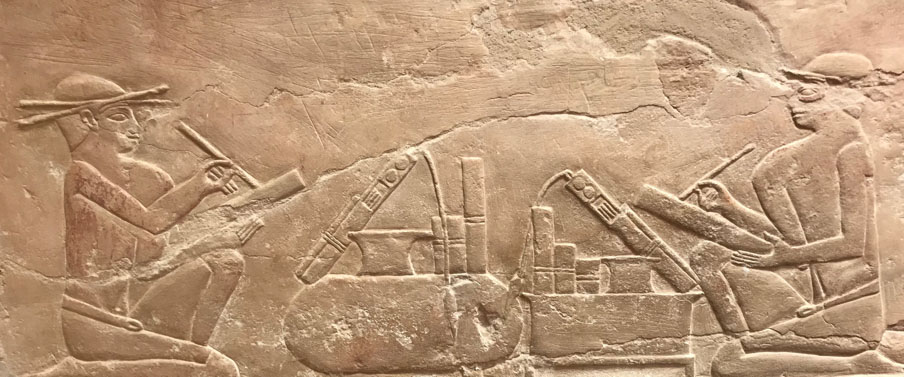
 Figure 24. A relief at the mortuary complex at Saqqara depicting ancient Egyptian scribes with their scribal equipment in the act of writing. Photograph by Stephen O. Smoot.
Notes
1. The Pearl of Great Price: A Selection from the Revelations, Translations, and Narrations of Joseph Smith (Salt Lake City: The Church of Jesus Christ of Latter-day Saints, 2013), 29.
2. “The Book of Abraham,” Times and Seasons 3, no. 9 (March 1, 1842): 704. The Salt Lake City 1878 edition of the Pearl of Great Price dropped the phrase “purporting to be” from the title. This omission was retained in subsequent editions, including the 1902 edition prepared by James E. Talmage that serves as the basis for the 1981 and current 2013 editions of the book.
3. Robin Scott Jensen and Brian Hauglid, eds., Revelations and Translations, Volume 4: Book of Abraham and Related Manuscripts, Joseph Smith Papers (Salt Lake City: Church Historian’s Press, 2018), 219. To view the manuscript online, see “Book of Abraham Manuscript, circa July–circa November 1835–C [Abraham 1:1–2:18],” Joseph Smith Papers, accessed January 26, 2023, https://www.josephsmithpapers.org/paper-summary/book-of-abraham-manuscript-circa-july-circa-november-1835-c-abraham-11-218/1.
4. Marc Coenen, “The Dating of the Papyri Joseph Smith I, X and XI and Min Who Massacres His Enemies,” in Egyptian Religion: The Last Thousand Years, Part I: Studies Dedicated to the Memory or Jan Quaegebeur, ed. Willy Clarysse, Antoon Schoors, and Harco Willems (Leuven, Belg.: Peeters, 1998), 1103–15; Michael D. Rhodes, The Hor Book of Breathings: A Translation and Commentary (Provo, Utah: Foundation for Ancient Research and Mormon Studies, 2002), 3.
5. Joseph Smith, “Editorial, circa 1 March 1842, Draft,” 1, in Documents, Volume 9: December 1841–April 1842, ed. Alex D. Smith, Christian K. Heimburger, and Christopher James Blythe, Joseph Smith Papers (Salt Lake City: The Church Historian’s Press, 2019), 207; “A Glance at the Mormons,” Alexandria Gazette, July 11, 1840, [2]; “The Mormon Population of Montrose and Nauvoo,” Boston Evening Transcript 15 (January 20, 1844): 2; Charles Francis Adams Sr., Journal, May 15, 1844, repr. in Henry Adams, “Charles Francis Adams Visits the Mormons in 1844,” Proceedings of the Massachusetts Historical Society 68 (October 1944–May 1947): 285; Henry Halkett, “Henry’s Notes upon Joe Smith the Prophet [May 1844],” circa 1845, 5–6, Miscellaneous Collection, William L. Clements Library, University of Michigan, Ann Arbor, Mich.; Josiah Quincy, “The Mormons—a Sketch of Their History,” Portsmouth Journal of Literature and Politics 65, no. 4 (January 28, 1854): [1]; Figures of the Past from the Leaves of Old Journals (Boston: Roberts Brothers, 1883), 386; Wilford Woodruff, “Journal (January 1, 1841–December 31, 1842),” February 19, 1842, Wilford Woodruff Papers, accessed January 26, 2023, https://wilfordwoodruffpapers.org/documents/a9d1a2cb-18fe-445d-a5e4-350caaf63442/page/28532206-eb7f-4fe4-b955-9b5763ab18d6; Parley P. Pratt, “Notices,” Latter-day Saints’ Millennial Star 3, no. 2 (June 1852): 32.
6. Terryl Givens with Brian M. Hauglid, The Pearl of Greatest Price: Mormonism’s Most Controversial Scripture (New York: Oxford University Press, 2019), 155. See also the discussion in John Gee, “Eyewitness, Hearsay, and Physical Evidence of the Joseph Smith Papyri,” in The Disciple as Witness: Essays on Latter-day Saint History and Doctrine in Honor of Richard Lloyd Anderson, ed. Stephen D. Ricks, Donald W. Parry, and Andrew H. Hedges (Provo, Utah: Foundation for Ancient Research and Mormon Studies, 2000), 192–95.
7. See the comments in John E. Clark, “Archaeological Trends and Book of Mormon Origins,” in The Worlds of Joseph Smith: A Bicentennial Conference at the Library of Congress, ed. John W. Welch (Provo, Utah: Brigham Young University Press, 2006), 84–87, which apply just as well to the Book of Abraham.
8. Hugh Nibley, “As Things Stand at the Moment,” BYU Studies 9, no. 1 (1969): 74–78; Hugh Nibley, Abraham in Egypt, 2nd ed., ed. Gary P. Gillum, The Collected Works of Hugh Nibley 14 (Salt Lake City: Deseret Book; Provo, Utah: Foundation for Ancient Research and Mormon Studies at Brigham Young University, 2000), 4–9; compare John Gee, “Were Egyptian Texts Divinely Written?,” in Proceedings of the Ninth International Congress of Egyptologists, ed. J. C. Goyon and C. Cardin (Leuven, Belg.: Peeters, 2007), 807; and John Gee, “Literary Titles from the Greco-Roman Period,” in En détail—Philologie und Archäologie im Diskurs: Festschrift für Hans-W. Fischer-Elfert, ed. Marc Brose and others (Berlin: De Gruyter, 2019), 344–45.
9. Steve Vinson, The Craft of a Good Scribe: History, Narrative and Meaning in the First Tale of Setne Khaemwas (Leiden, Neth.: Brill, 2017), 114; compare Miriam Lichtheim, Ancient Egyptian Literature, Volume III: The Late Period (Berkeley: University of California Press, 1980), 118; William K. Simpson, “The Romance of Setna Khaemuas and the Mummies (Setna I),” in The Literature of Ancient Egypt: An Anthology of Stories, Instructions, Stelae, Autobiographies, and Poetry, ed. William Kelly Simpson, 3rd ed. (New Haven: Yale University Press, 2003), 456; and James Allen, The Ancient Egyptian Language: An Historical Study (Cambridge: Cambridge University Press, 2013), 191.
10. Janet H. Johnson, ed., The Demotic Dictionary of the Oriental Institute of the University of Chicago (Chicago: Oriental Institute, 2001), 60; Janet H. Johnson, Thus Wrote 'Onchsheshonqy: An Introductory Grammar of Demotic, 3rd ed. (Chicago: Oriental Institute, 2000), 31; see also the discussion in Gee, “Were Egyptian Texts Divinely Written?,” 807–10, esp. 809; and Gee, “Literary Titles from the Greco-Roman Period,” 344–45.
11. Gee, “Were Egyptian Texts Divinely Written?,” 809, citing P. Louvre 3284 2, 8/9, and other texts.
12. Alan Gardiner, Egyptian Grammar, 3rd ed. (Oxford: Griffith Institute, 1957), §178; James Hoch, Middle Egyptian Grammar (Mississauga, Can.: Benben Publications, 1997), §81.
13. Bentley Layton, A Coptic Grammar, 3rd rev. ed. (Wiesbaden, Ger.: Harrassowitz Verlag, 2011), §209; Gregory E. Sterling, Coptic Paradigms: A Summary of Sahidic Coptic Morphology (Leuven, Belg.: Peeters, 2008), 32.
14. William K. Simpson, “The Kamose Texts,” in Simpson, Literature of Ancient Egypt, 349; H. S. Smith and Alexandrina Smith, “A Reconsideration of the Kamose Texts,” Zeitschrift für Ägyptische Sprache und Altertumskunde 103 (1976): 61.
15. Simpson, “Kamose Texts,” 349–50.
16. Wolfgang Helck, Historisch-biographische Texte der 2. Zwischenzeit und neue Texte der 18. Dynastie (Wiesbaden, Ger.: Harrassowitz Verlag, 1983), 94, translation ours (gm.n=ỉ ḥr=s m ḏd m sš m-ꜥ ḥḳꜣ ḥwt-wꜥrt ꜥꜣ-wsr-Rꜥ sꜣ Rꜥ ỉppỉ ḥr nḏ-ḫrt nt sꜣ=ỉ ḥḳꜣ n kšỉ); compare Simpson, “Kamose Texts,” 349; Smith and Smith, “Reconsideration of the Kamose Texts,” 61.
17. Lincoln H. Blumell, “Scribes and Ancient Letters: Implications for the Pauline Epistles,” in How the New Testament Came to Be: The Thirty-fifth Annual Sidney B. Sperry Symposium, ed. Kent P. Jackson and Frank F. Judd Jr. (Provo, Utah: Religious Studies Center, Brigham Young University; Salt Lake City: Deseret Book, 2006), 208–26.
18. See John Gee, “Abraham and Idrimi,” Journal of the Book of Mormon and Other Restoration Scripture 22, no. 1 (2013): 34–39, esp. 37.
19. Kerry Muhlestein, “Egyptian Papyri and the Book of Abraham: A Faithful, Egyptological Point of View,” in No Weapon Shall Prosper: New Light on Sensitive Issues, ed. Robert L. Millet (Provo, Utah: Religious Studies Center, Brigham Young University; Salt Lake City: Deseret Book, 2011), 230.