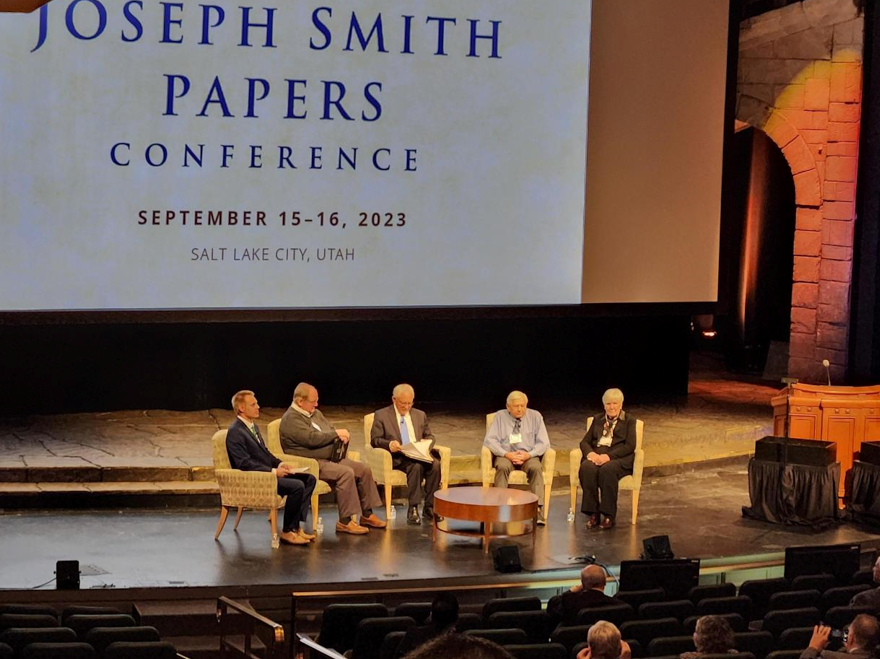
The following is a transcript of a roundtable discussion on the origins of the Joseph Smith Papers. The September 15, 2023, roundtable, moderated by Brent Rogers and featuring Gail Miller, Ronald K. Esplin, Ronald O. Barney, and Elder Marlin K. Jensen, was held in the Conference Center Theater as part of the final Joseph Smith Papers Conference. In the conference program, this session was titled “Commencing the Project: Reflections on the Origin and Early Days of the Joseph Smith Papers.” The recorded remarks have been edited for clarity and readability.
Panel at the September 2023 Joseph Smith Papers Conference. Left to right: Brent Rogers, Ron Barney, Elder Marlin K. Jensen, Ron Esplin, Gail Miller. Courtesy Brooke Jurges.
Brent Rogers: Thank you all for being here this morning for this conference and for this gathering. And thank you to our panelists for being here for this opening roundtable. My name is Brent Rogers, and I am the managing historian for the Joseph Smith Papers [Project].1 I wanted to start off by saying something. If I can be so bold as to say that the Joseph Smith Papers is an epic project; every epic has an origin story, and this roundtable will talk about that origin story. We’ll have the privilege of discussing the origin and early days of the Joseph Smith Papers with some of the key figures who were there at the commencement of the project and who have blessed and benefited the work in the years and decades beyond that. I’ll make a few brief introductions.
First is Gail Miller. Gail is the owner of the Larry H. Miller Company and a gracious and generous benefactor of the Joseph Smith Papers. She has been with us almost from the project’s beginning and has supported us all the way. Next to her is Ronald K. Esplin, who is a general editor of the Joseph Smith Papers and who served as the managing editor and historian of the project from its beginnings. He has been influential in the work of this project from its earliest stages. In the middle is Elder Marlin K. Jensen, a General Authority Seventy emeritus of The Church of Jesus Christ of Latter-day Saints and the former Church Historian and Recorder. Our guest next to me on the left is Ronald O. Barney, a former archivist and historian with the Joseph Smith Papers, who also served as the executive director of the Mormon History Association for a time and did a marvelous job of leading that organization and in contributing to the work of understanding Joseph Smith. If you haven’t read his book on Joseph Smith,2 I suggest that you do.
Let’s start with a question that I would like to direct to our two Rons, Ron Esplin and Ron Barney. Why did you both see a need for this massive undertaking? Maybe you could talk about that need and the impetus for beginning this great work. Let’s start with Ron Esplin.
Ron Esplin: I first became aware of the importance of documentary editing as a graduate student at the University of Virginia, where I did a thesis on Benjamin Franklin and had the happy coincidence of choosing a time period in his life that had already been covered by The Papers of Benjamin Franklin series.3 I did the obligatory trips to places where those great documents were stored. But I did most of my work in Alderman Library4 at the University of Virginia from the volumes of The Papers of Benjamin Franklin. Because they had covered the period that I needed, I was able to write a better thesis quicker than I could possibly have done otherwise. I realized that the work that had been done by these historians, gathering and contextualizing the documents, made history better and easier.
At that same period, Dean Jessee was working at the Church Historian’s Office, as President [Dallin H.] Oaks mentioned.5 In 1970, the same year I was writing my thesis, Dean happened to be perusing the shelves of the University of Utah library and came upon The Papers of Thomas Jefferson series. That had started in the 1940s. But this was 1970, and it was still only beginning.6 He said to himself, Joseph [Smith] needs something like this.
Within two or three years, Dean and I were working together. He worked mainly on Joseph and a little on Brigham [Young]. I worked mainly on Brigham and a little on Joseph. But we both realized that Dean’s vision of doing something similar to what had been done for Thomas Jefferson and Benjamin Franklin needed to be done for Joseph Smith. Together, we laid some of the groundwork for that in the 1970s.
But at Brigham Young University with the Joseph Fielding Smith Institute for Church History, we were able to do much more. Because I understood intrinsically the value of this—that you could do better history quicker and that more people would be involved in good history if we got these papers out—I could enthusiastically support Dean’s effort. At the beginning, it was a one-man effort. But with the efforts of many people at the Smith Institute and, as President Oaks has outlined, the collaboration between the Smith Institute and the Church History Department, we were able to gradually bring more resources to bear and support Dean’s vision.
Brent Rogers: Great, thank you, Ron. Ron Barney, can I turn to you now and ask you about your involvement in joining Ron and Dean and how you saw the impetus and need for this massive project?
Ron Barney: Before the active involvement that captured my attention with the Joseph Smith Papers, I had been working for several years as a historical liaison with the curriculum writing committee, which was producing the Joseph Smith volume in the Presidents of the Church series developed for Priesthood and Relief Society instruction.7 My charge was to present to the writing committee everything that Joseph Smith had ever said. [audience laughter] We even created a system where we could determine for the committee whether something attributed to Joseph Smith could be considered reliable. That process, which was going on right up to the early part of the 2000s, just happened to coincide with when I was asked to be a resource for providing materials, other kinds of data, and information to the folks that were beginning the Joseph Smith Papers at Brigham Young University. It was primarily at Steven Sorensen’s request that I do this, just mainly to supplement what was happening at BYU.8 I’d always been an admirer of Ron and Dean, so when I was asked to participate at the entry level, I was very, very happy to do so.
Brent Rogers: Thanks, Ron. I think you point to a couple of things about collaboration between Church departments and between the Church History Department and BYU. Maybe we could take a moment to say thank you to all the collaborators that we’ve been able to work with on the Joseph Smith Papers, both at BYU over the years and various Church departments. It’s truly a great effort that we’ve been able to make. We’ve had a lot of help along the way because of some of these cross-divisional and -departmental efforts, and that’s wonderful.
Gail, I’d like to ask how you got involved with the Joseph Smith Papers Project. Maybe you could give us a little bit of insight into your thinking as some of these things started to happen and what brought you and your husband Larry into the circle.
Gail Miller: I often think that we got involved by accident, but I know now it wasn’t an accident: It was orchestrated. Looking back on the path we took, Larry and I were both brought up in the Church but in our teenage years became inactive. We moved to Colorado after getting married, and during our life there, we had a bishop, David Brown, who was interested in reactivating us. A few years later, we moved back to Utah, went through the temple, and had our family sealed. Bishop Brown had, by then, become a stake president and then a mission president and then been called to be the first director at the new visitors’ center at Kirtland. He said, “I don’t know enough [about Kirtland history]; I need a crash course,” and he called the Church History Department. He was connected with Ron Barney, who invited him to bring his family and learn about Kirtland. Ron told him he could bring some friends. So he invited Larry and me to come and listen to the lecture.
When we got there, our eyes were like saucers because on the table in front of us were all these original Church history documents, including many of Joseph Smith’s journals and personal writings. We felt like that was a very special opportunity for us but didn’t know what it would lead to. As we left that night, Larry said, “You know, there’s a reason this happened; there’s something I need to be doing.” So he called Ron and asked if he could have a meeting with him. As he [Larry] told me, he went to Ron and said, “Ron, I think there’s something you’re involved with that I need to help. But I don’t know what it is. Do you? I don’t really know why I’m here, but I think that is what it is.” Ron said, “I don’t know what it would be. I don’t know why you’re here; you called the meeting.” [audience laughter] So they talked about a lot of things, didn’t come to any conclusion, and Larry left that meeting.
Larry thought about it for a few weeks and then called Ron back and said, “I figured out what it was.” Ron said, “So did I.” It happened to be the Joseph Smith Papers Project. We were at a point in our business history where we could do some things in a financial way that we had not been able to before and decided that this was an area where we could focus some of our blessings and our wealth to help the project move along. So that’s basically how we got started. I look at it as not an accident but a willingness to listen to the Spirit and to be moved and obedient to what Heavenly Father wants us to do.
Brent Rogers: Thank you, Gail. We have such a great beginning here. We have a need to understand Joseph Smith better. We have insight and inspiration and resources that are willing this into existence. Elder Jensen, I’ll ask you to speak about your perspective, but you could also speak from the Church’s institutional perspective. Why was it so important for the Church to see this vision of this history project, to invest in it, to support it, and to ultimately go through with publishing the papers?
Elder Marlin K. Jensen: I’d like to invoke a moment of personal privilege before I speak to your question. I’m sitting here between two Rons. Larry was fond of talking about the founders of this movement as “two Rons and a Steve.” [audience laughter] Steve Sorensen, who was a historian of equal quality [to] these two Rons, was a big part of those initial discussions and the direction and momentum that was created at that time. Sadly, he passed away some years ago. But I wanted to add his name to our historical record. I would do the same just to support what President Oaks has said about Dean Jessee, who I don’t think appears on the program but lives on in the twilight of an amazing career. I think but for Dean, there would probably be no papers project. I just want, as a past-tense Church Historian, to add these two significant but missing persons to the record of today’s proceedings. [audience applause]
I came to the Church History Department a couple of times, actually. But as it’s pertinent today, I came the final time in 2004. The activities that have been described here were well underway, and I was happy to ride that crest. It was a magical time, I thought, for Church history. The internet was just beginning to flourish. I’d been in Europe and had written my first email in 2001. Previously, I had my secretary print my emails off, and I had dictated responses to them for her to type. So I was a latecomer to the technology world. But I remember the buoyant feeling that existed at that time and the opportunities that were arising with the advent of digitization, the web browser, and the World Wide Web that would make the dissemination of this very important information possible.
I think from the Church’s point of view (and again, President Oaks in his beautiful opening remarks has pretty much preempted what I might say here), the documentary history, Joseph Smith’s History of the Church,9 which had been the foundation of early Church history writing, had had its challenges. It was done to the standards of the day. It was, in essence, a chronological series of documents stitched together with commentary and was wonderful to have. It did fulfill, I think, the Lord’s command that a record be kept. But as we got into the 1960s and people like Dean Jessee began to plumb the historical depths of Joseph Smith and the historical origins of the Church, it was obvious that we needed a firmer foundation. I think the papers project came as a response to that great need—that we would have something that could meet contemporary standards of biographical and historical researching and writing and would provide an accurate and reliable base of information that scholars then could access and produce the kinds of derivative products that we’re now seeing come to light.
I think there was, though, a spiritual reason as well impelling the Joseph Smith Papers Project. Joseph Smith was not an ordinary man in any sense of that word. He ushered in the dispensation of the fullness of times. His life, I think, deserved a more complete, accurate, and nuanced treatment than it had ever had. I’m thrilled with the announcement that there will be a new biography written of him in the years to come that will largely be based on the work of the Joseph Smith Papers Project.10 I think the reason that Joseph is important isn’t just because of his greatness as a prophet; it is because of what he stands for and the light that his life and teachings shine on the Savior of the world. I’ve always been intrigued by Alma’s explanation to his son Helaman when he was trying to convince him to keep the record: that if he kept it, it would enlarge the memory of the people, it would correct error, and it would foster faith in God unto salvation [Alma 37:8]. I think Joseph might well have quoted John the Baptist as he [John] said of the Savior: “I must decrease”; “he must increase” [John 3:30]. So I think there was always that underlying doctrinal reason for highlighting Joseph’s life more completely because no one in the history of mankind has brought greater truth to light or promoted faith in a greater way than he has in our Savior, Jesus Christ.
Brent Rogers: Thank you for that, Elder Jensen.
Maybe we could talk a little bit about your [the panelists’] thinking about this: You had the Church’s support. We had financial support and other support from Gail and Larry Miller. But the corpus of records, the amount of material—there’s a veritable mountain to climb when it comes to getting the work started. Maybe each of you could take a minute or two and talk about your thoughts while you were standing at the base and how you started thinking about and conceiving this work and how it was to get done. Ron, would you start on that one?
Ron Esplin: At the beginning, we were not just optimistic; we were dreaming. We were working with part-time people who had full-time jobs. We assigned the volumes out to teams; we had everything assigned out. We hoped to get some things produced in a matter of several years. Max Evans, who had been director of the Utah State Historical Society and an archivist here [Church Historical Department] with Steve, Ron, and me in the early 1970s, was then director of the NHPRC, the National Historical Publications and Records Commission.11 We consulted a little bit about how this would go. He said, “Ron, you have no idea. Nobody ever gets anything done the first five years. It takes that long to just get your arms around the project.” Max was right, and we were wrong. It did take the eight years that President Oaks mentioned to get that first volume out because we were trying to work at a scale that we hadn’t done before. And we had to learn the task of documentary editing.
We were all trained historians and had written and published, but we had not done documentary editing. We were tutored by some of the best. On the board that President Oaks mentioned, we had Mary-Jo Kline, who had written the bible on documentary editing. She was on our advisory board. We had the tutoring of Barbara Oberg, who was then the director of the Thomas Jefferson papers. She came out here and helped get us trained. We also had a delegation go to her shop to see firsthand what they were doing. It took a long time to get real traction. Even then, we were faced with challenges that we hadn’t anticipated and opportunities that we hadn’t anticipated. They came together in a marvelous way, but it took a lot longer to get traction than we ever thought at the beginning.
Brent Rogers: Ron Barney, what would you add to that?
Ron Barney: When we were first invited to participate (and we were the passive part of the active group that was underway), the Church archives had a very different way of thinking about things. We had, I believe, elevated the status and abilities of the Church archives to a level that was equal to anybody in the United States. Steve Sorensen and I had traveled all over the country, from the Bancroft Library and Huntington Library in California to the Beinecke [Rare Book and Manuscript] Library on the East Coast. In every repository we visited, it was, in part, to find what was said about Mormonism there. So we collected a great deal while we were there. In all of this, we think we became a little bit better than what we had started as; we’d become more professional.
Coincidental to that, the archival profession itself had become more scholar-oriented and certainly more able to perform the duties that archivists are supposed to do. These were, first of all, the acquisition of records, preserving them, describing them, and then making that information available to the public. Then our good friends down at BYU asked for our support because the Church History Library is the most remarkable archive of any having to do with The Church of Jesus Christ of Latter-day Saints. It truly is a remarkable repository.
I remember one time I was asked to host James Hutson, who was the curator of the Library of Congress, when he came to Salt Lake City. I was asked to take him on a tour. After he explained the way they did business, I was kind of embarrassed. I didn’t say, Well, you know, we do it a lot better. [audience laughter] I didn’t say that. But it became very apparent that what had been started thirty years previously had really brought together a professional organization that could supply the kinds of information—the kind of understanding—that could effectively augment what was being done by the Joseph Smith Papers. So we were very glad to be involved. I don’t think we were nearly as well-equipped as the folks down at BYU. They had in mind very clearly what they wanted to do and the precedent of Dean Jessee and his once-in-a-generation work on Joseph Smith. So we came in as a supporter, as a resource, for the Joseph Smith Papers at the outset.
Brent Rogers: Elder Jensen, what were some of the thoughts you had as you were starting to climb that veritable mountain?
Elder Marlin K. Jensen: Well, again, a little larger context: At the time, the Family History Department was combined with the Church History Department. So while these efforts were going on, we were also developing the new FamilySearch, which was a tremendous and very costly undertaking. There was always a discussion of the burn rate—how much money it was taking every month to keep Family History alive. And now we were looking at the possibility of having our own large project on the Church History side. We needed to ramp up too because we were understaffed. At the time, the Church History Department was a collection of independent scholars pursuing their own agenda—under some control but not strategically employed. We were trying to think through what Church History ought to be all about and reorganize the department accordingly.
Happily, during those years, we came up with a very simple view, I think, of what the Church History Department is to do, which is to collect, preserve, and share Church history. Of course, all those activities are involved in the Joseph Smith Papers Project. But that insight gave us clarity to organize our department in a different way, which I think was an important development during that 2001 to 2005 time period. Eventually, Church History and Family History were separated. We took that proposition to the Brethren, and it was reported that President [Thomas S.] Monson said, “Well, sometimes marriages work out, and sometimes they don’t. Let’s grant them a divorce.” [audience laughter] So we split into two departments around 2008.
But one of the things that we definitely needed was more horsepower—more qualified scholars. And again, 2006, 2007, 2008—we remember those dark days of financial challenges. The Church was impacted too in its revenues and had, if not a hard, at least a soft hiring freeze on. I remember going hat in hand several times to . . . I think it was the Human Resources Committee to obtain permission for new FTEs [full-time equivalents]. We were very blessed, I thought, to have something like sixteen new PhDs approved for hiring. I think that was a significant event in the history of the papers project—to get the manpower to get up that mountain and to meet the kind of time constraints that obviously we wanted to honor.
Brent Rogers: Gail, what were some of your impressions of the work that the team needed to do and how they went about doing that work, especially as you got more involved in providing some of that funding and especially as those hard economic times came?
Gail Miller: Well, I remember early on, when we first became involved, Larry came at it from a business sense. He understood the importance of the project; he understood that it would go forward no matter what because it was something the Lord and Heavenly Father were planning on having happen. But I know there were discussions about, How much is this going to cost? How much do you need? How many scholars will you have to hire? Larry encouraged them to hire what they needed, as I recall: “Do what you need to do to make this work happen.” They came back with a budget, and he said, “You need to double that.” He had an uncanny ability to be visionary about things, and he, I think, knew that it would take more than anybody thought it would. But he was prepared. Then the question was, How do we as a family fund this and keep it stable? We started with a donation to BYU in the form of stock, where they could use dividends from that. Well, the stock fell flat, so that didn’t work. We had to then plan on what it would take each year. And it worked out just fine.
But then, in 2009, Larry passed away. As I remember, it was a time of poor economy—2007, 2008, 2009. Those were the years when Larry was sick, and we were trying to keep afloat and still support our commitment. My son was the CEO of our company at the time. When Larry passed away, I said to him [her son], “Look, I know that we have to cut back. We have to cut back on inventory; we have to cut back on staff; we have to cut wherever we can, but the one area that we are not going to cut is giving. We have committed to the Joseph Smith Papers; we will continue that support.”
I remember Elder Jensen coming to visit me after Larry passed away with a little bit of worry in his heart about are you going to continue. I committed that we would, and thankfully, we have been able to continue to the end and tie it up with a nice big red bow. I know where my blessings come from, and I haven’t missed one dollar. So we’ve been very grateful to be able to be involved and to support the project and do what Heavenly Father wanted us to do. [audience applause]
Elder Marlin K. Jensen: Could I just say, Gail, I well remember that visit. Yes, we were anxious. That period of time—call it a recession, call it a depression, whatever it was—was as serious for you and your business entities as it was for the rest of the world. If the papers help us know Joseph’s heart, I think that moment—I’ll call it a hinge moment—when you decided to continue your financial commitment, shows us what was in Larry’s heart and in your heart as well. That applause, I think, is an indication of the great appreciation that’s felt really Churchwide for you and your family. [audience applause]
Gail Miller: Thank you. Thank you. I do want to add to that that I have never expected anything in return, but I have had blessings manyfold. So thank you for the opportunity. [audience applause]
Brent Rogers: I would just like to express my deepest gratitude (I know I have at previous functions and things like that) to everybody on this stage, especially to you, Gail. Elder Jensen, thank you for going hat in hand to ask for more FTEs and those kinds of things. I owe my career to the people on this stage. And I know that I can speak for our staff members who feel and have a love for you, Gail, and for the work that you’ve allowed us to do. So thank you.
If I could start with you on the next question while we’ve got you here. What would you say were some of the defining moments of the early years of the Joseph Smith Papers Project?
Gail Miller: Well, I think for me personally, one of the exciting and memorable events that we had was creating a trip with the historians, where we took them on a trip back East to visit the sites that they were studying and researching and had a lecture in each of those places by the historian who was doing that work. That was very memorable to me. Marlin was on that trip. We had some really fun moments. This is really not spiritual, but I’m going to tell it anyway. We had a rainstorm one day, and we were on a big bus. The bus was going down a dirt road headed toward a cliff, and there was a big tree that would have stopped the bus. We stopped in time, but we couldn’t back up. So everybody got off the bus and started trying to get the wheels shored up so we could turn. I [was] standing under a shelter in the rain, and Marlin [was] standing with me. He looked out and said, “Gee, that’s great. Your sons are so helpful. Look what they’re doing.” I said, “No, it’s not my sons doing the work. They’re giving instructions.”
But it was a very memorable experience. I still look back on that, on the pictures, with fondness about each experience that we had during that trip that defined it. It solidified and deepened that commitment for me and I think for the historians as well because they could see what they were doing and how impactful it was and where it came from and why it was important to research that area. So that was one of the defining moments for me.
Others would have been the dinners that we had every year, where we had reports about discoveries and research and learning. Getting acquainted with the people that were working on the project was very meaningful to me. Another is that, quite often, I would be invited to the quarterly meetings, where they discussed the Joseph Smith Papers Project and what was happening. Sometimes they even asked my advice, which was very flattering. So there were a lot of memorable times along the way, and I’m very grateful for them.
Brent Rogers: Wonderful. Thank you. Ron Barney, what would you say were some of the defining moments of the early years of the project?
Ron Barney: Very clearly for me, it was the initial visit, when David and MelRae Brown came to the second-floor conference room in the east wing of the Church Office Building to see material that was pertinent to their upcoming work in Kirtland. I know this story has been told many times; I’m not really sure if I’ve ever told it.
Gail Miller: I’d love to hear it.
Ron Barney: As I made the presentation (there were, I’d guess, a few dozen people there or something to that effect), I had documents surrounding this very lengthy table. And I presented these original documents beginning with the original manuscript of the Book of Mormon and original revelations, Joseph Smith’s 1832 diary, etc. I lined the entire table with these documents and then began to tell, in story form, how they were all pertinent. Larry didn’t say anything during the presentation or after it, but I invited everyone to come up afterward and walk around the table to look at the documents. At that time, Larry came up to me and handed me his card and asked for mine and said, “I’d like to talk to you about this.” That event took place on January 30, 2001. I was really impressed with Larry at the time. Everybody came in their Sunday best, and Larry came in his Sunday best too: It was a golf shirt, tan khakis, and white sneakers. I loved Larry’s lack of pretension. He was never pretentious. He so impressed me in that way. Afterward, we met several times and had the experience that Gail described, where we met each other in the hall and both said, “We think we’ve figured this out”—of what his purpose for being there was.
Then on March 9, 2001 (when it was actually “three Rons and a Steve”—Ron Walker was the director of publications at the Smith Institute, if I remember right), we were all sitting there, and Larry looked very anxious to help us. After explanations were given about the kinds of things that we were planning on doing (and I wasn’t one of the masterminds at the time; I was just kind of sitting there because of the experience that I’d had with Larry), Larry was sitting there, calculating while we [were] talking. After seeing what was said, he kind of proposed the budget and said, “I’ll give you X amount,” which, as I recall, was about $100,000 more than what had originally been envisioned to get this off the ground. Then it certainly multiplied thereafter. I think it was just a week after that that Larry brought all his executives from the Larry H. Miller enterprise, and I did another presentation. It started at 3:00 in the afternoon, and I don’t think we got out of there until almost 6:30 that evening. It was just rich. Some of Larry’s employees were not Latter-day Saints or active Latter-day Saints; other ones were. It was a very special time.
So, I’ll just say this: that the scholars are really important in all of this, as you well know. By the way, you [Brent] were the one who replaced me when I left.
Brent Rogers: I wasn’t going to say. [audience laughter] I said everybody on this stage had an impact [on] my hiring.
Ron Barney: You got my position, and they were so much better off thereafter. There have been some very thorny times, no question about it, with personalities involved. Yet, on this incredibly hastened schedule, the books came out, the first one in 2008 and then, just very recently, the last one. So my perspective on this has been, with the great scholars that have been around, that Larry Miller was plucked out of the universe to come and participate in this. This was no accident. Gail as his companion was no accident. She was always supportive, and it was quite wonderful to watch.
Brent Rogers: Thank you, Ron.
Ron Esplin: I used to catch Larry at the end of a business day and had the privilege a number of times to visit in his office for a while. He would kick up his feet on his desk, and we would chat for hours sometimes because he had so much interest in the history. I heard this story from Larry’s point of view a number of times. One of the things Larry liked to say was, “How many coincidences does it take before you know it’s not a coincidence?” And one of the coincidences was a failure to get something published. That fed into the story that Ron just told us.
Dean Jessee had published two volumes of The Papers of Joseph Smith as a one-man project beginning in the 1980s.12 By the 1990s, he had a third volume finished, but we couldn’t get the final approval. Elder [Neal A.] Maxwell wanted to have a discussion with the First Presidency where we could have a big piece on the agenda (and not just have a little item that could be easily turned down or approved and move on) because there were a lot of issues in that final volume of the Nauvoo journals that needed to be discussed. It had the temple in it; it had things about plural marriage in it; it had Nauvoo Legion tensions and lots of things that were issues that needed to be discussed so that the First Presidency knew its contents and could approve its publication. He finally got that on the agenda on one occasion, as I recall, when Elder Maxwell and Elder Oaks were the advisors. We discussed this in a meeting in Elder Maxwell’s office. He was very pleased about that because it was going to be the discussion. When he told Elder Oaks about the meeting, as I recall, Elder Oaks said, “But Elder Maxwell, I’ll be gone then because I have to be in the Philippines for two weeks.” Elder Maxwell replied, “Well, I’m not going up without you on this one,” and they took it off the agenda.
It was not approved for publication. It was never disapproved. But there was a lot of discussion. It was discussion around that unpublished volume that eventually led to the approval by the First Presidency and the Quorum of the Twelve of a broader project that would include everything, including that volume.
Now, when Elder [Jeffrey R.] Holland got back from his time as an Area President in Chile, he was reappointed as an advisor, and he asked me to give him a copy of that third volume: “If I’m going to have that discussion and be part of it, I want to read it. And I need to know what I’m talking about so I can defend it.” So we hurriedly upgraded that volume with everything we could give it. Richard Jensen read every word. I read every word. We changed a number of footnotes. We proofed it the best we could. We printed out a new version, and we gave a copy to Elder Holland.
We also gave a copy to Steve Sorensen and said, “Steve, you’re the partner institution with us. You’ve got to read this and understand it so you can help explain it and defend it.” Steve gave it to Ron Barney. Steve didn’t read it. I don’t know if Ron ever read it, but it was on top of his filing cabinet when Larry came in to visit, saying, “There’s something about what you’re doing that I need to be involved in. Do you know what it is?” Well, Ron talked to him about this project of the department and then the work of Brother Jessee. “See that volume up there on my filing cabinet? That’s the work of Brother Jessee.” Ron then explained to [Larry] something about the Joseph Smith Papers Project. Larry went home still undecided, uncertain what the feelings in him were that he had to support something that was involved in these documents. Then he came to the realization: It’s the work of Brother Jessee.
Ron Barney: That was the trigger.
Ron Esplin: That was the trigger. And that was one of those coincidences: that Steve wouldn’t read it and you [Ron Barney] didn’t read it, but it was on the filing cabinet.
Ron Barney: You don’t know that I didn’t read it. [audience laughter]
Ron Esplin: I don’t know that you didn’t read it, but it was one of Larry’s coincidences. Had you not explained that volume to him that day, who knows what would have been?
Ron Barney: That’s right. You told that story much better than I could have.
Ron Esplin: I wasn’t even there. Larry told me. [audience laughter]
Brent Rogers: Elder Jensen, is there anything that you would add—your perspective on defining moments of the early years of the Joseph Smith Papers?
Elder Marlin K. Jensen: Just two briefly. One, I think it wasn’t clear from the beginning who the audience for the papers would be—whether it would be published for a general Church audience or pitched for scholars. We took that decision to the First Presidency, and President [Gordon B.] Hinckley, who had more interest in Church history than almost any other prophet we’ve ever had, felt like the papers should be directed to the scholarly world. That, I think, was a really crucial decision in determining how the papers would be written, the standards that we would adhere to, and the future value that the project would have.
Related to that was how we would publish them. The Church doesn’t typically publish in its own name. We thought about the BYU entities that publish; we thought about Deseret Book; [we] finally ended up deciding that it would be prudent for the publication of the papers and for future high-quality historical products to create our own publisher’s imprint—the Church Historian’s Press. So we obtained permission to do that and then partnered with Deseret Book to be the printer.
Just a little sidenote: When the first volume of the papers came out, there was so much interest in it. Maybe we overhyped it slightly because it sold sixty thousand copies at fifty dollars apiece. I remember shortly thereafter receiving one of those early morning calls that President [Boyd K.] Packer was fond of making. Though he wasn’t at that time one of the advisors to Church history, he nonetheless retained a very lively interest in what we were doing, and he had become aware of the high number of sales of that first volume. He said, “Marlin, I just called to tell you that not every LDS housewife in tennis shoes needs to own a copy of Joseph Smith’s papers. There’s a little too much,” he said, “of Muhammad and not quite enough of Allah.” Think about how profound that counsel is and was: to keep our eyes and the eyes of those working on the papers project on the Savior and on the ultimate goal that we all have to become like him—and not unduly emphasize those people along the way, great as they may be, who are instrumental in helping us walk that path.
Ron Esplin: I’d like to mention one other crucial time for the papers. Following Larry’s death and without yet being recovered from the financial problems that he had dealt with the last years before his death (and that Gail and the companies were still dealing with), we had one of those quarterly board meetings in Elder Jensen’s conference room on the fourth floor of the Church History Library. Larry sometimes attended those. I remember one of those where you [Elder Jensen] said, “I’ve never been in a board meeting in this room where I’m sitting across from somebody in a blue shirt instead of a white”—that was me—“and a pink shirt”—that was Larry. Well, Gail was not in a pink shirt that day, but Gail was there, and Greg [Miller]13 was there.
The question was, What are we going to do? The Brethren are concerned that we have committed ourselves to a couple of dozen volumes, and we’ve only got two or three out. If we can’t get this done in ten years, we’re going to lose focus and lose support, and it’s just not going to work. We realized that we did not have what we called “the horses” to succeed; we did not have the horsepower on the scholarly side to get this done. There was no way to publish two volumes a year, which was our goal and our commitment and the reality if we were going to get it done in the timetable that had been agreed to with the Millers and the Brethren. So our proposal was, We cannot do it without more horses on the scholar side. It’s going to be expensive, and we need to hire a number of people. Brent was one of those hires.
We had that discussion that day. I remember Greg saying, “Are the people out there? Can you get people of the right quality and the caliber to get this done if you have the resources?” We said, “We think so,” and we found some wonderful people. Gail said, “If that’s what it takes, we’re going to do it.” That decision (I think it was in 2010, in a period of difficulty for the company), where the Millers stepped up and said, “Regardless, if that’s what it takes, we’re in it for the long haul, and we’re in it if it hurts, and we’re in it right now—go hire the people,”—that made all the difference. We never could have done two volumes a year without what happened at that board meeting that day.
Brent Rogers: Well, I wish that we could spend a lot more time up here because we are hearing some beautiful words and some great history. I have just one more question for the panel before we spend a few minutes with the audience. I want you to think about this and give the answer that you wish to give, starting with Gail. What have you learned from the Joseph Smith Papers that has influenced or changed your life?
Gail Miller: I don’t know that I can specify what I’ve learned from the papers. But from the experience, I’ve learned that we’re all here for a purpose. And we have to be in tune to learn what that is. It may be a long road to that vision where we understand why we’re here. But once we do, it’s important to be all in; it’s important to make a commitment and to keep your word and to keep your eye on the end goal, which is eternal. So for me, watching what’s happened and the impact it will have on the world is quite marvelous because you see the hand of God in what he wants to have come about. And he will make it happen no matter what. If Larry and I hadn’t stepped up, somebody else would have. I know that. We were not special in any way. We were an instrument and willing and able and obedient to recognize what needed to be done and then [be] able to commit and keep the commitment. There were times when I thought, How many more years is this going to go? But I didn’t ever worry about the money because I knew it would be there. We had made the commitment, and I knew it would be there. I’m grateful to be in a position to see it from the beginning to the end. It’s just a remarkable, remarkable experience for me and my family and a remarkable product for the world.
Brent Rogers: Beautifully said. Thank you, Gail. Ron Esplin.
Ron Esplin: We knew quite a bit about Joseph Smith when we started. We know a lot more now. But one of the things that I did not understand until well into the project was how foundational revelation was to everything that happened in the Restoration. Richard Bushman was once asked [something like], How is it that Joseph Smith could go from the ashes of defeat and have the courage to go forward and rise to a new level—and then experience a crushing defeat and again rise?14 He said it was because he [Joseph] had the revelations at his back and that no one believed the revelations more than Joseph.15 These revelations didn’t ask a little of him or of the Church or the Latter-day Saints. It didn’t lay out a program that you could take care of before breakfast or this month or next month. It was a program of years of effort and labor.
Every major initiative of the early Restoration was driven by revelation—the publication of the Book of Mormon, the movement from New York to Ohio, the gathering place in Ohio, the establishing of a second gathering place when there weren’t even resources for one. All of those were driven by the revelations. In a document that Dean [Jessee] published early on in his Papers of Joseph Smith, Volume 1, an editor from Pittsburgh interviewed Joseph in Nauvoo and asked, “Isn’t this rather presumptuous to be claiming to give revelations?” Joseph commented a little on revelations, and then said “that when he was in a ‘quandary,’ he asked the Lord for a revelation, and when he could not get it, he ‘followed the dictates of his own judgment, which were as good as a revelation to him; but he never gave anything to his people as revelation, unless it was a revelation, and the Lord did reveal himself to him.’”16
One of the things that I’ve learned with the Joseph Smith Papers is that at the beginning, there was no story without the revelations. We don’t have a minute of the first meeting of the Church on the 6th of April 1830—nothing. The Saints didn’t keep [a] record of Joseph’s sermons or feel it was very important until Nauvoo, where they really made an effort to try and gather his teachings. What they kept were the revelations, which were gathered from the summer of 1830 on—gathered and copied and prepared for publication. It drove the Restoration, and it drove Joseph Smith.
Brent Rogers: Great, thank you. Elder Jensen.
Elder Marlin K. Jensen: I think periodically of Joseph’s statement in section 128 regarding the subject of baptism for the dead, which he said did “occupy my mind and press itself upon my feelings the strongest” [D&C 128:1]. That may well have been one of his ways of getting the revelations that he received. I’ve had a similar experience with a question in Alma 32 that has been occupying my mind and pressing itself on my feelings during these last ten or twelve years as the faith of many people in the restored gospel and in its history has been shaken. In that thirty-second chapter, Alma teaches what we must do to have our faith increase; describes tangible evidence of that increase, such as spiritual enlightenment and understanding; and then, of that experience, asks rhetorically, “O then, is not this real?” [Alma 32:35]. I can’t imagine a more pertinent question at this moment in time than, What is real? I think what my limited (because I was just there in the beginning years) exposure to the papers project has done for me (and I’ve tried to keep up as subsequent volumes have appeared) is that it has made Joseph and his life and his work and his truth claims real in a way that my faith has become unshaken and well settled. It’s my hope that the papers will do that for everyone who reads them or who reads things that other faithful people have written based on them.
Brent Rogers: Thank you, Elder Jensen. Ron Barney.
Ron Barney: I can’t help myself because I have always had in the back of my mind the question, How is this going to look twenty years from now or fifty years from now or a hundred years from now? I don’t remember the exact day that it dawned on me that history five hundred years from now will look back upon the Joseph Smith Papers Project as a turning point for us. You [Elder Jensen] have said as much: that in this generation, it’s the most important thing in a historical way that the Church has done. I’m certain that we remain on the cusp of something enormous, something that will transcend what we individually can offer. But cumulatively, the work of everyone who worked on the project has brought about something where no one can say, Well, if you’d only done this, or, You’ve left out this. My view of this has been that it was done as it was supposed to be. It’s a marvelous project.
And just a sidenote. I’ve said this to other people. I’ll say it again. If there’s no Ron Esplin, there is no Joseph Smith Papers Project. I think Ron was that essential and that critical, and he’s still involved in it. I think it’s pretty remarkable. [audience applause]
Brent Rogers: Thank you. Well, folks, I guess we are up on the time. We started early, hoping that we’d get to the point where we could have some interaction. Maybe if our guests are okay to stay up here for another few minutes and take one or two questions.
Audience question: This was awesome. I can’t believe listening to the history of the history could possibly be so fascinating. I was curious about the history of how we ended up getting the First Presidency to release the Council of Fifty minutes and the manuscript revelation book because that was stuff that all of us nerds thought would never see the light. We knew it existed, but none of us ever thought it’d see the light of day.
Brent Rogers: Elder Jensen or Ron, are there insights that you have?
Ron Esplin: Let me just say that I was asked a question for years: “But what about the Council of Fifty?” I said, “At the appropriate time, I’m confident we’ll be able to get the Council of Fifty minutes and get them published.” Indeed, it’s the only true prophecy I ever made.17 [audience laughter] But it was true. And you [Elder Jensen] may tell us how that came to pass.
Elder Marlin K. Jensen: One must appreciate, I think, the way our Church operates at its highest levels. As a young General Authority, I probably felt that our administrative processes were quite conservative and laborious. The longer I served, however, the more I came to really appreciate our administrative and ecclesiastical processes and the great blessing we have to have a prophet leading our Church and to be assisted by his apostolic associates.
A number of access questions came up during the papers project and during the writing of the first Mountain Meadows Massacre book that was being written at the same time.18 These questions concerned documents that the Church held in its archives that had never been previously released for research or publication. Over the course of time, it became apparent that in this technologically advanced age, a policy of historical transparency needed to be pursued. As leaders of the Church History Department (and I must mention here that Richard E. Turley Jr. was an indispensable part of all that was done in those years), we worked under the direction of our apostolic advisors, President Nelson and President Oaks, who previewed our access requests to the Quorum of the Twelve. With their advice and direction, we could then take ripened, well-reasoned proposals to the First Presidency, which [they] always met, I think, with very careful consideration and inspired decisions. Gradually, over time, confidence in our work grew, and as knowledge of our Church’s history expanded, it became a rather natural consequence for the Brethren to approve making the requested documents available. We live now in an age of transparency, and our Church is a part of it—and I think the better for it. We needed to own our history; we needed to own up to our history. I think, in this papers project, we’ve done that with Joseph Smith in the very best way we can.
Brent Rogers: Very well said, Elder Jensen. Thank you so much. [audience applause]
1. Brent Rogers became the managing historian of the Joseph Smith Papers in December 2021.
2. Ronald O. Barney, Joseph Smith: History, Methods, and Memory (University of Utah Press, 2020).
3. The Papers of Benjamin Franklin series is a documentary editing project at Yale University that began in 1954 and has published forty-four volumes. The Papers of Benjamin Franklin, The American Philosophical Society and Yale University, accessed June 14, 2025, https://franklinpapers.org.
4. This library was renamed the Edgar Shannon Library in 2024.
6. The Papers of Thomas Jefferson is a documentary editing project at Princeton University that began in 1943 and has published forty-seven volumes. The Papers of Thomas Jefferson, Princeton University Library, accessed June 14, 2025, https://jeffersonpapers.princeton.edu/.
8. Steven Sorensen was an archivist at the Church History Department from 1980 to his death in 2009. He was appointed director of the Church archives in 1989. See Ronald O. Barney, “A Generation of Church History: A Personal View,” in Preserving the History of the Latter-day Saints, ed. Steven C. Harper and Richard E. Turley Jr. (Religious Studies Center, Brigham Young University, 2010), 220.
9.History of The Church of Jesus Christ of Latter-day Saints, ed. B. H. Roberts, 2nd ed., 7 vols. (Deseret Book, 1971).
14. See also Ronald K. Esplin, “Joseph Smith and the Kirtland Crisis, 1837,” in Joseph Smith, the Prophet and Seer, ed. Richard Neitzel Holzapfel and Kent P. Jackson (Religious Studies Center, Brigham Young University; Deseret Book, 2010), 261; R. Scott Lloyd, “Prophet Joseph Smith Was Energized by Revelations,” Church News, May 26, 2012, https://www.thechurchnews.com/2012/5/26/23225529/prophet-joseph-smith-was-energized-by-revelations/.
15. See also Richard Lyman Bushman, with Jed Woodworth, Joseph Smith: Rough Stone Rolling (Alred A. Knopf, 2005), 173.
16. “Interview, 29 August 1843,” in Documents, Volume 13: August–December 1843, ed. Christian K. Heimburger, Jeffrey D. Mahas, Brent M. Rogers, Mason K. Allred, J. Chase Kirkham, and Matthew S. McBride, Joseph Smith Papers (Church Historian’s Press, 2022), 90.
17. See “The Genesis of the Joseph Smith Papers Project,” herein, 100–103.
18. Ronald W. Walker, Richard E. Turley Jr., and Glen M. Leonard, Massacre at Mountain Meadows: An American Tragedy (Oxford University Press, 2008).