It is a commonly held truism that temple marriages are less likely to end in divorce. But is it true? How do we know? The fact is that this popular belief is primarily based on surveys that are now forty to fifty years old. A popular statistic of temple marriages having a 6% divorce rate is cited by the Gospel Topics essay on “Temple Marriage,”1 which in turn cites an article from the Los Angeles Times.2 However, the Times article came from a 1985 Church study that used 1981 data,3 making this 6% number more than forty years out of date.
Another commonly referenced statistic of a 10% divorce rate is based on a small survey (364 temple marriages) cited by President Spencer W. Kimball in 1976.4 This number is likely based on an internal Church survey, as we have been unable to find a public-facing source. Regardless, the latest this survey could have been conducted was in 1976, making this statistic almost a half century old. Another survey from the early 1980s found a 7% divorce rate among Utah Latter-day Saints.5 A mid-century study on Latter-day Saint divorce used Utah and Salt Lake County marriage records from the first half of the early twentieth century and found that temple marriages had divorce rates of about 1–2%, as opposed to nontemple Latter-day Saint divorce rates of approximately 8–12%.6
However, there is more recent data available that is correlated with temple marriage divorce rates, even if the precise question about temple marriages was not asked. At a 2002 FAIR Conference, BYU professor and demographer Tim Heaton conjectured that temple sealing divorce rates were about 25–30% (two-thirds the national average), extrapolating this conclusion from 1990s data on divorce rates for church-attending Latter-day Saints.7 Additionally, the authors of a more recent survey of returned missionaries in the late 1990s and early 2000s suggested that return missionary divorce rates might imply a lifelong temple divorce rate “somewhere in the teens and probably no higher than 20%.”8
While prior researchers did fine work given the data limitations, the fact is that current temple divorce estimates are either based on very out-of-date data or are indirect conjectures based on related but distinct concepts such as returned missionary status and church attendance. However, with the 2023 B. H. Roberts Survey of Current and Former Latter-day Saints (2023 CFLDS Survey), we now have a dataset that is large, current, and precise enough to calculate current temple divorce rates. We can also rigorously and statistically compare temple divorce rates to rates for those who do not marry in the temple and those who marry civilly first and are later sealed in the temple.
Why might we expect temple marriages to have lower divorce rates? In addition to the suggestive prior empirical findings by Heaton and others, there are several theoretical reasons why this might be the case that are supported by the divorce and religion literature more broadly. First, it is likely that temple marriages are proxying on some level for religious commitment, and religiosity has been shown to have many salutary benefits for marriage. For example, one study found that religiosity protected against divorce through the mediating mechanism of higher happiness. In other words, religious people are happier, and happier people are less likely to get a divorce.9 Another study found that religiosity was associated with higher marital commitment, which in turn lead to lower divorce rates and was negatively associated with known risk factors for marital distress.10
Though not every study has found a relationship between religiosity and divorce,11 there has been sufficient research showing that religiosity is related to measures of a lasting marriage, making it likely that the lower divorce rate of temple marriage has something to do with the higher religiosity of the couple. To be more specific, a temple marriage can be seen as an act of marital sanctification, or “the process via which one’s spouse or marital relationship is perceived as having divine character or sacred significance,”12 and marriages that score higher on marital sanctification have been shown to have higher marital quality. A temple marriage is an endowment of a marriage with divine, eternal significance, and this act of sanctification can, in principle, contribute to a lasting marriage.
The cohabitation literature may also be germane here. While initially many believed that premarital cohabitation would be related to a lower risk of divorce, it is now clearly demonstrated in the literature that the opposite is true: couples who cohabit before marriage have been shown to have a higher risk of divorce,13 perhaps because cohabitors are more open to marital dissolution.14 In addition, people who save their sexuality for marriage might take the status of being married more seriously. In much the same way, temple marriages “for time and eternity” may make the boundary between marriage and divorce even higher given the stakes and added seriousness of an eternal marriage.
Finally, it is worth emphasizing here that we are specifically analyzing the effect of first-time marriages, while second, third, or other higher-order marriages (marriages after a first marriage) have been shown to have a higher risk of divorce.15 Given that higher-order divorces are relatively rare, it is difficult to obtain an adequate sample size with enough statistical power to investigate the effects of higher-order temple marriages. Additionally, multiple marriages could include a combination of temple and nontemple marriages, splitting the sample even further and making it more difficult to isolate the association between marital stability and temple marriages. Consequently, in this analysis we will focus on first-time marriages.
Data and Methodology
The 2023 CFLDS is a large-N (N=3,865) multimodel survey consisting of two main components:
1. An address-based mailer survey of the Latter-day Saint corridor region, defined as counties with 15% or more Latter-day Saints. Mailers were sent using the USPS’s Every Door Direct Mail approach, where entire mail routes were sampled. Mail routes were randomly selected within counties, and the number of mail routes within a county was probabilistically selected based on Latter-day Saint percentages. Consequently, this sample was designed to be representative of members residing in the Latter-day Saint corridor region.
2. A survey disseminated using Facebook ads targeted toward people the Facebook algorithm determined were likely to be Latter-day Saints. Facebook ads have been shown to be an effective method for surveying organizations like The Church of Jesus Christ of Latter-day Saints that do not have publicly available membership lists to serve as a sampling frame.16
There were also some responses from word of mouth, but these were excluded from this analysis. We also excluded the never-married and mixed-faith couples, and we deleted observations with missing data due to participant nonresponse, which left an analytical sample of N=~1,675.
The Facebook component of the survey was further split into inside and outside the Latter-day Saint corridor, and weights were applied separately to each of the three samples per Latter-day Saint demographics derived from the Cooperative Election Study.17 Specifically, these weights were designed to make the Latter-day Saint corridor samples approximate the age, gender, and educational characteristics of Latter-day Saints living in the Latter-day Saint corridor (represented by those living in Utah and Idaho in the Church Education System or CES) and, separately, members living outside the Latter-day Saint corridor (those living outside of Utah and Idaho in the CES). Weights were not included in any regression analyses that used age, gender, and education as covariates.
As there is a risk of systematic bias in the Facebook-centered survey data, since it specifically selects people who are active on Facebook, numbers will be provided for each of the three subsamples (address-based Latter-day Saint corridor, Facebook Latter-day Saint corridor, and Facebook outside Latter-day Saint corridor). Further methodological details are provided at the B. H. Roberts Foundation website.18
The divorce rates were derived from two questions in the survey.
Which of the following best describes your situation?
☐ I have never been married.
☐ I am currently married and have only been married once.
☐ I was married once, and that marriage ended in divorce.
☐ I was married once, and that marriage ended in the death of my spouse.
☐ I have been married multiple times, and my first marriage ended in divorce.
☐ I have been married multiple times, and my first marriage ended in the death of my spouse.
This question was designed to parsimoniously measure both marital status and whether the first marriage ended in divorce. Never-married individuals were dropped from the sample, while current and former members were considered separately, as they represent very distinct populations. Also, in the case of former members, we do not have time-order data as to when they left the Church and when they married a member. In other words, it could be that some of the “never sealed in the temple” category for former members are marriages to current members that are not sealed in the temple because the respondent is not in the Church. While this group is probably small, the distinctions do not exist in this dataset to empirically know for sure.
We divided the “sealed in the temple” concept into three categories to more precisely differentiate between different marital contexts.
Which of the following best describes your situation? If you have been married more than once, please answer according to your first marriage.
☐ I was married in the temple.
☐ I was not married in the temple at first but was later sealed in the temple.
☐ I was married outside of the temple, and we have never been sealed in the temple.
We removed interfaith marriages since, while technically nontemple marriages, they represent a distinct phenomenon. Divorce rates are notoriously complicated and controversial to calculate19 because it is impossible to know whether the couple will ever divorce until one of the partners dies. As long as they are both still alive, there is a chance that it will end in divorce in the future. While this data does not include how old the marriage is, we controlled for age in our regression models to capture some of the time effect. We performed a simple logistic regression analysis with accompanying predicted probabilities to test whether the effect of being married in the temple is spuriously correlated with other variables.
Summary Statistics
We calculated the weighted proportion of respondents who reported that their first marriage ended in divorce by survey subsample and temple marriage status. The number of responses are reported distinctly for current and former members.
Table 1. Average Divorce Percentages by First Temple Marriage Status, Current Members
As seen in table 1, the number of current members who are married but not sealed is relatively low. Much higher are temple marriages of members who were sealed later. Still, the summary statistics suggest that the probability of temple marriages ending in divorce is quite low, in the teens. While the sample sizes for the other categories are too small to split by age, we combined the different survey subsamples and have a large enough sample to chart age-specific probabilities of a temple marriage ending in divorce. Again, this is not a time-since-marriage estimate, and to some extent, a person’s age is proxying for cohort (the era somebody was born in). Still, showing probabilities by age provides insight into possible lifetime divorce rates for temple marriages. Because the weighting is largely based on age distributions anyway, we show unweighted estimates for simplicity.
Figure 1. Temple Divorce Rates by Age Group
Table 2. Divorce Percentages for Temple Marriages by Age Group
Age group
Not divorced
Divorced
Divorced %
18–29
97
2
2%
30–39
202
16
7%
40–49
318
40
11%
50–59
264
35
12%
60–69
276
64
19%
70–79
161
42
21%
80+
41
6
13%
As seen in table 2 and figure 1, the temple-married divorce percentage is about 20% for the older groups, which approximately matches the estimate of Chadwick, Top, and McLendon (the authors of the returned missionary study) and is slightly lower than Heaton’s estimate. Although it is higher than surveys that use simple averages without taking age into account, this rate is still well below the national estimates of around half of first marriages ending in divorce.21
Table 3. Average Divorce Percentages by Temple Marriage Status, Former Members
Mailer (Latter-day Saint corridor)
Facebook (Latter-day Saint corridor)
Facebook (Non-Latter-day Saint corridor)
Sealed First
34% (n=136)
29% (n=156)
32% (n=151)
Sealed Later
18% (n=16)
44% (n=17)
68% (n=26)
Never Sealed
54% (n=64)
71% (n=28)
77% (n=27)
The former-member summary statistics interestingly suggest that there is a divorce-protective effect for temple marriages—even among former members—with the sealed-first divorce rates in the 30s, and the never-sealed rates in the 50s–70s. Of course, the numbers involved are quite small. However, a simple T-test (or a comparison-of-mean test) performed among former members shows statistical significance (p = .002) when “never sealed” (54% divorce rate) are compared to “ever sealed” (34%). There was also statistical significance (p = .03) when those married first in the temple (34%) are compared to everyone else (46%).
To test predictors of marital stability, we also performed a simple logistic regression with sociodemographic variables such as education, age, and gender.
Table 4. Marital Stability and Temple Marriages (Logistic Regression) Ever Married Members Who Married a Member
Dependent variable: Not divorced, first marriage
Model 1
Model 2
Model 3
Sealed Later
−0.2
(0.2)
Omitted Ref.
1.7***
(0.3)
Never Sealed
−1.9***
(0.3)
Omitted Ref.
Omitted Ref.
Sealed First
Omitted Ref.
0.8***
(0.2)
1.9***
(0.3)
Did Not Attend Church School
0.04
(0.1)
0.04
(0.1)
0.04
(0.1)
Education
0.03
(0.1)
0.03
(0.1)
0.03
(0.1)
Income
0.2***
(0.05)
0.2***
(0.05)
0.2***
(0.05)
Female
−0.3
(0.1)
−0.3*
(0.1)
−0.3
(0.1)
Other gender
−1.0
(1.2)
−1.0
(1.2)
−1.0
(1.2)
White non-Hispanic
0.2
(0.3)
0.1
(0.3)
0.2
(0.3)
Age
−0.03***
(0.005)
−0.03***
(0.005)
−0.03***
(0.005)
LGBTQ+
−0.2
(0.3)
−0.2
(0.3)
−0.2
(0.3)
Latter-day Saint Corridor
−0.2
(0.2)
−0.2
(0.2)
−0.2
(0.2)
Mailer (v. Facebook)
0.3
(0.2)
0.2
(0.2)
0.3
(0.2)
Constant
2.1***
(0.6)
1.3*
(0.6)
0.2
(0.6)
Observations
1,675
1,675
1,675
Log Likelihood
−656.3
−668.8
−656.3
Akaike Inf. Crit.
1,338.7
1,361.7
1,338.7
Note: *p < 0.05, **p < 0.01, ***p < 0.001
Education: What is the highest education degree you have earned? 1 = Less than high school, 2 = High school, 3 = Associate/Jr. College, 4 = Bachelor’s, 5 = Graduate
Income: What is your total household income? 1 = <$15,000, 2 = Between $15,000 and $29,999, 3 = Between $30,000 and $49,999, 4 = Between $50,000 and $74,999, 5 = Between $75,000 and $99,999, 6 = Between $100,000 and $150,000, 7 = Over $150,000
Per table 4, model 1, members who are married but never sealed have a higher divorce probability, but there are no statistically significant differences between members who were initially married and sealed in the temple and those who were married first and sealed later. However, when the sealed-later and never-sealed groups are combined in table 4, model 2, the sealed-first group shows significantly more stability. When the sealed-first and sealed-later groups are compared to the never-sealed group in table 4, model 3, it becomes clear that being sealed, whether first or later, is significantly related to a lower risk of divorce.
In other words, while we find that temple marriages are indeed less likely to end in divorce, the survey results show that what prevents a higher risk of divorce is that the marriage is eventually sealed in the temple. It is likely that previous data papered over relevant differences between those who are initially sealed and those who are sealed later through dichotomizing the data.
How big are these differences? When the formula derived from model 1 in table 4 is used to create predicted probabilities using R’s ggpredict command, assuming the averages and reference groups in the regression model, the probability of first-marriage divorce for a never-sealed member who married a member is 53%. This is close to the national risk for a first marriage ending in divorce. In contrast, the probability of divorce for a sealed member is 14%. It is worth noting here that this prediction uses average age and should not be interpreted as a final, lifetime divorce rate. However, when we use the age covariate to predict the rates for a sixty-year-old, the predicted numbers are 58% for never sealed (CI = 43%–71%) and 17% for a sealed member (CI = 14%–20%). Consequently, the numbers derived from the predicted probabilities tell the same story as the simple, age-specific divorce probabilities calculated above, which show a divorce rate from the mid-teens to low twenties.
When the regressions in table 4 are used on the former-member sample, temple marriage status is not related to divorce risk probability in any of the models except, interestingly, the later sealed coefficient in the appendix (model 3). Consequently, while the summary statistics suggest that former members are less likely to be divorced if they were married in the temple, the supporting evidence from the regression analysis is weak.
Conclusion
Are temple marriages less likely to end in divorce? Yes. While a large bevy of data from the twentieth century answers that question in the affirmative, more recent data testing this question has been unavailable until now. Based on the 2023 CFLDS Survey, the temple-marriage divorce rate is in the mid-teens to low twenties, while marriages between members that are not sealed in the temple are closer to the national rate of about half of marriages ending in divorce. There is some suggestive, but not definitive, evidence for this temple-marriage effect among former members as well.
However, there are several limitations inherent in this study. We do not specifically test causality, and there are a number of theoretically plausible explanations for these patterns. It could be that there is more pressure to keep a temple-sealed marriage together. A temple sealing might be proxying for more generic religiosity—not just at the moment the survey was taken but across the life course of a marriage. Selection effects could also be operating, with couples less likely to divorce more likely to enter into a temple marriage. Ultimately, to truly test causality about temple sealings, people would have to be randomly assigned to be married in the temple or not, and that is obviously not feasible. Another limitation is that the data these results are based on largely come out of the Latter-day Saint corridor region. While table 1 and table 2 both suggest that being inside or outside the Latter-day Saint corridor does not matter much for divorce rates, it is worth noting that these data only apply to a small portion of the highly diverse Latter-day Saint experience.
Appendix
Marital Stability and Temple Marriages (Logistic Regression) Ever Married Former Members Who Married a Member
Dependent variable: Not divorced, first marriage
Model 1
Model 2
Model 3
Sealed Later
0.5
(0.4)
Omitted Ref.
1.1*
(0.5)
Never Sealed
−0.6
(0.3)
Omitted Ref.
Omitted Ref.
Sealed First
Omitted Ref.
0.2
(0.3)
0.6
(0.3)
Did Not Attend Church School
0.01
(0.2)
−0.02
(0.2)
0.01
(0.2)
Education
0.3*
(0.1)
0.3*
(0.1)
0.3*
(0.1)
Income
0.2*
(0.1)
0.2*
(0.1)
0.2*
(0.1)
Female
0.5*
(0.2)
0.5*
(0.2)
0.5*
(0.2)
Other gender
−0.4
(0.9)
−0.3
(0.9)
−0.4
(0.9)
White non-Hispanic
0.9
(0.5)
0.7
(0.5)
0.9
(0.5)
Age
−0.05***
(0.01)
−0.04***
(0.01)
−0.05***
(0.01)
LGBTQ+
−1.0**
(0.3)
−1.0**
(0.3)
−1.0**
(0.3)
Latter-day Saint Corridor
−0.3
(0.3)
−0.3
(0.3)
−0.3
(0.3)
Mailer (v. Facebook)
0.1
(0.3)
0.03
(0.3)
0.1
(0.3)
Constant
0.1
(0.9)
−0.1
(0.9)
−0.5
(0.9)
Observations
441
441
441
Log Likelihood
−255.7
−258.7
−255.7
Akaike Inf. Crit.
537.3
541.4
537.3
Note: *p < 0.05, **p < 0.01, ***p < 0.001
Education: What is the highest education degree you have earned? 1 = Less than high school, 2 = High school, 3 = Associate/Jr. College, 4 = Bachelor’s, 5 = Graduate
Income: What is your total household income? 1 = <$15,000, 2 = Between $15,000 and $29,999, 3 = Between $30,000 and $49,999, 4 = Between $50,000 and $74,999, 5 = Between $75,000 and $99,999, 6 = Between $100,000 and $150,000, 7 = Over $150,000
Stephen Cranney is a Washington D.C.–based data scientist and nonresident fellow at Baylor’s Institute for the Studies of Religion. He has produced eight children and thirty peer-reviewed articles. His research interests center on fertility intentions, sexuality, and the social psychology of religion.
Joshua Coates is the executive director of the B. H. Roberts Foundation. Josh studied computer science at UC Berkeley and is the founder and/or CEO of several tech companies related to data storage and education technology. He is an amateur astronomer, welder, and machinist.
3. Tim B. Heaton and Kristen L. Goodman, “Religion and Family Formation,” Review of Religious Research 26, no. 4 (1985): 354, https://doi.org/10.2307/3511049.
5. Stan L. Albrecht, Howard M. Bahr, and Kristen L. Goodman, Divorce and Remarriage: Problems, Adaptations, and Adjustments (Greenwood Press, 1983).
6. Harold T. Christensen and Kenneth L. Cannon, “Temple Versus Nontemple Marriage in Utah: Some Demographic Considerations,” Social Science 39, no. 1 (1964): 26–33, https://www.jstor.org/stable/41885017.
8. Bruce A. Chadwick, Brent L. Top, and Richard J. McClendon, Shield of Faith: The Power of Religion in the Lives of LDS Youth and Young (Deseret Book, 2010), 261.
9. Joshua D. Tuttle and Shannon N. Davis, “Religion, Infidelity, and Divorce: Reexamining the Effect of Religious Behavior on Divorce Among Long-Married Couples,” Journal of Divorce & Remarriage 56, no. 6 (2015): 475–89, https://doi.org/10.1080/10502556.2015.1058660.
10. Jonathan R. Olson, H. Wallace Goddard, and James P. Marshall, “Relations Among Risk, Religiosity, and Marital Commitment,” Journal of Couple & Relationship Therapy 12, no. 3 (2013): 235–54, https://doi.org/10.1080/15332691.2013.806705.
11. Susan McDaniel, Adebiyi Germain Boco, and Sara Zella, “Changing Patterns of Religious Affiliation, Religiosity, and Marital Dissolution: A 35-Year Study of Three-Generation Families,” Journal of Divorce & Remarriage 54, no. 8 (2013): 629–57, https://doi.org/10.1080/10502556.2013.837723.
12. Christopher G. Ellison and others, “Sanctification, Stress, and Marital Quality,” Family Relations 60, no. 4 (2011): 404–20.
13. R. Kelly Raley and Megan M. Sweeney, “Divorce, Repartnering, and Stepfamilies: A Decade in Review,” Journal of Marriage and Family 82, no. 1 (2020): 81–99, https://doi.org/10.1111/jomf.12651.
14. Martin Kreidl and Zuzana Žilinčíková, “How Does Cohabitation Change People’s Attitudes Toward Family Dissolution?,” European Sociological Review 37, no. 4 (2021): 541–54, https://doi.org/10.1093/esr/jcaa073.
15. Anne-Rigt Poortman and Torkild Hovde Lyngstad, “Dissolution Risks in First and Higher Order Marital and Cohabiting Unions,” Social Science Research 36, no. 4 (2007): 1431–46, https://doi.org/10.1016/j.ssresearch.2007.02.005.
16. Daniel Schneider and Kristen Harknett, “What’s to Like? Facebook as a Tool for Survey Data Collection,” Sociological Methods & Research 51, no. 1 (2022): 108–40, https://doi.org/10.1177/0049124119882477.
19. Robert Schoen and Vladimir Canudas-Romo, “Timing Effects on Divorce: 20th Century Experience in the United States,” Journal of Marriage and Family 68, no. 3 (2006): 749–58, https://doi.org/10.1111/j.1741-3737.2006.00287.x.
20. In this article, n refers to the number of people who responded to the survey.
21. Arun S. Hendi, “Proximate Sources of Change in Trajectories of First Marriage in the United States, 1960–2010,” Demography 56, no. 3 (2019): 835–62, https://doi.org/10.1007/s13524-019-00769-3.


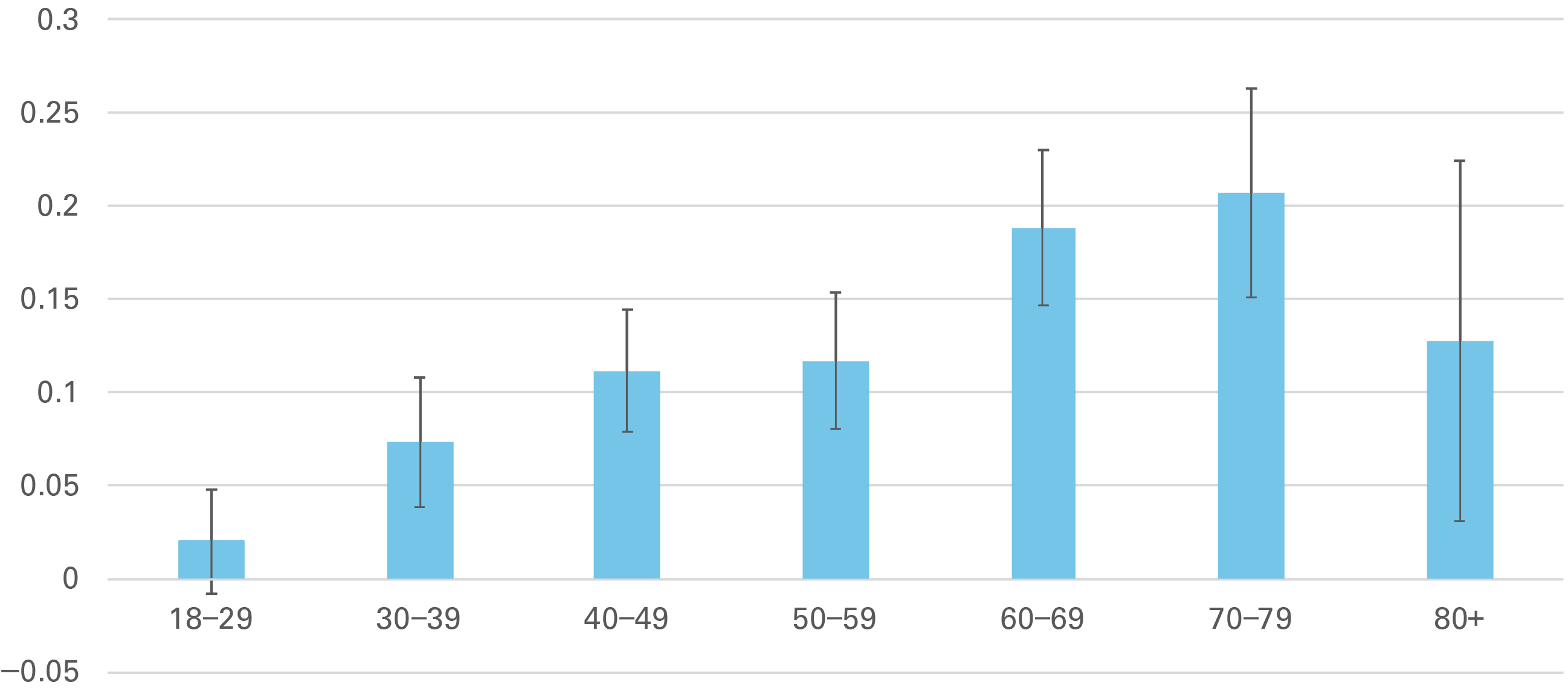 Figure 1. Temple Divorce Rates by Age Group