


Notes
1. Record of Births, Marriages, Deaths and Miscellaneous Records, Book “A”, p. 129, located in the Tunbridge Town Clerk’s Office, Tunbridge, Orange County, Vermont, hereafter cited as Record of Births, Marriages, Deaths and Miscellaneous Records, Book “A”.
2. Lucy Smith, Biographical Sketches of Joseph Smith the Prophet, and His Progenitors for Many Generations (Liverpool: S. W. Richards, 1853), pp. 36–37, hereafter cited as “Lucy Smith.” Where significant changes occur between the 1853 edition and the revised edition of 1902, the writer will make a distinction between the two texts.
3. Land Deeds, Book No.1, p. 208; Land Deeds, Book No. 2, pp. 50, 93, 99, 105, 106, 107, 377 et al., located in the Tunbridge Town Clerk’s Office, Tunbridge, Orange Co., Vt. In 1970 only one general store persisted in the small community of Tunbridge. Attempting to identify any remnant of the old mercantile establishment of “Mack and Mudget,” the writer talked to Mrs. Vernon G. Steed who, with her husband had operated “Steed’s IGA” for fifteen years. Mrs. Steed stated that she had been told that their building was at least one hundred and fifty years old. She said that she was unaware of any relationship between the present site and the “Mack and Mudget” firm. Mrs. Steed further indicated that at one time there were four stores in the community, but she did not know how old these other establishments might have been. Personal interview with Mrs. Vernon G. Steed, Tunbridge, Vermont, April 1, 1970.
4. Lucy Smith, op. cit., p. 45.
5. Land Deeds, Book No.1, p. 324, located in the Tunbridge Town Clerk’s Office, Tunbridge, Vt.
6. “Records of Junius F. Wells,” LDS Church Historian’s Office, cited in “Joseph Smith Memorial History Book,” (Unpublished, typescript history), located at the Joseph Smith Memorial, Sharon, Vermont; hereafter cited as “Joseph Smith Memorial History Book.” A “gore” is a term used in Vermont to define a piece of property which lies outside of the legal survey line and, therefore, is not included in the original survey of a particular township. The “Tunbridge Gore” was added to the Township of Tunbridge by legislative act.
7. Land Deeds, Book No. 2, pp. 101, 121, and 211, located in the Tunbridge Town Clerk’s Office, Tunbridge, Vt.
8. “Records of Junius F. Wells,” cited in the “Joseph Smith Memorial History Book”. In the company of Glade F. Howell, New England Division Coordinator for the LDS Department of Seminaries and Institutes, and Kenneth R. Myers, Supervisor of Home Study, New England District, the writer visited the “traditional” site of the old Smith homestead at the “Tunbridge Gore,” March 31, 1970. The location was identified by President Robert L. McShinsky, President of the LDS South Royalton Branch. The home currently situated at the site is not the original. Mr. Stanley Sargent, who occupies the present home, informed the writer that the old house had burned down several years ago and a new one had been built in its place. He was unaware of the historical significance attached to the location. He stated that for many years the property was owned by Mr. John F. Bennett, and it is still referred to as the “lower Bennett” place.
Dr. Russell R. Rich, Brigham Young University, informed the writer that Mr. Lewis Middleman, a local historian at Tunbridge, Vermont, believed that the Joseph Smith, Sr., home was not at the site of the Sargent residence, but further east, “where an old hole of a cellar is still visible.” Personal interview with Dr. Russell R. Rich, January 29, 1971.
On March 31, 1970, the author also spoke to Mr. Clark E. Davis, 74 years of age, and former President of the LDS South Royalton Branch. He stated that he first visited the Smith homestead (at the site of the Sargent residence) fifty years ago, and that “the house was small, with a double-pitch roof and attic. It had been remodeled, but was the same basic structure.” Mr. Davis indicated that the significance of the site was impressed on him by Heber C. Smith about twenty years ago.
Heber C. Smith first visited the Joseph Smith Memorial and vicinity in September, 1907, as a guest of Junius F. Wells. He subsequently returned as director of the Memorial, 1919–1924; 1927–1930, and 1946–1955. See “Letter of Heber C. Smith to Mr. and Mrs. LeRoy Archibald, February 12, 1963,” located in the “Joseph Smith Memorial History Book.”
9. Record of Births, Marriages, Deaths and Miscellaneous Records, Book “A”, p. 188. Asael also had a pew in a community church house, in the village of Tunbridge, which was apparently separate from the Universalist society. A floor plan of this community meeting house shows that Asael owned pew No. 41. See Ibid., pp. 195, 196.
10. Record of Births, marriages, Deaths and Miscellaneous Records, Book “A”, p. 88.
11. Lucy Smith, op. cit., p. 45.
12. Record of Births, Marriages, Deaths and Miscellaneous Records, Book “A”, pp. 130, 402. In Lucy Smith, op. cit., p. 40, there is an apparent deviation in the dating of Alvin’s birth. In that text the date is recorded as Feb. 11, 1799. However, Book “A”, p. 130, above, dates his birth as Feb. 11, 1798. Lucy Smith’s history was later revised by George A. Smith and Elias Smith and published under the title History of the Prophet Joseph by his Mother Lucy Smith (Salt Lake City: Improvement Era, 1902). Their revision agrees with Book “A”.
13. Lucy Smith, op. cit., p. 45.
14. Ibid., pp. 47–48.
15. Ibid., p. 48.
16. Ibid., p. 49. The Encyclopedia Britanica states:
Ginseng is the common name of two species of Panax (family Araliaceae), herbs whose roots constitute a drug in China. . . .
The Chinese from time immemorial have considered ginseng to be a cure for most diseases and infirmities. In fact the generic name of the plant, Panax, is derived from Greek words translated as “panacea,” a cure-all. The continued demand for ginseng roots, and especially those roots that may resemble a man in form, is probably due to a belief widely held among the Chinese that ginseng is an aphrodisiac. There is no evidence, however, to indicate that ginseng has any value, either as a drug or as an aphrodisiac. The export of wild ginseng root from America to the orient began in the early 1700s. . . Shipments have continued from that time until the present.
See Encyclopedia Britanica (1970), X, 424.
17. Lucy Smith, op. cit., p. 49.
18. Ibid., pp. 49–50.The Prophet later stated that his father “was swindled out of the entire proceeds by the shipmaster and agent, he was consequently obliged to sell his farm and all his effects to pay his debts.” See HC, 4:89–90.
19. Ibid., pp. 49–51. The writer has been unable to find any indenture in the name of Joseph Smith which would give the particulars of the sale of the farm. The earliest indenture in Tunbridge involving a “Joseph Smith,” May 12, 1794, describes property in Lot 197 which was not in the “Gore,” but in north Tunbridge, and identifies this “Joseph” as being of Gilmantown, Stafford County, New Hampshire. See Land Deeds, Book No. 2, p. 47, located in the Tunbridge Town Clerk’s Office, Tunbridge, Vt.
There were two “Joseph Smith’s” living simultaneously in Tunbridge. Subsequent land transactions reflect only the purchases of the “second” Joseph Smith not the father of the Prophet. See Land Deeds, Book No. 2, p. 510, et al. See also Book “A”, p. 397, which lists the birth of a daughter to a Joseph and Hannah Smith in Tunbridge.
The writer believes that it is possible that there was an interfamily sale or exchange made. As already described, the initial family holdings in Lot 18 were in the name of Asael Smith, with Joseph eventually settling on and working the homestead on shares. It is conceivable that the family purchased his “share” without the need of a legal document showing such a transfer. Joseph and Lucy were apparently still living on the farm as late as May 17, 1803, when a daughter, Sophronia, was born. See Records, Book “A”, p. 402. Again, there appears to be a discrepancy in the printed edition of Lucy Smith, 1853, and that of the records in the Tunbridge Town Clerk’s Office. Lucy’s book, p. 40, designates May 18, 1803 [the 1902 ed., says May 16, 1803], while Book “A” specifies May 17, 1803.
During this period there was an interesting agreement entered into by members of the Smith family involving the mortgage of Lots 10 and 17. This document stipulates the following:
The consideration of the above obligation is such that if I the said Asael Smith do pay or cause to be paid to the said Thomas Emerson (of Topsfield, Mass.) a certain note of hand of this day date signed by me the subscribers & Asael Smith Jr., and Silas Smith for seven hundred dollars payable in one year from the date with the interest then this obligation to be void & of none effect otherwise to remain in full force & virtue. Paul Spooner Asael Smith Jesse Smith June 2, 1803.—See Land Deeds, Book No. 3, p. 69, located in the Tunbridge Town Clerk’s Office. The writer suggests that this transaction could have been entered into in order to raise the capital to purchase Joseph’s “share,” or may be in some way connected with the effort to settle accounts with the “Boston” merchants. However, it may reflect other encumbrances which were taken on by the designated parties.
20. Lucy Smith, op. cit., p. 56.
21. Land Deeds, Vol. 5, p. 313, located in the Sharon Town Clerk’s Office, Sharon, Vermont. Mrs. Esther J. Drown was the town clerk in 1970. Relative to the movement of Solomon Mack, Sr., from Gilsum, New Hampshire to Tunbridge, Vermont, Archibald F. Bennett indicated that in the Grand Levies of Gilsum “from 1799 on, only the name of Solomon Mack appears. This was Solomon, Jr., who had married in 1797; his father had gone to live in Tunbridge where three of his married children were then residing. . . . The last remaining unmarried child of the family, Daniel Gates Mack, of Montague, Mass., married Sally Ball, of Montague, at Tunbridge, Vt., 27 January, 1799. When Solomon Mack and wife Lydia removed to Tunbridge, they probably lived with these newlyweds. The census of Tunbridge, Vermont, for 1800, lists. . . Solomon Mack with one male in family between 26–45.” The Improvement Era, LIX (January, 1956), 36.
22. Dr. Russell R. Rich, who has made a detailed investigation of the purported Solomon Mack dwelling, informed the writer that he is satisfied from his research that the existing foundation marks the site of the original Mack home. Personal interview with Dr. Russell R. Rich, January 29, 1971.
23. In December, 1969, the LDS Church Historian’s Office received an item of information from Dr. C. S. Evans, M.D., of Salt Lake City, designed to lend an additional note of insight into the birth of Joseph Smith, Jr. The Historian’s Office informed the writer of the following particulars:
During the year 1969, Dr. Evans attended an F.A.A. Seminar in Oklahoma. While in attendance at this seminar he was approached by a Dr. John D. Spring. Noticing that Dr. Evans was from Salt Lake he asked if he was LDS and related the following. (Dr. John D. Spring is a non-member [non-Mormon] from Nashua, New Hampshire). Dr. Spring said that his ancestor, Joseph Gunnison [Joseph Denison], was the doctor that delivered Joseph Smith. He was a country doctor who rode around on horseback and was paid in produce. Dr. Gunnison [Dr. Denison] evidently kept a diary which was in the possession of Dr. Spring’s aunt but has now been thrown away.
—Personal Correspondence of Dean C. Jessee, LDS Church Historian’s Office, to the writer, February 13, 1970.
Upon receipt of this information from Dean Jessee, the writer contacted Glade F. Howell, New England Division Coordinator for the LDS Seminaries and Institutes, and requested that he call on Dr. John D. Spring in Nashua, New Hampshire. Mr. Howell visited Dr. Spring on May 27, 1970. From the following statement, the reader will note that the doctor involved in the account is “Dr. Joseph Denison” rather than the “Dr. Joseph Gunnision” identified in the information supplied the Church Historian’s Office by Dr. C. S. Evans of Salt Lake City. Dr. Spring stated:
I, John D. Spring, M.D., have told a family story concerning Dr. Joseph Denison of South Royalton, Vermont, who delivered Joseph Smith, the founder of the Latter Day Saints. The story was told my mother by her aunt, Mrs. Louise Elder, who had cleared out the house of Dr. Denison after the death of him and his family. The report was bound in his account books of delivering a son for old Joe Smith. Under a later date he had put a note on the same entry saying “If I had known how he was going to turn out I’d have smothered the little cuss.”
John D. Spring M.D.
273 Main St.
Nashua, N.H.Signature witnessed by
Glade F. Howell
New England Division Coordinator
May 27, 1970.
Dr. Denison is described in the following terms:
Joseph Adams [Adam] Denison, M.D., eldest son of James and Eunice (Stanton) Denison, was born at Stonington, Connecticut, December 22, 1774. He studied medicine with Dr. Gallup [Dr. Benjamin Gallup?] one of the best known and most influential of the early settlers of Vermont. He became a resident of Bethel, Vermont, in 1797, and practiced his profession in that town till 1815, when he removed to Royalton, where he died September 5, 1855. He married, June 9, 1802, in Cornish, New Hampshire to Rachel Chase, who was born January 10, 1774, and died August 3, 1858, in her eighty-fifth year. She was a daughter of Dudley and Alice (Corbett) Chase (see Chase IX). They had nine children, three of whom died in childhood. The six who reached adult age were: Joseph A., George, an Episcopal minister, who died at Keokuk, Iowa; James, an attorney, who died at San Antonio, Texas; Alice (deceased) who married David W. Grant; Rachel C., who resided in Royalton, and Dudley C., a prominent lawyer of Royalton.—Ezra S. Stearns (ed.), Genealogical and Family History of the State of New Hampshire, (New York: Lewis Publishing Company, 1908), I, 311.
Bethel, Windsor County, Vermont, is located twelve miles northwest of Sharon, Windsor County, Vermont. For an extended genealogy of Dr. Jo Adam Denison,” see Evelyn M. Wood Lovejoy, History of Royalton, Vermont, with Family Genealogies, 1769–1911 (Burlington: Free Press Printing Company, 1911), pp. 749–752.
Unfortunately, the corroborative records of Dr. Denison himself have been “thrown away.” However, from the supportive statement of Dr. Spring, above, it is possible that the attendant physician at the birth of Joseph Smith, Jr., has been found.
24. To authoritatively locate the town line would require a vote at a town meeting by each town, Sharon and Royalton, and the appropiation of the necessary funds. To set the county line officially, would require an act of the Vermont Legislature authorizing the action and the appropriation of the necessary funds for the survey. Without getting involved in a “surveyor’s” controversy, the writer merely cites the comment of the LDS South Royalton Branch President, Robert L. McShinsky, who stated:
The bedroom in which Joseph was born was in Sharon township, while the remainder of the home was in Royalton township. The township line runs on an angle past the corner of the doorstep, through the reflecting pool and past the flagpole.”—Personal interview with Pres. Robert L. McShinsky, Sharon, Vermont, March 31, 1970.
Today the new director’s cottage is in South Royalton, while the monument and bureau are in Sharon township. A short distance west of the memorial is a beautiful chapel belonging to the LDS South Royalton Branch, Vermont District. It was dedicated June 27, 1965. In 1970 the branch had a membership of 345.
25. Land Deeds, Book 18, pp. 524–525, located in the office of the Town Clerk of Sharon, Vermont, and also in Book Y, page 14, of the Town Clerk of Royalton, Vermont.
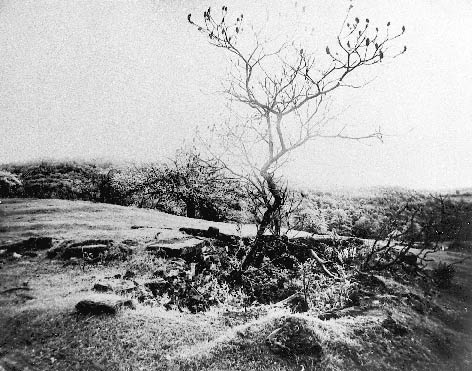
26. See, Figure 1, p. 22. The original photograph, taken about 1905, was given to Elder and Sister LeRoy Archibald, missionary couple at the Joseph Smith Memorial, by Ruth R. Lombard, of Milton, Vermont, March 19, 1964. The frame in which the picture is housed, has been made from a branch of the tree in the center of the picture. The photograph originally belonged to her father.
27. Miscellaneous Record Book, Vol. 1, pp. 50–51. For the complete statement, see Appendix A. See also, Testimony of Harvey Smith, November 14, 1905, Misc. Rec. Bk., Vol. 1, pp. 49–50 and testimony of Maria N. Griffith, November 16, 1905, Misc. Rec. Bk., Vol. 1, pp. 52–53, located in the office of the Town Clerk of Sharon, Vermont.
28. The specific measurement of the shaft’s thirty-eight and one-half feet is reminiscent of one foot for each year of Joseph’s life. Thirty-eight spruce trees have also been planted at the site by the Vermont District priesthood members, one for each year of Joseph’s life.
29. Proceedings at the Dedication of the Joseph Smith Memorial Monument at Sharon, Windsor County, Vermont, etc., December 23, 1905 ([Salt Lake]: Deseret New, n.d.), p. 15.
30. A metal plaque designates the spot from which the hearthstone was removed from placement in the Bureau of Information. The inscription read:
Birth place of Joseph Smith the Prophet, December 23, 1805–June 27, 1844. This plaque marks the place in the old Solomon Mack home where rested the family hearthstone (27 x 54 inches) now preserved in the new Bureau of Information 200 feet southeast from here. Around this hearthstone and its glowing fireplace, two days before Christmas 1805, the Smith family washed, dressed and cuddled the future organizer of “God’s Kingdom Restored”—December 23, 1963.
31. Lucy Smith, op. cit., p. 56.
32. Ibid., pp. 56, 58–60.
33. Personal interview with Dr. Russell R. Rich, January 29, 1971. Dr. Rich stated that he had obtained his information from Mrs. Dehlia Edson of West Lebanon, New Hampshire. Mrs. Edson’s daughter, Louise, had learned of the Smith’s residence in West Lebanon while visiting with a Miss Fannie Alden who lived to be more than one hundred years old. Miss Alden’s parents had owned an inn near the farm which the Smiths rented in Lebanon township.
34. Lucy Smith, op. cit., p. 41.
35. Ibid., p. 60.
36. Frederick Chase, A History of Dartmouth College and the Town of Hanover, New Hampshire (to 1815), (Brattleboro, Vermont: The Vermont Printing Co., 1928), pp. 634–635, located in the Baker Memorial Library, Dartmouth College Libraries, Hanover, New Hampshire.
37. Personal correspondence of the Kenneth C. Cramer, Archivist, Baker Memorial Library, Dartmouth College Libraries, Hanover, New Hampshire, with the writer, April 28, 1970. In an accompanying pen diagram, Mr. Cramer further identified a plot immediately west of the junction of modern-day (1970) Main and Wentworth Streets as the site of the Charity School. Moor’s School was closed in 1849. See Leon Burr Richardson, History of Dartmouth College. (Brattleboro, Vt.: The Stephen Daye Press, 1932), Vol. II, p. 419.
38. Lucy Smith, op. cit., p.60.
39. Ibid.
40. Joseph Smith, “Manuscript History of the Church,” Book A-1, Note A, p. 131, located in the LDS Church Historian’s Office, Salt Lake City, Utah, hereafter cited as Joseph Smith, “MS History of the Church,” Book A-1. In this same treatise, Joseph Smith, Jr., stipulated that he was five years of age, or thereabouts at the time of the operation, Ibid., p. 131. See also Lucy Smith, op. cit., pp. 62–65.
41. Lucy Smith, op. cit., p. 65.
42. Rev. Charles A. Downs, History of Lebanon, N.H., 1761–1887 (Concord, N.H.: Rumford Printing Co., 1908, p. 240.
43. Lucy Smith, op. cit., p. 64.
44. Thinking that Dr. Stone might have been a member of the faculty or a student of Dartmouth College, the writer visited that institution and was informed by Mr. Walter Wright, Chief of Special Collections, Baker Library, Dartmouth, that their first medical graduate with the name of Stone was in 1826. Personal interview with Walter Wright, March 30, 1970. A survey of their records revealed no faculty member by the name of Stone nor could he be found in the local histories provided in the Lebanon Public Library, Lebanon, N.H.
45. Mr. Kenneth C. Cramer, Archivist, Baker Memorial Library, Dartmouth College, informed the writer that two early staff members of that institution fit the situation relative to time and circumstance, Dr. Nathan Smith and Dr. Cyrus Perkins. Mr. Cramer provided personal sketches of the lives of these men. See Appendix B herein. Mr. Cramer also examined the daybooks of these doctors but could not find conclusive proof of any visits to the home of Joseph Smith, Sr. However, it is possible that subsequent examination of those records may yet prove valuable in establishing the exact time of the devastating sickness among the Smith family and of their residence in West Lebanon.
46. Lucy Smith, op. cit., p. 66. The writer believes that they probably remained in Lebanon at least through the harvest season of 1813, before making their removal to Norwich.
47. 47. Ibid. Lucy Smith identified the landlord as “Esquire Moredock,” while another source calls him “Squire Murdock.” See “Records of Junius F. Wells,” p. 2, cited in the “Joseph Smith Memorial History Book.” [Since the completion of this dissertation in 1971 the writer has found that the landlord was Squire Constant Murdock, see LaMar C. Berrett, et al., Sacred Places: New England and Eastern Canada (Salt Lake City: Bookcraft, 1999), 94–96.]
48. “Records of Junius F. Wells,” p. 2, cited in the “Joseph Smith Memorial History Book.”
49. Lucy Smith, op. cit., p. 66.
50. Stilwell, op. cit., pp. 129–130. For the effects of this cold spell in Seneca County, New York, see “The Cold Summer of 1816,” “Historical Scrapbook #2, 1875–19—,” p. 16, located in the Waterloo Library & Historical Society, Waterloo, New York.
51. Ibid., pp. 125, 134–135, 139.
52. Stilwell, op. cit., pp. 140–141.
53. Ibid., p. 135.
54. Patriarchal Blessing Record Book, Vol. 2, p. 12, located in the LDS Church Historian’s Office, Salt Lake City, Utah. This blessing was given by Patriarch Joseph Smith, Sr., on the head of his son, Don Carlos Smith, September 15, 1835. The date and place of birth are given in connection with the blessing.
55. Stilwell, op. cit., p. 129.
56. Joseph Smith, “MS History of the Church,” Book A-1, Note A, p. 131.
57. Lucy Smith, op. cit., pp. 67–69.
58. Joseph Smith, “MS History of the Church,” Book A-1, Note A, pp. 131–132. Archiblad F. Bennett commented, “She died about 1818, presumably in Tunbridge or Royalton, but no gravestone inscription to her name has been located after diligent search.” See “Solomon Mack and His Family,” The Improvement Era, LIX (January, 1956), 37. Lucy Mack Smith asserted:
My aged mother, who had lived with us [at Norwich, Vermont] some time, assisted in preparing for the journey. She came with us to Royalton, where she resided until she died, which was two years afterwards, in consequence of an injury which she received by getting upset in a waggon while travelling with us . . . my mother went to Daniel Mack’s, with whom she afterwards lived until her decease.
—Lucy Smith, op. cit., pp. 68–69.
59. Lucy Smith, op. cit., p. 70.
