Being first attracted by Josiah Stowell’s offer of employment, Joseph found his experiences in Susquehanna County to be of considerable moment both to himself and to the inception of the LDS Church. It was in this county that Joseph met Emma Hale his future wife. In Harmony, Pennsylvania, much of The Book of Mormon was translated. Joseph also reports having received several revelations and visitations from heavenly messengers while living in this locality. The Prophet’s early associations on the Susquehanna River eventually resulted in an expanded acquaintance with significant people in Broome and Chenango counties to the immediate north.
Susquehanna County and the Formation of Harmony and Oakland Townships
As one attempts to retrace the early beginnings of Mormonism from the vantage point of the Twentieth Century, he is immediately impressed with the numerous instances of change relative to geography and place names which have occurred in the interim period. Unless identified, these rearrangements of boundary lines and names can be very misleading. Joseph Smith’s experiences in Susquehanna County have provided an excellent example of this difficulty. He was a “periodic” resident of Harmony township, Susquehanna County, Pennsylvania, during the years 1825–1830. The area in which Joseph lived during that period was sub [111] sequently set off from Harmony township and became a part of Oakland township. This transition has caused a certain amount of confusion to those trying to locate the place of his activity because even the nearby settlement of Harmony, which remained in Harmony township at the time of division, eventually disappeared. A brief chronology of the evolvement of Harmony and Oakland townships therefore, may be helpful.
The northeastern part of Pennsylvania was originally known as Northumberland. On September 25, 1786, the county of Luzerne was created from part of Northumberland. Susquehanna County itself was divided from Luzerne County through an act of the Pennsylvania State Legislature on February 21, 1810. However, it was not fully organized, with county officers, until the fall of 1812.1
While still a part of Luzerne County, the settlement of Harmony was given its name in 1798. In 1809 the township of Harmony, Luzerne County, was organized, bearing the name of the original settlement.2The following is a description, in 1832, of both Harmony township and the village:
Harmony, t-ship, Susquehanna Co. bounded n. by the state of New York, E. by Wayne C. S. by Jackson t-ship; length, 8 ms, breadth 6; area, 30,720 acres. The Susquehanna r. flows into the t-ship from the state of New York, southward along the eastern side of the Oquago [also spelled Ouaquagua] mountain, and turning west around that mountain into Great Bend t-ship. Several streams flow through Harmony into the river, [112] the chief of which are Starucca and Conewanta creeks. The Oquago mountain fills the whole of the N.E. angle. The remainder of t-ship is hilly; the soil is gravel and clay. Pop. in 1830, 341; taxables 1828, 53.
Harmony, village and p-t [post town] of the above t-ship, is situated on the Oquago turnpike road, and the eastern bank of the Susquehanna r. within 2 miles of the state line, and about 18 miles due N.E. of Montrose. It contains 6 or 7 dwellings 1 store and 1 tavern.3
The home of Isaac Hale, father-in-law of Joseph Smith, Jr., was on the “North side of the Susquehanna River.”4 Because of the bend of the river occurring at that point, Isaac Hale’s residence is said to be on the “north” side while the village of Harmony is referred to as being on the “east side.” Not only was the Hale home on the opposite side of the river, but it was also approximately one and one-half miles west of the village. Although the Hales lived in the near proximity of the village, they were not a part of the settlement proper.
Present day Oakland township was not set off from Harmony township until December, 1853, when it was separated by an act of the Court of Susquehanna County.5 A description of the new boundaries and the primary geographical features is informative. It states:
New York State lies on the north, Harmony and Susque [113] hanna River on the east, Jackson on the south, and New Milford and Great Bend on the west. From north to south it is about six and one-half miles. Its surface is exceedingly broken and hilly, the Ouaquagua Mountains, occupying so large a part as to leave but very little level land north of the Susquehanna River, which bisects the township about midway between its northern and southern lines: and that portion which lies south of the river, although some of it has been brought into arable condition, is, in the main, not well adapted to agriculture. Only by dint of commendable perseverance and toil has any of the land been improved, except, possibly, a little that lies along the river and near the beds of the few small streams that are found in some parts of the township, and along Drinker Creek.6
In 1853, the lands once occupied by the Isaac Hale and Joseph Smith families became a part of the newly created Oakland township, while the site of the old village of Harmony remained in the boundaries of its namesake, Harmony township.
The Isaac Hale and Nathaniel Lewis Families on the Susquehanna
Isaac Hale, son of Reuben Hale and Diantha Ward, was born at Waterbury, Connecticut, March 21, 1763.7 During the Revolutionary war he went with his grandfather to Vermont. After a summer’s employment in Connecticut, he concluded to go west. Isaac boarded with Major Daniel Buck at Ouaquaga, New York. A short time later, about the fall of 1787, he went down the Susquehanna River to the Great Bend.8 David Hale, son of Isaac Hale, stated: [114]
After exploring the country, and getting acquainted with the oldest settlers, viz., Moses Comstock, Jonathan Bennett, Deacon Jedediah Adams, etc., he went back to Vermont, and married Elizabeth Lewis, Sister of Nathaniel Lewis, who married about the same time Sarah Cole, whose sister Lorana Cole, afterwards married Timothy Pickering, Jr.
Well, now for the emigrant train, Isaac Hale and Nathaniel Lewis, with their wives Elizabeth and Sarah. Nathaniel Lewis had a yoke of steers and a cart, on which to carry all their plunder (baggage), a distance of about two hundred and twenty miles from Wells, Rutland County, Vt, to Willingborough, Luzerne County, Pa . . . they went through to Pennsylvania, as near as I can make it, in 1790.
Isaac Hale bought an improvement of Jonathan Bennett. The land he afterward bought of Robert H. Rose, the same place on which I was raised, and on which he lived when I left my native place, and where he was buried.9
Isaac Hale and Nathaniel Lewis purchased property under Connecticut’s claim to the land only to find that the state of Pennsylvania disputed their right of ownership. The difficulty was decided in Pennsylvania’s favor, and Hale and Lewis found themselves under the necessity of arranging terms for repurchase.10
As early as 1791, the two brothers-in-law had established themselves on the land, locating near to each other on the north side of the Susquehanna River. Later, Nathaniel Lewis bought a place on the south side of the river, where he resided for a number of years.11 The writer has found indentures which indicate that Isaac Hale (and others) purchased some 623 acres of land in Harmony township between 1809 [115] and 1833.12
Isaac and Elizabeth Hale were the parents of nine children, Jesse, born February 24, 1792; David, born March 6, 1794; Alva, born November 29, 1795; Phebe, born May 1, 1798; Elizabeth, born February 14, 1800; Isaac Ward, born March 11, 1802; Emma, born July 10, 1804; Tryal, born November 21, 1806; and Reuben, born September 18, 1810.13
The tax list of 1813, names Isaac Hale, Jesse Hale and Nathaniel Lewis as free-holders. Isaac Hale is identified as having served as a “Supervisor, Assessor, and Collector.” Jesse Hale, oldest son of Isaac Hale, also served as tax-collector over a number of years. David Hale, similarly, was collector in 1820. That year there were twenty-eight “taxables” in Harmony township. When a new school house was erected in 1830, the Prospect School, Jesse Hale and Robert McKune were named trustees.14
“Hunting the deer was quite a business with a certain class, and their skins were among the articles of trade with the merchants.” A historian stated: “Venison was a very important article of sustenance, and when corned or jerked could be kept any length of time.”15 Isaac [116] Hale is referred to as being among that “class” of men, a “great hunter.” Rev. George Peck, a Methodist minister who visited the Hale home in the course of his travels on the Broome Circuit, tells us something of Isaac Hale’s prowess:
Hale was a mighty hunter. In fact, he came from Vermont, and fixed his home in this new region for the purpose of pursuing game in the Harmony Woods—the great forest which then stretched from the Susquehanna to the Delaware. He slaughtered about a hundred deer annually, most of which he sent to the Philadelphia market. He often killed bears and elks, as well as a great variety of smaller game, of the flesh of which I often partook at his table.16
Hale was spoken of as a man of “forethought and generosity.” The meat from the elk, which he killed up the Starucca in the fall, “often found its way unheralded, to the tables of others when the occupants of the house were out of sight; and to them the gift seemed almost miraculous.”17 Even in death, Isaac’s skill in the hunt was reflected by the lines of a borrowed epitaph which declared:
ISAAC HALE died Jan. 11, 1839, AE. 75 y’s 10 mo. & 10 d’s.
The body of Isaac Hale, the Hunter, like the cover of an Old book, its contents torn out, and stript of its lettering and guilding, lies here food for worms, yet the work itself shall not be lost for it will as he believed, appear once more in a new and more beautiful edition, corrected and [117] amended.18
Isaac was interred in a place of his own request. He had stated, “I further desire my body buried on my own land back of the garden [later became the McKune Cemetery] near the line betwixt me and Joseph McKune, Jr.”19 Elizabeth was placed next to her husband, the inscription reading, “Elizabeth wife of Isaac Hale, Died Feb. 16, 1842, Aged 75 Years 2 mo. & 28 d’s.”
In 1887, Rhamanthus M. Stocker, commenting on the Isaac Hale and Nathaniel Lewis posterity still in the vicinity, stated: “Hale and Lewis repurchased their claims and afterwards became quite prominent citizens but of their descendants none are living here now, as nearly all have removed farther west.”20
Methodism in Harmony Township
Elder Nathaniel Lewis is identified by Emily Blackman as “the pioneer Methodist of what is now Oakland.”21 He was ordained a deacon in 1807. A history of the Lanesboro, Pennsylvania, Methodist Episcopal [118] Church, clearly identified his ordination and other particulars of the rise of that denomination. The history stated:
There were occasional Methodist services in the south part of Harmony township about 1800. In 1807 Bishop Asbury was at a camp meeting on Squire Light’s ground, near Owego. In his diary he says that on Sunday, July 12, “I ordained five worthy men, local preachers, to the office of deacon”— and he names Nathaniel Lewis among them. Lewis must have preached before this, as tradition has it that John Hilborn advised him to get his license. The first definite record of services at Lanesboro is in 1810. Loring Grant and Joseph Kinhead were that year the preachers on the Tioga Circuit, which had 30 preaching places, 400 miles being traveled each trip around it. Mr. Grant says that in 1810 he preached regularly at John Comfort’s (the frame house) and Isaac Hale’s (below Oakland). In 1812 Lanesboro was taken from the Tioga circuit and placed on the Broome circuit. Elijah King was the first preacher on the newly formed Broome circuit.22
The Hale and Lewis families were devout Methodists and were numbered among the members of the first class conducted at Lanesboro, Pennsylvania, some two miles east of their home sites. The following account recorded their activity:
The first class at Lanesboro was formed in 1810 by Mr. Grant [Loring Grant], or in 1812 by Mr. King [Elijah King]. It included John and Phoebe Gildersleeve Comfort, Isaac and Elizabeth Hale, Nathaniel and Sarah Lewis, Marmaduke and Clarisa Salsbury, and James Newman and Betsy Rouse; and if not at first, soon after, Mary Hilborn. James Newman later married Betsy Rouse.
Nathaniel Lewis, an ordained local preacher, was deeply pious, shrewd, witty, and at home in the rough-and-tumble polemics of the time. He preached and formed classes at Jackson, Thompson, Starrucca and other places. Charles Beebe, now 83 years old, heard Lewis preach in Martin and John Hupman’s newly built barn at South Windsor in 1835. Later he went west. . . .
Provisions often ran scarce in those early days. In such a time, in 1812, Lewis was reading his Bible before going to service on Sunday, when he saw a deer near his house. Taking [119] down his gun, he shot the deer, dressed it and sent portions to his neighbors. Called to account for breaking the Sabbath, he asked his accusers, “What do you suppose the Lord sent that deer into my field for?” “Well, I suppose it was to try you.” “No it wasn’t he replied, “for the Lord knows that when He sends me blessings, I don’t wait until the next day to take them.” Once he preached to a disorderly congregation and called them a “Hogmatical set.” A brother local preacher asked Lewis if he did not use a wrong word. “No,” he replied, “you have heard of dogmatical, I suppose?” “Yes, But—” “Well,” interrupted Lewis, you can shame a dog, but a hog you can’t.”23
In the Methodist Quarterly Review, the content of an affidavit asserts that “Father Hale’s house was the preacher’s home.”24 In 1816, Elisha Bebins (also spelled Bibbins) and George Peck were assigned to the Broome Circuit of the Chenango District, Genesee Conference, which included preaching appointments in Harmony.25 Rev. Peck remembered visiting the Hale family. He reported:
In the morning I rode to Jesse Hale’s [Isaac Hale’s] some six miles above the Great Bend. . . . He was a shrewd, witty man. He was the father-in-law of Joseph Smith, the Mormon prophet. . . . Mr. Hale gave me a cordial reception, and in the afternoon I preached in a little log school-house to a small but earnest congregation.26
Initially, there was no regular place of gathering. Meetings were held at various private houses in the winter and in barns in the [120] summer. Jacob Skinner, an immediate neighbor of the Isaac Hale family and a devoted Methodist, often entertained the circuit riders in his home and his barn was used for the quarterly meetings of that society.27When a log school house was built at Lanesboro, meetings were often conducted there.28
Finally, on August 22, 1834, at a meeting held in the Lanesboro school house, it was determined to construct a house of worship in Lanesboro. Among those who signed the articles of incorporation of “the Lanesborough Society of the Methodist Episcopal Church in Harmony, Susquehanna County,” was David Hale. Three separate subscriptions were taken in order to raise money for the erection of the building. The first, made on July 5, 1834, bears the names of Isaac Hale, $2.00 and David Hale, $10.00 (in work).29 Elizabeth Hale, wife of Isaac, is stylized as being, “for fifty years a consistent member of the Methodist church.”30
Joseph Smith and Josiah Stowell in Harmony Township
The statement of a Mr. J. B. Buck places Joseph Smith in the [121] New York–Pennsylvania border region “shortly after 1818” as a participant in a lumbering enterprise.31 However, Joseph’s own narrative commences his acquaintanceship with the area as a result of his employment, in October, 1825, by Josiah “Stoal” [Stowell].32 Mr. Stowell resided on a farm bordering the Susquehanna River some three miles southwest of the village of South Bainbridge (now Afton), Chenango County, New York.33 He had professedly identified an area near the village of Harmony, in the township of Harmony (now Oakland township), Susquehanna County, Pennsylvania, about three miles below the New York line, where, “a company of Spaniards, a long time since, when the country was uninhabited by white settlers, excavated from the bowels of the earth ore, and coined a large quantity of money; after which they secured the cavity and evacuated, leaving a part still in the cave purposing to return at some distant period.”34
Mr. Stowell had previously been digging in an attempt to dis [122] cover the whereabouts of the mine, but without success. He had hired a number of workmen to assist him in retrieving the purported treasure and was now desirous of securing Joseph’s services “on account of having heard that he possessed certain means by which he could discern things invisible to the natural eye.”35
Another account stated that Mr. Stowell learned of Joseph Smith’s unusual abilities while visiting his cousin, Simpson Stowell, who resided at Palmyra, New York.36 Whatever the manner of contact, Joseph Smith indicated that his hiring was done on a wage basis of $14.00 per month.37
Although Joseph initially demurred, the insistence of Mr. Stowell and the prospects of acquiring the stipulated wages apparently prompted the return not only of himself but also Joseph Smith, Sr., to the digging site. Joseph Smith, Jr., stated the conditions of his [123] employment:
In the month of October, 1825, I hired with an old gentleman by the name of Josiah Stowel, who lived in Chenango county, state of New York. He had heard something of a silver mine having been opened by the Spaniards in Harmony, Susquehanna county, state of Pennsylvania; and had previous to my hiring to him, been digging, in order, if possible, to discover the mine. After I went to live with him, he took me with the rest of his hands, to dig for the silver mine.”38
It is possible that certain of the “hands” who were hired by Mr. Stowell are identified in a purported “Articles of Agreement” which was said to be in the possession of a resident of Thompson township, Susquehanna County, Pennsylvania in 1880. The supposed agreement stated:
ARTICLES OF AGREEMENT
We, the undersigned do firmly agree, & by these presents bind ourselves, to fulfill and abide by the hereafter specified articles:
First—That if anything of value should be obtained at a certain place in Pennsylvania near a Wm. Hale’s supposed to be a valuable mine of either Gold or Silver and also to contain coined money and bars or ingots of Gold or Silver, and at which several hands have been at work during considerable part of the past summer, we do agree to have it divided in the following manner, viz., Josiah Stowell, Calvin Stowell and Wm. Hale to take two-thirds, and Charles Newton, W. I. Wiley, and the Widow Harper [Mrs. Oliver Harper] to take the other third. And we further agree that Joseph Smith, Sen. and Joseph Smith Jr. shall be considered as having two shares, two elevenths of all the property that may be obtained, the shares to be taken equally from each third.
Second—And we further agree, that in consideration of the expense and labor to which the following named persons have been at (John F. Shephard, Elihu Stowell and John Grant) to consider them as equal shares in the mine after all the coined money and bars or ingots are obtained by the undersigned their shares to be taken out from each share; and we further agree to remunerate all the three above named persons in a handsome manner for all their time, expense and labor which they have been or may be at, until the mine is opened. If anything should be obtained; other wise they are to lose their time, expense and labor. [124]
Third—And we further agree that all the expense which has or may accrue until the mine is opened shall be equally borne by each of the sharers.
Township of Harmony, Pa., Nov. 1, 1825. In presence of
If the purported “Articles of Agreement” are valid, the Calvin Stowell referred to was probably the same Calvin Stowell who was a brother of Josiah Stowell. Elihu Stowell could well have been Elihu Cooper Stowell, son of Abishai Stowell who was a half-brother of Josiah [125] Stowell.40 Oliver Harper, one of the original treasure seekers in the area, had apparently been associated with Josiah Stowell previously. His home was about two miles below Windsor, New York, on the river road.41 On May 11, 1824, he was murdered by Jason Treadwell as he walked toward his home on the Old Harmony road.42 A previous agreement with the husband may account for the inclusion of the “Widow Harper” (Mrs. Oliver Harper), in the reported “Articles” above.
Isaac Hale stated that Joseph Smith, Jr. and the other “money diggers” arrived at Harmony, Susquehanna County, in November, 1825, and boarded at his place during the course of their mining operation.43According to a local account, Stowell and his crew opened up at least two general excavation sites in the vicinity. One of the spots where treasure was supposed to lie buried “was on the place now owned by J.M. Tillman, near the McKune farm, then the property of Wm. Hale. Excavations were also made on Jacob Skinner’s farm, some of which remain well marked today.”44
Emily Blackman prepared a detailed pictorial diagram of the [126] location of the “pits” on the Jacob Skinner farm and gave an exacting description of how to arrive at “the diggings.” She related:
Jacob I. Skinner, son of Jacob (who was a twin-brother of Israel Skinner), has the deed of the land on which Joseph’s followers experimented. It is something over a quarter of a mile north of the river to “the diggings,” up Flat Brook. . . .
Starting from Susquehanna Depot to reach this place, one crosses the bridge and turns to the left following the road nearest the river, which strikes the old river road at Shutt’s house; then continuing on down until he crosses a creek and comes in sight of a schoolhouse, with a grove beyond it, in front of which, on the opposite side of the road, is a graveyard [the McKune Cemetery]. Just above the school-house he turns into a road on the right, and follows up ‘Flat Brook’ to the farm now owned by J. I. Skinner. From his house a path leads about 120 yards southeast to the largest excavation [20 feet deep and 150 feet in circumference], which was also the last one, from which proceeds a drain about twelve rods long.45
She identified five holes in the earth, the largest of which measured twenty feet in depth and one hundred-fifty feet in circumference.46[127]
“It is said that even Mr. Isaac Hale was at first a little deluded about the digging, while he boarded the party.”47 Should the “Articles of Agreement” prove to be a true document, this would account for the witnessing signature of Isaac Hale on the same. Apparently he gave his initial sanction to the operation, but later became its critic. Mr. Hale attested that after a short time the treasure seekers “became discouraged, and soon after dispersed. This took place about the 17th of November, 1825.”48 Relative to their fruitless search for wealth, Joseph Smith, Jr., said: “I continued to work for nearly a month, without success in our undertaking, and finally I prevailed with the old gentleman to cease digging after it.”49 According to local accounts, others continued to dig for treasure even after Josiah Stowell and Joseph Smith had removed to Mr. Stowell’s residence about three miles southwest of South Bainbridge, Chenango County, New York.50
Joseph Smith, Jr., and Emma Hale— New York and Return
While boarding at Isaac Hale’s home, Joseph Smith, Jr., and [128] Isaac’s daughter, Emma, developed a mutual attraction for one another which resulted in an eventual elopement and marriage in South Bainbridge, New York, January 18, 1827. Members of the Hale family were highly incensed with the “abduction” of Emma.51 Knowing the attitude of the Hale’s, the newlyweds traveled to Manchester, New York, where they received a contrasting welcome, and resided with Joseph’s parents during the farming season of 1827.52
While in Manchester, Emma corresponded with her father, Isaac Hale, asking if she could acquire the clothing, furniture, cows and other items belonging to her, but left behind during the elopement. According to Mr. Hale’s affidavit, he replied that “her property was safe and at her disposal.”53 With this assurance, Joseph secured the services of Peter Ingersoll, a neighbor, to assist him and Emma in getting the goods. Ingersoll reported:
In the month of August, 1827, I was hired by Joseph Smith Jr. to go to Pennsylvania, to move his wife’s household furniture to Manchester, where his wife then was. When we arrived at Mr. Hale’s, in Harmony, Pa. from which place he had taken his wife, a scene presented itself, truly affecting. His father-in-law (Mr. Hale) addressed Joseph in a flood of tears; “You have stolen my daughter and married her. I had much rather have followed her to her grave. You spend your time digging for money—pretend to see in a stone, and thus try to deceive people. . . . ” Mr. Hale told Joseph, if he would move to Pennsylvania and work for a living, he would assist him in getting into business. Joseph acceded to this proposition. I then returned with Joseph and his wife to Manchester.54[129]
According to Isaac Hale, at the same time Joseph agreed to return to Pennsylvania, he also made arrangements with Alva Hale to “go to Palmyra, and move his [Smith’s] furniture &c. to this place.”55However, due to prior commitments, this removal was not affected until several months had passed. During the intervening time, Joseph had a highly significant meeting with Moroni at the Hill Cumorah. He stated that on September 22, 1827, that messenger delivered the “Golden Plates” into his hands, in order that the work of translation might begin. In the face of mounting opposition to his work in Manchester, and with the settlement of his personal affairs, Joseph and Emma met with Alva Hale, according to the earlier agreement, and were conveyed to Harmony, Pennsylvania in December, 1827.56
The Isaac Hale Property and Home
As early as 1790–1791, Isaac Hale had bought an improvement from Jonathan Bennett in Harmony.57 Because of the varying land claims between Connecticut and Pennsylvania, Mr. Hale didn’t acquire a valid title to the initial property until a ninety acre plot was deeded to him by Robert H. Rose, November 29, 1809.58
The home built by Isaac Hale on the old homestead remained in [130] tact until either 1873 or 1875, when it was destroyed by fire. In 1957, Samuel Colwell of Windsor, New York, gave a highly informative statement relative to the disposition of the Hale home. He stated:
I Samuel Colwell, age 64, hereby state that my grandparents [Mr. and Mrs. George Miles Doolittle] bought the Isaac Hale farm about 1889 [April 17, 1880]. My grandfather, George Doolittle built the barn by the creek [on the east side of the home site] in the eighties. The Hale barn was west of the house. The original Hale home burned down 1873–75. The foundation that is there now is part of the original but the home was rebuilt after the fire and was added to, so the foundation is larger now than the original Hale home. I lived in the rebuilt home from 1912 to 1924. After the Mormons bought the place someone (not Mormons) tore down the house and moved the lumber away.59
President Horace H. Christensen informed the writer:
The Isaac Hale home burned in 1875, and was then replaced by a later home. Local townspeople tore it down for materials. It was a wooden frame home and was still standing in 1951, but by 1957 it was gone. In 1957 there was only a wooden flooring left.”60
Carter E. Grant commented that “since this old home later stood empty and was falling to pieces, the president of the Eastern States Mission, Elder George Q. Morris, had the house torn down in 1951–52. He then sold the old lumber to the highest bidder.”61[131]
In a deed dated June 4, 1948, Marietta Colwell, Anna Rose Colwell and Jessie Mabel Colwell, conveyed to Mr. Wilford C. Wood, of the LDS Church, the site of the old Isaac Hale Farm. Mr. Wood and his wife Lillian, then deeded the property to the Corporation of the President of the Church of Jesus Christ of Latter-day Saints, July 16 1948.62
The Joseph Smith Jr., Home on the Susquehanna
Speaking of the time soon after the return of Joseph and Emma, Isaac Hale stated:
I was informed they had brought a wonderful book of Plates down with them. I was shown a box in which it was said they were contained, which had, to all appearances, been used as a glass box of the common size window-glass. I was allowed to feel the weight of the box, and they gave me to understand, that the book of Plates was then in the box—into which, [132] however, I was not allowed to look.
I inquired of Joseph Smith, Jr., who was to be the first who would be allowed to see the Book of Plates? He said it was a young child. After this I became dissatisfied, and informed him that if there was anything in my house of that description, which I could not be allowed to see, he must take it away; if he did not, I was determined to see it. After that the Plates were said to be hid in the woods.63
It was also shortly after the ultimatum of Father Hale that Joseph Smith and his wife moved to another home, approximately 150 yards southeast of the Isaac Hale residence. The new home of the Smiths belonged to Jesse Hale, and rested on property owned by Isaac Hale. The contractual arrangement with Jesse for the home remains unknown.64 However, in February, 1879, Emma Smith stated to her son, Joseph Smith III: “Your father bought your uncle Jesse’s [Jesse Hale’s] place, off father’s [Isaac Hale’s] farm, and we lived there till The Book of Mormon was translated; and I think published. I was not in Palmyra long.”65
Relative to the house and site, one account recorded: “Upon this little strip of land Smith moved a partly-furnished house, twenty-six feet broad, eighteen feet deep and fourteen feet in the posts. It is evident, from the stovepipe through the roof, that the edifice was never finished.”66 Although Joseph Smith occupied the land shortly after his arrival from Palmyra in December, 1827, he didn’t secure title [133] to it until August 25, 1830, when, for two hundred dollars he purchased thirteen acres and eighty perches from Isaac Hale.67 John Whitmer signed as a witness to this transaction. After Joseph and Emma left the Pennsylvania–New York area, in 1831, for residence in Kirtland, Geauga County, Ohio, they sold their small parcel of land on the Susquehanna to Joseph McKune, Jr., for three hundred dollars, June 8, 1833.68
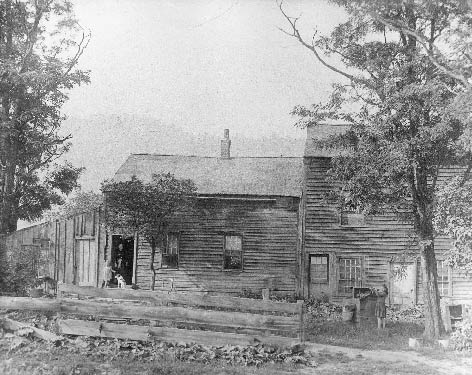
Over a period of years, many alterations occurred to the home occupied by Joseph and Emma Smith at Harmony. The house originally consisted of three rooms, two rooms at ground level and one large room upstairs. There was also a full basement. At some point after the Smiths left, a lean-to was added to the east side. Carter E. Grant reported that in 1834, Joseph McKune, Jr., “moved his large six-room home from the hill north of the cemetery [McKune Cemetery] and joined it to the west end of Joseph Smith’s home.” Grant also stated that later, another owner of the enlarged house, Anliza Barnes, in 1906, added an eight-room wing on the east, [where the lean-to had been], making a house of seventeen rooms and three halls, including Joseph Smith’s original home.”69[134]
Elder and Sister Abner H. Baird, LDS missionaries then living at Scranton, Pennsylvania, have preserved a most informative statement by a former inhabitant of the Joseph Smith farm, Mr. Rex B. Hawes, of Oakland, Susquehanna County, Pennsylvania (now deceased). Mr. Hawes stated:
I, Rex B. Hawes, of Oakland, Susquehanna Co., Penna., was born 31 October 1888 and I lived in the original Joseph Smith home from 1896 until 1909. My great grandfather was Jacob Skinner and he moved to this area from Orange County New York about 1814. He lived in a log house about a mile below the Isaac Hale property and it was here that my grandfather, Nathan Skinner was born in 1826. My father died in 1899 and my grandfather in 1908. At the time I lived in the Joseph Smith home, Benjamin McKune owned the property but it was heavily mortgaged to Mr. Simon Barnes. When my grandfather died my mother tried to buy the property but the Barnes estate wanted too much for it so my mother moved from there in 1909. Mr. Edward Beavans then bought the property.
The Joseph Smith home was built of lumber having two rooms downstairs. The floor downstairs was of beautiful hardwood maple. When entering the house, one came into a hallway and there a stairway led up to an attic or loft. The east end of this loft was boarded off into a room with a window looking toward the east, I was told that Joseph Smith did a lot of writing in this room. Another stairway, underneath the attic stairway, led down to a cellar underneath the house. There was a nice fireplace at the north end of the house but this fireplace was removed when McKune moved another house there and joined it to the Joseph Smith home. The house added to the original home was moved from the McKune property on the hillside.
As a boy and young man living in that home, I have many pleasant memories. We milked ten to twelve cows and had three horses. We farmed the ground down around the Susquehanna River and this land was very fertile and free from rocks. We raised wheat, oats, corn and potatoes, and I remember mowing clover that was as high as the horse’s bridle. We farmed the land around the river which has since grown up to trees and brush.
There was a spring of good cold water just under the brow of the hill south of the house, this spring is still there running in a pipe just at the bottom of the Erie railroad grade. [135]
About thirty-five feet north of the house was a well of very good cold water, a dairy thermometer registered it as 34°F. This well was thirty feet deep.71
There are no visible remains of the Joseph Smith home today. The structure was entirely destroyed by fire in 1919. Mrs. Helen Hawes Harvey, who once lived in the home, stated that the house burned on Monday night, June 23, 1919. The home was then standing vacant. Mrs. Harvey felt that the fire was caused by a spark from “a hard-laboring engine puffing up the heavy grade,” on the railway tracks a short distance from the house.72
Figure 3. The Home of Joseph Smith, Jr., and Emma Hale Smith, Harmony Pennsylvania.70[136]
On October 17, 1946, Jessie M. Colwell deeded the land encompassing the Joseph Smith, Jr., home site to Mr. Wilford C. Wood. Under date of February 7, 1947, Wilford C. Wood and his wife, Lillian W. Wood, for the sum of $10,000, conveyed the parcel of land to the Cor [137] poration of the President of the Church of Jesus Christ of Latter-day Saints, “a Utah Corporation Sole”, of Salt Lake City, Utah.73
The LDS Church has placed a marker just off the northeast corner of the old foundation site which reads:
NEAR THIS PLACE
in the village of Harmony, Pennsylvania, much of The Book of Mormon was translated by the modern American Prophet Joseph Smith.
His wife, Emma Hale Smith, was a native of Harmony. Her parents, Mr. and Mrs. Isaac Hale invited Joseph and Emma to come to Harmony from Manchester, Ontario County, New York, where they lived in 1827.
In the Hale home, Joseph worked on the translation of the sacred record which told the history of the ancient inhabitants of America.
This record, engraved on plates of gold, had been given to Joseph Smith by Moroni, who came to him as a heavenly messenger.
Moroni, while living on the earth as a mortal being, was the last of a great people who inhabited ancient America, but was destroyed in war about 420 A.D. He hid the record in the earth for safekeeping.
Under the direction of God, Moroni returned to the earth in 1827 and placed the record in the custody of Joseph Smith as part of a modern restoration of the gospel of the Lord Jesus Christ.
Though unschooled, Joseph translated it by divine power and published it as The Book of Mormon in Palmyra, New York, in 1829 [1829–1830].
Martin Harris and the Transcript of Characters
Lucy Mack Smith, mother of Joseph Smith, Jr., has recorded that prior to Joseph’s departure from Manchester, he made arrangements with Martin Harris to join him in Harmony for a specific purpose. She said:
When Joseph had had a sufficient time to accomplish the [138] journey, and transcribe some of the Egyptian characters, it was agreed that Martin Harris should follow him—and that he (Martin) should take the characters to the East, and, on his way, he was to call on all the professed linguists, in order to give them an opportunity to display their talents in giving a translation of the characters.74
Accordingly, Martin traveled from his home in Palmyra township to Pennsylvania, arriving at the Smith home sometime in the month of February, 1828. Prior to Mr. Harris’ arrival in Harmony, Joseph Smith had begun copying a “considerable number” of the characters from the plates and had translated some of them by means of the Urim and Thummim in his possession. The resultant transcript was then taken to New York City by Martin Harris for an evaluation by scholarly persons.75
Dr. Hyrum L. Andrus has explained the major reason for Martin’s visit to the learned in the east. He stated:
As the angel Moroni revealed the ancient record to Joseph Smith, he explained that “the scripture must be fulfilled before it is translated, which says that the words of a book, which are sealed, were presented to the learned; for thus has God determined to leave men without excuse, and show the meek that his arm is not shortened that it cannot save.” The scripture to which Moroni referred is found in the book of Isaiah, who said of the coming forth of a record of a people who would be brought down and “speak out of the ground”:
“The vision of all is become unto you as the words of a book that is sealed, which men deliver to one that is learned, saying, Read this, I pray thee: and he saith, I cannot; for it is sealed:
And the book is delivered to him that is not learned, saying, Read this, I pray thee: and he saith, I am not learned.
Wherefore the Lord said, Forasmuch as this people draw [139] near me with their mouth, and with their lips do honor me, but have removed their heart far from me, and their fear toward me is taught by the precept of men:
Therefore, behold, I will proceed to do a marvelous work among this people, even a marvelous work and a wonder: for the wisdom of their wise men shall perish, and the understanding of their prudent men shall be hid.”
It should be noted that the words of the book, not the book, were to be delivered to the learned. But the book was to be delivered to another who was not learned, and through his instrumentality God promised to bring forth a marvelous work and a wonder in which the wisdom of the wise would perish and the understanding of the prudent would be hid.76
There is evidence that Mr. Harris may have made stops at Utica and Albany en route to New York, perhaps even calling on Lt. Governor Luther Brandish for consultation.77 Martin Harris later detailed to Joseph Smith the circumstances of his visit to New York. He reported:
I went to the city of New York and presented the characters which had been translated, with the translation thereof to Professor Anthony [Anthon], a gentleman celebrated for his literary attainments; Professor Anthony [sic] stated that the translation was correct, more so than any he had before seen translated from the Egyptian. I then showed him those which were not yet translated, and he said that they were Egyptian, Chaldeac, Assyriac, and Arabic, and he said that they were the true characters. He gave me a certificate certifying to the people of Palmyra that they were true characters, and that the translation of such of them as had been translated was also correct. I took the certificate and put it into my pocket, and was just leaving the house, when Mr. Anthony [sic] called me back, and asked me how the young man found out that there were gold plates in the place where he found them. I answered that an angel of God had revealed it into him.
He then said to me, let me see that certificate, I accordingly took it out of my pocket and gave it to him, when he took it [141] and tore it to pieces, saying that there was no such thing now as ministering of angels, and that if I would bring the plates to him, he would translate them. I informed him that part of the plates were sealed, and that I was forbidden to bring them, he replied “I cannot read a sealed book.” I left him and went to Dr. Mitchell who sanctioned what Professor Anthony [sic] had said respecting both the characters and the translation.78
In answer to the question, why was Anthon selected? Dr. Kimball suggested:
In 1828 the main centers of learning were, of course, all in “the East.” There were five such centers—Harvard, Yale, Princeton, the University of Pennsylvania (or what was later called by that name), and Columbia College (now Columbia University). Since the science of Egyptology did not exist in 1828 there were no Egyptologists. The only scholars in the world acquainted to any degree with the Egyptian language would have been those in the field of classical studies. In those days, classicists did not limit themselves strictly to Greek and Roman studies, but studied most of the other ancient civilizations as well.
The chief classical scholars in the United States in 1828 were Edward Robinson, George Ticknor, Edward Everett, and George Bancroft at Harvard; James L. Kingsley and T. D. Woolsey at Yale; and Anthon at Columbia. Robinson and Woolsey, however were in Europe in 1828; Ticknor was at that time primarily interested in the Romance languages; and Everett was in politics after 1826. Of the remaining practicing classicists in the East during 1828, Anthon was the best known. It seems certain then that anyone qualified to advise Harris properly would have recommended him to Anthon.79
The “Dr. Mitchell,” spoken of by Martin Harris, has been rather conclusively identified as “Dr. Samuel Latham Mitchill.”80 Martin Harris, a farmer of long standing in the Ontario–Wayne County area, may have known of Dr. Samuel L. Mitchill because of that gentleman’s notable attainments in the world of agriculture as well as the field of ancient civilizations. Dr. Mitchill was highly active in agricultural circles. [141] He was selected as the first secretary of New York State’s pioneer society, the Society for the Promotion of Agriculture, Arts, and Manufacture, 1792. “He read articles on grasses, canker worms, and various other subjects and delivered many addresses on agriculture at meetings in different parts of the State.”81 Although by no means certain, Martin Harris may have been one of those in his audience.
In addition to his achievements in agriculture, Dr. Samuel L. Mitchill is accredited with the following achievements:
. . . Chemist, botanist, Surgeon General, Professor of History, Chemistry, and Agriculture in Columbia University, congressman, senator and leading scientist in the new world. . . . In his day he was by far the best known scientist in New York, with a reputation as a poet and humorist as well, withall of so helpful and kindly a disposition that people felt a sense of personal proprietorship in him and his works.
In the “Croakers,” Rodman Drake, the poet, thus addressed him as the Surgeon-General of New York:
Dr. Kimball believes that despite the great achievements of these two men of letters, neither Anthon nor Mitchill would have been sufficiently equipped to give a legitimate answer relative to the authenticity of the “reformed Egyptian” characters presented to them by Martin Harris. He suggested:
Anthon and Mitchill merely recognized the characters as some form of Egyptian and so stated this. . . . Many books had been published by 1828 containing facsimiles of Egyptian [142] characters and Anthon and Mitchill could easily have been acquainted with at least the appearance of the various styles of Egyptian writing. Whatever they said respecting the correctness of the translations cannot be taken too seriously. Even a reincarnated Egyptian could not have translated the characters because the “reformed Egyptian” had been so changed that “none other people knoweth our language.” It is entirely possible, of course, that they said nothing at all about the translation, but only remarked that the transcription was correct, for in 1828 neither Anthon, Mitchill (nor anyone else in the world for that matter) had seen much translated from the Egyptian.83
Whatever circumstances attended the visit of Mr. Harris to these men, it is interesting to note the effect of this experience on Martin. He returned to Harmony for a consultation with Joseph, then journeyed to his farm in Palmyra township where he arranged his affairs for an extended absence. He next traveled back to Pennsylvania where he joined Joseph as his scribe in the translation of the plates.84
Lucy Harris was greatly exasperated with her husband’s assistance to Joseph Smith. She did everything within her power to disrupt their association and to turn public sentiment against Joseph both in New York and Pennsylvania. In order to further her designs, she accompanied Martin on his return to Harmony. Mother Smith described Mrs. Harris’ actions while in Susquehanna County:
As soon as she [Lucy Harris] arrived there, she informed him [Joseph] that her object in coming, was to see the plates, and that she would never leave until she had accomplished it. Accordingly, without delay, she commenced ransacking every nook and corner about the house—chests, trunks, cupboards, &c; consequently, Joseph was under the necessity of removing both the breast-plate and the Record from the house, and secreting them elsewhere. Not finding them in the house she concluded that Joseph had buried them, and the next day she commenced searching out of doors, which she continued to do until about two o’clock P.M. . . . [143]
The woman was so perplexed and disappointed in all her undertakings, that she left the house and took lodgings during her stay in Pennsylvania with a near neighbor.
While this woman remained in the neighborhood, she did all that lay in her power to injure Joseph in the estimation of his neighbors—telling them that he was a grand impostor, and, that by his specious pretensions, he had seduced her husband into the belief that he (Joseph Smith) was some great one merely through a design upon her husband’s property.
When she returned home, being about two weeks after her arrival in Harmony, the place where Joseph resided, she endeavored to dissuade her husband from taking any further part in the publication of the Record; however, Mr. Harris paid no attention to her, but returned and continued writing.85
Translation of The Book of Mormon Begins
Martin Harris returned to Harmony from Palmyra about April 12, 1828.86 Isaac Hale recalled his arrival, saying: “About this time, Martin Harris made his appearance upon the stage; and Smith began to interpret the characters or hieroglyphics which he said were engraven upon the plates, while Harris wrote down the interpretation. It was said that Harris wrote down one hundred and sixteen pages.”87
The plates were apparently placed in a box and secreted in the woods when not being employed. Isaac Hale stipulated that when Emma and Joseph first came down, he was shown a “glass box of the common [144] sized window-glass” in which the plates were reportedly contained.88Another account suggests that this box may have been exchanged later for one that was more secure. Supposedly, Benjamin Wasson, Joseph Smith’s brother-in-law, living in the village of Harpursville, Colesville township, Broome County, New York, was commissioned to make a container. He was reportedly a cabinetmaker “and, although not a Mormon, he made a strong box for the plates.”89
From April 12, 1828 to June 14–15, 1828, Joseph and Martin prepared one hundred and sixteen pages of manuscript. Mr. Harris, apparently anxious to display his accomplishments to his wife and others, asked that he be allowed to take the transcription to his home in Palmyra township.90 Lucy Smith indicated that Martin’s request was an attempt to ameliorate conditions with his wife. She stated: “Martin Harris, having written some one hundred and sixteen pages for Joseph, asked permission of my son to carry the manuscript home with him, in order to let his wife read it, as he hoped it might have a salutary effect upon her feelings.”91
Joseph Smith affirmed that he utilized the Urim and Thummim to determine the will of the Lord, but received a negative response. This sequence was repeated three times, at the behest of Martin Harris, and [145] finally the inquiry received a conditional affirmative. Joseph related:
After much solicitation I again inquired of the Lord and permission was granted him [Martin Harris] to have the writings on certain conditions which were, that he show them only to his brother, Preserved Harris, his own wife, his father and mother, and a Mrs. Cobb, a sister to his wife. In accordance with this last answer, I required of him that he should bind himself in a covenant to me in a most solemn manner that he would not do otherwise than had been directed. He did so. He bound himself as I required of him, took the writings, and went his way.92
Soon after Mr. Harris left, (June 14 or 15), Emma Smith gave birth to her first child, a baby boy, who “remained with her but a short time before it was snatched from her arms by the hand of death.”93The original brown slate headstone still stands in the northeast corner of the McKune Cemetery, bearing these simple lines: “In Memory of An Infant Son of Joseph And Emma Smith June 15th 1828.” The figure “8”, in “1828”, is directly on the right-hand edge of the stone and has been chipped in a fashion as to make it appear like a “4”, thus reading “1824” instead of “1828”. The infant is buried approximately thirty feet directly south of his grandparents, Isaac and Elizabeth Hale.
The year 1828 was a year of sadness for the Smith-Hale families. [146] Just a few feet south of Joseph and Emma’s son’s grave is a similar brown slate headstone which reads: “In Memory of Nancy Hale, Daughter of Jesse and Mary Hale who died January the 29th AD. 1828 Aged Two Years & six months, thirteen Days.”
Following the birth of her infant, Emma’s situation was apparently very serious. Joseph remained with her constantly for a two week period. She then began to recover and Joseph was persuaded, by Emma herself, to go in search of Martin Harris, who had not been heard of since his departure. Emma’s mother, Elizabeth Hale, cared for her daughter while Joseph traveled to his father’s home in Manchester. Enroute to his destination, Lucy Smith indicated that her son received some unusual assistance from a fellow passenger on the stage, a stranger, who physically helped the exhausted Joseph the last twenty miles from where the coach had let them off.94
Upon Joseph’s arrival Martin Harris was sent for, and after a lengthy delay he made his appearance and confessed that the hundred and sixteen pages of foolscap manuscript had been lost.95 Mother Smith recorded a measure of her sons anguish upon hearing this news. She related:
“Oh, my God!” said Joseph, clinching his hands. “All is lost! What shall I do? I have sinned—it is I who tempted the wrath of God. I should have been satisfied with the first answer which I received from the Lord; for he told me that it was not safe to let the writing go out of my possession.” He wept and groaned, and walked the floor continually.96[147]
Joseph had already felt the displeasure of the Lord and was divested of the Urim and Thummim in Pennsylvania, for having “wearied the Lord in asking for the privilege of letting Martin Harris take the writings.”97 Joseph Smith explained the loss of the manuscript when he stated: “Notwithstanding . . . the great restrictions which he, Martin, had been laid under, and the solemnity of the covenant which he had made with me, he did show them to others, and by stratagem they got them away from him, and they have never been recovered unto this day.”98Lucy Smith expressed very strong sentiments as to just who she thought had engineered the theft of the manuscript when she stated: “There is no doubt but Mrs. Harris took it from the drawer, with the view of retaining it until another translation should be given, then, to alter the original translation, for the purpose of showing a discrepancy between them, and thus make the whole appear to be a deception.”99
After a short time, Joseph Smith returned to his home in Harmony, Pennsylvania. There, in July, 1828, the Urim and Thummim was returned sufficiently long for Joseph to receive a revelation from the Lord chastising him for allowing “the counsel of thy director to be trampled upon,” and assuring him that, “nevertheless, my work shall go forth.”100 The Urim and Thummim was then again taken. However, it was later restored to the Prophet,101 and by revelation he was informed that [148] designing men were seeking to destroy the work by altering the text of his original translation. For this reason, he was to translate an alternate source which covered the same period of time, but was to be “more particular concerning the things which, in my [the Lord’s] wisdom, I would bring to the knowledge of the people in this account.”102
Although the Urim and Thummim and the “Gold Plates” were once again in Joseph’s hands, the work of translation did not begin immediately. Joseph felt himself under the necessity of farming his land in order to provide for his family. There is little information relative to his activities until February, 1829, at which time Joseph Smith, Sr., and Lucy Smith, concerned about a lengthy silence, came from Manchester to visit their son and his family. In lieu of the many accounts respecting the various containers in which the plates were housed, it is interesting to observe that the first thing Lucy Smith noted when she walked into Joseph’s home “was a red morocco trunk, lying on Emma’s bureau, which,” she said, “Joseph shortly informed me contained the Urim and Thummim, and the plates.”103
During this visit, the desires of Joseph Smith, Sr., to know the will of the Lord concerning his actions in the expanding work brought forth a revelation, in February, 1829 now contained in The Doctrine and Covenants, Section 4.104 Today, the content of the revela [149] tion has been inscribed on a marker entitled, “Great Revelation,” some thirty-five yards northeast of the “Restoration of the Aaronic Priesthood” monument.
The Smith and the Hale families were able to become better acquainted during the stay of Joseph’s parents. Relative to this experience, Lucy Smith commented on her reaction toward the Isaac Hale family. She stated:
They were an intelligent and highly respectable family. They were pleasantly situated, and lived in good style, in the town of Harmony, on the Susquehanna river, within a short distance of the place where Joseph resided. The time of our visit with them, we passed very agreeably, and returned home relieved of a burden which was almost insupportable, and our present joy far overbalanced all our former grief.”105
In attempting to continue with the translation of the plates, Joseph found himself frustrated by “secular” affairs and the lack of a steady scribe. Martin Harris was not acceptable in this position after his loss of the one hundred and sixteen pages of manuscript. Although not allowed to assist in the work of translation, Martin Harris continued to have great interest in its progress. Sometime in March, 1829, he traveled from Palmyra to Harmony, “seemingly for the prime purpose of being permitted to see the plates.” Gunnell stated: “According to other testimonies, Martin had not seen the plates during the time he was writing for the Prophet, and he wanted to know of their existence.”106[150] Martin was informed by the word of revelation that if he would prove himself worthy, he would be one of three men who would eventually witness the plates.107
Emma Smith apparently gave some assistance as a scribe on the extensive project, but she “had so much of her time taken up with the care of her house, that she could write for him but a small portion of the time.”108 Emma, in conversation with her son, Joseph III, gave some insight into the conditions surrounding her acting as a scribe and other attendant details of the translation. The report of the conversation is as follows:
Q. Had he [Joseph Smith] not a book or manuscript from which to read from?
A. He had neither manuscript nor book to read from.
Q. Could he not have had, and you not know it?
A. If he had had anything of the kind he could not have concealed it from me.
Q. Are you sure that he had the plates at the time you were writing for him?
A. The plates often lay on the table, without any attempt at concealment, wrapped in a small linen tablecloth, which I had given him to fold them in. I once felt of the plates, as they thus lay on the table, tracing their outline and shape. They seemed to be pliable like thick paper, and would rustle with a metallic sound when the edges were moved by the thumb, as one does sometimes thumb the edges of a book.
Q. Where did Father and Oliver Cowdery write?
A. Oliver Cowdery and your father wrote in the room where I was at work.
Q. Could not Father have dictated the Book of Mormon to you, Oliver Cowdery, and the others who wrote for him, after having first written it, or having first read it out of some book?
A. Joseph Smith [and for the first time she used his name direct, having usually used the words, “your father,” or “my husband’] could neither write nor dictate a coherent and well-worded letter; let alone dictating a book like the Book of Mormon. And, though I was an active participant in the scenes [151] that transpired, and was present during the translation of the plates, and had cognizance of things as they transpired, it is marvelous to me, “a marvel and a wonder,” as much as to anyone else.
Q. I should suppose that you would have uncovered the plates and examined them?
A. I did not attempt to handle the plates, other than I have told you, nor uncover them to look at them. I was satisfied that it was the work of God, and therefore did not feel it to be necessary to do so.
Major Bidamon here suggested: Did Mr. Smith forbid your examining the plates?
A. I do not think he did. I knew that he had them, and was not specially curious about them. I moved them from place to place on the table, as it was necessary in doing my work.
Q. Mother, what is your belief about the authenticity, or origin of the Book of Mormon?
A. My belief is that the Book of Mormon is of divine authenticity—I have not the slightest doubt of it. I am satisfied that no man could have dictated the writing of the manuscripts unless he was inspired; for, when acting as his scribe, your father would dictate to me hour after hour; and when returning after meals, or after interruptions, he would at once begin where he had left off, without either seeing the manuscript or having any portion of it read to him. This was a usual thing for him to do. It would have been improbable that a learned man could do this; and, for one so ignorant and unlearned as he was, it was simply impossible.109
In the year of her death, 1879, Emma Smith also was asked to identify those who wrote for her husband. She specifically named her brother, Reuben, as one of the participants:
Q. Who were scribes for Father when translating the Book of Mormon?
A. Myself, Oliver Cowdery, Martin Harris, and my brother Reuben Hale.
Q. Was Alva Hale one?
A. I think not. He may have written some; but if he did, I do not remember it.110
Joseph Fowler McKune reportedly was boarding in the neighborhood and attending school at Hickory Grove. During the time Joseph [152] Smith, Jr. was translating at Harmony, he was “quite often in Smith s house,” and stated that, “Reuben Hale acted as scribe a part of the time.”111 David Hale substantiated his brother’s role when he said that Reuben, “assisted Joe Smith to fix up some characters such as Smith pretended were engraven on his book of Plates.”112 Another account stated that “the little low chamber in Smith’s house was used as a translating-room,” and further listed the scribes as “Martin Harris, Oliver Cowdery and Reuben Hale.”113
Mr. Samuel Brush was one of those who came to the Smith home and often called Reuben Hale away from his work, and the pair went for a walk. Reuben explained the phenomenon of the peek-stone on the theory of “deflected light.” Mr. Brush declared that Martin Harris was a believer in “second sight,” and further stated that “Smith was a good and kind neighbor”.114
The writer has not been able to find any evidence that Reuben continued his interest in Mormonism to the point of joining that body when it became an organized society in 1830. In 1852, Reuben Hale and his wife, Bathiar Salisbury, sold a small tract of land on the south side of the Susquehanna River, Harmony township, formerly belonging to Bathiar’s deceased father, Marmaduke Salisbury. The indenture stated that Reuben and his wife were, at the time of sale, residents of Brook [153] County, Virginia.115
On April 5, 1829, Joseph Smith received visitors in Harmony, his brother Samuel Harrison Smith, accompanied by a gentleman named Oliver Cowdery. According to Joseph, Mr. Cowdery informed him that, “Having been teaching school in the neighborhood where my father resided, and my father being one of those who sent to the school, he went to board for a season at his house, and while there the family related to him the circumstance of my having received the plates, and accordingly he had come to make inquiries of me.”116 An invitation to assist Joseph in the translation process was accepted by Oliver and during the months of April and May, 1829, several revelations were accorded these men by the Lord to give them direction in their work.117
During the course of translation, Joseph and Oliver were enabled to continue their work with a minimum of concern for material needs because of the provisions supplied by Joseph Knight, Sr., of Colesville, New York. Joseph Knight, Sr., was the subject of a revelation given during one of his visits, May, 1829.118
Restoration of the Aaronic Priesthood
While pursuing their endeavors with the plates, Joseph and Oliver had a singular experience with a heavenly messenger, [154] on May 15, 1829. Joseph Smith affirmed: “We still continued the work of translation, when in the ensuing month (May, 1829), we on a certain day went into the woods to pray and inquire of the Lord respecting baptism for the remission of sins, that we found mentioned in the translation of the plates.”119 Oliver Cowdery was more specific in identifying the fact that they had just been translating 3 Nephi. Oliver declared:
No men in their sober sense, could translate and write the directions given to the Nephites, from the mouth of the Savior, of the precise manner in which men should build up his church, and especially, when corruption had spread an uncertainty over all forms and systems practiced among men, without desiring a privilege of showing the willingness of the heart by being buried in the liquid grave, to answer a “good conscience by the resurrection of Jesus Christ.”
After writing the account given of the Savior’s ministry to the remnant of the seed of Jacob, upon this continent, it was easy to be seen, as the prophet said would be, that darkness covered the earth and gross darkness the minds of the people. On reflecting further, it was easy to be seen, that amid the great strife and noise concerning religion, none had authority from God to administer the ordinances of the gospel. . . . If these facts were buried, and carefully concealed by men whose craft would have been in danger, if once permitted to shine in the faces of men, they were no longer to us; and we only waited for the commandment to be given, “Arise and be baptized.”
This was not long desired before it was realized. The Lord who is rich in mercy, and ever willing to answer the consistent prayer of the humble, after we had called Him in a fervent manner, aside from the abodes of men, condescended to manifest to us his will. On a sudden, as from the midst of eternity, the voice of the Redeemer spake peace to us. While the vail was parted and the angel of God came down clothed with glory and delivered the anxiously looked for message, and the keys of the gospel of repentance!120
Joseph Smith described this heavenly visitation in these words:
While we were thus employed, praying and calling upon the Lord [155] a messenger from heaven descended in a cloud of light, and having laid his hands upon us, he ordained us, saying: “Upon you my fellow servants, in the name of Messiah I confer the Priesthood of Aaron, which holds the keys of the ministering of angels, and of the Gospel of repentance, and of baptism by immersion for the remission of sins; and this shall never be taken again from the earth, until the sons of Levi do offer again an offering unto the Lord in righteousness.” He said this Aaronic Priesthood had not the power of laying on hands for the gift of the Holy Ghost, but that this should be conferred on us hereafter; and he commanded us to go and be baptized, and gave us directions that I should baptize Oliver Cowdery, and afterwards that he should baptize me. Accordingly we went and were baptized. I baptized him first, and afterwards he baptized me, after which I laid my hands upon his head and ordained him to the Aaronic Priesthood, and afterwards he laid his hands on me and ordained me to the same Priesthood for so we were commanded.
The messenger who visited us on this occasion and conferred this Priesthood upon us, said that his name was John, the same that is called John the Baptist in the New Testament, and that he acted under the direction of Peter, James and John who held the keys of the Priesthood of Melchizedek, which Priesthood he said would in due time be conferred on us, and that I should be called the first Elder of the Church, and he (Oliver Cowdery) the second. It was on the 15th day of May, 1829, that we were ordained under the hand of this messenger and baptized.121
Today, a beautiful monument of Carnelian granite, bearing a bronze panel with the figures of John the Baptist, Joseph Smith and Oliver Cowdery, marks the general location of this great event. The bronze figures are the work of Avard Fairbanks. This monument was paid for by donations from Aaronic Priesthood members of the LDS Church. It was dedicated on June 18, 1960, before an assemblage of some 1200 persons. The monument itself weighs 23 1/2 tons and stands 12 feet in height.122
Having been invested with the power of the Aaronic Priesthood, Joseph and Oliver began to “reason out of the scriptures” with friends [156] and acquaintances. The first to receive their ministrations was Samuel H. Smith, who was baptized on May 25, 1829, and thereafter “returned to his father’s house, greatly glorifying and praising God, being filled with the Holy Spirit.”123 Hyrum Smith, older brother of Joseph, came to Harmony a few days later, still in the month of May, 1829, to make inquiries concerning their work. He was the recipient of a revelation admonishing him to “wait a little longer, until you shall have my word, my rock, my church, and my gospel, that you may know of a surety my doctrine.”124 He was subsequently baptized in Seneca Lake, Fayette township, Seneca County, New York, by Joseph Smith, during the month of June, 1829.125
Restoration of the Melchizedek Priesthood
The day, month and year designation which so positively identifies the restoration of the Aaronic Priesthood is, unfortunately, lacking for the restoration of the Melchizedek Priesthood. As is the case with some other important dates in LDS Church history, the exact moment of this significant event has been lost with the passage of time. The writer believes that elements of the historical puzzle will eventually fit together and give us a closer approximation or even the actual date. However, at present, the affixed time is obscure. [157]
Brigham H. Roberts, Assistant Church Historian, from April 6, 1902 to September 27, 1933, suggested that the restoration took place sometime between May 15, 1829 (the date of the Aaronic Priesthood’s re-establishment), and the end of June, 1829. He has said:
In a revelation bearing the date of June, 1829 [Fayette, New York], making known the calling of the Twelve Apostles in these days, and addressed to Oliver Cowdery and David Whitmer, the Lord said: “I speak unto you, even as unto Paul mine Apostle, for you are called even with that same calling with which he was called.” As this could scarcely be said of men who had not been ordained to the same holy apostleship as that held by Paul, and consequently to the Melchizedek Priesthood, the conclusion is reasonable that the ordination promised by John the Baptist, doubtless occurred sometime between May 15, 1829, and the expiration of June of that same year.126
Joseph Smith alludes to this event, giving us the names of the heavenly messengers responsible for the restoration and the geographical confines within which it occurred. He refers to “the voice of Peter, James and John in the wilderness between Harmony, Susquehanna County [Pennsylvania] and Colesville, Broome County [New York], on the Susquehanna river, declaring themselves as possessing the keys of the kingdom, and the dispensation of the fullness of times!”127
Under date of January 31, 1881, Oliver B. Huntington recorded in his journal a purported statement on the restoration of the Melchizedek Priesthood which he had received in a letter from Addison Everett. If a factual reminiscence, it contained the most detailed account of that occurrence yet received. The content of the Addison correspondence was as follows: [158]
I heard the following conversation between Joseph & Hyrum a few days before they were martyred. . . .
In the conversation between J. & H. Oliver Cowdery was spoken of and Joseph went on to state that “at Coalville [sic] he & Oliver were under arrest on charge of Deceiving the people & in court he stated that the first miracle done was to create this earth. About that time his attorney told the court that he wanted to see Mr. Smith alone a few moments. When alone Mr. Reid said that there was a mob in front of the house & hosting [sic] the window, Joseph & Oliver went to the woods in a few rods, it being night, and they traveled until Oliver was exhausted & Joseph almost carried him through mud and water. They traveled all night and just at the break of day Olive [sic] gave out entirely and exclaimed “O! Lord! How long Brother Joseph have we got to endure this thing,”
Brother Joseph said that at that very time Peter, James & John came to them and Ordained them to the Apostleship.
They had 16 or 17 miles to travel to get back to Mr. Hales his father in law and Oliver did not complain anymore of fatigue.”
Now Brother Huntington I have told you what I heard Bro. Joseph tell, almost the last time I ever heard him talk.
It is a source of satisfaction & pleasure to me to have seen & heard the Prophet of God.128
The Everett account refers to a “Mr. Reid” who defended Joseph and Oliver on this particular occasion. The person inferred is undoubtedly John Reid, Esq., a farmer who was well versed in the law. If this is a valid report, then it appears that John Reid may have defended Joseph in at least two trial sequences, at Colesville, Broome County, New York, May–June, 1829, and South Bainbridge–Colesville, June, 1830.129 The latter trial, June, 1830, was definitely attended by John Reid, Esq., but is precluded as the restoration period of the Melchizedek Priesthood since the apostleship had already been received [159] by June, 1829.130
On January 2, 1843, while at the home of a Mr. Sollars in Springfield, Illinois, Joseph Smith remembered an early experience with people opposing his work in the Colesville–South Bainbridge area. The writer wonders if there might not evolve a pattern or a tie-in with elements of the Everett account. Joseph stated:
When I first commenced this work, and had got two or three individuals to believe, I went about thirty miles with Oliver Cowdery, to see them. We had only one horse between us. When we arrived, a mob of about one hundred men came upon us before we had time to eat, and chased us all night; and we arrived back again [at Harmony] a little after daylight, having traveled about sixty miles in all, and without food. I have often traveled all night to see the brethren; and, when traveling to preach the Gospel among strangers, have frequently been turned away without food.131
The fact that this occurred when only “two or three individuals believed” suggests that it was at a very early juncture in the work of conversion, before the Prophet moved to Fayette.
Erastus Snow gave still another account which closely parallels the above statement, and ascribes its source to Joseph Smith. This experience is definitely linked with mob action and the restoration of the Melchizedek Priesthood. Erastus Snow stated:
In the due course of time, as we read in the history which he [Joseph] has left, Peter, James and John appeared to him—it was at a period when they were being pursued by their enemies and they had to travel all night, and in the dawn of the coming day when they were weary and worn who should appear to them but Peter, James and John, for the purpose of conferring upon them the Apostleship, the keys of which they themselves had held while upon the earth, which had been bestowed, upon them by the Savior. This Priesthood conferred upon them by those three messengers embraces within it all the [160] offices of the Priesthood from the highest to the lowest.132
There are two apparent time periods in which the restoration of the Melchizedek Priesthood could have occurred. As previously stated, the Aaronic Priesthood was restored on May 15, 1829. David Whitmer affirmed that “the translation at my father’s [Peter Whitmer, Sr.,] farm, Fayette Township, Seneca County, New York occupied about one month, that is from June 1 to July, 1829.”133 If David Whitmer’s report of June 1 can be taken literally, then the removal of Joseph and Oliver to Fayette, New York, had been accomplished by that date. Joseph Smith stated that they went to the Whitmers’ “in the beginning of the month of June.”134 Did the restoration then take place between May 15, 1829 and prior to their arrival in New York, June 1, 1829, or at least by the “beginning” of June? Dr. Hyrum L. Andrus, who has given considerable attention to the life of Joseph Smith, indicated to the writer that he personally believes that Joseph and Oliver were given the higher priesthood before moving to the Whitmer home in Fayette. He suggested that it would have been only natural for them to call on Joseph Knight, Sr., and other interested parties in the Colesville area before moving to Fayette. Dr. Andrus feels that such a visit may have precipitated the events which culminated in the restoration of the Melchizedek Priesthood.135[161]
The second option would suggest that at some point, in the month of June, Joseph and Oliver returned to the Harmony-Colesville area from the Whitmer farm in New York, and at that time received the higher priesthood. The writer believes that the demands of translation, arranging for the publication, their many proselyting activities, and the time-distance factor would have precluded a return to the Susquehanna during the remainder of June, 1829. It is interesting to note that on June 11, 1829, Joseph Smith, Jr., deposited the title page of The Book of Mormon with R. R. Lansing, Clerk of the Northern District [Northern District Court] of New York, in order to secure a copyright on the volume.136 However, the writer recognizes that the certainty of the options named cannot be positively stated with the information currently at hand.
Although documentation of the date is highly problematical, there are a number of affirmations on the part of Oliver Cowdery as to the certainty of the event itself. Among these statements was a very positive response by Mr. Cowdery to Mr. Phineas H. Young, from Tiffin, Ohio, in 1846. Oliver affirmed: “I have cherished a hope, and that one of my fondest, that I might leave such a character as those who might believe in my testimony, after I shall be called hence might do so, not only for the sake of truth, but might not blush for the private character of the man who bore that testimony.” He wrote, “I have been sensitive on this subject, I admit, but I ought to be so—you would be, under the circumstances, had you stood in the presence of John, with our [162] departed Joseph, to receive the Lesser Priesthood—and in the presence of Peter, to receive the Greater, and look down through time, and witness the effects these two must produce.”137
Oliver was even more definite in a statement which he gave to Mr. Samuel W. Richards in 1849. He wrote:
While darkness covered the earth and gross darkness the people; long after the authority to administer in holy things had been taken away, the Lord opened the heavens and sent forth his word for the salvation of Israel. In fulfillment of the sacred Scripture the everlasting Gospel was proclaimed by the mighty angel, (Moroni) who, clothed with the authority of his mission, gave glory to God in the highest. This gospel is the “stone taken from the mountain without hands.”
John the baptist, holding the keys of the Aaronic Priesthood; Peter, James and John, holding the keys of the Melchizedek Priesthood, have also ministered for those who shall be heirs of salvation, and with these ministrations ordained men to the same Priesthoods. These Priesthoods, with their authority, are now, and must continue to be, in the body of the Church of Jesus Christ of Latter-day Saints. Blessed is the Elder who has received the same, and thrice blessed and holy is he who shall endure to the end. Accept assurances, dear, Brother of the unfeigned prayer of him, who, in connection with Joseph the Seer, was blessed with the above ministrations, and who earnestly and devoutly hopes to meet you in the celestial glory.138
Due to an increase in the opposition manifest toward Joseph Smith and Oliver Cowdery concerning their activities in and about Harmony, Joseph thought it wise to remove to a situation where there would be a more tolerant atmosphere for the completion of the translation of the Book of Mormon. Joseph indicated that “shortly after commencing [163] to translate, I became acquainted with Mr. Peter Whitmer, of Fayette, Seneca County, New York.”139 This acquaintanceship undoubtedly came through Oliver Cowdery. Oliver met David Whitmer while the latter was in Palmyra on a business trip in 1828. When Oliver Cowdery went to Pennsylvania to see Joseph (April, 1829), he stopped at the Whitmer home and the two men again conversed about the unusual work. Oliver directed at least two letters to David Whitmer. David later stated that the second letter told “me to come down into Pennsylvania and bring him and Joseph to my father’s house, giving as a reason therefor that they had received a commandment from God to that effect. I went down to Harmony, and found everything just as they had written me.”140
As previously indicated, Joseph and Oliver accompanied David Whitmer to Fayette, arriving at their destination either by June 1, 1829, or in the first part of June. Emma Smith remained with her parents “to take charge of affairs during her husband’s absence.” The “Gold Plates” were conveyed to the Whitmer residence by “an angel.”141
Subsequent Periods of Residence in Harmony, Pennsylvania
No mention is made by Joseph Smith of any return to Harmony [164] from June, 1829 to August, 1829. According to John H. Gilbert, typesetter for The Book of Mormon, the first pages of the manuscript were brought to E. B. Grandin’s printing establishment “about the middle of August, 1829.”142 It is probable that Joseph remained in the Manchester-Palmyra vicinity until he was assured that the publishing of the volume was well under way in the capable hands of Oliver Cowdery and Hyrum Smith. Lucy Smith stated that following the copyright and printing arrangements, Joseph returned to his home in Harmony.143
On October 22, 1829, Joseph addressed a letter to Oliver Cowdery from Harmony, Pennsylvania, indicating his continued presence in that area.144 When Abner Cole began promising and then actually printing extracts from The Book of Mormon in The Reflector, Palmyra, New York, during December, 1829–January, 1830, Joseph was picked up in Harmony, by his father, who had come all the way from Manchester for the purpose, and conveyed to Palmyra to assert his copyright over the impositions of “O. Dogberry, Esquire.”145
Joseph then went back to Harmony, only to return shortly there [165] after [February–March?] because E. B. Grandin had suspended work on the publication of The Book of Mormon due to a local boycott of the volume. With the assistance of Martin Harris, the necessary assurance was given Mr. Grandin that he would receive the agreed payment, and the publication was resumed.146 During the month of March, 1830, Joseph was at Manchester, New York, and received a revelation directed to Martin Harris.147 In Lucy Smith’s chronology of her son’s activities, she indicated that Joseph once more returned to Pennsylvania following the arrangements with Grandin, and then, “about the first of April of the same year in which The Book of Mormon was published [1830], Joseph came again from Pennsylvania, and preached to us several times.”148 Perhaps this latter return, styled “about the first of April,” was more specifically the latter part of March.
The Church was organized on April 6, 1830, at Fayette, Seneca County, New York. On both April 11 and 18, Joseph was apparently in attendance at special meetings of the new faith in Seneca County. However, sometime after the latter meeting, and still in the month of April, 1830, Joseph Smith visited the Joseph Knight, Sr., family and friends in Colesville.149 He makes no mention of going on to Harmony, however, it seems logical to the writer that he would have done so.
Joseph was in Fayette, New York, for the first conference of the Church, June 9, 1830. Immediately after its conclusion, he travel [166] ed to his home in Harmony. Apparently, from this point until the last of August, 1830, Joseph spent a majority of his time at Harmony, making only periodic trips to such places as Colesville, New York, and a visit to Fayette, New York, to correct an error of Oliver Cowdery’s.150During one interval, July 1830, Joseph Smith stated: “I began to arrange and copy the revelations, which we had received from time to time; in which I was assisted by John Whitmer, who now resided with me.”151
Local historians list an unidentified boy living with Joseph at this time. R. M. Stocker stated that “he had a boy living with him that attended Miss Hupman’s [Miss Lesana Hupman] school during the summer of 1830.”152 The 1830 census for Susquehanna County, Pennsylvania, lists a male “of ten and under fifteen” living in the household.153 This unnamed boy attended the Prospect School, erected in 1830, on the south side of the river, and was the first public school-house in what is now Oakland. Jesse Hale and Robert McKune were “directors.”154[167]
At the expiration of the term for 1830, Miss Hupman submitted a bill listing those family heads who had sent pupils to the school and the number of aggregate days attendance. The statement reads:
Local tradition stipulated that during this period, Joseph Smith laid the foundations for a “Mormon Temple” on the D. Mathews farm in the hills above the community of Oakland, Pennsylvania (on Oquago Mountains). Accordingly, the 1872 Atlas of Susquehanna Co., Pennsylvania, designated the site.156 However, Emily C. Blackman stated: “This is incorrectly marked on the new atlas as ‘Foundation of the first Mormon Temple.’” She clarified the situation with the following report:
Selah Payne was a school teacher here, early in the century. He had been a student in the first school at Ouaquago, and was ambitious to fit himself for teaching. He afterwards became a Methodist preacher. . . . He was an eccentric man, but had considerable ability. On a large tract of land (540 acres) which he purchased near Icabod Swamp, he designed a kind of African college; but, after laying the foundation, the enterprise was abandoned for want of funds, and Mr. Payne left the place.157
Unfortunately, strong local opposition reached a high tempo [168] in the latter part of 1830. Joseph described the difficulties which developed:
About this time [August, 1830] a spirit of persecution began again to manifest itself against us in the neighborhood where I now resided, which was commenced by a man of the Methodist persuasion, who professed to be a minister of God. This man had learned that my father-in-law and his family had promised us protection, and were friendly, and inquiring into the work; and knowing that if he could get him turned against me, my friends in that place would be but few, he visited my father-in-law, and told him falsehoods concerning me of the most shameful nature, which turned the old gentleman and his family so much against us, that they would no longer promise us protection nor believe our doctrines.158
In 1829, while Joseph and Oliver were translating the Book of Mormon they had been threatened “with being mobbed from time to time, and this, too, by professors of religion.” Only the influence of Isaac Hale had saved them from real violence.159 Now, there was apparently no one to speak in their behalf.
A leader of those opposing the activities of Joseph was “the pioneer Methodist of what is now Oakland,” Nathaniel C. Lewis, a brother-in-law of Isaac Hale and the uncle of Emma Hale Smith. Elements of what was to be a growing discord between the two men were given in a reported account of an early meeting which stated:
After the story of the golden Bible and the miracle-working spectacles had come out, Joe undertook to make a convert of “Uncle Nat.” The old gentleman heard his tale with due gravity, and then proceeded: “Joseph, can anybody else translate strange languages by the help of them spectacles?”
“O yes!” was the answer.
“Well now,” said Mr. Lewis, “I’ve got Clarke’s Elementary, and it contains a great many strange languages; now if you will let me try the spectacles, and if by looking through them I can translate these strange tongues into [169] English, then I’ll be one of your disciples.”
This was a poser, and the only way Joe had to escape from “Uncle Nat’s” net was to get away and run.160
The strong sentiments of Nathaniel C. Lewis toward Joseph were pointedly expressed, March 21, 1834, when he, alluding to his disbelief of the Prophet’s report of the appearance of heavenly beings, stated: “Joseph Smith Jr., is not a man of truth and veracity; and that his general character in this part of the country is that of an impostor, hypocrite and liar.”161
Apprehensive of their personal safety were they to remain, Joseph and his family were required to leave Harmony for the security of Fayette, New York. Arrangements were made with Newel Knight to convey them to Seneca County. Joseph stated: “Meantime, Brother Knight had come with his wagon, prepared to move my family to Fayette, New York. Mr. Whitmer, Peter Whitmer, Sr. having heard of the persecutions against us at Harmony, Pennsylvania, had invited us to go and live with him; and during the last week in August (1830) we arrived at Fayette, amidst [170] the congratulations of our brethren and friends.162[171]
Notes
1. Emily C. Blackman, History of Susquehanna County, Pennsylvania (Philadelphia: Claxton, Remsen & Haffelfinger, 1873), p. 24, hereafter cited as Blackman, History of Susquehanna County, Pennsylvania, located in the Susquehanna County Historical Society and Free Library Association, Montrose, Pennsylvania.
2. Ibid., p. 89. There is a community of “Harmony” which exists today, in Pennsylvania, but it is in Butler County, some 250 miles southwest, and has no relation to the site under discussion.
3. Thomas F. Gordon, A Gazeteer of the State of Pennsylvania (Philadelphia: R. Belnap, 1832), p. 193. A further description of the village of Harmony stated “Harmony is another small village on the eastern side of the Great Bend, on the left bank of the river, about two miles below the New York line.” See Sherman Day, Historical Collections of the State of Pennsylvania (Philadelphia: George W. Gorton, 1843), p. 624, located in the Pennsylvania State Library, Harrisburg, Pennsylvania.
5. Ibid., p. 100; Rhamanthus M. Stocker, Centennial History of Susquehanna County, Pennsylvania (Philadelphia: R. T. Peck & Co., 1887), p. 554, hereafter cited as Stocker, Centennial History of Susquehanna County, Pennsylvania.
7. Mary Audentia (Smith) Anderson, Ancestry and Posterity of Joseph Smith and Emma Hale (Independence: Herald Publishing House, 1929), p. 299; hereafter cited as Anderson, Ancestry and Posterity of Joseph Smith and Emma Hale.
8. Blackman, op. cit., pp. 102–103. The Susquehanna river makes a very capricious bend as it flows out of the state of New York and into the northern part of Susquehanna County, and after turning around Ouaquagua (also spelled Ocquago) mountain, recrosses into New York. For a graphic description of the Susquehanna River, its course and tributaries etc., see Richard E. Myers, The Long Crooked River (The Susquehanna) (Boston: Christopher Publishing House), n.d. [1949], located in the New York public library.
12. Deed Book II, p. 444, Luzerne County Courthouse, Wilkes-Barre, Pennsylvania; Susquehanna County Courthouse, Montrose, Pennsylvania, Deed Book 2, p. 138; Book 6, p. 225; Book 8, p. 47; Book 9, p. 77. At least one of these deeds, of fifty acres, Book 6, p. 255, may represent an attempt on the part of Isaac Hale to purchase back land which he bought originally in conjunction with others.
13. Anderson, Ancestry and Posterity of Joseph Smith and Emma Hale, pp. 304–305, 308.
14. Stocker, op. cit., pp. 573–574; Blackman, op. cit., p. 96; The Susquehanna Register [Montrose], May 1, 1834.
15. Mrs. George A. Perkins, Early Times on the Susquehanna (Binghamton: Malette & Reid, 1870), p. 210, located in the Binghamton Free Library, Binghamton, New York.
16. Rev. George Peck, The Life and Times of Rev. George Peck, D. D., Written by Himself (New York: Nelson & Phillips, 1874), pp. 67–68, hereafter cited as Rev. George Peck, The Life and Times of Rev. George Peck, D. D. George Peck had a resting place with the “Deerslayer,” See Rev. J. K. Peck, Luther Peck and His Five Sons (New York: Easton & Mains, 1897), pp. 97–98, located in The Genealogical Society of Utah, Salt Lake City, Utah.
18. Inscription on the headstone of Isaac Hale, located in the McKune Cemetery, Oakland township, Susquehanna County, Pennsylvania. The grave is in the northeast corner of the cemetery and some six yards south of State Highway 171. The cemetery proper is just 75 yards east of the “Restoration of the Aaronic Priesthood” monument. The lines of the epitaph were originally coined by Benjamin Franklin as a “self epitaph.” See M. L. Weems. The Life of Benjamin Franklin (Philadelphia: Uriah Hunt & Sons, 1845) p. 238.
19. “Will of Isaac Hale, Deceased,” Will Book 1, p. 178, located in the Susquehanna County Courthouse, Montrose, Pennsylvania.
22. Rev. Albert Clarke, Methodist Episcopal Church, Lanesboro, Pennsylvania Centennial Celebration, March 3–5, 1912, located in the Susquehanna County Historical Society and Free Library, Association Montrose, Pennsylvania, hereafter cited as Rev. Clarke, Methodist Episcopal Church, Lanesboro, Pennsylvania. Lanesboro (originally Lanesville) became the central point of old Harmony. See Blackman, op. cit., p. 96.
24. Rev. George Peck, “Mormonism and the Mormons,” Methodist Quarterly Review, II (January 1843), 112.
25.. Minutes Taken at the Several Annual Conferences of the Methodist Episcopal Church in the United States of America for the Year 1816, (New York: The Methodist Episcopal Church, 1816), p. 47, located in the Wyoming Seminary, Kingston, Pennsylvania.
26. Rev. George Peck, The Life and Times of Rev. George Peck, D. D. Written by Himself (New York: Nelson & Phillips, 1874), pp. 67–68.
30. Blackman, op. cit., p. 103. On March 20, 1970, the writer called on the Methodist minister at Lanesboro, Pennsylvania, Rev. Jack L. Topolewski, an ordained deacon. He searched through the materials in the parsonage and the church house, but could find no records dating to the period described above. The earliest document discovered was a ledger dated 1857, which was interesting, but not important to the present study. Rev. Topolewski said that he was not aware of where the records had gone in the intervening years, however, the Reverend was very informative as to other sources of Methodist history.
31. Blackman, op. cit., p. 577. Joseph Smith would have been only thirteen years of age in 1818. It is doubtful that he would have been engaged on the Susquehanna at this time. The family has made no mention of Joseph’s residence in Pa., during this period.
32. Joseph Smith, “MS History of the Church,” Book A-1, p. 7, located in the LDS Church Historian’s Office. See also Joseph Smith, History of the Church of Jesus Christ of Latter-day Saints, ed. B. H. Roberts (2d ed. rev.; Salt Lake City: Deseret Book Co., 1964), I, 17, hereafter cited as HC. These accounts spell the name of Josiah Stowell both “Stowel” and “Stoal.” Official records in the Chenango County Courthouse, Norwich, New York, spell Josiah’s name with a double “l”, “Stowell.” The writer will adopt this latter form, “Stowell.”
33. For additional information of Josiah Stowell and his place of residence, see Chapter V herein.
34.. Latter Day Saints’ Messenger and Advocate [Kirtland], October, 1835, p. 20.
35. Lucy Smith, Biographical Sketches of Joseph Smith the Prophet and His Progenitors For Many Generations, (Liverpool: S. W. Richards, 1853), p. 91, hereafter cited as Lucy Smith, Biographical Sketches of Joseph Smith the Prophet.
36. Carlton, J. H. Hayes, Story of Afton (Afton, N.Y.: Afton Enterprise Press, n.d. [1957], p. 15. See also Charles Marshall “The Original Prophet,” Fraser’s Magazine, London New Series, VIII, February, 1873, p. 229. The writer has attempted to find a “Simpson Stowell” in Palmyra, New York, at the time, but hasn’t been able to establish his residence. No Simpson Stowell is listed in the book by William Henry Harrison Stowell, Stowell Genealogy, (Rutland: The Tuttle Company, 1922), hereafter cited as Henry Harrison Stowell, Stowell Genealogy. However, the writer did find a “Simpson Stowell” in the name file of the Tioga County Historical Society, Inc., Owego, N.Y. He was born “July 29, 1791 and died on March 27, 1868. Simpson Stowell is buried in the Smithboro Cemetery Township of Barton, Tioga County.” His place of burial is interesting. In about 1833, Josiah Stowell became a resident of this same locale, his wife Miriam Bridgman, dying at Smithboro, New York, September 23, 1833. See Chapter V herein for particulars on Josiah Stowell and his wife.
37.. Elder’s Journal [Far West], July, 1838, p. 43; HC, III, 29.
39.. Susquehanna (Pa.) Journal, March 21, 1880, cited in, The Salt Lake Daily Tribune, April 23, 1880, and the reported “Articles of Agreement,” the writer visited Mr. Louis C. Parrillo, editor of The Transcript, published in Susquehanna, Pennsylvania. Mr. Parrillo said “We have no files of those early newspaper editions.”—Personal interview, January 31, 1970.
The writer also visited the Susquehanna County Historical Society and Free Library Association, Montrose, Pennsylvania, March 20, 1970. The curator, Mrs. Mabel C. Lyons, was unable to find a Susquehanna Journal for that date. Other county newspapers of that period were surveyed in the hope of finding a reprint of the “Articles,” but none was found. Following the writers visit, Mrs. Lyons made a thorough examination of the society’s newspaper files and again reported:
We do not have the Susquehanna Journal for March 20, 1880. In fact we have but three or four years of Susquehanna Newspapers, namely the Susquehanna Ledger. . . . I have sought the names you mentioned as having been in “Articles of Agreement” also from several other sources . . . William Hale was an uncle of Mrs. Joseph Smith [Emma Hale Smith]. The Newton family came early to the county but no Charles or P. Newton. They came to S. Montrose and Clifford as early as 1815. Widow Harper is quoted as a wife of Oliver Harper. Later Oliver was allegedly shot by Jason Tredwell and Tredwell was subsequently executed.
I am distressed that I am unable to do better for you. . . . I had a talk with the editor of our local paper, he is also an authority on Susquehanna County history, but he could not help me. He did say that the Journal burned about 1874 and was moved to another location.—Personal correspondence of Mrs. Mabel C. Lyons with the writer, June 9, 1970.
41. Ibid., p. 573. A Mr. R. C. Doud asserted that “in 1822 he was employed, with thirteen others, by Oliver Harper, to dig for gold.” See Blackman, op. cit., pp. 580.
43.. The Susquehanna Register [Montrose], May 1, 1834, located in the Susquehanna County Historical Society and Free Library Association, Montrose, Pennsylvania.
44.. Susquehanna (Pa.) Journal, March 20, 1880, cited in The Salt Lake Daily Tribune, April 23, 1880.
45. Blackman, op. cit., p. 581. Rhamanthus M. Stocker is more plaintive in his directions to the site. “The place is about one and a half miles west of Oakland borough, on the side-hill above the McKune Cemetery.” See Stocker, op. cit., p. 556.
46. Ibid. The writer inspected the sites named by Mrs. Blackman on two different occasions, August 27, 1968, and March 20, 1970. There are definite disturbances of the earth in the area represented by her diagram, and one can piece together her intended identification of those “pits” on the ground. Some have been filled in and are practically obscured by the undergrowth. However, it is obvious that there was a “man-made” effort to excavate a series of holes at some time or another. Digging in that vicinity would have been extremely difficult because of the preponderance of rock. The writer was directed to the “diggings” by a Mr. Schuman who has lived at the base of the hill for some forty-six years. He said that he “has often played in and around the holes as a boy. Mr. Schuman indicated that long-standing tradition has associated the digging of the holes with Joseph Smith. —Personal interview, August 27, 1968.
Mrs. Frank (Myrtle) Skinner was also conversant with the history surrounding the diggings. Mrs. Skinner lives immediately west, and just below the “Spanish Silver Mine.” Her husband, Frank Skinner (deceased), was a direct descendent of Jacob Skinner, the original owner of the property at the time Josiah Stowell and his crew came to dig. When the writer asked her about the name of the stream which flows in front of her house, she replied, “I don’t know whether or not it is ‘Flat Brook’—it doesn’t have a name.” Mrs. Skinner gave directions to the same site as were previously given by Mr. Schuman. —Personal interview, March 20, 1970.
58. Deed Book II, p. 444, Luzerne County Courthouse, Wilkes-Barre, Pennsylvania.
59. Statement of Samuel Colwell, Windsor, New York, to Elder and Sister Abner H. Baird, October 7, 1957, cited in Abner H. Baird and Hazel H. Baird (comp.), “Harmony, Pennsylvania, Deeds, Wills, Maps, Pictures and Historical Information of the Joseph Smith and Isaac Hale Farms,” Scranton, Pennsylvania, November 28, 1958. (MS copy in possession of President Horace H. Christensen, Endwell, New York). Hereafter cited as Baird, “Harmony Pennsylvania.” Elder and Sister Baird were LDS missionaries at the time this valuable compilation was assembled. They were assisted and encouraged in their work by Pres. Horace H. Christensen, former Susquehanna District President and currently second counselor in the Susquehanna Stake Presidency. Copies of their findings were also placed with the LDS Church Historian’s Office and the Improvement Era Office.
61. Carter E. Grant, “An Angel Visited This Home,” The Improvement Era, LXVI (March, 1963), 171. hereafter cited as Grant, The Improvement Era, LXVI (March, 1963). Leo Palmer, age seventy-six (1968), a member of the LDS Church, living near Susquehanna, Pennsylvania, told the writer that he would have moved into the home on the Hale farm, if he had had the go ahead, in order to preserve it. He said that there were some boards loose and plaster falling down, but that as a carpenter he could have fixed that up. However, he couldn’t get confirmation to do so, and while he waited it was destroyed.—Personal interview, August 12, 1968.
The writer last visited the site of the Hale-Doolittle home on March 20, 1970. The laid-rock foundation, some eight feet in depth, is still in a fair state of preservation, although there is marked evidence of crumbling and eventual collapse of all the walls. The respective divisions of the original and added portions of the foundation are clearly discernible. There is no marker designating the position of the home. The foundation is flush with the ground and is indistinguishable when the foliage is high. It lies about twenty yards north of Pennsylvania State Highway 171 and approximately two hundred yards northwest of the “Restoration of the Aaronic Priesthood” monument which is on the south side of Highway 171. The monument is 1.7 miles west of the Borough of Oakland, Pennsylvania.
62. Deed Book 213, p. 173; Deed Book 213, p. 175, located in the Susquehanna County Courthouse, Montrose, Pennsylvania.
63.. The Susquehanna Register [Montrose], May 1, 1834.
65.. The Saints’ Herald [Plano], October 1, 1879, p. 289.
66. Frederic G. Mather, “The Early Days of Mormonism,” Lippincott’s Magazine, XXXVI (1880), 201, hereafter cited as Mather, “The Early Days of Mormonism.”
67. Deed Book 8, pp. 59–60, located in the Susquehanna County Courthouse, Montrose, Pennsylvania.
68. Deed Book 9, 290, Susquehanna County Courthouse, Montrose, Pennsylvania. An account stated that Martin Harris came to Harmony to affect the transaction with Joseph McKune, Jr. See Mather, op. cit., p. 201. The writer has no knowledge of the accuracy of this statement. Arthur N. Thompson, a great grandson of Joseph McKune, Jun., showed the writer a photograph of the deed from Joseph Smith to McKune. Mr. Thompson said that his sister has the original indenture in a safety deposit box.—Personal interview, Borough of Oakland, Pennsylvania, August 12, 1968.
69. Grant, op. cit., pp. 170–171. The above description is Grant’s conclusion after corresponding with the descendants and others who were acquainted with the house. See also Bettie Watson, “Mormonism Founded Here,” The Sunday Times [Scranton], May 21, 1967, copy in possession of writer. See Figure 3, p. 136, for a picture of the Joseph Smith home.
70. The original home is in the center. The appendages on either side were later additions. The woman in the doorway is the mother of Rex B. Hawes. The girl standing next to the mother is Helen Hawes, a daughter. Another daughter is standing next to the well cover. This photograph is located in Baird, op. cit.
71. Baird, op. cit., Statement of Rex B. Hawes, Oakland, Susquehanna County, Pennsylvania, To Elder and Sister Abner H. Baird, October, 7, 1957.
An excellent scale-model of the original Joseph Smith home was constructed by Mr. Ralph B. Norton (deceased), who lived less than a mile east of the Smith home, on Pennsylvania State Highway 171, in Oakland, Pennsylvania. Mr. Norton had been in the Smith home many times before its destruction. The writer called on Mrs. Ralph B. Norton, and learned that her husband had prepared the model of the home during a time of failing health when “he needed something to do.” She stated that the mock-up of the home had been taken West and was in the possession of Wilford C. Wood in Utah (now in the possession of Mr. Wood’s widow at Woods Cross, Utah, where the writer saw it on May 8, 1971).—Personal interview with Mrs. Ralph B. Norton, August 12, 1968.
The site of the former home can be readily found as it is only 135 feet north west of the “Restoration of the Aaronic Priesthood” monument.
73. Deed Book No. 206, p. 305, located in the Susquehanna County Courthouse, Montrose, Pennsylvania.
74. Lucy Smith, op. cit., pp. 113–114. The writer had the opportunity of seeing the original transcript of characters while doing research in The Auditorium (RLDS), Independence, Missouri, November 12, 1968. Richard P. Howard, the RLDS Church Historian stated that the “Anthon” transcript was among the David Whitmer papers procured by the RLDS Church from George W. Schweich, grandson of David Whitmer, in April 1903.—Personal interview, March 20, 1971.
76. Hyrum L. Andrus, God Man and the Universe (Salt Lake City: Bookcraft, 1968), p. 79. See also Isaiah 29:4, 11–14.
77. Stanley B. Kimball, “The Anthon Transcript: People, Primary Sources, and Problems,” Brigham Young University Studies X (Spring, 1970), p. 335, hereafter cited as Kimball, BYU Studies, (Spring, 1970). This definitive treatise is a comprehensive analysis of the event and gives the reader many significant details not previously compiled. [The writer has learned that the Hon. Luther Bradish was not the Lt. Governor of New York until a later period. At the time of the Martin Harris visit, he served as an assemblyman from Franklin County in the New York State Legislature. Interestingly, Luther Bradish was the brother of Chloe Bradish Robinson, the wife of Gain Robinson, well-known Palmyra physician. However, Martin’s visit seems more than a courtesy call. Bradish was a graduate from Williams College and a noted scholar. He also had an interest in antiquities. Bradish was in a position to direct Martin to the learned men of New York City, see Robinson Family file, King’s Daughters’ Free Library, Palmyra, New York.]
78.. Times and Seasons [Nauvoo], May 2, 1842, p. 773.
81. Ulysses Prentiss Hedrick, A History of Agriculture in the State of New York (Albany: J. B. Lyon Company, 1933), pp. 113–117, located in the Waterloo Library and Historical Society, Waterloo, New York, hereafter cited as Hedrick, A History of Agriculture in the State of New York.
85. Lucy Smith, op. cit., pp. 115–116. The moment Lucy Harris arrived back in the town of Palmyra, she continued her attempts to injure Joseph’s character. Lucy Smith affirmed:
Immediately after Martin Harris left home for Pennsylvania, his wife went from place to place, and from house to house, telling her grievances, and declaring that Joseph Smith was practising a deception upon the people, which was about to strip her of all that she possessed, and that she was compelled to deposit a few things away from home in order to secure them. Ibid., pp. 116–117.
89. Mather, op. cit., p. 201. Benjamin Wasson married Elizabeth Hale, sister of Emma Hale Smith, see Anderson, Ancestry and Posterity of Joseph Smith and Emma Hale, p. 305.
93. Lucy Smith, op. cit., p. 118. The writer called on the great grandson of Joseph McKune, Jr., Arthur Newell Thompson, who lives in the Borough of Oakland, Pennsylvania, in order to learn more concerning the McKune Cemetery where the infant is buried. Mr. Thompson informed the writer that he is now the owner of the McKune Cemetery property.—Personal interview, Oakland, Pennsylvania, August 12, 1968.
Arthur Thompson’s parents were Robert B. Thompson and Nellie N. McKune. Nellie N. McKune was the daughter of Benjamin F. McKune, son of Joseph McKune, Jr. See Commemorative Biographical Record of Northeastern Pennsylvania (Chicago: J. H. Beers & Co., 1990), p. 1085, located in the Susquehanna County Historical Society and Free Library Association, Montrose, Pennsylvania.
101. Relative to the date of the restoration of the Urim and Thummim, Joseph Smith stated that Moroni informed him: “If you are humble and patient, it may be you will receive them again; if so, it will be on the twenty-second of next September [1828].” See Lucy Smith, op. cit., p. 125.
102. D&C, 10. See also “The Words of Mormon,” The Book of Mormon, pp. 123–133.
106. Wayne Cutler Gunnell, “Martin Harris—Witness and Benefactor to The Book of Mormon” (unpublished Master’s thesis, Brigham Young University, 1955), pp. 29–30. Mr. Harris’s continued attentions to the translation created strong prejudices against Joseph Smith by Lucy Harris, wife of Martin Harris. She accordingly attempted to indict Joseph before a court of law. See Lucy Smith, op. cit., pp. 132–135.
118. See Chapter IV herein for an account of Joseph Knight, Sr.’s assistance during this time period; D&C 12.
119.. HC, I, 39. [Since the completion of this dissertation in 1971, the writer has assimilated various source documents related to the restoration of the Aaronic and Melchizedek Priesthoods and examined their content in a single resource, see Larry C. Porter, “The Restoration of the Aaronic and Melchizedek Priesthoods,” Ensign, 26 (December 1996): 30–47.]
120.. Latter Day Saints’ Messenger and Advocate [Kirtland], October, 1834, p. 15.
125. Ibid., p. 51. It should be noted that the baptisms of both Hyrum and Samuel Smith were for a “remission of their sins” only. They were baptized again, following the organization of the Church, April 6, 1830, for receipt of the “Holy Ghost,” and entry into the “Kingdom of God.” See Chapter VI herein.
127. D&C 128:20. This revelation was given at Nauvoo, Illinois, September 6, 1842.
128. Letter of Addison Everett to Oliver B. Huntington, St. George, Utah, February 17, 1881, cited in “Oliver Boardman Huntington, Journal #14, January 31, 1881,” located in the Brigham Young University Library. Addison Everett was baptized in New York, September 1, 1837, lived in Nauvoo, Illinois, and was a member of the pioneer company of 1847.
129.. HC, I, 89–96. For an account of the June, 1830 trials see Ibid., I, 88–96.
135. Personal interview, March 15, 1971. See also Andrus, God, Man and the Universe, pp. 101–105.
136. “Title page,” 1830 edition of The Book of Mormon. Whether Joseph deposited the title page in person, by an agent, or through the mail, is not presently known to the writer.
137. Oliver Cowdery to Phineas (Phinehas) H. Young, March 23, 1846, see “Oliver Cowdery Papers, 1835–1849,” located in the LDS Church Historian’s Office, Salt Lake City, Utah.
138. Statement of Oliver Cowdery to Samuel W. Richards, January 13, 1849, cited in Deseret Evening News [Salt Lake City], March 22, 1884.
140. Statement of David Whitmer to a newspaper reporter. See Kansas City Daily Journal, June 5, 1881. Lucy Smith indicated that they also stopped at the Whitmer farm on their way down to Harmony to visit Joseph and Emma (February, 1829). See Lucy Smith, op. cit., p. 137.
141. Ibid., I, pp. 264–265; HC, I, 48; Lucy Smith, op. cit., p. 137.
142. Letter of John H. Gilbert to James T. Cobb, Palmyra, New York, February 10, 1879, located in the New York Public Library.
144. Letter of Joseph Smith to Oliver Cowdery, October 22, 1829, located in the Joseph Smith, Jr., Letter Book November 22, 1832 to February 9, 1843, in LDS Church Historian’s Office, Salt Lake City, Utah.
145.. The Reflector [Palmyra], December 9, 1829–January 22, 1830 located in the J. Reuben Clark Library, Brigham Young University, Provo, Utah. “O. Dogberry “was the pseudonym for Esquire Abner Cole, an ex-justice of the peace, who had obtained access on Sundays and evenings to the use of the idle E. B. Grandin & Co. press, the same press which was being used to print The Book of Mormon.” See Russell R. Rich “The Dogberry Papers and The Book of Mormon,” Brigham Young University Studies, X (Spring, 1970), 315.
151. Ibid., p. 104. See also D&C Sections 24, 25, 26. The revelation on the sacrament, section 27, was to be added in August 1830. In all, fifteen revelations received at Harmony have been included in the D&C.
152. Stocker, op. cit., p. 556. John Whitmer does not qualify as a “boy” being born in 1802. The unnamed person might be one of the Hale children, or perhaps even Don Carlos Smith.
153. 1830 Census. Population Schedules, Pennsylvania, Susquehanna County, Film #317, J. Reuben Clark Library, Brigham Young University, Provo, Utah.
156. F. W. Beers, Atlas of Susquehanna Co., Pennsylvania (New York: A. Pomeroy & Co., 1872), p. 17, located in the Susquehanna County Historical Society and Free Library Association, Montrose, Pennsylvania.
160. George Peck, Early Methodism (New York: Carlton & Porter, 1860) pp. 332–333.
161.. The Susquehanna Register [Montrose], May 1, 1834. As previously mentioned in this chapter, Lucy Harris was among those who contributed much to the early opposition engendered toward Joseph Smith and the work of translation.
162.. HC, I, 109. There is one puzzling aspect relative to Joseph’s arrival at Fayette in “the last week in August.” Parley P. Pratt was baptized on Wednesday, September 1, 1830, at Fayette. Joseph was not there at that time, as Parley had not yet met him. Nor was Joseph there the following Sunday, September 5, 1830, since Parley had to leave Fayette for eastern New York without being able to see Joseph. The two did not meet until the latter part of September or the first part of October, in Manchester, New York. See Parley Parker Pratt, The Autobiography of Parley Parker Pratt (New York: Russell Brothers, 1874), pp. 43, 46. Commenting on D&C 27, which is listed as being given in August, 1830, Harmony, Pennsylvania, Joseph stated that the first four paragraphs of this revelation were written in August, 1830, and the remainder in September following. See HC, I, 106. Perhaps the entire revelation was given while Joseph was yet in Harmony if Parley P. Pratt’s recollections are correct.