The settlers called to smelt iron near the canyonlands of southern Utah were part of Brigham Young’s plan to create and maintain a self-sufficient empire in the West from the Rocky Mountains to the Pacific Coast. Explorers as early as the Dominguez-Escalante party reported iron deposits in the area. Mountain men and adventurers found its natural resources worth developing.1 The iron missionaries planned to go far beyond this. Their vision was no less than establishing a center of industry in the wilderness.
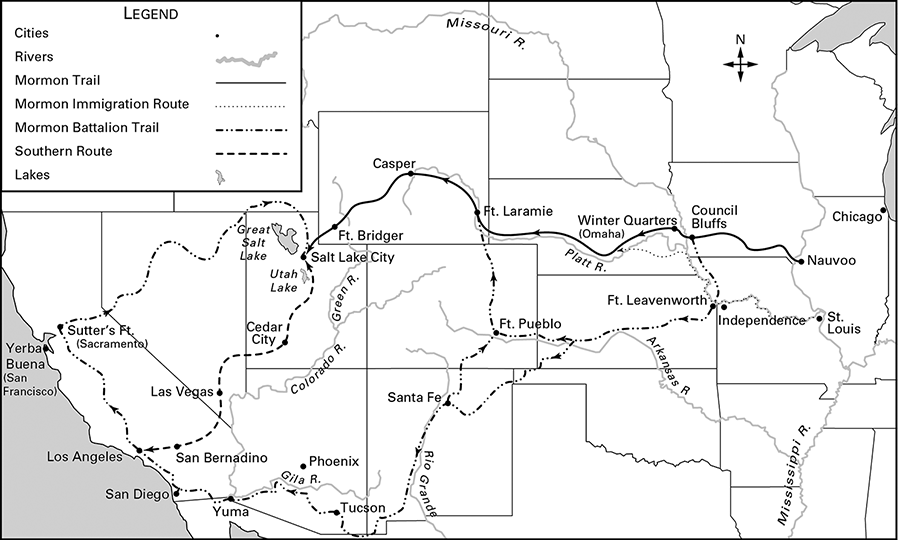
Driven from Nauvoo, Illinois, in February 1846 for their religious beliefs, the Latter-day Saints determined to leave the boundaries of the United States and seek refuge in the Great Basin extending from the Wasatch Mountains to the Sierra Nevada (see illus. 1-1). The first party reached the valley of the Great Salt Lake on 23 July 1847. Many Mormon pioneers, however, wearied by the 1,000 mile journey to the new city quickly rising there, found only a temporary haven. As early as 1848, the First Presidency of The Church of Jesus Christ of Latter-day Saints called men and women to begin establishing outposts north and south of the original colony. Unlike the haphazard settling of other Western communities—especially mining towns—each new Mormon community was carefully planned, following Joseph Smith’s instructions for Jackson County, Missouri, and Nauvoo. The settlements along the Mormon Corridor, which stretched north to Idaho and southwest to California, absorbed new Saints as they gathered to Zion and helped claim large tracts of land as bastions against the threat of continuing persecution.
To further the goal of economic independence, some settlements had more specific assignments. The Iron Mission to southern Utah was one of the first of these. Cedar City in Iron County not only became Utah’s southern gateway, but also took up the challenge of manufacturing iron in a wilderness. As iron historian James D. Norris has observed, “Unlike most frontier industries, the manufacture of iron required a large amount of capital, a highly skilled labor force, and some of the most advanced technology of the nineteenth century.”2 Although they were poor, the Mormons could draw on the resources of the entire community through tithing and special requisition to underwrite economic development. The Latter-day Saint missionary effort in Great Britain had already attracted experienced iron workers. Adapting production techniques mastered in England to conditions in the American West required flexibility, but the Mormon pioneers were used to making the most of what they had on hand.
Before the American Revolution, the colonies had been prohibited from importing equipment from Great Britain’s foundries to preserve their dependence on the mother country. Nevertheless, all but Georgia had managed to smelt bog iron. Using charcoal from America’s abundant forests, the next generation of ironmongers worked the rich vein of magnetite ore running from western Massachusetts to New Jersey. Foundries spread west to Pennsylvania, which became the heart of nineteenth-century America’s iron industry, and then south to Ohio, Kentucky and Tennessee. In 1825, Thomas James, an entrepreneur from Ohio, learned of red hematite deposits near an abundant water source, the Maramec Spring in southeast Missouri. There, the following year, he founded the first large-scale iron works west of the Mississippi.3 It was the “discovery” of iron deposits in southern Utah in 1849 which gave the Mormons the opportunity to attempt their own venture.
Discovering Iron along the Old Spanish Trail
In October 1776, an expedition led by Francisco Dominguez and Silvestre Vélez de Escalante, two Spanish Franciscans, left Santa Fe searching for an overland route to Monterey. They traveled as far north as Utah Lake, there encountering the Timpanogos Utes, but an early winter storm between present Milford and Cedar City forced them to abandon the attempt to reach California. Instead, they traveled south through the Cedar Valley area where Vélez de Escalante reported rocks containing almost 70 percent iron as well as large lode deposits close to the trail. The exploring party continued down Ash Creek before heading east along the Virgin River to the Colorado River, fording just north of the current Arizona border. They returned home in January 1777. Although the Spaniards lacked resources to found settlements along the Dominguez-Escalante trail, Spanish traders roamed north, trafficking in Native American women and children who were then sold as slaves in Mexico. Ute tribes participated in this commerce, raiding less warlike neighbors for human booty to be traded for horses and guns.4
In the same year Dominguez and Vélez de Escalante were charting southern Utah, Father Francisco Garcés traveled from southern Arizona across the Mojave Desert to Mission San Gabriel, near Los Angeles. Fifty years later, in 1826 and 1827, the explorations of trapper Jedediah Smith covered terrain which linked the Dominguez-Escalante and the Garcés trails together, thus creating a route all the way from Sante Fe to the California coast.5 Called the Old Spanish Trail, it was heavily used in the 1830s and 1840s by traders, trappers, couriers and adventurers, such as Kit Carson, George Brewerton, George Yount, Peter Skene Odgen, J. J. Warner and William Wolfskill.6 The southwestern leg of the trail became known as the California Road. From southern Utah, the road followed the Santa Clara and Virgin Rivers to Las Vegas and thence to the Cajon Pass, San Bernardino and Los Angeles.
Some Mormon pioneers became familiar with the California Road after serving as members of the Mormon Battalion. The Mormon Battalion was a cadre of volunteers who fought for the United States in the Mexican War in exchange for much-needed cash to help the main body of Mormon emigrants move west. After its long march across the southwest, the Mormon Battalion mustered out in southern California on 16 July 1847, only eight days before Brigham Young’s advance party entered the Salt Lake Valley. Jefferson Hunt, the battalion’s highest-ranking LDS officer, led a party of 240 men from the Los Angeles area to Sacramento, thinking the pioneers were planning to settle in California. There he learned that Samuel Brannan, having arrived on the ship Brooklyn with a large company of immigrants, was en route to the Salt Lake Valley. Hunt, with a few men, the battalion pay and some seed grain, followed Brannan to the Great Salt Lake, leaving most of the other volunteers behind. It was some of these former battalion members who, employed by wealthy Swiss emigrant-farmer John Sutter, discovered traces of gold in his tail race and precipitated the gold rush.7
Brigham Young had already returned to the pioneers’ Winter Quarters in Nebraska by the time Hunt reached the infant Salt Lake City in October 1847, but Hunt’s description of fertile California convinced those left in charge to send him back there for more seed grain and supplies. On first traveling to Utah, Hunt had taken a northern route eastward from Sacramento along the Humboldt River. Returning south, he led a group of 19 along the portion of the Old Spanish Trail called the California Road, departing 18 November 1847 (see illus. 1-1). None had been over the trail before. They planned a 30-day trip, but it took 45, forcing them to kill horses for food before arriving in present-day San Bernardino on Christmas Day.8
Illus. 1-1. Overland routes from St. Louis to southern California. From Cedar City, the southern route or California Road to Los Angeles generally followed the Old Spanish Trail.
After recovering, they made their return to Salt Lake Valley, leaving in mid-February with seed grain, 40 bulls and 200 cows. The bulls and half the cows died before the party arrived in May. A month behind Hunt was a second party of 25 former battalion members with a supply wagon and herd of 135 mules. This entourage, reaching Salt Lake City on 5 June 1848, proved the California Road a passable route for the wagon trains yet to follow.9
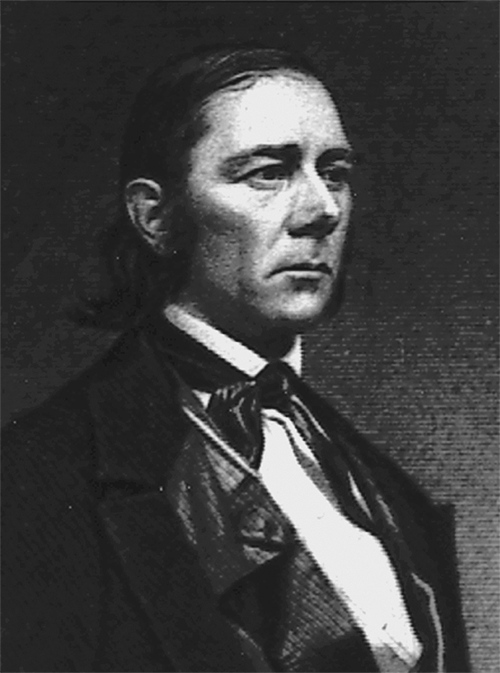
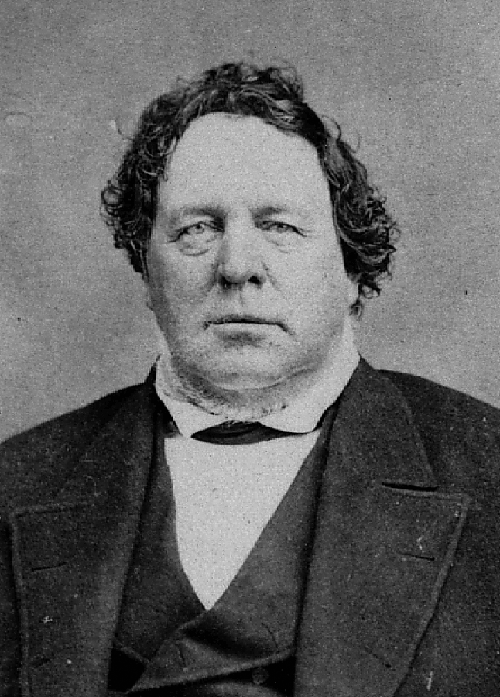
In October 1849, with the California gold rush in full spate, Jefferson Hunt’s familiarity with the southern route brought his services into great demand. With Brigham Young’s encouragement, Hunt accepted an offer of $1,000 to guide a company of 500 to California and then explore the area, looking for a suitable site for a Mormon outpost. Amasa M. Lyman, of the LDS Quorum of the Twelve Apostles, was already there on the same assignment. With Hunt was Apostle Charles C. Rich (see illus. 1-2), called to help Lyman, and three missionaries headed for the Society Islands. These were joined by a party of “gold missionaries” captained by J. M. Flake, a non-Mormon guide. The “gold missionaries” were sent as a special contingent by Brigham Young to enhance Zion’s economy without luring the majority of Mormons away from their settlement tasks. The expanded wagon train continued on to Beaver Creek, 200 miles south of Salt Lake City, where Captain O. K. Smith, with 20 to 30 prospectors calling themselves Jayhawkers, also joined the company.10
Illus. 1-2. Charles C. Rich (1809–83) of the Quorum of the Twelve Apostles was the first Mormon to note iron deposits in southern Utah. Courtesy LDS Church Archives.
Captain Smith flourished a map describing “Walker’s Cut-Off,” which would, he claimed, reduce the journey by some 500 miles. This won the confidence of a number of the travelers who headed off with Smith into the desert. Charles C. Rich and some of his missionaries followed Smith’s group to keep them from perishing.When the combined party became lost and disoriented from lack of water, however, Rich broke with Smith, leading all the missionaries and two of the Jayhawkers back to the Old Spanish Trail where they reunited with Hunt. Some of those who followed Captain Smith into the desert did not survive. In their memory, Walker’s Cut-off was given a new name: Death Valley. Hunt’s party safely arrived in San Bernardino on 27 December, having lost only one ox.11
It was on this harrowing journey that Charles C. Rich became the first Mormon known to take note of the iron deposits along the Old Spanish Trail. These were the natural resources soon to prompt the creation of the Iron Mission. Rich’s journal reads:
MONDAY 29th [October 1849] after traveling 8 miles came to a good spring at the point of a mountain in the south end of the Valley, 6 miles further came to Little Muddy [or “Coal Creek,” the future site of Cedar City] a good sized creek, plenty timber & grass 8 miles further where we came to some springs [Iron Springs]. [H]ere we found iron ore.12
Addison Pratt, bound for the Society Islands, also noted the metal’s abundance: “1st Novr [1849]. Went to Cedar Springs [Iron Springs] and camped. In the night had a snow storm, but it melted off by daylight. Near this spring is immense quantities of rich iron ore.”13
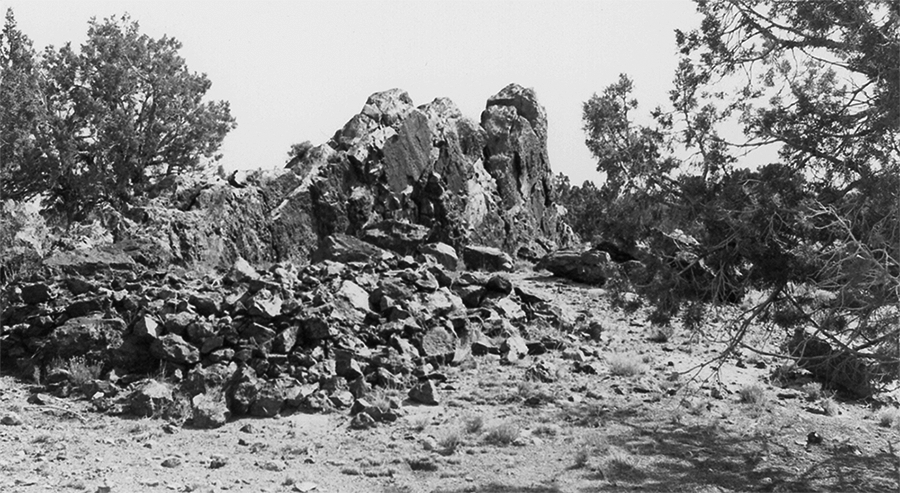
On 18 November, Howard Egan, another Mormon wagon master of considerable experience, left Salt Lake City to lead a small Mormon contingent to California’s goldfields over the southern route.14 His contribution was to meticulously number the stops, give distances between them and comment on water, feed and campgrounds.15 By 1851 a “Mormon Way-Bill” described campsites from Salt Lake Valley to Los Angeles, the distance to Parowan covering some 253 miles16 (full transcript in app. 1). In 1854, Thomas Bullock compiled a more direct route, slightly reducing the distance to 249 miles. Both routes passed conspicuous iron deposits lying just a few hundred yards from the trail (see illus. 1-3).17
Illus. 1-3. Iron ore outcropping near the old pioneer trail in the Iron Springs area. Photograph by Morris A. Shirts.
Parley P. Pratt’s Southern Exploring Expedition
The iron deposits were especially inviting because the Mormons needed them so badly. They wanted to stake out and control a large territory and develop a self-sufficient economy within its borders. Freight was $200 a ton from Missouri and the Utah settlements needed “stoves, pots, rolls for squeezing the juice out of sugar cane, castings for sawmills, as well as mold boards for plows.”18
The first purposeful Mormon exploration of the Coal Creek/Iron Springs area occurred during the winter of 1849–50. Acting by direction of Brigham Young and the provisional state legislature, Apostle Parley P. Pratt organized the Southern Exploring Expedition. On 24 November 1849, 47 seasoned men, traveling with 12 wagons, 24 yoke of oxen, 38 horses and mules, a brass cannon and food for about three months left Salt Lake Valley.19 Eight of these men (marked by an asterisk in the accompanying sidebar) would later be associated with the Iron Mission. Pratt listed the entire company in his autobiography, under his entry for 7 February 1850.
The travelers were taking chances with the weather, and they were not lucky. By the time they reached Fort Utah (Provo), there was a foot of snow on the ground. At Salt Creek (Nephi), they detoured to visit Isaac Morley’s 12-day-old settlement called Manti. At the time, Manti was the fifth Mormon colony, following Salt Lake City, Sessions Settlement (Bountiful), Provo and Tooele.20
Pratt’s party continued exploring possible townsites all along the route, mapping distances and surveying streams, farmland and water supplies. In the Sevier River Valley, the group traded with Wakara, known among settlers as Chief Walker.21 Wakara’s band was suffering from the measles and, at his request, Dan Jones and Indian interpreter Dimick Huntington prayed for the suffering Utes and “rebuke[d] their meazles, by laying hands on them in the name of Jesus.”22
Wakara’s people were a significant presence in the area. After avenging his father, killed by the Timpanogos Utes, Wakara had moved south to the Sanpete Valley, establishing his base there. During the winter months, Wakara customarily moved further south along the Sevier River to the Parowan basin, also home to the southern Paiutes. “Parowan” is a Paiute name meaning “bad, salty, or harmful water,” referring to a small lake in the valley which has since dried up.23
The Utes and the Paiutes, although speaking different dialects, shared a language system with the Shoshoni Indians in northern Utah and Idaho. While the Paiutes, often called “Piedes” by the Mormons, were peaceful seed-gatherers traveling in small family groups, the Utes had acquired horses from the Spaniards, giving them greater power to hunt and trade. Wakara was especially ambitious, raiding ranches as far away as California for horses and capturing Paiute women and children to sell as slaves in Spanish territory.24
Wakara’s first face-to-face encounter with the Mormons had been in September 1848 when he came with several hundred Utes, including the peacemaker Chief Sowiete, into Salt Lake City hoping to sell California horses and learn more about the settlers (see illus. 1-4). In June 1849, Wakara met with Brigham Young and other Mormon leaders in the Council House on the present site of Temple Square. Wakara was eager to establish a good relationship with the Mormon settlers, both to facilitate trade and to strengthen his position relative to the other Indian tribes. Aware of increasingly scarce natural resources in his homeland, Wakara also expressed an interest in having Mormons teach his people to raise their own food and livestock.25
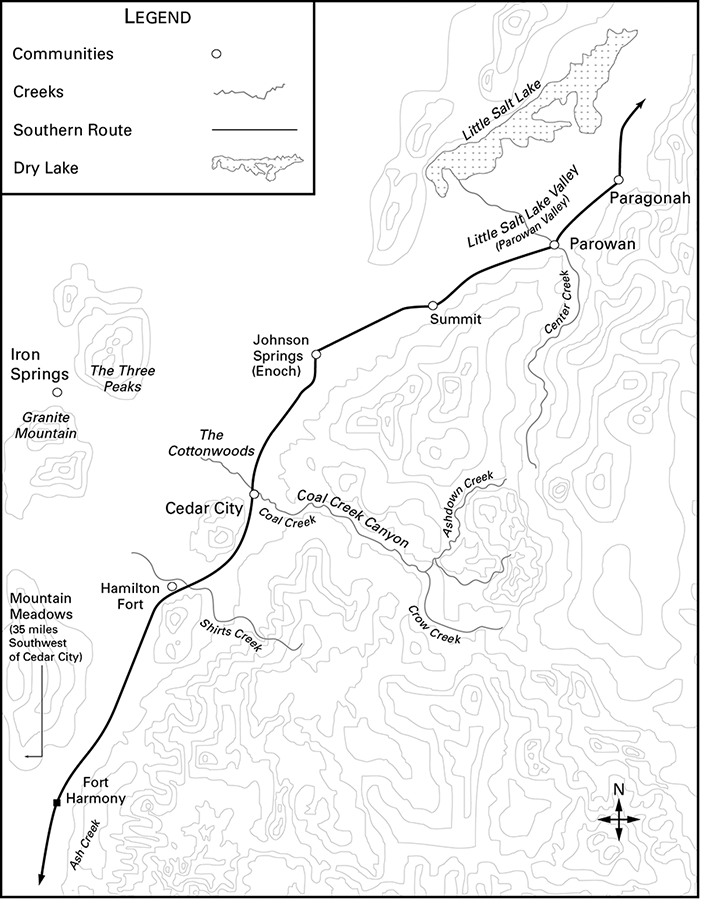
With these considerations in mind, Wakara invited Brigham Young to send colonists to settle in his lands and live among his people. It is uncertain whether his invitation was to the Sanpete Valley, to his winter camp in the Parowan basin or to both.26 When Parley P. Pratt and his company passed through the Sevier River Valley in December, Wakara was willing to show them lands to the southeast available for immediate settlement. Guided by Wakara’s brother Ammomah, the expedition made note of a particularly good site at “Merry vale” (later Marysvale) before continuing their journey. Then, struggling through drifted snow against knifing winds, they battled forward three or four miles a day across the mountains separating Sevier River Valley from the Parowan basin. Because the basin had ramparts of mountains to the east and a small salty lake like the Great Salt Lake, the pioneers named it Little Salt Lake Valley (see illus. 1-5).27
Illus. 1-5. Cedar City and Environs.
Isaac C. Haight noted their difficult approach to the valley. On 18 December 1849 he wrote, “The snow two feet deep and drifted in heaps . . . Stormed continually.” The next day, he reported that
with much labor and toil we got our wagons all together upon the summit of the mountain and came three miles and camped as usual without water. Our cattle almost exhausted for want of food and water. The cold was intense. Every man froze his feet more or less.28
In the comparative respite of Little Salt Lake Valley (present-day Parowan Valley), Pratt decided to let the exhausted oxen recuperate while an advance party went on, riding the mules and horses that were still fit. He and 20 men left the day after Christmas to go over the south rim of the Great Basin while the others established a base camp at the mouth of the canyon, where feed and fuel were more abundant. Continuing on a few miles, Pratt’s forward company traveled through the area where the city of Parowan is now located, judging it to be a favorable place for a settlement because of its rich soil and water. On 27 December the group camped 20 miles further southwest, on the banks of the Little Muddy (or Coal Creek), the future site of Cedar City. In the official report to the territorial legislature, Parley P. Pratt and camp clerk Robert Campbell enthusiastically observed:
But the best of all remains to be told, near the large body of good land on the Southwestern borders are thousands of acres of cedar contributing an almost inexhaustible supply of fuel which makes excellent coal. In the centre of these forests rises a hill of the richest Iron ore.29
Pratt and Campbell estimated that the combined resources of Little Salt Lake Valley and the land to the southwest could support 50,000 to 100,000 people.30
Although the group did not explore the “hill of iron,” the forward party collected ore samples (described as “first rate” and “beautiful”) over the next few days.31 They then continued on to the area just south of present-day St. George. Advised by Native Americans from a village on the Santa Clara that the country further south was not suitable for settlement, they returned to the main camp in Little Salt Lake Valley.
Arriving on 8 January 1850, the men raised a liberty pole and prepared a feast. According to Isaac Haight, they picnicked on a wagon cover on the ground, “enjoying roast beef, mince and pumpkin pie, apple pies, sauce, coffee, etc.”32 The next day, he wrote:
I shall leave this place with regret. It is one of the most lovely places in the Great Basin. On the East high towering mountains covered with evergreen forests and one of the most beautiful creeks running from them. On the west and south a large valley of the most beautiful lands. Little Salt Lake bordering the valley on the west and beyond a range of hills covered with verdure and backed with high towering mountains covered with eternal snows, all of which contributed to beautify the scenery and while the clouds hang heavily on the mountains and the storms and tempests are rearing [roaring] the valley enjoys a beautiful serenity.33
His nostalgia was not misplaced. The weather was ferocious all the way back to Salt Lake City (along a route comparable to modern I-15, west of the trail they had followed on the way down). Their animals, exhausted and tenderfooted from floundering through snow, almost starved for lack of forage. Finally, near present-day Fillmore, it became obvious the whole company could not reach home without help. They decided to leave the wagons with the younger men while the older men and those with families awaiting them would go on with the strongest horses.34
Pratt, along with 24 men and 26 horses, left on 22 January. On the south slope of the elevation later called Scipio Pass, drifts reached over 10 feet. The men broke trail for the horses, rotating to the rear as they became too tired to breast the drifts. Two horses gave out and had to be abandoned. Near the summit, the men shoveled down to make a fire pit and resting space, then wrapped themselves in blankets and tried to sleep. The next morning they took their hungry horses to the wind-swept hills where the animals could forage for dry grass.35
By the following evening, the party had crossed Round Valley (Scipio), fighting snow all the way into the pass about four miles south of the Sevier River, east of the present highway. That night it snowed again. Pratt’s journal reveals his delightful sense of whimsy under difficult circumstances:
In the morning we found ourselves so completely buried in snow that no one could distinguish the place where we lay. Some one rising, began shoveling the others out. This being found too tedious a business, I raised my voice like a trumpet, and commanded them to arise; when all at once there was a shaking among the snow piles, the graves were opened, and all came forth! We called this Resurrection Camp.36
On Sunday, 27 January, they again divided their forces for survival. Pratt, Chauncey West and Dimick Huntington took the strongest animals and struck out for Fort Utah (Provo) still some 50 miles away. Huntington, too weak to go on, had to turn back to camp. West and Pratt continued, taking turns breaking trail through knee-deep snow. They reached Summit Creek (Santaquin) at 11:00 p.m. and, extremely hungry, feet frozen, decided to stop for the night. They made a fire but still had “the coldest night we ever experienced, and after trying in vain to thaw out our frozen shoes, stockings and the bottoms of our drawers and pants, we rolled ourselves in our blankets, and lay trembling with cold a few hours.” Rising well before daylight, they “bit a few mouthfuls off the last black frozen biscuit remaining,” mounted their animals and, after traveling another weary day “living on a piece of biscuit not so large as our fist,” they reached Fort Utah at dusk. Quickly reporting their dilemma, they asked for a posse of men and fresh animals. This was fitted out and sent right away, to bring in the rest of Pratt’s men.37
Isaac C. Haight, 20 miles back on the trail, apparently had a thermometer, for he recorded that the temperature on the morning of 28 January was 30 degrees below zero. The rescue party found Stephen Taylor, who had left the main camp to follow Pratt, lying helpless in the snow about eight miles from Provo. He survived but had limited use of his limbs. The remainder of the party near the south end of the valley had weathered the night and the young men near Fillmore simply waited there until the worst weather passed, then came on to Salt Lake City in March.38
Called to the Iron Mission
Pratt’s report helped the leaders in Salt Lake City determine southern settlement plans. Little Salt Lake Valley, which had so impressed Isaac C. Haight, became a priority site. At the April 1850 general conference, tentative possibilities took on a definite shape and purpose. George A. Smith (see illus. 1-6) was appointed to head the colonizing of Little Salt Lake Valley and build an iron works there.39
Illus. 1-6. George A. Smith (1817–75) of the Quorum of the Twelve Apostles was called to lead the Iron Mission. Courtesy LDS Church Archives.
As a member of the Quorum of Twelve Apostles, Smith was part of the governing body of the LDS Church, second in authority only to the First Presidency (consisting of Brigham Young and his counselors). Not only were Apostles assigned to lead proselyting missions, they were also the vital force heading the colonization effort. By fall 1849, Ezra Taft Benson was directing the settlement of Tooele Valley on the Great Salt Lake’s south shore. In February 1851, Apostles Charles C. Rich and Amasa Lyman would found an outpost in San Bernardino, California. After his mission in Europe, Rich would establish a community in northern Utah near Bear Lake. Apostle Orson Hyde would head settlements in Green River, Wyoming; Carson Valley, Nevada; and Sanpete County, Utah, while Lorenzo Snow, on returning from Italy, would oversee Brigham City, Utah. Although alternating service abroad with service at home could disrupt leadership continuity, it nevertheless gave members of the Twelve a broad overview of the needs of the Kingdom.40
Although such seasoned leadership was important, success of the colonization program depended upon the rank and file. The first recruiting announcement for the Iron Mission appeared in the columns of the Deseret News on 27 July 1850:
Brethren of Great Salt Lake City, and vicinity, who are full of faith and good works; who have been blest with means; who want more means, and are willing to labor & toil to obtain those means, are informed by the Presidency of the Church, that a Colony is wanted at Little Salt Lake this fall; That fifty or more good, effective men with teams and waggons provisions and clothing for one year;
Seed grain in abundance, and tools in all their variety for a new colony, are wanted to start from this place immediately after the fall, (Friday, 4th of Sept.) Conference; to repair to the valley of the Little Salt Lake; without delay; there to sow, build and fence; erect a saw and grist mill; establish an iron foundry as speedily as possible; and do all other acts and things necessary for the preservation & safety of an infant settlement among indians;—for the furnishing of provisions and lumber the coming year for a large number of emigrants, with their own families, and castings of all kinds for all the mountain settlements the coming Spring.—Farmers, Blacksmiths, Carpenters, Joiners, Mill Wrights, Bloomers, Moulders, Smelters, &c. Stone Cutters, Brick Layers, Stone Masons, one Shoemaker, one Tailor, &c. &c., in variety of occupations, who have the means, and are willing to sacrifice the society of wives and children for one year; believing that he who forsakes wife and children for the Kingdom of Heaven’s sake shall receive an hundred fold, are requested to give their names, in writing, together with their occupation, residence, strength of team, wagons, grain, tools &c., for an outfit, without delay, and without further notice, to Br. Thomas Bullock, or leave the same at the Post Office, directed to WILLARD RICHARDS, Gen. Church Recorder.41
When volunteers were not forthcoming, the announcement was repeated in general conference on 6 October.42 Timing was critical. The new settlers could not afford the luxury of traveling in good weather. They first had to harvest their crops at home, then travel south over the winter so they would be ready to plow and plant their new fields when spring arrived.
George A. Smith took personal action, analyzing needed manpower and logistical skills and issuing calls to qualified men. At a 26 October 1850 meeting of the Seventies in the Bowery on Temple Square, he called 100 men by name to join the proposed 12-month mission to southern Utah. As Brigham Young explained:
We want to plant a colony there and we don’t want men to take families or little children. Those who are feeble or who suffer with lung complaints will be healthier here than there. We want to plant colonies from here to the Pacific Ocean.43
Brigham Young personally recruited John D. Lee a few days later, but Lee resisted. He had his house in Cottonwood Canyon “up to square,” a family to care for and winter was about to set in. He offered to pay $2,000 for someone to take his place. But Young refused this offer and Lee reluctantly joined the company.44 Nor was Lee’s hesitation to accept this call unique. At Fort Utah, Isaac Higbee later told George A. Smith, he had, at Brigham Young’s request, scoured the country for 10 volunteers to join the Iron County expedition and none would go.45 Those called by George A. Smith were listed in the Deseret News of 16 November, along with an elegant plea for more volunteers:
Brother Geo. A. Smith, the president of the mission to L. S. Lake calls for 50 volunteers, and it is right . . . that brethren who can, should respond to the call, and not press him, in the multitude of his cares, to run about the country to pick them up. Some of the brethren may have a delicacy in volunteering their services, and would say “I am ready to go if I have a call, but I don’t like to volunteer; if the president wants me he will lay his hand on me and I am ready to go.” Just right, brethren, exactly right; fifty of you not advertised in this paper, who can go (and you could all go if a mob were at your heels,) come forward and volunteer, for you not only have a call but the president’s hand is on you, and you are wanted. The mission is an important one, as thousands of the saints will be ready to testify when they have spent a few years in the mountains without a stove to cook by, or keep themselves warm; a kettle to boil soap in; or a mill to grind their wheat, because there were no castings or iron by which it might be constructed. No mob is wanting to fill such a glorious mission, warm hearts will stimulate the whole. Come brethren, volunteer, and get ready.46
Identifying every Iron Mission pioneer is complex. Besides the call list in the article just cited, another in the Deseret News, published 11 January 1851, records “Names of persons over 14 years of age, on 21st December, gone to Iron county.” The two versions are not identical; Apostle Ezra Taft Benson, for instance—who appears on the “call list” as company co-president with George A. Smith but nowhere on the “departure list”—was sent instead to Pottawattami County, Iowa, to organize the Saints who were still emigrating.47 Chapman Duncan, too ill to go, joined the company later, as did Peter M. Fife and Daniel Carn.48
Another tally is Andrew Jenson’s “arrival list” of 13 January 1851, which evidently drew from both the Deseret News articles.49 The longest list is in Utah’s contribution to the 1850 U.S. Census, begun in Iron County as early as 1 April 1851 but not formally enumerated until May. By then the original population had almost tripled, primarily because many wives and children left behind for the winter joined their menfolk that spring. The accuracy of this census, however, is problematic. Names were spelled phonetically, polygamous families ambiguously entered and children under 14 often omitted50 (see app. 2 for a comprehensive list of Iron Mission participants, collated from key primary and related secondary sources).
All four lists account in different ways for stragglers, late arrivals and dropouts. Despite instructions to the contrary, some 30 women—11 of them pregnant—and 10 or so children under 14 years of age also made the trip. Together the four lists create a relatively complete tally of Iron Mission members by occupation, as shown in sidebar 1-2.
While most of these occupations are self-explanatory, two categories are puzzling: “fishermen” (Peter Shirts and sons George, Darius and Don Carlos) and “yeoman” (George A. Smith and Almon Fulmer). Peter Shirts had been called with others by Joseph Smith to provide fish for the needy Saints of Nauvoo.51 Perhaps he humorously claimed it as his occupation in 1848 or wanted to indicate his pride in it. Why the two “yeomen” were distinguished from the farmers is unclear.
With Parley P. Pratt’s Southern Exploring Expedition having prepared the way, George A. Smith’s “volunteers” were ready to move south, bent on establishing an iron works that would supply all the territory’s needs, from wagon wheels to andirons. The iron missionaries would be traveling over a fairly well-marked but snow-covered road where the hardships of winter travel would test their courage. Despite the initial reluctance with which many received their callings, they would, once committed, give the cause of the Iron Mission their best efforts.
As Jan Shipps noted in Mormonism: The Story of a New Religious Tradition, Latter-day Saints of the nineteenth century expressed their religious devotion differently from their modern counterparts. Attendance at formal Sunday meetings was irregular and copies of the Bible and Book of Mormon were scarce on the frontier. Obeying the Word of Wisdom, including abstinence from alcohol, tobacco, coffee and tea, was not yet considered essential to full fellowship. For the pioneer Mormon, sanctity meant sacrificing whatever was necessary to build up the Kingdom of God on earth.52 Raising fences, irrigating fields, digging coal, and quarrying rock were tangible demonstrations of true spirituality. If called by their prophet to leave home and family in the middle of winter and found a new settlement, the pioneers were ready to do so. In the process, they found themselves transformed from ordinary farmers, blacksmiths, carpenters, millwrights, teamsters and forgemen into citizen-saints of Zion.
Sidebar 1-1: The Southern Exploring Expedition of 1849–50
Parley P. Pratt, president
W. W. Phelps and D. Fulmer, counselors (Phelps also listed as topographical engineer)
Robert L. Campbell, clerk
First Ten
*Captain Isaac C. Haight, Parley P. Pratt, William Wadsworth, *Rufus Allen, Chauncey West, Dan. Jones, Hial K. Gay, George B. Mabson, *Samuel Gould, *Wm. P. Vance.
Second Ten
Captain Joseph Matthews, John Brown (also “captain of sixty”), Nathan Tanner, Sterling G. Driggs, *Homer Duncan, Wm. Matthews, Schuyler Jennings, John H. Bankhead, John D. Holiday, Robert M. Smith.
Third Ten
*Captain Joseph Horn, Wm. Brown, George Nebiker, Benjamin F. Stewart, Alexander Wright, *James Farrer, Henry Heath, Seth B. Tanner, Alexander Lemon, David Fulmer.
Fourth Ten
Captain Ephraim Green, Wm. W. Phelps, *Charles Hopkins, Sidney Willis, Andrew Blodgett, Wm. Henry, Peter Dustin, Thomas Ricks, Robert Campbell, Isaac H. Brown.
Fifth Ten
Captain Josiah Arnold, Jonathan Packer, Christopher Williams, Stephen Taylor, Isaac B. Hatch, John C. Armstrong and Dimick B. Huntington.
Source: Pratt, Autobiography, 365–66. The spellings are Pratt’s.
Sidebar 1-2: Occupations of the Iron Mission Colonizers
Iron and Stone Workers
Blacksmiths
5
Brick Masons
4
Stone Cutters
2
Forgeman
1
Miner
1
Collier
1
Iron Maker
1
Machinist/Engineer
1
16
General Service
Tailors
2
Storekeepers
2
Merchants
2
Butcher
1
Shoemaker
1
Coal merchant
1
“Woolenman”
1
Tinsmith
1
11
Woodworkers
Joiner
1
Ship’s Joiner
1
Chairmaker
1
Coopers
2
Wheelwright
1
Millwright
1
7
Farmers
32
Professional
Physicians
2
School Teachers
2
Surveyor
1
Engineer
1
6
Other
Yeomen
2
Sailor
1
Interpreter
1
Currier
1
Fishermen
4
9
Source: List of occupations compiled from the May 1851 U.S. Census (see n. 46).
Notes
1. Rick J. Fish, “The Southern Utah Expedition of Parley P. Pratt, 1849–1850” (master’s thesis, Brigham Young University, 1992), 5–17, 87–88; Ted J. Warner, “The Spanish Epoch,” in Richard D. Poll, Thomas G. Alexander, Eugene E. Campbell and David E. Miller, eds., Utah’s History (Logan: Utah State University Press, 1989), 35–49; William B. Smart and Donna T. Smart, Over the Rim: The Parley P. Pratt Exploring Expedition to Southern Utah, 1849–50 (Logan: Utah State University Press, 1999), 3–7.
2. James D. Norris, Frontier Iron: The Maramec Iron Works, 1826–1876 (Madison, Wis.: State Historical Society of Wisconsin, 1964), v.
3. Norris, ibid., v, 4, 11–12; Peter Temin, Iron and Steel in Nineteenth-Century America: An Economic Inquiry (Boston, Mass.: MIT Press, 1964), 20; Samuel Eliot Morison, Henry Steele Commager and William Leuchtenberg, The Growth of the American Republic, 7th ed., 2 vols. (New York: Oxford University Press, 1980), 1:101; Harold Underwood Faulkner, American Economic History, 6th ed. (New York: Harper and Brothers, 1949), 262.
4. Warner, “Spanish Epoch,” 35–49; Fish, “Southern Utah Expedition,” 87–88; Nels Anderson, Desert Saints: The Mormon Frontier in Utah, 2nd ed. (Chicago: University of Chicago Press, 1966), 124–25.
5. LeRoy R. Hafen and Ann W. Hafen, eds., Old Spanish Trail: Santa Fe to Los Angeles, vol. 1 of Far West and the Rockies (Glendale, Calif.:Arthur H. Clark, 1954), 109–119, 129.
6. Smart and Smart, Over the Rim, 3–7; Morris A. Shirts, “The Old Spanish Trail in Utah,” 1–2, 17 Feb 1990; Morris A. Shirts, “The Old Spanish Trail and the California Road through Mountain Meadows,” 1–9, Jan, Feb 1990: unpublished papers in Morris A. Shirts Collection, L. Tom Perry Special Collections, Harold B. Lee Library, Brigham Young University (hereafter cited as Perry Special Collections), Provo, Utah.
8. Milton R. Hunter, Utah: The Story of Her People (Salt Lake City: Deseret News Press, 1946), 102–3; B. H. Roberts, A Comprehensive History of The Church of Jesus Christ of Latter-day Saints, Century One, 6 vols. (Salt Lake City: Deseret News Press, 1930), 3:337.
9. LeRoy R. Hafen and Ann W. Hafen, eds., Journals of Forty-Niners—Salt Lake to Los Angeles, 1820–1875, vol. 2 of Far West and the Rockies, (Glendale, Calif.: Arthur H. Clark, 1954), 26; Smart and Smart, Over the Rim, 9.
10. Leonard J. Arrington, Charles C. Rich: Mormon General and Western Frontiersman (Provo, Utah: Brigham Young University Press, 1974), 138–41; see also Hafen and Hafen, ibid., 2:307–19.
11. James S. Brown, “Life of a Pioneer,” in Hafen and Hafen, ibid., 2:118–123; Arrington, ibid., 141–48.
12. “Charles C. Rich Diary,” in Hafen and Hafen, ibid., 2:184. Coal Creek was first named the Little Muddy, in honor of the Muddy River in Nevada. It was also known as the “Cottonwood” during the early months of settlement. “Coal Creek” was the established name by May 1851. For geographical references, see ch. 1, illus. 1-5, “Cedar City and Environs,” and ch. 2, sidebar 2-2, “Place Names along the Mormon Corridor.”
13. S. George Ellsworth, The Journals of Addison Pratt (Salt Lake City: University of Utah Press, 1990), 385.
14. J. Kenneth Davies, Mormon Gold (Salt Lake City: Olympus Publishing, 1984), 201–7.
16. Joseph Cain and A. C. Brower, Mormon Way-Bill (Salt Lake City: W. Richards, 1851), reprinted in Hafen and Hafen, ibid., 2:321–24.
17. Thomas Bullock, “Table of Distances from Salt Lake City to Harmony” in Journal History of the Church, 19 May 1854, Archives Division, Historical Department, The Church of Jesus Christ of Latter-day Saints, Salt Lake City (hereafter cited as LDS Church Archives), microfilm copy in Perry Special Collections.
23. Ronald Walker and Dean Jessee, “First Contacts in Utah,” draft chapter in Brigham Young’s Indian Correspondence (publication forthcoming); John W. Van Cott, Utah Place Names (Salt Lake City: University of Utah Press, 1990), 288.
24. Walker and Jessee, ibid., “First Contacts in Utah” and “Settling Parowan”; Eugene E. Campbell, Establishing Zion: The Mormon Church in the American West, 1847–1869 (Salt Lake City: Signature Books, 1988), 95–98.
25. Walker and Jessee, “First Contacts in Utah”; Campbell, ibid., 98.
28. Isaac C. Haight, journal (part 1: 7 Jun 1842–Aug 1852; part 2: 9 Aug 1852–Jan 1862), typescript, 18 Dec 1849 Special Collections, Gerald R. Sherratt Library, Southern Utah University, Cedar City, Utah (hereafter cited as SUU Archives); original in possession of Herbert Haight, Cedar City, Utah.
38. Ibid., 369–370; Haight, journal, 28 Jan 1850. The remainder of Haight’s terse comment reads: “We almost perished with cold. Came 12 miles; camped on Summit Creek. Had a little flour stirred in boiling water” (punctuation added).
39. Zora Smith Jarvis, Ancestry, Biography, and Family of George A. Smith (Provo: Brigham Young University Press, 1962), 146–47.
44. Juanita Brooks, John Doyle Lee: Zealot, Pioneer Builder, Scapegoat (Glendale, Calif.: Arthur H. Clark, 1962), 154.
45. “Journal of George A. Smith, President of the Iron County Mission” (hereafter cited as Smith, journal), vol. 1 (7 Dec 1850–7 Apr 1851) and vol. 2 (8 Apr 1851–ca. 18 Nov 1851), LDS Church Archives. See 16 Dec 1850. As handwriting samples from Smith’s personal letters show, the two volumes of this journal are not penned by him. The handwriting of Henry Lunt, who was Smith’s officially appointed “private clerk” for the journey south, and who kept his own record of it, is similar to the hand in Smith’s journals. Comparing these to Lunt’s own diary strengthens the inference that he was the scribe, especially given the duplication of phrasing between the two records. Presumably, Smith not only dictated passages to Lunt as opportunity arose, but had Lunt write up entries in Lunt’s own words. That Henry was generally the penman is confirmed by Smith in the entry for Monday, 17 Feb 1851, which closes with the comment “Bro. Henry Lunt wrote up my journal about 10 o’clock this evening.” Note that typed transcripts of these journals exist, headed “Journal of George Albert Smith (1817–1875); Principal Residence during This Period (1850–51) Parowan, Utah.” The initial typescript was originally in possession of Mrs. Luella A. Dalton, Parowan, Utah. BYU Library copied this in 1956, creating a second typescript now in Perry Special Collections. (A carbon copy of the 1956 typescript is in the Rock Church, Parowan, Utah.) The Dalton transcription, incorporating both volumes into one typescript, does not consistently preserve the language forms and punctuation of the originals and in places even creates content errors. It should not be used as a primary source.
46. “Volunteers,” Deseret News, 16 Nov 1850, 154–55.
47. Andrew Jenson, Latter-day Saint Biographical Encyclopedia: A Compilation of Biographical Sketches of Prominent Men and Women in The Church of Jesus Christ of Latter-day Saints, 4 vols. (Salt Lake City: Andrew Jenson History, 1901–36), 1:101.
48. “Biography of Chapman Duncan: 1812–1900,” pp. 11A–12, under heading “Great Salt Lake this year 1850,” in 1952 bound typescript, item 2, vol. 15, “Mormon Diaries,” Perry Special Collections (subtitled “Parowan City, June 22nd, 1852,” 2–3; copy in Shirts Collection).
49. Andrew Jenson, “Parowan Ward History, 1849–1900,” 4–6, citing bound typescript, Perry Special Collections (“BYU copy”), made from MS loaned by Mrs. Luella A. Dalton. A note inside front cover of BYU copy describes the original: double-spaced, 134 sheets, single-sided, 14 by 8½ inches, inch-wide left margin punched to hold four binding screws; covers of medium-weight binder board in gray buckram with hinge bored to fit margin holes, but only two screws used (ca. 7 mm., too long to hold the document firmly). A BYU copy was made, table of contents and name index also compiled, the whole hardbound. Another copy of “Parowan Ward History” is on microfilm, SUU Archives. Jenson’s authorship of this document is attributed by William R. Palmer, which is logical since it is typed in the same pica font as that on Jenson’s Royal typewriter, which he used for many years. All cites in this book are from BYU copy.
50. George O. Zabriskie and Dorothy Louise Robinson, “U.S. Census for Utah, 1851,” Utah Genealogical Magazine 29 (Apr 1938): 65–72; (Jul 1938): 130–42. Copy in Family History Library, The Church of Jesus Christ of Latter-day Saints, Salt Lake City. Note that Utah’s census enumerations were not taken until 1851 but were later collated with the national census of 1850. A second transcript, made by William Bowen, collates entire territory census alphabetically (also in Family History Library, but not checked against microfilm of original by authors).
51. Journal History, 15 Jul 1844. Peter Shirts is the great-great-grandfather of author Morris Shirts.
52. Jan Shipps, Mormonism: The Story of a New Religious Tradition (Urbana: University of Illinois Press, 1984), 109–11, 124–25.