Despite the iron missionaries’ concerns about the adequacy of their efforts, the reception at general conference of the first small bar of pig iron was entirely positive. The Eighth General Epistle of the First Presidency, dated 13 October 1852, singled out the achievement for special mention:
A specimen of pig iron, from the furnace in Iron county, was presented at the October Conference, as good as could be expected for the first; and from this time the founders will be relieved from farming to sustain themselves; and have other assistance which they need to prosecute their business; and soon we expect a good supply of iron ware, of home manufacture.1
The First Presidency went on to report the discovery of coal at several sites, predicting that charcoal pits to make use of the new resources would be operating soon.
During this conference, George A. Smith gave the first of two “iron sermons” recorded in the Millennial Star, noting that “We are almost a world by ourselves, we are a thousand miles from any other place . . . and whatever is brought here, is imported at a vast expense.” He claimed that the local ore deposits could supply the needs of the entire territory, echoing the hope that trained iron workers would be relieved from farming in order to lay the foundation of economic independence. “Iron is the sinew of power,” Smith insisted. “Of it your guns and your wagons are made; all the utensils in husbandry are made of iron.” If the community would support the iron works, he predicted, eventually fences of iron would be cheaper than fences of wood.2
Erastus Snow’s brother Zerubbabel, a territorial judge, seconded George A. Smith’s remarks, saying that Smith had aptly named it “a Gospel sermon for the salvation of this people”—no civilized nation could ignore the manufacture of iron.3 Other conference talks reiterated this concern over “home industry” and the need to become self-sufficient. The Eighth General Epistle, for instance, estimated “over 30,000 inhabitants in the Territory,”4 and Heber C. Kimball, in his remarks, focused on the vital concern of feeding this increased population.5
While the small pig iron sample lying on the pulpit was tangible evidence of successful iron production, a stable iron industry would require more manpower. Enough workers seemed to be available. The problem was persuading them to migrate. Orson Hyde addressed himself to this challenge, claiming that Salt Lake Valley was already filled with farms and that wood, water and grass were scarce there. Hyde encouraged his listeners to go south where there was
plenty of room for the exercise of your energies. In Iron county they are beginning to make iron, and those who live there on the manufacture of the first stove or porridge pot, their names will be had in remembrance. . . . Then don’t stay here, but go to the land of clover and grapes . . . where you can get coal for the digging of it.6
Heber C. Kimball tried another approach. Many settlers wanted to remain in Salt Lake City to have access to the sealings and blessings of the Endowment House, both for themselves and for their families. Kimball gave such notions short shrift:
I will tell you, that stay here for this purpose, you will not get your blessings as soon as those will who go and settle where they are counselled. For none of you can have these blessings until you prove yourselves worthy, by cultivating the earth, and then rendering to the Lord the first fruits thereof, the first fruits of your cattle, of your sheep, and of all your increase. This is how I understand it. Now go and get farms for yourselves while you can.7
An editorial in the 6 November 1852 Deseret News emphasized the economic imbalance between Mormon society and the outside world, because the Saints were still forced to buy from “the gentiles” much of what they needed to live on. “We do not blame the traders for coming here,” the editorial continued, “nor for selling their goods as high as they can,” but the Saints were placing themselves at an economic disadvantage because of their extreme need. It was clear they risked losing their independence unless they could become self-sustaining within a very short time.8
Plans in Europe: Creating the Deseret Iron Company
Previous chapters have already touched on the organization that came to be known as the Deseret Iron Company. Its history was tangential there, but now becomes central to the Iron Mission story. Ironically, the farmers and iron workers living in the southern settlements remained essentially unaware, as they anxiously waited to hear how their sample of iron was received at October conference, that a new entity was about to become part of their lives.
The origins of the Deseret Iron Company can be traced to Brigham Young, who knew from the first reports of ore deposits in the south that an infant iron industry would not be able to grow on missionary zeal alone. His goal was always to have a corporate structure ready to be put in place once the intended iron works became stable enough to benefit from a broader financial basis. To that end, he officially announced through the Sixth General Epistle of the Presidency, dated 22 September 1851, a program of capitalization and labor, seeking investors among the European Saints to develop a profit-making iron industry in southern Utah:
The Valley is well-supplied with a general assortment of merchandize at the present time; but the exportation of cash having been far greater than the importation the past year, it is to be feared that many articles will remain unsold. . . . If a company of brethren could be formed in England, Wales, Sweden, or any other country, to come and make Iron from ore (magnetic ore of the best quality) and machinery for rolling, slitting, and cutting nails, and drawing off wire, it would be one of the greatest auxiliaries for advancement in building up the vallies of the mountains; and the presiding elders in those countries are instructed to examine this subject, and forward such a company with the least possible delay.9
The Epistle would have reached the iron missionaries in Parowan some weeks after the fact through either the Deseret News or the Millennial Star, arriving with regular mail deliveries or passed along to the settlers by occasional visitors. The concept of an investment program, however, developing outside southern Utah and merely awaiting the right time to be imported there and implemented, seems to have been unknown to the iron missionaries almost up until the time it became operational late in 1852.
Tangible outlines of such a program were becoming visible early that spring. Across the Atlantic, Apostle Franklin D. Richards was presiding over the British Conference, while Apostles John Taylor and Lorenzo D. Young (Brigham’s brother) were presiding in Europe. Their fellow Apostle Erastus Snow was mission president in Denmark from 14 June 1850 to 4 March 1852.10 On his way home, he stopped in England. There, he and Richards began discussing the formal organization of a company to develop and support large-scale iron manufacturing in Utah. Brigham Young’s correspondence to both men contains no authorization to proceed. However, providence had placed them in the British Isles, one of the greatest steel-producing regions in the world. On 31 March 1852, Erastus Snow wrote his family from Dublin, Ireland:
We expect to meet in Conference in London April 6th. Bro. Franklin [D. Richards] and myself for scouring the churches with a view of searching out and combining the energies of the Saints with means to establish works for the manufacture of Iron and Nails, Wire &c. in Utah.11
According to the minutes of that conference, held 6–9 April 1852 in London, Snow gave an eloquent discourse on the need for an iron industry in Deseret:
I was much pleased with the success which attended Elder Taylor’s labours in the organizing of companies to manufacture sugar and cloth, and my prayer is that they may prove successful. . . . But when I compare these with the manufacture of iron, I feel that iron is of greater importance. And every year that this matter is delayed, it is thousands of pounds out of our pockets. . . . The Presidency have it in their mind . . . to establish a furnace, and form a company to bring the ore from the mountains. And the next thing is (to my mind) to have a ROLLING MILL. . . . Nails and wire, and a great many other things, cannot be made until we have a rolling mill; and the rolling out of sheet iron for many purposes; and the small bars for drawing out wire, and many other uses. Have these things, and the stoves and railroad irons, and nail factories, and machinery of various descriptions, and all the rest of those things necessary for the permanent establishment of iron works; and our people will save thousands of pounds.12
The conference subsequently resolved: “That a company of monied and faithful men be organized and sent from this land, next season, to the Valley, for the purpose of building furnaces, erecting the machinery, &c., necessary for the smelting and manufacturing of iron.”13 Erastus Snow describes traveling throughout the British Isles for the next few weeks seeking financial support:
We commenced our operations at the Special General Conference of April 6th, 1852, in London. We here obtained of the Presiding Elders the addresses of our wealthier brethren in different parts of the empire, and spent most of that month in visiting them, and various iron works in England, Wales, Ireland, and Scotland, obtaining all general information on the subject of making iron from magnetic and other ores, but especially labouring with our brethren who had means, the Lord labouring with us by His Spirit, to show them the importance of the work we had undertaken. We found a general readiness on their part to receive our counsel, and employ their funds as we thought best for the making of iron in these valleys.14
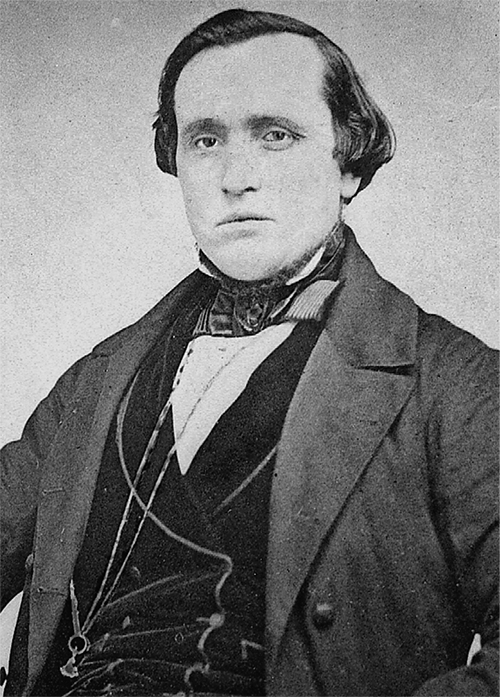
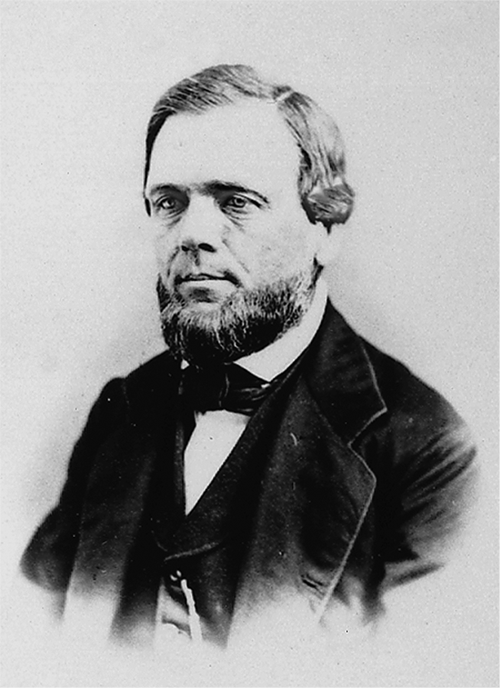
Undoubtedly, Snow (see illus. 10-1) and Richards (see illus. 10-2), pleased by the willingness of the British Saints to contribute, felt encouraged to proceed with the formation of a company. On 28–29 April 1852, nine men met in Liverpool to organize the Deseret Iron Company: Erastus Snow (chair), Franklin D. Richards (secretary), Samuel W. Richards (brother of Franklin D.), Levi Richards (brother of Dr. Willard Richards), Joseph W. Young (nephew of Brigham Young, called to serve a mission in England at the same time as Franklin D. Richards), Vincent Shurtleff (a missionary from Massachusetts, about to return home), John Weston (overseer of an iron works) and Thomas Jones and Thomas Tennant (representatives of the wealthy English Saints who intended to donate money).
Illus. 10-1. Erastus Snow (1818–88), member of the Quorum of the Twelve Apostles. While on a mission in Europe, Snow recruited British Saints with iron-making experience to emigrate to Utah and join the Iron Mission. Courtesy LDS Church Archives.
Illus 10-2. Franklin D. Richards (1821–99), member of the Quorum of the Twelve Apostles. He served as president of the British Mission, where he recruited wealthy British Saints to invest in the Deseret Iron Company. Courtesy LDS Church Archives.
The minutes of the organizational meeting, kept by Franklin D. Richards, explain that the men intended to address the vital interests of the Latter-day Saints from both a business and a spiritual perspective. Richards quoted from the Sixth General Epistle of the First Presidency that had called for a “company of brethren” to finance the iron works established in the southern settlements and invited his fellow mission leaders and associates in Europe to organize this company as soon as possible. Richards then asked how much stock individuals were willing to buy and received three responses: Thomas Tennant pledged £2,000 (equivalent to $9,680 in U.S. currency of the time) by 1 January 1853, Thomas Jones pledged £500 by the same date and Christopher Arthur sent a letter promising the same amount by the first of the year.15 Thomas Tennant, who was investing one-fifth of his personal assets in the company, was designated treasurer.
Plans Take Shape: Incorporating the Deseret Iron Company
Erastus Snow, Franklin D. Richards and Levi Richards were appointed to draw up the deed of agreement for the new company. These Articles of Incorporation designated the original shareholders as a board of directors with each member entitled to one vote for each share owned. A president, secretary and treasurer were to be chosen from the board. No one could withdraw stock without consent of three-quarters of the members and interest was charged on unpaid stock. The first annual meeting was scheduled for the third Monday in September 1853 in Utah Territory, although it was not held until November of that year.16
On Friday morning, 29 April, all nine members of the original group met to consider the articles that had been drafted (see app. 7). That afternoon they voted unanimously to admit only baptized members into the company until it was successfully established in Utah. The articles, serving as a constitution for the Deseret Iron Company, were unanimously adopted and signed by five members who subscribed for eight shares: Thomas Tennant received four shares for his pledge of £2,000 and Thomas Jones and John Weston received one share apiece for their individual pledges of £500. Franklin D. Richards and Erastus Snow received one share each as payment for their services in organizing and directing the company.17
The original draft included 17 articles. A week after it was adopted, Snow and Richards wrote a letter to the board of directors suggesting an additional article that would underscore the spiritual nature of the whole venture:
Article 18th. Forasmuch as we invoke the blessings of our Heavenly father upon our capital & business, therefore resolved that each member of the Deseret Iron Company shall hallow his stock vested in the company unto the Lord by paying tithes thereon and that the company regularly tithe there increase ever after.18
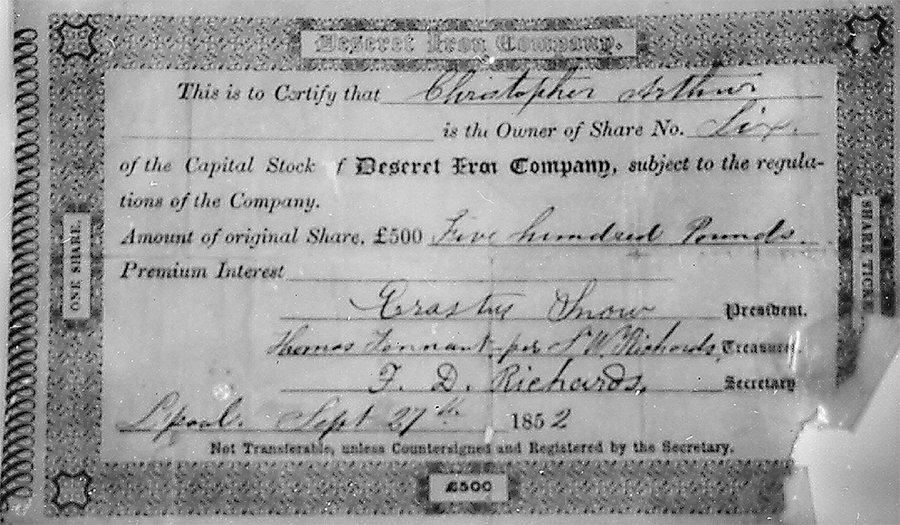
Shareholder investments listed at the end of the articles show that the company incorporated with £4,000 sterling. This sum, however, appears to include the credit of £1,000, in the form of one share each, to Snow and Richards. The next to officially join the enterprise were Elias Jones and John Jones (investing £500 each) and Christopher Arthur, who made good by letter his previous offer of £500.19 Arthur’s stock certificate has been preserved (see illus. 10-3). Apparently Elias Jones, John Jones and Christopher Arthur were considered original shareholders, because their names were added to the Articles of Incorporation as they appear in the Deseret Iron Company minutes.20 John Weston’s name, although listed on the first copy of the articles, does not appear in this later version. The shareholders in general later voted to admit John Weston as a member of the company, even though he was unprepared to pay the full amount of his pledge by 1 January 1853.21
Illus. 10-3. Deseret Iron Company stock certificate issued to Christopher Arthur in Liverpool, England, on 27 Sep 1852. This is the only certificate of its kind known to have survived. Palmer Collection, SUU Archives. Photograph by Randall B. Shirts.
Taking these adjustments into consideration, the total pledged investments of the “wealthier brethren” seem to have been 11 shares (eight as indicated in the Articles plus the three purchased by Jones, Jones and Arthur), capitalizing the company at £5,500 ($26,620) due on 1 January 1853. Subtracting £1,000 for the two shares credited to Snow and Richards leaves £4,500 ($21,780) as a more practical figure for the company’s initial assets. Even this was an impressive sum for those times.
At least two of the original stockholders, Christopher Arthur and Thomas Tennant, emigrated to the United States. Arthur settled in Cedar City where he served as head clerk of the Deseret Iron Company. His son and namesake eventually became mayor of Cedar City. Tennant was not so fortunate. He came with his wife and a minor son but died near St. Louis on 4 October 1856. His estate was placed in the hands of Daniel Spencer, whom the Tennants had known while Spencer was on a mission in England. Upon probate, Tennant’s bills were paid, including his pledge for a Deseret Iron Company share.22
Others also wanted to emigrate but could not liquidate their assets. Charles Jordan of Liverpool was invited to come to Cedar City and design machinery for the iron works but was forced to remain in England when Tennant was unable to borrow money for Jordan’s passage. Jordan promised to send drawings that anyone could work from and suggested two millwrights, James Jones (formerly of Abordave in Glamorganshire) and Samuel Leigh (a native of Glamorganshire), who could, at least, make the wheel pit if not build the furnace. His letters indicate the detail with which men on the other side of the Atlantic were envisioning the project in Cedar City. An undated letter from Jordan, written from 15 Wilton St., Liverpool, concluded:
I should like to know what head of water you can get as that would determine the Diam—of the wheel, if practicable, I wd advise a 15 foot wheel 5 feet wide but if a less diam—! it must be wider in proportion, that will work two Cylinders 3 feet diam and to work 5 feet stroke which wd be sufficient size to Blow one furnace and a remelting cupola[. T]his machine I have calculated to blow a high pillar of blast which would be required if you use anthracite coal[;] if bituminous coal it will be equally as suitable[. S]hould you commence with the furnace at once you should select a place convenient to the mine & coal & also a convenient place for tipping the cinders from the furnace as there will be a great quantity of it.23
On 27 April 1852 he wrote again, with the good news that
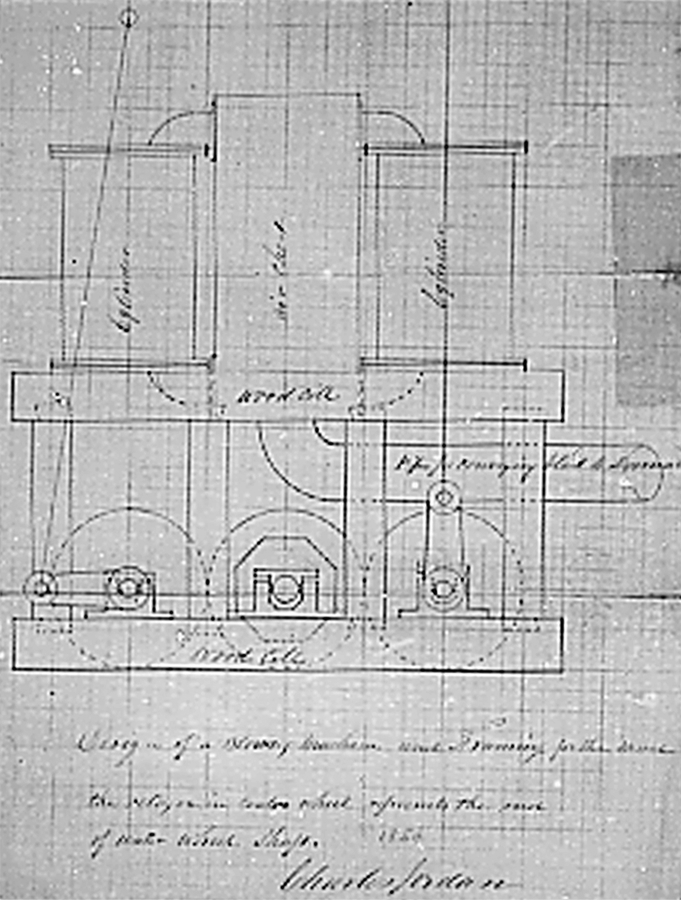
According to promise I forward you the Diagram of a Blowing Machine. Having been from home since you were here am sorry I have not had time to draw it to a working scale, but it will be sufficient to show you what is necessary to blow one Furnace & a remelting Cupola.—the air chest I would propose to be made of wrought Iron on account of its being considerably light[er] than cast Iron.24
His diagram was attached to the letter. Drawn very neatly on light orange graph paper, it seems to be the work of an accomplished draftsman (see illus. 10-4).
Illus. 10-4. Draftsman Charles Jordan’s 1852 design for a blowing machine and frame intended for the Deseret Iron Company. Photograph by Randall B. Shirts.
Having organized an English company to invest in iron production in America, Snow and Richards now needed to take the Articles of Incorporation to Brigham Young for approval. Before they could depart, however, they had to appoint a purchasing agent for the new company who could take care of business in England and in America. They selected Vincent Shurtleff, the Massachusetts man who, with his wife, had initially gone west with the Daniel Spencer Company in 1847. Called on a mission to England in 1851, he was, by the spring of 1852, about to return home.25 On 1 May, two days after Snow and Richards organized the company in Liverpool, they appointed Shurtleff and gave him a letter of authorization to purchase equipment and to collect payments on shares:
Elder Vincent Shirtliff is hereby appointed our agent in behalf of the “Deseret Iron Company” to act under our instructions in Great Brittain or elsewhere in procuring such machinery or other articles or he may find expedient to order, or employ such workmen for the use of the company . . . and the emigration of its operatives who may be wanted, to Utah Teritory. In selecting men or machinery he will avail himself of experienced counsellors and particularly Elder John Western of Dudly Port.
He will also visit soon as convenient Brother B. T. Clark[,] Histon Road near Cambridge[,] as well as Brothers Thomas, Jones, Arthur and others, to acquaint them with the proceedings of the company, obtain their signature to articles of Compact of Constitution, and receive their first installment on shares and deliver share tickets to those who can pay them in full.
He will immediately deposite all funds which he may receive with the Companys treasurer; and return share tickets or treasurers receipts to those who may be entitled to them. Receipts may be signed by Thomas Tennant, treasurer or L. W. Richards assistant Tr. He will keep a faithfull account of all Receipts & expenditures that he may show himself approved as a faithful & wise Steward and he shall in nowise loose his reward.
[F]rom the knowledge we have of Elder Shirtleff as a business man and a faithfull servant of God we warmly commend him to the confidence of all whom it may concern.26
There are no records that Vincent Shurtleff ever purchased a “blowing machine” in Liverpool or any other equipment in England. No doubt Snow and Richards intended, once in Utah, to construct Charles Jordan’s machine from his blueprints.
Even though the share subscriptions which had been pledged were not due until 1 January 1853, some investors appear to have paid early. The stock certificate of Christopher Arthur, for instance, was dated 27 September 1852 in Liverpool, well before the deadline (and, coincidentally, three days before the first iron was made at Cedar City).
Plans in Salt Lake City: Preparing to Take the Deseret Iron Company South
By 8 May, Snow and Richards had left Great Britain. When they reached Salt Lake City the following August, they reported to Brigham Young on membership growth in Europe as well as on the newly formed Deseret Iron Company. The same August, on the 8th or 9th, J. C. L. Smith went to Salt Lake City from Parowan but spent little time there. He also met with Brigham Young (perhaps Snow and Richards were in attendance) but was speedily sent back with instructions.
Smith arrived in Parowan on Saturday, 25 September, and found iron works Superintendent Richard Harrison there. He had come to pick up a load of lumber but, possibly on Smith’s orders, did not stay the night. He left for Cedar City immediately, arriving at 2:00 in the morning. We have already noted in chapter 9 how Harrison woke Lunt to tell him that Brigham Young wanted Harrison himself and furnace master Thomas Bladen to come to Salt Lake City directly. The more disquieting news was that Apostles Erastus Snow and Franklin D. Richards were scheduled to arrive in southern Utah right after October conference,27 the implication being that they were bringing a new iron company organization with them. By that Friday, 1 October, Harrison and Bladen, accompanied by Bishop Klingensmith and Brothers Cartwright and Wood, were on their way north.
Franklin D. Richards, still in Salt Lake City, spoke in conference on 6 October. Although brief, his remarks were specific and probably constitute the unveiling of plans for a profit-making company in Iron County, a first step in realizing the goals expressed in the Sixth General Epistle. Elder Richards pronounced such a company not only necessary for the survival of the community but also a “most profitable source of investment.” Further, he announced plans to go with Erastus Snow to Iron County, personally leading a train of supplies, “to unite with our brethren there” and insure the stability of investments.28
At this time, George A. Smith’s thoughts were also turning to southern Utah. Having presided over Utah County almost since leaving Cedar City on 6 November 1851 (immediately after its initial survey and naming), Smith now had a new commission from Brigham Young, which he reports in his journal entry of 13 October 1852. Anticipating an influx of settlers, the prophet wanted George A.’s experienced eyes and ears down south, at least for the time being. He arrived in Parowan on Saturday, 23 October, the same day J. C. L. Smith, Wood, Bladen, Harrison and Cartwright returned from their hastily arranged trip to Salt Lake City.29 The latter three spoke the next day during Sunday services, reporting on their trip to the settlers.
Plans in Cedar City: The Parowan Iron Company
Without waiting for Apostles Snow and Richards to arrive and impose on the iron works an outside organization, several of the settlers tried to create an indigenous version of their own, to be called the Parowan Iron Company. Its point of origin may have been 14 November, following Sunday services in Cedar City, at which George A. Smith preached three “most excellent” sermons. Afterward, Lunt noted, George A. requested the brethren to remain, so that they could hold a council meeting:
Bro Smith said he wanted for to hear them express their feelings, they did so, and manifested a great disunion amongst them. Thought they had suffered very much, because some of them had to go barefoot, and others were short of good shirts[.]30
It is difficult to tell from Lunt’s wording whether the frustration expressed at the meeting was coming from overwork in a taxing environment, which intensified the sense of hardship, or from a simmering case of indignation vaguely directed toward leadership in Salt Lake City but keenly felt in the settlements as a lack of respect for the efforts made to date. In any event, the men were vocal, anxious, uncertain and divided. But two days later, James James, the chemist, had an idea he wanted to share. He showed Lunt a piece of iron that he
had made from the ore. Talked to me about commencing a new Iron Company said he believed he could make Iron in a Pudling Furnace, and that if I was willing to join with him and a few more brethren who would be invited that we could make considerable Iron this winter. He said he had no faith to join the organized Company, and would prefer commencing a new company. I told him I would go up to Parowan in the morning and lay the matter before George A Smith.31
In the morning, 17 November, Lunt and James, accompanied by John Griffiths, went to Parowan, where Lunt “sat in council,” apparently alone with George A. Smith, explaining the concept James had proposed. George A. received it with enthusiasm and asked Lunt to get James, J. C. L. Smith and John Steele. The five men then “counseled together,” Lunt recording that “Bro G. A. Smith seemed to be full of the Spirit of God and it burned in my bones.” Apostle Smith said he wished Lunt to preside over the company and “spoke a great deal on the subject.” In the midst of this, Richard Varley and two others (“Benson & Davies”) interrupted the meeting and “insu[l]ted Bro George A Smith and caused bro Smith’s Soul to be grieved.” Lunt does not record why the men were angry or how the situation ended but he does note that Smith reproved Varley and that Varley did not accept the chastisement.32
On the morning of the 18th, Lunt again talked with George A. Smith and then, by 11 a.m., headed off with Priddy Meeks, Samuel West, James James and William H. Dame on an “exploring expedition in search of Iron Ore.” A ride up Little Creek Canyon, just north of Paragonah, proved successful and the next morning, while Lunt and George A. continued in council together, James James and John Steele constructed a “small air Furnace” to try the good ore they had found the day before. George A. Smith felt a larger burden would be worth the effort and sent Lunt up the canyon again. By half past six he was back with about 60 pounds, which was tried that very night, producing a little iron.33
It is important to note that these men were trying a new technology—an “air” furnace (which James called a “puddling” furnace) rather than the standard “blast” furnace. A blast furnace reduces large amounts of raw iron ore to melted iron by physical and chemical means inside the furnace. Heat is applied directly to the ore via the fuel mixed in with the ore, a blast of air helping intensify the burning of the fuel. Carbon monoxide (generated within the furnace by incomplete combustion of the fuel) combines with the oxides of iron, creating enough heat to separate out the pure metal.
In contrast, the air furnace is seldom used to reduce raw iron ore (although this is what James James was attempting to accomplish with hematite ore from Little Creek Canyon). Air furnaces, also called reverberator furnaces, reheat pig or scrap iron to make it malleable enough to be worked into various shapes. In the air furnace, pig iron or scrap metal is melted without direct contact with flame. Such a furnace requires a blast of air, as does the blast furnace, but direct contact between fire and iron has to be avoided. In air furnaces, the firebox is usually found beside the hearth, or crucible, into which the iron is placed and the heat generated in the firebox is blown across the iron. In contrast, a blast furnace fire is directly below the burden of iron.
On 19 November, while James James waited to see the outcome of his air furnace’s initial trial, John Steele drafted a constitution for the Parowan Iron Company, recording it in his journal as follows:
November 19th 1852. We the undersigned subscribers agree to form ourselves into a company for the manufacturing of iron, to be called the Parowan Iron Company, and to have a president, secretary and treasurer, and we severally agree to pay the sums annexed to our names in shares of $100 each to be appropriated in the erection of iron works. And we further agree that we will not dispose of our intrust in the company without the consent of the same and we also agree to pay one-tenth of the increase of the company into the tithing office of the Church of Jesus Christ of Latter-Day Saints previous to a dividend being made and that we will be governed by the councils of the Church of Jesus Christ of Latter-Day Saints.34
The very next day, 20 November, Erastus Snow and Franklin D. Richards arrived in Parowan. Richards found George A. Smith about to leave for Salt Lake City but persuaded him to postpone his departure. The two stayed up past midnight discussing the prospects of the iron works. Franklin D.’s journal entries indicate a keen interest in the “experimental” Parowan Iron Company:
Sat 20 . . . Br. James James has pretty conclusively shown that the Iron can be got out in an air Furnace [i.e., a puddling furnace], & the incoherence of the present Iron Co. at Coal Creek has led him to organize a Co. here for the purpose of experimenting on the air plan this Co. of 12 or 15 persons of $100.00 shares each. . . .
Sunday, 21st . . . accompanied Br. George A. to Paragoonah then went with Br. Erastus to the Mt. in little Creek Kenyon & saw the Ore of that place returned & spoke after Br. Erastus to the house full of hearers. After meeting arranged to set the experimental Co agoing next a.m. conversed with Br. J. C. L. Smith Prest of the stake till 1 o.c.35
Richards also kept abreast of the activities in Cedar City, despite a heavy snow storm that delayed by four days his visit to the foundry there. He recorded hearing “that in examining the Furnace at Coal Creek the brethren found 4 or 5 crops of good Pig metal in the bottom of it—Hurrah for Iron.”36 This final comment may be a more positive version of the situation as recorded in the Deseret Iron Company minutes. J. C. L. Smith, Harrison and Bladen had returned from their Salt Lake City trip on 23 October 1852, about a month after the initial furnace run. As soon as he could, Bladen checked the furnace and found, as the minutes state,
a lump of iron [weighing] some 400 lbs. which was very hard and tough. A recommencment of the works would have been made, but the company were informed that Erastus Snow and Franklin D. Richards were on the way here with another company of brethren from England, for to join this company, consequently it was deemed wisdom for to stop until they came and another organization was formed.37
Unfortunately, Lunt does not comment on Bladen’s discovery of additional iron in the blast furnace at Cedar City. Likewise, Richards reports nothing further, as these are his last journal entries until 8 July 1853. His observations in November 1852, however, show that the Parowan Iron Company was not a conspiracy to undercut the mining plan organized in England and Salt Lake City. Rather it was a local project discussed openly in official circles, one about which Snow and Richards were fully informed. When the Deseret Iron Company was presented to the iron workers, the Parowan Iron Company was one of the logical alternatives.
In Cedar City, on Sunday, 21 November 1852, Henry Lunt preached at length on faith and obedience and “alluded considerable to the manufacture of Iron.”38 The visiting James James apparently convinced him to help the Parowan Iron Company secure iron ore for trial in the air furnace. James A. Little and Zadok Judd arrived on Tuesday, 23 November, to get a variety of ore samples from West Mountain. Lunt, who wished to show Little the deposits, had no horse. Joseph Walker refused to lend him one, apparently out of loyalty to the existing pioneer iron works on Coal Creek. Lunt reports Walker saying, “if you want work, we can find you plenty in our own Company.” Lunt borrowed a horse elsewhere. On Wednesday the 24th, Little and Judd returned to Parowan, while Erastus Snow and Franklin D. Richards arrived in Cedar City the same day, just in time for supper.39
Initially, their arrival did not dishearten the Parowan Iron Company supporters. Not only had the group proved that hematite found in Little Creek Canyon could be smelted in a puddling furnace, they had also obtained magnetite from West Mountain. And there were ore samples from a separate deposit Peter Shirts had called to their attention on 1 November.40 Although Lunt and Joel H. Johnson were preaching unity among the iron workers and diligence in following counsel, it is quite clear the organizers of the Parowan Iron Company hoped to be taken seriously not only by Snow and Richards but also by the uncommitted among their fellow iron workers, who must have wondered which company offered the best hope for a stable and profitable future.
The first trial run by James and Steele with the “small air furnace” in Parowan suggested it might be possible to simplify the iron-making process required by blast furnace technology. The remaining questions were whether the air furnace could function on a large scale and whether it would work with magnetite ore from West Mountain. Apparently the Cedar City iron men who preferred blast furnace technology believed that only a few more experiments would be needed to solve their technical problems and allow the iron workers to make full use of the region’s ample magnetite ore. On the other hand, the Parowan group had shown that an air furnace, less expensive to construct and much easier to operate than a blast furnace, might prove equally efficient.
The inexorable steps that led to unity between settlers and visitors are only hinted at by Lunt but they can be traced with the help of Deseret Iron Company records. On the evening that Snow and Richards arrived in Cedar City, 24 November, a meeting was held in the schoolhouse. Lunt says only that much but it would surely be logical to assume that Snow and Richards were at the meeting and that the topic of the (subtly) competing companies was foremost. Evidently the Parowan Iron Company supporters—at least Lunt and James—were not yet ready to accept the Deseret Iron Company. They were still gathering ore samples from deposits in the area, including West Mountain and the lode Peter Shirts discovered, presumably to try the ore in an air furnace again before making a final decision. Snow and Richards, however, did not intend to wait for the outcome. The morning after their arrival, they took a ride with Lunt around the iron works and the city plat, probably evaluating water, land, fuel and ore, as well as the furnace and other structures belonging to the pioneer iron works. Afterward, Lunt hosted the Apostles at dinner in the home of his in-laws, the Whittakers. Both Snow and Richards spoke at a second general meeting that afternoon.41
Lunt’s entry for the 26th, while saying nothing directly, implies a fundamental shift in direction. He notes being with “Bro Snow and Richards most of the day. Spent the day in makeing out the accounts of the men in the Iron works. James Whittaker assisted me most of the time.”42 As well as showing that the two Apostles were ready to assert their authority (however benignly) to initiate a review of the iron accounts, the entry reveals their—and Lunt’s—awareness of the major problem attending any change to a profit-making venture: the relationship of workers to company.
From the beginning, the men had never worked for wages, despite the running summary of hours kept on the project, always considering it a mission. If the nature of the iron works was now moving to a commercial footing, what financial arrangements would be made on behalf of the men? Lunt spent the next two days with his father-in-law, James Whittaker, accounting in detail for the iron works’ financial status.43 By the evening of the second day, Saturday, 27 November, the two men had some figures to present to the iron workers. This meeting, which probably involved going over each worker’s individual time sheet, lasted until 2:00 a.m.44
On Sunday morning, Snow “preached a most splended sermon.” At 4 p.m. that afternoon, the brethren met again, this time to discuss iron business, during which many more questions were raised. Lunt records that the meeting went “very late.” The next day, 29 November, Matthew Carruthers was called in to help audit the books, perhaps because Lunt was not feeling well. Even so, another meeting convened that night, lasting until 3:00 a.m.45
Uniting the Plans: The Deseret Iron Company Takes Over
By this time, the pioneers had apparently decided to sell the iron works to Snow and Richards on whatever terms they offered. The settlement’s iron workers were all invited to become stockholders in the new company and each was to be paid wages. This appeal to a general sharing of potential profits may have been the deciding factor, as the Parowan Iron Company seems to have been conceived to benefit only the few invited to join as stockholders.
Lunt apparently yielded with good grace. On 30 November the bill of sale was signed. Erastus Snow appointed J. C. L. Smith to be general superintendent of the Deseret Iron Company, Henry Lunt as clerk, Thomas Bladen as engineer, David Barclay Adams as furnace master and Richard Harrison (superintendent of the former pioneer iron works) as superintendent of the moulding department. Basically, J. C. L. would be in charge, with Henry Lunt as his “right hand man.”46 As president of the Stake of Zion since May 1852, J. C. L. had been generally responsible for the pioneer iron works. The new Deseret Iron Company organization put him both more formally and more practically in charge.
Apparently, part of the orderly transfer of assets was an accounting of the hours each man had spent on iron production. The individual ledger sheets comprising the greater part of the Iron Works Account Book (introduced in chapter 8) are summarized at its end. This summary shows the total credits or wages owed to 53 workers as $4,171.38½. The individual balances from the summary are given in the sidebar below.
To the end of the original bill of sale, 31 men appended their signatures. Each of these men appears in the Iron Works Account Book. Against most of their signatures on the bill of sale is a penciled amount of reimbursement. A quick glance suffices to show that these reimbursements are consistently less than the amount the same worker is credited with on his ledger sheet. In the sidebar listing this information, the bill of sale reimbursements are bracketed after the ledger credits from the account book. Note that the reimbursements set against the names of those who signed the bill total only $2,211.35. This is lower than the figure of $2,865.64 stated in the bill itself. The discrepancy may or may not be accounted for by the missing reimbursement notations for several of the 31 signers.
Since only 31 men did sign, 22 of the men who appear in the account book did not. The reason for this is unclear. Some were farmers, some were from Parowan and some were iron workers—in other words, they spanned the variations within the community. Thus, no special position or place of residence seems to be a cause of their not signing the bill.
As Henry Lunt, James Whittaker and Matthew Carruthers brought the account book up to date, they also made a detailed inventory of the company’s property. The list itself has not been discovered but the original bill of sale specifies some of this property:
We the undersigned proprietors and owners of the Iron Works now erected on Coal Creek in Iron County Territory of Utah for and in consideration of the sum of twenty eight hundred & sixty-five dollars & sixty four cents to us in hand Paid or accredited to us as stock in the Deseret Iron Company the receipt whereof is hereby acknowledged to by these presents bargain, sell & convey unto Erastus Snow & Franklin D. Richards Agents for the Deseret Iron Company all our rights titles and interests in the Furnace, Blowing machine, Smith’s Shop, mill sites & now situated on Coal Creek also our rights titles and interests in the Coal mines which have been discovered or worked by either or any of us which are situated in Coal Creek Kanyon and also all buildings Lumber, Tools or property of any kind thereunto belonging or in any wise appertaining and we do also hereby agree to warrant and defend the said Deseret Iron Company & Erastus Snow & Franklin D. Richards their Agents from any and all claims which may be made against them for said property by any and all persons whomsoever[.]
Witness our signatures this thirtieth day of November eighteen hundred and fifty two.47
All who had labored on the original iron works were invited to purchase stock in the Deseret Iron Company. Some listed in the account book bought shares; some who signed the bill of sale did so as well. The two sets of names overlap but they are not identical. Some of the men may have applied their work credits toward stock in the company. Those who did pledge to buy stock and had their names entered on the company books understood that they would be charged interest on the unpaid balance of their pledges at five percent until 1 January 1853 and at 10 percent after that date, as provided for in the constitution.
According to the Deseret Iron Company minutes, the Iron County men who both signed the bill of sale and pledged to purchase stock, becoming shareholders in the new company, included Henry Lunt, Richard Harrison, Thomas Cartwright, George Wood, Jonathan Pugmire, Benjamin R. Hulse, William Stones, Matthew Carruthers, Joseph Walker, Joseph Chatterley, Joseph Clews, David Stoddard and Samuel Kershaw. The two men who did not sign the bill of sale but did purchase stock were David Barclay Adams and Alexander Easton. All shareholders purchased a quarter share for $605 except George Wood and Joseph Chatterley, both of whom purchased a half share for $1,210. Thus, only 13 of the 31 who signed the bill of sale also purchased stock.48 No reasons for this low percentage are identified in contemporary documents. Perhaps those who did not purchase stock were unprepared to accept a debt of up to 10 percent interest. Or perhaps they were merely not supportive of the new iron company.
In any event, the Deseret Iron Company was established in southern Utah with a total of $32,065 in pledged stock. The greater proportion of this came from the nine shares equaling $21,780 pledged by the comparatively wealthy English Saints. The remainder of the total, or $10,285, was the amount pledged by the poverty-stricken workers of Iron County. (It is important to remember, here, that the shares given to Snow and Richards for their organizational efforts were credits and are thus not being included here in the company’s total assets.) Other investors would participate later, including the territorial legislature and Brigham Young himself (as Trustee-in-Trust for the LDS Church). It is impossible to say how many of these pledges were subscribed to in cash but apparently there was sufficient money to meet immediate expenses when Snow and Richards left for Salt Lake City on 2 December, depositing $1,400 in cash with J. C. L. Smith. Since the iron men were “paid” only by credits at the company store, they must have hoped the $1,400 would be disbursed as hard-currency wages. A month later, Lunt recorded that he “counseled the brethren to put in their means to forward the Iron works—instead of drawing cash, as there is not much cash on hand.”49 It is debatable whether any cash was ever paid out to the workers. Certainly, some resented the $1,400 being entrusted not to them but to the stake president and new superintendent, J. C. L. Smith, who lived in Parowan and had no background in iron manufacture. On 1 March 1853, J. C. L. arrived from Parowan with worse news—the cash was all gone.50 According to one account, the $1,400 went toward the construction of an experimental “air tunnel” designed by James James to increase the efficiency of the furnace blowing system.51 (This plan will be discussed further in the next chapter.) In general, company accounts indicate that, besides underwriting capital improvements, the money acquired from shareholders was used to stock the company store with items not produced in the settlements, such as farm equipment, turpentine, linseed oil, shoes, cloth and thread.
Buying Shares in the Company
Despite the primary sources discussed in this and previous chapters, it is difficult to compile an exact list of shareholders in the Deseret Iron Company, in part because of a continuing process of stock acquisition, transfer and withdrawal. The six original English investors, plus Snow and Richards, added to the 15 local stockholders (13 bill of sale signers and two non-signers), all of whom joined the company in November 1852, total 23 initial investors.52
Minutes of the annual shareholders’ meetings of the Deseret Iron Company record transfers and withdrawals by shareholders. These transactions required approval of the combined members. A pocket-sized notebook entitled “Share Register 1853, Book A” (one of the records in the Palmer Collection) suggests separate registers were kept in the names of shareholders.53 This booklet shows the current status of 16 shareholders: Henry Lunt, Jonathan Pugmire, Benjamin R. Hulse, Joseph Walker, Joseph Chatterley (who died in September 1853), Mrs. Catherine Chatterley (Joseph’s widow), Isaac C. Haight, Robert Kershaw, George Wood, James Bosnell, Thomas Cartwright (withdrawn), George A. Smith (withdrawn), James A. Little (withdrawn), Vincent Shurtleff (transferred to Christopher Arthur Jr.), Charles W. Dalton (transferred to S. D. White) and Richard Harrison. Eight of these were among the 1852 shareholders.
John G. Crook’s master’s thesis, “The Development of Early Industry and Trade in Utah,” names another 23 subscribers to the company: 21 men plus “Utah Territory” and Brigham Young as Trustee-in-Trust. The men are Marius Ensign, Robert Kershaw, James Bosnell, Isaac C. Haight, Charles W. Dalton, U. V. Stewart, J. C. L. Smith, Job P. Hall, John Steele, William Barton, Elias Morris, C. P. Liston, Peter M. Fife, Philip Klingensmith, Robert Reid, Henry Cook, George Coray, Ira Allen, Sam C. Pollock, William Shelton and Vincent Shurtleff. Each of these purchased a quarter share for $605, except Marius Ensign, who divided his with Benjamin R. Hulse, and Philip Klingensmith, who bought a whole share for $2,420.
The territorial legislature authorized Governor Brigham Young to buy its two shares for $4,840 on 19 January 1855. These were funded through the Perpetual Emigrating Fund Company in Salt Lake City on 31 October 1855. Brigham Young, as Trustee-in-Trust, bought another two shares for the same amount, the funding provided from tithing offices in Cedar City, Harmony and Parowan. The LDS Church paid for its shares by allowing the company to draw necessary goods from the respective office up to the given value:
Over time, stockholders withdrew for various reasons. Matthew Carruthers, David Barclay Adams, David Stoddard, Alexander Easton and Thomas Cartwright left the community, either withdrawing their stock or letting it lapse as a bad debt, since they probably had not paid for it anyway. Most withdrew because they did not have the resources to pay their pledges in full and could not continue to pay interest on the amounts they still owed. Withdrawals were routinely granted to shareholders who found themselves in financial difficulty or otherwise unable to participate. For instance, when Matthew Carruthers and others withdrew from their participation in the company on 10 November 1853, the minutes record that “It was motioned and seconded and unanimously voted that the above named persons be released from their subscription on stock, with permission to dispose of and transfer the several amounts of stock which they now have in the company, to any stockholder, or to the company.” As President Snow affirmed, the “real capital was bone and sinew.” Good will toward the company would not be judged solely by the ability to contribute money, although men who were able to pay would be expected to fulfill their commitments. Those who could not were charitably released.55
In September 1854 the board of directors of the Deseret Iron Company heard through J. C. L. Smith that some Parowan residents wanted to buy stock as a group but objected to paying back-interest on stock that had been available since 1 January 1853.56 The original constitution required that the holders of “all unpaid stock” would be required to pay 10 percent interest after 1 January 1853, even though it was unclear whether interest also accrued on unsold shares of stock. At the next general meeting, 1 November 1854, the board discussed the same problem and amended Article 8 of the constitution as follows:
Be it resolved that the 8th section of the Constitution of the Deseret Iron Co. be so altered as to read, that 10 per cent shall be the rate of interest required, to be paid on all unpaid stock from this date only until otherwise altered by the Co.57
There are no other entries in the minutes to indicate whether the Parowan group went ahead with the stock purchase (see app. 6 for summary of known shareholders).
Trading at the Company Store
The Deseret Iron Company store made a significant contribution to the regional economy. Iron factories in Pennsylvania, Ohio and Missouri routinely operated company stores. Snow, Richards and possibly other iron company administrators were familiar with the concept and David Barclay Adams, the new furnace keeper, would have known about it as he had recently arrived from Iron Plantation, Pennsylvania.
The Maramec Iron Works, Maramec Spring, Missouri, which had been successfully smelting iron and manufacturing iron products for 23 years, provides a good example of a pioneer company store. This one traded with the entire community, not just iron workers. Stocks included dry goods, medicine, hardware, books, dishes, tobacco, turpentine, meat and crackers. Most everything had to be shipped great distances; with a practically nonexistent local cash flow, the company store inevitably began accepting farm produce in exchange for manufactured items. More importantly, workers were credited at the company store for their wages and could thus “purchase” needed foodstuffs and store goods. The tallies of these transactions showed up in the credit and debit columns of the individual ledger sheets kept at the store by the company bookkeeper. The store also functioned as post office, bank, credit bureau and news exchange.
The store extended credit for as much as a year to people in a cash-starved locale. When workers left the area with a credit balance, the store often extended a “note of credit” that could be cashed in another store in another community. More often, they left in debt. The mark-up on goods had to be high, for the company had a difficult time collecting bad debts. The Maramec Springs store, which had 200 to 300 individual accounts, reported annual gross sales of over $50,000. “The store served as a banking agency for the community, debts among the inhabitants often being settled by a simple bookkeeping entry transferring credit on the store books from one person to another.”58
The Deseret Iron Company store followed the Maramec model in many respects. When Henry Lunt, the company’s first bookkeeper, indicated he sold store merchandise for cash, he did not necessarily mean an exchange involving money. Hard cash was rare in the territory—hardly a sermon was preached without praising the values of “home industry,” because leaders were concerned about money going out of the territory to purchase goods when little was coming in. Ledgers of the Deseret Iron Company show that most transactions involved goods traded for labor or for other goods. In fact, when Cedar City iron workers traded goods and services, the transactions were all cleared through company books in the usual form of debits and credits. If one man worked for another, the employer would “pay” by entering a credit to the employee on the company books. In this barter system, the company served as middleman.
Iron workers could subscribe to newspapers like the Deseret News through the Deseret Iron Company. The Western Standard (edited by George Q. Cannon in San Francisco) and the Luminary (published in St. Louis) were also ordered through the company, giving Iron County pioneers a look at the outside world.59 Almost all the workers contributed to the company dramatic association.60 Territorial taxes were taken directly out of workers’ Deseret Iron Company accounts. Often they chose to pay off their taxes by working on community projects, such as digging irrigation ditches.61 Several men obtained their naturalization papers with the county recorder, charging the fee to their company accounts.62
LDS Church members were expected to contribute one-tenth of their income to their local bishop’s storehouse. These tithes, both for iron workers and for settlers with other occupations, were tallied in the Deseret Iron Company books. In 1853, for example, Peter Shirts was debited $14.00 for unpaid tithing wheat, $13.50 for unpaid tithing corn and potatoes and $6.00 for unpaid tithing butter on three cows. Charles P. Smith’s account was debited $48.00 tithing in 1853 but also creditedwith $36.00 tithing labor. Tithing offices of the various communities were also credited with contributions on the company books.63 For instance, Parowan, Cedar City and Harmony had formal tithing accounts. One man in Harmony might pay a grain tithing to his bishop, which would then be recorded on the man’s ledger sheet. Next, its weight would be credited in the company warehouse, where it would eventually be drawn by a different man as part of his iron-making “wages.”
In early Mormon culture, it was the practice of local patriarchs to charge a fee to members. Fees for patriarchal blessings were credited, for instance, to Patriarch Elisha H. Groves from the Deseret Iron Company accounts of about 10 Scandinavian iron workers. Through the company books, Groves charged for these blessings and, in turn, paid a clerk to transcribe them.64
The Southern Indian Mission, led by Rufus C. Allen and Jacob Hamblin (see illus. 10-5), with about 30 missionaries, was established in 1854 to preach the gospel to the Indians on the Santa Clara River and teach them how to farm. Food and clothing were provided to some of them through the Deseret Iron Company store. Thomas Dunlop Brown, recorder for the Southern Indian Mission, was also engaged on occasion to help the Deseret Iron Company with its accounting, providing a direct link between the store and the Southern Indian Mission.65
Illus. 10-5. Jacob Hamblin (1819–86) led the Southern Indian Mission, which received supplies from the Deseret Iron Company Store. Courtesy LDS Church Archives.
Establishing Wages and Prices
On 1 December 1852, Lunt reports the first meeting of a new committee headed by J. C. L. Smith to establish wages and price equivalents.66 After a discussion in the blacksmith shop, the committee recommended the following: common labor would be credited at $1.25 per day; carpenters, millwrights and woodworkers would receive between $2.00 and $2.50 per day. Blacksmiths and masons would earn $2.50 per day, with an additional wage of 25¢ per hundred adobes set, with their helpers (“strikers” for smiths and “tenders” for masons) earning $1.65 and $1.50 per day each. Also receiving $2.50 per day were furnace feeders (or fillers) and assistant furnace keepers, while the furnace keeper earned the highest salary of all, $3.50 per day. The labor of a span (matched pair) of horses or two yoke of oxen and a wagon were worth $1.25 per day.67 Within the next few years, the wages for manual labor increased significantly.
Produce prices were set at $1.25 per bushel for wheat and shelled corn, while beets, carrots and parsnips brought 75¢ per bushel. Potatoes are not mentioned. The committee set 6¢ per pound for beef on the hoof and 8¢ per pound per quarter dressed. Lumber was valued at $2.50 per hundred board feet; adobes were 50¢ per hundred. Cows went at $25.00 per head, while oxen brought $60.00 to $80.00 per yoke. An interesting species of livestock on the list was cats, appraised at 75¢ each (the equivalent of about half a day’s work). These prices were recommended, not only for the company, but for all Iron County citizens.68
Deseret Iron Company minutes indicate that Snow and Richards had “brought some 600 dollars worth of dry goods, which would help the brethren along a little, such as a few boots and shoes, shirtlings, callicoes, hats and few groceries.”69 An itemized inventory of this shipment, delivered to Cedar City by James Bulloch and James Bay in November 1852, showed a higher total—$1,087.35—than recorded in the minutes. The inventory reports additional items not listed there, such as panes of glass, nails, linseed oil and turpentine, soap, leather, candle wicking, “2 bolts Buffalo cloth,” “1 bolt Blue Jeans” and “51 lbs. Saleratus.” There were also books on iron and steel making. Of the $1,087.35 total, only $289.30 was reserved exclusively for the Deseret Iron Company. The remainder was for resale.70
When Snow and Richards left Cedar City for Salt Lake City on 2 December, they left the goods with Lunt and J. C. L. Smith, who did not make them available for purchase for nearly a week, but instead left them packed in the freight wagons. Four days after Snow and Richards left, Amasa Lyman and Charles C. Rich arrived from San Bernardino with a party of 18 bound for Salt Lake City. If the goods had been available, Lunt and Smith could hardly have denied the travelers purchase privileges and that would have been unfair to the iron workers.
Once Lyman and Rich left on 8 December, J. C. L. Smith came from Parowan, bringing some of the merchandise with him, to help Lunt “mark off the goods.” The task kept them working until 1:00 a.m. There was no store building, so Lunt and Smith rented a room from James Bosnell, collecting goods that had been stored at the homes of James Easton and James Bulloch.71
When they opened the door on the morning of 9 December, Cedar City’s people were ready. Lunt records that he was “very busily engaged all day with J C L Smith selling off the goods.” He reports their value at about $500, Salt Lake Valley prices, although he felt that there were not enough items for that amount of money. Regretting there was so little to be divided among so many, he still appreciated the comfort the goods would give the struggling settlers. He himself received two pairs of boots.72 A record of these sales must have been kept but apparently has not survived.
The activities of the pioneer iron works and the swift transition into and out of the Parowan Iron Company raise a number of questions about the more official nature of the Deseret Iron Company. The iron workers were apparently to be compensated by the Deseret Iron Company as if they owned the existing works, but did they? If they indeed owned them, did the farming members of the mission also have an interest? To whom was the $2,865.64 (offered by Snow and Richards in the bill of sale) paid? Did any cash change hands for the iron works’ buildings and equipment or was the sale only a paper transaction?
We know that the Deseret Iron Company purchase included land over and above the site of the works themselves. The minutes state: “We next secured to the company a tract of land extending from Cedar City to the mountains eastward embracing the numerous water privileges on Coal Creek.”73 The Articles of Incorporation had authorized the purchase of 640 acres but the company acquired more, as an entry in Deed Book A of the Iron County Recorder’s Office indicates. It was “filed” on 27 November 1852 (three days before the bill of sale was signed, transferring assets of the Parowan Iron Company to the Deseret Iron Company) and “filed for record” on 3 January 1853:
Know all men by these presents that Erastus Snow & Franklin D[.] Richards are entitled to a Certain piece or parcel of land lying and being on Coal Creek Iron County U.T. viz commensing 152 Rods South of 3 Rods East of South West Corner of Lot 2 Block 1 Range 1 N & W of Coal Creek Survey Running South 480 rods Thence East 400 rods thence North 480 rods thence West 400 rods to place of beginning the Same to Contain 1200 Acres more or less[.] Surveyed by W. H. Dame.74
This description covers all the land east of present-day Main Street to Red Hill and south from about 400 North to 600 South.
Putting the Deseret Iron Company on Firm Legal Ground
The Deseret Iron Company compact drawn up in Liverpool in April 1852 had a number of deficiencies. For example: (1) the company had no official or legal status in England, the United States or even Utah Territory—not being a legal entity, it could not sue, be sued, hold property, sell property or legally conduct business; (2) the officers were not bonded to protect the investments of shareholders or the value of company property; and (3) the board of directors was not adequately defined. Article 2, which states that the original members of the company comprised the board of directors, was apparently in conflict with Article 10, which implies that anyone who owned shares was a member of the board of directors. The size, term of office and election procedures for the board were also not specified.
As a way to solicit European capital, the original Articles of Incorporation were useful but their failure to function legally, governing the operations of a vested company and protecting that company’s workers, put the entire venture at risk. When George A. Smith left southern Utah for Salt Lake City on 21 November 1852 and Snow and Richards the following 2 December, they had clear ideas about improving the Deseret Iron Company. Soon, they submitted a bill to the legislature that officially chartered the enterprise. Some references indicate that George A. Smith, as a member of the legislature, sponsored the bill. His name is included as a member of the company.75
Besides granting the Deseret Iron Company legal status in the territory of Utah, the revised Articles of Incorporation clearly defined the board of directors as a separate group elected by the shareholders. The board consisted of a president, secretary and treasurer, elected for two years each, plus four trustees. In the first election, trustees would be chosen to fill terms of one, two, three and four years. Subsequently, one new trustee would be elected annually as vacancies occurred. The bill was passed by the House of Representatives and signed into law on 17 January 1853 (see app. 7).76
When the shareholders of the Deseret Iron Company met that November for their 1853 annual meeting, they elected a board of directors as dictated in the revised charter and approved by the legislature. Further complying with legal requirements then in operation, President Erastus Snow and Secretary Franklin D. Richards gave bonds in the sum of $10,000 each, Treasurer Thomas Tennant in the sum of $50,000 and each of the elected trustees—Isaac Haight, Vincent Shurtleff, Christopher Arthur and Jonathan Pugmire—$2,000 each.77
Although the territorial charter cleared up the legal deficiencies in the original Deseret Iron Company compact, it did not address aspects that still might lead to dissatisfaction among the iron workers. First, the compact did not provide for any management options or policy-making input from the iron workers themselves. Such decisions were reserved exclusively for the board of directors listed in the Articles of Incorporation. But iron production in southern Utah required the good will of the workers and, with the iron works under the direction of the Deseret Iron Company, the common laborers were even more likely to resent supervision. Many of them were there only because they saw their jobs as a mission. Knowing that the company did not have the resources to operate on a strictly cash basis must have increased their frustrations.
Second, the price of shares was too high. Almost no one in Utah could raise the £500 or $2,420 needed to purchase a full share, thus preventing virtually all the iron workers from investing in the company—the very people who had the greatest immediate interest in seeing it succeed. Further, shareholders could not vote on company policy unless they had paid for their stock in full.
Although Erastus Snow and Franklin D. Richards did not make arrangements for the workers to have a formal voice in the councils of the Deseret Iron Company, they realized they were taking over an established operation and therefore took care to acknowledge the pioneer workers’ contributions. A year after coming to Cedar City, Snow and Richards reflected on the Deseret Iron Company’s beginnings in a report to the workers at the company’s first annual meeting, November 1853. In their report, they affirmed the wisdom of uniting all “the interests and labors of those brethren who were already endeavoring to lay a foundation for the development of the mineral resources of this county.”78
During fall 1852, that attitude was already permeating the community with renewed feelings of unity and hope, thanks to the efforts of the two Apostles. If animosity were present, it did not dominate public meetings. Many involved in the pioneer iron works and Parowan Iron Company were supportive members of the Deseret Iron Company. Stake President J. C. L. Smith did not initially subscribe for stock in the new company but continued to act as superintendent of the works. David Barclay Adams, who did buy stock, was hired as blast furnace master because of his experience in Pennsylvania and Great Britain; James James, not a stockholder, gained permission to proceed with his air furnace experiment.79
Commenting on all that had been accomplished during their November 1852 visit, Erastus Snow reported that
considerable excitement prevailed through the County, on the subject of Iron at the time of our arrival, much heightened by the arrival of those whom we had recently sent there who had been operators in the Iron business in Wales and in Pennsylvania, and we found a Scotch party, a Welch party, an English party, and an American party, and we turned Iron Masters and undertook to put all these parties through the furnace, and run out a party of Saints for building up the Kingdom of God.80
By weaving together theology and science, Snow was expressing his faith that the iron missionaries, for all their diverse backgrounds and varying skills, could meld themselves into a well-integrated force. He knew their efforts, united in the cause of manufacturing iron, held the key to economic independence, so vital to Latter-day Saint interests. Ironically, by creating the Deseret Iron Company—the means by which he intended to accomplish this goal—he changed the status of the iron workers from missionaries to employees with stock options.
Of course, the Deseret Iron Company was not an enterprise of strict capitalism. Church leaders still headed the iron works and iron workers still labored from a sense of religious duty. No one would question that the shareholders invested for the cause of Zion rather than for personal profit. Nevertheless, the financial principles and institutions of “gentile” society were making an impact and the economic foundations of Mormon society were shifting in response.
Sidebar 10–1: Settling Accounts: Worker credits in the Iron Works Account Book with bracketed reimbursements as noted on the Bill of Sale
Richard Harrison
183.11 ½
[67.00; 122.07]
Thomas Bladen
248.04 ½
[165.36]
James Bosnell
141.09
Joseph Chatterley
319.88 ½
[213.25]
Joseph Walker
250.79
[167.19]
Thomas Cartwright
151.40
[6.00; 100.00]
George Wood
156.29 ½
[104.19]
William Slack
86.06 ½
[54.70]
Philip K. Smith
83.24 ½
[55.49]
Benj. R. Hulse
184.99
[123.32]
Henry Lunt
188.00
[73.76; 125.33]
John Easton
117.95
Rob. Easton
57.52
*[—]
James Easton
131.22 ½
*[—]
Alexander Keir
155.14
[103.42]
James Williamson
160.71
[107.14]
William Bateman
36.85
[24.56]
James Bulloch
110.64 ½
*[—]
Joseph Clews
75.12 ½
[50.08]
Jonathan Pugmire
68.70
[45.80]
David Stoddart
144.59
[96.39]
Richard Varley
108.62 ½
[72.41]
Samuel Kershaw
147.59 ½
[98.39]
William Hunter
124.04
[82.69]
Matthew Carruthers
5.99 ½
[3.96]
William Stones
5.34
[43.52]
Matthew Easton
40.19 ½
[26.79]
John White
69.84
[46.56]
John Greaves
39.54½
James Whitaker
41.05 ½
Joel H. Johnson
41.10
Robert Henry
8.11 ½
[5.40]
Peter Shirts
78
Alexander Easton
14.14 ½
Thomas Machin
18.00
[12.00]
Edward Williams
9.34
**[6.21]
William Wood
4.54
**[3.02]
Charles Smith
8.00
William Adshead
8.10
[5.35]
Joseph Bateman
22.00
David Barclay Adams
10.50
Arthur Parks
2.00
Merius Ensign
45.36 (lumber)
John D. Lee
91.09 "
John L. Smith
31.36 "
Richard Benson
65.90 "
Miles Anderson
18.75 "
George Braffit
31.71 "
John Topham
15.00 "
Orson Adams
23.61 "
James Lemon
6.69 "
Edward Dalton
6.30 "
James H. Dunton
8. 88 "
$4,171.38 ½
$2,211.35
* These names have no amounts accompanying them.
** These two entries are noted as having been signed by Thomas Rowland.
Sources: Iron Works Account Book (see chapter 8, n. 26) and Deseret Iron Company Bill of Sale (see n. 47). Original spelling retained.
Notes
1. “Eighth General Epistle,” Millennial Star 15 (19 Feb 1853): 114.
2. “Continuation of Minutes of General Conference,” Millennial Star 15 (5 Mar 1853): 151.
7. Heber C. Kimball, Journal of Discourses (7 Oct 1852), 1:295.
8. Anonymous editorial, Deseret News, 6 Nov 1852, 102.
9. “Sixth General Epistle of The Presidency of The Church of Jesus Christ of Latter-day Saints,” Millennial Star 14 (15 Jan 1852): 20.
10. Andrew Karl Larson, Erastus Snow: The Life of a Missionary and Pioneer for the Early Mormon Church (Salt Lake City: University of Utah Press, 1971), 212, 242.
15. Deseret Iron Company, Minutes, 22. Andrew Karl Larson estimates the value of the pound sterling at that time as $4.84. Larson, Erastus Snow, 243–44.
16. Deseret Iron Company, misc. documents: “Articles of Incorporation, 1852” (referred to in the Minutes as “Articles of Compact”), holograph, Palmer Collection. Note that Article 12 is written on a separate sheet of paper laid on top of the sheet containing Articles 13, 14 and 15.
22. Daniel Spencer invested the remainder in stocks and real estate. The estate was turned over to Thomas A. Tennant upon his coming of age in May 1876. See Thomas Tennant Estate Papers, filed under Utah District Court (Salt Lake County), “Probate Records, Estates and Guardianship, 1852–1910: An Index to Book A through F,” catalogued, as of this writing, as film 0425668, 112, 140, 293, LDS Family History Library, Salt Lake City. Regarding Thomas Jones, a Thomas Jones worked in Cedar City in 1853–54 as a miner and mason, but nothing is known to connect these references to the English investor.
23. Charles Jordan to Erastus Snow, undated letter (ca. 1852), Deseret Iron Company, miscellaneous documents.
24. Charles Jordan to “Dear Sir,” 27 Apr 1852. Deseret Iron Company, miscellaneous documents. The drawing mentioned in the letter is at a separate location in the Palmer Collection, title given as “Design of a Blowing Machine and Framing for the Same.” The drawing’s penciled date of “1854” is incorrect; the correct date is 1852.
25. Frank E. Esshom, Pioneers and Prominent Men of Utah (Salt Lake City: Utah Pioneers Book Publishing, 1913; reprint, Salt Lake City: Western Epics, 1966), 123, 1160.
26. Erastus Snow and Franklin D. Richards to Vincent Shurtleff, 1 May 1852, Deseret Iron Company, miscellaneous documents. The page heading reads “Copy of a letter of instructions to the agent of Deseret Iron Company—.”
52. Deseret Iron Company, Minutes, 5, 23. The “original” (English) investors were Thomas Tennant, Thomas Jones, Elias Jones, John Jones, Christopher Arthur and John Weston.
53. Share Register, 1853, Book A, Deseret Iron Company, miscellaneous documents.
54. Crook, “Early Industry and Trade,” 49. Crook does not provide the dates on which the other 21 subscribers purchased their shares, nor does he document from which source(s) he derived their names. Tabulating 23 “initial” investors (the 22 listed in the Minutes, 5, plus John Weston, noted in the Minutes, 23, as being “admitted a member of the company”) with Crook’s listing of 23 others (21 subscribers plus Utah Territory and Brigham Young as Trustee-in-Trust) results in a total of 46 shareholders. There are, however, at least nine other names connected to shareholder or company references which do not appear in Crook, but do appear later in the Minutes than on p. 5 (or, like Thomas Bladen and George A. Smith, prominently in various journals). These are Christopher Arthur Jr., Thomas Bladen, Thomas Dunlop Brown, Catherine Chatterley, Alexander Keir, James A. Little, George A. Smith, George Williams and James Williamson. This brings the known total of shareholders to 55, each of whom is represented in app. 6. For related discussions, see Leonard J. Arrington, Great Basin Kingdom: Economic History of the Latter-Day Saints, 1830–1900 (Lincoln: University of Nebraska Press, 1968), 125–26, 453 n. 129; and app. 9.
75. See, for instance, Jarvis, Ancestry, 168: “Both of these acts were sponsored by Representative Smith.” Jarvis does not, however, cite the source of that statement.
76. “An Act to Incorporate the Desert Iron Company,” Jan 1853, in Territorial Acts and Resolutions, 14–16 (holograph signatures of Richards and Grant on original, but not reproduced on version cited here).