The visits of Brigham Young’s three representatives, former Iron Mission president George A. Smith and his fellow Apostles Erastus Snow and Franklin D. Richards, initiated great changes in the settlements. One was the organization of the Deseret Iron Company and its acceptance by local iron workers. A second was relocating the site of the community to the south side of Coal Creek on what became known as “Plat A.” The settlers would also find themselves facing an influx of newcomers who expanded the local population just as a fierce winter struck southern Utah.
As mentioned in chapter 8, Brigham Young visited Cedar City during his annual tour of the outlying colonies. On 11 May 1852, Apostle Wilford Woodruff, traveling with the President, took a walk with him to view the Compact Fort and surrounding area. Three days later, Henry Lunt and Bishop Philip Klingensmith went to “look out a sight for building another Fort.”1 The timing of these two events suggests that Brigham Young had not been totally pleased with the Compact Fort’s location. It is logical, therefore, to assume that this visit in May prompted President Young to send George A. Smith back to Cedar City to oversee its relocation. Smith recorded this commission, noted in chapter 10, in his journal in October 1852:
I took leave of President Young, who gave me instructions to visit Iron County, locate a survey on Cedar City plot, and preside over the affairs of that section, to counsel the emigration in regard to locating in the southern settlements, to locate several cattle ranches, to visit John D. Lee’s settlement, and see that it was made in a safe position, as he anticipated about one hundred fifty families would go to the Iron County.2
Reasons for Relocating: Security Concerns
Apparently, two reasons prompted the decision to change the settlement site. First, the Compact Fort area was deemed vulnerable to Indian attack. Brigham Young’s visit in May had made this all too apparent. When he and his party ascended the Knoll and viewed the landscape below, they could look directly down into the fort. Much of its interior was accessible by bow and arrow, largely nullifying the protective effect of the walls.
Although the neighboring Paiutes were generally peaceful, Cedar City and Parowan were over 200 miles from the nearest help. Wakara’s extended family, including Sowiete, Peteetneet and Arapeen, led the Utes back and forth across the area on trading expeditions. The Navajos of New Mexico and Arizona often traveled north over the San Juan River to trade with the Utes. Chief Kanosh of the Pahvants, from the Fillmore area, was friendly with the Mormons but could not always control his warriors. Furthermore, the settlers had steadily lost small numbers of unguarded livestock to Indian raids.3
The settlers’ journals record numerous confrontations with Native Americans during the spring and summer of 1852. On 12 March, James Whittaker reported that a “dozen men on horseback well armed” went to the encampment of Peter Shirts on Shirts Creek to bring him and his family back to the Compact Fort because word of a disturbance involving Paiutes had reached Cedar City. They found Shirts absent on a visit to Parowan but his family returned to Cedar City with their “rescuers.” Whittaker’s entry for 16 March records the outcome:
Br Shirts came from Parowan last night, said that the Indians had shot an ox with 5 arrows, belonging to Bishop Robinson, and they were oblidged to kill it. Also said that some of the Pihedes [Paiutes] had told the Brethren at Parowan that there were but four Pihede Indians that were mad and would Kill the Cattle, all the rest were friendly. He said that a Co of the Brethren intended to go out on horse back to day in pursuit of the Indians. Br Shirts went back with his family to his new farm.4
Early in July, John White and his family were returning from Salt Lake City. On the way, Indians stole two of their calves and wounded two others. On Saturday, 7 August, a “Pihede” brave entered John D. Lee’s home and behaved “very impudent,” attacking Sister Lee with a club or plank, opening a “very dangerous wound” in her head. Brother William Barton came to her aid, intervening just in time to prevent the Indian’s next blow. Barton struck him and he ran off.5
Luella Dalton reports that Paiute Chief Ouiwonup (brother of this attacker), another Indian (apparently a Pahvant chief) and several braves met with J. C. L. Smith, John Steele, Henry Lunt and John D. Lee to work out a mutually acceptable punishment for the serious assault. Eventually, all agreed the offender should be tied to the liberty pole and given a public whipping of 40 lashes, which Ouiwonup would personally administer. On Monday, the 9th, the culprit was brought to the settlement. Ouiwonup warned his brother, on pain of death, not to retaliate for the whipping and the sentence was carried out. Afterward, they smoked a peace pipe together and the Mormon leaders gave gifts to the chiefs in token of their understanding and cooperation.6
Brigham Young’s policy was to maintain harmonious relations with Native Americans whenever possible. In April 1852, he instructed an Indian agent, Major Holman, to
endeavor to conciliate the Indians; also to learn their numbers, situation, usual haunts, disposition to make treaties, and obtain their consent, if possible, for a settlement upon such location as shall be most desirable for an agency and farming operations.7
The Mormons were also eager to proselyte. Henry Lunt reported with delight that J. C. L. Smith had baptized 58 Indians on Sunday, 18 October. On 7 November, George A. Smith wrote of this event to Franklin D. Richard’s brother Samuel:
Oiuwonup, the Pyede [Paiute] chief, in connection with fifty-seven others of Pyede parvente Indians, have been baptized at Parowan. They are becoming more industrious, and are learning to work for their bread—in the language of the chief—“we will quit stealing, and work and get an honest living.” Seventeen Pyedes have been baptized at this place.8
Three days after the baptism, in a further expression of neighborliness, “4 Squaws and some Indian Children” assisted Lunt and his wife in harvesting potatoes, onions and beets. In the same diary entry, he notes that “Yesterday my wife commenced husking corn and some squaws came to her assistance and soon finished what was in my garden.”9
While Brigham Young had long instructed the Saints to engage in peaceful relationships with the Indians, he also counseled that they maintain a social distance. “Stockade your fort and attend to your own affairs, and let the Indians attend to theirs. . . . the more familiar, you will find the less influence you will have with them.”10 Henry Lunt would lecture the pioneers in a similar manner in the Compact Fort in February 1853, reminding them
to be careful how they treated the Indians, and told them not for to make free with them, and allow them . . . to come into their houses as they are doing but keep them at a propper distance, and if they give them anything for to have them do something first. Teach them to be industrious, and let them know that our bread is worth something, and that we have to work hard for to obtain it.11
Although it is true that both cultures tried, in general, to accommodate each other, they often perceived morality and justice very differently. Impatient and sometimes aggressive individuals in both camps pressed their luck, breached their own rules of ethics and dragged others into the conflict. Both groups were justifiably suspicious—and at times, afraid—of each other. The Mormons, no matter how conciliatory, had settled on the choicest lands and their guns gave them an ultimately decisive advantage. Even so, if conflict did arise and the tribes became angry enough to attack, the present position of the Compact Fort made it indefensible from too many points.
Reasons for Relocating: Increased Population
During his May 1852 visit, Brigham Young would have noticed the crowding in the Compact Fort. Even before the October conference plea for more Saints to settle in the Iron Mission, two wagons of Scottish pioneers were heading south, traveling with a group of emigrants bound for San Bernardino. Another newcomer, arriving shortly after the Scottish Saints, was Charles Willden, who worked in the steel mills of Sheffield, England, before emigrating to America. He, his wife and six children had started from Council Bluffs on 2 June, traveling in Thomas C. D. Howell’s company, reaching Salt Lake City on 13 September. Once there, Charles hoped Lorenzo D. Young would employ him in farming,
but as soon as Lorenzo heard the name Willden he wanted to know if he was Charles Willden, the steel refiner by trade. Being answered in the affirmative Lorenzo said he could not make any other arrangements as he had heard his brother Brigham speak of him and that he rather expected that his brother’s intentions were to send him to Cedar City, then known as Coal Creek, to work in the iron industry there.12
The Willdens entered Cedar City on 29 October, having traveled down with a man named John Gregory and his wife. Three days later, a David Cook arrived with his wife and six children, along with a family named Muir (Walter, his wife and daughter) and presumed relatives David Muir, Thomas Muir and Thomas’s wife.13
As the month turned, Joseph Bradshaw arrived, reporting that his brother and family were at Fillmore and would be in Cedar City soon. On 2 November, Lunt refers to a “Bro Adams wife and 5 children” who arrived that evening.14 Most likely this is David Barclay Adams, whose father, James, was a foundry worker at the Carron Iron Works in Sterlingshire, Scotland. David was born there on 4 May 1814, and grew up to become a skilled furnace master in his own right. He was baptized on 6 April 1844, converting while working at the Glendon Ironworks in Pennsylvania. Like Willden, he left for Utah from Council Bluffs in June 1852, traveling in John Tidwell’s company. Arriving in Salt Lake City in September, he was immediately called to help found the iron industry in southern Utah.15 Interestingly, Willden and Adams left Council Bluffs two days apart and arrived in Salt Lake two days apart. Perhaps their separate companies traveled most of the way together and the two men became acquainted on the plains.
Within two weeks after Willden and Adams arrived, Lunt mentions “Bro. Davis and family, Miller from Gt. Salt Lake City” as coming to Cedar City, along with several other families whose names he intends to record, but apparently never does.16 As they arrived, these newcomers were encouraged to settle on the new Plat A townsite. By 11 November 1852, Lunt placed the number of men in Cedar City (excluding their family members) at 60; on 7 November, however, George A. Smith, had already estimated “upwards of seventy families” in the settlement.17 Since the original group of Cedar City pioneers is documented by contemporary sources to have been around 35 men, the entries made by Lunt and Smith show, in effect at least, a doubling of the population within the first year.
Planning the New City
Community leaders had to consider several factors before selecting a relocation site: it had to allow room for growth, be easily defended, be close to culinary and irrigation water for a new community field and be close to the iron works. These issues were well-understood by George A. Smith, who arrived in Parowan on 23 October to fulfill Brigham Young’s commission. On the 27th, in the company of Stake President J. C. L. Smith, Bishop Tarlton Lewis, Surveyor William H. Dame and Brother Samuel Gould, George A. traveled down to Cedar City, where he soon became involved in the debate which ended in the adoption of the Deseret Iron Company. His primary directive, however, was to oversee the colony’s relocation and, to that end, on the afternoon of his arrival there, he went with Lunt “and the other brethren up to the Iron works, and to look out a sight for a city.”18
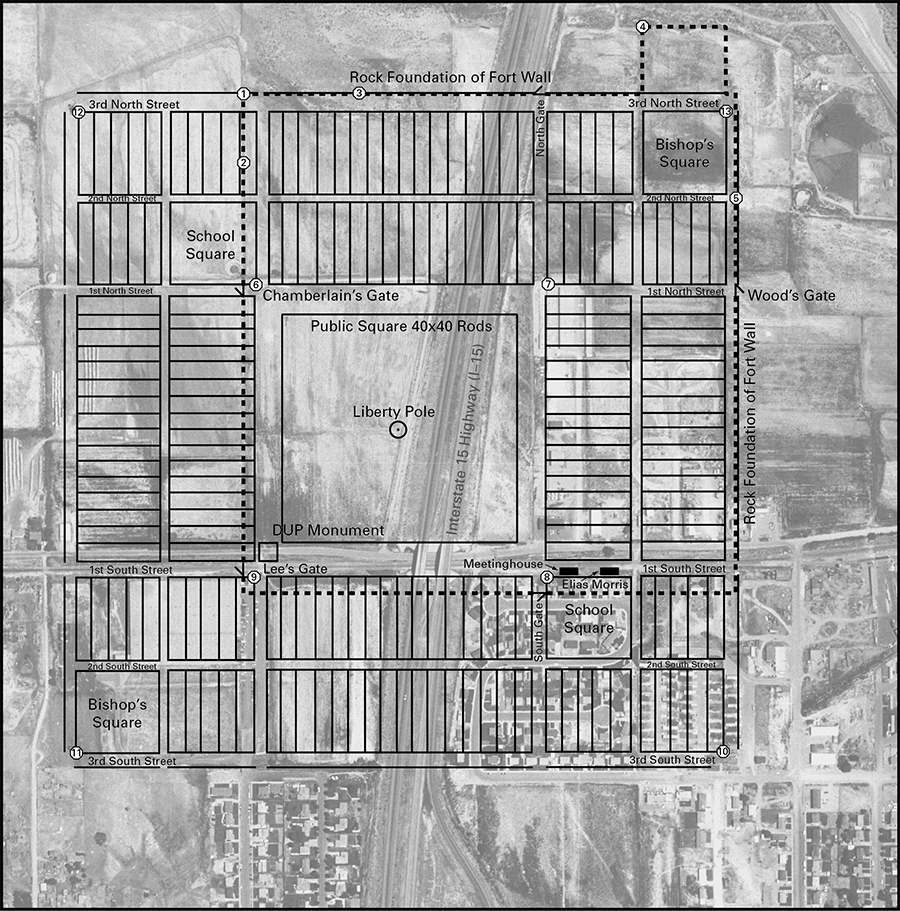
From their vantage point overlooking the Compact Fort and environs, George A. Smith and his companions decided that moving the townsite south and west would be best. As usual, William Dame was set to surveying; his perimeter placed the new city plat on the south side of Coal Creek, which meant that any fort raised there would be distant enough from the Knoll to be safe from attack by Indians (or anyone else). Dame sketched the new site on the western half of his 1853–1854 “Coal Creek Survey” (marked “Plat A” and “Plat A Fort” on illus. 7-3), drawing it as an empty square which he labeled “Cedar City Location.” The northeast corner of this new survey square touches the southwest corner of the Old Fort plat. To keep the two distinct, we will use Dame’s own designation—Plat A—to refer to the relocation site (see illus. 11-1). (Historically, “Cedar Fort” is the name the settlers used most often, both for the townsite as a whole and for its fort, soon to be erected in the northeast sector of Plat A.)
Illus. 11-1. Dame’s 1852 survey of Plat A (Cedar City) superimposed over a 1985 aerial photograph. (Authors’ reconstruction based on original survey in Iron County Recorder’s Office.) Broken line indicates fort boundary.
Plat A met the resettlement criteria well. The new townsite was located on a flat plain, controlling all approaches from all directions. Trees and tall brush were cleared from the south and west to eliminate cover for potential attackers. It was evident that water from Coal Creek could easily be channeled into both townsite and fields. Although the iron workers moving to Plat A would have to cross the creek to go to work at the first blast furnace site on the east bank, both Plat A and Compact Fort were comparably close to the iron works, so the move would not be a hardship in that regard.
Like most Mormon townships of this era, Plat A appears to have been a modification of Joseph Smith’s plan for the City of Zion. Dame’s survey provided for 188 individual lots19 measuring 4 by 20 rods (66 by 330 feet), like those intended for the City of Zion, each containing a half acre. These lots, much larger than those at Parowan or in the Compact Fort, could each contain a home, a small garden, barn and corrals. Each also faced a wide street with the houses offset from it two rods (33 feet) back. Alleys three rods wide (49.5 feet) gave easy access to outbuildings behind each house, with stables facing on the alleys. This design kept barnyard areas at least 300 feet away from the nearest dwelling, yet left them easily accessible.
George A. Smith handled the distribution of these new city lots by delegating the task to Lunt, assisted by Bishop Klingensmith. On Wednesday, 27 October (the same day he arrived in Cedar City and walked out with Lunt to find the relocation site), George A. “requested those brethren who intended to build this fall on the New City plot” to give their names to Lunt. The next day, Lunt and Smith counseled together again and Smith confirmed he would “leave it to [Lunt] and the Bishop to give out the Lots in the City,”20 although he himself remained in southern Utah for almost another month.21
The new site George A. Smith helped create before returning north provided space for two large school yards and two bishop’s compounds (the four corners: Blocks 5, 9, 17 and 21), each 300 feet square (20 rods) or two and a half acres apiece. The large 18.8 acre, 56-rod town square in the center, called “Temple Square,” was probably not intended as a temple site but rather as a space for public gatherings and worship, thus serving the same function as Temple Square in Salt Lake City. The inscription on Dame’s original Plat A survey reads: “Scale 30 [?] to the inch, Outside street 7 rods, Alley 3 rods, Center Streets 6 rods, Lots 4 rods by 20, Block 13. 56 rods square, Houses front the streets, 2½ rod from the line[.] Stables on the Alleys[.] Variation N 15˚ 51' East[.]”
In the City of Zion plan, the public square (Block 13) would also house administrative offices; in Parowan and Cedar City, it provided enough room for a public corral. Each bishop’s square was intended to contain a tithing storehouse and corral to receive in-kind tithing, including livestock. The 188 lots, two school yards, two bishop’s squares and central public square were arranged into a half-mile-square master plan which could be duplicated in adjacent or nearby tracts to accommodate new settlers. The square shape also lent itself to walling in, if needed. Dame evidently altered his original Plat At some point, changing the width to provide for a 10-rod “inside” street around the public square and a seven-rod “outside” street around the perimeter of the entire plat.
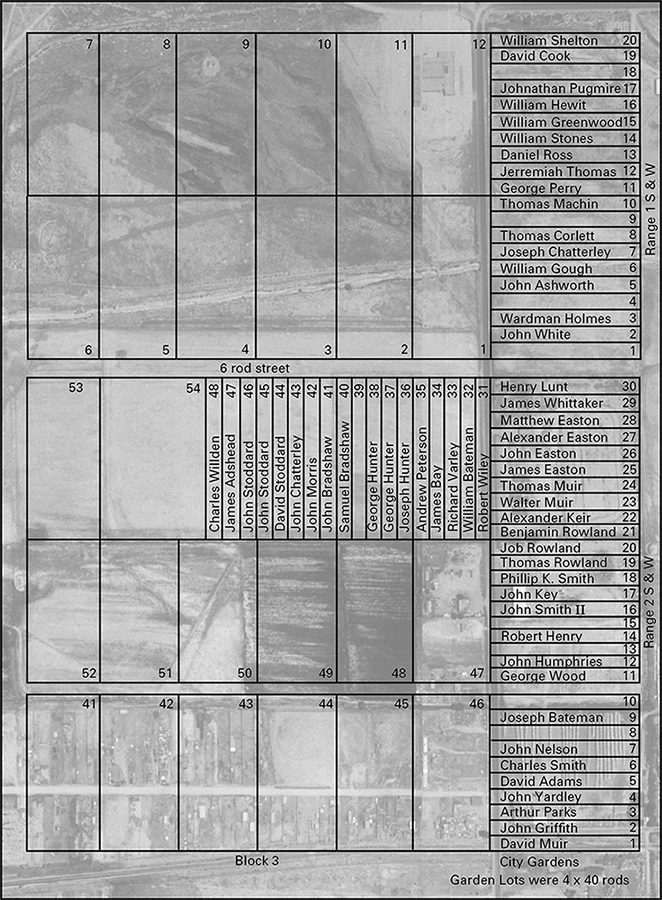
Magnifying the small shaded marks on illustration 11-2, which shows the area west of Plat A in Dame’s 1853–54 survey, reveals them to be numbered property divisions. Iron County deed books show that these were one-acre garden lots, 4 by 40 rods each, deeded to individuals. A water ditch still runs along most of the east side of this garden area. Much of the ditch is still in use. Many of the garden lots have been consolidated, changing widths but not lengths. They now measure almost 40 rods from the head ditch to modern Airport Road, which runs down the western edge of the first garden tier (thus placing it between the east and west gardens), following the boundary line separating Robert Wiley’s garden lot from those of Henry Lunt, James Whittaker and others.
Illus. 11-2. West Garden lot allocations taken from deed books in the Iron County Recorder’s Office, following Dame’s 1851 to 1854 composite survey, superimposed over aerial photograph.
In addition to the Plat A survey site, where it was expected many of the new settlers would raise their homes, Dame’s survey included 1,000 acres of new farms to the west where they could grow their crops (shown on illus. 7-3). We designate this area the “West Field,” in contrast to the old farming site, the Big Field, which was north of the Compact Fort. As in the first settlement days, the Plat A settlers could have three properties if they chose: a city lot (with room for a small produce garden at the back), a separate garden lot immediately west of the city survey and a larger farming lot further to the west. Iron workers were generally encouraged not to handle too much land and some of them took no farm lots at all.
None of the townsite, West Field or garden lots was registered until 28 January 1853 when the first fees were paid by 30 men and one woman (both old and new settlers) for lots in the new city.22 These were most probably “surveying” fees, because “recording” fees for 25 of the 30 are posted in the deed books on 1 March 1853 (see app. 8 and illus. 12-2).
The Lunts’ Plat A House
The complex story of the Lunt family homesites illustrates the gradual process of moving to Plat A. While gathering materials for a house in the Compact Fort, Henry Lunt and his bride had stayed in the homes of other settlers. On 28 June 1852, he records that he had “Moved in Bro Wiley’s house until mine is built.” Robert Wiley, the bricklayer and choir master, had gone to Salt Lake City to bring his wife back with him to Cedar City. Lunt was thus able to take Ellen to a finished home, albeit a borrowed one, while their own was being built. Through the rest of the summer, on into September and for most of October, successive diary entries report various tasks for the house, most of which concern making or “hawling” adobe bricks (some of which could have been for the iron works). Wiley returned on 14 October and Lunt must have felt obligated to vacate the house. By 26 October, Lunt records that he is “now living with my Father inlaw and am very thankful that I am so comfortable.”23
After the October decision to relocate, however, Lunt began building again, this time on his new townsite lot. He records being pleased that this lot was less than perfect. On Monday, 1 November, although he wasn’t feeling well, he took a walk and
looked at the Lot I had selected on the plot for the City found that it was rather broken having a hollow running through it and some large rocks on it. I was well satisfied with it, Knowing that no one would envy me of it, and could not say that I had chosen one of the best Lots. I thank my Heavenly Father that I have the priviledge of having an inheritance in one of the Cities that are to be built up unto the Lord[.]24
It would still be more than three months before the house on the new lot would be ready for occupancy. In fact, many of the brethren would pitch in and help build it, since Lunt’s time was taken up with administrative tasks. Lunt expressed gratitude to his fellow settlers again and again during the long weeks of house-building. He knew that the number and nature of first priorities, all demanding immediate attention, relentlessly drained the time and strength of any new settlement group. This made him keenly appreciate those who increased their own work load on his behalf so that he could handle undistracted the leadership tasks on which the colony’s survival depended. But finally, on 5 February 1853, he records with obvious delight the completion of his first home in the Iron Mission:
Removed from Father Whittakers house to my own House on the new City [lot.] Father and James [Whittaker Jr.] assisted me. . . . I have it not in my power at the presant time to pay them for their work done for me. . . . Father Whittaker has been working for me for the past week. Mother Whittaker furnished us with a number of articles necessary in housekeeping which I was entirely destitute of such as Pots and Kettles &c &c. . . . In the evening in my usual Evenings devotion, I thanked the Lord for the comfortable house that he had given me and my wife, and asked his Blessings to rest upon it; and dedicated it to the Lord. It is a dobie House 15 inch wall 15 by 16. 10 feet high well finished inside, fronts the south Lot 5 corner lot, Block 19. The first Adobie house built in Cedar City.25
Twenty-one days later, in a letter to the editor of the Deseret News, Lunt noted that the new city plat “has already on it 9 Log Houses, 2 Adobie and 10 good cellars, all inhabited.” He also noted that the settlers had removed some of the fence around the Compact Fort’s Big Field to begin enclosing a small field to the west of Plat A. This he expected to be completed by 1 March, “with an excellent fence all round it 6 poles high, and 2 good strong lumber gates to enter.” Further, he noted, an irrigation system to water both city and field was already in place.26
No domestic history of the Lunts would be complete without including a most unusual event recorded in Henry’s journal. He had already noted snow falling in mid-May 1853. Other journal entries confirm that the ever-unpredictable southern Utah weather was predictably displaying every mood from a “Friday that . . . Blew so tremendously” to a “Very hot day” to a “Very sharp frost last night.”27 But on Thursday, 19 May, Henry reported an unforgettable incident:
Very warm day. . . . About ½ past 4 p.m. it began to thunder and lighten over Shirts Kanyon, and in a few minutes the whole Heavens were black with clouds, and the Lightning and Thunder began to approach very near and was tremendous loud; the wind began to blow in a most terrific manner and large drops of rain decended[.] I and Ellen then went into the house. She sat down near to the fire place, and I went to the wood pile for some wood for the fire. As I came through the door, I pushed it wide open, and just as I was in the attitude of laying the wood down by the side of the fire place, The Electric Fluid struck the chimney of the house accompanied with the loudest burst of Thunder I ever before heard[.] Nocked a part of the chimney down rent the house from top to bottom blew the mantle piece to pieces took a piece out of the floor, nocked the bottome out of a Keeler which was full of water, a hole into a Box, nocked the plaster of[f] the wall, tore one of the shoes to pieces on my wife’s foot, and a large hole into the other, took the use out of both of her legs for some time. I had to carry her out of the house and at the same time my own legs were burning with heat as though I had been in a fire. The house at the moment of the tremendous shock was filled with a Blaze of fire. We were both of us sensible at the time and are now that had it not been for an overruling providence which had shielded us from the danger, we most certainly should have both of us been instantly killed. It was the most awful scene I ever witnessed, and certainly will never be forgot. Praised be the Lord for his goodness unto us[.] Attended meeting in the evening.28
In the Fort, in the City: The Meetinghouse Expands
Providing more formal data, Lunt’s diary makes it clear that people continued to live in or near the Compact Fort during and after relocation to Plat A. His journal entries frequently distinguish between the old and new townsites. On 11 February, for instance, he “gave it out in the Fort” that mail had arrived in Parowan, while he went on home “to the City,” taking newspapers from that delivery given him by John Kay, whom he happened to meet on the road. On 19 February, he again went to the Compact Fort, this time to a dance held in the meetinghouse. On 2 June, he reported that a search party, returning after retrieving stolen cattle from the Indians, was greeted “at the Fort” by a large crowd.29
The Ross family’s old home in the Compact Fort, which had become both schoolhouse and general meeting place, remained the center of the community through the summer of 1853. During Sunday meetings on 17 October 1852, Lunt had “urged the brethren to build a school house,” an open-ended phrase that may have meant he was thinking of rebuilding on Plat A.30 This did not happen, however, and by 7 November, also a Sunday, Lunt noted that the settlers “Met again in the afternoon at two oclock, meeting house densly crowded.” Since the building was used as much for business meetings concerning the iron works and for various community gatherings as it was for religious services on Sundays and Thursday evenings, the situation was becoming unbearable. On Christmas night, Lunt recorded events at a holiday party but admitted that “after dancing a little while the room became so densly crowded that it was impossible for to dance with any degree of pleasure.” On Sunday, 23 January 1853, he noted the “Meeting house was crowded so that some had to stand up all the while,” while his entry for Sunday, 6 February, expresses both pride and frustration: “Our meetings are attended most excellent, so crowded that the house will scarsly, hold all the people.”31
On 6 March, after ending a long day of Sunday services in cramped quarters, Lunt had had enough. He records, “I instructed the school Trustees to take measures at the evenings meeting to enlarge the School House.”32 This directive, however, went unheeded. By the end of the month, Lunt had to put his energies into an upcoming trip to Salt Lake City to attend April conference. When he returned, he was ready to have the old problem solved once and for all. On 27 April he
instructed the brethren for to get the school house enlarged this week, and recommended bro Hewitt to take the Job, and levy a Tax on the people for to pay them for the Job. Bro Hewett and some half dozen more of the brethren are now busily engaged at the Job, and expect to have it finished this week.33
With a plan of action firmly in place, the work went so well that Lunt was able to record on Sunday, 1 May, that “The Brethren have made an excellent Job of the meeting House. It is now very comodius.” Only the day before he had gone out “in the afternoon and looked out some lots for some brethren that have lately come in.”34 By collating the enlargement of the Compact Fort’s schoolhouse with ongoing reports of new settlers moving to city lots in Plat A, we know that both sites were active and growing during the spring of 1853.
Poverty Among the Newcomers
A primary reason for relocation was to make space for new settlers, inspired by the special emphasis put on the Iron Mission during the last October’s general conference in Salt Lake City. However, leaders were so successful in calling recent arrivals to take up iron production that the sheer volume of newcomers to Cedar City overwhelmed the settlement’s meager resources. Arriving too late to plant and harvest, these autumn pioneers had to survive a long winter on what they brought or on what they could trade for. Purchases from other settlers were the exception, as few of the newcomers had any money to spend on even basic necessities. The Charles Willden family, for instance, set up housekeeping—exactly where isn’t recorded—in their wagons and a dugout. Although the young sons herded the city’s cows, there is no evidence they were paid for their time.
According to the Charles Willden family history, “Everybody was out of flour and some did not have even bran to eat. . . . [Mother was] praying and hoping all the time that a thaw would come before her family would be in need, but a thaw did not come and our family was at the starvation point.”35 Feargus O’Conner Willden, then 12 years old, later reminisced:
[We] arrived at Coal Creek on Friday the 29th of October and on the 4th day of December father took a cow herd of about 2 to 3 hundred. Me and John, my brother, sent out with them, also our sheep which had then increased to about 10 head. I was entirely bare foote and had been ever since I left Pottawattamie or better known as Council Bluffs.
We kept the herd all that winter of 1852 and 1853 with Bran Bread to eat for one month and not plenty of that. In the Spring of 1853 I dug roots and eat hands full of grass to subsist on, to keep body and soul together. For the people seemed to have nothing to pay with and bread stuff being very scarce. This I had to do every day whether rains, hail, wind or snow over hills, rocks, prickley pairs, brush and many times snow very deep and cold. North wind blowing without any sunshine. When I got home at evening I had to feed the sheep, wood to cut, water to carry in the house and milk cows.36
All the colonists were poor, but some were much poorer than others. Since there was little circulating currency, wages had to be paid in produce and those who had it—usually farmers—could demand almost any price for it. Henry Lunt was concerned about established settlers withholding wheat from new arrivals, like Willden, who were iron workers and had nothing yet to exchange. In response to a proclamation from Brigham Young that the first day of the new year should be a day of praise and thanksgiving, Lunt encouraged the settlers to “give liberly of their abundance to the poor, so that they might rejoice with us.” The next day, he gave “a good large piece of Beef to the Bishop for the poor,” and asked the “old Citizens to make a contribution” as well, “which some of them contributed to freely. The Bishop devided it out and it caused everyone to have abundance.”37
Apparently, this exercise in practical charity was not sufficient. In February 1853, Lunt needed to instruct the farmers “not to do as the gentiles do[:] raise the price of wheat because it is likely for to be scarse.” He suggested that they continue to sell wheat at one-fourth dollar per bushel.38 Later in the month, he lamented that neither he nor President J. C. L. Smith could get any wheat for a number of men laboring at the iron works. Those in the first settlement, Parowan, who did have wheat to spare would not sell it for less than two dollars a bushel. “I am sorry,” reported Lunt, “to see Saints keep their wheat locked up because they think they can make a little more of it by keeping it for a while. . . . The principle is an old Gentile Devilish principle and therefore was not good for saints.”39
Problems of scarce supply and urgent demand were chronic in the settlements, not limited to one place, one season or one year. A letter to George A. Smith from his wife Zilpha, written from Parowan on 24 September 1854, provides compelling evidence of one woman’s struggle to survive without the most basic means to do so:
Dear George . . . you wrote in your last letter that you saw no way to help me[. I]f you do not I do not know how I shall get along as there is neither Shoes leather or groceries in the place and there is no way to get money to send for such articles[. I]f you could send me one bottle of oil one ounce of camphor some sugar and tea and eight yards and a half of calico—the calico I had to borrow to pay a woman for washing for me[.] If you can send me these articles I Shall be very glad.40
Harsh Winter at the Iron Works
Although living conditions were difficult, the iron workers continued their divinely commissioned efforts. On 16 December 1852, according to Henry Lunt’s diary, the iron workers tried the ore in a “small Cubelo” furnace but without success. Lunt records that the waterwheel ran all night but froze up in the morning, which suggests that they may have been blowing air into the cupola as they would into a full-sized blast furnace.41 Another trial was made on 30 December, running about 15 hours, but again there was no iron, Lunt reporting that “it is the judgment of all that there is something in it, that eats the Iron away.”42
Although J. C. L. Smith had been named general superintendent of the iron works, he lived in Parowan and his duties as stake president kept him busy. He visited the works every two weeks or so, Lunt managing day-to-day affairs during his absence. In mid-December, Lunt confessed that he felt “a very heavy responsibility resting upon me in regard to the Iron works.”43 On 3 January 1853, Lunt consulted with Thomas Bladen, the engineer, and David B. Adams, the furnace master, on making iron. Lunt felt encouraged enough by their optimism to trust that God would indeed help the Iron Mission accomplish its task.44 Four days later, Lunt invited the Deseret Iron Company officers still in Cedar City to a meeting and organized them as a council similar to the ecclesiastical councils with which he was familiar. In that setting, Lunt knew that he could reconcile any difficulties that existed among leaders of the company.45 Writing to George A. Smith, he observed wryly, “As a general thing the spirit of the Lord presides in this place. There are few cases of the common disease, viz: a swelling in the head. I would recommend as a preventative, one ounce of humility and one grain of the spirit of the Lord.”46
The harsh winter of 1852–53 limited activity at the iron works. J. C. L. Smith wrote George A. Smith early in January that the weather had been so cold it took two or three men half a day to chop ice off the waterwheels. The superintendent lamented that “some days we could not even do that, for it was so cold that it would freeze ice to the wheels so that they would not run.”47
When that happened, the men used the time to get ready for the next thaw. On 10 December, for instance, Lunt rode along Coal Creek, seeking the best outtake from which to run water to the wheel for powering the blast.48 On 12 January 1853, Lunt, J. C. L. Smith and James James opened a “splended mine of bog ore [hematite] one mile north East of the Iron works.”49 Several men spent the winter hauling dry pitch pine from the mountains, while Samuel Gould labored as collier, piling the wood into pits for making charcoal.50 One of the pits “bursted out” and Lunt, alarmed, sent “the brethren to run with Buckets,” dousing the flames before the cordwood could be consumed.51 During the winter, six men from Parowan, led by John Steele, traveled 200 miles south to the Big Muddy, searching the California Road for discarded scrap iron. They returned with two tons.52
The main body of the blast furnace had been constructed of adobe in the summer. During the coldest months, the bottom of the furnace was repaved with new stones and the top was raised higher. A platform was erected on the east side of the furnace so that the charge of fuel, flux and ore could be wheeled directly to the mouth of the furnace. Thomas Cartwright made tuyeres (called “tweers” by the pioneers) for the furnace under the direction of David B. Adams. Two were thought sufficient because the furnace was small.53
Sometime before the end of 1852, James James, whom the boys of Cedar City jokingly called “Double James,” had an idea for an “air furnace” which he enthusiastically brought to J. C. L. Smith. James believed that a sufficient draft of air could be created whether the smoke stack was lying down or standing up. Instead of building a higher chimney, he suggested they construct a horizontal smoke stack lying underground to connect with the 40-foot chimney already in existence.54 James was confident that, with the draft created by this flue, his air furnace could not only smelt iron out of untried ore but also reheat pig iron for further castings.55 Matthew Carruthers seems to have agreed with the concept, having commented as early as 3 January 1853 that “It seems quite certain that all the ores will work in the air furnace.”56 On 8January, Henry Lunt recorded that the iron workers, implementing the design proposed by James James, had begun building the foundation of the “stack for an air Furnace which will also answer for 4 furnaces.”57 This new “stack” was constructed as a horizontal flue, 250 feet long and lined with brick, requiring some 40,000 adobes.58 Lunt reported on the progress of this “excellent Air Furnace” to the Deseret News on 26 February.59
It is clear from the primary sources that trial runs were soon underway, but problems were seen almost from the start. Deseret Iron Company Minutes record that, on 12 May, Erastus Snow requested “fire brick for the arch of the air furnace, as the adobies had proved a failure and would not stand the fire, in consequence of which the furnace had not yet had a fair trial.”60 Lunt notes a further trial of the air furnace (perhaps rebuilt) on 13 July, producing 40 lbs. of “good clear metal,” but on 18 July he had a new failure to report:
Another trial was made in the air Furnace, the Furnace became exceedingly hot, and about 2 oclock the arch over the grate burned through, and a small quantity fell in. Consequently nothing much was done. The arch over the fire place was built of dobies. It was of the opinion of bro James that the stack wanted to be taken higher, and the arch to be built of fire brick. . . .61
Lunt’s phrasing here is noticeably similar to Snow’s of 12 May, strongly suggesting that the Apostle’s request for firebrick two months earlier had been ignored. Taken together, the comments indicate that inferior materials were certainly jeopardizing the experiment.
For whatever reason, the venture seems not to have ended well. The author of the biographical sketch on J. C. L. Smith, quoted in the previous chapter, devotes several paragraphs to James’s air furnace. In his opinion,
The project proved a costly failure. The draft was temperamental. It flowed down as often as up and it changed without any provocation or warning. The money was wasted but the mistake was as much the fault of Erastus Snow and Franklin D. Richards as of John Calvin Smith. He spent it honestly and got good value in labor and materials for it but the idea was wrong.62
Because one end of the underground flue surfaced near the bank of Coal Creek, it became in later years an adventuresome hideout near the swimming hole for the town’s youngsters, salvaging something of use from an otherwise frustrating venture.63
On a more encouraging note, George A. Smith sent word on 15 January 1853 that the territorial legislature had approved $3,000 for coal and iron business in southern Utah.64 This revenue was granted in addition to the $2,000 appropriated in December for developing roads to the coal mines. According to William R. Palmer, the Iron Mission was also awarded something of a tax break:
The tax levy was 1 per cent—five mills for the Territory and five mills for the County. The assessor did a through job for both tax units needed money badly. The local tax valuation was $19,894, which included homes, farms, wagons, horses, oxen, clock and watches and every other kind of property found by the assessor. The total tax levied was $198.94, one-half of which ($99.47) belonged to the Territory. To clear their records and avoid showing a loss, the Territory made the generous gesture of assisting the iron industry by appropriating to them “the deliquent taxes of Iron County for the year 1852.” These deliquent taxes amounted to something less than $50.00, the debtors having absconded to California.65
On 31 January, 40 iron workers were busily working on the supposedly improved blast furnace. In the weeks that followed, Richard Benson put up a wooden casting house and Richard Harrison laid out casting moulds on the foundry floor, ready for the next pour from the furnace.66 Thomas Bladen repaired the blowing apparatus to work with the new overshot wheel and the wheel itself was given a new dam, millrace and flume. On 25 February, the improved system was tried and, with minor adjustments, worked satisfactorily.67
Trial Runs
These winter attempts to upgrade the blast furnace culminated in a trial run on Saturday, 26 February. As recorded in the Minutes of the Deseret Iron Company, the first charge consisted of the following materials:
In his letter to George A. Smith of 7 March, Henry Lunt stated that the bog ore (hematite) and West Mountain ore (magnetite) made a “first rate” combination.69 The slag began running within half an hour after the blast was put on and continued throughout the day, with iron beginning to be visible in the slag. Despite their high hopes, however, furnace master David B. Adams discovered early Sunday morning that the iron had chilled at the bottom of the furnace. Acting immediately, Lunt and six of the iron workers began clearing the furnace. They found that the iron had indeed chilled around the tuyeres. They fired up again, hoping to create a blast hot enough to burn the iron out. The approach did not work, so all they could do was begin preparations for a new trial run.70
At this point, the iron workers decided that a change in furnace design might improve their luck. Thinking that perhaps blasting from two tuyeres on opposite sides of the hearth was causing the furnace to blow itself out, they “fixed both Tweers together in one Tweer hole” and rerouted the blast.71 They also experimented with a new charge, decreasing West Mountain ore and bog ore by 6 pounds each and adding 5 pounds of limestone flux. This time they met with more success. Starting Tuesday, 1 March, the furnace ran for 18 hours and produced about 250 lbs. of iron. By Thursday, the furnace was consuming 200 bushels of charcoal every 24 hours. Thursday was supposed to be fast day, but the iron workers were too busy to observe it, everyone working feverishly to replenish the fuel supply. The next day, the furnace had to be stopped for lack of fuel. During the week, about 1,600 bushels of charcoal were consumed, resulting in approximately 2,500 lbs. of white, hard iron.72
“Hosannas to God”: Cast Iron for April Conference, 1853
Given the fuel emergency, Lunt called a special Sunday meeting of company shareholders on 6 March to consider the best way to obtain “stone coal.” Matthew Carruthers was made “Ground Bailiff” and it was decided to get the coal by letting the job out to the lowest bidder. On 10 March, crews were sent into the canyon to remove snow “some two feet deep and more” from working mines and search for new deposits although it was “snowing very fast all the time, and very cold and stormy.73”
Meanwhile, James James hurried north with a sample of iron, ready to report that no obstacle stood in the way of making iron as fast as coal could be obtained to fuel the blast. Willard Richards, editor of the Deseret News, was suitably impressed and voiced the hope that “appropriations of the Legislature will be speedily applied to the opening of the roads, mines, &c., so that the precious metal may be soon in circulation, in all its useful modes throughout our Territory.”74 Both money and equipment were needed to alleviate the fuel crisis. As early as February 1852, Matthew Carruthers had written Brigham Young begging for supplies: “If the brethren that come on this sp[r]ing would bring along boring rods, rope for sinking pits, and all the mining tools they possibly can, all the blasting powder they can, also iron and steel etc., they would confer a favor.”75
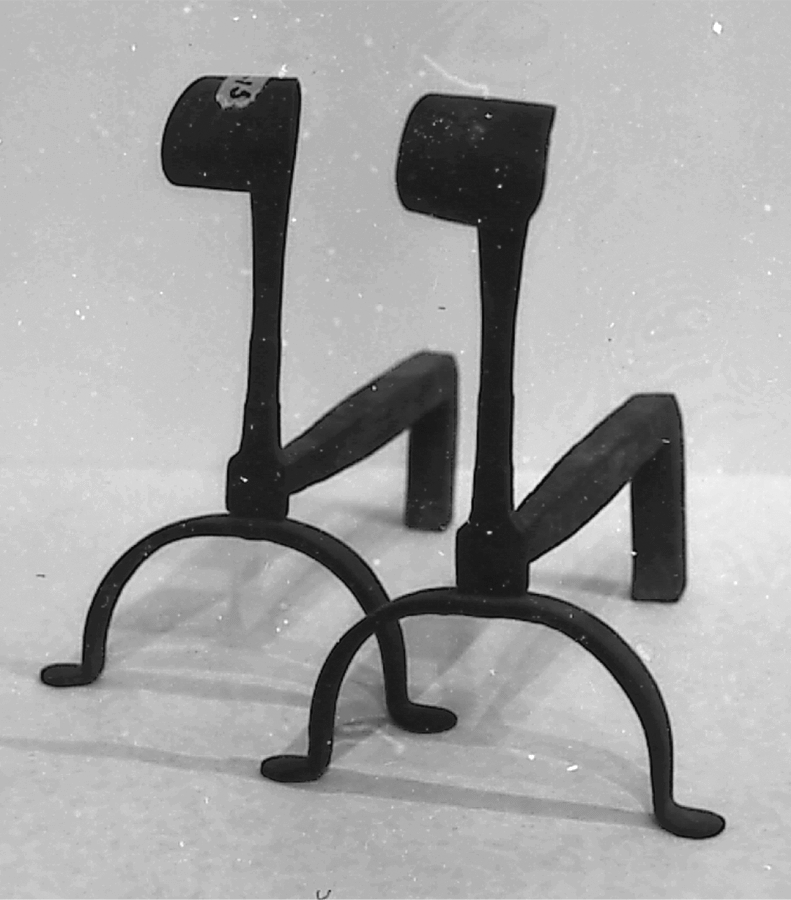
On 15 March 1853, less than three weeks before April general conference, Lunt visited the iron works and found that several of the brethren were determined to set up the cupola furnace in order to cast a useful object for display in Salt Lake City. On the 16th, Richard Harrison, the moulder, reported having “fixed the cubelow Molded 2 Skillits and a pair of Hand Irons for fire place” (see illus. 11-3). The next day he wrote:
T 17 [March] 1 Day Heated up the Cubelow and melted about 400 lbs of Iron. Cast a pair of Hand Irons or fire Dogs, the first pair ever cast in Iron County, State of Deseret. A number of persons on the ground at the time to see the Sight. 3 cheers was given for Iron County and the Heavens whas made to ring with Hosannas to God and the Lamb for ever & ever.76
Illus. 11-3. This set of pioneer andirons (dog irons) is similar in shape and style to those produced by the Deseret Iron Works at Cedar City in the 1850s. These irons were made by historian William Palmer’s father, Richard Palmer. Photograph by Randall B. Shirts.
Such success right before April conference was exhilarating. Lunt wrote that a “spirit of energy and enterprise seemed to be in the bosom of many of the brethren.”77 On 18 March, the cupola was raised several feet and preparations were made for another trial. On the 19th, Harrison heated the cupola and moulded a kettle, a skillet, two spider gears, two tuyeres, dam plates and another pair of andirons. Even so, he noted, “The Mettle whas very Hard and thick.”78
The next day was Sunday. At the evening meeting, Henry Lunt, Matthew Carruthers and Richard Harrison all gave iron sermons. Lunt especially “preached a most tremendous loud discourse to the brethren on their Mission of making Iron, long to be remembered I presume by all who were sent down to this place.” When he asked for those willing to spend full time on iron to signify their intentions, 33 men stood up.79 They assembled in the casting house on Monday, 21 March, and were organized to carry out their tasks. They met again that evening in the fort with the farmers whose help was solicited to haul wood. Lunt felt the farmers “were very backward at promising to do anything for the Iron works” and he chastised them severely.80
On 22 March, Lunt recommended that they try “Raw Pitch Pine” in the cupola furnace and it worked “first rate.” Harrison was able to cast a pair of pedestals, a wheel, another spider gear and tuyeres for the furnace. Leaving Matthew Carruthers in charge of the iron works, Henry Lunt and J. C. L. Smith headed for Salt Lake City, having chosen to take the andirons for conference display.81 While their leaders rode north, the iron workers were eager to try pitch pine in the blast furnace. On 1 April, they tried a charge that produced the “best cast of iron” than any before it:
Wood
100 lbs.
Charcoal
50 lbs.
West Mountain ore
25 lbs.
Bog ore
30 lbs.
Limestone
10 lbs.
The result was “good shaped pigs” of “good grey iron.” Raw wood was tried without charcoal but did not work as well. Thomas Bladen fitted the waterwheel with a fly-wheel and added a turning lathe and circular saw (presumably to cut wood for the furnace).82
In Salt Lake City, Henry Lunt toured the city with his wife Ellen. They were among the more than 5,000 Saints who witnessed the laying of the foundation cornerstones for the Salt Lake Temple. Lunt was impressed that “some hundreds of houses . . . and some very good ones too” had been built since he left two years earlier. He felt that the Tabernacle, the council house and the storehouse were fine buildings that “would grace the City of London.” Lunt called on Brigham Young, who seemed pleased that he had brought a sample of the iron castings. George A. Smith assured Lunt that President Young would have the “Dog Irons” polished and placed on the stand during conference.83
On Thursday, 7 April, Henry and Ellen arose early for an 8:00 a.m. meeting in the Tabernacle. When members of the congregation were invited to speak, Lunt rose out of the audience and told about the progress of the Iron Mission in Cedar City. At this point, Dr. Festus Sprague brought the andirons out of the vestry where they had been stored and placed them on the stand. Lunt was satisfied that “the saints appeared quite excited and well pleased at the sample of cast Iron made in the mountains by the Saints.”84
In the regular conference session later that day, George A. Smith was called on to give another “Iron Sermon,” just as he had done in October 1852. As the Deseret News reported it, he “took in the stand one of the Fireirons, holding the same over his head, cried out, ‘Stereotype edition,’ and descended, amid the cheers of the Saints.” It is not unreasonable to suspect that the congregation, which had been seated over five hours, eagerly stood for a rousing rendition of the closing hymn, “Praise God from Whom All Blessings Flow!”85
The atmosphere of success apparently encouraged some enterprising individuals to attempt making iron on their own. In spring 1853, Peter Shirts and Thomas Jones were reported to have built a smelting furnace on the outside of the fort wall to try some ore they had prospected. John D. Lee was concerned that their furnace would provide cover for Indians who might shoot at the fort. Shirts and Jones refused to pull down their furnace, so John D. Lee did it himself. John Spiers, a settler in Cedar City, stated cynically that the ruins made an even better hiding place for the Indians, “for where only ten could hide before fifty could now find ample protection.”86
All in all, many of the settlers were engaged in iron-making throughout the spring. The daily journal of the Deseret Iron Company for 1853 lists the names of 68 men who labored at the iron works between January and April 1853, as well as the number of days they worked. Collectively, the number came to 2,106. David B. Adams, Thomas Cartwright, Joseph Walker, Thomas Bladen and Jonathan Pugmire worked over 100 days each. The entire complement of men averaged 30 days each, although about a third of them contributed only the equivalent of a week or less.87
Buying Merchandise for the Company Store
At the beginning of May 1853, Erastus Snow, accompanied by Amasa Lyman and Charles C. Rich, paid a second visit to Iron County. Erastus Snow informed the iron workers that they could not expect a pay check every Saturday night, but that
we will endeavour to satisfy your wants as well as we reasonably can. I know it will be a very good thing for you to have your wages in the iron works as a bank, for if you have your money you will squander it, and if it is in the bank, it will be saved till a day of need.88
About the only “wages” the workers received came as goods stocked by the Deseret Iron Company store, which indeed acted as the community bank. On his recent trip to Salt Lake City for conference, Henry Lunt had met Edward Williams and his company about seven miles north of Beaver on their way to Cedar City. Williams was bringing “a few groceries” from Erastus Snow and Franklin D. Richards for the store as well as an invoice for about $900.00 worth of dry goods, which would be sent along soon.89 This document, entitled “Invoice of goods for Iron County, No. 1,” is dated 28 February 1853. It lists $869.93 worth of dry goods, mostly fabric (including alpaca, silk, flannel, muslin, Irish linen, velvet, lace, “Casimere” and “Green Barize” for veils) and $182.30 worth of books (including 80 readers, four copies of Webster’s Dictionary, 30 of Holbrook’s Arithmetic, 20 of Weld’s Grammar, nine of Olney’s Geography, two of Parker’s Philosophy and one of Comstock’s Chemistry.)
Lunt’s “few groceries” were also listed on “Invoice No. 1” and amounted to $751.55 worth of coffee, tea, sugar, tobacco, dried fruit and soap.90 An “Invoice No. 2” for additional delivery to Cedar City, dated March 1853, itemized several pounds of dye (indigo, Prussian blue, umber and “extract of logwood”), boots, locks and latches, lampblack, starch, borax, sand paper and 25 bottles of “Acids, &c.” purchased by James James.91
Home from his conference trip, Henry Lunt spent 2 May opening and marking off the goods and 3 May with J. C. L. Smith selling the goods for cash.92 Comparing a price list of items for sale with the original invoices indicates goods were sold for what they cost, with no mark-up. Iron county residents could buy a first reader for 30¢, a grammar book for $1.25, a pound of sugar for 50¢, a pound of imported tea for $2.25, a pair of men’s boots for $4.50, one cravat for $2.00, a bonnet for $3.50, bar soap for 55¢, one yard silk for $2.20, a yard of linen for $1.25 or a card of hooks and eyes for 10¢.93
Not only did Richards and Snow supply the Deseret Iron Company store through Salt Lake City merchants such as Kinkead & Company but they also bought goods from a variety of enterprises in St. Louis. These transactions were made by purchasing agent Vincent Shurtleff on credit through the Alexander Dow Company, a kind of international clearing company that arranged for financing from England or Salt Lake City and then paid the bills. Although the ultimate goal of the Iron Mission was to make Utah Territory more independent, receipts from 8 to 14 June 1853 show that the Deseret Iron Company was, in fact, buying on a large scale in St. Louis from numerous companies (see related sidebar).94
A final shipment of merchandise for the year 1853 was sent to President J. C. L. Smith by Snow and Richards on 5 September. The shipment consisted primarily of boots and shoes, cloth and construction materials. As the two noted, the purpose of the shipment was to pay the company’s debts and to “supply . . . the wants of the people.” Smith was cautioned to keep a strict account of every item, reimbursing the account of Snow and Richards as soon as the goods were sold. The value of any unsold item was to be credited back to the Deseret Iron Company. After having sold the merchandise, Smith credited $1,475.67 to Snow and Richards and later transferred $96.79, representing the unsold goods, back to the general manager for the use of the company.95
Sharing the Workload: the Iron Council is Called
On 12 May 1853, two weeks after he addressed the iron workers, Apostle Snow met with the company’s leadership. J. C. L. Smith pointed out that he had more work than he could handle and would be happy to be released as superintendent of the works. Snow decided to retain Smith at least until the general shareholders’ meeting in the fall, but proposed that a council of five men help him. Matthew Carruthers, Henry Lunt, Richard Harrison, Thomas Bladen and David Barclay Adams were unanimously chosen to form this council. A special office was planned for the iron works, to serve as both superintendent’s office and council room.
The makeup of the group is intriguing. Carruthers and Lunt would be considered management; Bladen and Adams, labor; Harrison, iron moulder and former superintendent, falls into both categories. Snow may have realized that it was time to invite workers’ opinions into the decision-making process. John Chatterley, many years after his service as a foundryman, penned a strong opinion of his own about labor relations on site, using Adams as his example:
The business would have been successful if those that had a little authority would not have interferred with the practical workmen, who had in their native homes in the old countries run out thousands upon thousands of tons of cast iron but authority would order the charges in the blast furnace changed[,] consequently the furnace gobbed up. . . . There was one person (David B. Adams) was a thorough practical furnace keeper and when allowed to have his way about managing the furnace, would make the moltin iron run from the furnace as free and almost as thin as water.96
As well as organizing the iron council, Snow also admonished Henry Lunt to take care of the company books; further, Snow made Matthew Carruthers responsible for day-to-day administration of the works when J. C. L. Smith was unavailable.
In addition to documenting the iron council, the minutes of the 12 May meeting are valuable because they explain an otherwise ambiguous reference to a fort that Henry Lunt makes note of in his journal on 14 May: “Went up to the Iron works with bro Snow and look[ed] out a place for to lay off a Fort. He said he empowered me to see to the locating of it, and also to the giving out of the Lots.”97 It was on 14 May 1852, exactly one year earlier, that Lunt had gone walking with Philip Klingensmith, also to “look out a sight” for a new fort. Nothing came of their efforts at that time, as we know, and Lunt does not record the true beginnings of Cedar City’s relocation phase until six months later, on 27 October, when he again, this time in the company of George A. Smith and others, “look[ed] out a sight for a city,” the future Plat A.
The 1852 events might mislead us into assuming that the 14 May 1853 site review was similar—a premature attempt that produced no results. Indeed, the outcome of this second search for a fort site was the same as the first: nothing happened. But the intention here, in 1853, was more defined and its scope more precise than that of a year ago. This site exploration would probably have resulted in a building project adjacent to the iron works had the town’s priorities not been redirected by fears of Indian unrest. The intended 1853 fort was, in fact, the brainchild of Erastus Snow, who appears to have envisioned it as a kind of workers’ dormitory, convenient for the men and efficient for the iron works:
President Snow said he had decided to have a fort built near to the iron works for the brethren to live in who would be constantly employed at the works. He sugested that the lots and entire fort be in the hands of the Deseret Iron Company; he recommended the houses to be built uniform neat and good. He thought of proposing that the brethren turn in the field [presumably West Field] to the company, and for the company to employ a few good hands to farm it.
The workers, however, were not enthusiastic about the idea, the desire seeming to be “for every one to farm his own.” Even so, “It was moved and carried unanimously that Bro. Snow select a sight for a field for the Deseret Iron Company.”98 Despite Snow’s apparently well-conceived design and his sufficient authority to implement it, neither fort nor field materialized as he intended. Instead, central activities in the township for the next few months focused on securing what already existed against possible Indian attack.
Meanwhile, the newly formed iron council met first on 5 June, to discuss spending the appropriations for roads and coal mines in the canyons, and again on 10 July to discuss ways to move ahead on the iron works and provide food for the workers.99 On 9 July, Lorenzo Barton asked members of the council for 270 lbs. of iron from the blacksmith shop to build machinery in Parowan but they concluded that, if Barton had “nearly all the wrought Iron that the Iron Co. had on hand,” it would slow the progress of the iron works.100 A meeting between Franklin D. Richards and the “proprietors” was scheduled for 26 July 1853, but due to Brigham Young’s warnings regarding Indian difficulties, it was canceled in favor of devoting all energies to settlement defense.101
The pioneers had fulfilled the monumental task of relocating their townsite while still maintaining trial runs at the iron works, producing, indeed, the first actual implements. Again, however, the uncertainties of pioneer life interrupted furnace activity. For the rest of the summer, community efforts would be channeled into “forting up,” a task which necessarily brought iron production to a standstill.
Sidebar 11-1: Shopping in St. Louis—Deseret Iron Company Receipts, June 1853
2. Jarvis, Ancestry, 165. During the October general conference, George A. Smith himself had proposed that Lee start a settlement on the Virgin River where warm-weather produce could be raised.
3. Conway B. Sonne, World of Wakara (San Antonio, Tex.: Naylor, 1962), 200–201; S. Lyman Tyler, “The Earliest Peoples,” in Poll, Alexander, Campbell and Miller, eds., Utah’s History, 28–29.
8. George A. Smith to Samuel W. Richards, 7 Nov 1852, cited as “Prosperity of Iron County, Deseret” in Millennial Star 15 (19 Mar 1853): 188; see also Lunt, diary, 18 Oct 1852.
15. LaVon Adams Mons, “History of David Barclay Adams, Pioneer of 1852,” typescript, 1–2, copy in Shirts Collection; see also Mary E. Adams, comp., “Diary of David Barclay Adams,” typescript, 1, copy in Shirts Collection.
19. George A. Smith to Samuel W. Richards, 26 Dec 1852, published in Millennial Star 15 (30 Apr 1853): 286. Smith mentions 200 lots, while William Palmer gives a figure of 120. Palmer, however, was only including those lots north and east of the public square which fell inside the Cedar City (Plat A) fort. See illus. 12-1 incorporating Palmer’s drawing of the Plat A Fort; see also Palmer, “Gleanings,” Palmer Collection; and Jarvis, Ancestry, 166–67.
21. See ch. 10, n. 35. Franklin D. Richards verifies that George A. Smith left for northern Utah on 21 Nov, the day after Snow and Richards arrived in Parowan. See Richards, journal, 20–21 Nov 1852.
36. Several sources on Feargus O’Connor Willden are known. The LDS Church Archives has a “compiled information” file, donated in 1957 by Ione Thompson of West Valley City, Utah. It is distinct from the one-page sheet of notes made by William Palmer about Feargus, titled “Extracts of Biography of Feargus O’Connor Willden Written by Himself” which is now in the Palmer Collection. Here, we cite passages from a typescript about Feargus of which the Shirts Collection has only pp. 3–6 and 10 and the origin of which was long unknown. Late in preparing this book, however, contact was made with Ronald Payne of Spanish Fork and Sharon Rae Payne of Salt Lake City, who made available their Willden family histories for examination. The Shirts Collection pages appear to be taken from a 68-page history entitled “Biography of Feargus O’Connor Willden and Progenitors” of which the Paynes have a complete copy (the location of the original is unknown). We are indebted to them for identifying this source.
40. Zilpha Smith to George A. Smith, 24 Sep 1854, George A. Smith Papers, LDS Church Archives. We are indebted to Jill Mulvay Derr for bringing this letter to our attention.
42. Ibid., 30 Dec 1852. See ch. 13, nn. 17–19 in reference to a similar situation in 1854, pointing up a chronic problem within the pioneer smelting process.
64. Lunt, diary, 15 Jan 1853; “An Act, Appropriating Money to promote the manufacturing of Iron in Iron County,” 5 Jan 1853, in Territorial Acts and Resolutions.
65. William R. Palmer, “Utah’s Pioneer Iron Industry,” Sons of Utah Pioneers News (Salt Lake City: Sons of Utah Pioneers, Aug 1957), B-10, B-11.
66. Harrison, diary, 6. The relevant phrases are: (26 Feb) “preparing floor of the foundry”; (28 Feb) “fixing the moulding floor in the foundry”; (1 Mar) “fixing Molding floor”; (2 Mar) “working at a flask & molding floor”; (21 Mar) “Prepaired the Sand for molding.” Lunt’s letter of 26 Feb 1853 mentions that about half of the 70 men in and about Cedar City were regularly employed by the Deseret Iron Company.
67. Deseret Iron Company, Minutes, 7; Lunt, diary, 25 Feb 1853.
72. Ibid., 1–4 Mar 1853; Deseret Iron Company, Minutes, 8. Lunt writes that coal was used, while the Minutes refer to charcoal. In his letter to George A. Smith, 7 Mar 1853, Lunt agrees with the Minutes in stating that charcoal was used for this run.