The Walker War and the need to fort up against it were not the only events that delayed iron production toward the end of 1853. On Saturday, 3 September, a fierce cloudburst unexpectedly flooded Coal Creek, destroying every canyon bridge and washing out dams the pioneers had labored so hard to build. Eight months after the event, Brigham Young described the swollen creek as a “singular stream,” which could sometimes “sweep across the flat, carrying down rocks that would weigh perhaps twenty or thirty tons.”1 The autumn storm sent water rushing three feet deep over the iron works, washing away hundreds of bushels of charcoal (estimated to be worth $500) and scattering stacks of wood. The “Report of Travels” written by Apostles Snow and Richards included an assessment of this flood, ending with the telling statement that “the present site was not the proper one on which to permanently locate the Iron Works.”2 The day after the storm, at the Sunday morning muster, the militia was put to work repairing the dam and soon restored a proper flow of water to the fort.3 The community suffered another blow at the unexpected death on 10 September of revered settler Joseph Chatterley, who had accidentally shot himself a few days earlier while lifting a rifle from a wagon.4
A week after the Cedar City flood, “the first Stake Conference ever held in Iron County convened in Parowan,” moving to Cedar City the next day, a Sunday.5 On Monday, Stake President J. C. L. Smith, in his role as superintendent of the iron works, gathered the proprietors of the company together at Jonathan Pugmire’s blacksmith shop to evaluate flood damage. Although acknowledging the canyon bridges were gone, Smith felt the damage to the iron works was minimal and asserted that he “did not see anything in the way of commencing the iron works again.” Many of the brethren insisted they were already overwhelmed by the effort to comply with President Young’s orders to enclose the fort. It was decided that the leaders themselves would take on the job of gathering up company property washed down the creek by the flood. Several men volunteered to go exploring for fire clay of good quality,6 a sign of optimism that furnace operations would resume before long.
Pioneer resilience is demonstrated in Snow and Richards’s “Report of Travels.” Giving a positive spin to the setbacks caused by the flood, they noted that the waters had created a supply of “ready-made adobies:”
This freshet brought down an immense quantity of well ground material and desposited the same in various depths on the surface, from four to ten inches, which when dried, proved to be a very superior material for building wall and houses and has been extensively used for that purpose.7
Appointing a New General Manager
The first annual convocation of Deseret Iron Company stockholders began on 10 November 1853 with additional sessions held the 16th, 18th, 27th and 28th. Erastus Snow had a number of concerns that he expressed over the several days of discussion. He was primarily concerned about tightening up the finances of the company. He chastised shareholders for crediting hours of labor toward the unpaid balances on their shares and also condemned the practice of paying debts or ordering goods without authorization from the general superintendent. Probably during the meeting on the 18th, Snow reported the company’s assets and debts, balancing $10,704.29 received by the company with $10,440.44 paid out. To the remainder of $263.85, Snow factored in amounts outstanding due to the company plus an estimate of its holdings in merchandise and other property. This resulted in the company having a paper value of $11,374.81 on which to operate.8
Two days after the meetings started, a petition signed by 184 Cedar City men, including J. C. L. Smith, John Steele, Tarlton Lewis, Henry Lunt and David B. Adams, was sent to the territorial legislature asking for additional road appropriations. The petitioners pointed out that the strongest bridges their resources could build had been destroyed by the flood of 3 September and that new bridges would cost $800.00 to $1,000.00 each. One alternative would be to cut through canyon rock, creating a route that would avoid the creek, but carving such a road out of the mountain would also be expensive.9
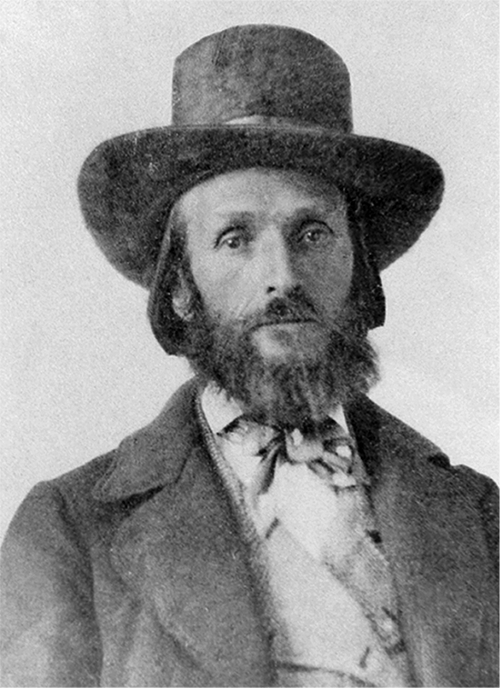
It was during this month, November 1853, that Isaac C. Haight (see illus. 13-1) became active in the Iron Mission. Shortly after returning from his mission to England, he was called by Brigham Young to relocate in Iron County. On 8 October 1853, Haight wrote in his journal that “I had much rather have stayed here [Salt Lake City], but am willing to obey the counsel of my Brethren.”10 Leaving on the 20th, he arrived with his family in Cedar City on 1 November. He was officially introduced at the 10 November 1853 shareholders meeting. After opinions were expressed about committing the company’s welfare to non-shareholders, Haight demonstrated his commitment to the Iron Mission by volunteering to become a shareholder himself.11
Illus. 13-1. Isaac C. Haight (1813–86), became general manager of the Deseret Iron Company in late 1853. Courtesy LDS Church Archives.
On Sunday, 5 November, five days before the shareholder assembly, numerous meetings—religious, military and economic—had been held throughout the day. As George Bowering’s journal records, at a midday public gathering in front of Bishop Klingensmith’s house, Erastus Snow “spoke at some length upon various subjects,” especially touching on those who had left for California. In his opinion, “they will be loosers by so doing and . . . a blessing unto us they are gone.” He then brought up the need to build a “meeting and school house.” A motion was quickly made and carried to erect an assembly room 25 by 40 feet to be paid for by subscription.12
The urgency of this decision makes sense when we remember that the old schoolhouse, which had just been enlarged on 1 May, was a casualty of the Walker War, being demolished (at the very least dismantled) by 11 August during the pulling down of the Compact Fort. Those now crowding onto Plat A, therefore, had apparently been without a “comodius” building for three months and the continued lack of meeting space had become a priority.
The ongoing shareholders’ meetings reconvened on 26 and 27 November 1853 and Isaac C. Haight was appointed general manager of the Deseret Iron Company. This required him to post a bond of $10,000. In addition, since he was also elected one of four company trustees (the others being Vincent Shurtleff, Christopher Arthur and Jonathan Pugmire), he was required to post another bond of $2,000.13
Prior to the company meeting on 27 November, Erastus Snow and Franklin D. Richards presided over a stake conference where Isaac Haight and Marius Ensign were appointed to fill vacancies on the high council. Very possibly one of these positions was that formerly held by Matthew Carruthers, who had apparently decided that iron-making in southern Utah could not generate a livelihood. After months of inner debate, he finally relinquished his ties to the community, sometime after 10 November, and returned to his native Scotland.14
Before departing for Salt Lake City, Snow and Richards recommended that Cedar City be organized as a municipality, nominating city officers and designating Isaac C. Haight as mayor. On 6 December 1853 the first city election in Cedar City was held, confirming the nominations. John D. Lee, William Miller, George S. Clark and Philip Klingensmith were chosen to serve as aldermen and James Lewis became city recorder.15 Haight, who had been reluctant to take over the management of the iron works in the first place, now found himself not only a business and ecclesiastical leader but a civic leader as well.
Early Trial Runs of 1854
The iron works stopped while all hands helped to raise the Plat A fort wall. Precisely on 1 January 1854, however, despite severe cold, the pioneers began mining and hauling coal. By 9 January the iron works had been repaired, the furnace charged and the blast put on. The furnace continued blowing until the evening of the next day when the air was so cold the water froze up in the wheel, interrupting the blast and cooling the works, resulting in solidification of the iron. Little iron had been made anyway, because the sulfur in the inferior coal had eaten away at the iron during smelting, leaving it brittle. Work was temporarily put on hold and Haight wrote to Erastus Snow asking him to purchase a steam engine so they need not depend on Coal Creek to power the blast.16
Two anecdotal sources add to the evidence that high sulfur content in the coal was interfering with proper smelting. In a missionary reminiscence, John Lee Jones, son of iron worker John Pidding Jones, recalled that the pig iron “was so hard they could not chip it. It was as hard as bissmer [Bessemer] steel on account of so much sulpher in the coal. It ate the carbon out of the iron and left it very hard.”17 William Ashworth, son of iron worker John Ashworth, remembered that “During the time Father worked at the foundry, they made a limited variety of articles, but the metal was so hard for lack of proper fluxing material that it could not be dressed—a fire would not even phaze it.”18
The furnace was not charged again for over two months. On 27 March the furnace master tried a mixture of half charcoal and half coke (Haight asked that more wood be burned into charcoal) but the furnace still needed to be blown out after three days because of the damage done by the sulfur. Furthermore, the blow-outs had damaged the furnace itself and repairs needed to be made.19 J. C. L. Smith, Henry Lunt, James A. Little, John D. Lee, Samuel West, James H. Martineau and Silas and Jesse Smith took time to attend April conference in Salt Lake City but without any new iron products to display this year.20
By 8 May the furnace was repaired, sufficient charcoal had been processed and the iron workers were ready for another trial run. The first charge produced too little iron, and that of an inferior quality, so furnace master David B. Adams experimented with a combination of six bushels of charcoal, 20 lbs. of magnetite, “20 lbs. of lean ore from the mountain” and 15 lbs. of limestone. Although by the evening of 10 May the furnace had produced 500 to 600 lbs., “a good specimen of model iron,” the lining gave way at midnight and the blast was taken off.21
Building the Noble Furnace
The furnace was inadequate to the task. When the Deseret Iron Company board met on 23 May 1854, the decision to enlarge the furnace had already been made. To increase the blast in their bigger furnace, Haight recommended that they also enlarge both the waterwheel and the cylinder. A week later, the old furnace was razed and the rubble wheeled away. A foundation for the new furnace, three feet deep and 21 feet square, was dug on the site of the old one and lined with solid rock. The project was considered significant enough to require an architect and Elias Morris, skilled in masonry and building construction, was appointed. Even before it was begun, the pioneers expected it to be a “noble building” and it came to be known as the “Noble Furnace.”22
Work continued all summer, as we learn from an untitled account book kept by James Whittaker from April to September 1854. It is one of only two bound account books remaining from the Deseret Iron Company. Preserved in the LDS Church Archives, it demonstrates how the iron operation had matured. The workers were well organized and efficient in their own specialties as they cooperated to construct the Noble Furnace.
According to this book, miners James Williamson, John Smith II, Robert Latham, Alexander Patterson, Alexander Campbell, Thomas Rowland and George Parry stopped digging in the coal fields in May to begin quarrying rock for the new furnace.23 During June and July, joined by James Bullock, William Thomas, Uriel Curtis, Thomas Jones, Thomas Thorley and George Easton, they divided their time between the quarry and the coal mines.24 In August the miners again focused their efforts on quarrying rock for furnace construction. The account book indicates the more experienced miners were credited $3.00 a day; others earned $2.00 to $2.50.25
Teamsters John and Evan Owens, John Hamilton, Alanson Niles, George Wood, Orin Craw, William Lewis, James Farrer, W. W. Willes, Robert Easton and H. H. Kearns hauled rock from the quarry for $1.00 a ton and coal down the steep canyon roads for $5.00 a ton. Over the summer they freighted 560 tons of rock and 115 tons of coal to the iron works. Coal was processed into coke throughout the summer, in anticipation of large runs once the Noble Furnace was completed—Eliezar Edwards, the chief collier, was credited $2.50 a day for coking. Teamsters also carted sand, adobes and lumber to the furnace site.26
Masons Robert Wiley, Joseph Clews, Thomas Jones, John Groves, Joseph Hunter and Samuel Bradshaw earned $3.00 a day building the furnace. Elias Morris, the superintending mason, was the highest paid worker at $4.00 a day; however, he volunteered to exchange his wages for a quarter share in the company, which he valued at $635.00.27 His brother John Morris earned $3.50 a day, also as a mason. Furnace master David B. Adams labored at the iron works five to six days a week all summer for $2.50 a day. In May, he and his assistants were busy “filling” and “keeping” the old furnace before its lining gave way; their “labor at the furnace” in June, July and August presumably referred to helping the masons construct the new furnace, as there are no further references to “filling” and “keeping” at this time.28
Richard Harrison, superintendent of the moulding department, lent an extra pair of hands to the construction effort, working all summer as a carpenter for $2.00 a day. H. H. Kearns doubled as both teamster and carpenter. He must have been a skilled woodworker for he earned $3.00 a day. In August, John Ashworth joined the carpenters, working for $2.00 a day. Common laborers who helped build the furnace also earned $2.00 a day credited to their company accounts.29
On 19 July, Isaac Haight left for Salt Lake City with a train of empty wagons to bring back merchandise to restock the company store. He returned on 2 September, but supplies from the East had not arrived in Salt Lake City in time to fill his wagon train. He left with a much smaller load of goods than anticipated, disappointing to the men who had worked all summer in hopes of receiving considerable reimbursement from the company store.30 On his return, Haight would find one of the pillars of the community absent. Henry Lunt, who had devoted so much time and effort to the establishment of the Iron Mission, left in August on a proselyting mission to his native England, wearing the best clothes he owned, “a broadcloth coat, moccasins, and a pair of pants made from one of . . . his wife’s blue serge skirts.”31
In Cedar City, as the furnace neared completion that September, the board of directors met to balance the books and recruit new shareholders, hoping to start iron production in earnest. Thomas Dunlop Brown, an experienced bookkeeper who was also recorder for the Southern Indian Mission headquartered in Harmony, was engaged to audit the company books. After store goods were distributed to the iron workers, debits of $4,785.96 were balanced with credits in an equal amount. A total of 206 men were listed as having accounts; Catherine Chatterley, widow of shareholder Joseph Chatterley and an otherwise unidentified “Mrs. Randals” were the only women on the list. There were also accounts for the Deseret News and for tithing offices in Parowan, Cedar City and Harmony.32
On 24 September 1854, Isaac Haight wrote to Franklin D. Richards, then in Liverpool, of the furnace’s completion:
The foundation of a new furnace was . . . laid about the 25th of May, twenty-one feet square, of red sand stone, carried up perpendicularly twelve feet above the ground, then tapered eighteen feet to the top. The tunnelhead is eight feet, making the furnace thirty-eight feet to top of tunnel head. It is six and a half feet in the boshes, three and a half feet at tunnel head inside, and thirteen feet square outside. The lining is of porus sand stone, that will stand the fire well. The cause of lining with rock is that we can get no fire brick that will stand. The hearth is of grey sand stone. It took some six hundred and fifty tons of rock, and cost $3782.45. . . .
We have also enlarged the water wheel four feet, and made circular cylinders three and a-half feet in diameter, which also are completed. They work admirably, and will give a blast of two and a-half pounds to the square inch.
The furnace is also completed, and is said, by those who have seen it, to be as good a furnace as they ever saw in England, or any other country. The blast pipes are not yet finished, but will be by the time the furnace will be heated ready for the blast.
We are also building six coke ovens, of the same kind of rock as the furnace; and after they are finished, I intend to add six more, with which I am in hopes to supply the furnace with good coke, and make good iron.33
An itemized list of the building costs for the Noble Furnace shows that $2,027.12 was credited to 28 men who presumably worked directly on furnace construction. According to the list, furnace master David B. Adams received $247.50 and chief mason Elias Morris earned $121.25. The labor required to quarry the rock cost $630.32, hauling rock cost $623.80, hauling limestone $5.00, hauling clay $7.87 and hauling sand $60.50. Since the sandstone itself did not cost anything, the amount paid for materials was minimal, consisting primarily of $25.00 for lumber (most likely from the sawmill in Parowan) and $262.34 for items provided by the blacksmith.34
As Haight had requested, the waterwheel was enlarged four feet to provide a larger blast. Two new double-action cylinders, three and a half feet in diameter, constituted the blowing equipment powered by the wheel. The bridge over which the charge would be carried to the furnace was built at a 20-degree incline and included a hoisting device, also run by the waterwheel.35 Of the large sandstone coke ovens referred to by Haight in his letter to Richards, four were built by January 1855, two were under construction and six more were planned.36
A complete inventory, dated 16 September 1854, was taken of all the iron company property. This included the furnace, casting house, bridge house, office, furnace tools, blacksmith tools, wagons and supplies of fuel and iron. The Deseret Iron Company’s total assets (excluding company store merchandise) came to $16,168.48. The pioneers had stockpiled 215½ tons of coal at $10.00 a ton, 165 tons of coke at $20.00 a ton, 1,000 bushels of charcoal valued at $210.00, 200 tons of iron ore at $6.00 a ton and an unspecified amount of “Shirts iron ore” (hematite ore discovered by Peter Shirts northeast of the iron works) valued at $206.08. The cost of the wheel and cylinders equaled $896.16.37 Significantly, the fuel cost more than the iron ore, probably because the latter was more plentiful and accessible. Historian and economist Leonard Arrington suggests that the Iron Mission had access to two hundred million tons of 52 percent iron ore.38
Keeping Records in the Deseret Iron Company Journal
The same month the inventory was taken, a new account book was begun, the second of the two complete Deseret Iron Company ledgers to have survived. A gold mine of information about the iron works, it was kept continuously from 6 September 1854 to 16 May 1867. Entries for 1861 to 1867, however, cover only a few pages. Located first in the collections of the Cedar City chapter of the Daughters of Utah Pioneers, then stored in the basement of the federal post office in Cedar City, it is now in the Southern Utah University Archives. This large, leather-bound book is simply marked “Journal” and will be referred to by that name hereafter. The pages measure 9½ by 15 inches and are of pale blue paper with blue lines. Between the pages are small accumulations of sharp dust particles and flakes of charred paper, which might be dust from the operation of the iron works or evidence that the book has survived a fire. The Journal is in fairly good condition, with none of the binding stitches broken. Entries were made by several men, whose hands are quite legible.
The bookkeeping system used in the Journal is more complex than that used in the April–September 1854 untitled account book. While that book simply records the credits and debits of the Desert Iron Company as a whole, the Journal divides the company into separate departments, each with its own account. Headings appearing regularly throughout the book include engineering, furnace, furnace no. 2, office expenses, blacksmith shop, moulders cupola, stock, trial furnace, trial furnace no. 2, store house, machine shop, coke ovens, sundries and merchandise. Evidently, the company bookkeepers collected time sheets and charges from each of the foremen at the end of the week and then posted them in the Journal on Monday, to insure the work was done before it was posted. Entries tracking goods from the company store were posted throughout the week. Individual accounts in the Journal are very clearly entered. Because it is unclear, however, exactly how the pioneer iron clerks allocated each worker’s labors to the various departments, the entries are sometimes difficult to interpret.
Journal entries for the first few months, late in 1854, record general activities needed to put the renovated iron works in operation. Preparations intensified, leading up to the big furnace runs beginning April 1855. Generally, the men worked in teams organized around their iron-making specialties, although, during peak periods of construction or furnace-tending, everyone helped out wherever needed.
Through fall 1854, over 50 teamsters, making up the largest group of iron workers, hauled coal, wood, rock and lumber. John and Evan Owens continued to be among the most active teamsters, as were John Hamilton and James Farrer, joined by John Nelson, Adam and Peter Fife, John Yardley and Robert Keys. After the Noble Furnace was completed that September, many hours were spent quarrying rock to build the coke ovens. The Owens brothers and others hauled almost 82 tons of rock from the quarry in September, 68 tons in October and 12 tons in November, although this was significantly less than the amount quarried over the summer for the construction of the Noble Furnace. Some of this rock might have gone into the construction of the storehouse, as John Ray and John and Evan Owens also hauled rock there. By the end of October, teamsters had hauled over 9 tons of coal from the Coal Creek mines.39
James Williamson, Alexander Patterson, Robert Latham, Alexander Campbell and John Smith II, the miners, continued to work late into the fall. Coal was mined in yards and carried away in tons. The miners received $14.00 per yard for digging coal, comparatively good wages. In November the miners dug 31 yards of coal (the equivalent of 47 tons of coal hauled to the furnace site). In December, they dug 29½ yards but 86 tons of coal were reported to have been hauled away from the canyon. The miners probably stockpiled some of the coal they had mined over the summer and the teamsters were hauling this as well as newly mined coal.40
At the same time, William Davidson and William Morgan spent two days exploring for new coal deposits, earning $3.00 a day each. William Thomas, William Evans and David and John Morgan (not on the regular mining crew) worked at the Salt Creek Mine less than a mile up the canyon, northeast of present-day Milt’s Stage Stop. The iron workers, especially Henry Lunt, blamed inferior coal for the company’s early failures to make iron. Evidently, the pioneers still felt apprehensive about the coal and continued searching for a better-quality source. While the coal miners labored in Coal Creek, George Parry, Andrew Patterson, John Hamilton, John Nelson and the Fife brothers together hauled over 40 tons of iron ore, at $4.00 per ton, from West Mountain to the furnace site.41
At the beginning of December 1854, teamster Robert Keys brought 12 loads of sand, two loads of adobes and one load of wood for the continuing construction of the coke ovens. Separate accounts were kept for wood hauled to the storehouse to warm the clerks and wood taken to the furnace site to stockpile for fuel. Both cedar and pine were stocked. A circular-bladed saw attached to the waterwheel gearing cut wood for the furnace.42
Elias Morris, who supervised the building of the Noble Furnace, also headed the group of masons who worked on the construction of the coke ovens (an indication the iron workers had advanced beyond the stage of digging coal pits in the ground). Thomas Thorley and George Munroe joined Eliezar Edwards in the coking operation.43
As the iron workers geared up for production on a larger scale, the masons built a company office. By spring 1855, they had also built a trial furnace, “moulder’s oven” and machine shop. Morris and Wiley received 12½¢ a yard for plastering work on the new office. The masons also built a storehouse of adobe brick, while carpenter Alvah Benson worked on its flooring, a storage bin and a door. Carpenters H. H. Kearns and John Ashworth shingled the storehouse roof for which Jabez Durfee provided 7,000 shingles for $56.00.44
The engineers, led by Thomas Bladen, included Wardman Holmes, William Morgan, George Horton and Charles Simpkins. Technically, they were the most ambitious of all the iron workers. Their ingenuity, however, often makes it difficult to tell what mechanical devices they were actually working on. Bladen and Morgan designed some kind of lifting apparatus, while Kearns and Ashworth worked on the “run” and Bladen, Horton and Holmes worked on the “tram” or “charging tram.” It appears that the frontier engineers created a mechanized furnace-loading assembly based on an incline plane up which buckets traveled, loaded with charging materials for the furnace. William Morgan dug pits for a “filling machine,” possibly preparing a foundation for the mechanized charging tram. Bladen, Horton, Holmes and Samuel Leigh not only worked on the “filling machine” but also constructed water pipes.45 Andrew Patterson worked in the rock quarry “making a bridge,” which might have been either a bridge to cross Coal Creek (which otherwise had to be forded to reach the quarry) or a bridge leading to the top of the furnace.46
In November 1854, Joseph Hunter sold the company a lathe for $80.00, and Thomas Bladen spent several days using it. Although the engineers worked mostly with wood, Bladen also spent time in the blacksmith shop making “turning tools.” Blacksmith Peter Hanson, assisted by Thomas Corlett as his striker, sharpened coke oven tools, such as picks, drills, hammers and chisels, and made necessary items like coal buckets. Together, Thomas Bladen and Peter Hanson used up 725 lbs. of coal during mid-November.47
Journal entries for February and March 1855 indicate that Engineer Charles Simpkins spent at least 12 days “pattern making,” credited with $3.00 per day. The term “pattern making” usually referred to moulds used in casting and he could have been planning to make some special parts like cog wheels or spider gears.48 After the patterns were made, Richard Harrison cast the pig iron into practical items using the moulder’s oven. He was assisted at various times by John Pidding Jones, Joseph Walker, Samuel Pollock, C. P. Liston and Thomas Green.
The engineers also repaired and maintained the waterwheel. William Richards and William Morris spent many hours cleaning the tailrace. Thirty-three feet of lumber went to a “water cistern.” Perhaps the engineers repaired its tank to insure a constant water supply for the overshot wheel. The Journal also lists 200 feet of lumber for “blast pipes,” a necessary part of furnace technology. Later the engineering crew used 126 feet of lumber to add water pipes for cooling purposes near the tuyeres.49
As general manager of the Deseret Iron Company, Isaac Haight was well-compensated. According to the Journal, he received $97.50 in October 1854, $100.00 in November and $350.00 for work between 1 December and 24 March. For the next seven months, he earned a standard rate of $125.00 a month, compared to some $50.00 a month for common laborers and $60.00 to $100.00 a month for skilled laborers.50
Keeping the Deseret Iron Company Journal was most likely the responsibility of Christopher Arthur and his sons Joshua and Christopher Jr. who served as company clerks. Christopher Arthur, an original shareholder and one of the first four trustees, had immigrated from Wales, arriving in Salt Lake City on 26 September 1853. He bought a farm, intending to settle there, but was recruited by Erastus Snow in March 1854 to run the Deseret Iron Company farm which Snow hoped to establish. Selling his own property “for chips and wetstones,” Arthur relocated to Cedar City in less than a month.51
Arthur’s sons had been well-educated in their Welsh homeland and were prepared to serve in positions of responsibility. The day after the family arrived in Cedar City, Isaac Haight asked Christopher Jr. (Christopher Jones Arthur) to act, in their absence, as deputy secretary for Franklin D. Richards and deputy treasurer for Thomas Tennant.52 Young Christopher also clerked in the store for $2.50 a day, while his brother Joshua managed the books at the iron works for comparable wages.
Isaac Haight saw his promising clerk, Christopher Arthur Jr., not only as a potential leader, but also as a future son-in-law. One day as Christopher was working in the company store, Haight arrived with a fine carriage and asked him if he would drive Sister Haight and his daughter Caroline from Parowan to Cedar City. Christopher had already noticed the tall, dark-haired girl and readily complied. On the way back, Sister Haight suggested stopping over in Summit, “the ground being covered in a luxurient plat of beautiful grass mingled with flowers,” and hinted that Christopher might gather a bouquet for Caroline. When Christopher asked Haight for “the privilege of keeping his daughters company with the design of marriage,” he easily received consent. Christopher proceeded to buy a city lot from Elias Morris next to his father’s and contracted for the building of a house, while paying “homage to Caroline once and sometimes twice a week.” On 30 December 1854, at the marriage of friends, someone hinted that another ceremony might be in the offing. This resulted in a private talk between Christopher and Caroline: the bride’s father performed their own wedding that very evening.53
Charging the Noble Furnace
Preparations for the first run in the Noble Furnace had intensified early in December 1854. By the 9th, Haight had written George A. Smith about the settlement’s most pressing needs. Smith passed this wish list along to the Deseret News, which printed it on the 21st:
By a recent letter from Mr. Isaac C. Haight, superintendent of the Iron Company’s operations in Cedar City, we learn that one of the principal drawbacks to the iron works in that place, is the want of mechanics who are properly skilled in the different departments of iron manufacture. Two good furnace keepers, two blacksmiths well skilled in engine work, and two good cokers, are very much needed; and we feel, through your columns, to invite such mechanics as are acquainted with the manufacture in iron, to locate themselves in Cedar City, and apply their skill and ingenuity in unfolding to this territority the rich treasures of the mountains. A good furnace is completed. Seven coke ovens are also prepared, and four hundred tons of fuel on hand. The blowing apparatus is of the best quality, and the spell which has so long hung over the iron operations will soon be broken.54
The pioneers did not let the holiday season go by without notice. Dancing well into the night was a time-honored tradition with the Saints, and the Journal records that William Sears Riggs earned $5.00 for fiddling and Darius Shirts $2.50 for “calling.”55 Although workers accomplished little during the last week of 1854, except for coking and for hauling a considerable amount of cord wood (the latter by John Yardley, William Shelton, John M. Higbee and William Greenwood),56 by early January, all was ready. James Lewis reported to George A. Smith that “great exertions are being made to give the iron ore a trial in a few days, and things in that quarter appear far more prosperous, preparations having been made upon more scientific principles.”57 Just as they had done the year before, David B. Adams and his crew started operations on New Year’s Day. At 9:00 p.m. on Monday, 1 January 1855, they began charging the Noble Furnace with a mixture of three lbs. coke, 99 lbs. “Utah coke,” 20 lbs. magnetite, 60 lbs. bog ore and 30 lbs. limestone. The blast was put on at 4:00 in the afternoon the next day and continued to blow until early Wednesday morning when the waterwheel froze. Closing up the furnace tightly to prevent the iron from chilling, the men waited until the afternoon sun had thawed the ice and continued to operate the furnace. On Thursday a connecting rod of the cylinder piston broke but they continued blowing with only one cylinder until noon when they tapped the iron to check its progress and found it “hard brittle and white.” The rod was repaired by 5 p.m. and the blast put on again, running until 6 a.m. on the 5th. When the furnace was tapped, iron of a similar constitution was found. The blast continued until 11 p.m. that night with no further improvement.58
Late Friday, 5 January, Adams modified proportions in the charge by adding 10 lbs. more magnetite and 10 lbs. less limestone. Heavy snow on 6 January slowed the movement of charges up the inclined plane, but workers continued blasting until the other cylinder went out on Sunday, 7 January. They repaired the blowing machinery and tried to start up the blast on Tuesday but by then the furnace had cooled down so much the iron was chilled. It took nine men nine hours to clean out the furnace and retrieve the “bear” or “salamander,” which amounted to about 760 lbs. of iron, valued at $190.00. Furnace repairs were again made, the men hoping for better luck when enough charcoal would be available, leaving them less reliant on “Utah coke.”59 David B. Adams, now receiving $4.00 a day as furnace master, was paid $1.00 a day in overtime for around-the-clock attention to the furnace. The seven men assisting him received 50¢ a day in extra wages during the blasts.60
While repairs were being made on the Noble Furnace, some of the iron workers decided to experiment with different combinations of fuel and iron in a smaller trial furnace. On 19 January, they charged the furnace with 50 lbs. of charcoal, no coke, 10 lbs. of magnetite, 15 lbs. of “dry kanyon ore” and 10 lbs. of limestone. Experimenting with a new hot blast technique, however, they burned out the tuyeres, which caused the blast to melt the furnace lining made of sand and fire clay. Although the iron workers had charged the furnace eight times before the lining gave way, the iron ore had been “eaten up.” This surprised them, since they usually attributed such results to sulfur in the coal and this time no coal had been used.61
On 20 January, they retried the cold blast method, producing iron of a nice grey color. It was lumpy rather than fluid, however, so it was given to the blacksmith to make into nails. The men then decided to line the trial furnace with the same sandstone that lined the Noble Furnace and on 25 January they began experimenting again with various mixes of coal, charcoal and raw pine.62
By mid-February 1855, the iron workers were experimenting with a “new cupola,” which the Journal designates “trial furnace no. 2.” Thomas Bladen and Joseph Walker alternated as furnace masters on the cupola, which may have been even smaller than the first trial furnace. Per day, Bladen received $3.50 and Walker $3.00 for their labors.63 The iron workers continued trying different proportions of charcoal, wood, magnetite, red ore, limestone and clay. New mixtures were tested each day in batches of 1,000 to 2,000 lbs. Initially the blast was too small and the iron not hot enough to run, but with an increased blast (despite difficulties caused by another snowstorm), the ore ran clear on 16 February and produced the much-anticipated result—“good grey iron.”64 The yield was 530 lbs. of ore worth $132.00.65 Materials for the charge cost $66.80, mostly for fuel. Labor cost at least $141.40.66
Deseret Iron Company Journal entries from the beginning of March show that the colliers had been working furiously throughout February to produce charcoal for another run in the Noble Furnace. H. L. Cook, the head charcoal man, was credited with 1,364 bushels of charcoal at 20¢ per bushel, the largest order to date. Two weeks later, he and his assistants had produced another 371 bushels at 20¢ a bushel for $74.20.67 Architect and mason Elias Morris was paid $65.00 for improving the Noble Furnace by “opening a new tweer.” The amount implies a complex operation, even for the most skilled mason in the company. The furnace men evidently felt they were not getting enough blast from the tuyeres already in use. Usually their furnaces had two tuyeres on opposing sides of the hearth. A third one could be added at the rear, but doing so would require a complete revamping of the blast pipes and the hearth.68
The furnace workers put the blast on the renovated “great furnace no. 2” at 5:00 p.m., Saturday, 3 March. The charge balanced coke and charcoal in equal proportions and used three kinds of iron ore: not only magnetite but “red ore” and “lean ore” as well (both probably hematite). Everything went well until Monday afternoon when the waterwheel malfunctioned. After two hours of repairs, the furnace was operated again until Wednesday morning when it “clogged up”—the lining had failed. A new lining of red sandstone was installed within a week and by the next Wednesday, 14 March, the blast was renewed. The new charge was fueled with a proportion of 12 lbs. coke to four lbs. charcoal. The iron flowed well but was ruined by excess sulfur. The charge was modified to increase the charcoal content and 80 lbs. of iron was produced. By 17 March the tymp stone burned out and the Noble Furnace had to be blown out again for repairs.
Meanwhile, construction continued on the “moulder’s cupola,” using 2,400 adobes. The moulders cast six hot blast pipes (to increase furnace heating power), two pedestals, bed plates and a pinion wheel. At the same time, some of the workers were logging hours on a new (or possibly rebuilt) air furnace, apparently beginning around 19 March.69 But primary focus stayed on blast furnace preparations. Anticipating Brigham Young’s annual visit in the spring, everyone expended the utmost energy on making an impressive run in the Noble Furnace before his arrival. This required hauling coal, sand, iron ore, limestone and “1,000 feet of lumber.”70
Tasting Success
Once repaired, the Noble Furnace was started up again on 9 April 1855. Months of experimentation finally paid off. The blast was put on at 3:45 in the afternoon and by 6:00 the next morning 130 lbs. of beautiful grey iron poured out. The furnace was tapped again at 12:45 p.m., producing another 165 lbs. of iron. Work stopped early in the evening of 10 April to repair the waterwheel and reproportion the ingredients in the charge but the furnace was back in operation by 12 April and working well. By that evening, 400 lbs. of iron had been produced and another 484 lbs. ran out overnight. On 15 April it was necessary to halt production for five hours to fix the waterwheel again and build a stone wall to support a bridge that had collapsed. The furnace was up again the same day with production figures far exceeding anything the Iron Mission had previously achieved:
April
Charges
Coke
Charcoal
Wood
“Magnite” Ore
“Lean” Ore
Limestone
Proceeds
15
31
125
100
100
45
90
50
1,112 lbs.
16
40
125
100
100
45
90
50
1,714 lbs.
17
58
100
100
150
45
90
50
932 lbs.
18
32
100
300
45
90
50
1,480 lbs.
19
48
100
300
45
90
50
1,419 lbs.
20
49
100
300
45
90
50
1,938 lbs.
21,22
28
100
300
45
90
50
369 lbs.
Total:
8,964 lbs.
On 20 April the furnace hit peak production with 1,938 pounds of iron. At 2:00 p.m. on the following day, the gudgeon of the waterwheel broke. Work was halted while a replacement part was quickly made. Production started up again at 11:00 p.m. on Sunday, 22 April.71 The total output for the furnace runs from 9 to 22 April was 10,143 lbs. of pig iron. The 8,964 lbs. produced in the last week alone entered into the accounts of the Deseret Iron Company on 23 April as being worth $2,241.00 or $500.00 a ton.72
Around this time, tragedy was averted by the watchful eyes of iron workers who were always mindful of each other’s safety. John Lee Jones, the son of John Pidding Jones, recounted a night during one of the furnace runs when the life of James Timmings, a furnace stoker, was put in jeopardy:
One Night the Wind was Very Rough & Whistled around a great deal. Those who was tending Furnace at Night inquired why Jim had not come down the tramway for near 2 Houres, one of the men went up & found him[.] his Body was Hanging by his Chin over the Curving Stone dangling in the air 38 ft above the ground[.] They immediat ly Took his Body downe thee Tram Way, Dug a Hole in the Ground 12. Oclock at Night & Put him with his Head downward & Buried him for ½ Hour or So to draw the fumes of Sulpher from his Lungs. He Came to Life[?] again but his appearance his Face was ashley White. I can remember his Pale look Vividly[.]73
The method of resuscitation was certainly unorthodox but at least it seems to have worked.
Minutes of the Deseret Iron Company (dictated by either the furnace master or the general manager) do not mention any runs after 22 April and do not state when the furnace stopped operating. An entry in the account book for 28 April, however, credits the furnace with another 6,118 lbs. of iron, valued at $1,529.50 ($500.00 a ton), which implies that operations continued beyond 22 April.74 According to Isaac Haight’s journal, output was even greater than that recorded in the minute book, his entry exulting that “we made some ten tons of good iron.”75 Apparently the run did not stop because of mechanical failure. As stockpiles of traditional fuel disappeared, the pioneers gathered huge quantities of sagebrush to burn, an inefficient source at best.
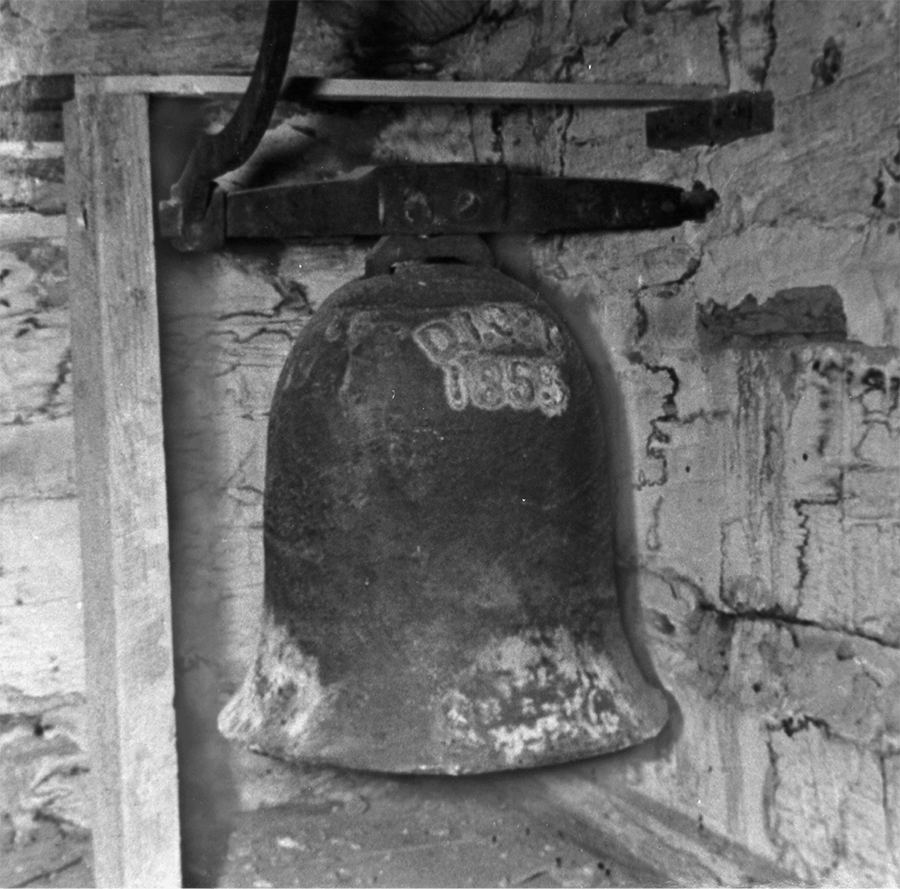
Nevertheless, with the large amount of iron produced during April 1855, moulders were kept busy transforming pig iron into useful implements, including more hot blast pipes, machine parts, tools, horseshoes, pots, flatirons and nails. William Ashworth recalled later in life that the iron workers “made a few stoves but could not get them smooth enough to be marketable. Some bells for school houses and churches were cast.”76 One of the few artifacts known to have survived from the Deseret Iron Company is one of these bells (see illus. 13-6). It weighs about 150 lbs. and was originally placed in a wooden tower; later it hung in the belfry of a hotel run by Henry Lunt’s family. According to local historians, the boys of Cedar City rang it often. “Meetings, schools, funerals, dances, even the time for taking the town herds of sheep and cattle out to feed and their return, were rung by the community bell.”77
Illus. 13-6. Deseret Iron Company bell, cast in 1855. Photograph taken inside George and Mary Davies Wood cabin. The bell is now on permanent display (as is the cabin) at Iron Mission State Park in Cedar City. Photograph by York Jones.
With many technical problems solved—excepting lack of fuel—the greatest need was for still more manpower. George A. Smith, who had led the first settlers to Iron County, enthusiastically called for more recruits:
One hundred and fifty men are wanted immediately in this county to carry on the Iron Works successfully; those most needed are wagoners, miners, colliers, lime-burners, lumbermen, quarrymen, brick and stone masons, carpenters, joiners, machinists, charcoal burners, and furnace men. Fifty additional teams are necessary to keep the furnace supplied with fuel and ore. The people are in high spirits on the iron subject; the furnace having been kept successfully in operation two weeks satisfied the most sceptical that nothing was wanting but to continue the charge, as the furnace was blown out simply for want of fuel.78
George A. Smith’s euphoria is understandable. The pioneer iron workers had struggled through a whole range of problems from inadequate natural resources to extremes in climate, improvising techniques to match the peculiar challenges of smelting ore on the American frontier. Now they had prevailed, creating a sustainable iron-making operation. The Iron Mission seemed poised, at last, to become truly successful.
Sidebar 13-1: General Conference Statistical Report
One method of tracking the continuing streams of converts hoping to help build Zion was statistical reporting at each semi-annual general conference. Figures for Parowan and Cedar City, tallied 6 October 1853, are given below:
Parowan (Bishop Tarlton Lewis reporting):
High Priests:
11
Seventies:
38
Elders:
29
Priests:
2
Teachers:
⁄ *
Deacons:
⁄ *
Total Ward Population:
392
Cedar City (Bishop Philip Klingensmith reporting):
High Priests:
12
Seventies:
25
Elders:
48
Priests:
7
Teachers:
12
Deacons:
5
Total Ward Population:
455
*The slash marks appear to represent zero.
Source: Deseret News, 15 Oct 1853 (vol. 3, no. 19), 3d unnumbered page.
Sidebar 13-2: Analysis of Pioneer Ore by York Jones
Around 1977, York Jones analyzed an iron ore sample taken from the furnace site and found an explanation of the “hard brittle and white” pig. Pioneer iron had 1.02 percent phosphorus compared to modern specifications of about .3 percent. Too much phosphorus causes brittleness, yet its levels in iron are difficult for a furnace master to control. Furthermore, samples of “bog ore” (hematite) taken from an old mining site at the base of Red Hill east of Cedar City had an unusually low iron content, only 15 percent Fe2O3, with almost 60 percent silicon dioxide. Ideally ore should have over 40 percent iron and less than 10 percent silicon dioxide. Limestone found at an old pioneer digging near the same site was adequate, but coal from the Webster-Nelson mine near the pioneer mine in Right Hand Canyon had too much sulfur and too little carbon, making it unsuitable for coking.
Source: Jones, “Iron Mining and Manufacturing”, 61–62. The MSS is undated, but two hand-written notations, one reading “1976” and the other “5/78,” both initialed by Jones, allow us to approximate the date of his study.
Notes
1. Brigham Young, Journal of Discourses (27 May 1855), 2:283.
2. Erastus Snow and Franklin D. Richards, “Report of Travels,” ca. 6 Dec 1853, published in Deseret News, 15 Dec 1853, 3d unnumbered page; Deseret Iron Company, Minutes, 12–13; Arrington, Great Basin Kingdom, 125, citing “Manufacture of Iron in Utah.” See also Henry Lunt to Franklin D. Richards, 25 Sep 1853, published in Deseret News, 15 Oct 1853, 4th unnumbered page; and Bowering, journal, 3 Sep 1853.
9. “Petition of Cedar City Residents,” 12 Nov 1853, document no. 1815, Utah State Archives and Records Service.
10. Haight, journal, 8 Oct 1853. Haight’s arrival in Cedar City on 1 Nov 1853 is documented by Bowering, who writes in his own journal of a meeting that Wednesday evening “in the centre of the Fort round a fire” at which “Elder I. C. Haight, Spoke his feelings, and then the meeting dismissed.”
12. Bowering, journal, 5 Nov 1853. Snow and Richards give the building’s dimensions as 28 x 60 feet (in “Report of Travels,” cited in n. 2 above); Jenson gives them as 25 x 60 feet (in “Manuscript History of Cedar City,” 37). Bowering’s 5 Nov journal entry, cited above, uses the phrases “of building” and “be built,” both of which imply new construction. Andrew Jenson, however, in a somewhat ambiguous comment says that the schoolhouse was moved rather than demolished. Referring to the Ross home, which became the school-cum-meetinghouse in the Compact Fort after the family left Cedar City, Jenson reports: “It remained there until 1853 when, on account of Indian difficulties, it was removed to its present location. The meeting house in the second location was an adobe building standing against south wall, about 60 by 28 feet. When the location was changed the house was taken down and moved to the present location, and put up on Block 37, lot 18, east of present Tabernacle, on the same block. It was called the Social Hall. It was used for all public purposes until the present tabernacle was built. It was still standing . . . until 1891 when it was considered unsafe for public use” (Jenson, “Manuscript History of Cedar City,” 8). Jenson appears to be saying the old schoolhouse was still standing when he wrote the manuscript history but was derelict by 1891. The “second location” should be Plat A, the south wall reference putting the building’s relocation somewhere near the back edge of one of the 16 lots in Block 8 (see illus. 12-2). Jenson’s reference to “present location” should mean Plat B, although Lot 18 of Block 37 on that plat was assigned to William Stewart. If Jenson is correct, the building had an unexpectedly active and varied existence: supposedly the first structure raised in the Compact Fort, it was originally a family home. It was then expanded and turned into a meetinghouse by Joseph Chatterley, acting privately; expanded again by Henry Lunt, acting publicly as community leader; supposedly dismantled, moved and rebuilt on the south side of the public square in Plat A; and finally moved again, this time to Plat B where it took on new life as the Social Hall. Erastus Snow’s remarks “on the necessity” of building a meetinghouse and George Bowering’s report of dismantling the Compact Fort, however, substantially weaken the premise that the Social Hall could be the direct descendant of the Ross family cabin.
13. Deseret Iron Company, Minutes, 30, dating Haight’s appointment to 26 Nov 1853. Haight’s journal entry for the 27th, however, records his being appointed that day “one of the Directors and . . . Manager of the Company’s affairs in America.”
14. Haight, journal, 27 Nov 1853; Snow and Richards, “Report of Travels”; and Deseret Iron Company, Minutes, 14, confirm that Carruthers was living in Cedar City until at least this date. At the 10 Nov shareholders meeting he is listed as one of five men (the others being David Stoddard, James Williamson, William Stones and Joseph Clews) who “asked leaf to withdraw” as shareholders of the company. The absence of his name in subsequent company documents implies that he left for Scotland not long after this meeting.
15. Snow and Richards, “Report of Travels”; Jenson, “Parowan Ward History,” 65; Deseret Iron Company, Minutes, 30. Haight, journal, records that the municipal election was held Monday, 5 Dec, rather than 6 Dec as given in the “Parowan Ward History.”
17. “Taken from a Autobiography of John Lee Jones as a missionary,” 2-pg. reminiscence in possession of the Alva Matheson family in Cedar City, Utah. Final line of typescript reads “Ella Leigh has the original copy of this paper. Copied October 1965” (cited from copy in Shirts Collection).
18. William Ashworth, “Autobiography,” bound typescript, 9 Perry Special Collections.
25. Ibid., 90–124. As already noted in ch. 10, it should be emphasized here that, in almost all cases, amounts earned by workers were actually credits entered against their names in the company books.
33. Reprinted in “Manufacture of Iron in Utah,” Millennial Star 17 (6 Jan 1855): 6; more details appear in Deseret Iron Company, Minutes, 37. Very similar descriptions of the furnace occur in all three sources and in Morris, diary excerpts, 2. A comment in the Millennial Star article, “The particulars of the furnace, brother Elias Morris, who was the Architect, will give you,” suggests that he was the original source of the description.
34. “Furnace Account, cost of erecting, from 30 May to 16 Sept. 1854,” Deseret Iron Company, miscellaneous documents, Palmer Collection.
35. Crook, “Early Industry and Trade,” 65; Jones, “Iron Mining and Manufacturing,” 56.
36. Lucius N. Scovil to editor, 7 Dec 1854, published in Deseret News, 4 Jan 1855, 2nd unnumbered page.
73. John Lee Jones, single holograph sheet, “The Names of Those Who Run the Blast Furnaces,” including report of a life-threatening accident, Palmer Collection (copy in Shirts Collection).