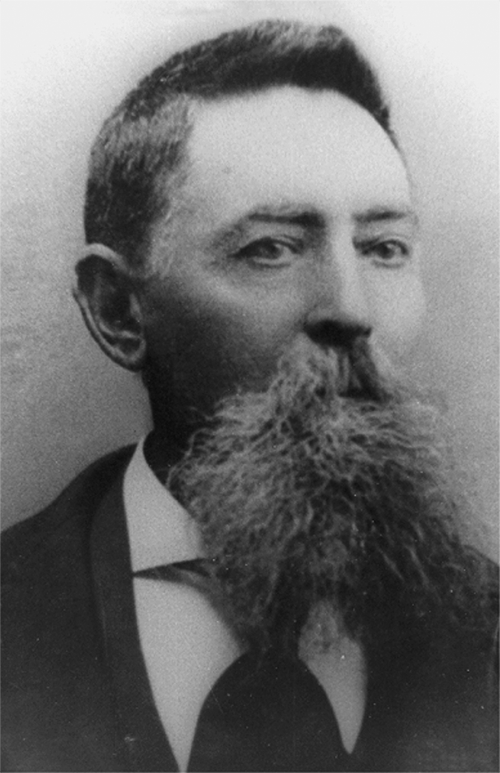
On 19 May 1855, Brigham Young and his company arrived in Cedar City to evaluate the progress of the Iron Mission, having stopped on the way to investigate the abundant coal deposits in Sanpete County. They visited the iron works as soon as they arrived and saw for themselves the recent successes in iron output. Achievements there were matched by increasing growth and stability in both Parowan and Cedar City. The day after his visit to the iron works, Brigham Young presided over a conference making Cedar City, Harmony and Johnson’s Spring a new stake, separate from the one at Parowan. Isaac C. Haight was appointed president of the new Cedar City Stake with Jonathan Pugmire and John M. Higbee (see illus. 14-1) as his counselors.
Illus. 14-1. John M. Higbee (1827–1904), counselor in the Cedar City Stake Presidency and major in the territorial militia. Courtesy Richard Neitzel Holzapfel.
Haight felt burdened with this new responsibility but, as usual, agreed to shoulder the additional load. He commented that the stake presidency “with my other duties, seemed a great task, yet I feel to do as the Lord shall direct or appoint me to do.” A week earlier, Haight had been reelected mayor of Cedar City for another two years. On 21 May, President Young returned to Parowan and reorganized the stake there. J. C. L. Smith, who had presided over the original stake, was named president of the now-separate Parowan Stake.1
Immediately upon returning to Salt Lake City, Brigham Young addressed the Saints in the Tabernacle, reporting at length on the Iron Mission. In light of recent successful runs in the Noble Furnace, he affirmed that “the brethren have done as well as men could possibly do, considering their impoverished circumstances, and the inconveniences they have had to labor under.” He stressed the benefit of running the furnace as long as possible, preventing damaging “blow outs” which cost so much to repair. To this end, he called for 15 good teams and 25 more men to go to Iron County and help meet the increasing demand for iron ore and fuel. He insisted that if they had a mind to, they could keep the furnace running for several months at a time:
Iron we need, and iron we must have. . . . We have an abundance of the best quality of iron ore. A trial furnace was made, and kept hot for sixteen days, and produced as good pig metal as can be found in the world; this they puddled, and brought forth excellent iron. I believe the castings made from the pigs will be superior to any in the world. I repeat that iron we must have, and we are right on the threshhold of obtaining it; we have our feet on the step, and our hand holds the latch of the door that leads to the possession of this invaluable material.
He also pointed out the difficulty of relying on creek water to power the blast. “[I]n one freezing night it will perfectly close up, insomuch that there will not be enough to water a horse.” He noted with anticipation that the iron workers were building an engine that would keep the blast furnace operating through the winter. Because plentiful, high-quality fuel was so important to continuous iron production, President Young revealed that he had considered moving the iron works to the rich coal supplies in Sanpete County. Nevertheless, he had decided against it for the time being.2
Contemplating a Third Move
Although Brigham Young was satisfied to leave the iron works in southern Utah, he was not satisfied with the Plat A fort site. At the Cedar City stake conference, he proposed moving the town one more time because of flood danger to Plat A if Coal Creek overflowed. He suggested relocating south of the iron works and east of the Plat A fort. He did not recommend tearing down the fort, which could be used to accommodate newcomers, but encouraged Cedar City residents to move to the new location at their discretion. One week after Brigham Young’s visit, Isaac Haight motioned that “the city be located and occupied according to the proposals of President Young.” Agreement was unanimous.3
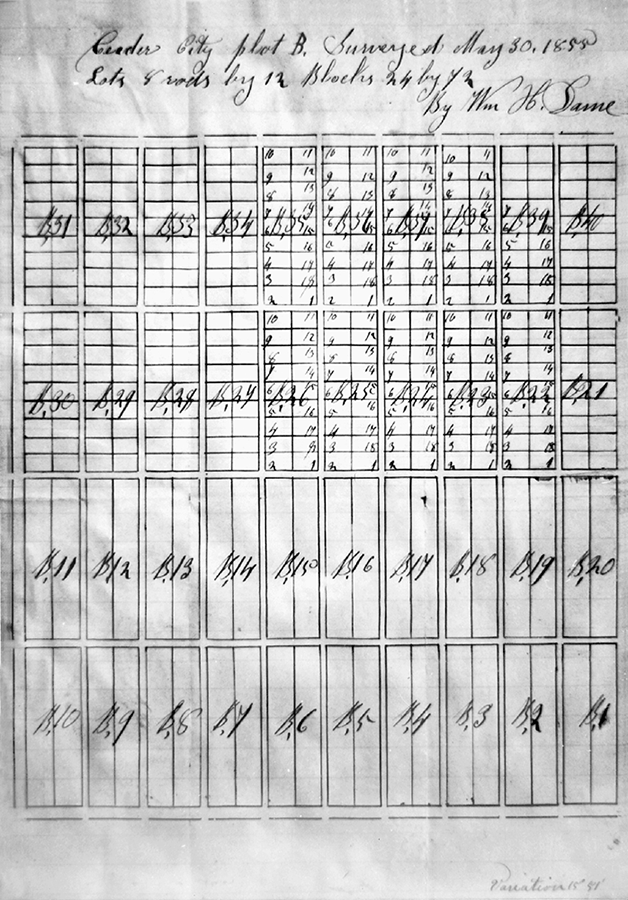
By the end of the month, William H. Dame had surveyed the relocation site, designated Plat B, the present location of Cedar City. Dated 30 May 1855, Dame’s survey consisted of 40 blocks, the first group of which were 24 by 72 rods, with Blocks 21 to 40 subdivided into lots 8 by 12 rods (see illus. 14-2). Landmarks in modern Cedar City correlate easily with this survey. Block 44 was reserved for the city park. Modern 200 North borders Blocks 31 to 39 on the north, while Center Street borders them on the south. Center Street is north of Blocks 22 to 30, which are bordered on the south by 200 South. Sixth West is adjacent to Blocks 30 and 31 on the west and 300 East is adjacent to Blocks 22 and 39 on the east.
Illus. 14-2. Dame’s “Ceader City” Survey of Plat B, dated 30 May 1855, showing individual lots at 8 by 12 rods and city blocks at 24 by 72 rods. This is the site of modern-day Cedar City (see app. 10 for listing of lot owners). This plat is furnished for information only. No liability is assumed by Assessor’s or Recorder’s Office as to correctness of such data. Iron County Recorder.
On Sunday, 10 June 1855, Isaac Haight encouraged the settlers to start building on the new site, stating that “if they did not feel to build there they are not as they ought to be in feeling, for the president [said] it was not safe here.”4 On 25 June 1855, over 90 men paid fees for lots in Plat B, many claiming double lots, although the actual move took place more slowly (see app. 10).
Battling the Environment: Grasshoppers and Drought
The greatest challenge that spring, however, was not relocation but the combined effect of drought and insects, which proved almost catastrophic. Farmers were still planting in May because spring warmth had come so late but even worse were the “grasshoppers of small dimensions” which were “far more numerous than the contending armies in the Crimea.”5 George A. Smith wrote Franklin D. Richards on 31 May that “in every settlement I passed through there were myriads of grasshoppers. At Parowan there were none when I arrived there, but in a few days the little fellows began to appear in innumerable hosts.”6 During Brigham Young’s trip to the southern settlements that month, as reported in the Deseret News of 31 October, he found the Saints “with their crops almost entirely destroyed by the ravages of grasshoppers, rendering their hard exertions and the labors of their hands fruitless.”7 William McDonald planted 20 acres of wheat on his rented farm but the insects attacked his field:
It came up Nice and was looking fine and the Grasshoppers Hatched out And Swept the ground so Clean there wasent a Green thing left. That stopped My farming that year and it seemed as though there Wood be a famin for the Whole Country Was swept Clean of vegetation and We Were over a thousand Miles from Where We could get aney Help.8
The drought was equally uncontrollable, made worse by relentless winds. George A. Smith complained on 18 May that “The wind has blown a gale here for the last four days, dust in the eyes, and every where, that dust can find a resting place, is the result. The farmers have to irrigate all the land before sowing, the spring has been so dry.”9 James Lewis echoed in the Deseret News that “the streams are very low, and we have had no rain this summer, the country is very much parched.”10
In October 1855, when J. C. L. Smith, Jesse N. Smith, Philip Klingensmith and Thomas Dunlop Brown arrived in Salt Lake City with a party from Iron County, they reported that not over 20 bushels of wheat had been raised at Parowan.11 The Parowan settlers rationed food but also took an additional precaution, as reported by the Deseret News in June of that year:
The fields look like a desert and every separate bench appears to be hatching out fresh crops of grasshoppers. . . . The water is lower than has ever been known before, and but a small portion of the land resown can possibly be watered. . . . The Public Square at Parowan city (10 acres) has been planted with potatos in the hopes that the united efforts of men, women, and children, chickens, ducks, turkies, &c, &c., may save a sufficiency to have occasionally a little potato soup next winter.12
The emergency forced the settlers to abandon their wheat fields outside the fort and ration available water among the garden-sized interior plots. A series of entries in Deed Book B proves the existence of 88 small lots, 18 feet wide and 132 feet long in Block 12, the public square. No survey map is extant, but the number of lots plus the space needed for irrigation ditches and access paths would completely fill the square as it probably existed then. George A. Smith’s ironic comment to John Taylor at the time echoes the Deseret News report: “Men, women, children, geese, ducks and chickens are all conspiring to try and raise something.”13
In Cedar City, as in Parowan, crops were light and the pioneers devoted much of their energy to mere survival. Coal Creek ran so low that it could not be divided sufficiently for both farming and iron production. Home building in the new city halted and water levels dropped too low to allow the waterwheel at the iron works to operate. Fires swept through the canyons, destroying not only standing timber but also the bridges the pioneers had built.14
Although the Noble Furnace could not function without water, other activities at the iron works continued throughout fall 1855. The men in the blacksmith shop were busy fixing both farm tools and furnace parts. The engineering department continued its efforts—which Brigham Young had noted at the last general conference—to build an engine able to make the iron works independent of Coal Creek. The Deseret Iron Company Minutes confirm that, when the furnace was idle (as it was for much of 1855), the men always tried to occupy their time as best they could:
No record being kept from April to Oct. 14th, the following is as near as the clerk at the works can recollect. A pudling furnace and Trip Hammer were put up and some few hundred of scrap iron was heated and drawn out for the lathe, furnace bars and water tweers. The moulders made castings for hot blast, a large lathe and wheels for gearing of the cylinders. A new water wheel was made with cast iron cranks and gudgeons, put in together with the wheel gearing for working the cylinders. One of the cranks bursting by wedging too tight a new one was cast the following day and put in. Several tons of Lean ore were hauled placed upon beds and roasted. A few hundred bushels of charcoal was burned and hauled by D. Gould. Several hundred tons of coal was hauled and burned into coke.15
According to the Deseret Iron Company Journal,almost 17 tons of rock were quarried and 54,000 adobes delivered to build a large machine shop.16 Coal was hauled from the mines, Henry Cook and Samuel Gould processed bushels of charcoal and cords of wood were stockpiled.
The water flowed again briefly and the iron workers made another start with the Noble Furnace toward the end of November. In the week ending 23 November 1855, 24 tons of “lean ore” and 12 tons of “magnetic ore” (magnetite) from West Mountain were hauled in, as well as over 25 tons of coal and approximately 20 cords of wood. Samuel Gould provided 662 bushels of charcoal. In addition to gathering sufficient fuel for another furnace run, the teamsters hauled large quantities of adobe brick for the construction of a foundry.17 Nevertheless, a severe winter was moving in on the iron works. Erastus Snow reported these problems in a letter written 11 December:
I learn that the freezing of Coal Creek, a few days since, stopped the blast from the furnace after a few days’ successful operation; and the directors have concluded to suspend further operations until spring, except to use up the metal now on hand in casting some mill gearing, &c. It is certain that Coal Creek cannot be relied upon for a motive power in our Iron Works, and that the sooner we have an engine the better. The cost of such a one as we need would not exceed $1500 in St. Louis.18
Writing two weeks later, Snow referred to the pioneers “occasionally” succeeding “in running out about a ton a day” of ore through this period. Even so, snow was so deep that coal beds in the canyon were inaccessible and mining stopped as well.19
The end of the year brought another and more unexpected calamity. On 30 December 1855, John Calvin Lazelle Smith, Parowan’s respected stake president and community leader, died of heart failure after a brief illness but some years of less than perfect health.20 In a 29 December letter, written from then-state capital Fillmore City, George A. Smith alerted Franklin D. Richards that “President John C. L. Smith of Parowan is reported very sick.” After sharing more news, he broke off the completion of his letter until the following 5 January, then noting that a “Brother Wilford, an emigrant from Australia, came in from Parowan last evening, with letters and the melancholy news of the death of Elder John C. L. Smith, the president of the stake. He was a good man and has gone to rest, but his loss will be sever[e]ly felt in that part of the country.”21 J. C. L. Smith was only 33 years and a few months old when he died. The sadness felt by the settlers at his passing intensified on 10 August 1856, not much more than seven months later, at the death of his infant son, little John Lazelle Smith.22 William H. Dame, the hard-working surveyor of Parowan and Cedar City, became the new stake president on 16 January 1856.23
By 3 February, even with snow still on the ground, George A. Smith was encouraging a general relocation to Cedar City Plat B. “We should improve that place as Brigham had said so,” he affirmed. He “did not wish to see any more improvement made here [on Plat A] not even on a house worth fifteen dollars.”24 Three weeks later, water ditches on the new townsite were ready and the Saints were again urged to build there.
In spring 1856, new settler Bengt Nelson described the dwellings in Plat B, which reflected the poverty of the pioneers:
Returning from Iron Springs, the first thing I did was to secure a lot on which to erect a home for myself and wife, the new city, the present site of Cedar, having been surveyed the year before. I secured a city lot from the Bishop and was the third settler in the new city, as the people had not started to move up from what was called the old Fort, but as I was expected to work at the iron works I came direct to the new location as it was much nearer the iron works than the old Fort. I dug a cellar, but having no lumber, I used willows for the roof, then covered them with straw that I obtained from a kind farmer, and then covered that with dirt, but it proved to be a rainy season, and the roof leaked badly. I tore the roof away, made some adobes, walled up the cellar, and built an adobe room on top of it. I succeeded in procuring some old boards for the roof, and covered them with dirt. But not having any boards for the floor, we had quite a time, until I got hold of a few pieces and we made them answer for part of a floor, at least.25
Tackling Manpower Shortages and Technical Challenges
The “rainy season,” which made it so hard for Nelson to install his roof, was all too brief. In 1856, the Iron County pioneers were again plagued with drought and grasshoppers and some settlers left to find farms in more hospitable country. On 21 May, President Haight wrote Brigham Young that “our prospects in relation to the Iron Works looks to me rather discouraging at present, for want of the necessary help.” When he returned from the statehood convention, he asked for volunteers to haul coal, but the men said their teams were too weak to get up to the mines. He noted that
the prospect looks rather dull for getting much fuel. I expect to Start the Blast furnace some time in June and use up the fuel we have on hand, And so much more as we can get, I feel almost discouraged Some times and ready to give up the Job but as you sent me here to take charge of the Iron Works I intend to continue to do the best I can however discouraging things may appear, until you see fit to appoint another that will take hold and do beter than I have yet been able to do.26
A 10-day trial of the “hot blast” furnace, possibly trial furnace no. 1, ran from 20 to 30 June 1856 but produced only 300 lbs. of iron (on the 22nd) before the iron chilled and the furnace had to be blown out.27 In July, desiring to salvage the iron, Joseph Walker built a small furnace “for running the old bear in to pigs.”28 On 21 July, a company led by Isaac Haight went to West Mountain exploring for iron. Peter Shirts successfully located a deposit and they returned the next day with 2,400 lbs. of high quality metal, which they called “virgin ore.” This ore body is believed to be the deposit located about two miles west of Pinto Junction beside Highway U-56, the highway between Cedar City and Newcastle. The explorers wanted to calcine the ore and then try it in a cupola or small furnace. On 28 July, Elias Morris began taking down the old hearth, reducing the boshes and relining the Noble Furnace in preparation for another run.29
The shortage of labor prompted Thomas Bladen to go on a mission to “recruit and convert skilled iron workers” in England and he arrived in Liverpool on 7 August 1856. He wrote to John Taylor from New York describing the iron works in glowing terms, going so far as to imply that the coal was of a high quality for coking. As he reported,
There is an extensive range of buildings for the work shops where a great number of mechanics are employed in almost every branch of the iron trade. Other mechanics will shortly be wanted to assist in carrying on the work. The company is fast preparing to supply the rising state of Deseret with everything in the iron trade that she will require from a nail to a steam engine.
Brethren who feel an interest in this great work, will do well to arise and assist in rolling on the same, that Deseret may be independent of the nations for the most valuable of all metals—iron. The bees of the hive of Deseret are at work.30
Despite Bladen’s enthusiasm, iron production was plagued with difficulties in 1856. A furnace run was tried in June, but failed. Thomas Gower, rather than the experienced David B. Adams, was the keeper.31 The workers were just getting the furnace started up when the blast pipes accidentally burned out. By the time the pipes were replaced, the water shortage in Coal Creek made it difficult to operate the furnace. Another run was attempted in mid-July with David B. Adams as keeper, but it was cut short and the iron chilled.32 Shortly afterwards, Adams left the works and moved to Beaver County, probably due to the terrible drought. On 4 August, wrote Haight in his journal “We also started the iron works, but for the want of water we had to stop without accomplishing much.”33 The moulder’s cupola continued to operate, making castings for individuals and small accounts (such as a business run by Isaac Haight and Charles Simpkins) to supplement iron company work. As with the winter of 1855–56, the iron works essentially shut down over the winter of 1856–57.
Even as they were struggling in near poverty, the iron workers were willing to give assistance to a short-lived attempt to produce lead in southern Nevada. Indian missionaries called to the area in June 1855 had discovered outcroppings of lead 30 miles southwest of Las Vegas. Brigham Young approached Nathaniel V. Jones in February 1856 to lead an expedition of 30 men to investigate and, if possible, found a lead industry. The Iron Mission provided supplies and Bishop Klingensmith traveled with the lead missionaries to Las Vegas to evaluate the deposits. Hauling equipment from Salt Lake City, Jones and his men were able to produce about 9,000 lbs. of lead which the Mormons made into bullets. Lack of nearby water and forage, however, made mining difficult, as did impurities in the lead. The missionaries abandoned the effort and returned to Salt Lake City in March 1857. Ironically, the impurities which had frustrated the smelting process turned out to be silver and “gentile” prospectors discovered a nearby lode in 1861, which became the immensely rich Potosí silver mines.34
New hope for the iron works arose in March 1857, however, when Isaac Haight received a letter from Brigham Young offering the use of a steam engine that had originally been imported for the sugar mill and was now being surplused by the paper mill in Salt Lake City.35 A pair of 30 horse-power engines had been brought south from Salt Lake Valley a year before (March 1856) but had not worked well. The iron company engineers in Cedar City had not been able to build a satisfactory engine themselves, despite newspaper accounts of the iron company casting “some beautiful machinery, intended to supercede the use of Coal creek for motive power.” President Young suggested that Haight send a company of trusted men to Salt Lake City to retrieve the new engine but the directors of the Deseret Iron Company wanted Haight himself to supervise the transport.36 The Minutes record the much-anticipated arrival:
April 8th, 1857. The engine sent down by Prest. Young arrived in this city 4 p.m. and on the morning of the 9th was taken to the iron works, examined and found correct according to invoice, except cold water pump.37
The Deseret Iron Company Journal indicates six months later that $2,181 was paid to Brigham Young for the engine.38 Setting it up, building an engine house and modifying the furnace was an ambitious project, but it promised to free the iron works from its frustrating dependence on Coal Creek.
The engine was tried on 8 July 1857 but the new technology created its own set of mechanical problems which needed to be solved before the furnace could function properly. At first, the workers could not create a sufficient draft in the chimney for the boiler fire. They tried lining the stack to decrease its diameter, then raising the stack, then running a new flue from the fire box to the stack. As Isaac Haight informed Brigham Young on 25 July, “We are preparing to put the blast on the furnace on Monday[;] wee have been raising our Chimney stack to increase the draft from the Baile [sic] furnace as we use the Old Stack that was built for the Old Air furnace.”39 Finally the draft was strong enough for the engine to power a furnace run on 28 July; however, a leak in one of the flues in the boiler stopped the engine after a 12-hour run. The blast was put on again on 30 July but muddy water from a canyon rainstorm deposited sand in the steam cylinders. The workers then decided to build a reservoir to provide a supply of clear water for the boiler. The small reservoir, 75 feet long and averaging 25 feet wide, was lined with fire clay and gravel.40
The engine now worked well, but other problems with the furnace remained unsolved. First a valve on the blast cylinder broke, then the furnace lining proved insufficient for the strength of the blast. When the furnace was put back on, it worked “very middling,” yielding “little iron[,] cinder and bogus.”41 Comparing the various Deseret Iron Company records reveals that the number of iron workers continued to decline throughout the coming months. Those who remained worked mostly on repairing equipment and on constructing or improving buildings.42
Restructuring the Territorial Militia
Isaac C. Haight, called to the Cedar City stake presidency on 20 May 1855, was elected to the 1855 territorial legislature that August. He left with Jesse N. Smith on 5 December, in freezing weather, to attend legislative sessions in Fillmore, where he was appointed a member of the military committee. There, he worked on a bill to more completely organize the militia.43 Following a family visit, Haight again headed for Fillmore, leaving on 4 March 1856, this time as delegate to the convention preparing a petition for statehood. He was accompanied by Washington County’s representative, John D. Lee, of Fort Harmony.44
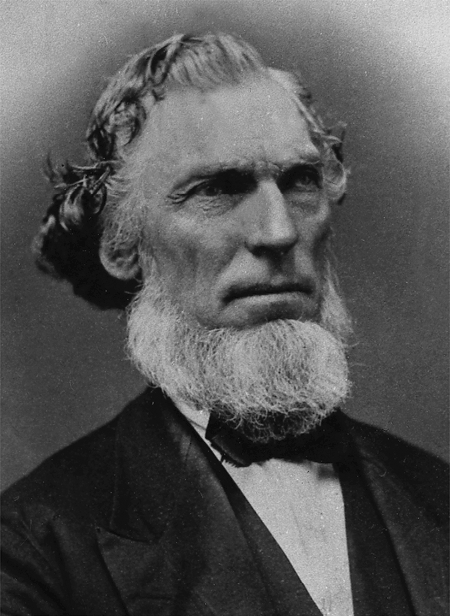
Although conditions at the iron works had given Haight a temporary rest, he was now kept busy by a second term as territorial legislator. The 1856–57 sessions met on 8 December 1856 in Fillmore, only to reconvene on 18 December in the Social Hall in Salt Lake City. Haight was again appointed to the military committee. Because there had been no serious military engagement since the Walker War, the legislature took advantage of the time to restructure the Nauvoo Legion, authorizing Lieutenant General Daniel H. Wells (see illus. 14-3) to head a committee to draft a new set of laws and regulations. In February 1857 the committee met to reorganize the militia, as requested. Each division would have two brigades, consisting of 1,000 ordinary soldiers. And each brigade would contain two regiments (of five battalions each). Individual battalions would have 100 soldiers, organized into two companies of 50 men each, while a company would be divided into five platoons of 10 men each who would elect their own platoon leader from within the group. Military district boundaries were redrawn, making a total of 13 for the territory. The “Iron Military District,” or Tenth Regiment, included Iron, Beaver and Washington Counties and was to be organized under the supervision of William H. Dame.45
Illus. 14-3. Daniel H. Wells (1814–91) appointed to lead the territorial militia. CourtesyLDS Church Archives.
During the 1856–57 legislative session, Haight recorded that Heber C. Kimball, Brigham Young’s first counselor, presided over a ceremony designed to rededicate the legislators from all over the territory to the work of establishing the Kingdom of God. On 30 December 1856,
Both houses met in joint session and Prest. Kimball required every member to repent of all their sins and be baptised for the remission of the same before any business could be done. Preparations were then made and all the members repaired to the Endowment House and were baptised in the font, and were confirmed and all were made to rejoice with joy and gladness unspeakable.46
This rededication was part of a movement begun earlier in 1856 by Brigham Young’s second counselor, Jedediah M. Grant. Grant wanted to reinvigorate the Saints who, he felt, were becoming lax in religious observance after almost ten years in their Great Basin sanctuary. During this Mormon Reformation, local leaders conducted detailed personal interviews with members to evaluate their conduct. Rebaptism followed, renewing spiritual commitment and enthusiasm for the cause of Zion. After witnessing the fruits of the Reformation in Salt Lake City, President Haight was determined to bring this work back home. His diary entry for February 1857 records that he “started the reformation in Cedar City and vicinity,” although other pioneer journals indicate the Reformation was already well recognized as far south as Harmony. A constant Reformation theme echoing in Sunday meetings throughout southern Utah was strict obedience to all authorities—both general and local.47
Political Maneuvering in the Nation
As if the technical problems of manufacturing iron and the difficulties of surviving the unpredictable climate of southern Utah were not enough, the iron missionaries were about to be embroiled in troubles on a much larger scale. When statehood was deferred and the Territory of Utah was created on 9 September 1850, politically astute Thomas L. Kane warned the Mormons that territorial status came with hidden dangers: federal control of all key administrative positions by using the power of political appointments.48 In the 1856 presidential election, John C. Frémont, Abraham Lincoln and Stephen A. Douglas, all former friends of the Mormons, became involved in arguing against the “twin evils” of polygamy and slavery. The Democrats won the election and James Buchanan became President, strongly urged by southern constituents to emphasize a national crusade against polygamy over the crusade against slavery. Alarming reports were coming in from disgruntled presidential appointees to Utah, including Judge W. W. Drummond (who was forced from his Utah judgeship for reported immoral conduct). Relying on such reports, President Buchanan became convinced that Utah Territory was in a state of rebellion against federal authority.49
Drummond’s opinions, for instance, were echoed by Thomas S. Twiss, Upper Platte River Indian Agent, and W. M. F. Magraw, former contractor of mail services between Missouri and Utah. Since 1849, Brigham Young and other leaders had discussed the possibility of creating a Mormon mail and freighting service. They hoped to improve communications among the Saints and tap some of the profits to be made in overland trading and hauling, primarily with those wagon trains headed for California. By 1855–56, a marked decline was observable in eastern mail service and the time seemed right to push Mormon plans forward as a practical alternative.50
On 6 August, the Deseret News printed a request from Postmaster General James Campbell soliciting bids for the mail route between Independence, Missouri, and Salt Lake City. Church financial backing enabled Mormon contractor Hiram Kimball of Salt Lake City to make the “lowest responsible offer” and he was awarded the route. The first months of 1857 brought flurries of related activity and far-flung correspondence, planning more connections once the central carrier service began. Brigham Young was elated. Then, suddenly, all was over.
In June 1857, the government nullified Kimball’s contract, giving as official justification the “non-arrival of the mail within the stipulated time.” The true origin appears to be the enmity of W. M. F. Magraw, who, as former mail contractor, disliked the idea of the potentially lucrative government contract going to Mormon bidder Hiram Kimball. Magraw vented his indignation by writing what Andrew Neff calls a “malignant” letter to the President of the United States. In it, Magraw described the Saints “as being in an uncontrolled state of lawlessness, in which murder, rapine and terrorism flourished and which had been superimposed upon a helpless society by a vicious, despotic, self-constituted theocracy at the head of which was Brigham Young.”51
Without any fact-finding or local investigation to support his actions, Buchanan decided to take a strong stand. He made new appointments, including Alfred Cumming as governor of Utah Territory, Jacob Forney as Indian Superintendent and Delana R. Eckles, Charles E. Sinclair and John Cradelbaugh as federal judges.52 Mormons were especially alarmed by the appointment of Cumming, former mayor of Augusta, Georgia, because of his connections to Missouri (well remembered for its anti-Mormon hostilities) where he was a successful administrator of Indian lands. On the advice of Secretary of War John Floyd, Buchanan’s plan included sending a sizable military expedition along with the new appointees, to enforce their acceptance.
On 28 May 1857, orders were dispatched by General Winfield Scott to assemble a large army at Fort Leavenworth, Kansas, to march to Utah. On 29 June, General Scott appointed General W. S. Harney as commanding officer of this expedition.53 Harney’s appointment was met with trepidation in Utah as he was a tough-minded military officer who had earned the epithet “Squaw Killer” in his battle with the Sioux Indians in 1854. It was reported that Harney planned “to capture Brigham Young and the twelve Apostles, and execute them in a summary fashion, and winter in the Temple of the Latter-day Saints.”54 Before the army left for Utah, however, Harney was reassigned to Kansas to maintain peace between abolitionists and their opponents. Colonel Albert Sidney Johnston, another stern disciplinarian, replaced Harney.
The first contingent of 850 troops left Fort Leavenworth on 18 July 1857 and arrived at “Camp Scott,” better known as Fort Bridger, in November. By late that month, the force had increased to over 2,000 men,55 ultimately reaching approximately 2,500. The total standing U.S. Army at that time was only 13,000 men,56 which meant that, at peak operation, almost one-fifth of the nation’s military manpower was diverted to solve the “Utah problem.” Congress was not in session when Buchanan decided to send such a large force; apparently he attempted to execute the entire operation in secrecy. Brigham Young may have learned something of “Buchanan’s Army” as early as 7 June 1857, for on that date, in a speech in Salt Lake City, he reportedly expressed the opinion that “trouble was brewing, and that some of the officers who had been sent to the Territory were circulating false rumors about the Latter-day Saints.”57
On 24 July 1857, approximately 2,600 pioneers assembled at the head of Big Cottonwood Canyon, east and south of Salt Lake City, to celebrate the tenth anniversary of their arrival in the valley. A. O. Smoot, Judson Stoddard and Porter Rockwell, who had been checking out the anticipated Mormon-operated mail route to Missouri, arrived at noon and confirmed Brigham Young’s suspicions—U.S. troops were approaching Fort Laramie. The three messengers, in a small springboard wagon with two span of horses, had covered the 500 miles from Fort Laramie in five days to alert Brigham Young as soon as possible. However, the Saints assembled for the anniversary festivities were not given the unsettling news until that evening.58 In Cedar City, oblivious to the approaching danger, citizens celebrated with a parade in which a “Company of Mechanics from the Iron Works” marched together, “each man bearing machinery representing his branch of industry.”59
Preparing for War
Brigham Young, who had not yet been officially advised of his replacement, moved to exercise his authority as governor to defend the territory against all enemies. On 5 August, two weeks after the army’s approach was confirmed at the 24 July celebration, President Young issued a “Proclamation of Martial Law.” The essence of the document was succinctly put in three statements at its end:
1st:—To forbid, in the name of the People of the United States in the Territory of Utah, all armed forces, of every description, from coming into this Territory under any pretense whatever.
2nd:—That all the forces in said Territory hold themselves in readiness to march, at a moment’s notice, to repel any and all such threatened invasion.
3d:—Martial law is hereby declared to exist in this Territory, . . . and no person shall be allowed to pass or repass into, or through, or from this Territory, without a permit from the proper officer.60
Two days prior, George A. Smith, who had commanded all the southern militia units during the Walker War, had left Salt Lake City to prepare outlying citizens for anticipated hostilites with approaching federal troops. On 4 August, he directed General Aaron Johnson of Springville to mobilize the local troops; at Nephi, Smith delivered orders to Major George W. Brandley; at Fillmore, he instructed Major L. H. McCullough to prepare. In Beaver, he met with Bishop Philo T. Farnsworth who was captain of a company attached to the battalion at Parowan. Finally, on 8 August, Smith himself arrived in Parowan where he found Colonel William H. Dame already drilling the troops.61 According to James Martineau:
This afternoon, at 3 o’clock the 1st Bat. mustered for the first time since its organization, and while on parade, Br. Geo. A. Smith arrived from G. S. L. City bringing information on the approach of an army from the United States to invade the Territory and wage a war of extermination against us. He brought orders from Head Quarters of immediate preparation for defense and for the preservation of grain etc; also instruction from Pres. B. Young to the same effect, and recommending that the Bishop get possession of all grain not wanted for immediate use and recommending all to live their religion and be prepared for that which may come to pass.62
As president of the Parowan stake, William H. Dame was the ranking religious leader. As colonel and commanding officer of the Iron Regiment, to which he had been elected on 28 July 1857, he was also the ranking military leader. The regiment consisted of four battalions, each with a major as its commanding officer. The First Battalion was in Parowan, commanded by Major James Lewis. The Second Battalion was in Cedar City, commanded by Major Isaac C. Haight, who had a dual rank as he was also lieutenant colonel, second in regimental command to William H. Dame. Major John M. Higbee, now first counselor to Haight in the presidency of the Cedar Stake, commanded the Third Battalion, also in Cedar City. Major John D. Lee commanded the Fourth Battalion, located at Fort Harmony (see app. 11).
On Sunday, 9 August, George A. Smith spoke twice to the people assembled in the Parowan Tabernacle, recalling his role in founding the town and appealing to the fighting spirit of the citizens. Because he was so trusted and beloved, his words had heightened impact:
As a people we have been long harassed and oppressed, driven, slain and plundered. I have got through with it. . . . If we trust in God he will give us power over our enemies. If there are any who are afraid, I wish them to go now, go like gentlemen, all who are not willing to die for their religion.63
On 10 August, Smith back-tracked to Paragonah to speak. After working on his property for three days, he traveled to Cedar City, where Colonel Dame had gone to drill the Second and Third Battalions. George A. Smith visited the iron works on 15 August and spoke twice the next day in Sunday meetings. That evening he traveled to Fort Harmony and the next day, as Rachel Lee reported, “the brethren paraded in order to show the Officer of this place how to disiplin their men aright. . . . President G. A. Smith deliverd a discours on the Spirit that actuated the United States towards this people—full of hostility and virulence.”64
Apostle Smith and Colonel Dame then rode south to Washington City where again Smith preached and Dame drilled the militia. Smith spoke in Santa Clara before returning to Parowan, speaking once more on Sunday, 23 August, encouraging the settlers to destroy their property rather than let it be used by their enemies: “But if the gentiles do come here I hope they will find nothing but a desert.”65 These speeches were inflammatory and obviously designed to prepare the people psychologically for all-out war. Their homes, their lives, their families and their lifestyle were believed to be in jeopardy. Responding to the threat, Colonel Dame reported to Lieutenant General Daniel H. Wells on that same Sunday that the district militia was organized with 200 men, armed and ready for action.66
George A. Smith left Parowan for Salt Lake City the next day. “From about this time,” Martineau noted, “parties of from three to five men were sent out to explore in the mountains,” to search for a hiding place in the south where the Mormons could gather if the army invaded the northern settlements.67 A letter from Lieutenant General Wells to Colonel Dame, sent on 13 August, again emphasized the need to conserve grain and counseled Dame to “instruct the Indians that our enemies are also their enemies. . . . They must be our friends and stick to us for if our enemies kill us off, they will surely be cut off by the same parties.”68 By mid-August all militia units throughout the territory had held musters and some were in the field. “Observation forces” were sent to Fort Hall and Bear River to guard the northern approaches. One group was sent to observe U.S. Army activities in the Fort Bridger and Fort Laramie areas and to harass the troops whenever possible. Now that martial law was in effect, Iron County units guarded southern approaches to the territory and allowed no one through without a pass.
Disaster at Mountain Meadows
Although a steady stream of emigrants had arrived in Salt Lake City throughout the summer, until the first part of August they had chosen the northern route to California, bypassing southern Utah. The first wagon train to take the southern route that year, rather than risk a possible winter passage over the Sierra Nevada Mountains, was a party of some 40 wagons and considerable ranching stock. Captained by Alexander Fancher and John T. Baker, the group consisted mainly of families from northern Arkansas intending to settle in the San Joaquin Valley.69 Unaware of the “Proclamation of Martial Law,” the Fancher-Baker train moved south without a pass or the sanction of a Mormon escort. As they traveled down the Mormon Corridor, contact with settlers became abrasive. The emigrants were anxious to replenish supplies for the long trek across the desert and objected to the Mormon policy of withholding grain from outsiders, especially for animals. Conversely, by traveling through Utah Territory without permission, the wagon train may have seemed a direct, even willful violation of President Young’s edict. Only a few months earlier, Apostle Parley P. Pratt, the beloved Mormon leader who first explored southern Utah, had been murdered in Arkansas.70 At the very least the Arkansas travelers would have been a galling reminder of this still painful loss.
Later accounts claim that members of the wagon train went even further, threatening the very safety of the Mormons. This harassment supposedly came from a group of “Missouri Wildcats” who had joined the Arkansas families en route. Analysis of the Fancher-Baker company, however, reveals that few of the travelers and none of the 13 single men in the party had Missouri connections.71 Even so, settlers apparently assumed that some of the company were from Missouri where Mormons had been severely persecuted 20 years earlier. Iron missionary C. Perry Liston, for example, recalled his anxiety when the “large party of emigrants partly from Missouri passed through our quiet settlement” boasting that “Johnsons [sic] Army was coming from the East and from the South and they would kill every mormon in Utah.”72
The prospect of a wagon train reaching California and inciting the federal troops there to march on Utah Territory would have been especially alarming to the isolated southern outposts. Acting in their military roles, local ecclesiastical leaders met several times in both Cedar City and Parowan to determine how Brigham Young’s proclamation of martial law should be applied. Finally, President Haight sent James Haslam, furnace keeper at the iron works and fifer for Colonel Dame’s regiment, as an express rider to President Young asking for advice.73
A significant part of Mormon defense strategy had been a campaign to convince Native Americans that Mormons were their friends and advancing American forces their enemies. Jacob Hamblin brought several Indian chiefs, including Paiute Chief Tutsegabit, to meet with Brigham Young in Salt Lake City to reinforce the message.74 In his autobiography William Ashworth recounted that a group of Indians had followed the Fancher-Baker train into Beaver, convinced that they had poisoned a spring at Corn Creek which had made the Indians sick.75 The 500 to 900 head of cattle belonging to the emigrants could also have tempted the Indians, who, joined by local tribesmen, trailed the wagon train to Mountain Meadows.
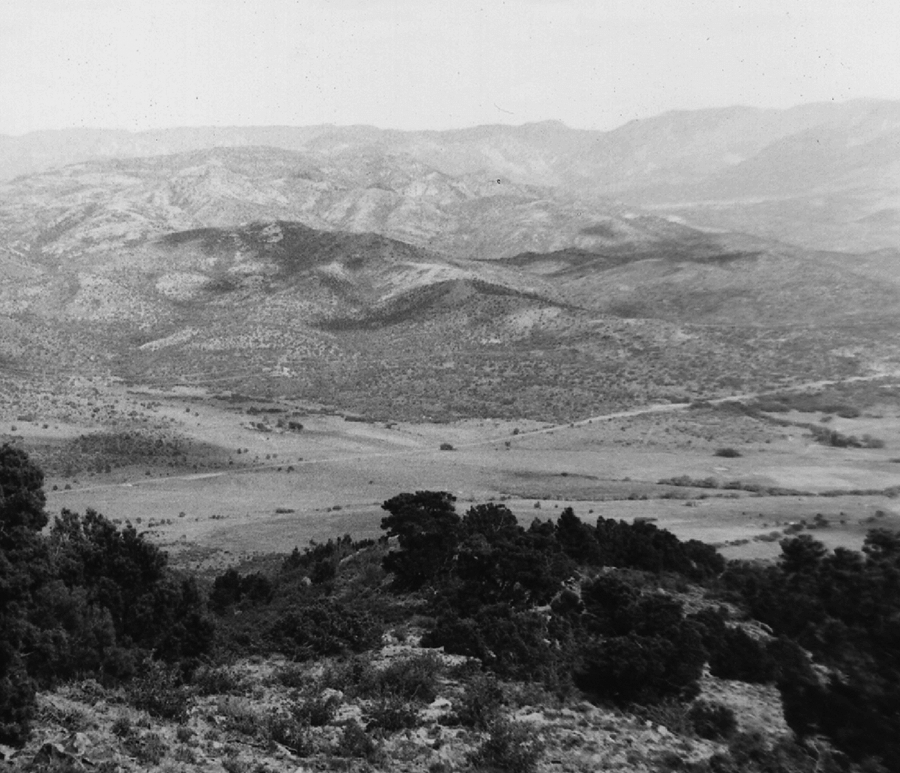
Mountain Meadows was a well-known campsite on the California Road. Its luxurious grasses provided a final rest stop for exhausted livestock before the much-feared desert crossing between Utah and California (see illus. 14-4). Given the size of the train, some of the emigrants may have driven loose oxen and cattle another four and a half miles south to Cane Springs, where more pasture was available.76
Illus. 14-4. Wide-angle view, southwest of Mountain Meadows, overlooking the site of the 1857 massacre of the Fancher-Baker wagon train. Because of severe grazing, drought and flood, sagebrush and weeds have replaced the once-luxuriant grasses. Photograph by V. Lee Oertle.
At dawn on Monday, 7 September, the Fancher-Baker train was brought under siege. The party at Cane Springs may have suffered the first Indian attack, survivors retreating to Mountain Meadows. There the emigrants drew their wagons into a circle, chained wheels together, dug firing pits and threw dirt under the wagons, creating a strong defensive barrier. While some emigrants, perhaps as many as seven, were killed and others wounded in the initial assault, the entire group resisted the siege for five days. By Friday, 11 September, however, low on water and ammunition, they were in a desperate state.77
The role of the Mormons in inciting the Indians to attack the Fancher-Baker train continues to be debated but there is no doubt that Mormon militiamen from the Second and Third Battalions (Cedar City) and the Fourth Battalion (Harmony) took part in the siege, including at least two high-grade field officers, Majors John D. Lee and John M. Higbee. The Indians were incensed by the casualties they had suffered and the situation was becoming volatile even for the Mormons. If the Indians chose to interpret as a betrayal any mercy shown by the militia toward surviving emigrants, the Indians might turn and attack the Mormons. Seeking for some kind of authoritative solution, the militiamen sent messengers to William H. Dame as Parowan Stake President and head of the Iron Military District and to Isaac C. Haight as Cedar City Stake President and second in regimental command (see app. 11).78
James Haslam, the emissary to Brigham Young, had reached Salt Lake City around noon on Thursday, 10 September, leaving immediately after his meeting with President Young and arriving in Cedar City on the 13th. However, before he returned with Young’s reply (which contained orders not to molest the wagon train), William Aiden, one of three men from the Fancher-Baker party trying to escape for help, was killed by a Mormon militiaman. At that point, the decision was made to give in to increasingly hostile feelings among the Indians and eliminate the entire wagon train.79 Exactly who made this decision and when it occurred has never been established.
Most reports concur that, after almost a week of fighting, Major John D. Lee, who claimed to be acting on orders from his superiors, led a negotiation team to the emigrant camp, to lure them from their redoubt, unarmed, on the promise of safe conduct to Cedar City, 35 miles back along the pioneer trail, if they would leave all their possessions to the Indians. Having little choice, the emigrants accepted the conditions and began their trek. The youngest of the children, 17 or 18 of them, were placed in the first wagon, followed by a second wagon containing the wounded, as well as arms and ammunition. These wagons were followed by the women and older children walking in a group. Some distance behind them walked the able-bodied men, each paired with an armed militiaman. After traveling one and one-half miles, these groups were intentionally allowed to string out along the trail, separated from each other by a small rise in the ground and by shrubbery. At a given signal, the accompanying Mormon militiamen, aided by Indians coming out from cover, attacked and massacred the entire train of emigrants, with the exception of the youngest children. These were taken to safety by Bishop Philip Klingensmith.80
Within days, the militiamen, appalled by their own deeds, confused about who exactly had ordered the destruction of the Fancher Train and afraid of possible repercussions, attempted to blame the entire episode on the Indians. John D. Lee reported this version of the story to Brigham Young on 29 September when Lee was in Salt Lake City for general conference.81 Initially, the cover-up was successful, but gradually the involvement of community leaders such as John D. Lee, John M. Higbee, Isaac C. Haight, William H. Dame and Philip Klingensmith became known. Because these men led not only the militia but also the stakes and wards, the civil government and the iron works, they had been greatly trusted. Their status had been reinforced by recent emphasis on Mormon Reformation, which renewed the obligations of Saints to follow their leaders. At the local level, at least, that trust was now broken.
Suspending Iron Operations
Until the ramifications of the Mountain Meadows massacre surfaced, the advancing U.S. Army contingent was still perceived as the primary threat to the well-being of the community. In September 1857, Isaac Haight wrote in his journal that because of that threat, President Young had ordered him to close down the iron works:
We started the iron works. Had received word to suspend all business and take care of the grain as the United States were sending troops into the Territory to oppress the Saints, and force officers upon us contrary to our wishes and the constitution.82
The Deseret Iron Company Journal for 3 October 1857 shows that John P. Jones, Joseph Walker, George Munroe, Joseph H. Smith and John Bradshaw Jr. were paid for melting down the furnace, while George Horton was reimbursed for tending the steam engine during operations. The week ending 12 October appears to be the final week of tangible iron work before Brigham Young’s injunction took effect. Planning on the day when they could reopen the works, some of the men continued to labor on the engine house as well as on a shanty in the canyon for the miners. On 12 October, Isaac Haight and Christopher Arthur were reimbursed for their respective services over the past year as general manager and clerk. These payments closed the office expense account.83 On 23 November, the Cedar City Tithing Office was credited with $2,223.87 from which 38 iron workers drew funds. It is unclear whether any of these “credits” came in the form of cash payouts.84
Providentially, an early winter ushered in by severe cold on 17 October halted the approach of Johnston’s Army, preventing inevitable hostilities. Although conflict was postponed, the territory remained in a state of alert. Mass meetings were held in various communities throughout the territory to express support for a joint proclamation by Brigham Young and the territorial legislature, chastising the government of the United States for sending an army against the people of Utah. In Cedar City, a resolution was passed that outlined grievances accumulated since the Nauvoo period, which approved Brigham Young’s establishment of martial law and pledged lives and property to protect the territory against invasion.85 William Dame and James Lewis wrote to George A. Smith on 23 December to assure him that the people of southern Utah were continuing their preparations: “The spirit of the south is good and all are on hand to do what they can to roll forth the good work. Bro. Dame has put 60 bushels of wheat into your bin and has stopped the work upon the overshot wheel until orders from you.”86
As spring 1858 approached, leaders in Salt Lake City realized the need to respond to the U.S. forces that would certainly enter the valley when the weather warmed. The policy of laying waste to the northern settlements and fleeing to the south as the army approached seemed most likely to win the sympathy of the people of the United States. In line with activites begun the previous fall, Brigham Young, on 10 March, wrote Isaac Haight, asking him to “send a company to explore White Mountains to find a place for the Saints to hide from the gentiles.”87 On 21 March, the president called a public meeting in Salt Lake City explaining the evacuation plan. He asked all those who had never been driven from their homes to raise their hands and said that they would be given the opportunity to move first.88 On 30 March, he again wrote Haight requesting that teams and wagons come to Salt Lake City to move the printing press south.89
In April, Brigham Young intensified the search for a safe haven. He instructed William H. Dame to raise a large company “of from 60 to 70 men, 20 waggons with 4 mules to each wagon, 2 Teamsters & a Horseman, with seed, grain, tools, &c., to Penetrate the Desert in search for a resting place for the Saints.”90 Ultimately, it was decided that a move only as far south as Utah County would be sufficiently impressive.
Meanwhile, President Buchanan, under pressure for allowing so many U.S. troops to be deployed on an uncertain expedition, ventured to defuse the situation by issuing, on 6 April 1858, a “full and free” pardon to the “rebellious” Mormons. Feeling that they deserved an apology rather than a pardon, Brigham Young waited until 12 June to officially accept. At that point, the Mormons allowed Alfred Cumming to assume his position as governor of the territory and the federal troops marched peacefully through a deserted Salt Lake City on their way to new headquarters 40 miles away at Camp Floyd.
Starting Back Up on a Smaller Scale
As early as January 1858, iron workers restarted operations, although on a limited scale. On 9 February, Henry Lunt, who had been home from his mission to England since September, wrote Albert Carrington: “Nothing has been done at the Iron works since last fall, but of late some of the brethren have been altering and repairing the blast furnace and preparations are being made for another trial, which I trust will prove successful.”91 On 12 March, Isaac Haight had received formal approval from Brigham Young to “go ahead with the Iron Works.”92 The first entry in the Deseret Iron Company Journal made in five months was on 31 March 1858, crediting several men for working on furnace repairs as far back as 19 January.93
Masons and common laborers spent the month of April erecting a new furnace, supposedly on top of a cupola that had just been torn down. This furnace was most likely a reincarnation of “trial furnace no. 2,” which may itself have been the demolished cupola. For the new construction, sand, rock and fire clay were hauled to the site and entered under the Journal account for “furnace no. 2.” Labor on the new furnace included hauling adobes and calcining ore. The engineering department worked on raising an incline, digging trenches and making and laying blast pipes. The blacksmith shop made bolts, bands and pump valve covers.94 Haight wrote Brigham Young on 4 May 1858, describing the completion of a “Small furnace 3 feet in the Boshes,”95 obviously the new “furnace no. 2” referred to in the Journal.
Evidently, the iron workers were going back to the idea of using charcoal in the blast, as a number of men were credited with hauling wood for burning.96 On 4 May, Haight reported to Brigham Young that he had been searching books on the manufacture of iron, especially Overman’s, and had learned “that the Magnetic Ore has to be worked with Charcoal.” Haight also claimed that the iron operation was “rather weak handed this Season” because of the number of men who had been sent exploring.97 (He did not specify whether these explorations were for hiding places for the Saints or for new coal and iron deposits.)
In May, the steam engine was refurbished to power the new furnace. The old flue was torn down and a foundation dug for a “new engine stack.”98 Over 50 tons of magnetite ore were broken by Thomas Thorley and William Roberts and the moulders’ cupola was used to fashion 225 lbs. of pig iron into new tuyeres and a dam plate.99 Journal entries during the first week of June indicate that wood was hauled and chopped, limestone broken and coal and fire clay hauled in preparation for the next furnace run. At least 331 bushels of charcoal were purchased in one week and Jehiel McConnell was credited for another 556 bushels of charcoal the next. This effort appears to have been a bona fide furnace run. Furnace keepers Joseph Walker, Thomas Crowther and Joseph H. Smith worked from 3 to 6 days each. Fillers James Haslam, John Humphries and Joseph Clews kept the furnace charged, while George Horton, Samuel Jewkes and Richard Birkbeck drove the steam engine. Some of the men had to do double-duty, as most of the skilled workers also worked as common laborers and for laborers’ wages.100
Despite two months of work expended on the new furnace, however, the run was not successful. An entry on 14 June indicates that Joseph Clews was paid for “getting the bear out of furnace” (cleaning up after the failure). Some iron may have been salvaged, as the moulding department paid $275 to the account of furnace no. 2 for 1,100 lbs. of cast iron. The fact that Theodore Turley was sent exploring for ore gives a hint that the iron workers suspected their problems were incident to the quality of ore they had been using.101
Aftermath of the Utah War
With Governor Cumming’s announcement, on 14 June, that peace had been officially restored to Utah Territory, both Mormon and non-Mormon leaders set about to uncover the truth behind the Mountain Meadows massacre. In July 1858, Apostles George A. Smith and Amasa Lyman traveled to southern Utah. On 29 July, they visited the scene of the massacre, where bones that wolves had disinterred still lay scattered. Complaints against President Haight and Bishop Klingensmith were investigated in Cedar City from 4 to 6 August. Although it is unclear whether these complaints related directly to Haight and Klingensmith’s supposed participation in the massacre, it is clear the community had withdrawn its support. As Juanita Brooks points out, “In less than a year after the massacre at Mountain Meadows, the feeling among the people was so strong against their local church leaders that they made a formal complaint against them, an action rare in Mormon society.”102 According to John D. Lee, who was asked to attend the proceedings, Apostles Smith and Lyman “reproved the authorities for the unwise policy which they had adopted to govern the People & told them that they should never over rate their influence amoung the People.” They then effectively released the settlers from their commitment to remain in Cedar City, telling the people that “they were at liberty to remove to any settlement where they thought that they could better their condition.”103
From 10 to 12 August, in Parowan, the two Apostles also investigated charges against William H. Dame.104 This almost certainly touched on Mountain Meadows, since George A. Smith, on 17 August, wrote a lengthy report from Parowan to Brigham Young about the massacre. Ultimately, Dame was absolved of all complicity. Only John D. Lee, absent from this investigation, was specifically mentioned by George A. Smith as having been at the scene of the massacre with the Indians.105
A separate federal investigation began seven months later. In March 1859, Jacob Forney, the recently appointed superintendent of Indian affairs, traveled to southern Utah to collect the small children saved from the massacre. During his visit, he gathered information that he felt implicated Mormon militiamen in the calamity. In April, Judge John Cradelbaugh, associate justice for the southern district of Utah Territory, left for the south with 200 U.S. troops, planning to find and punish those responsible. On 29 April, Isaac Haight, who had been warned of their coming, went into hiding for three weeks, together with John M. Higbee and others. John D. Lee and Philip Klingensmith hid separately.106 Although some citizens were persuaded to talk privately with Cradelbaugh, he was unable to make any arrests.107 Advised that the judge and his troops were heading back north, Haight and company started for home. Ironically, they ran right into the search party but were not recognized—a situation Haight attributed to divine intervention.108
One Last Try for Iron
Between the time of these two investigations, a new furnace run of considerable size was attempted in late September 1858, using “stone coal” (probably lumps of bituminous coal rather than coke). Entries in the Deseret Iron Company Journal imply that the run was a failure. Possibly the boiler became plugged with sand, requiring the foundation to be dismantled for repairs. Or the foundation could have given way, causing the boiler to settle, disrupting the flow of steam to the engine. In any case, the steam cylinders had to be cleaned and, because the blast was interrupted, the furnace cooled. Cleaning the furnace was no minor operation—a new tymp stone, hearth and dam were installed. Even the funnel head had to be replaced, along with the hearth, to clean out the “bear” and repair the inside of the furnace.109
The furnace interior was almost completely rebuilt, the steam engine and boiler readied and the charge prepared by mid-October. The run was a relatively short one; whether it succeeded or failed was not recorded in the Journal.110 Isaac Haight was more specific, writing dispiritedly in his journal for September–October 1858 that he “Spent the time in procuring material for the furnace. Made two trials in making iron, in both the lining of the furnace gave way, made but little iron.”111
This run was the last. Haight had received a letter from Brigham Young, dated 8 October, instructing him to close down the iron works:
We think it would be well to abandon the idea of making Iron for the present, and let all the brethren; [sic] pursue those avocations which they please. Put every thing in as good a condition for preservation as possible, and let it rest. Such fruitless exertions to make Iron seems to be exhausting not only the patience, but the vital energies, and power of the settlement. Hence we consider it best for the present, at least to suspend further operations, in such useless endeavors to produce that important article.
If however you succeed in your present attempt, which I understand you are now making in producing iron from the ore (which I must confess is hardly a supposable case) of course it would materially alter the case, and I should be very agriably disappointed and wish you to go ahead with the works.112
This letter constitutes a huge shift in Brigham Young’s attitude, standing as the first evidence of official recognition that the dream of creating a sustainable iron industry in southern Utah was over. The Iron Mission had been created for that purpose but now the iron works had become secondary to the survival of the settlement itself. It would be hard to prove that the loss of public trust in Parowan and Cedar City’s ecclesiastical leaders affected Brigham Young’s final decision to shut down the iron works but it must have been central to the issues he was wrestling with at this difficult time.
There are postings over the next few weeks in the Deseret Iron Company Journal for items directly or indirectly connected to the iron works. William Davidson was credited for digging lean ore and fire clay for John Urie. William Lapworth built a mud wall on the company’s city lot. Isaac Haight was paid for the two and a half months he spent in Salt Lake City, attending various conferences and the territorial legislature. A few entries were made to furnace no. 2, apparently to tally any outstanding labor or equipment charges, to clear all accounts. The company books were audited at the end of October by Martin Slack and J. T. Geary, James Whittaker preparing the accounts for them. At the end of their calculations, they found that the company suffered a loss of $14,221.15 for 1858.113 Overall, the Deseret Iron Company owed more than $37,000.00 in accounts payable which did not include thousands of dollars of labor that were never reimbursed.114 In the final analysis, around $150,000.00 had been spent on the iron works, producing only about 25 tons of pig iron.115
This audit officially closed the iron works account, although domestic entries related to the company store continued in the Journal. Entries in November 1858 show that Jehiel McConnell was burning around 1,000 lbs. of charcoal on West Mountain, raising the possibility that the wood near Cedar City had been depleted by iron production. An entry for 10 December lists two gallons of tar for the engine, suggesting that other uses might have been found for the steam engine after the closing of the works. On 22 December, the engineering department was paid for preserving the steam engine for the winter and securing the engine house doors.116
In July 1859, George A. Smith traveled south and was importuned by Isaac C. Haight, who wanted to be released from the presidency of Cedar Stake, “as my enemies swore they would destroy me if they could get me. There was little prospect of my being at home much for a time to come, to attend to the duties of my office.”117 Consequently, George A. Smith released the entire stake presidency (Haight, Higbee and Richard Morris), effectively dissolving Cedar Stake. Philip Klingensmith was released as bishop of Cedar City as well and replaced by Henry C. Lunt as “Presiding Bishop.” The unusual reorganization continued with Richard Morris being named Lunt’s first counselor, as well as “2nd Bishop & clerk to keep the tithing Books.” Thomas Jones was named “2nd con. [counselor] & Bishop.”118 Lunt himself, in his diary, draws attention to the unique nature of these callings:
On Sunday, the 31st of July, 1859 Apostle Geo. A. Smith drove up to my house about noon, dined with us and at two o’clock attended meeting. After the usual exercises he arose and said “The President has instructed me to come and disorganized this Stake of Zion and to make a Bishop and President out of one man, and I nominate Bro. Henry Lunt as that man.”119
The declining population of Cedar City was undoubtedly a contributing factor in the decision to combine normally separate offices into one. While there had been approximately 1,000 settlers at the time of the most successful furnace run in April 1855, population levels had dropped below 400 (about 55 families) by the 1860 census, after the iron works were closed.120
In December 1859, Martin Slack, clerk of the Cedar City Ward, reported on conditions in the smaller Cedar City with cautious optimism:
Our new city [Plat B] is being built up steadily; there are already several large houses built of brick and a few more in contemplation; it has a much better location than the Old Fort. Two years ago there were about 150 families residing in this place, but through various causes, such as a scarcity of water, poor land and the suspansion of the iron works—some have removed to other parts of the Territory, and a few more families anticipate removing next spring. Although Cedar city is such a remarkably hard place to live in, yet I believe every family raised sufficient breadstuffs to serve them until another harvest and some raised a large surplus; hence we have not a poor person in our midst.
Shortly into the new year, he again wrote, reporting holiday events and mentioning civic projects to come. Henry Lunt was singled out for special praise:
Bishop Lunt, by the judicious course he is taking, has secured the confidence and esteem of the people over whom he presides; he is zealously and successfully discharging the duties of his calling and takes great interest in the general welfare of the Saints.121
During the next two years, and ironically for the citizens of Cedar City and Parowan, the coming of Johnston’s Army made home manufacture of iron less crucial because supplies and equipment the army brought west found their way into use throughout the territory. The enterprising duo of Charles Simpkins and Jonathan Walker operated a small foundry at the old iron works, casting scrap iron into useful objects like threshing machines and lathes.122 In 1861 seven wagon loads of cannon balls surplused from the U.S. troops were hauled to Cedar City. They were melted down by Walker and John P. Jones and made into sawmill and gristmill irons, bells, stove parts and molasses rolls (large bars used to press sugar cane). Eventually, the coming of the Union Pacific Railroad to northern Utah in 1869 brought down the high cost of imported iron, which had been a major reason for establishing the Iron Mission in the first place.123
A number of entries in the Deseret Iron Company Journal from 1859 to 1862 indicate that private individuals and small businesses were buying coke, coal, charcoal and cast iron from the company’s stock. Brigham Young maintained a personal interest in the steam engine, requesting Henry Lunt to keep it in “a good state of preservation” until further notice.124 A large auction was held on 19 December 1861. Over 40 of the iron workers, along with groups such as “Leigh Wood & Co.” and the Cedar School trustees, bid on chains, doors, shovels, hammers, wrenches, anvils, wagons, lumber, wheelbarrows, glass, brads, bolts, sandpaper, coke and iron. Joseph Hunter paid $87 for the warehouse and $150 for the storehouse, while George Wood paid $245 for the overshot wheel and $40 for a city lot owned by the Deseret Iron Company.125
There were no more auctions, but other transactions occurred between June 1862 and May 1867. They indicate that the remainder of the company holdings were sold directly to individuals and businesses, such as $546 worth of equipment to “Snow & Whipple & Co.” A list of men who turned in grain to the Cedar City Tithing Office on 16 May 1867 closes the Journal. The last entry in the books, other than the list of grain transfers, symbolizes the demise of the Deseret Iron Company: “for one bull, small old and scrubby to bishop Lunt 25.00.”126
A Mission Transformed
Parowan, Cedar City and their satellite communities no longer existed only to support the production of iron. Occupations which had been secondary now became significant. The open ranges of southern Utah were well-suited for raising sheep and cattle and for dairy farming. The settlements provided farms for converts immigrating to the Great Basin and their strategic location along the Mormon Corridor also made them ideal freighting headquarters. Furthermore, they were a strength and resource to outposts further south, founded to work with the Indians, raise winter crops and grow cotton for home use and export. By 1870 the population of Iron County had risen to over 2,000.127
Henry Lunt, whose mission to England kept him free from taint by the Mountain Meadows massacre, presided over Cedar City’s transformation in his triple role as bishop, stake president and mayor. Even as his eyesight degenerated, he remained a capable leader and prodigious correspondent. The communitarian economic principles he had fostered in the pioneer iron works contributed to the growth of Cedar City’s cooperative store, as well as to sheep and cattle cooperatives in the 1860s and 1870s.128 Bishop Lunt called upon Cedar City’s successful freighters, such as the former boy-pioneer David Bulloch, to assist the new Church Immigration Plan, bringing converts over the Great Plains to Zion until the transcontinental railroad, completed in 1869, superseded the old modes of travel.129 When the Deseret Telegraph Line linked Salt Lake City with St. George in 1867, Henry’s wife, Ellen, and his daughter, Henrietta, were among the first telegraph operators.130
Early in the Iron Mission years, George A. Smith had built a sawmill in Parowan, to which Samuel Gould added a pair of stones for grinding flour.131 The trades continued to flourish in Parowan with the addition of a tannery, Calvin Pendleton’s gun and machine shop, William Holyoak’s saddle and harness shop, Lorenzo Barton’s wheelwright shop, Herman Bayles’s carpenter shop, Morgan Richards’s lime kiln, Thomas Davenport’s pottery factory, Thomas Durham’s cabinet mill and Peter Mortenson’s tub and bucket factory.132 In 1869, William Dame, still Parowan Stake President, organized the Parowan United Mercantile and Manufacturing Institution (PUMI) to sustain home industry by buying supplies wholesale and bargaining with buyers. The cooperative expanded the tannery into a boot and shoe shop; the professions of tailor, hornmaker, painter, clockmaker, dressmaker and milliner were also added to Parowan’s thriving trade center.133
Over the years, the Iron Mission had given birth to offshoot settlements along the Old Spanish Trail. In 1852, the same year that John D. Lee and Elisha Groves settled Harmony, former trail captain Anson Call led fifty families to Fillmore, midway along the route from Salt Lake City to Parowan. In 1855, William C. Mitchell, Sydney R. Burton and John Steele helped settle Las Vegas, teaching the Indians there to farm and protecting California-bound travelers.134 In the 1860s, pioneers seasoned by years of experience in the Iron Mission now became leaders in new enterprises beyond the Parowan-Cedar City hub.
Veteran iron entrepreneur Erastus Snow was called to preside over the cotton-growing communities along the Virgin River in 1861. When war between the states seemed imminent, Mormon experiments in growing cotton gained importance. Ever the champion of self-sufficiency, Snow warned that “with the prospect of general distress through the destruction of the cotton industry of the South[ern States] . . . the question of shirts or no shirts loomed up before the people of Utah.”135 Snow brought equipment auctioned from the Cedar City iron works to St. George, 50 miles south—the town had been named in honor of the first Iron Mission president, George A. Smith. A small cotton mill in the former tub and bucket factory in Parowan processed a portion of the crop grown in Utah’s Dixie until mills could be built closer to the fields.136 In 1870, the Rio Virgin Manufacturing Association was formed, with Erastus Snow as president, to attract investors to the cotton industry much as the Deseret Iron Company had once sought to raise capital for iron production.137 Acreage devoted to cotton decreased, however, before adequate factories were operational. Desperate cotton missionaries found their yield difficult to market from remote fields and turned to harvests which would feed their own families first. Molasses from sorghum cane emerged as the export which saved the colonies from complete poverty.138
Furnace-master David B. Adams, who had moved from Cedar City to Beaver in 1856, became, in the spring of 1862, the founding father of Adamsville, nine miles west. Later, Adams and iron moulder Richard Harrison lent their expertise to a new effort, the 1868 organization of the Union Iron Works in the Pinto-Iron Springs area, west of Cedar City. The Union Iron Works operated three beehive coke ovens and a small furnace on Pinto Creek, producing pig iron destined for the stamp mills of Bullion, Nevada. The company underwent a series of reorganizations to attract new capital, but eventually failed for the same reasons that plagued the Deseret Iron Company: iron ore so hard it was difficult to flux, coal too high in sulfur to easily coke and charcoal increasingly expensive to make.139
Mormon efforts to accelerate industrialization in the American West were doomed by the nature of the very resources and technologies they hoped to exploit. Land was so abundant that fur trading, stock raising and agriculture were initially far more attractive to westerners than foundries and factories too capital-intensive to survive. The discovery of gold in California brought prospectors rushing to exploit mineral resources, but few made fortunes in mining until a transportation infrastructure had been developed. Lacking the navigable rivers of the East, western industry could not begin to keep pace with settlement until the final link of the transcontinental railroad was completed. As auxiliary rail lines made the system more accessible, raw materials from distant ports of origin could finally be brought economically to local factories and finished products delivered to markets equally far-flung.
When Brigham Young envisioned a thriving iron industry in southern Utah, he wanted to produce the iron implements which would supply an agrarian economy—nails, ploughs and wagon wheels. During the next decade, however, iron processing was transformed by the use of bituminous coal for smelting ore and the development of the Bessemer method of producing steel. After the Civil War, iron and steel not only went into agricultural implements, but made possible the rapid rise of American industry. Demand increased, both for wartime and peacetime pursuits, and the consolidation of small enterprises into larger companies in the latter half of the nineteenth century made financing possible for projects that had only been dreamed of by earlier generations. In the 1880s, President John Taylor, attempting to revive the cooperative ideal, promoted church sponsorship of the Iron Manufacturing Company of Utah. It was not until 1924, however, that the Columbia Steel Corporation brought sufficient capital to the area to build a modern plant at Ironton, between Provo and Springville, becoming the first iron works to reap a profit from the rich ore deposits of southern Utah.140
Notes
1. Isaac C. Haight, journal, 20 May 1855; Knecht and Crawley, Early Records, 157; “Minutes of First Cedar Stake and High Council (1855–56). Original,” 1, Palmer Collection.
2. Brigham Young, Journal of Discourses (May 1855), 2:281–83 (see app. 9 for full transcript).
5. George A. Smith to editor, 14 May 1855, under “Home Correspondence” published in Deseret News, 30 May 1855, 92.
6. Jarvis, Ancestry, 197, citing George A. Smith to Franklin D. Richards, 31 May 1855.
7. “Thirteenth General Epistle of the Presidency of The Church of Jesus Christ of Latter-day Saints,” Deseret News, 31 Oct 1855, 268.
8. William McDonald, diary, typescript, 4, Shirts Collection.
9. George A. Smith to editor, 18 May 1855, published in Deseret News, 30 May 1855, 92.
10. James Lewis to George A. Smith, n.d., under “Elders’ Correspondence” in Deseret News, 3 Oct 1855, 238.
11. “Home News,” Deseret News, 3 Oct 1855, 237, regarding “Prest. J. C. L. Smith and Hon. J. N. Smith of Parowan, Bishop Klingensmith of Cedar, Elder T. D. Brown of Harmony” and others.
12. “Grasshoppers, &c.,” Deseret News, 27 Jun 1855, 125.
13. George A. Smith to John Taylor (in Taylor’s capacity as editor of The Mormon), 20 Jun 1855, reprinted in Jarvis, Ancestry, 198–99.
15. Deseret Iron Company, Minutes, 44. No one named “D. Gould” appears in Iron Mission records. Most likely this is a simple typographical error for “S. Gould.”
18. Erastus Snow to editor, 18 Dec 1855, published in Millennial Star 18 (19 Apr 1856): 51.
19. Erastus Snow to editor, 15 Jan 1856, published in Deseret News, 23 Jan 1856, 368.
20. Jenson, “Parowan Ward History,” 88; “History of John Calvin Lazelle Smith,” unpublished family history comp. 1959 by great-granddaughter Helen Thurber Dalton, expanded 1975, Shirts Collection.
21. Jarvis, Ancestry, 204–5; see also Dalton, ibid., 36 (handwritten numeral “51” on this page in Shirts Collection copy).
39. Isaac C. Haight to Brigham Young, 25 Jul 1857, LDS Church Archives. The questioned letter-form appears to be “Baile” but is ambiguous in this context. Deseret Iron Company, Minutes, 49, records that “Engineer wanted the stack raised 20 feet higher, worked at raising stack to 23 July. 27 July. Run a flue inclining about 6 feet from the fire box to the stack, shutting off old flue underground.”
47. Haight, ibid., Feb 1857; Rachel Andora Woolsey Lee, journal, 1856–1860, 9–11, 14–15, 17, original in Henry E. Huntington Library, San Marino, California, copy made 1970 by Harold B. Lee Library in Perry Special Collections; “The Journal of Samuel Holister Rogers,” 156; George K. Bowering to editor, published in Deseret News, 3 Dec 1856, 309.
48. Arrington, American Moses, 225–26; Anderson, Desert Saints, 90–91.
49. Norman F. Furniss, The Mormon Conflict, 1850–59 (New Haven: Yale University Press, 1960), 63–67, 75.
50. Neff, History of Utah, 326–33; Campbell, Establishing Zion, 227–29.
53. LeRoy R. Hafen and Ann W. Hafen, vol. 8 of The Utah Expedition: 1857–1858, Far West and the Rockies (Glendale, Calif.: Arthur H. Clark, 1958), 14, 27–34.
58. Arrington, American Moses, 251; Bancroft, History of Utah, 504; Furniss, Mormon Conflict, 60–61; Pusey, Builders of the Kingdom, 90. Pusey says that Smoot, Stoddard, Rockwell and Nicholas Groesbeck rode into camp “on the second day of the outing.”
59. Martin Slack and George Bowering, report to editor, 24 Jul 1857, in Deseret News, 19 Aug 1857, 187.
60. “Citizens of Utah,” broadside publication, 5 Aug 1857, as quoted in Arrington, American Moses, 254 (reissued 15 Sep 1857 with minor changes; re-printed in Whitney, History of Utah, 1:626–27). Sections headed “Preparing for War” and “Disaster at Mountain Meadows” drawn from unpublished draft articles by Morris A. Shirts (copies in Shirts Collection): “Conditions Which May Have Triggered the Mountain Meadows Massacre,” Aug 1993; “Mountain Meadows Massacre—Another Look,” Mar 1991; “The Old Spanish Trail and the California Road through Mountain Meadows,” Jan, 15 Feb and 21 Feb 1990; “Cane Springs: Its Physical and Historical Relationship to Mountain Meadows,” 1 May 1989.
61. Jarvis, Ancestry, 215; it may be of interest to note that Bishop Philo T. Farnsworth is the grandfather of namesake Philo Farnsworth, the inventor of television.
62. “James H. Martineau Record, Parowan, Utah” (1855–1860), pt. 2, p. 32; typed copy made and proofread by William H. Palmer, Palmer Collection. Likewise, on 8 Aug 1857, Samuel H. Rogers recorded that Smith “brought leters from President Brigham Young and Daniel H. Wells, also other important news respecting the movements of Congress of the United States with regard to Utah, also of the two thousand and five hundres soldiers being in rout for Utah Territory” (“The Journal of Samuel Holister Rogers,” 162).
65. “Martineau Record,” pt. 1, p. 25; see also Jarvis, Ancestry, 216.
66. Dame listed the weapons and ammunition available and noted the condition of the troops: “The command feel calm, quiet, and willing to act upon any command that may be given and any orders from head Quarters will be cheerfully obeyed—We can place 200 effective men in the field if necessary. Every effort is being made to secure all the grain in every settlement, and your previous orders are being strictly carried out. Every inlet of the District south of Beaver is now guarded. If a hostile force is found to be approaching us we shall immediately express to you, and await your further orders; unless attacked, in which case we shall act on the defensive, and communicate immediately with you” (William H. Dame to Daniel H. Wells, 23 Aug 1857, Territorial Militia Records, series 2210, Utah State Archives and Records Service).
67. “Martineau Record,” pt. 1, p. 26. Young erroneously believed that there were hiding places in the southwest deserts capable of supporting a large population, although previous explorations had failed to discover them (Campbell, Establishing Zion, 247–48).
68. Daniel H. Wells to William H. Dame, 13 Aug 1857, Palmer Collection.
69. Larry Coates, “The Fancher Party before Mountain Meadows,” 22, Brown Library, Special Collections, Dixie State College, St. George, Utah.
70. Juanita Brooks, Mountain Meadows Massacre (Norman: University of Oklahoma Press), 57.
72. “Autobiography of Commodore Perry Liston, 1821–1879,” typescript, Perry Special Collections. Parowan settlers Tarlton Lewis and Isaac Leavy had both been seriously wounded in 1837 when Missouri militiamen attacked a Mormon village at Haun’s Mill after Governor Lilburn Boggs ordered Mormons to leave the state or be exterminated. Lewis’s brother Benjamin had been among 19 Mormon men and boys who had died as a result of the assault. Elisha H. Groves, Urban V. Stewart and John S. Higbee (father of John M. Higbee, commander of the Iron Regiment’s Third Battalion) had all filed petitions for redress from the state of Missouri for losses when they were driven from their homes. See Dalton, Iron County Mission, 23–24, and Clark V. Johnson, ed., Mormon Redress Petitions, Documents of the 1833–1838 Missouri Conflict (Provo, Utah: Religious Studies Center, 1992), 222–23, 235, 286. See also Marvin Hill, Quest for Refuge: The Mormon Flight from American Pluralism (Salt Lake City: Signature Books, 1989), 93–94.
74. Janet Seegmiller, A History of Iron County (Salt Lake City: Utah State Historical Society, 1998), 66.
75. Ashworth, Autobiography, as quoted in Brooks, Mountain Meadows Massacre, 50–51. (The passage cited is on p. 102 of the copy of the Autobiography in Perry Special Collections.)
76. “Martineau Record,” pt. 2, p. 34; Joseph Fish, “History of Enterprise,” typescript, 10–12, Perry Special Collections; Clive Burgess, interview by Morris Shirts, regarding Burgess family history, 1989–90, notes in Shirts Collection.
77. Morris Shirts, research/correspondence with Lee Oertle and J. K. Fancher Jr., 1988–90, Shirts Collection; see also Ashworth, Autobiography, 9.
80. Brooks, Mountain Meadows Massacre, 74–75; see reports of 1859 U.S. military expedition to the massacre site in Captain Reuben P. Campbell, interim report to F. J. Porter, 30 Apr 1859, Sen. Ex. Doc. 42, 36th Cong. 1st Sess., 15; Assistant Surgeon Charles Brewer, official report to Reuben Campbell, 6 May 1859, photocopy of holograph, Shirts Collection; Brevet Major James Henry Carleton, special report to W. W. Mackall, Assistant Adjutant General, U.S. Army, San Francisco, California, 25 May 1859, House Doc. 605, 57th Cong. 1st Sess., 26–29.
85. Resolution drafted in Cedar City, Deseret News, 10 Mar 1858, 6. The committee to draft the resolution was chaired by John M. Higbee and included Elias Morris, Theodore Turley, Daniel M. Thomas, Richard Harrison, Ira Allen and Martin Slack, secretary.
86. William H. Dame and James Lewis to George A. Smith, 23 Dec 1857, in Journal History.
106. Lee, the only participant ever convicted of the Mountain Meadows killings, was executed in 1877, following two trials and 20 years of conflicting testimony about the event. Whatever the degree of his guilt, he enjoyed little peace in the years that followed the massacre. On 5 Mar 1864, for instance, the minute book of the Fort Harmony branch contains the following entry: “Bishop Lunt was present. John D. Lee tendered his resignation as President of the Branch because of much dissatisfaction among the people toward him. Elder James H. Imlay was selected and set apart to succeed him as President. Bishop Henry Lunt set Mr. Imlay apart” (Jones, Henry Lunt, 251, citing Harmony Ward Minute Book).
114. Jones, “Iron Mining and Manufacturing,” 74. One iron worker complained, “I was constantly busy for the people both night and day and worked for nothing. . . . I never received one cent, neither from tithing, donation, or gift.”
115. Gustive O. Larson, “Bulwark of the Kingdom: Utah’s Iron and Steel Industry,” Utah Historical Quarterly 31 (summer 1963): 253; Arrington, Great Basin Kingdom, 127.
118. Lee, journal, as cited in Cleland and Brooks, Mormon Chronicle, 1:213.
119. Lunt, diary, entry following 1 Nov 1858 and preceding 25 Sep 1859.
120. Wood and Armstrong, “Abbreviated Sketch,” 11; Dalton, Iron County Mission, 120.
121. Martin Slack to editor, 19 Dec 1859 and 4 Jan 1860, published in Deseret News, 15 Feb 1860, 394.
122. Henry Lunt to George A. Smith, 29 Aug 1860, published in Deseret News, 12 Sep 1860, 221; Henry Lunt to editor, 18 Aug 1862, published in Deseret News, 27 Aug 1862, 72.
123. Crook, “Early Industry and Trade,” 69; Dalton, Iron County Mission, 120; Jones, “Iron Mining and Manufacturing,” 74; John Lee Jones also refers to his father-in-law, James Simpkins, a “noted machinic,” making “quite a number of Thereshing Machines & Cane Mills. From Cannon Balls, that was brought here to Utah . . . at the time that the Johonston Army was Sent by Prest Beaucannon. to Kill & exterminate all the Mormons The Very weapons, as I have Said before in My Record. That was brought to destroy the Saints of God in these Mountains, was afterwards used in building up Zion, thus the Lord performs his Mighty Works & Wonder among the children of men and turns the wrath of man to praise him” (Jones, Biography of John Lee Jones, 100–101).
124. Brigham Young to Henry Lunt, 10 Feb 1860, Palmer Collection.
139. Larson, “Bulwark of the Kingdom,” 253–54. See also Graham D. Macdonald III, The Magnet: Iron Ore in Iron Co. Utah (n.p.: privately published, 1990).