Given the iron missionaries’ determination to succeed, how can we account for their failure to create a sustainable iron industry? Largely through no fault of their own, the iron missionaries faced a number of difficulties they could neither foresee nor surmount. Among these were: (1) geographical problems, (2) unpredictable climate, (3) smelting challenges, (4) insufficient financing, (5) personnel conflicts and (6) security concerns.1
Geographical Problems
For the blast furnace to operate efficiently, it had to be located near ample and easily obtainable supplies of iron ore, fuel for the furnace, limestone for flux, a power source for the blast and adequate lumber and stone. Vast supplies of high quality iron ore were available at the first site proposed for the blast furnace, the well-named Iron Springs, eight miles west of Cedar City. Because the iron workers, trained in Great Britain, preferred coke as fuel, the pioneers decided to locate the blast furnace in Cedar City itself, near the coal deposits of Coal Creek Canyon. Even though three of the key ingredients necessary for successful iron production—coal, limestone and water power—were within easy reach, the coal at this site contained too much sulfur for optimum coking. At one point, President Young even considered moving the iron works to the superior coal fields of Sanpete County, but never followed through with the idea.
Locating firm ground on which to build the furnace was also crucial. The foundation of the stack had to support not only the full weight of stack and lining but also the burden of fuel, limestone and iron ore. The Noble Furnace, for instance, contained over 640 tons of stone but was supported by a rock foundation only 21 feet square and three feet thick. Bedrock lay an estimated 30 feet below the surface at this point. As a result, the furnace may have settled, cracking the outer wall and contributing to the instability of the lining.
Daily life in Cedar City gave the pioneers, on separate occasions, compelling reasons to move the settlement itself. When he visited the Compact Fort in May 1852, Brigham Young saw that its location, directly below the Knoll, made the colony vulnerable to attack. After the settlers moved to the second site, Plat A, their experiences with Coal Creek alerted President Young to the dangers of flooding. Consequently, he ordered a move southwest to Plat B, the site of modern Cedar City. Although each reason for relocating the settlement site was sound, the repeated transfers diverted time and energy from the iron works.
Unpredictable Climate
The early settlers of Iron County attempted to build and operate the iron works in a strange, often hostile, environment. Extreme weather proved to be the norm and settlers found it difficult to implement, let alone sustain, a normal planting schedule. During their first winter, temperatures rose to over 80 degrees in February. Having no experience with local seasons, the pioneers promptly planted their crops. At the next cold snap, seedlings froze in the ground. The spring runoff, which looked more than adequate for irrigation, dwindled and disappeared each summer, leaving crops to burn in the fields. Moreover, the crucially important spring-summer farming cycles occurred in the very months when the ironmongers could hope to run the furnace at full capacity. Thus, the demand for water was highest when its availability, as summer came on and the streams dried up, was least to be trusted.
Early furnace blasts were powered by waterwheels geared to a pumping device. Ideally, a furnace blast had to be evenly maintained. If the blast were interrupted or the furnace shut down, the furnace burden would cool, congealing into a conglomerate mass. Unfortunately for the iron missionaries, such interruptions occurred: (1) when Coal Creek flooded, washing out diversion dams and carrying off fuel, lumber and other supplies; (2) when high water in springtime threatened crops in the fields, requiring all hands to avert the emergency; (3) when low water in late summer imperiled growing crops, requiring a diversion of the water from iron production to save them; and (4) when Coal Creek froze up, often in December or January, locking the waterwheel in ice. While the steam engine sent to the iron workers in 1857 was intended to replace the waterwheel, making the engine operational created a whole new series of technical challenges.
Right after April 1855, when the iron missionaries achieved their greatest success, a summer drought and grasshopper infestation plagued southern Utah. When similar conditions ruined the harvest again in 1856, the community found itself in a fierce and unexpected struggle merely to survive. Under these circumstances, many iron workers, previously dependent on the town’s farmers to supply their daily bread, had to abandon their furnace assignments and take up subsistence farming just to keep their own families from starvation. Bowing to reality, many settlers left the area to relocate in more hospitable surroundings. As a result, the iron works suffered manpower losses that drained the young industry of needed expertise.
Smelting Challenges
Processing iron ore required advanced technology and a highly skilled labor force. The ironmongers of England, Scotland, Ireland and Wales who joined the Iron Mission were well-trained but unfamiliar with magnetite ore and other raw materials native to southern Utah. Consequently, they were forced to experiment continually with charge mixtures and furnace structure, rather than devote their efforts to actual production. Foundry records indicate that the iron workers had particular difficulty with the furnace lining and the quality of fuel.
Technical failures in pioneer furnace lining materials often caused problems during iron production. A cracked hearth lining, for example, could allow furnace gas or slag to escape, compromising the smelting process. The bosh lining could collapse, clogging the hearth. The tuyeres, through which air was blown into the furnace, could also be damaged, cooling the furnace burden prematurely.2 To function properly, the furnace lining required construction materials which could: (1) resist temperatures at least as high as the melting point of iron; (2) endure sudden changes in temperature which would otherwise cause the lining to spall (chip or splinter); (3) survive the physical action of hard, abrasive pieces of iron ore, limestone and coke grinding away as they passed through the furnace and (4) tolerate adverse chemical reactions between ingredients in burden and lining.3
Firebrick that contained at least 40 to 45 percent alumina (aluminum oxide) but was low in iron, silica and carbonate was preferred. Such brick was being made in England (known there as Stourbridge brick) and exported to centers of industry in the eastern United States in the 1850s; it was not, however, available on the Western frontier. The only clay the iron missionaries could access did not meet the standard necessary to produce firebrick of sufficient hardness.4
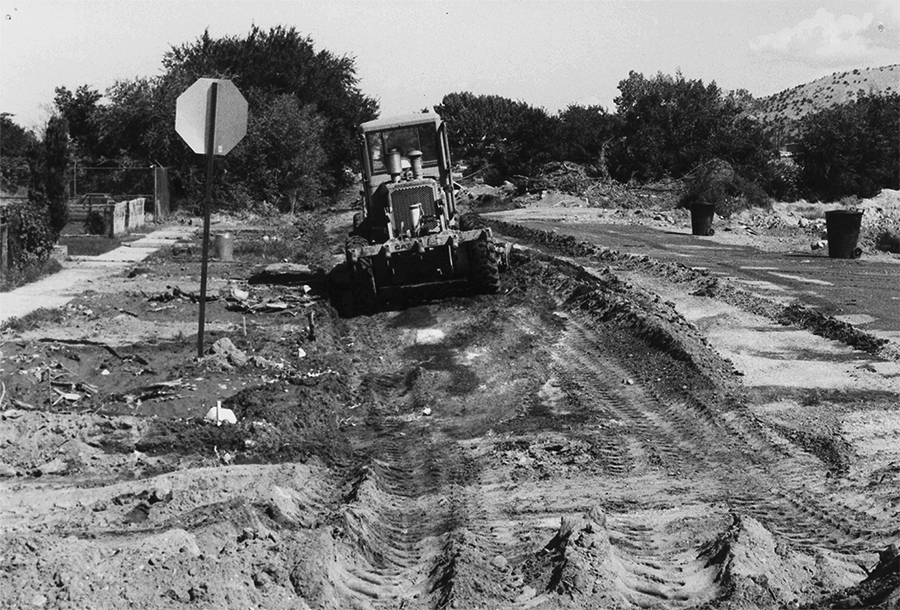
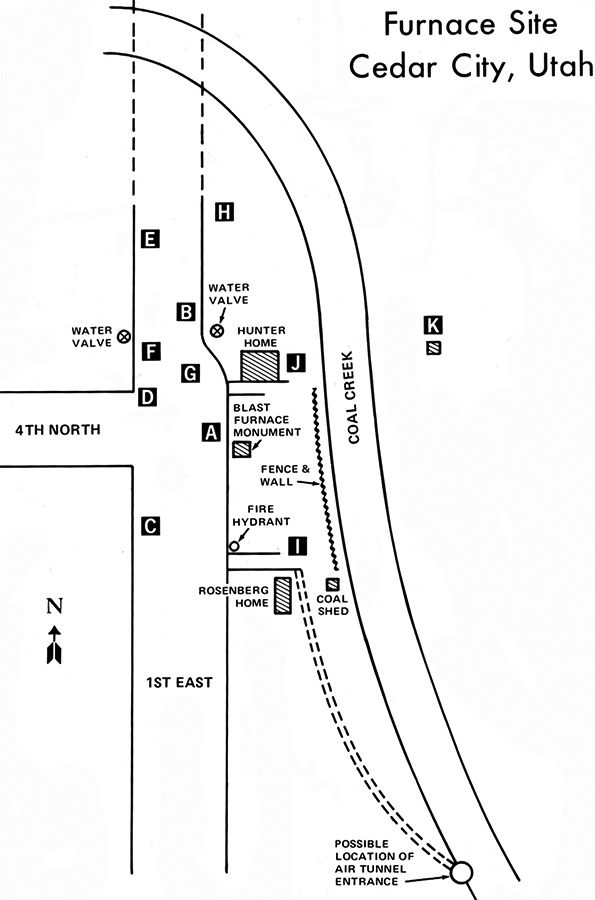
An opportunity to directly analyze pioneer furnace lining came in fall 1982 when Cedar City public works crews excavated the intersection of 100 East and 400 North to improve underground utilities (see illus. 15-1). Realizing this was the site of the pioneer iron works, author Morris Shirts collected samples of furnace rubble, including charred brick and sandstone, sending some of the brick to Dr. William T. Parry, professor of geology and geophysics at the University of Utah (see illus. 15-2). Dr. Parry’s analyses revealed only a small amount of the desired aluminum oxide content but large amounts of quartz (silica oxide), iron oxide and calcium carbonate, all of which limited the capacity of the lining to withstand high temperatures. He found, in fact, that the brick could melt at around 250 degrees F., well below the melting point of iron.
Illus. 15-1. Cedar City Street Department excavations in fall 1982 uncovered rubble from pioneer blast furnace runs. Author Morris Shirts collected various pieces from the furnace layer and sent them to Dr. William Parry, geologist at University of Utah, for analysis. Photograph by Morris A. Shirts.
Illus 15-2. Diagram of the Deseret Iron Company’s blast furnace site uncovered during street excavations. Recovered specimens are identified at the locations on which they were found: (A) blackened earth and partially smelted iron ore; (B) cinder; (C) ashes, not from the blast furnace; (D) furnace rubble—brick and sandstone; (E) scattered furnace rubble; (F) coke; (G) cinder; (H) cinder, charcoal; (I) coal, charcoal; (J) cast iron pieces; (K) possible location of the first furnace. (See “The Demise of the Deseret Iron Company: Failure of the Brick Furnace Lining Technology,” Utah Historical Quarterly 56 [Winter 1988]: 31.)
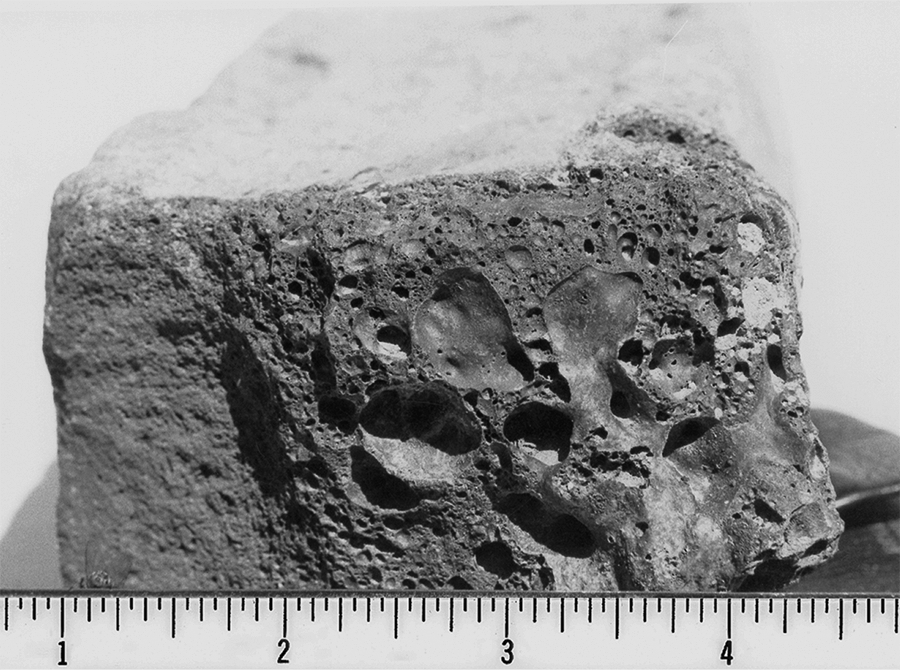
The reaction of quartz and calcium carbonate during pioneer furnace runs would have created calcium silicate and carbon dioxide gas, producing large bubbles in the brick as it melted under the heat of the burden (see illus. 15-3). Reactions between carbon monoxide from fuel combustion and iron oxides in the brick clay produced metallic iron particles in the brick itself, further undermining its stability. Expansion and compression during heating and cooling had badly spalled the particular samples of lining retrieved for analysis. Later efforts by pioneer iron workers to use sandstone in the lining material (in the 1854 Noble Furnace, for example) were more successful, but high carbonate content eventually caused weakening and spalling even of this stone.5
Illus. 15-3. This brick from the Deseret Iron Company coking kilns shows thermal and chemical deterioration. It was partially melted by the heat of the smelting process. In addition, gases evolving from chemical reactions produced bubbles throughout the brick. Photograph by Morris A. Shirts prepared for Utah Historical Quarterly article referenced at illus. 15-2.
Providing quality fuel for the furnace proved to be as difficult as providing quality lining. Enthusiasm for local coal soon waned when it was found to contain too much sulfur (5.76 percent), resulting in a reaction that produced hard, brittle pig iron. Hoping to find higher quality coal, the pioneers mined at least five different sites in the canyons of Coal Creek, but all proved inferior. As an alternate fuel, hundreds of bushels of charcoal were made from scraggly cedar and pine trees in the immediate area, but supply was limited and could not be quickly renewed. In March and April of 1853, when iron workers were trying desperately to get display samples to Salt Lake City for April general conference, they resorted to charges of raw pitch pine, but this was even more inadequate. The fuel problem was never solved well enough to provide long-term, reliable, uninterrupted blast furnace operation.
Insufficient Financing
Although the Deseret Iron Company was created to provide proper financing for the plant, creating a stable economy for the workers, there was never enough operating capital. Stock subscriptions in the company were never completely paid and there was little, if any, circulating currency, especially among the workers. Attempts to attract overseas investors were only partly successful. Cash flow problems afflicted the whole territory but such attempts to help as sending “gold missionaries” to California and organizing special work projects for newly arrived immigrants had little impact on Iron County. The most notable relief came from a territory-wide tax levy. Iron County men had the option of paying their tax assessments by performing some form of labor related to work at the foundry.
Church tithing donations were deposited locally, some designated for the support of needy iron workers. These local contributions were most often collected in the form of farm produce and were administered through the Deseret Iron Company store which served, in reality, as the bishop’s storehouse. The Deseret Iron Company also purchased consumer items, often in St. Louis, to meet the settlers’ needs. Nevertheless, the company store could not fully support the workers and their families. Since the situation required iron workers to be farmers as well, iron work too often lagged.
Personnel Conflicts
While the strength of Mormon colonizing lay in the willingness of individual Saints to accept difficult assignments without question, it is not surprising that some rebelled against ecclesiastical control. In 1851, four of the original iron missionaries, Samuel Bateman, Thomas Corbitt, Dennis Winn and Hiram Woolsey, returned to Salt Lake City “contrary to counsel,” not the only such instance. Some pioneers became disenchanted with the rigors of climate and geography and left for “greener pastures,” particularly California. In 1853, during the Walker War, the unwillingness of local settlers to release their cattle for transport to Salt Lake City as a protective measure against Indian raids actually reached the point where mutinous militiamen leveled rifles at their superior officers.
The settlers least happy about moving cattle north were members of the Scotch Independent Company. Most of the time, however, ethnic disagreements were not sufficiently contentious to undermine the purposes of the Iron Mission. A more serious threat was economic inequality. At the outset of the mission, John Steele felt that prosperous farmers were more likely to complain about the Parowan soil and then abandon the mission at the earliest opportunity.6 During the winter of 1852–53, Henry Lunt and J. C. L. Smith chided established settlers for selling grain at prices too high for newcomers to afford or, even worse, for stockpiling precious supplies as immigrants starved. While new recruits were often called south specifically for their skills in working iron, their poverty kept them from using those skills to best advantage.
Even less destitute settlers, however, found it difficult to meet their own basic needs while addressing mission priorities. So many crucial tasks demanded attention that the Iron Mission’s most troublesome disputes revolved around which to tackle first. Some disagreements were settled amicably through discussion and negotiation. Other differences were resolved by multiple meetings lasting long into the night, draining resources and exhausting emotional energy. Still others were settled by ecclesiastical fiat, an apparently efficient means which tended to suppress dissent only temporarily.
The iron managers were faithful and hard-working men, but their multiple roles often left them overwhelmed and exhausted. J. C. L. Smith, for example, superintended the iron works, served as stake president and worked as a local attorney. His heavy schedule may have aggravated the heart condition which led to his premature death. Isaac C. Haight was simultaneously general manager of the Deseret Iron Company, Cedar City stake president, mayor of Cedar City, major in the militia, local postmaster and representative to the territorial legislature. Although such arrangements centralized leadership, it was impossible for individual men, however capable, to serve effectively in so many capacities. Managers, charged with making critical decisions, lacked time to familiarize themselves with the technical aspects of iron-making. Furthermore, experienced leaders were lost to the region when called on proselyting missions or to other assignments. Apostles George A. Smith, Erastus Snow and Franklin D. Richards, for example, were given major responsibilities elsewhere, which deprived the iron industry of much needed continuity in leadership.
Security Concerns
Mormon settlers and Native Americans were never completely at ease with one another. As towns crowded out wilderness, tribesmen were hard-pressed to sustain themselves by traditional pursuits. Hungry Indians saw the settlers’ cattle as a communal source of food. Perceiving Native Americans as wayward children whose behavior would improve under firm parenting, pioneers reacted to the raids on their herds with scoldings, threats and, on rare occasions, whippings. Mormons were anxious to improve the condition of the Indians through proselyting and practical education. Most Indians, however, preferred their own traditions. Many considered baptism and priesthood ordination a matter of diplomatic necessity without sincere conversion. Others could not adapt to the settled life of farming.
Although both sides tried to achieve alliances for mutual benefit, Indians and settlers could not rely on each other’s promises. Constant skirmishes left both groups wary and insecure. When the Walker War broke out in 1853, anxieties accelerated, effectively closing down iron production while the settlers built forts in Cedar City and Parowan. Peace was negotiated but the need for constant guard duty continued to draw manpower away from iron production.
The iron missionaries’ uneasy relationship with neighboring tribes was overshadowed in 1857–58 by a more uneasy relationship with the United States. The economic and political consequences of the Utah War critically affected the iron works. Brigham Young declared martial law throughout the territory and placed the Iron County militia on special alert to guard the southern approaches to the region. Although specific orders had been issued to avoid bloodshed whenever possible, they were insufficient to prevent the most unfortunate consequence of this political and military imbroglio: the September 1857 massacre, by Mormon militiamen and Native Americans, of all the adults and older children in the Fancher-Baker wagon train. Three-fifths of the Mormon militia at Mountain Meadows were iron workers.
For deeply religious people, no matter the rationale of a possible war of extermination with the U.S. Army, such slaughter was psychologically and spiritually debilitating. The oath of silence taken by the participants in the massacre meant that there was, in effect, no way to talk about it and come to terms with what had happened. The scapegoating, first, of the Indians and, second, of John D. Lee added more lies to the initial cover-up. Furthermore, it fractured the trust and confidence the members had had in their leaders. Suffering from personal despair and spiritual disaffection, many iron workers moved away. Others withdrew emotionally. Mountain Meadows, in short, cast a pall over the entire settlement which has, in many ways, only begun to lift in recent years.7
The Iron Mission Legacy
Although the iron missionaries were never able to supply the territory with adequate iron implements, the benefits they gained by colonizing southern Utah far outweighed their failures. Those sent to the Iron Mission understood they were being called by a prophet representing the will of God. Although some pioneers faltered in the face of overwhelming obstacles, most remained true to their callings and endured the difficult years. Many of their descendants still live in the Parowan-Cedar City area; others helped populate settlements in all six states of the southwest. Even though the Iron Mission never fulfilled initial expectations, permanent settlements there guarded the southern gateway of the Mormon empire and established the southern boundary of the state.
The Iron Mission also powerfully affected the lives of those who joined it. Being a member of the Iron Mission constituted a tremendous challenge to individual iron workers and their families. The Mormons’ westward immigration has rightly been compared to the biblical exodus of the ancient Hebrews from Egypt. However, those who served in the Iron Mission, or in similar colonizing projects, did not find rest in the promised land still being created in the valley of the Great Salt Lake. To leave the haven of Salt Lake City, for so long the ultimate goal of their efforts, and move, sometimes shortly after their arrival, to a barren and inhospitable land amidst the dangers of an icy winter, must have been hard to bear. To build a complex industry from the ground up without benefit of a working infrastructure (agriculture, transportation, financial institutions or civic services) was a superhuman task. Each difficulty the iron missionaries faced brought a new test of character and a new trial of their dedication to establish the Kingdom of God in the desert. In the final analysis, floods, drought, technological problems and interpersonal disagreements were insufficient to deter these pioneers from their assigned callings.
One who studies the history of the Iron Mission cannot fail to be reminded of a biblical metaphor that exemplifies the whole enterprise: “Behold, I have refined thee, but not with silver; I have chosen thee in the furnace of affliction” (Isaiah 48:10). The integrity and religious commitment of each iron worker was refined and tested through adversity no less than the iron they smelted. The furnace smoke rising to the sky above Coal Creek represented for them as much a burnt offering, and just as demanding a sacrifice, as the smoke rising above the temple altar in the Hebrews’ promised land. The smelting and purifying of iron stood as a daily symbol of the spiritual purification and character refinement that each pioneer experienced by putting aside his or her personal interests to establish a modern-day Zion. Both descendants and students of history can learn a great deal from the commitment of these unfaltering men and women to a vision of overarching importance and take pride in the way they faced and overcame the trials of their faith.
Notes
1. Materials in this chapter first appeared in two forms: a presentation at the Mormon History Association annual meeting, St. George, Utah, 1993; and an article, coauthored with William T. Parry, professor of geology and geophysics at the University of Utah, who provided technical information necessary to explain the situation at the company works. The article is titled “The Demise of the Deseret Iron Company: Failure of the Brick Furnace Lining Technology,” Utah Historical Quarterly 56 (winter 1988): 23–35 (hereafter cited as Shirts and Parry). James D. Norris’s Frontier Iron and Frederick Overman’s Treatise on Metallurgy (both cited in the bibliography) are helpful sources on understanding early blast furnaces and metallurgy. Overman’s earlier work, The Manufacture of Iron in All Its Various Branches (Philadelphia: Henry C. Baird, 1850), is also recommended.
2. Shirts and Parry, 35. See also Deseret Iron Company, Minutes, Book 1, 40–43 (ca. Jan and Mar 1855) and Book 2, 8–11 (ca. Sep–Oct 1858); see also Haight, journal, entry for “April, 1854.”
6. “Extracts from the Journal of John Steele,” Utah Historical Quarterly 6 (Jan 1933): 25.
7. Two events of equal importance to the story of this difficult episode in southern Utah history took place in the final decade of the twentieth century. On 15 Sep 1990, a new memorial to the Mountain Meadows victims was dedicated by Gordon B. Hinckley, then a counselor in the LDS First Presidency. Raised on Dan Sill Hill, just above the level stretch of the meadows, it gave a clear view of the whole landscape and was accompanied by a set of plaques that included a list of those in the Fancher-Baker wagon train. Erecting the 1990 memorial and successfully coordinating with Arkansas descendants of the massacre victims were achievements in large part due to amateur historian Lee Oertle. He made the initial overtures in 1988 to create a proper memorial at the site and quickly recruited Morris Shirts and approximately 30 others, creating the Mountain Meadows Memorial Committee. Their more than two years of untiring effort brought the hope of a new monument to reality. Sadly, after this important step was achieved, both Shirts and Oertle died. The memorial itself was, over the next few winters, severely damaged by water infiltrating between the stem wall and the monument face. (It has since been repaired and is being maintained by the Utah State Parks and Recreation Department.) During a visit in 1998 to Dixie College in St. George, LDS Church President Gordon B. Hinckley visited the Mountain Meadows site and expressed concern over continued deterioration at the 1932 monument marking Brevet Major James H. Carleton’s 1859 memorial cairn. Hinckley spearheaded plans not only for repairs but also for a new monument at that site, aided by the Mountain Meadows Association. This memorial was dedicated by President Hinckley on 11 Sep 1999, at ceremonies well-attended by descendants of both Mormon militiamen and Arkansas emigrants.