Meetings held in Salt Lake City in fall 1851 would directly affect the southern settlements. At the October general conference and at other special meetings that year, Brigham Young called pioneers to strengthen these outlying colonies. In the case of the Iron Mission, this would lead to the founding of a new settlement late that year which would be given the name of Cedar City.
George A. Smith, who departed Parowan 21 August 1851 to attend general conference, arrived in Salt Lake City only a week after starting out. Even with visits to friends in Nephi, Payson and Provo, his party took one-fourth as long riding north as they had on the journey south the previous December. Peter Smith (Dibble), driving George A.’s wagon, had left on 19 August, in advance of the main group. A company led by Robert Wiley, the English bricklayer, left the same day.1
Church leaders Brigham Young, Heber C. Kimball, E. T. Benson, Orson Hyde, George A. Smith, Wilford Woodruff, W. W. Phelps and Lorenzo Dow Young all spoke at a special gathering, 7–9 September, in the Bowery on Temple Square. Their counsel, however, was overshadowed by non-Mormon Perry E. Brocchus, federal associate territorial judge, who gave a provocative talk denouncing polygamy and absolving the U.S. government of responsibility for Mormon persecutions in Missouri and Illinois. Brigham Young immediately stood and challenged Brocchus, marking the beginning of intensifying hostilities between the U.S. government and the Mormons.2
General conference convened a month later, on 6 October. At that session, several items of business concerned Cedar City:
George A. Smith made an appeal in behalf of the southern settlements and it was proposed that John D. Lee form a settlement at the junction of the Rio Virgen and Santa Clara where grapes, cotton, figs, dates, raisins, etc., could be raised. It was also proposed to make a settlement in Coal Creek valley, 20 miles beyond Parowan City, where coal had been found in the canyons and also plenty of timber. . . . The first company was to be piloted by Peter Shirts and start next Wednesday. The second company was to start in about 2 weeks and be piloted by John A. Wolf and Andrew Love. . . . All the propositions were put to vote and unanimously sustained by the conference.3
Brigham Young’s history confirms: “It was voted that three companies piloted respectively by Peter Shirts, John A. Woolf, and Andrew Love, should start within two weeks, to make or strengthen settlements in the Southern parts of the Territory.”4
These terse reports only hint at the exploration and discussion that resulted in George A. Smith’s proposal to create a second settlement to the south. As early as January 1851, the option of having iron workers live somewhere other than Parowan had been rejected, even though the initial foundry was to be located at Iron Springs, some 12 miles away. Coal Creek was deemed unfavorable because the canyon was narrow, making the construction of buildings difficult. It was much less accessible to wagons during winter months and the suitability of its channel for irrigation was questionable. Like Shirts Creek six miles to the south, it eventually fanned out over a broad area like a river delta, making control of the water flow difficult.
The original choice, therefore, to keep the settlement at Parowan but place the foundry at Iron Springs, seemed a good compromise. What, then, prompted the reevaluation? Almost certainly it was the April 1851 discovery of coal in the canyon east of present-day Cedar City. Finding this abundant fuel source resulted in a decision to consolidate both townsite and blast furnace on the banks of Coal Creek, near the canyon. The coal would have to be hauled only six miles—and all downhill. And even though it could not be reached during winter months, it could be stockpiled by careful management.
Although the iron ore, in contrast, would still have to be hauled eight miles, that distance was four miles closer to Coal Creek than to Parowan. After assessing all the options, George A. Smith recommended the move, pleased by the “splendid sight” he and Aaron Farr had come upon in their explorations of 7 May 1851. Brigham Young had apparently given tacit approval, during his 15 May visit, for the second colony to be founded there. Although establishing a new colony would delay the iron business another year, the failure of Center Creek to supply adequate water to the Parowan settlement must have convinced the leaders that moving to Coal Creek was the better plan. Another consequence of creating a second settlement would be the drastic change in Parowan’s function in the region. Instead of being the iron manufacturing center as first envisioned, it would now take on a supporting role. The political, civic and educational needs of the area would have to be rebalanced between two communities instead of one.5
It is not clear when the companies called during October general conference started back for southern Utah. The three men recorded as their leaders, Peter Shirts, John Woolf and Andrew Love, all appear in the “departure list” of 21 December 1850, the May 1851 Utah Census and related “first settler” records (see app. 4). Further, on 16 May 1851, Smith records that Andrew Love and John Woolf were made counselors on the newly organized Parowan City Council. The name Peter Shirts appears frequently in George A. Smith’s journal between the founding of the Iron Mission and the settling of Coal Creek almost a year later, although Lunt only mentions Shirts as the host of a ball for the 24 July celebration.6
On 4 August 1851, Smith organized the traveling company of those about to attend October conference in Salt Lake City and put Peter Shirts at its head, referring passingly to “Capt. Shirts” in his 22 August entry, made during the trip north.7 Combined, the various references more than suffice to indicate that Love, Shirts and Woolf were in southern Utah until shortly before conference, when Love and Woolf must also have returned to Salt Lake City, either in the same company as Smith and Shirts or a bit earlier.
Surprisingly, John Anthony Woolf appears not to have made the expected journey back south. Separate anecdotal accounts from Woolf family histories report that, having lived in Salt Lake City since 1847, John responded to Brigham Young’s call in 1852 for additional settlers in Iron County. That spring, he left his family behind and went on ahead to build a house and plant crops. He then returned north to attend conference and pick up his family. Unfortunately,
they were destined NOT to return to Iron County. While camped on the banks of the Jordan River, all their cattle were stolen and could not be recovered. Because of the delay in searching for the cattle, and because of Sarah Ann’s poor health, they found it necessary to remain in the area for the winter.
A second family history says that they wintered in a house Woolf built on the Provo River, but both agree the family tried again to go south in spring 1853, only to be preempted by Brigham Young, who asked them to settle in Mona for the time being.8
Some anecdotal detail is also available on Peter Shirts. According to family history, Brigham Young introduced Peter, during his attendance at general conference, to Belana Pulsipher, the newly arrived widow of Horace Burgess, one of Brigham’s Nauvoo friends. Peter’s first wife, Margaret Cameron, had died in 1849 on the banks of the Platte River. Belana and Peter courted during the weeks he was in Salt Lake City and then married, leaving for Parowan in early October 1851. No known document records their journey or their arrival at Coal Creek.9 Perhaps the Scotch Independent Company or some of its members traveled south with Shirts.
The Scotch Independent Company
Members of the Scotch Independent Company had arrived in the Salt Lake Valley just before October conference and were quickly called to help establish the iron works at Cedar City. The story of the Scotch Independent Company begins in the 1840s when the Matthew Carruthers family, James and Isabella Dunn Bulloch and John and Janet Kerr Stoddard were converted to Mormonism in Scotland. Two of the sons, David Bulloch and David Kerr Stoddard, left autobiographies detailing their travels to Utah. The Bullochs, with 120 other Latter-day Saints, organized as the Franklin Richards Company, embarked from Liverpool on 20 February 1848 aboard the Carnatic and arrived in New Orleans in mid-April. The Stoddards reached New Orleans in October 1848 aboard the Sailor Prince. The Bullochs and Stoddards, with the families of Alexander Keir, James Williamson, Matthew Carruthers, John Grant and several Easton families, spent about two months traveling up the Mississippi and Missouri rivers, arriving in St. Louis just before Christmas 1848.10
After the party reached St. Louis, some members pushed directly on to Salt Lake Valley, while others stayed behind to earn funds for wagons, animals and supplies. The Bullochs remained almost three years, the Stoddards for two and a half. James Bulloch and Matthew Carruthers farmed together during the summers of 1849 and 1850.11 During this time, young David Bulloch ran to see a passing mare and colt and, coming too close to the animals, was kicked unconscious by one of them. After being attended by a doctor who doubted for his life, David recalled in his memoirs, “my father [James], Mathew Cruthers and Samuel Richards administered to me and in a day or two I was able to run around at play again. The Doctor said it would have been much better if I had died as I could never be mentally efficient. This proved to be false.”12
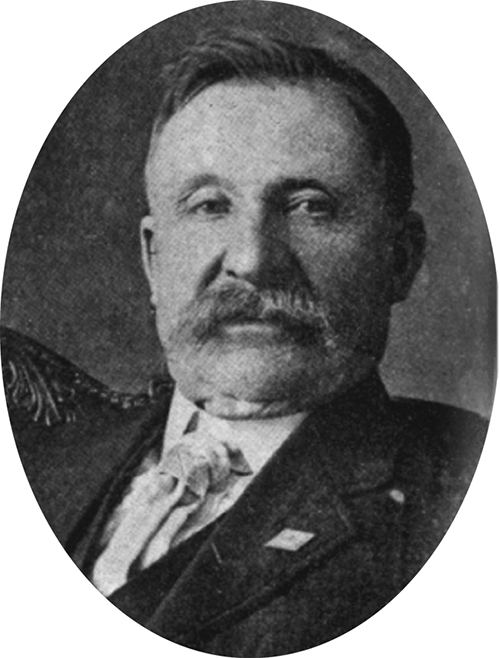
Illus. 6-1. David Bulloch (1844–1928) wrote an autobiography telling the story of the Scottish immigrants to southern Utah. Esshom, Pioneers and Prominent Men, 280.
Carruthers was still in Scotland when he confirmed Christina Bulloch, David Bulloch’s sister, after her baptism. Yet he reached Salt Lake City before the others, since he met with Brigham Young to “receive instructions about melting iron” on 8 November 1850.13 He was also listed in George A. Smith’s company of those who left Provo for the Iron Mission the following December, was in Iron County when the census was taken in April or May 1851 (noting his profession as “iron maker”) and was already a presiding elder and militia major when the rest of the Scotch Independent Company arrived. John Chatterley reports Carruthers was in charge of the day school in Cedar City until he was called to “superintend the Iron Works.”14 Perhaps Matthew visited the Maramec Spring Iron Works southwest of St. Louis, where he could have observed how Americans constructed and operated blast furnaces, techniques that would later appear in the Iron Mission project. As the story of Carruthers makes clear, the Scottish converts did not all reach Utah in the same company.
By spring 1851, the main company of Scots still in St. Louis had enough cash and experience to set out across the plains. Bulloch recalls that each family had two yoke of oxen and two cows,15 making a caravan of 10 or 12 wagons. David Stoddard records that they left St. Louis in April and arrived at Winter Quarters six weeks later. They were further delayed at Winter Quarters when flooding made it impossible to “take the old road up the Platte River or the old Mexican Trail.” They lost time searching for a new road, Bulloch says, but at Council Bluffs, under Captain John Easton, they were
joined by others and organized into a larger company. But in traveling in this large company we were hindered considerably. Some of the men had never driven oxen before, others had only little experience and their troubles would hinder the whole train. Therefore, after a few days of travel with the train, our Company from St. Louis broke with the main company and traveled on ahead of them to Salt Lake. We were called the Independent Scotch Company.16
David Stoddard also remarks on this split from the larger company:
After a week’s travel we were discouraged, as so much time was wasted. The captain, John Easton, called us all into council and laid before us the condition of affairs, asked if we were willing to travel alone as [a] company of ten, and leave the others. We all agreed to do this. We reached Salt Lake City on Friday, October 5, 1851, in Captain Cardon’s Company.17
Stoddard’s memory appears to be faulty, however, since records show that John Easton and his group left Captain Cardon’s company, rather than arriving with it. As William Booth, a clerk in Cardon’s company, records on Saturday, 12 July 1851, a meeting was held the night before to discuss Easton’s proposal to take his part of the company on alone. Booth’s final comment was that “Captain Easton left us this morning with his company. I fear he will repent of so doing.”18
The next reference to the Scotch Independent Company may be this from the Journal History of 19 August 1851: “Wilkin’s merchandize train consisting of ten wagons, with a Scotch company in the rear, were met at, or near the same place they met Mr. Brown’s company; also Gordon’s.”19 It should be noted that the Millennial Star, 15 October 1851, offers a similar account.Perhaps the reference to Gordon, which sounds similar to “Cardon,” is an indication that Stoddard and his group did meet up with Cardon’s company again and arrived together, as the excerpt from his life story would suggest (although Booth’s journal does not record any such reunion). Records of the date the Scottish company arrived in Salt Lake City, therefore, remain vague: Wilkin’s train reportedly arrived 18 September 1851, while David Stoddard put his group’s arrival at 5 October.20 David Bulloch did not give a date, but only said they arrived “two weeks ahead of the big company of 1851.”21
David Stoddard lists members of the company who traveled together to Salt Lake Valley; David Bulloch lists those who said they were in that part of the Scotch Independent Company that traveled on to Iron County. David Bulloch was only seven when his family arrived; David Stoddard was 21. The two did not compile their respective lists until many years later. The lists are arranged as a sidebar into logical family groupings, retaining spellings from each source. Family relationships have also been supplied, where known, but pioneer punctuation injects some ambiguity. According to David Stoddard, there were nine family groups that comprised the Scotch Independent Company journeying to Salt Lake City,22 while the “Life Sketch of David Bulloch” lists five family groups arriving in Iron County in November 1851.23 Inexplicably, the “Life Sketch” does not include the Bulloch family in the list of first settlers. However, an additional source, “Facts Furnished by David Bulloch,”24 does list James Bulloch, the father, and children Robert (14), Christine (13) and David (7), making a total of six family groups.25
Joseph Horne, who appears on David Stoddard’s list, had actually preceded the rest of the group to Utah. He appears both as captain of the 3d 10 in Parley P. Pratt’s Southern Exploring Expedition of 1849–50 and as an original member of the Iron Mission, 1850–51. He is also on the May 1851 Iron County Census (listed as a farmer from England). Perhaps there were two Joseph Hornes, but this is unlikely.26 A possible inconsistency about Stoddard himself is that George A. Smith, en route to Salt Lake City two months earlier, in August 1851, records meeting three men at Corn Creek (later named Kanosh for the Pahvant Ute chief). He identifies them only as “father Gould and br Stodard and Lewis.”27
Brigham Young’s Trip South, October 1851
Shortly after the Scotch Independent Company left for Cedar City, President Young left Salt Lake City (on 21 October) to seek a more central site for the state capitol and to inspect the southern settlements. He was accompanied by his board of commissioners,28 Orson Pratt, Albert Carrington (clerk and historian), Jesse Fox (surveyor), William Staines and Joseph Robinson. Also present were Counselor Heber C. Kimball, General Daniel H. Wells, Judge Zerubbabel Snow and Indian Agent Stephen B. Rose. In his journal entry of the same date, George A. Smith mentions that he and Bishop Joseph L. Robinson accompanied President Young. On the 22nd, he notes 15 in the company, of whom he specifically names Young, Kimball, Pratt, Wells, Carrington and Fox. He also mentions Horace Eldridge, not named in the previous list.29
On 28 October 1851, Brigham Young located a site for Fillmore City on Chalk Creek, “up the creek about a mile and a half from our camp,” returning to Salt Lake City by 7 November, while George A. Smith’s party continued on to Parowan, where they arrived 30 October. The next day, Peter Shirts hosted a welcome-home party.30 George A. had not come back to direct the new settlement, however. In Salt Lake City, he had been called to preside over the Utah Stake in Provo and had come south only to clear up his affairs. A major obligation—the thousand dollars he owed those who had built the mill for him—dissolved when they made him a present of the bill, thus clearing the account.31 A 28 October letter from Brigham Young and Heber C. Kimball written to the “Presidency of Parowan” implies that the appointment of Elisha H. Groves as George A. Smith’s replacement had been made permanent. Since Groves would be serving annually in the territorial legislature, however, Brigham Young wanted counselors appointed to take care of the mission in his absence and suggested the names of John Lyman Smith (George A. Smith’s brother, hereafter “John Lyman,”) and Matthew Carruthers.32 The letter expresses concern for the southern colonies and gives specific advice on protecting them:
When the brethren first go to Coal creek, we suggest that they leave their families at Parowan until they build the fort at that point. We further suggest that in all your settlements the people do not stray about at a distance alone, or only a few in company, and that you herd and coral your cattle.33
Surveying the New Settlement
On 2 or 3 November, George A. Smith took his brother John Lyman, Elisha H. Groves, Matthew Carruthers, William Dame (and others, among whom were probably James A. Little and Henry Lunt) and traveled to Coal Creek, where they laid out the position for a new fort and, possibly, dedicated the site for the manufacture of iron.34 Unfortunately, none of the presently known primary sources that record the colonizing of Coal Creek mention a dedication of any kind.
There is, however, one reference which should be considered: the “Early History of Cedar City and Vicinity,” written by local historian John Urie in 1880. Since Urie was not a pioneer settler of the new colony, his comments must have been compiled from the first-hand memories of others. The relevant passage reads as follows:
[O]n Nov. 3rd E. A. Groves, Wm. H. Dame, James A. Little, Henry Lunt with George A. Smith and others arrived from Parowan on the spot marked out by Parley P. Pratt two years before for settlement. Next day Nov. 4th 1851, Cedar City was surveyed by Wm. H. Dame. It is distant about a mile due north from the present location. The name Cedar City was given because of the abundance of Cedar trees that abounded all over the country. Geo. A. Smith in h[u]mility before God together with the rest of his fellow Pioneers dedicated the ground just surveyed, the surrounding lands, the minerals in the water, the timber, the grass, to the service of God, in the manufacturing of Iron, machinery and that our necessities might be supplied and the territory built up.35
Urie’s account helps us to interpret Cedar City’s settlement date. Henry Lunt writes that on “the 4th of November they located and surveyed a fort, and returned to Parowan.”36 George A. Smith concurs with Lunt’s diary and Urie’s reminiscence in a letter of 5 November 1851 printed in the Deseret News: “Yesterday a site was surveyed for a fort and stock caral on Coal Creek, 20 miles from Parowan.” Since the 5th was a Wednesday, this dates the survey to Tuesday, the 4th. The Journal History notes, also under 5 November, that George A. Smith’s letter to Brigham Young reports a fort selected and laid off “on the 4th inst.” Surprisingly, Smith’s own journal dates the survey to Monday, not Tuesday, recording that on “November 3rd. We located a site for a fort and cattle coral. Bro. Dame surveyed it. Returned back to the city.”37 Whichever day was correct, we now have both primary and secondary sources identifying a trip by George A. Smith, just before leaving southern Utah, at which a second colony site is surveyed for the benefit of settlers who will colonize it immediately after his departure.
We can also infer a formal dedication at Coal Creek by George A. Smith, during which the site was named for its plentiful cedar trees.38 If John Urie is reporting historical fact, then he must have meant that Smith dedicated the site shortly after Dame completed his survey. Thus (depending on which journal one accepts as the most precise), the dedication took place on Monday, 3 November, or Tuesday, 4 November, either before or after the survey but before the survey party returned to Parowan. Urie’s history thus asserts a very early date for the official use of “Cedar City,” superseding “Little Muddy,” “Cottonwoods” and “Coal Creek” as place names (although they continued to be in use—especially Coal Creek—for some months to come). Both in recognition of this and for ease in discussing the townsite, we will use “Cedar City” hereafter, unless a different term is used in a quotation.
Organizing the Militia
Establishing the new settlement involved not only surveying a townsite but also organizing the pioneers into traveling companies structured along military lines. George A. Smith explains this in his 5 November 1851 letter, cited just above:
Yesterday a site was surveyed for a fort and stock caral on Coal Creek, 20 miles from Parowan. To-day a company has been organized to commence operations immediately in the construction of this new post. They are mostly composed of English, Scotch and Welsh miners and iron manufacturers. They have also been organized into two companies of militia, one a horse, and the other foot, and form the 2d Battalion of Iron County. Matthew Caruthers is the Major. The company are all in fine spirits. They will commence on Monday to put up their caral, after which they will move their families which are remaining here, and encamp in their caral until their fort is completed.39
“Company” has two meanings here. The “company . . . organized to commence operations immediately” referred to a traveling group like any of those crossing the plains by wagon train and handcart. Smith also used the word as a military term: “they have also been organized into two companies of militia.” John D. Lee’s letter to Brigham Young, reporting his successful return to Parowan from Salt Lake City, clarifies the nature of military command in the Iron County district:
on the 5th inst. the militia of Cole creek were organized into a Battalion which caused the Iron Battalion together to grow into a regiment over which Geo. A. Smith was elected colonel, James A. Little lieut. Col. and Mathew Carrathers major.40
In short, as military records in the Utah State Archives and Records Service confirm, a foot company and horse company of militia, constituting a new battalion (the Second) of the Iron Regiment of the Nauvoo Legion, were organized at Parowan on 5 November 1851, to be headquartered at Cedar City. According to the muster roll of 29 November (those for 5 November are missing), the foot company, Company F, consisted of 25 men commanded by Captain Henry Lunt, also identified as the “president” of the whole traveling company.41 The cavalry, Company C, consisted of 11 men and mounts commanded by Captain Peter M. Fife.42 Both groups included several members of the Scotch Independent Company (indicated by an asterisk in the accompanying sidebar). Combined, these two companies totaled 36 men—close to the traditional number of 35 original settlers of Cedar City,43 although no evidence exists proving that each of the men listed in the two companies reached the Coal Creek settlement and camped together there the first night.
The March to Cedar City
On 10 November 1851, Henry Lunt’s journal records that “a Company of 11 wagons started from Parowan for the purpose of making a settlement at Coal Creek; Henry Lunt having been President of the Company.”44 Lunt doesn’t specify the order of march to the new site. However, the most likely premise is that one militia company preceded the other by a full day. Company C, with 10 to 13 mounted men (the roster names only 11), is probably the group which departed Parowan on 10 November, probably to secure the area and organize the campsite. Although it should have been a relatively easy one-day trip to Coal Creek, Lunt goes on to note that the party camped that evening at Summit Creek, six miles from Parowan, and reached Coal Creek the next day by 4:00 p.m.
As no member of Company C is known to have accompanied George A. Smith in selecting the Coal Creek location, how did this first party of settlers identify it? Perhaps a member of the group had been on the survey without recording it or perhaps directions were sufficiently explicit without a guide. A third and more likely possibility is that Henry Lunt, who had been a member of Smith’s site-selection committee on 2–4 November and who had helped Dame make his survey, delegated leadership of Company F to someone else and accompanied Peter M. Fife’s Company C to Coal Creek. Perhaps Lunt was originally assigned to lead the foot company simply because he had no horse. In any case, his journal implies that he came to Coal Creek with the earlier Company C.
Lunt is our best source for the two-day trip, clearly recording that the group left Parowan on 10 November, arriving at 4:00 p.m. the next day, after the overnight camp at Summit Creek. The journal account, however, seems to contradict his 4 February 1852 letter to George A. Smith: “I started from Parowan on Monday, November 11th (1851) with eleven wagons for this place . . . breaking a new road nearly the whole of the way.”45 Most probably the letter, which was written in retrospect, and not the journal, contains a dating error, since Monday fell on 10, not 11, November. In any event, it would appear that Company F, consisting of 25 men, some wagons, cows, calves, two English sheep dogs and some hobbled mules, left on Tuesday, 11 November, and reached Coal Creek late the same day, probably arriving about three hours after Company C.
In 1918, at age 78, four years before his death, John Chatterley wrote an account of this trip, presumably with the foot company, which took place when he was 16 years old:
On the 11th day of November, 1851 a company of emigrants left Parowan, Iron Co., Utah who had gathered there and came down to settle Cedar, Henry Lunt having charge of the company. They arrived here about 7 p.m. of that day. The reason they were late in arriving at the camping place on the East bank of Coal Creek, was on account of the guide Peter Shutz [i.e., Shirts] leading the company up on the South East side of the big knoll about 3 or 4 miles this side [south] of Parowan, near to the main chain of the mountains, as they, the settlers had to make road in places, the road was not used after the first trip over it, the road out in the valley North West of the knoll was made the main road. The writer of this, in company with two young men, named Duncan Ross and James Anderson, respectively drove the loose animals, cows and calves, and having two English sheperd dogs, which caused the cows to travel pretty lively, and of course cows, calves and hobble-donkeys arrived on the bank of Coal Creek hungry enough to demolish the half of a calf without an[y] cooking. There were about 13 men camped there the first night.46
Chatterley recalls his departure from Parowan as 11 November and arrival as late the same day—7 p.m., probably after dark. His account claims the eastward route Shirts led them on was never used again but a number of journals refer to an “upper road” and “lower road” between Cedar City and Parowan. The main, or lower road, went west near Summit and then either through the mountains to Antelope Spring or further south through the Woolsey Ranch and Pinto. The eastern, or upper road, was mentioned by Thomas Bullock as late as 1854, noting that he used it to drive from Cedar Fort to Parowan.47
Possibly, Shirts and the other travelers had to contend with snow along the trail. Alexander Matheson, who knew most of the Cedar City pioneers, told his son Alva that the foot company trudged in facing a snowstorm and, on arrival, took refuge in the cove on the north side of the Knoll.48 This landmark, lying north of modern Cedar City, now topped by television and microwave relay stations, extends east to west and curls slightly north at its eastern extremity. Its western extremity has been reduced several times to provide a better approach to Cedar City’s Main Street, but the cove there is still quite prominent.
To join the presumed advance party of Company C, Lunt may have felt it militarily expedient to delegate his command of Company F. Peter Shirts, who does not appear on the roster of either company but who was one of the three men designated at October conference to pilot new settlers to Cedar City, may have been pressed into service as teamster and guide. If Carruthers, as major, had led the battalion, traveling with Fife’s cavalry while Lunt led his foot company, it seems unlikely that the services of Shirts would have been needed.
Although the two companies reached the Cedar City encampment the same day, 11 November, James Whittaker Sr., a member of Company F, records that (having arrived in Parowan on 29 October) he traveled from Parowan to Coal Creek on Wednesday, 12 November.49 Lunt reports two new arrivals the same day:
Wm. C. Mitchell and his son, Wm. C., Jr. arrived at Coal Creek from Parowan to assist in making the settlement. Bro. Mitchell stayed a few days then returned to Parowan, leaving his son to build the fort, who stayed and built a house and helped to make a public corrall and survey the first field in the valley.50
On 18 November, according to Whittaker, another train of 16 wagons arrived in Cedar City. Most of these settlers were Scots.51
Resolving Issues of Command
Major Matthew Carruthers, battalion commander of both companies as well as presiding elder of the new Cedar City settlement, is not listed on the rosters of either Company C or Company F. This strongly implies that he stayed in Parowan during the first remove to Cedar City. His presence with the advance company would more than likely have meant that he, rather than Lunt, was the appointed president of the combined traveling group. As “Elder Carruthers” presiding over the contemplated settlement and as “Major Carruthers” commanding the battalion, Carruthers had as much, if not more, status than Lunt.
On 18 November, the same day the 16 wagons of new emigrants arrived, Carruthers wrote an eloquent letter to the Deseret News on behalf of the Cedar City pioneers, asking for additional support for the Iron Mission:
For us to furnish the iron necessary for the teritory, would be, in my opinion, to accomplish one of the most important objects connected with the up-building of the kingdom of God upon the earth; and we, by so doing, would secure to ourselves a name, a place and a standing among our brethren, the honor and glory of which would not once be worthy of comparing with the labor and toil which might be necessary to accomplish it. . . .
Come, then, my brethren, obey the counsel of your leaders, fulfill the predictions of the prophets, and flow together to the goodness of the Lord in the valley of Coal Creek, for wheat, for corn, for potatoes, for melons, for beets, for carrots, for squashes, for pumpkins, for onions, for large cabbages, and for both the young and the old of the flock, for the wheat tithing given to the poor, and above all, to get out the coal and the iron; and if you live humble, keep the commandments, and obey counsel, your souls will be like unto a well irrigated field of goodly soil, so that there will be no necessity of your sorrowing any more at all.52
Henry Lunt’s “election” as president of the traveling company is undocumented but probably took the usual form, in this case George A. Smith presenting him to the traveling group for a “sustaining vote.” If Smith had intended Lunt to preside permanently at Cedar City, Lunt would have outranked Carruthers ecclesiastically, yet would have served as his military subordinate. The 39-year-old Carruthers definitely outranked 27-year-old Lunt, although neither of them had strong qualifications as military leaders. Lunt had been mustered into the militia as a private at Peteetneet (Payson) as the iron missionaries first traveled to Cedar City. Carruthers and Lunt were both privates in Captain Edson Whipple’s foot company in Parowan as of 8 August 1851. Barely three months later, on 5 November, Carruthers was promoted to major and Lunt to captain. Neither Lunt, a middle-class Englishman, nor Carruthers, a middle or upper-class Scot, had any known prior military experience.
Journal entries and letters suggest that Lunt saw his authority as president of the traveling company extending beyond the trip from Parowan and into the first stages of settlement. In the journal entry of 10 November 1851, cited above, Lunt gives evidence he considered himself in command: “A company of 11 wagons started from Parowan for the purpose of making a settlement at Coal Creek; Henry Lunt having been President of the Company.” He also wrote to George A. Smith in February 1852, sharing his “serious reflections:”
Twelve months had scarcely elapsed since I had the first interview with Bro. Geor. A. Smith and came on the mission to Parowan (or Iron County). Then I knew but little, what it was to help build up our Heavenly Father’s Kingdom in making new settlements, and now I was leading a company myself to a large and delightful valley to form another new settlement.53
Matthew Carruthers acknowledged Lunt’s role as commander over part of the camp at least. Two months into the settlement process, he wrote George A. Smith on 3 January 1852, saying:
“Shortly after your departure, bro. Henry Lunt, at the head of a portion of the brethren destined for this place, went down and built a good substantial canal, mostly with the drift wood that lay scattered on the banks of the creek.”54
For his own part, Henry Lunt deferred to the ecclesiastical leadership of Carruthers. The entry in Lunt’s journal for Sunday, 1 February 1852, reads: “As br Carruthers was writing a letter he requested me to take charge of the meeting which I did.” The next day, Lunt added:
bro Wiley & myself . . . had considrable counsel with bro Carruthers . . . he proposed that Henry Lunt be his first councillor & John Easton 3nd he felt that these were dictated to him by the Spirit of God, they were unanimously Elected, after which H Lunt R. Wiley Josh Chatterly were chosen as a committee for public works. I was elected clerk.55
Appointed to fill two roles, Lunt here refers to himself in the third person as counselor but in the first person as clerk. His journal entry for 8 May 1852 is amusing in its layering of titles: “Prest Carruthers received a not[e] from Prest Groves, Parowan, saying that Prest Young had come there.”56 The title was appropriate for these men and for their counselors, since all members of a presidency are addressed as “President.” But even without the complications of terminology, it is clear that authority parameters were sometimes misunderstood, a confusion which paved the way for disagreements. Later on, Carruthers became superintendent of the iron company, with Lunt as his clerk. This “cross-threaded” organization shows why pioneer leaders often found it difficult to understand their own lines of authority and even act cooperatively, let alone effectively.
More New Settlers
Even after the roles of the Scotch Independent Company and the militia companies in the move to Cedar City are clarified, questions about personnel remain. The military companies included teamsters, assigned to handle equipment and drive the supply wagons, who are not listed in the rosters. Andrew Jenson identifies two of these as Peter Filanque and Peter Shirts.57 Gladys McConnell includes George and Darius, sons of Peter Shirts, as teamsters.58 And John Chatterley, Joseph Chatterley’s son, identifies himself, James Anderson and Duncan Ross as the young drovers in charge of loose stock.59
In his older years, remembering first impressions of his new wilderness home, David Bulloch wrote about traveling south from Parowan with members of the Scotch Independent Company about to settle in Cedar City. Along the trail, they met up with a Parowan man who was bringing down supplies for the newer colony on the running gears of his wagon. As David recalls,
I jumped on his wagon with him and arrived on Coal Creek a little ahead of the main company. As I got off the wagon Brother Henry Lunt Sr. took my hat off my head and laying his hands on it said, “My boy, you have the honor of being the first white boy on this creek.” He then remarked about my hair which was as white as cotton.60
Ellen Whittaker is another name that appears in some sources as a first settler of Cedar City. Her father, James Sr., arriving on 12 November, notes in his journal a return to Parowan on Tuesday the 25th to bring her back with him.61 He also refers to John Lowe, a name which seems not to appear anywhere else in Iron Mission documents, writing on 4 February, that “the Co of Spaniards started for California, James Baird Duncan Ross, & John Lowe went with them.” A subsequent 3 March entry laconically records: “I have heard that Amon the Indian says that Duncan Ross & the rest who went with him are killed by the Indians.”62
Ambiguities among the various civic and family histories may have many origins: inaccurate memory, hasty and erratic journal-keeping, even the honest desire to be listed as a direct descendant of the city founders. But a close study of the extant data shows that the course of settlement on Coal Creek, unlike the arrival of the Mayflower, for instance, is too fluid to provide a definitive list of “first settlers.” John Chatterley compiled a list of pioneers whom he remembered as being “in the first group that arrived at Cedar Fort site, November 11, 1851 & lived there 2 winters.”63 This list (see related sidebar) was checked by other descendants of original settlers and preserved by his daughter, Nancy Walker.
While Chatterley’s list is a valuable historical tool, entries from pioneer journals and other reminiscences show that it is not comprehensive. Even from the first day, the road between Parowan and the new settlement of Cedar City probably had two-way traffic and all those moving south did not arrive the same day. Even so, all these various sources record the names of men, women, boys and girls considered to be the first (or nearly first) settlers of Cedar City between 11 November and 31 December 1851 (see app. 4). Regardless of the order in which they came, each found, upon arriving, some assignment he or she could take up, either working in the established townsite of Parowan or helping create the new site on Coal Creek. For all of them, the preeminent goal was building a secure location from which they could manufacture iron.
Sidebar 6-1: Family Groups in the Scotch Independent Company
David Stoddard’s List
John Easton, captain, and family
James Easton and family
Robert Easton and family
Alexander Easton and family
Mrs. Easton, their mother
Two married men, George and Matthew Easton
James Williamson and family
Sandy Kear and family
Sandy Mustard and daughter
John and Andrew Burt
Joseph Horne
James [father,] Robert and David Bulloch [sons]
James Berner
John Stoddard and family [including David, the autobiographer]
David Bulloch’s List
Johnie Stoddard, Jr. [sic] and wife; Grannie; David [the autobiographer], John Jr. [sic] and John 3rd
Alec Keer Sr. and wife [Mary], son Alec Jr., nephew Robert Keer
James Williamson and wife, son James Jr., son Thomas, daughters Mary [later, wife of David Stoddard] and Margaret [also called Maggie]
Robert Easton, wife [Mary] and baby; John Easton and wife and family John, Elizabeth and Barbara; Sandy Easton and wife; orphaned boy Johnie Grant
Henderson family
Source: Mona Busby, “The Iron Miner,” as printed in Kate Carter, Pioneer Heritage, 13:390–91 and David Bulloch, “The Life Sketch of David Bulloch,” Cedar City Public Library, 1–2.
Sidebar 6-2: Second Battalion, Iron Regiment, Nauvoo Legion
Company F (Foot)
Henry Lunt, Capt.
Samuel West, First Lt.
James H. Martineau, First Sgt.
James Baird, Second Sgt.
James Bulloch* [all privates hereafter]
William Stone
James Williamson
Alexander Kier*
Robert Henry
Duncan Ross
George Cassell
William C. Mitchell, Jr.
John Tout
James Thorpe
Richard Harrison
William Woods
James Whittaker, Sr.
James Whittaker, Jr.
Thomas Rowland
William Slack
Edward Williams
William Evans
John Stoddard* [Sr. or Jr. not indicated]
Thomas Cartwright
John Chatterley
Company C (Cavalry)
Peter M. Fife, Capt.
Joseph Chatterly, First Lt.
Alexander Easton*
[all privates hereafter]
John Easton*
George Easton*
Robert Easton*
William Bateman
Alexander Ross
Daniel Ross
N. Johnson
S. Johnson
* Member of Scotch Independent Company
Source: Territorial Militia Muster Rolls (1851–1867), Iron County, Utah State Archives and Records Service, Salt Lake City.
Sidebar 6-3: John Chatterley’s List of Cedar City’s First Settlers
Matthew Carruthers
James Whittaker, wife, 3 daughters
Joseph Chatterley, wife, 2 daughters, 2 sons
Daniel Ross, wife, 2 daughters, 2 sons
Benjamin Hulse, wife, 3 daughters, 1 son
George Wood, 2 wives, 1 daughter, 1 nephew
Richard Harrison, wife, 2 sons
James Bosnell, wife, 1 daughter, 1 son
James Pugmire, 2 wives, 1 daughter, 1 son
Joseph Walker, wife, 1 daughter, 6 sons
Wm Hunter, wife, 2 sons
Joseph Hunter, wife, 2 sons
Alexander Kier,* wife, 2 sons
Wm Henderson, 1 son
Alexander Campbell,* wife
Alexander Easton,* wife
John Easton*
James Easton*
George Easton,* wife, 2 children
Mathew Easton*
William Wood, wife
James Bullock,* wife, 1 daughter, 2 sons
Thomas Cartwright, wife
_____ [sic] Gregory, wife
Henry Lunt
Jessie Lewis
Philip Klingensmith, wife, 1 daughter, 1 son
Thomas Bladen, wife, niece, 3 daughters, 2 sons
Peter Shurtz, 3 sons
Peter Filance
William Slack, wife, 2 children
Arthur Parks, wife, 2 children
William Deakin, wife
33 of the 35 men, 26 women, 55 younger girls and boys
*Indicates member of Scotch Independent Company
Source: Cited in full at n. 63 below. Original spelling retained.
Notes
1. Smith, journal, 29 Apr and 19 Aug 1851. The 19 Aug entry reads “Peter went with my waggon,” which could be interpreted to mean Peter Shirts. However, Smith’s journal entries always refer to Peter Shirts by some variant of his full name, such as “Bro. Shirts,” “P. Shirts,” or “Capt. Shirts,” while the given name “Peter” appears to be reserved for the young man living with the Smith family, sometimes referred to in pioneer records as Peter Smith and sometimes as Peter Dibble. See, for instance, 29 Apr 1851, where George A. writes that “Br Gould and Peter started out on the California road for search of some Iron,” followed by “P. Shirts & W. Chipman & 3 others started exploreing.”
2. Knecht and Crawley, Early Records of Utah, 91–100.
4. Knecht and Crawley, Early Records of Utah, 109.
5. Keeping the county seat at Parowan was challenged almost immediately and people have argued about it ever since. The issue has been voted on several times. A plurality of the citizens has consistently voted to change the seat to Cedar City; however, the legal requirement of two-thirds majority has never been met. Thus, Parowan has remained the county seat.
7. Smith, ibid., 4 Aug and 22 Aug 1851; Love’s own journal begins later in 1852, so it provides no assistance in dating the activities of Love, Shirts or Woolf in 1851.
8. The references come, respectively, from Edith L. Baker, “Tales of the Fore-Bears” (Bountiful, Utah: privately published, 1989), 111; and “John Anthony Woolf Family Life Histories: John Anthony Woolf and Sarah Ann Devoe, Their Children and Grandchildren” (Salt Lake City: Woolf Family Organization, 1965), n.p., copy in possession of Nancy Magleby Calkins of Springville, Utah, a direct descendent of John Anthony Woolf, to whom we are indebted for bringing these references to our attention.
9. Peter Shirts was literate, but it is not known whether he kept a journal. If he did, it may have been lost at the time of his death in New Mexico or perhaps destroyed when a fire consumed the home of his sons in Escalante, Utah, in the 1940s.
10. David Bulloch, “The Life Sketch of David Bulloch,” typescript, 1–2, Historical Collection, Cedar City Public Library, Cedar City, Utah (cited here from copy in Shirts Collection). Related materials in Mona Busby, “The Iron Miner,” cited in Carter, Our Pioneer Heritage, 13: 390–91. The company is cited variously in these records, from Scotch Independent Company to Independent Scottish Company and so forth.
18. “Journal of the 3rd Company of Ten under the Presidency of Captain Levi Hammon, William Booth, Clerk, Organized in the 2nd 50 (Captain Alfred Cordon), on Friday, the 14th day of June, 1851,” n.d., n. p., typescript in Church Emigration Book, 1850–54, LDS Church Archives.
19. Anonymous update, “Later from Great Salt Lake and the Plains—Indian Depredations, &c.,” Millennial Star 13 (15 Oct 1851): 314; Journal History, 19 Aug 1851.
24. Kate Palmer Macfarlane, “Facts Furnished by David Bulloch concerning Settlement of Cedar City. Dictated by David Bulloch January 25, 1920 and Received and Recorded by Kate Palmer Macfarlane,” typescript, 1, Palmer Collection, SUU Archives (copy in Shirts Collection). Original spelling and punctuation retained. The list names: “Jno. Stoddard Sr. and wife; John and David, sons, and a nephew John; Sandy Keer (or Kear); Robt. Keer, nephew, and Alexander Jr., son. . . . Mother Keer and two small daughters[;] James Williamson Sr. and wife; James Jr. and Thomas, sons[;] Maggie, daughter, and Mary, daughter, married to D. Stoddard, Jr. Robert Easton and wife Mary; John and wife and son, John Alexander Easton, wife and son Geo. Easton, unmarried; James and wife, Mathew [sic]. The men all brothers. James Bullock, Robert, aged 14, Christina (Sherratt) aged 13; David aged 7.”
25. There are minor differences in these lists. Bulloch’s “Alec Keer” is almost certainly the same as Stoddard’s “Sandy Kear.” David Stoddard’s mother’s name was Janet Keer, suggesting a likely relationship. Stoddard lists John Berner, John Burt and Andrew Burt as members of the party coming to Salt Lake City, but they appear in no Iron County record and presumably did not go south with the rest.
26. Pratt, Autobiography, 366; Zabriskie and Robinson, “U.S. Census for Utah, 1851.”
34. On Monday, 3 Nov 1851, Lunt refers generally to Smith and “a small party of men” (Lunt, diary, 3 Nov 1851); the day before, however, Smith identifies John Lyman Smith, Elisha Groves and Matthew Carruthers as his companions, referring the following day to William Dame surveying the site, so we know Dame must have also been one of this group (Smith, journal, 2–3 Nov 1851). Little and Lunt “with others” are present as well, according to John Urie, in a passage more fully discussed and cited in n. 35. It is perhaps of interest that Lunt, in his 3 Nov entry, writes “they located” and not “we located.”
35. John Urie, “Early History of Cedar City and Vicinity.” There are at least eight slightly distinct versions of this quotation. Photocopies of seven of them—either full document or excerpts—are in the Shirts Collection; another complete typescript version is in Perry Special Collections at large. Originals of three of the Shirts Collection copies (all typescripts; all prepared on different machines) can be found, respectively, in the Cedar City Public Library; the Utah State Historical Society (archival information unmarked on Shirts Collection copy); and the Palmer Collection, SUU Archives. Andrew Jenson, in his “Manuscript History of Cedar City Ward” (see n. 57) incorporates Urie’s quotation into his review of events in 1851 almost verbatim, which begs the question of which man borrowed from the other. A version is excerpted by Kate Carter in Our PioneerHeritage but without attribution to Urie. The history is also printed in Evelyn K. Jones and York F. Jones, Mayors of Cedar City and Histories of Cedar City (Cedar City: Southern Utah State College [now SUU], 1986) and the passage quoted here is reprinted with slight differences in Evelyn Jones’ more recent Henry Lunt Biography and History of the Development of Southern Utah and Settling of Colonia Pacheco, Mexico (Provo, Utah: privately printed, 1996), where she cites Kate Carter as source but does not mention Urie. The quote used here is a collation of the three Shirts Collection versions identified above and the Perry Special Collections version.
37. Smith, letter to editor, 5 Nov 1851, published in Deseret News, 29 Nov 1851, 3d unnumbered page; Journal History, 5 Nov 1851, transcribing letter from John D. Lee to Brigham Young; Smith, journal, 2–5 Nov 1851.
38. Another primary source regarding the naming of Cedar City, although, like Urie’s history, written much after the fact, is John Chatterley’s brief “History of Cedar City,” the reminiscence of his early days as a first Cedar City settler. The relevant sentence reads: “Cedar City was so named from the fact that the first day of its settlement the settlers camped in some Cedars, that were growing on the East bank of the Creek, where the North field is located at its South end [sic].” The source cited here is not, unfortunately, the original holograph, but a typescript of it.
39. Smith, letter to editor, cited above at n. 37.
41. Territorial Militia Muster Rolls (1851–67), Iron County, document #3285, acc. no. 014279, Utah State Archives and Records Service.
42. Territorial Militia Muster Rolls (1851–67), Iron County, document #3287, acc. no. 014279.
43. Many of the early militia rosters of the Nauvoo Legion in Utah are missing, but those preserved in the Utah State Archives and Records Service provide an extremely valuable resource. The 5 Nov 1851 muster rolls have not been located for Company C and Company F, who left for Cedar City only five days later on 10–11 Nov; however, there was apparently a general muster of all southern Utah units on 29 Nov, on which date Companies A, B and E mustered in Parowan and Companies C and F in Cedar City. Possibly (though doubtful), major changes took place in company personnel between 5 and 29 Nov.
47. Journal History, 21 May 1854. Note that the term “Cedar Fort” as used in this book always refers to the site of Cedar City in southern Utah. No reference, unless so stated, refers to the present-day Utah County town, Cedar Fort, which lies west of American Fork and southeast of Tooele.
48. Alva Matheson, interview by Morris A. Shirts, undated notes in Shirts Collection.
57. Andrew Jenson [authorship attributed by William R. Palmer], “Manuscript History of Cedar City Ward,” 8 [faint, hand-writen numeral], LDS Church Archives (cited from copy in Shirts Collection).
58. Gladys McConnell, untitled talk on history of Cedar City, given 3 Nov 1951, typescript, 2–3, Cedar City Public Library (cited from copy in Shirts Collection).
63. John Chatterley, unsourced, undated list of Cedar Fort Pioneers, Cedar City Public Library (cited from copy in Shirts Collection). The heading reads: “This list of names, Nancy Walker gave to me shortly before her death, saying, ‘This was given by my father John Chatterly, as the list of people, as he remembered them, who were in the first group that arrived at Cedar Fort site, November 11, 1851 & lived there 2 winters[.]’ The list, as checked by a very small number of families enough interested to have kept track of their history, is authentic.”