Mere survival in nineteenth-century settlements in the western United States depended on access to an immediate, reliable and inexpensive source of iron. Nails, wire, shovels, hoes, hammers, bits, horseshoes, stirrups, axes, chisels, blades and hundreds of other items were costly to buy and impossible to replace without easy access to iron. It was basic to household goods, agricultural tools, construction equipment, transport vehicles and machines of all kinds. It was also so scarce, especially for home building, that a common practice, as far back as colonial days, was to burn vacant houses to the ground to salvage the nails. Pioneers searched constantly along the trails for even the smallest abandoned item of iron. As early as 1850, an attempt was made at Temple Square’s public works blacksmith shop to recast “old hub cast iron boxes” into a large spur wheel for Brigham Young’s mill. The smithy’s forge served as a “pocket furnace.” An old Pennsylvania wagon skein was used to transfer the molten ore to the ladle, which itself was made from old wagon hub-bands.1
Knowledge that southern Utah contained iron reserves ignited Brigham Young’s dreams of a self-sufficient Great Basin kingdom. Iron County was envisioned as the center of a great iron mining and manufacturing industry. Articles in the Millennial Star frequently compared the territory’s future to that of Great Britain after its burgeoning iron industry gave the island its manufacturing supremacy.2 It was an ambitious, logical and defensible undertaking.
From the start, however, iron production as a working venture was beset with problems. Capricious weather, substandard resources, poverty and uncertain relations with local Indian tribes were daily realities for the iron missionaries. As Joseph Fish, an early diarist in southern Utah, poignantly wrote, “Later generations will never know what it cost the Latter-day Saints to settle the Great Basin.”3
Nineteenth-Century Metallurgy
A basic understanding of iron-making in the 1850s is needed to more fully appreciate the process of making iron and the monumental problems facing the pioneers of the Iron Mission. This industry required some of the most advanced technology of the times. A leading authority in the field was Frederick Overman, born in Elberfelt, Germany, in 1803. He had traveled all over Europe as a consultant and superintendent at various iron manufacturing installations. Disliking the political climate in Europe, he emigrated to the United States in 1842, where he found continuous employment in iron manufacturing along the Atlantic seaboard. His book, A Treatise on Metallurgy, was published in 1852 and was considered by the London Mining Journal to be the best work on the subject. Written before the beginnings of photographic journalism, the book was illustrated by a series of woodcuts. Unfortunately, at the age of 49, Overman accidentally inhaled “arsenated hydrogen” during a chemical analysis on 7 January 1852 and was fatally poisoned. At the time of his death, only two-thirds of his manuscript had been set in type.4
According to Overman, there were two types of ore important in the iron industry: magnetite (Fe3O4) and hematite (Fe2O3). Magnetite, which is usually richer in iron, is highly attracted to magnets and is black, hard, brittle and opaque. It is a refractory ore, heat resistant and difficult to reduce. Magnetite was the ore discovered along the California Road 13 miles west of Cedar City and is the resource that drew the iron missionaries to the region. It was referred to by the iron workers as “West Mountain” ore or in some cases “Virgin Ore” because of its assumed purity (see illus. 1-1).
Hematite is found in various forms including red oxide (red hematite) and bog ore (brown hematite). It comprises the bulk of iron ore in the United States and throughout the world. All furnaces in America in the 1850s except one processed this type of ore. The pioneers who came to Utah’s Iron County were evidently more familiar with hematite than they were with magnetite. They found a small vein of hematite ore only about a mile from their furnace site, at the base of Red Hill east of Cedar City, and mined it for use at the furnace.
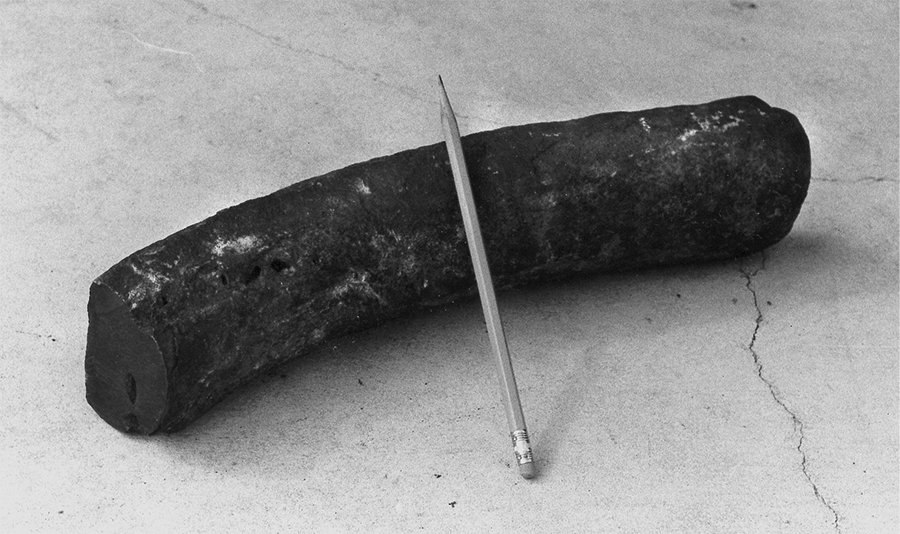
Overman lists two kinds of processed iron common in the United States: cast iron and wrought iron. Cast iron is crystalline, very brittle and usually hard. It is also known as mottled pig iron. Molten cast iron is poured into moulds at the foundry or remelted and hammered into wrought iron, a fibrous metal, which is ductile and therefore workable into many useful forms. The iron is first heated in a refinery forge. Once red hot, it is struck many times to make it malleable. During the pioneer era, wrought iron was used extensively for wagon tires and horseshoe nails. It was called grey pig iron or bar iron because of its shape coming out of the blacksmith’s forge (see illus. 8-1). Wrought iron usually contained less carbon than cast iron did. The type of ore used, impurities in the ore, furnace design, furnace temperature and other variables determined which type of iron was to be smelted.
Illus. 8-1. This small bar of pig iron, produced in 1852 by the Deseret Iron Company, is on display at the Iron Mission State Park, Cedar City, Utah. Photograph by Morris A. Shirts.
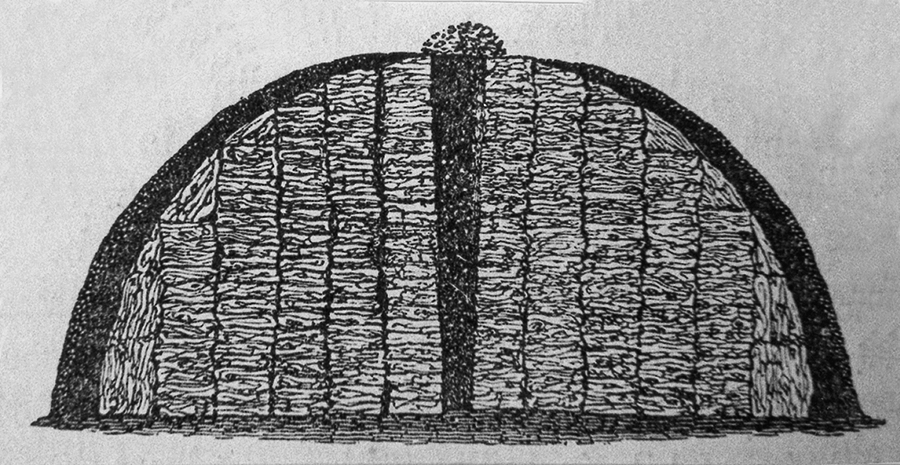
Initially, raw iron ore was combined with a predetermined mixture of fuel and limestone to make a charge. A charge is like a cake recipe and a number of charges are necessary to fill or burden a furnace. The fuel is typically either charcoal or coke and the workers who process both are called colliers. Charcoal is produced when wood is burned in the absence of air. It is created by stacking raw wood in piles, usually in pits, and covering these with dirt, leaving openings in the piles leading to the center. When burning is controlled in such a way as to smolder for a long period of time without actually igniting, the result is charcoal. Charcoal ovens require more work to build than charcoal pits, but are more efficient (see illus. 8-2). Beehive-shaped ovens made of stone became popular in the western United States, especially in the last decades of the nineteenth century.
Illus. 8-2. Charcoal oven processing. “Billets of wood precut to a uniform size were stacked on end around the perimeter of a pit. The collier carefully arranged succeeding billets so as to provide a system of flues to carry away smoke and gasses, the resulting wood pile was then covered, usually with dirt, and then lighted.” Caption and illus. from Overman’s 1852 Treatise on Metallurgy.
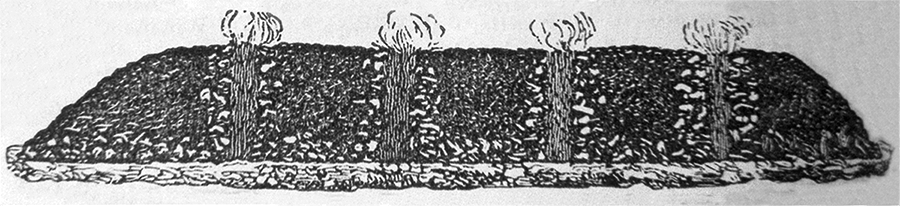
Coke, in comparison to charcoal, is produced when coal rather than wood is burned in the absence of air. Porous, yet having a strong structure, coke is made from coal in much the same way charcoal is made from wood—piled in stacks, usually in a pit, with flues arranged inside the pile to carry off sulfur, the whole then covered tightly and set on fire from the bottom, burning the material but not consuming it (see illus. 8-3).
Illus. 8-3. Coke oven processing. These piles may or may not have been constructed in pits. Coal was carefully stacked in rows commonly 20 to 100 feet long, 3 to 5 feet high and 6 to 12 feet wide. Overman’s 1852 Treatise on Metallurgy.
In 1709, Abraham Darby developed the techniques necessary to smelt iron with coke. During the next century, the British iron industry came to rely predominantly on coke, halting the depletion of Britain’s limited forests and transforming the nation into an exporter of iron. Coke was not widely used in the United States until after 1850. Wood for charcoal was so plentiful that Americans did not equip their foundries to make use of the advanced technology pioneered in England. Since the iron missionaries were trained for the most part in England, they initially favored coke as fuel for iron smelting.5 Unfortunately, the Iron County pioneers were not able to produce a high-quality coke. The local coal contained too many impurities, including sulfur, that combined with the raw ore imperfectly, leading to substandard iron.
While charcoal resulted in softer, more workable pig iron than coke, producing it ate up too much timber to make it an ideal fuel. The Maramec furnace, located 75 miles south of St. Louis, consumed over 1,600 bushels of charcoal a day at peak production in 1858.6 When the southern Utah iron workers did not have time to make charcoal or coke, they sometimes used unprocessed coal and “raw pitchy-pine” wood or scrub cedar as fuel, neither very successfully.
Pioneer iron makers did understand the use of limestone in the smelting process. Limestone served as flux, a substance that assisted in melting the iron ore and then combined with undesirable elements, carrying them away from the molten iron. Iron makers used local limestone just as it came from the quarry. There is evidence that the pioneers may have calcined or roasted the limestone before adding it to the furnace.7 This was done to drive out moisture, removing unwanted impurities. The pioneers obtained limestone in Cedar City from at least four different locations. One was the hill north of the present North Water Tank. A second was the foot of the hill near what is now the fifth hole of the Cedar City Golf Course. A third was the mouth of Squaw Cave, southeast of town. The fourth was the limestone hill on the north side of Coal Creek Canyon, immediately above the modern power station. Some of these limestone quarries were used by builders until well into the twentieth century. The pioneer iron workers had difficulty with the limestone and constantly experimented with it. Samples of yellow, grey and white limestone can still be found near the location of the pioneer blast furnace.
In general, the following mix of ingredients constituted a charge:
Limestone (the flux)
10%
Coke (the fuel)
30%
Iron ore
60%
These proportions are estimates: the furnace master adjusted the balance whenever he deemed necessary. Modern blast furnaces are burdened with a mix that is very accurately balanced, both chemically and physically. The precise amount of each ingredient is determined quantitatively and nothing is left to chance. This was not so with early iron makers. They experimented with a basic recipe to which they added “a little of this and a little of that” until the mix looked about right in the furnace. Once the furnace master was satisfied with his mix, several charges would be added to the furnace to make a batch of iron.
The actual separation of the metal from the ore depended upon the presence of heat, carbon and the weight of the metal compared to that of the oxidized substances that formed the cinder. We now call this slag and reserve the word cinder to describe the same material after it has cooled. The heavier molten iron would drip down through the furnace and into the hearth, or bottom level of the furnace, while the lighter molten slag floated on top of the hot, liquid iron. This was called the fluid process by Overman, as opposed to the solid process where a lump of solid iron was formed in the hearth. A pioneer furnace master had to learn by experience how the slag and the molten metal looked when the recipe was “right.” Frequently, his mistakes in judgment caused the furnace to chill with a solidified conglomerate mass, called a salamander or bear, resulting in a long, costly and unproductive period while the furnace lining was repaired or the whole furnace rebuilt.
Fluid-iron blast furnaces were the only kind used in the United States. Blast furnace technology initially developed when men learned to build furnaces with open sides facing downhill, taking advantage of the natural uphill flow of air. This flow provided an additional draft to make the fire hotter. Later, bellows were added to provide a more reliable draft. Mechanical means (such as waterwheels) further improved furnace design, eliminating the tiresome and sometimes ineffective bellows. Such inventions not only lightened labor but also provided a stronger draft, which, by comparison with the draft produced by bellows, was a blast of air. Fuels like coal and coke required a greater blast than charcoal.
Two types of waterwheels were in use in the mid-nineteenth century. Undershot wheels, where water flowed under the wheel, pushing against paddles arranged around the perimeter, were common in England and New England. Water to drive these wheels was stored in millponds and released as needed, through a controlled headgate that regulated the amount of water striking the wheel and, thus, the wheel’s speed. Undershot wheels were dependable, and exactly controllable, but produced relatively little power (see illus. 8-4).
The second wheel type was the overshot wheel. These were usually much more efficient than undershot wheels, utilizing not only stream flow, but also the weight of falling water, caught in the pockets or buckets formed by the perimeter spokes. At times, a long millrace had to be constructed a considerable distance upstream to bring water to the top of the wheel. The race included a wooden flume to convey the stream of water over the top of the waterwheel. A sudden flood could wipe out the creek dam, millrace and flume in seconds. In addition, the millrace could break or become “sanded up” or the flume could spring a leak, all of which would immediately shut down the system.
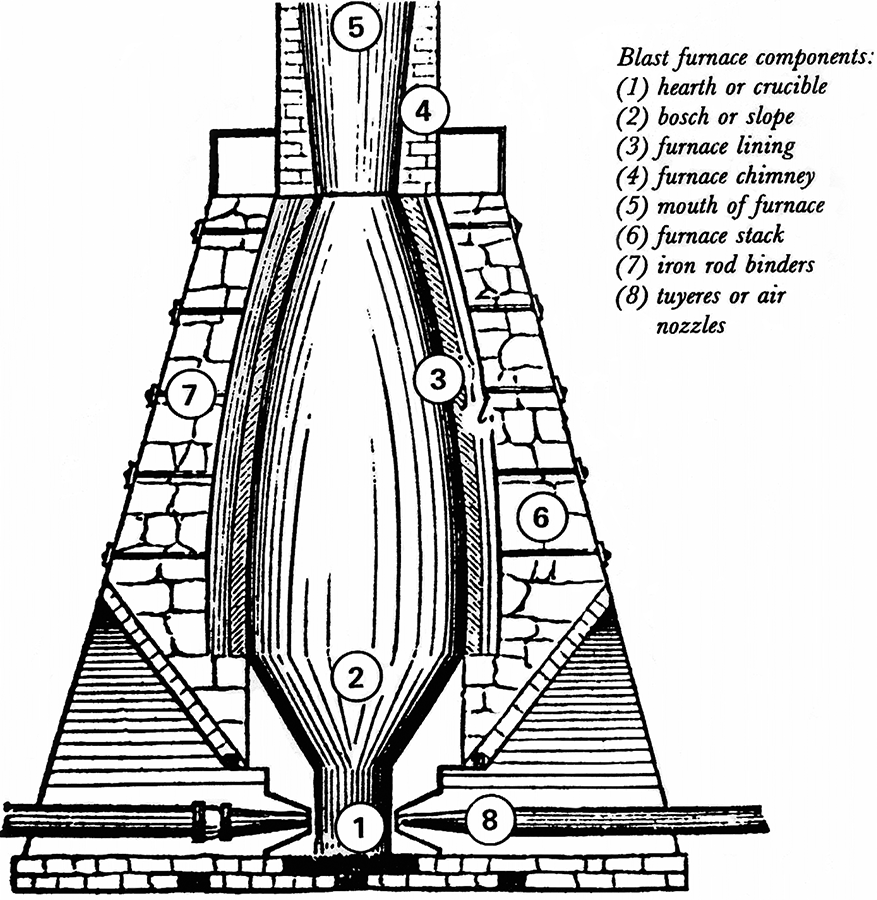
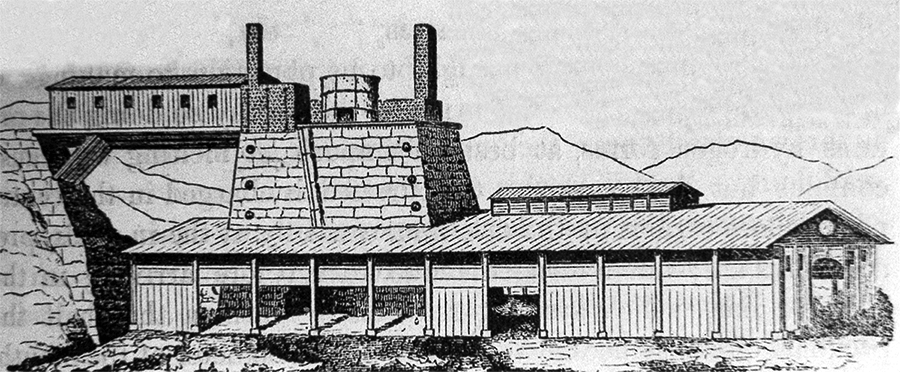
In the pioneer era, the blast furnace itself was a pyramid of masonry 25 to 50 feet high and commonly as wide at the base as it was high from base to mouth. It was usually constructed of rough stones cut from sandstone. Almost any stone could be used, except limestone. The bottom part of the interior was also sandstone, the upper interior, brickwork. The lower part of the furnace was termed the hearth or crucible; it was also the smallest part of the furnace. Usually square in shape, the bottom measured 20 to 60 inches, depending on the size of the furnace. The bottom of the hearth was called the hearth stone, just as in a fireplace. The front of the box was called the working or tymp side. The rear was simply called the back side. The remaining two sides were referred to as tuyere sides, the sides through which the air blast nozzles were placed. Thus, a 30-inch hearth had tuyeres placed 30 inches apart. A furnace smelting magnetite ore needed a larger hearth than one smelting hematite. Also, a hearth in which charcoal was to be used was generally smaller than one in which coke was the intended fuel (see illus. 8-5).
Illus. 8-5. Cross-section showing interior components of the blast furnace. Illustration from Overman’s 1852 Treatise on Metallurgy.
The upper part of a furnace was lined with firebrick, a refractory brick capable of withstanding high temperature. Manufacturing this type of brick requires special clay. Firebricks are fired in a kiln after sun-baking, much the same way as ceramic ware. If sandstone or adobe brick (sun-dried brick made from common dirt) is used for the lining, it invariably disintegrates and sloughs off, causing the furnace to blow out. This also happens if the furnace cools down during the smelting process. To prevent a blow out, the furnace is kept in continuous operation until the lining is burned up. Then, before the furnace can be burdened or charged again, its lining must be completely rebuilt.
This lining is not physically attached to the outside masonry. A space between six and eight inches wide is left between the lining and the outside wall to allow for expansion of the lining as it heats. This space is loosely filled with rough stones or in some cases, broken furnace slag. The outer sandstone wall is laid up without mortar to permit expansion. The masonry work is equipped with a series of adjustable metal binding rods, one and a half to two inches wide, which extends entirely around the outer furnace wall. As the furnace temperature changes, the binding rods are loosened or tightened by a system of keys at each end.
The boshes, or four sloping sides, extend upward and outward from the hearth, forming a hopper shaped somewhat like an inverted pyramid, upon which the cylindrical furnace lining sits. The use of the term is indicative of the influence of German iron makers on the industry and literally means “green slope.” The upper rim of the boshes is the widest part of the interior of the furnace. The diameter of the upper rim and the degree of slope of the boshes are dependent upon the type of fuel and the type of ore to be used, as well as the overall size of the furnace.
The pioneer furnace mouth, sometimes called the tunnel-head or trundle-head, was often fitted with an inverted V-shaped iron cylinder whose diameter varied from 20 inches to 10 feet. If iron were unavailable, the furnace sleeve or throat was made of firebrick. One or more doors were provided in the throat, through which the furnace was burdened. The throat was surrounded with masonry, termed the chimney. A wood-frame building, the casting house, enclosed the furnace, while a wooden bridge ran from chimney top down to the yard where the raw materials to form the charges—ore, flux and fuel—were stored. If the bridge were covered, it was called a charging bridge or charging house (see illus. 8-6).
Illus. 8-6. Large blast furnace exterior. The covered charging house provided dry storage and a mixing area for fuel, ore and limestone. Illustration from Overman’s 1852 Treatise on Metallurgy.
Outside access to the lower part of the furnace was necessary for furnace attendants to service the needs of the hearth. Roman arches built into the masonry wall supported its weight and provided access to the hearth. In large furnaces, these arches were interconnected by a tunnel through which furnace tenders could walk and communicate. The result of the whole process was liquid iron, which poured from the front opening of the hearth, called the tapping. This front opening was formed by tymp stones and dam stones plated with iron to withstand wear and tear.
The use of a cupola by iron workers in southern Utah is well-documented in several journals, but exactly how it was used remains somewhat of a mystery. It could have been a small experimental furnace where a single charge was tested before the large blast furnace was fully charged, thus reducing the possibility of a poor iron run and the risk of a blow out. There are also instances where the cupola was used as a reheating furnace to melt pig iron preparatory to casting or working into bar iron. Some cupolas were built on stilts with a trapdoor in the bottom so the burden could be easily removed.
Expectations and Experiments
By November 1851, when the iron missionaries arrived in Cedar City, they were a month short of having been in southern Utah for one year, a year spent in settling (then moving) their community, facing a cold spring and subsequent flooding and then dealing with a summer drought. As soon as Parowan’s first harvest was in, the men of Company C and Company F left to found the new community on Coal Creek. In important ways, they had to repeat all the prior tasks of settlement; even so, some work was directly related to the central mission of producing iron.
On 2 February 1852, John Lyman Smith wrote his brother, George A., reporting the attitude of the “Coal Creek brethren,” who “feel first rate and say they will have a sample of iron at Salt Lake City by 6 April; all are anxious to get the iron out from the ore.”8 No one could see this as an unrealistic expectation. They believed that iron production would begin shortly and that they would only have to rely for a few months on whatever scrap iron they could scavenge. This would be melted down by the blacksmiths and recast into the most necessary implements. Over the winter, blacksmith Burr Frost had already been attempting to make nails from scrap iron. In December 1851, he was able to report a modest success, as noted in the Deseret News:
Nails
We are pleased that some of the things wanted in our last, are, to some extent, on hand. We have been presented by elder Geo. A. Smith, with a specimen of nails, cut nails; sixes, eights, and brads, from Iron county; a very respectable article for a beginning. Cut? Yes! Cut out of old wagon-tire, and such like materials. True, the heads were not flattened like common nails; but left like common floor nails, or brads; which answer a good purpose, for many uses; and, if we had plenty of them, would do much towards supplying the immediate necessities of our flourishing territory; and with a little more experience, these nails may be as perfectly formed as any imported, and with as flat and perfect a head.
Will the mechanics of this valley let Iron county go ahead of them in making nails, so long as they make them of wagon-tire, and that wagon-tire has to be taken from hence, or has to pass through our city? We are told that 40 of these nails are now made in a minute, which is at the rate of 2400 per hour, or 28,000 per day, of 10 hours each. What is the use of bringing nails from foreign countries, if we can make them so fast, at home? Allowing 60 nails to the pound, the little factory at Iron county can now make 466 pounds every day, or ten hours; this multiplied by 300 days in a year, leaving sufficient for Sundays and holidays, and we have 139,800 pounds, or 1398 kegs of nails, of 100 pounds each, per annum, and if the tire can be made into nails at this place, it will save return cartage from Iron county. Great Salt Lake Valley mechanics, what do you say to this?9
The next month, Burr Frost ran an advertisement in the Deseret News for “all the old wrought and cast iron we can, for which we will pay a liberal price, either in nails, or apply the same on Tithing.”10 Although Frost’s nail making used already-fabricated iron, it fulfilled one of the Iron Mission’s objectives: to produce a variety of iron objects. A notice in the Deseret News, published two weeks after the ad just quoted, illustrates the interest and commitment felt at the time:
The Iron and Coal mines, are in great need of blasting Powder, who has the article? materials might be collected for making a few kegs, if a manufacturer could be found; if there is such a man in the Territory, let him report to the News, without delay; for we need the coal to melt the iron, and the iron to make the stoves, pans, kettles, rail roads, steam engines, nails and fish hooks.11
Within a year, Frost left Iron County to set up shop in Salt Lake City, but Joseph Chatterley and Jonathan Pugmire, who remained behind, were both blacksmiths, so the colony did not suffer from Frost’s absence. Early difficulties that disturbed the pioneering efforts of the iron workers included the unfortunate shooting of Jonathan Pugmire’s son by his fellow herdboy, an event which shook the whole community. It was the first death among the Iron Mission settlers. As the 21 February 1852 Deseret News reported:
The son of Robert Owens and the son of Jonathan Pugmire about 12 years of age each, were out herding last week, and through accident or otherwise, bro. Pugmire’s son was shot through the lower part of the face—the ball going in near the right corner of the mouth; and coming out at the back of the neck.12
Wheelwright William Leany’s diary contains some important details: “I was elected to the first city council and one of the first Magistrates and as such as coroner held the first inquest in the county on the dead body of little Jonathan pugmire [sic] and the jury returned a verdict of willful murder again[st] Jerome Owens for shooting him in the winter of 1852.”13 No mention is ever made in the Iron Mission journals of what punishment Jerome received or how he and his family were treated by the other settlers after the fact. We do know, at least, that Jerome was the oldest of nine children. Three sisters died at Winter Quarters and a brother died at age 15. Jerome’s next youngest brother George was born in Salt Lake City on 13 December 1852, suggesting that the Owens family left the Iron Mission to avoid the stigma of Jerome’s involvement in Jonathan Pugmire’s death. An entry in Lunt’s journal, however, on 12 September 1852, indicates that the Owens family remained a part of the community, since Lunt reports there that Jerome’s father was called on a foreign mission. Most likely, Robert Owens accepted the call to serve and moved his family to Salt Lake City to await his return. Whatever the family’s subsequent fortunes, young Jerome lived to marry, eventually moving to Eureka, California, where he died in 1902 at the age of 64. His wife Elizabeth survived him by 11 years and is also buried there.14
In addition to natural friction among the settlers, arising from their different cultural and ethnic backgrounds, the grueling nature of their hostile environment put unremitting physical demands on everyone. Disputes and defections were almost inevitable. John Lyman Smith and James Lewis hint at these problems in the same report to the Deseret News that carried news of the Pugmire boy’s death. Although Smith and Lewis complimented the “Colony at Cedar City” for their industry in enclosing the Compact Fort, they also acknowledged some defections from the ranks: “A small company are about starting for the gold mines from this place [Parowan]—some gentiles and the rest apostate Mormons—though they say they are strong in the faith; yet ‘by their work shall ye know them.’”15
Trying the Ore
That same February, problems in the overlapping administrative structures became apparent. With President Elisha R. Groves attending legislative duties in Salt Lake City, his counselor, John Lyman Smith, became de facto head of the mission, headquartered in Parowan. Matthew Carruthers, the other counselor, resettled in Cedar City and assumed the offices of presiding elder and major of the militia. On 2 February 1852, Carruthers had proposed that Henry Lunt, president of the now-dissolved traveling company, become first counselor in this new hierarchy, with John Easton, former captain of the Scotch Independent Company, as second counselor.16 This decision, temporarily at least, clarified lines of authority between Lunt and Carruthers. With no president residing in the Iron Mission to settle policy issues, however, the two counselors, John Lyman Smith and Matthew Carruthers, now found themselves sometimes at odds over which practical steps to take as the iron workers began their important tasks.
On Wednesday, 4 February 1852, Lunt recorded: “In the evening wrote a letter to George A Smith[.] Br Carruthers wrote a Letter to Govr Brigham Young, read it to me, I approved of it, and addressed it.”17 The letter to Young, dated the next day, vividly describes the conflict arising between Matthew Carruthers and John Lyman Smith over the trying of the ore. Apparently John Lyman had sent Thomas Bladen and Joseph Walker (see illus. 8-7 and 8-8) from Parowan to test the iron ore in Cedar City. Thomas Bladen (see illus. 8-9) came from a family of iron workers at the Sheffield Iron Works in England and converted while Franklin D. Richards was presiding over the LDS British Mission. Richards and Erastus Snow called Bladen, with other iron workers, to emigrate to southern Utah.18 Also born in England, Joseph Walker (winner of the ditch-digging contest mentioned in the previous chapter) was one of the original iron missionaries. As a skilled “forgeman,” he already had the experience in iron working so badly needed in southern Utah. Both men apparently reached Cedar City on 2 December 1851, James Whittaker noting that they “came into camp” on that date.19
Bladen and Walker asked a number of the Cedar City pioneers to help them test the ore. President Carruthers, however, felt that enclosing the fort should be the first priority, citing the counsel of George A. Smith. He resented the request from Bladen and Walker for manpower at such a crucial time. Furthermore, as he pointed out, “the canyon was locked up with snow, and we could not possibly get coal to try the experiment.”
Carruthers also expressed dismay to Brigham Young that John Tout had deserted the Iron Mission. Tout was a private in Company F and is first mentioned by James Whittaker, who recorded that he was “making a public grindstone” on 19 November 1851, a week after Cedar City was settled. Tout’s mechanical expertise would have been especially valuable when the time came to erect a trial furnace. Carruthers felt that “All was well with Brother Tout until a Gentile trader came along with a barrel of whiskey and a box of boots and poor John could stand the difficulties of his mission no longer and engaged to drive a few head of cattle for the gentlemen to your city and hastily took French leave.”20
Carruthers concluded his letter with the report that a compromise had been reached. Bladen and Walker agreed to help enclose the fort, while Bladen was allowed to try a little ore with charcoal. The charcoal proved unsatisfactory, so Bladen started to build a small furnace “to try the ores and blow the bellows by water power, so that by the time the furnace is ready the canyon will be so open that we can get some coal packed down on horses’ backs.” Possibly lobbying Governor Young for funds, Carruthers emphasized that coal was a “spring shut up—a fountain sealed until a road is made” up the canyon.21
Just over two months later, on 14 March, John Lyman Smith (see illus. 8-10) wrote Brigham Young about a further conflict between Thomas Bladen and Matthew Carruthers:
The people at Coal Creek are getting along very well. They have tried the iron as they have furnished a small specimen. Now they are divided. I am going with some of the brethren to see them to accertain their feelings and what they intend to do and any other matter, connected with the interest of the settlement.22
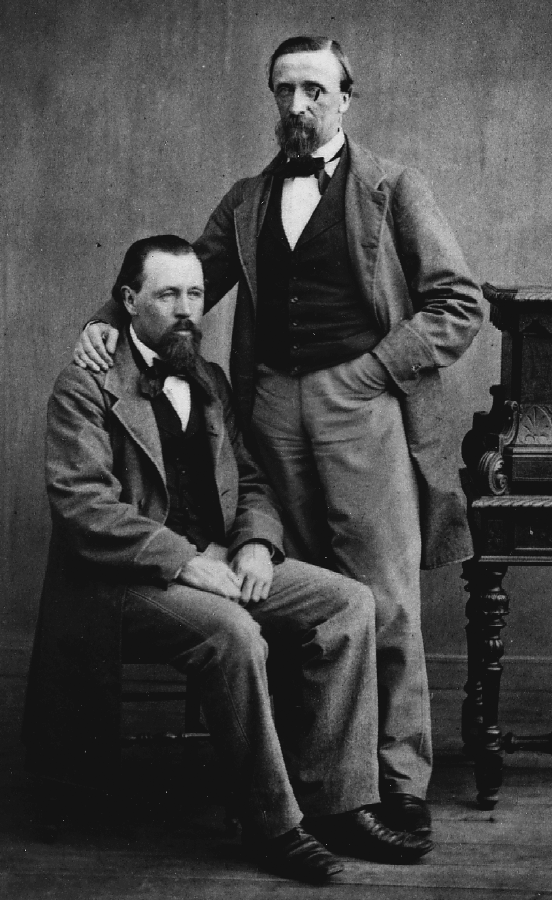
Illus. 8-10. John Lyman Smith (1828–98), seated, with unidentified man, served as first counselor to Elisha R. Groves and headed the Iron Mission while Groves served in the territorial legislature. Courtesy LDS Church Archives.
John D. Lee, who had traveled with John Lyman to Cedar City to resolve the dispute, describes the full nature of the conflict in his own letter to Brigham Young written three days later. Having agreed that trying the ore could proceed simultaneously with securing the Compact Fort, Bladen and Carruthers now disagreed over the scale of the test. Bladen wanted to build a full-sized waterwheel to power his furnace in order to give the ore a fair test. If the percentage of iron in the ore was not sufficient to justify establishing the iron works, the waterwheel could be used to power other machinery. Carruthers, on the other hand, thought it best to try the ore first with a smaller horse-powered apparatus. If the quality of the ore was high, the iron missionaries could then build on a larger scale. After learning of the differences between the two men, the brethren from Parowan
prayed the Lord in the spirit of humility to help us remove all causes of difference among them and in answer to our prayers the Holy Ghost fell upon us all. Some spoke in tongues and prophecied and truly we had a time of rejoicing. Pres. Caruthers, Bladen and all the leading men acknowledged the power of God and wept like little children and said that they would do whatever we considered was best and be one in their efforts. We advised Bro. Caruthers not to trouble Bro. Bladen, but to aid him in his opperations, in as much as they acknow[le]dge that he was acquainted with what process the ore should go through in order to test it; before we left they organized themselves to go to walk forthwith feeling warm in the cause.23
Lee’s letter shows that the stake presidency, which had originally sent Thomas Bladen to test the ore, now confirmed his authority in the matter. Carruthers and the other settlers at Cedar City were counseled to support Bladen. Lee reports their willingness to do so, effectively ending the disharmony and confusion over what to do next. Although Carruthers had reportedly superintended an iron works in Scotland and been rushed to Salt Lake City ahead of other Scottish immigrants to consult with Brigham Young, Thomas Bladen had hands-on experience at testing ore. For the present, his were the preferred skills.
The Iron Works Account Book
Such correspondence between the iron missionaries and Brigham Young is important, not only because it reveals personal interactions within the infant settlements but also because it tracks the iron workers’ first serious attempts to assess local iron. Even so, the chief sources of information on iron-related events from December 1851 through spring 1852 are Henry Lunt’s journal and the Iron Works Account Book.
The “Iron Works Account Book” is a descriptive title used by Morris Shirts for an important document—it has no cover or title, consists of 34 pages of pale blue paper and measures 7¾ by 12½ inches, the whole held together by stitching as if it were once a larger notebook. Thirty-one pages, ruled into debit and credit columns, each headed by the name of an iron missionary, have survived.24 A sample entry is shown in illustration 8-11. The pages record how much each man drew against the company (mostly in services since there are hardly any cash transactions) and how much each contributed to the project, ending with a closing balance for each. The last three pages are summaries of transactions and final additions to the register.
JAMES WHITTAKER
Dr[aws]Cr[edits]
———————————————————————————————1852
1852
July 5
To Setting 4 Tire
3.00
July 9
By 70 lbs Iron 20¢
14.--
To Herding
8.77½
July 16
By 54 " "
10.80
"
.98
Sept
By 7 days work
14.--
By 2 days Herding
4.--
By 4 " Paintg Flag*
8.--
By 1 Y† cattle 2 days
1.--
By 1½ lbs Black Lead 40
1.50
Waggons 2 days
.50
_____
______
12.75½
53.80
–12.75½
______
41.04½
*Shorthand for “painting flag”
†Probably “1 yoke cattle”
Illus. 8-11. Example of individual work tally from Iron Works Account Book.
The Iron Works Account Book appears to have been a final audit rather than a daily record. For example, William Hunter’s ledger sheet credits him with eight days’ work from 16 December 1851 through June 1852, all included in a single entry. Thus, the account book seems to have been copied, with summarized entries, from logs kept in a daybook that has not survived. All the entries are written with the same hand and level of legibility, as if they were made the same day, with the same pen, by the same person. The handwriting is extremely similar to that of James Whittaker Sr., as it appears in his personal journal. Both James Whittaker and Matthew Carruthers are known to have helped Henry Lunt write reports of the various iron works’ activities. Even though this account book is not a daily logbook, it is probably the best surviving source for identifying individual iron workers by name.
The “Iron Men”
As Lunt’s diary entries show, not all those living on Coal Creek were “iron men.” It is possible, using the account book, to reconstruct the personnel at the iron works with some accuracy. The 31 men whose names are identified on separate pages include:
1. Richard Harrison 2. Thomas Bladen 3. James Bosnell 4. Joseph Chatterley 5. Joseph Walker 6. Thomas Cartwright 7. George Wood 8. William Slack 9. Philip K. Smith25 10. Benjamin R. Hulse 11. Henry Lunt 12. John Easton 13. Robert Easton 14. James Easton 15. Alexander Keir 16. James Williamson 17. William Bateman 18. James Bullock 19. Joseph Clews 20. Jonathan Pugmire 21. David Stoddard 22. Richard Varley 23. Samuel Kershaw 24. William Hunter 25. Matthew Carruthers 26. William Stones 27. Matthew Easton 28. John White 29. John Greaves 30. James Whitaker 31. Joel H. Johnson.
The first seven names in the ledger are recognizable as those men most involved in the iron works, for their names often appear in other sources referring to iron production. John Greaves, listed on the 29th page, did no work himself, but paid the bishop for work done by the company’s blacksmith. Likewise, Joel H. Johnson, bishop at Johnson Springs (modern Enoch) did not work for the company but made contributions in goods, probably from his tithing office.
At the end of the set of ledger pages, a summary of all transactions appears. Another 22 men are listed here, none of whom appear in the first group of names. Each has a debit-credit summary, suggesting that their individual ledger pages have been lost. The individuals named are:
32. Robert Henry 33. Peter Shirts 34. Alexander Easton 35. Thomas Machin 36. Edward Williams 37. William Wood 38. Charles Smith 39. William Adshead 40. Joseph Bateman 41. David B. Adams 42. Arthur Parks 43. Merius Ensign 44. John D. Lee 45. John Lyman Smith 46. Richard Benson 47. Miles Anderson 48. George Braffit 49. John Topham 50. Orson Adams 51. James Lemons 52. Edward Dalton 53. James H. Dunton.
The group includes some men who are farmers, such as John D. Lee and Peter Shirts. Several of the 22 men listed lived in Parowan but did business with the iron works, including Richard Benson, sawmill operator; James H. Dunton, farmer; and John Topham, butcher.
A third list appears on the last page of the account book. It names those who worked after the books were closed. Some of those names already appear in the main body of the book. New names include William Gough, William Roberts, Thomas T[h]orley, Robert Gallisby, Alonso Niles and stone mason Elias Morris. The list credits each man for several days of labor, frequently on a differentiated wage scale (an official wage scale was not set until November 1852). From the Iron Works Account Book it may be difficult to identify which workers spent the majority of their time in the iron works; however, the total work force of 53 comes close to Lunt’s diary entry on 11 November 1852: “We now number about 60.”26
Tracking Labor at the Iron Works
The earliest entry in the account book is on 16 December 1851. On that day, William Hunter and William Stones took their ox teams to the iron works, presumably to clear and level the site selected for the factory.27 According to the account book, nine men performed approximately 69 days of labor on the iron works from 16 December 1851 through April 1852: Alexander Keir, James Williamson, David Stoddard (frequently spelled Stoddart), Matthew Easton, Robert Easton, Thomas Bladen, William Hunter, William Stones and Joseph Walker. Their tasks are rarely defined, the most usual notation being “work.” However, the 13 days Joseph Walker spent putting up the blacksmith shop in April and the “mining” Walker and Williamson did in the canyon are specifically noted.
Lunt’s journal implies that the major focus of the community during these months was meeting survival needs. Spring 1852 was a time of unremitting toil for the residents of Cedar City. Land-leveling, ditch-making, plowing, planting, herding and building began each day at dawn and continued until dark. At times necessity kept them at work even on Sunday. Matthew Carruthers and his counselor Henry Lunt were not exempt. Iron-making was simply not the first priority at this time. Assuming that “the iron men” (distinct from other occupations) were the nine who accounted for the 69 workdays credited in the account book, the time averages out over the four-month period to about five days per man, less than one work day per month. Obviously, no one was spending full time on iron.
Lunt’s first explicit reference to iron-making occurs on 5 April:
Delightful fine day. . . . Bro. Chatterly came in from Parowan, said that Bishop Lewis and others were coming down to see us tomorrow, and wished for there to be a meeting at 4 p.m. They had been told that the Iron business was standing [i.e., idle], and public works not going on &c. These statements I can Testify are altogether false and Untrue. Peace & prosperity is in our Midst.28
The next day, 6 April, Tarlton Lewis, James Lewis, James A. Little, Chapman Duncan and John Steele arrived from Parowan for the 4 p.m. meeting. Of this group, only Tarlton Lewis had accompanied John Lyman Smith in March when he came to Cedar City to personally mediate the debate between Matthew Carruthers and Thomas Bladen. Lunt does not record what was said at the afternoon meeting, only noting “a meeting in Bro. Ross’s house” where they were “addressed by the Parowan brethren.”29 Presumably, the group represented an investigative committee formed by John Lyman Smith to evaluate progress on the iron works. All the men were community stalwarts. Tarlton Lewis, later to become Parowan’s bishop, was a busy carpenter there. James Lewis, former clerk of the University of Deseret, worked as the first clerk of Iron County. John Steele was a surveyor and explorer. James A. Little (see illus. 8-12), Brigham Young’s nephew, had already demonstrated his skills as a road builder.
On Tuesday, 13 April 1852, the week after John Lyman’s committee came to Cedar City, Lunt recorded that he went to Parowan with Matthew Carruthers, Richard Harrison, Thomas Cartwright and George Wood. These men were all iron-makers, so it must be assumed that they went to Parowan on iron business, although they also participated in “electing” (i.e., sustaining the appointment of) Daniel H. Wells as lieutenant general of the Nauvoo Legion.30 One possibility is that the men were visiting as an advisory board, reporting to John Lyman with a production plan and perhaps a schedule.
But, practically speaking, activity was limited. The only work on the iron project Lunt hints at during this time seems to have been about 6 May when he and his father-in-law, James Whittaker, planted three-fourths of an acre of wheat for Joseph Clews.31 Clews, a brickmaker, was trading work with Lunt, a common practice in the community. Quite possibly, Clews was making adobes to be used in constructing the iron works’ furnace.
Brigham Young’s Annual Visit
In May 1852, Brigham Young, whose vision of the territory’s industrial potential first brought the Iron Mission into being, traveled south to inspect the settlements and give momentum to the iron enterprise (see sidebar 8-1). Almost a year and a half had passed since the colonists left Fort Utah and the samples promised for April general conference had never materialized.
On 9 May, Lunt records the arrival in Parowan of Young, Kimball, Pratt, Woodruff, Wells “and some 60 more brethren from the Gt Salt Lake valley.”32 With Brigham came George A. Smith, returning south almost exactly six months after leaving his position as Iron Mission president to become stake president in Provo. Some of the men’s wives were present (probably to handle the cooking), as were children, herders, drivers and guards. The president’s party had left Salt Lake City on 22 April, stopping at each settlement on the way down. The day after reaching Parowan, the visiting leaders held a conference for as many settlers as could attend.
On 10 May, driving 30 wagons and vehicles, the travelers arrived at Cedar City and were taken into various homes for food and lodging. Lunt enthusiastically notes that “Our little City was all in excitement through so great a number of visitors.”33 Later the same day, a meeting convened “in Bro Carruther’s yard.” There, Brigham Young and George A. Smith addressed all the settlers, both brethren and sisters. Their “principle subject was, to make Iron.” After the preaching, everyone was entertained by “the delightful notes of the Brass Band” (under the direction of William Pitt, captain of martial music), which Brigham had brought along with him.34 The next morning, Captain Lunt’s militia men passed in review before Brigham Young, Lieutenant General Daniel H. Wells and Adjutant-General James Ferguson.
At 4 p.m., the “brethren only” met at Brother Ross’s house, “for the purpose of organizeing an Iron Company.”35 Its name has not been preserved, if any were given, nor have many details about its structure and function. Since it was never legally incorporated, we have assigned it the name of “pioneer iron works.” This will distinguish it from its immediate successor, the Parowan Iron Company, which actually survived less than two weeks, and its true successor, the Deseret Iron Company, which became a legal entity. At this 10 May 1852 meeting, Richard Harrison was appointed to superintend the iron works and Henry Lunt was made clerk. Lunt records that “Other Brethren were appointed to manage the different departments.”36 Unfortunately, he did not specify them. Richard Harrison, the new superintendent, was a moulder whose specialty was reheating iron and shaping it into useful articles. Nothing indicates Harrison had any previous experience as an iron works superintendent.
On the evening of 11 May, Wilford Woodruff recorded that the party “took a walk on the Hill in the evening & viewed the Country. We spent the night in the fort.”37 Possibly, part of their time went to evaluating the Compact Fort’s military potential. Brigham Young may have been dissatisfied with it, since Lunt and Klingensmith (see illus. 8-13) went looking for “a sight for building another Fort” on 14 May, the day after Young’s departure.38 However, nothing came of this at this time.
Two days earlier, John Kay, Albert Carrington, Barney Ward and others had gone on a short “exploring” expedition—direction not specified—returning to report “they had discovered that there were Spaniards digging Silver in the Mountains.”39 The Spanish were known to have mined silver in the Enterprise-Holts Canyon area about 40 miles west of Cedar City and possibly in the Woods Ranch area 12 miles east of Cedar City on Cedar Mountain. It is possible that Kay, Carrington and Ward were exploring iron deposits in the Iron Springs area and beyond—perhaps to evaluate ore deposits there.
During his May 1852 visit, Brigham Young also clarified and streamlined ecclesiastical and civic structure in both Parowan and Cedar City (see related sidebar), just as he had initially organized Parowan’s city government on his first visit to the Iron Mission in 1851. On 12 May 1852, Young’s party returned to Parowan where “Parowan and Cedar Cities were organized into one Stake of Zion,” the first LDS stake in Iron County. (By date of organization, it was the fourth stake created in Utah Territory, the first three being Salt Lake City Stake, 3 October 1847; Weber Stake, 26 January 1851; and Provo Stake, 19 March 1851.)40
The new stake president was John Calvin Lazelle Smith (familiarly addressed as Calvin). Called to the Iron Mission in October 1850 while under contract to teach school in Salt Lake City, he had hired George Leavitt to assume his teaching duties. He arrived in Parowan in April 1852, barely a month before taking on the stake presidency.41 He chose John Steele from Parowan as his first counselor and Henry Lunt from Cedar City as his second. The high council members were also selected from both settlements. All the officers shared a wide variety of occupations, but only two, Matthew Carruthers and Richard Harrison, were directly associated with iron-making. Bishops for the respective wards were also called at this time: Tarlton Lewis for Parowan and Philip Klingensmith for Cedar City.
Up to this time, Matthew Carruthers had been “presiding elder” in Cedar City (delegated these duties as second counselor to Elisha Groves in the mission presidency). Under this reorganization, he was conspicuously passed over for a seat in the stake presidency in favor of Henry Lunt, the new second counselor. John Lyman Smith, first counselor to Groves, who presided in Parowan whenever Groves was absent, appears nowhere on Andrew Jenson’s list of officers in the new stake presidency. According to John Lyman’s own history, however, he was called to the high council at this time.42 In any event, he was representing Iron County in the territorial legislature four months later, so the issue of his active participation on the high council becomes moot. In his own words,
On August 2, 1852, I was elected as representative of Iron County to the State Legislature and on the 26th of September myself and wife and two children arrived in Salt Lake City where we met my father and family. The legislative assembly convened on the 12th of December, 1852. I answered roll call every time during the session.43
Although the new stake presidency had no formal training in iron production, as ecclesiastical leaders the three were expected to manage all aspects of the southern Utah settlements, including the iron works. As first counselor, Steele supervised Parowan and the settlement farms while Lunt, as second counselor, supervised Cedar City and the iron works. The high council, acting somewhat like a board of directors, represented both communities. Lunt’s position is interesting: as second counselor in the presidency, he was superior to Richard Harrison, who reported on the progress of the iron works to Lunt; but as clerk of the iron works, Lunt was subordinate to Harrison, its superintendent.
As Brigham Young understood, the success or failure of the Iron Mission rested with the workers at Cedar City. Near the conclusion of the Parowan conference, Brigham Young had James Ferguson, his captain of the guard, read an epistle that Young and Kimball had prepared for the occasion (see illus. 8-14). It seems unusual that Brigham would not deliver such an important message himself. Furthermore, the epistle is uncharacteristic of Brigham Young’s style and may have been dictated to Ferguson and modified as it was transcribed. Ferguson himself, over the course of his life, sampled many professions and took on a number of civic responsibilities. He was a talented debater, a thespian in the Deseret Dramatic Association, secretary to the legislative assembly, an attorney, sheriff of Salt Lake County for several terms and a close friend of both Young and Wells.44
The first part of the epistle emphasized potential danger from Indians, offered general guidelines to deal with them, chastised those who felt a few head of cattle were worth the life of a Native American and rebuked (without naming them) those like Peter Shirts who had built homes outside the fort, thus tempting Indian raids. The letter lauded the settlers’ sacrifice and faith, reminded them of the importance of their work and then unfolded a lengthy discourse aimed at Cedar City.
In this section, “To the Brethren at Cedar City” (see app. 5), Brigham Young emphasized the area’s resources that would facilitate iron production and promised additional settlers to help “accomplish this most desirable object, the manufacture of Iron.” President Young insisted that the people of the territory not be dependent on foreign countries for essential machinery and tools so they would not “labor under the present disadvantage, precarious and expensive transportation and continual drain of our money.” He reminded them of their “solemn covenant” to do everything in their power to produce iron, expressing
the fullest assurance that but a few weeks shall roll around before the cheering intelligence will salute our Ears,—“send your orders we are prepared to fill them. The Iron is piled up in our houses and in our streats send your teams and carry it away.”
Brigham Young further admonished them not to let selfishness get in the way of “devoted magnanimity for the Public interest.” He reminded them that it was “a gentile custom to sell Knowledge.” But the principles of salvation, he noted, required that “not only our Knowledge but our talents[,] our capacity, be it great or small should be devoted to the cause of God in what Ever calling we may be engaged in, that is conducive to its interest.” He insisted that manufacturing iron was part of the kingdom of God and “should be pursued as regardless of the consequences pertaining to pecuniary considerations as preaching the gospel[. I]t is as sacred as any other Mission.” The southern Saints would be expected to donate produce and labor as tithing. Rather than being subsidized by the leaders in Salt Lake City, the iron workers were expected to use their own resources to begin production and then increase it as circumstances allowed. President Young concluded with a prayer for the blessings of heaven to rest on “all the faithful saints” attempting to do God’s will.45
As a general guideline to the settlers, it was an inspiring address. Henry Lunt, the new second counselor (upon whose shoulders the burden of producing iron would soon fall), was given permission to copy the document. He retired to the home of a friend, Dr. William A. Morse, where he worked through the whole evening of 12 May until 1:00 a.m. to complete it.46 He subsequently refers to it a number of times as support for his unending efforts, against most difficult odds, to keep the iron workers unified.
In this frontier environment, with survival always foremost, volunteer laborers for community projects were hard to come by. Leaders, struggling to govern, had trouble meeting their own needs. In 1853, John Steele was to note in his journal: “About this time I had my hands so full, I could not tell what to do first, Indian troubles, settling home matters which are generally plenty and as Calvin or the President were absent nearly all the time, the work devolved upon me.”47 Lunt would have agreed, recording on 1 May 1852 that he had “returned home very much fatigued every night this week[.] It is a very toilsome job to break up new land, and to build new settlements.” An entry three weeks later, on the 21st, only underscored the amount of sheer physical toil the job demanded: “The remainder of the day myself and father Whittaker ditched on my ditching. Very much fatiegued in the Evening. The greatest portion of the lower dam, swept away by the high water. Creek still raising.”48
Meanwhile, Brigham Young had returned to Salt Lake City, apparently satisfied with the iron ore, coal, water, soil and settlement as a whole—but not with the progress toward manufacturing iron. On 18 September 1852 the Millennial Star reported that President Young and the exploring company arrived “all in good health and fine spirits,” speaking “highly of the industry and perseverance of the brethren . . . in their new locations.”49 Now that the basic tasks of settlement had been completed, however, the prophet expected the iron missionaries to proceed with the manufacture of iron without delay.
Sidebar 8-1: Brigham Young’s 1852 Traveling Company
Two notices in the Deseret News, dated 1 May and 15 May, name members of President Young’s party. Since 15 May is the more extensive listing, and no names are printed on 1 May that do not reappear on 15 May, only the 15 May list is given:
Brigham Young, President of Camp
Heber C. Kimball, 1st Counsellor
Geo. A. Smith, 2nd Counsellor
Daniel H. Wells, Captain of Camp
James Ferguson, Captain of Guard
William Clayton, Historian for Camp
S. M. Blair and John Kay, Chaplains
William Pitt, Captain of Martial Music
W. M. Andrews, Surgeon
O. Pratt and A. Carrington, Topographical Engineers
Jacob F. Hutchinson, Dancing Master
Elijah B. Ward and Miles Weaver, Interpreters
George S. Clark and J. L. Robinson, Bishops
W. W. Major, Artist
Samuel L. Sprague & Ezra G. Williams, Botanists
Geo. A. Smith, Orson Pratt, Albert Carrington [second mention each],
Z. Snow and Morgan Phelps, Geologists and Mineralogists
Source: William Clayton to Franklin D. Richards on 27 Apr 1852, Deseret News of 15 May 1852 (vol. 2, no. 14), 2nd unnumbered page. See also Anonymous report, Deseret News, 1 May 1852 (vol. 2, no. 13), 3d unnumbered page.
Sidebar 8-2: “Stake of Zion” Presidency, Iron County, Utah, 12 May 1852
Presidency
President J. C. L. Smith, schoolteacher, living at Parowan
First Counselor John Steele, bootmaker, living at Parowan
Second Counselor Henry Lunt, merchant and store clerk, living at Cedar City
High Councilors
Elisha H. Groves, farmer, living at Cedar City
Matthew Carruthers, iron maker, living at Cedar City
Richard Harrison, iron moulder, living at Cedar City (wrongly identified in Jenson’s Manuscript History of Cedar City, p. 27, as “Harmon”)
Joseph Chatterley, wheelwright and blacksmith living at Cedar City
__________ Graham*
James A. Little, schoolteacher, living at Parowan
William H. Dame, surveyor, living at Parowan
John D. Lee, farmer, living in both Parowan and Cedar City
Samuel West, profession not known, living at Cedar City
Elijah Newman, farmer, living at Parowan
Francis T. Whitney, blacksmith, living at Parowan
Joel H. Johnson, farmer, living at Parowan
Bishops
Philip Klingensmith, bishop of Cedar City
Tarlton Lewis, bishop of Parowan
*No Graham is known in Iron Mission literature. John Lyman Smith records being named to the high council, yet he is not listed here. John Easton, 2nd Counselor to Matthew Carruthers in Cedar City, is also a candidate, both “Easton” and “Lyman” sharing some of the orthographic elements of “Graham.”
Source: Andrew Jenson, Manuscript History of Cedar City, 27.
Notes
1. Temin, Iron and Steel, 42; John G. Crook, “The Development of Early Industry and Trade in Utah,” (master’s thesis, University of Utah, 1926), 30, citing Journal of Discourses, 26 vols. (Liverpool: F. D. Richards, 1855–86), 2:282. The “skein” is a metal collar assembly holding the axle to the wagon body.
2. See, for instance, Millennial Star articles in 13 (1 Apr 1851): 106–7, noting the preparation of a company of about 150 to go to Little Salt Lake settlement; 13 (15 Sep 1851): 273–77, comprising Thomas Bullock’s report of the “Tour of President Young and Suite”; 14 (15 May 1852): 179, inviting more brethren to “form themselves into a company to go to the Valley, and commence the manufacture of Iron”; 14 (29 May 1852): 210, “Minutes of the Special General Council” quoting Apostle Erastus Snow’s comment that “our minds have been more or less occupied with the subject of the manufacture of iron in DESERET”; 15 (19 Feb 1853): 114, “Eighth General Epistle of the Presidency of the Church of Jesus Christ of Latter-day Saints”; 15 (5 Mar 1853): 149–51, “Continuation of Minutes of General Conference of 6 October 1852,” detailing a further appeal for colonists to go south; 15 (16 Jul 1853): 458–61, outlining the organization of the Deseret Iron Company; and 17 (6 Jan 1855): 1–7, comprising the article “Manufacture of Iron in Utah,” cited in ch. 7, n. 17.
3. Joseph Fish, journal, 3, bound typescript, Perry Special Collections (copy in Shirts Collection: typescript of 1840–59 entries).
4. Frederick Overman, A Treatise on Metallurgy, 3d ed. (New York: D. Appleton, 1855). Overman’s premature death is discussed in the preface, ii.
5. Temin, Iron and Steel, 14–15; York Jones, comp. and ed., “Iron Mining and Manufacturing in Iron County, Utah, 1850–1975,” unpublished typescript, n.d., 29–30 (copy in Shirts Collection).
7. Calcined ore was roasted to drive out moisture and some of its impurities. The process would have required considerable labor and some kind of oven—perhaps similar to a coking pit.
8. John Lyman Smith to George A. Smith, 2 Feb 1852, Journal History.
9. “Nails,” Deseret News, 13 Dec 1851, 2nd unnumbered page.
10. “Notice,” Deseret News, 7 Feb 1852, 3d unnumbered page.
12. John Lyman Smith and James Lewis to editor, 12 Jan 1852, published in Deseret News, 21 Feb 1852, 4th unnumbered page.
13. William Leany, journal, Perry Special Collections, comprising three holographic autobiographical reminiscences; this book cites the third, which begins “[Jan] 4th 1888 Harrisburg Washington Co. Utah.”
14. Robert Owens family records, accessible through LDS Church, genealogy database [on-line], available from familysearch.org; see also Lunt, diary, 12 Sep 1852.
18. John M. Bladen, “Thomas Bladen,” memoir by Bladen’s grandson, copy in Shirts Collection; “Thomas Bladen,” brief biography.
19. Palmer, “History of Joseph Walker and Sons”; see also Whittaker, journal, 2 Dec 1851.
20. Matthew Carruthers to Brigham Young, 5 Feb 1852, in Journal History; see also Whittaker, journal, 19 Nov 1851.
21. Carruthers to Young, ibid. An earlier letter written by Matthew Carruthers to George A. Smith on 3 Jan 1852 appears in Deseret News, 21 Feb 1852, 4th unnumbered page. There Carruthers says “Brother Bladen is, in my opinion, well qualified to take the charge and management of the manufacture of iron, and we ought to encourage and strengthen him as much as we possibly can,” an endorsement that remained unchanged despite their administrative disagreements.
22. John Lyman Smith to Brigham Young, 14 Mar 1852, in Journal History.
23. John D. Lee to Brigham Young,17 Mar 1852, in Journal History.
24. Iron Works Account Book, Dec 1851–Nov 1852, incomplete MS, 1–31, authorship attributed to James Whittaker Sr. and descriptive title assigned by Morris Shirts, original in Palmer Collection.
25. This individual is almost certainly Philip Klingensmith. During the spring of 1852, he began writing his name as Philip K. Smith or P. K. Smith. No reason is given, but perhaps the German name seemed cumbersome. Throughout this book, he is referred to as Philip Klingensmith, rather than P. K. Smith, to avoid confusion with the other Iron Mission leaders surnamed Smith.
27. Iron Works Account Book. See p. 24 for William Hunter entries and p. 26 for William Stones entries, each of which shows the earliest beginning work date for any account, 16 Dec 1851.
45. Brigham Young and Heber C. Kimball, “to the Saints in Parowan and Cedar Cities,” in Brigham Young Papers, Outgoing Correspondence, LDS Church Archives. See app. 5 for complete text. Circumstantial evidence places this address in the context of the May 1852 conference. “Oct–Nov 1851” appears on the back of the text, but in a different hand, believed to be that of Thomas Bullock, Brigham Young’s clerk. As Cedar City was not settled until mid-Nov 1851, the speech could not have been made in Oct 1851. Most likely, Thomas Bullock was approximating the date.