The city of Bountiful in Davis County, Utah, begins its urban sprawl about ten miles due north of Salt Lake City. Access today is by freeway, so that on a traffic-friendly day, a conservative driver can leave downtown Salt Lake City and arrive at Bountiful’s Main Street in approximately fifteen minutes. The drive north from Salt Lake is anything but scenic. On the fringes of Salt Lake City spread recycling plants, car junkyards, and a scrubby tavern or two. Farther north, the east hillsides are scarred with ever-widening and constantly deepening gravel pits; to the west, clusters of oil refineries pump plumes of gray fumes into the skies.
High on the eastern foothills above Bountiful, the white spire of a Latter-day Saint temple reaches skyward. Expensive houses are clustered around the temple and are built ever higher on the mountain, as evidenced by new cuts for roads that feed into the burgeoning suburbs. Farther down the foothills, orchards that used to yield peaches, apples, pears, and other fruits have virtually vanished. While the Great Salt Lake is still visible, yesterday’s acres of blossoming springtime fruit trees between Bountiful and the lake exist only in paintings of an earlier era.
Bountiful claims the distinction of being the second settlement in Utah. Its first settler, Perrigrine Sessions, turned his saddle horse northward on September 27, 1847, only three days after leading his company of Mormon pioneers into the Salt Lake Valley. As both a leader of a Mormon pioneer company and as founder of Bountiful, Perrigrine is assured a well-deserved place in history. But founding the Wasatch Front’s second settlement after such a challenging cross-country expedition involved considerable risk. Departing so soon after reaching the valley for a further, unknown destination seemed almost foolhardy. Perhaps he was sent by Brigham Young—as Bountiful historians believe—although Perrigrine’s writings give no hint of such an assignment. At the Little Sandy in Wyoming in early September 1847, Perrigrine’s company encountered Brigham Young and other leaders who were on their way back to Winter Quarters, so perhaps an assignment was given then. It would be uncharacteristic of Perrigrine, however, not to mention that his greatly respected friend, Brigham Young, had charged him with finding a place to winter cattle.
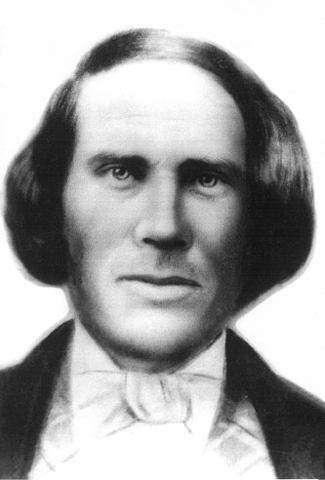
Perrigrine Sessions as a young man. Courtesy Suzanne Anderson.
According to Perrigrine’s eldest son, Carlos, Perrigrine returned from his horseback exploration to the north and reported to Parley P. Pratt and others in Salt Lake City that there was “a very large willow patch near a mile wide & 4 miles long with a heavy groth of grass all through the willows & lots of springs.”1 Perrigrine recognized this would be a good place to winter cattle. Although he failed to identify the participants, a council was held, Carlos wrote, and Perrigrine was assigned to drive all the surplus cattle north. In Perrigrine’s own words, he “made the first wagon track past the Hot Spring [Wasatch Springs] that was ever made.”2 Those wagon tracks were significant. They signaled the beginning of Brigham Young’s visionary expansion of Mormon settlements throughout the West.
During winter 1847–48, Perrigrine and his family lived in a dugout in the Bountiful area. The Sessions were the first white settlers to herd cattle there, the first to turn over the soil, to plant, and to harvest. The original name of the community was Sessions Settlement, so named for its first colonizer, who was also a husband, father, polygamist (some records claim he had the third largest posterity in the valley), farmer, missionary, wanderer, curiosity-seeker, and, yes, diarist.
Family Ties
Perrigrine was the first child of Patty and David Sessions, born on June 15, 1814, in Newry, Oxford County, Maine. Their reason for christening him his particular name can probably be attributed to Perrigrine Bartlett, the half brother of Enoch Bartlett, Patty’s father. Perrigrine’s parents may have been especially fond of their uncle or liked his moniker, but they could have had no glimmer of how their son’s life would mirror its meaning. The various forms of the name—peregrine, peregrin, peregryn(e), pelegryne, perrygryne, perigrine, peregrine—mean foreigner, to or from foreign parts, a pilgrim, a sojourner in a foreign land. Other definitions include roving, wandering, and migratory, all of which describe Perrigrine Sessions.
The work ethic of the Bartletts, Perrigrine’s mother’s family, was apt for Perrigrine too, as he continued the traditions of his forebears. The early Bartlett men participated in the Revolutionary War and settled on the land in Maine as payment for military service. They were hardy folk, living in an unfriendly environment, one that created strength of will, character, and body.
The name Sessions has an Anglo-Saxon root: Sass, a dweller on, or a tiller of the soil. Evidently the earliest point of origin known was a district in France, Sossons. The name was spelled with many variations: Seshins, Sutachins, Sisson, Sesson, Sission, and finally, Sessions the English spelling, which originated in Wantage, Berkshire, England. The present-day family, true to Perrigrine’s interest in genealogy, have traced their ancestry back to Wantage, discovered their family crest, the griffin, and determined their first ancestor of record born in the United States to be one Alexander, born about 1645 and living in Andover, Massachusetts, in 1669. Alexander’s father, Samuel, arrived in the New World in 1630.3
Brother Perrigrine
Fully converted to The Church of Jesus Christ of Latter-day Saints, Perrigrine uncomplainingly fulfilled whatever call came from its authorities. Although he did not hold high leadership positions in the Church, he was recognized as a leader in some situations, such as being assigned as captain of fifty in the 1847 pioneer migration of the Big Company, working as a member of the first bishopric in Bountiful, and serving as president of the Manchester Conference during his 1852 mission to Great Britain.
Another evidence of Perrigrine Sessions’s faithfulness to the principles of the Church was demonstrated by his participation in plural marriage. His eight wives and fifty-five children constituted one of the largest Mormon families. Polygamy worked very well in the Sessions families, and, in fact, a remarkably positive attitude toward polygamy among Sessions descendants describes their polygamous ancestors. The descendants claim that the wives were very fond of each other, supported each other, and lived together until the laws of the United States forced them to live separately. One of Perrigrine’s wives, Esther Mabey, had previously refused marriage with a young suitor because he did not believe in polygamy. She herself recorded that she didn’t hesitate for a moment when Perrigrine asked her to become his eighth wife.
A great-granddaughter of Perrigrine, Suzanne Brown Anderson, remembers the forceful words of her grandmother, Patty Orilla Sessions (Hatch Scott Mann), who was a daughter of Perrigrine and Sarah Ann Bryson. “When I was a young child,” Suzanne recounted,
and my grandmother would hear any of us joking or making light of polygamy or making negative comments about it, she was very quick to firmly say, “If you don’t have anything good to say about polygamy, then don’t say anything at all, because you obviously don’t understand it. We were all very happy growing up as family. There was NEVER discord, only love for one another. I wanted for nothing. We were well provided for and were very happy. If I ever needed my father, he was there. We worked together, prayed together, and we took care of each other together as brothers and sisters.”4
Such accounts reflect sentimental memories. Still, they add to an understanding of Perrigrine’s diaries, since they focus mainly on him. His record is enhanced by others who knew him and knew his times well.
Frequent Traveler
Perrigrine Sessions spent a great deal of his life on a road or a trail, on foot or on horseback, in a wagon, a carriage, a coach, a train, or an omnibus. Between his birth in 1814 and his death in 1893, Perrigrine migrated, according to a descendant, fifty thousand miles and spent several thousand dollars. It is a matter of speculation whether these alleged miles included the distance covered from one town to another during his wanderings or figured only the direct mileage from his starting point to his destination and home again. It would seem to be an impossible task to determine exactly how far were all the “and thence to’s” recorded in his diaries.
His first major journey was from Maine to Missouri, when, as new Church members, Patty and David Sessions were determined to gather with the Saints. Their immediate family, including Perrigrine and his first wife, Julia Ann, and their two-year-old daughter, Martha Ann, accompanied them. The journey lasted from June to November 1837. In spring 1838, Perrigrine went back to Maine to collect debts owed him. He returned to Missouri in the fall to find the Saints preparing, under force, to leave. The Sessions family endured much suffering between February and April 1839 before settling in Nauvoo, Illinois. In June 1839, Perrigrine again returned to Maine, this time on a mission. Returning to Nauvoo in July 1840, he found his family and the Lyman Leonard family—perhaps ten in all—living in a fourteen-foot square log cabin, which in 1998 was reconstructed on the original spot. Perrigrine served another mission to Maine between April 1843 and June 1844.
As for the several thousand dollars Perrigrine spent in his lifetime, it represents a considerable sum during a period when money was scarce and the prevailing means of exchange was barter. Perrigrine was not a moneyed man, and extant sources do not reveal how he acquired the means to be continually traveling, except that while he was in the mission field, he received significant financial support from other Saints.
Under pressure from their neighbors, the Saints, including Perrigrine’s mother and father, left Nauvoo, Illinois, beginning in February 1846, and they settled in what became Winter Quarters (now Florence), Nebraska. From there the pioneers began their trek, starting the next June. Perrigrine’s family remained behind in Nauvoo, though, where he worked to help prepare the poorer Saints to leave. The Perrigrine Sessions family finally left Nauvoo in May 1846 by means of what Perrigrine called a miracle, but he failed to record the circumstances or describe the miracle.
The Sessions family members who spent winter 1846–47 in Winter Quarters were Patty and David; Perrigrine; his two sister-wives, Lucina and Mary Call Sessions; and his two children, Martha Ann and Carlos Lyon. Patty’s only living daughter, Sylvia Sessions Lyon, and Patty’s son David were absent. Instead, they had moved to Iowa City with Windsor P. Lyon (1809–49), Sylvia’s husband, who had joined his brother in business there. The Big Company, as it was known, left from Winter Quarters to cross the plains to the Great Basin in June 1847. Perrigrine became a captain of fifty in Daniel Spencer’s contingent, which started westward June 17, following the tracks of the Pioneer Company that had begun their trek in April under Brigham Young’s leadership.
Perrigrine’s travels included other goals as well. Between October 1849 and April 1850, he crossed the plains to Iowa City to bring his sister Sylvia and her family to Salt Lake City. When Sylvia’s husband Windsor died, her family hoped she would join her brothers and sisters in the gospel in the West. But she disappointed everyone, as she was engaged to be married to a prominent Iowan, Ezekiel Clark (1817–98). She did not make the journey to Salt Lake City until almost five years later when she was persuaded to accompany Perrigrine, who was returning from his mission to England.
Perrigrine’s next journey began soon after the Church’s first public announcement of polygamy in September 1852. He, along with more than seventy other men, was called on a mission overseas, one purpose of which was to educate Church members about plural marriage and to justify the practice. Great Britain, where Perrigrine was sent, was a key area.5 Though the nature of the mission was not widely known, it was an overwhelming assignment. Perrigrine was taken ill on the transatlantic crossing and never fully recovered. His health deteriorated until he was sent home in 1854.
Perrigrine later served four more missions, all to Maine: fall 1868 to April 1869, August 1873 to July 1874, 1877 to 1878, and March 1886 to July 1886. Yet Perrigrine was not unique—in his day, mission calls were frequent and plentiful. A man was called, he went without purse or scrip, whether sick or well. He seldom had a companion, unlike missionaries today. There were no prescribed discussions. He had no checks deposited regularly into his account. He was on his own, but he was enthusiastic about his message, and he worked very hard to deliver it. Volumes have been written about Church leaders on missions, about their sacrifices and their successes. However, there were hundreds of ordinary men such as Perrigrine who had strong testimonies and who sacrificed as much, if not more, to fulfill their mission calls. They were not in the presiding Church councils or even in those of their stakes or wards. They were not wealthy. Sometimes they were unwell. Many, such as Perrigrine, had little or no formal schooling.
In his inimitable way, Wilford Woodruff described what it was like for missionaries who roamed the world to preach the gospel. On May 14, 1882, he explained:
I have waded swamps and swum rivers, and have asked my bread from door to door; and have devoted nearly fifty years to this work. And why? Was there gold enough in California to have hired me to do it? No, verily; and what I have done and what my brethren have done, we have done because we were commanded of God. And this is the position we occupy today. We have preached and labored at home and abroad, and we intend to continue our labors, by the help of God, as long as we can have liberty to do it, and until the Gentiles prove themselves unworthy of eternal life, and until the judgments of God overtake the world, which are at the door.6
In many ways, Perrigrine resembled this poignant description. He, too, encountered adverse situtions while attempting to share the gospel. Yet, with dogged determination, he endured the hard times and eventually found people to teach and baptize.
His writing was drawing to a close when, on July 13, 1886, in ill health, Perrigrine arrived home from his last mission to Maine. He wrote, “Continued sick for too weeks got alittle Better and rode to Mountain Green staid three weeks thence home staid ten days thence to Mountain Green staid four days I am at Peterson waiting for the train to Evinston health alittle Better.” He was on his way to visit his son Byron (of Mary Call), who was a rancher in the Randolph-Woodruff area of Utah. While visiting his son, Perrigrine enjoyed the fishing, but he was sick most of the time. Perrigrine’s last entry, written in October 1886, confides, “The 5 of October arived home health poor near wore out got little sleep.” He finally died on June 3, 1893, at age seventy-nine, less than six months after his mother’s death, and twelve days before his eightieth birthday.
By the time of Perrigrine’s death, Bountiful City had been incorporated (1892), the first telephone had been installed (1883), and the Davis County Clipper (still the local newspaper) had been founded (1892). Classified as a large town, Bountiful proudly owned an opera house and a hotel, which together cost $15,000 to build, as well as a mercantile.7
Obviously, Perrigrine witnessed dramatic changes, especially in advancements of transportation and in the growth of Salt Lake Valley. The railroad crossed the American continent in 1869. Telegraph wires were connected to Salt Lake City in 1861 and spread throughout the territory by 1865, making communication almost instantaneous. Manual labor began to be replaced by machines, and the agrarian social order began to disappear. By the time of Perrigrine’s death, manufactured goods of all kinds could be shipped to Utah, whereas earlier the economy had been self-sustaining. He never commented on the changes taking place around him; perhaps change and progress seemed natural to him. Still Perrigrine’s entries manage to pique readers’ interest about where he was and what he was doing. He went far afield from the place of his nativity, from the simple life of Maine with its wooded hills and plentiful ponds. Serving as a missionary to the Manchester district of Great Britain, which was the center of the industrial revolution in Victorian England, must have been an eye-opening experience for him. During that period, culture shock crept into his diaries. He wrestled to accept what he saw and, in some sense, decried the emerging age of industrialism and the evils of a big city. His own strong religious beliefs influenced his thinking and his way of living.
Because of his illness and his observations of the social ills around him in England, Perrigrine was extremely gratified by his return to Bountiful. What would he think now if he could see what has happened to the unspoiled landscape he discovered on that September day in 1847?
One also wonders what drove Perrigrine Sessions to labor over keeping his journals. One reason had to be the example set by his mother, who wrote faithfully for forty-two years. Another was probably the counsel to do so from Church leaders. Wilford Woodruff, one of the greatest diarists in the Church, exhorted missionaries on September 6, 1856, “to keep a Journal of their ministry every day of their lives” and added:
We are not apt to think of the importance of Events as they transpire with us but we feel the importance of them afterwards. . . .
If the power & blessings of God are made manifest in your preservation from Danger & death you should make a record of it. Keep an account of the dealings of God with you daily. . . . We want to make the History but if the Elders will take pains to write their Official Acts so the Historian can get hold of them it will be a benefit to the Church. The History of this Church will remain throught time and Eternity.
W. Woodruff said if their was no other motive in view ownly to have the privilege of reading over our Journals & for our Children to read it would pay for [the time spent in] writing it.8
Perrigrine’s Writings
Undoubtedly Perrigrine wrote for posterity. At the top of the first page of his diaries he cautioned,
This Book it is my Wish at my diseas [decease] that one of My Sons that Stands Highest in the Holy Priesthood shal take and Safeley Keep in City Bountiful For the inspection of All my posterity except Small children and Others that have no Buisnes with it it is a Sacred Book the History of the living And the dead and is to be Kept in sacred Hands P G Sessions.
This publication, Exemplary Elder, contains the firsthand accounts of Perrigrine, which are occasionally supplemented with writings from his mother, Patty Bartlett Sessions, a midwife-diarist who affectionately called her son “P. G.”; and from Perrigrine’s eldest son, Carlos Lyon Sessions.9 Information about Perrigrine’s plural wives collected from their descendants is also included.10 From all indications, they were strong women, uncomplaining, and devoted to Perrigrine, each other, and to the principle of plural marriage. Their records, limited as they are, are an important contribution to Sessions family history and on a broader scale, to pioneer history and to the history of polygamy as it operated in one of Utah’s most noteworthy families.
The original diaries of Perrigrine Sessions can be found in the archives of The Church of Jesus Christ of Latter-day Saints. They are fascinating but fading with age. They consist of eight volumes of various sizes bound in leather, often referenced by Perrigrine himself and presumably by his posterity. Perrigrine’s diaries chronicled forty-two years, from 1846 to 1888, but focused mainly on his missions. Perhaps when he was not serving a mission, he was too busy taking care of his land and the myriad needs of his large family. Or perhaps he left the record keeping to his mother then. But he wrote dutifully about his missionary travels, and his observations frequently illustrate his curiosity.
Perrigrine’s handwriting is not very legible, his spelling usually phonetic, and his style occasionally biblical. For a person of his simplicity, he sometimes chose words that were stilted. His curiosity seemed almost childlike, but his maturity filters through as well. A reader can tell when days were productive and satisfying to him and when they were not. Not infrequently he displayed a flair for description. Sometimes he showed indignation, particularly if he observed what he felt was an injustice toward humankind or the Church. This trait surfaced especially while he was on his mission to England.
Perrigrine began writing his family history in Nauvoo, recounting their migrations, and then recorded on-the-spot accounts of his various missions. His missionary diaries, though repetitious and sometimes tedious, are remarkably reflective of his place and time, and they often reveal his fascination with the unusual or the unfamiliar. His sense of duty in the face of his bouts with illness and his determination to do his duty against great odds are expressed clearly and forcefully. Uneducated, he struggled to get his diaries “right” for his posterity. To do so, he penned his experiences and later revised the first version.
Perrigrine’s voice is unique. His diaries lead us into many interesting diversions. He condemned methods used in slaughterhouses. He attended sideshows and marveled at the wonders to be seen there. He visited parks and gardens, and he commented on strange historical traditions in some of the places he wandered. He visited his relatives in New England repeatedly during his frequent missions there and probably tried to convert them each time. Although they were never baptized, he made sure their ordinances were performed after their deaths by proxy in the temple. Perrigrine showed amazing enthusiasm for whatever he was doing at any given moment. Much of the time he was ill, desperately ill, yet he would not be deterred in trying to accomplish whatever was expected from him by Church leaders or by himself.
In Perrigrine’s diaries, readers delve into many familiar stories in Church history and learn about numerous little-known events. For example, Perrigrine gave an account of the tribulations suffered in Missouri and of his family’s life in Illinois. There he performed ordinance work in the still-uncompleted Nauvoo Temple, worked in a blacksmith shop making wagon wheel spokes, hauled hay from the prairie, and performed other everyday duties on the frontier. Together, these accounts revealed the cooperation and selfless service the Sessionses and other Saints gave both their fellow pioneers on the trail and those who had been left behind—mostly the very poor—to escape from a city in turmoil. Perrigrine also mentioned a “flaim of fier” that was seen when the figure of an angel was raised on the steeple of the Nauvoo Temple. He described the angel as holding a Book of Mormon in one hand, a fact seldom mentioned today. According to Perrigrine, this phenomenon, the flame of fire, stopped temple work for two days.11
Not long after this event, the Sessionses crossed the Mississippi in midwinter, risking exposure, sickness, and death, they began the great Mormon migration across the plains. The family was among the first to begin the westward trek, a continual procession that involved some seventy thousand emigrants, about half from foreign lands, which lasted until the Central Pacific and Union Railroads met in 1869. While these stories reveal much about Sessions family history, they also help convey conditions in the early Church.
Notes
1. Carlos Sessions, History of Bountiful, holograph, Utah Historical Society, 1. Photocopy in possession of editor.
2. Found in chapter 9 herein. Though Perrigrine could not have known it, at least 61 and, by one estimate, possibly as many as 80 wagons made tracks “past [or near] the hot springs” in 1846. We know specifically of two wagon companies who, following the shortcut to California promoted by Lansford Hastings, descended Weber Canyon and traveled through today’s Weber, Davis, and Salt Lake Counties in that year.
One, comprising the families of George Harlan, Samuel C. Young, and others, started through Weber Canyon with 57 wagons. Three times during the six-day ordeal they had to use windlasses to lift the ox teams and wagons over mountain spurs bordering the river. On one occasion the rope broke and the oxen and wagon fell to destruction. Included in the company was the family of Peter L. Wimmer, his wife, and five children. They were said to be Mormon converts. The second company down Weber Canyon included five Swiss and German young men and the small families of Samuel Kyburz and John Barber. Being young, adventurous, and mostly single, they took their four wagons directly down the river, completing the passage in one long, arduous day. Heinrich Leinhard described the country Perrigrine would see the following year: “The land extends from the mountains down to the lake in a splendid inclined plane broken only by the fresh water running down from ever-flowing springs above. The soil is a rich, deep black sand composition doubtless capable of producing good crops. The clear, sky-blue surface of the lake, the warm sunny air, the nearby high mountains, with the beautiful country at their foot, through which we on a fine road were passing, made on my spirits an extraordinarily charming impression. The whole day long I felt like singing and whistling; had there been a single family of white men to be found living there, I believe that I would have remained. Oh how unfortunate that this beautiful country was uninhabited” (J. Roderic Korns, ed., West from Fort Bridger [Salt Lake City: Utah State Historical Society, 1951], 108, 131, 133, 134).
3. Francis C. Sessions, comp., Materials for a History of the Sessions Family in America: The Descendants of Alexander Sessions of Andover, Mass., 1669 (Albany, New York: Munsell’s Sons, 1890), 145–46, 209. See also Basil Cottle, The Penguin Dictionary of Surnames (Baltimore: Penguin, 1967), 254; and Elsdon C. Smith, ed., New Dictionary of American Family Names (New York: Harper and Row, 1956), 461.
4. Letter from Suzanne Anderson, in possession of editor.
5. For more information about the British mission in the 1850s, see James B. Allen, No Toil nor Labor Fear: The Story of William Clayton (Provo: Brigham Young University Press, 2002), 279–303.
6. Wilford Woodruff, in Journal of Discourses, 26 vols. (Liverpool: F. D. Richards, 1855–86), 23:130, May 14, 1882.
7. The population totaled about 2,500. By 1980, Bountiful had become the seventh largest city in Utah, with a population of 32,978. By the year 2000, the population had increased to 40,000. See Wayne L. Wahlquist, ed., Atlas of Utah (Provo: Brigham Young University Press, 1981), 101, 118; Utah Gazetteer 1892–93 (Salt Lake City: Stenhouse & Co., 1892–93), 43–44. Included with this book’s information on Bountiful is “Sessions Pool Hall, W. B. Sessions, Prop. Summer Drinks and Cigars, Bountiful, Utah.” One wonders, Who was W. B. Sessions? Neither Perrigrine nor his brother David fathered a son with the initials W. B., though Perrigrine had sons Wallace Orlando, William Westley, and Walter. Perrigrine would not have sanctioned such an establishment.
8. Wilford Woodruff, Wilford Woodruff’s Journal, 1833–1898, Typescript, ed. Scott G. Kenney, 9 vols. (Midvale, Utah: Signature Books, 1983–84), 4:444–45.
9. The diaries of Patty Sessions cover the same period but detail the broader Mormon experience, from Nauvoo, Illinois, to Winter Quarters, Nebraska, to the valley of the Great Salt Lake and the early history of Salt Lake City, and then to Bountiful. See Donna T. Smart, Mormon Midwife: The 1846–1888 Diaries of Patty Bartlett Sessions (Logan: Utah State University Press, 1997).
The Sessionses’ participation in the events before the exodus from Nauvoo, however, must be learned from Perrigrine’s memoirs, since the diaries Patty kept during that period have been lost. Even Perrigrine’s account of crossing the plains gives a more detailed story than Patty’s generally steady and constant narrative. Because Perrigrine wrote his early diary as a reminiscence, he had a broader perspective, and he likely had accessed his mother’s diaries for reference as well. Patty mentioned at one point that he was checking some dates in her diary.
Carlos’s history, in its own individual way, adds a welcome bonus to Perrigrine’s diary. Carlos Lyon Sessions, eldest son of Perrigrine, was born in Nauvoo on July 16, 1842. A few years later, young Carlos, Perrigrine, and Perrigrine’s second wife, Lucina Call Sessions, traveled on a history-making journey to the valley that was to be called Bountiful. Carlos was only five years old, but he retained vivid impressions and many colorful details about his first and last home in the West. Carlos’s history of Bountiful is preserved in the archives of the Utah State Historical Society.
Patty was immersed in people, Perrigrine in spreading and living the gospel, and Carlos in the development of a community. Each perspective describes an important part of the Sessions family history. In a broader sense, each of the pioneer accounts also shows how infant settlements began, operated, and grew, and they reaffirm how strong an influence religious beliefs can exert on a town.
Perrigrine and Carlos share an aggravating characteristic, though, Carlos perhaps following his father’s example. Each of them wrote his original record and later copied it, preserving both accounts. The first version was more spontaneous, but the second added details or made significant corrections. Perrigrine must have started the copying process soon after writing because he added minute details and eliminated others. He mentioned at least once that he was copying his journals.
10. Since Perrigrine almost never spoke of any of his eight wives by name, but rather referred to them in general terms as “my family,” the histories and family legends collected by posterity—some in the exact words and from the memories of the wives—inject an important feminine outlook on their family dynamics. After all, the women were carrying the burden of survival during the frequent and prolonged absences of their husband. They were raising the children; planting, harvesting, and preserving the crops; keeping their houses in order; and buoying each other up.
The women who added Sessions to their name were remarkable, and their tales, along with other traditional family stories, add a distinctive touch to a faithful man’s life and works. One of the wives, Sarah Crossley, was a thirteen-year-old in the Martin Handcart Company—one of the two companies that was stranded in bitter storms on the Wyoming plains in 1856. Her personal tale is poignant and vivid. Two of Perrigrine’s wives, Lucina and Mary Call, were sisters. Another, Fanny Emorett Loveland, was the niece of the two sisters and only fourteen years old when she married Perrigrine the day before he left on one of his missions. He most likely married Elizabeth Birdenow so that she would live with his mother and take care of her in her declining years.
11. Latter-day Saint temples traditionally feature a golden statue of the Book of Mormon prophet Moroni and his trumpet on the major spire, but the angel raised on the Nauvoo Temple was “a flying herald, sounding a trumpet.” No such representations have wings. A good source book for early temples in general and the Nauvoo Temple in particular is James E. Talmage, The House of the Lord (Salt Lake City: Bookcraft, 1963), 134.