At the outset, I wish to credit distinguished Yale historian Jon Butler for the colorful phrase that makes up the forepart of my title.1 Though my approach will diverge somewhat from Butler’s fascinating and significant revisionist study of American religious history, I find his phrase felicitous for capturing an image of waves of religious fervor washing over the American cultural landscape between the Revolution and the Civil War.
Religion and the American Revolution
The Revolutionary era is widely considered to have been a watershed moment in American history, but exactly how it was so varies from observer to observer. In terms of American Christianity, some historians stress its negative impact.2 Because of the war, they point out, churches were disorganized and some destroyed; Loyalist ministers fled and Patriot preachers left their locales to act as chaplains in the army. Moreover, the Revolution’s leaders tended to be drawn from a group of men who had been influenced by the Enlightenment to favor “natural religion” or deism over scripture-based, denominationally organized religion. The Revolution in its aftermath also gave considerable impetus to the tendency to move further west, where links with established Eastern churches were difficult to maintain and where, as one visiting cleric noted, the people acted “like freed prisoners,” engaging in all sort of “barbarous” activity.3 What all this meant was that the period immediately following the Revolution marked a low point in church attendance in United States history.4
And yet the Revolutionary era bequeathed to American Christianity its greatest gift—disestablishment.5 No longer would particular churches be officially and financially fostered by the government. Church and state were to be separated and full liberty of conscience was to prevail. With disestablishment, each denomination had to make its way by the sheer force of its persuasive powers, and by that alone. Henceforth, religion would be conducted on the “voluntary principle,” where the nature and degree of religious affiliation was left to personal choice without interference from the state. For some, this prospect was frightening. They believed that without state support of religion the very moral fabric of the Republic would unravel. Yet, as we shall see, the very opposite occurred. By the mid nineteenth century, America was to become the most “Christian” nation in the industrialized world, with its roots firmly planted in the rich soil of religious disestablishment.
Republicanism and American Religion
One of the most significant and salutary results of the American Revolution was that traditional authorities of all kinds, religious ones included, began to be questioned and reconsidered. If America and Americans could fend for themselves in matters political, why not in matters religious?6 Though Elias Smith has largely slipped from history, in the early 1800s, he was one of the great champions of “republican” or populist religion. He charged that religion had too long been controlled by the ministerial guild with their college degrees, broadcloth attire, and fancy carriages. Smith and others rebelled against the need for mediating elites. “Many are republicans as to government, and yet are but half republicans,” wrote Smith, “being in matters of religion still bound to a catechism, creed, covenant or a superstitious priest. Venture to be as independent in things of religion,” he urged, “as those which respect the government in which you live.”7 Elias Smith was not the only one to apply political republicanism to religion. Lorenzo Dow, a popular Methodist preacher, declared, “If all men are ‘BORN EQUAL,’ and endowed with unalienable rights by their CREATOR, in the blessings of life, liberty, and the pursuit of happiness”—an obvious tie to the Declaration of Independence—“then there can be no just reason, as a cause, why he may or should not think, and judge, and act for himself in matters of religion, opinion, and private judgment.”8 Such statements as these epitomize the democratizing attitude toward religion that developed in America in the years following the Revolution.
Concurrently, religious journalism flowered in America. Many of these newspapers were edited by religious “republicans,” and the press became one of their most effective means to challenge the established religious order. Elias Smith, whose Herald of Gospel Liberty (notice the link between Christianity and freedom) was the first religious newspaper in the United States, called the press “a short and cheap way” to present “a general knowledge” of his ideals.9 At the forefront of the populist Christian agenda was the destruction of “priestcraft,” their term of choice to derogate the ministerial guild. Several lines from Rogerene Baptist Timothy Waterous’s “Priestcraft Float Away” typify the animosity religious republicans felt toward the established clergy:
Why are we in such slavery, to men of that degree; Bound to support their knavery when we might all be free; They’r nothing but a canker, we can with boldness say; So let us hoist the anchor, let Priest-craft float away.10
Such sentiments both reflected and reinforced the broader democratization of Protestant Christianity then underway in the United States. By the mid-1830s, Alexis de Tocqueville would be able to generalize that religion in America was “republican religion.”11
Primitivism
To some people the word “primitive” means “crude, backward, or undeveloped.” As used in religious discussions of early nineteenth-century America, however, it carried a different connotation. Primitive drew directly from its Latin root primus to mean “first” and was related to other English words like “prime,” “primary,” and “primordial.” In religious conversation, it was often used, like Joseph Smith used it, to describe the New Testament church. The “prime-itive” or “first” church was the one Jesus organized in the first century a.d. In the early 1800s, there was considerable interest in America in the primitive church. Aware of the spiritual barnacles that over the centuries had attached themselves to existing Christian traditions, religious souls in a variety of denominations sought to re-form their churches in the primitive mold. Historians refer to this quest for the primitive church as “Christian primitivism” or simply “primitivism.” Many of those who joined The Church of Jesus Christ of Latter-day Saints in its early years were primitivists who found Mormonism to be the restoration of New Testament Christianity.12
Primitivism provided a popular antidote to the perennial problem of priestcraft. Alexander Campbell, one of the leading primitivists of the early 1800s, described the problem succinctly: “The stream of Christianity has become polluted,” and “all the reformations that have occurred . . . have failed to purify it.”13 The answer, explained Alexander’s father, Thomas, was to return “to the original standard of Christianity, the profession and practice of the primitive Church, as expressly exhibited upon the sacred page of the New Testament scripture.”14 Nothing since then was of any value. Elias Smith “protest[ed] against that unrighteous and ungodly pretense of making the writings of the fathers [Catholic ecclesiastics of the first centuries A.D.], the decrees of counsels, and synods, or the sense of the church, the rule and standard of judging of the sense of Scriptures, as Popish, Anti-Christian, and dangerous to the church of God.”15 Primitivists sought to cast away nearly two thousand years of Christian theology as obfuscatory accretions of the ages. Only by engaging the New Testament directly and taking it alone for their sure guide could truth seekers return to pure Christian beginnings and completely bypass the clerical corruption of the intervening centuries.
To be sure, such an enterprise was limited by human bias. Primitivists looked down the tunnel of time hoping to perceive the timeless primordium of truth. What, for the most part, they actually saw was their own reflection. Unaware of such cultural conditioning, though, seekers proclaimed that scripture was perspicuous, transparent even to the lowliest plowboy. The only requisite aid to understanding it was a sincere and open mind. In the end, primitivism tended to produce a proliferation of competing Christianities. As John W. Nevin, prominent mid-nineteenth-century theologian, noted, the belief was widespread that “every congregation has power to originate a new Christianity for its own use.”16 Richard McNemar, a Methodist-turned-Presbyterian-turned-Christian-turned-Shaker, spoke from experience when he penned these lines:
Ten thousand Reformewrs like so many moles Have plowed all the Bible and cut it [in] holes And each has his church at the end of his trace Built up as he thinks of the subjects of grace.17
If ordinary folk embraced such visions, so, too, did Enlightenment-influenced elites like Thomas Jefferson. Sounding quite primitivist, he wrote, “To the corruptions of Christianity, I am indeed opposed, but not the genuine precepts of Jesus himself. I am a Christian in the only sense in which he wished one to be; sincerely attached to his doctrines, in preference to all others.”18 Moreover, Jefferson linked his concept of primitive Christianity to his republican ideals: “Christian religion,” he declared, “when divested of the rags in which they [the established clergy] have enveloped it, and brought to the original purity and simplicity of its benevolent institutor, is a religion of all others most friendly to liberty, science, and the freest expansion of the human mind.”19 Thomas Jefferson spent a number years going through his Bible and excising passages that in his view evidenced priestly corruptions. What was left—Jefferson’s choices for the authentic teachings of Jesus—became known as the Jefferson Bible. Thus, even Jefferson created “a new Christianity for [his] own use.”
The creation of such renewed Christianities had millennial overtones. Alexander Campbell claimed, “Just in so far as the ancient order of things, or the religion of the New Testament, is restored, just so far has the Millennium commenced.”20 This sort of millennial optimism was common in the era of the Second Great Awakening where revivals and camp meetings seemed to be bringing about a spiritual prelibation of paradise.
Methodism
With the disestablishment of religion in the final quarter of the eighteenth century (Massachusetts and Connecticut held on into the nineteenth century), ministers had to compete with each other for adherents. Having previously relied on the state for support, the old established churches like the Anglicans (now Episcopalians) and Congregationalists were often ill-equipped to participate in the religious “free market” that emerged in the early Republic. Other denominations, especially the newer “upstart” religions, quickly adapted to this environment, however. As a result, religion in the new Republic “flourished in response to religious deregulation.”21 In the words of historian Martin Marty, “The evangelizers started a Soul Rush that soon outpaced the Gold Rush. Here was a textbook example of free enterprise in the marketplace of religion.”22
No religion was more successful in the era’s Soul Rush than the Methodists. Methodism began in England not as a break-away sect but as a movement within the Anglican Church.23 John Wesley and his associates felt that Anglicanism had grown overly formal and cold. Nicknamed “methodists,” they sought in small-group gatherings known as “classes” to recapture a vital, spirit-empowered religiosity, pursuing devotional exercises designed to invite the Spirit and reinvigorate the national church. This effort was similar in intent to the later, larger “revivals” that would sweep the transatlantic world. Revivals of whatever size or form were designed to “revive” the flickering flame of faith. A revival was not so much a venue where ministers tried to convert the unconverted, though that was an element of it. More than anything, it was an event at which backsliders could be reclaimed and lukewarm Christians “reheated.”
Because of its connection to Church of England, Methodism had a slow start in America, but after the war, under the leadership of Francis Asbury, a man of patriotic loyalties and boundless energy, the group mushroomed.24 This “Father of American Methodism” was an extraordinarily spiritual man among a group already noted for their religious rigorism. Here is a sampling of entries from his faithfully-kept journal, compiled by Martin E. Marty:
“My heart is still depressed for want of more religion.” On another day, “I must lament that I am not perfectly crucified with God.” And again: “A cloud rested on my mind, which was occasioned by talking and jesting. I also feel at times tempted to impatience and pride of heart.” When someone tried to compliment him, Asbury suspected them of flattery inspired of Satan. No one ever caught a glimpse of his furrowed face smiling over innocent pleasantries.25
For Methodists, logging seat time in a chapel on Sunday was far from salvifically sufficient; spiritual virtuosity was demanded.
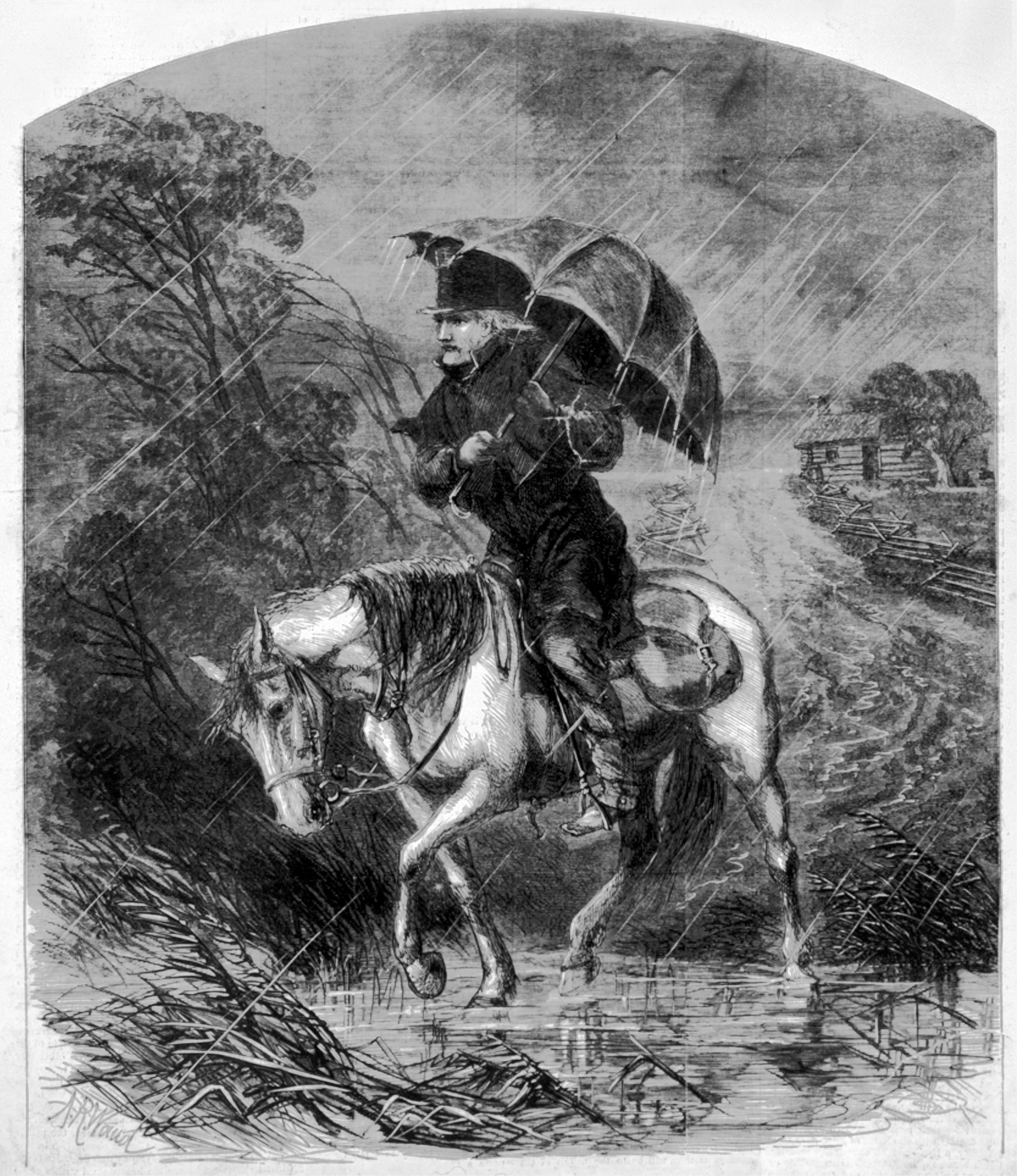
So was evangelism. Methodism played a prominent role in helping to “church” the West. Asbury and his itinerant preachers did not shy away from the challenge of reaching the tiny hamlets and backwoods huts of expanding America. Early on, Asbury expressed disdain for ministers “who had manifested a desire to abide in the cities and live like gentlemen . . . [they] seem unwilling to leave the cities . . . but I think that I shall show them the way.”26 Asbury spent the remainder of his life riding the circuit. He never married, never owned a home, and could carry the bulk of his possessions on horseback. Before dismounting for the last time, this spiritual Spartan described himself as “an old worn out old man of about sixty years, who has the power given him of riding five thousand miles a year, at a salary of eighty dollars, through summer heat and winter’s cold, traveling in all weather, preaching in all places; his best covering from rain often but a blanket.”27
The Circuit Preacher. Copyprint of wood engraving, after drawing by Alfred R. Ward. Harper’s Weekly, October 12, 1867. Such depictions illustrate the itinerant preachers’ dedication in the face of hardships. Courtesy Library of Congress.
Asbury not only set the standard for ministers of other faiths in reaching outlying and isolated areas, but he inspired his own army of itinerants who helped him take Methodism to every corner of the new republic. As superintending “bishop,” Asbury assigned each of his preachers a circuit or particular geographic area in which to minister. Circuit riders would organize converts into classes and appoint a class leader to watch over them while the traveling preacher was away. Asbury constantly rotated his ministers and worked them very hard, but “never asked a preacher to endure that which he did not undertake regularly.”28 The “worn out” circuit rider, or the itinerant preacher whose poor health finally forced him to retire, was not an uncommon phenomenon in the early days of American Methodism. Still, some were smitten by a different “disease”—marriage. According to Marty, as Asbury’s preachers accepted the hospitality of families on their circuits,
they observed the cozy life and met attractive and nubile women. . . . Because the Bible called marriage honorable, Asbury had to show grudging respect for its status before God, but this assent never helped him enjoy marriage, the “ceremony awful as death.” Asbury cried that he thus lost two hundred of his best traveling men in the world and feared that “the devil and the women” would eventually get all his preachers.29
In the end, his fears were unwarranted. Methodism grew in a dramatic fashion despite the fact that many of his preachers had to “run to their dears almost every night.”30 In 1780, American Methodists numbered less than ten thousand. By 1830 they had reached half a million—nearly a third, by some counts, of all U.S. citizens formally affiliated with a church.31 Not surprisingly, historians have labeled the early 1800s “the Age of Methodism,” a fitting title not only because of the Methodists’ numerical predominance but also because their evangelical techniques and spiritual emphases were contagious and spread to other denominations. Nathan Hatch has called it “the most powerful religious movement in American history, its growth a central feature in the emergence of the United States as a republic.”32
Revivalism
To quote Mark Noll,
The Second Great Awakening was the most influential revival of Christianity in the history of the United States. Its very size and its many expressions have led some historians to question whether a single Second Great Awakening can be identified as such. Yet from about 1795 to about 1810 there was a broad and general rekindling of interest in Christianity throughout the country. This renewal, in turn, provided a pattern and an impetus for similar waves of revival that continued throughout the nation until after the Civil War.33
Prominent among the settings for the Second Great Awakening were “camp meetings,” multi-day, and sometimes multi-denominational, outdoor religious gatherings that attracted large crowds to “hear the word.”34 Alexis de Tocqueville offered this description of camp meetings:
Almost every summer, it is true, some Methodist preachers come to make a tour of the new settlements. The noise of their arrival spreads with unbelievable rapidity from cabin to cabin: it’s the great news of the day . . . people show themselves almost starved for religion. . . . They come from fifty miles around. It’s not in a church that the faithful gather, but in the open air under the forest foliage. A pulpit of badly squared logs, great trees felled for seats, such are the ornaments of this rustic temple. . . . It’s there that, during three days and three nights, the crowd gives itself over to almost uninterrupted religious exercises.35
Though Methodists made widespread use of the camp meeting, so did the Baptists and even the Presbyterians. The most prominent camp meeting of the early Second Great Awakening, a massive convocation in Cane Ridge, Kentucky, was essentially a Presbyterian event led by James McGready.36 McGready, however, invited the participation of Baptists and Methodists. “In that awful day, when the universe assembled must appear before the quick and the dead, the question brethren, will not be, were you a Presbyterian—a Seceeder—a Covenanter—a Baptist—or a Methodist; but, did you experience a new birth? Did you accept of Christ and his salvation as set forth in the Gospel?”37 Spiritual rebirth rather than denominational recruitment was the focus of most camp meetings and revivals.
To bring about such a dramatic consequence required both a dramatic setting and dramatic preaching. “Father McGready would so describe Heaven,” reported one participant in the Cane Ridge revival, “that you would almost see its glories, and long to be there, and he would so array hell and its horrors before the wicked, that they would tremble and quake, imagining a lake of fire and brimstone yawning to overwhelm them, and the wrath of God thrusting them down the horrible abyss.”38 As for the setting, another eyewitness reported:
At night, the whole scene was awfully sublime. The ranges of tents, the fires, reflecting light amidst the branches of the towering trees; the candles and lamps illuminating the encampment; hundreds moving to and fro, with lights or torches, like Gideon’s army; the preaching, praying, singing and shouting, all heard at once, rushing from different parts of the ground, like the sound of many waters, was enough to swallow up all the powers of contemplation. Sinners falling, and shrieks and cries of mercy awakened in the mind a lively apprehension of the scene, when the awful sound will be heard, ‘arise ye dead and come to Judgement [sic].39
Of course, extraordinary behavior had also characterized the First Great Awakening, but it was the “innovations” of the Second Great Awakening that caught people’s attention. These included
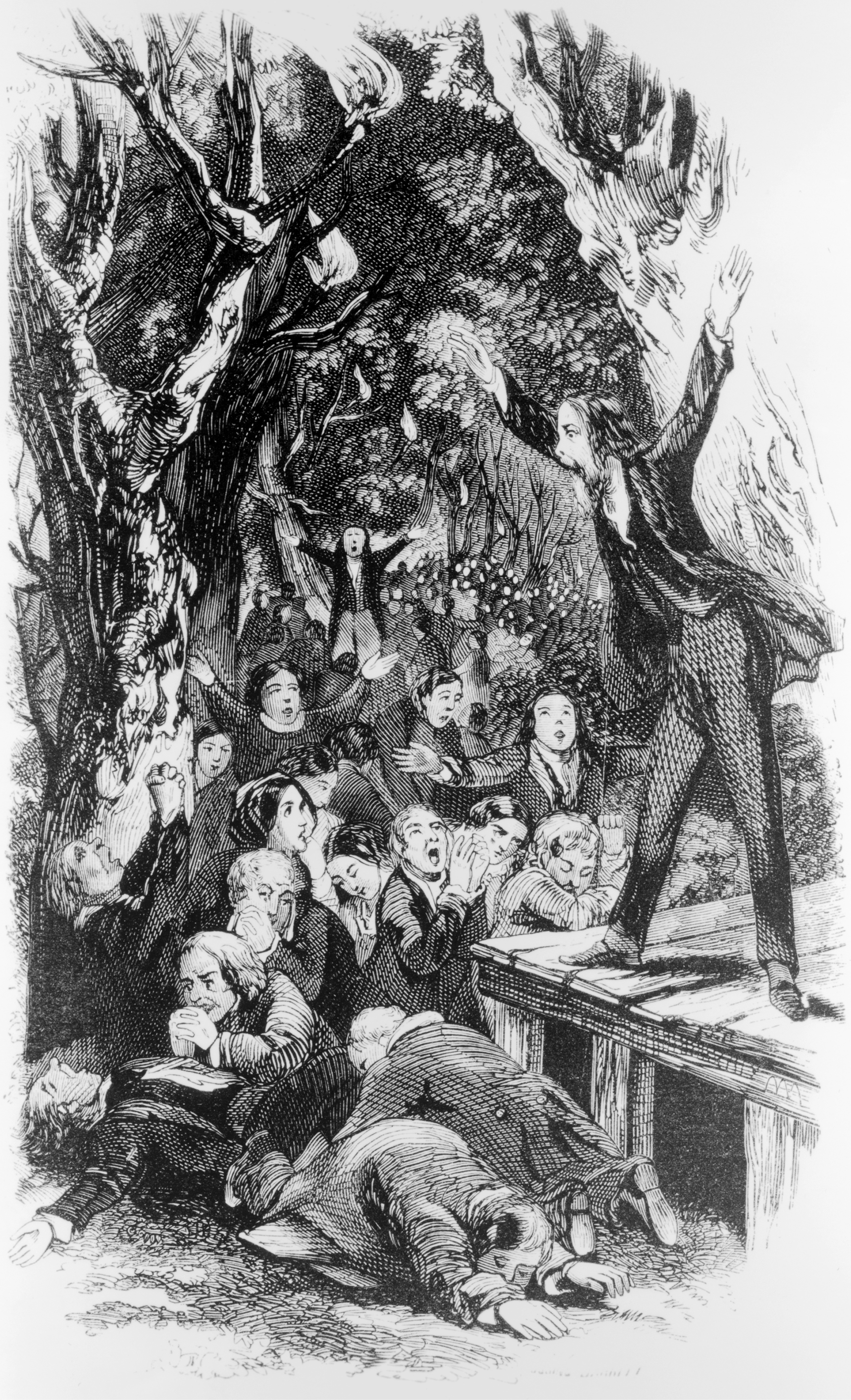
the rolling exercise, the “barking” exercise, in which new converts, like coon dogs, “treed” the devil; and the “jerks,” during which, the heads of participants “would jerk back suddenly, frequently causing them to yelp or make some other involuntary noise” . . . Heads often moved back and forth so fast ‘that the hair of females would be made to crack like a carriage whip,” showering bystanders with hair pins.40
Not all was white-hot spirituality at camp meetings. Participants also partook of a kind of festival atmosphere and camp meetings became major social events in their locales. On the isolated frontier, entertainment was at a premium. One contemporary observer claimed that the purpose of camp meetings was often to “engage our affections to the novelties of the scenes, and the greetings of new faces, and the hospitality of reciprocal visits, the exemption from the usual labours and cares.”41 A good deal of socializing and even courting took place at camp meetings. This mixture of pleasure and piety, religion and recreation evoked criticism. “All these things may give pleasing agitations to the mind,” wrote one critic, “but are they holy? . . . Take away the worship, and there would remain sufficient gratifications to allure most of the young people, and thousands if equally fed and freed from labour would follow.”42 Often there was the allegation of rampant sexual impropriety. At camp meetings “more souls were begot than saved,” wrote one wag.43 Converts, however, sought to counteract such caricature. After the “Great Revival” swept through western Virginia in the early 1800s, one commentator noted, “Formerly, when [people] collected together, drinking, swearing, horseracing, fighting, and such like practices, were common among them—But now . . . you will seldom see one pursuing any of these practices.”44
Lorenzo Dow and the Jerking Exercise. Copyprint of engraving by Losing-Barritt, c. 1840. An artist’s redition of the intense nature of camp-meeting revivalism. Courtesy Library of Congress.
Not all revivals occurred in camp meetings and not all took place on the frontier. The revival, for instance, that broke out contemporaneously at Yale College under President Timothy Dwight, grandson of First Great Awakening luminary Jonathan Edwards, was a good deal more subdued than the Cane Ridge exuberance.45 Indeed, both the appropriate character and the proper theology of revivals continued to be debated among Presbyterians for years and was major cause of the New School/Old School schism of 1837.46 The traditional idea had been that while revivals could be prayed for, they were unpredictable, divinely-orchestrated outpourings that would occur only when and where God designed.
Reflecting the changed tenor of the times in the early 1800s, Charles Grandison Finney embraced “new measures” and became the great architect of revivals on demand. In his famous Lectures on Revivals of Religion, he laid out his philosophy logically and boldly, like the former lawyer that he was:
There has long been an idea prevalent that promoting religion has something very peculiar in it, not to be judged of by the ordinary rules of cause and effect; in short, that there is no connection of the means with the result, and no tendency in the means to produce the effect. No doctrine is more dangerous than this to the prosperity of the church, and nothing more absurd.
Suppose a man were to go and preach this doctrine among the farmers, about their sowing grain. Let him tell them that God is a sovereign, and will give them a crop only when it pleases him, and that for them to plow and plant and labor as if they expected to raise a crop is very wrong, and taking the work out of the hands of God, that it interferes with his sovereignty, and is going on in there own strength; and that there is no connection between the means and the result on which they can depend.47
For Finney, revivals were not a mystery; there was a science to them which, once learned, could be applied over and over again with predictable success. A revival of religion, he wrote,
is not a miracle, or dependent on a miracle, in any sense. It is a purely philosophical [scientific] result of the right use of the constituted means. . . . I said that a revival is the result of the right use of the appropriate means. . . . But means will not produce a revival, we all know, without the blessing of God. No more will grain, when it is sowed, produce a crop without the blessing of God.
Still, he argued, though God’s influence was indisputable, “I fully believe that could facts be known” in all previous instances of religious revival, “it would be found that when the appointed means have been rightly used, spiritual blessings have been obtained with greater uniformity than temporal ones.”48
Theologically speaking, Finney’s philosophy was a kind of “Arminianized Calvinism,” the view that humans could choose to believe, to positively act for their salvation, rather than passively wait to be acted upon by God. As historian William McLoughlin has noted, such a perspective came to represent “a new ideological consensus after 1830.”49 Historian Timothy Smith explained that “the new evangelical synthesis required frank abandonment of the Old Calvinism,” and noted “the appeal in a Christian democratic society of the Arminian doctrines of free will, free grace, and unlimited hope for the conversion of all men.” In short, the Calvinist “idea of personal predestination could hardly survive amidst the evangelists’ earnest entreaties to ‘come unto Jesus.’”50 However revivals were envisioned—as unexpected rain from God or the right use of constituted means—and however they were experienced—as subdued inner stirrings of the soul while one was seated in a stately urban chapel or as physical and emotional ecstasy in a sprawling, raucous camp meeting—revivals played a profound role in the creation of the myth, if not the reality, of a “Christian America.”
Revivalism and Social Reform
Social reform efforts had been undertaken before, and would continue to be pursued after, the Second Great Awakening, but the revivals of the early 1800s provided a major impetus to such activities.51 Those converted to Christ were to consecrate their lives to him and serve their fellow man as he did. It was the natural consequence of a changed heart. As Finney explained, Christians “will be filled with a tender and burning love for souls. They will have a longing desire for the salvation of the whole world. They will be in agony for individuals whom they want to have saved; their friends, relations, enemies.”52 Not surprisingly, as the Awakening spread so did missionary and tract societies. The executive committee of the American Tract Society founded in 1825 offered this justification for the society’s existence: “A Minister may distribute Tracts among his people, and thus impress and extend his public instructions where the impressions of his official duty would otherwise be lost, or never extended; and in this way he may double his usefulness, and devote two lives to his Master’s glory instead of one.”53
Revivalism, however, generated more than just a concern for conversion. It raised questions about long-term religious obligations. What kind of Christian life should follow the “quickly achieved step of conversion? How would one live, by what signposts, in a world that supplied an ever-changing and evanescent offering of wants and needs? . . . Reform began to answer such questions.”54 The consecrated Christian was to carry the gospel into every walk of life, and reborn believers banded together in a great variety of societies intent on Christianizing the social and political fabric of America. Temperance, sabbatarian, and antislavery societies labored to eradicate their designated evils. Organizations to help the poor, the insane, the blind worked to alleviate suffering.55 Such societies reflected the contemporary “perfectionist” emphasis that sin, both personal and societal, could be totally eradicated. It was the obligation of every true Christian to help bring it about.
This “Benevolent Empire” of interdenominational associations and reform societies that arose in the years following the Revolutionary War exerted a significant moral influence in antebellum America. Writes Timothy Smith, “The churches were making a far greater impact upon American society than their numbers or separation from the state would imply.”56 Much of this success can be credited to the enthusiastic and sustained involvement of women in the societies of the Benevolent Empire, as well as to their heightened role, in the nineteenth-century world of “separate spheres” for men and women, as moral guardians of their own homes.57 This, Alexis de Tocqueville claimed, enabled men to better perform their public roles: when “the American [male] retires from the turmoil of public life to the bosom of his family, he finds in it the image of order and of peace. . . . While the European endeavors to forget his domestic troubles by agitating society, the American derives from his own home that love of order which he afterwards carries with him into public affairs.”58
Some evangelists and reformers, as did their primitivist contemporaries, thought they saw in all of this the dawning of a new age. In 1835, Charles Finney predicted, “If the church will do all her duty, the millennium may come in this country in three years.”59 No effort was to be spared when such a magnificent prize was in view. According to John L. Thomas, this “romantic faith in perfectibility, originally confined by religious institutions, overflow[ed] these barriers and [spread] across the surface of society, seeping into politics and culture.”60 Yet, the hoped-for millennium was not to be realized. In the words of James D. Bratt, “The three years Finney had targeted for the millennial dawn brought twilight instead.”61 Not only did Finney himself eventually retire from the fray but evangelical attention generally shifted to the massive influx of Irish Catholics into the country and to the nation’s growing sectional tension. By 1845 both the Baptist and the Methodist churches had split along the Mason-Dixon line.62 During and after the Civil War, the ebullient, perfectionist optimism of an earlier generation gave way to an acute awareness of the intransigence of many contemporary problems caused by industrialization, immigration, and urbanization.63
Conclusion
Looking back over the period between the American Revolution and the Civil War, it is clear that in the United States disestablishment did not, as some feared, sound the death knell of Christianity. Rather, it unleashed the “voluntary principle,” which created the necessary climate for healthy and pervasive growth. Republicanism became a distinguishing characteristic of religion as well as government. Primitivism, with its faith in the fresh start and its manifestation of creative vitality, insured that “the American religious tradition was born and reborn.”64 The Second Great Awakening, despite its exotic excesses, rejuvenated the spiritual life of many otherwise “formal” Christians and compelled them to carry their principles into social, economic, and political arenas.65 In sum, the circumstances and events of this era combined to make America, more than ever before, “awash in a sea of faith.” Thus, that astute foreign observer Alexis de Tocqueville could proclaim in the mid-1830s that “there is no country in the world where the Christian religion retains a greater influence over the souls of men than in America.” For de Tocqueville, America’s religiosity was proof that “if the human mind be left to follow its own bent, it will regulate the temporal and spiritual institutions of society in a uniform manner, and man will endeavor, if I may so speak, to harmonize earth with heaven.”66
Notes
1. Jon Butler, Awash in a Sea of Faith: Christianizing the American People (Cambridge: Harvard University Press, 1990).
2. Reviewed and assessed in Douglas H. Sweet, “Church Vitality and the American Revolution: Historiographical Consensus and Thoughts towards a New Perspective,” Church History 45 (1976): 341–57. For a sampling of writing on religion and the Revolution, see William Warren Sweet, The Story of Religion in America, 2d ed. (New York: Harper, 1950), 172–204; and Mark A. Noll, Christians in the American Revolution (Grand Rapids, Mich.: Christian University Press, 1977).
3. Isaac D. Denman, letter, January 7, 1826, quoted in William Warren Sweet, “The Churches as Moral Courts of the Frontier,” Church History 2 (March 1933): 8.
5. For what follows in this paragraph, see William Lee Miller, The First Liberty: Religion and the American Republic (New York: Knopf, 1985); and Ronald Hoffman and Peter Albert, eds., Religion in a Revolutionary Age (Charlottesville: University Press of Virginia, 1994).
6. The discussion that follows relies on Nathan O. Hatch, The Democratization of American Christianity (New Haven: Yale University Press, 1989).
7. Elias Smith, The Loving Kindness of God Displayed in the Triumph of Republicanism in America (n.p., 1809), 32, quoted in Hatch, The Democratization of American Christianity, 69–70.
8. Lorenzo Dow, History of Cosmopolite; Or, the Four Volumes of Lorenzo Dow’s Journal (Wheeling, Va.: Joshua Martin, 1814), 356–57, quoted in Hatch, Democratization of American Christianity, 37.
9. Elias Smith, Herald of Gospel Liberty, September 1, 1808, p. 1, quoted in Hatch, Democratization of American Christianity, 70, 73. Hatch, Democratization of American Christianity, 70, claims Smith’s paper was the first of its kind in the United States.
10. Timothy Waterous, The Battle-Axe and Weapons of War: . . . Aimed at the Final Destruction of Priestcraft (Groton, Conn.: n.p., 1811), quoted in Hatch, Democratization of American Christianity, 45.
11. Alexis de Tocqueville, Democracy in America, trans. Henry Reeve, ed. Phillips Bradley, 2 vols. (New York: Alfred A. Knopf, 1945), 1:300.
12. On primitivism, see Richard T. Hughes, ed., The American Quest for the Primitive Church (Urbana: University of Illinois Press, 1988); and Richard T. Hughes and C. Leonard Allen, Illusions of Innocence: Protestant Primitivism in America, 1630–1875 (Chicago: University of Chicago Press, 1988). Regarding Mormons and Primitivism, see Marvin S. Hill, “The Role of Christian Primitivism in the Origin and Development of the Mormon Kingdom, 1830–1844” (Ph.D. diss., University of Chicago, 1968).
13. Alexander Campbell, Millennial Harbinger, 1832, p. 13, quoted in Hatch, Democratization of American Christianity, 167.
14. Bill J. Humble, “The Restoration Ideal in the Churches of Christ,” in American Quest for the Primitive Church, 222.
15. Elias Smith, The Life, Conversion, Preaching, Travels and Sufferings of Elias Smith (Portsmouth, N.H.: n.p., 1816), 352–53, quoted in Nathan O. Hatch, “Sola Scriptura and Novus Ordo Seclorum,” in The Bible in America: Essays in Cultural History, ed. Nathan O. Hatch and Mark A. Noll (New York and Oxford: Oxford University Press, 1982), 67.
16. John W. Nevin, “The Antichrist and the Sect System,” cited in The Mercersburg Theology, ed. James Hastings Nichols (New York: Oxford University Press, 1966), 104, 111.
17. Richard McNemar, “The Moles Little Pathways,” quoted in Hatch, Democratization of American Christianity, 81.
18. Thomas Jefferson, Jefferson’s Extracts from the Gospels: “The Philosophy of Jesus” and “The Life and Morals of Jesus,” ed. Dickinson W. Adams and Ruth W. Lester (Princeton, N.J.: Princeton University Press, 1983), 331.
19. Thomas Jefferson, Writings, ed. Merrill D. Peterson (New York: Viking Press, 1984), 1087–88.
20. Alexander Campbell, in The Christian Baptist 2 (February 7, 1825): 136, quoted in Hughes and Allen, Illusions of Innocence, 173.
21. Roger Finke and Laurence R. Iannaccone, “Supply-Side Explanations for Religious Change,” The Annals of the American Academy of Political and Social Science 527 (May 1993): 29. See also Roger Finke and Rodney Stark, “How the Upstart Sects Won America: 1776–1850,” Journal for the Scientific Study of Religion 28 (March 1989): 27–44.
22. Martin E. Marty, Pilgrims in Their Own Land: 500 Years in America (Boston: Little, Brown, 1984), 169.
23. On the origins and growth of Methodism, see Richard P. Heitzenrater, Wesley and a People Called Methodists (Nashville: Abingdon Press, 1995).
24. Two indispensable recent studies of early American Methodism and Francis Asbury’s role in its growth are John H. Wigger, Taking Heaven by Storm: Methodism and the Rise of Popular Christianity in America (Urbana: University of Illinois Press, 2001); and Dee E. Andrews, The Methodists and Revolutionary America, 1760–1800 (Princeton: Princeton University Press, 2002).
30. Quoted in Marty, Pilgrims in Their Own Land, 173.
31. Edwin Gaustad and Philip Barlow, New Historical Atlas of Religion in America (Oxford: Oxford University Press, 2001), 219–28, 374; and Finke and Iannaccone, “Supply-Side Explanations,” 33.
32. Nathan O. Hatch, “The Puzzle of American Methodism,” Church History 63 (June 1994): 177.
33. Mark A. Noll, A History of Christianity in the United States and Canada (Grand Rapids, Mich.: Eerdmans, 1992), 166. A convenient overview of the Second Great Awakening can be found in William G. McLoughlin, Revivals, Awakenings, and Reform: An Essay on Religion and Social Change in America, 1607–1977 (Chicago: University of Chicago Press, 1978).
34. On camp meetings specifically, see Charles A. Johnson, The Frontier Camp Meeting: Religion’s Harvest Time (Dallas: Southern Methodist University Press, 1955); and Dickson D. Bruce, And They All Sang Hallelujah: Plain-Folk Camp-Meeting Religion, 1800–1845 (Knoxville: University of Tennessee Press, 1974). Kenneth O. Brown, Holy Ground: A Study of the American Camp Meeting (New York: Garland, 1992) emphasizes Methodist origins and prominence in the camp-meeting phenomenon.
35. George W. Pierson, Tocqueville and Beaumont in America (New York: Oxford University Press, 1938), 249, quoted in Johnson, The Frontier Camp Meeting, 232.
36. See Paul K. Conkin, Cane Ridge: America’s Pentecost (Madison: University of Wisconsin Press, 1990).
37. James McGready, The Posthumous Works of the Reverend and Pious James M’Gready, ed. James Smith, 2 vols. (Louisville: W. W. Worsley, 1931–33), 2:71, quoted in John B. Boles, The Great Revival, 1787–1805: The Origins of the Southern Evangelical Mind (Lexington: University Press of Kentucky, 1972), 40.
38. F. R. Cossitt, The Life and Times of Rev. Finis Ewing (Louisville: L. R. Woods, 1853), 43, quoted in Boles, Great Revival, 40.
39. Theophilus Armenius [psued.], “Account of the Rise and Progress of the Work of God in the Western Country,” Methodist Magazine 2 (1819): 273, quoted in Boles, Great Revival, 67.
40. Daniel Cohen, The Spirit of the Lord: Revivalism in America (New York: Four Winds, 1975), 19, quoted in James H. Hutson, Religion and the Founding of the American Republic (Washington, D.C.: Library of Congress, 1998), 104.
41. “Scurator,” 1822, quoted in Johnson, Frontier Camp Meeting, 208.
42. “Scurator,” quoted in Johnson, Frontier Camp Meeting, 208.
43. Cohen, The Spirit of the Lord, 22, quoted in Hutson, Religion and the Founding of the American Republic, 105.
44. “Extract from a Letter from a Missionary to His Friend in Rockbridge County,” Virginia Religious Magazine 1 (July 1805): 232, quoted in Boles, Great Revival, 187.
45. See Charles Roy Keller, The Second Great Awakening in Connecticut (1942; reprint, Hamden, Conn.: Archon Books, 1968).
46. See George M. Marsden, The Evangelical Mind and the New School Presbyterian Experience: A Case Study of Thought and Theology in Nineteenth-Century America (New Haven: Yale University Press, 1970).
47. Charles Grandison Finney, Lectures on Revivals of Religion, ed. William G. McLoughlin (Cambridge: Belknap Press of Harvard University Press, 1960), 14.
48. Finney, Lectures on Revivals of Religion, 13, 15.
49. McLoughlin, Revivals, Awakenings, and Reform, 138.
50. Timothy L. Smith, Revivalism and Social Reform: American Protestantism on the Eve of the Civil War (1957; reprint, Baltimore: Johns Hopkins University Press, 1980), 88–89.
51. See Smith, Revivalism and Social Reform; and Leonard I. Sweet, The Evangelical Tradition in America (Macon, Ga.: Mercer University Press, 1984).
53. Quoted in Edwin S. Gaustad, A Documentary History of Religion in America to the Civil War (Grand Rapids, Mich.: Eerdmans, 1982), 333.
54. Robert H. Abzug, Cosmos Crumbling: American Reform and the Religious Imagination (New York: Oxford University Press, 1994), 80.
55. See Clifford S. Griffin, Their Brothers’ Keepers: Moral Stewardship in the United States, 1800–1865 (New Brunswick, N.J.: Rutgers University Press, 1960); and Charles I. Foster, An Errand of Mercy: The Evangelical United Front, 1790–1837 (Chapel Hill: University of North Carolina Press, 1960).
57. See A. Gregory Schneider, The Way of the Cross Leads Home: The Domestication of American Methodism (Bloomington: Indiana University Press, 1993); and Colleen McDannell, The Christian Home in Victorian America, 1840–1900 (Bloomington: Indiana University Press, 1986).
59. Finney, Lectures on Revivals of Religion, 306.
60. John L. Thomas, “Romantic Reform in America, 1815–1865,” American Quarterly 17, no. 4 (winter 1965): 656.
61. James D. Bratt, “The Reorientation of American Protestantism, 1835–1845,” Church History 67 (March 1998): 61.
62. See C. C. Goen, Broken Churches, Broken Nation: Denominational Schisms and the Coming of the American Civil War (Macon, Ga.: Mercer University Press, 1985).
63. James Moorhead, “The Erosion of Postmillennialism in American Religious Thought, 1865–1925,” Church History 53 (March 1984): 61–77.