And kings shall be thy nursing fathers, and their queenes thy nursing mothers: they shall bow downe to thee with their face toward the earth, and licke up the dust of thy feete, and thou shalt know that I am the LORD; for they shall not be ashamed that waite for me.
Isaiah 49:23, King James Version (1611)
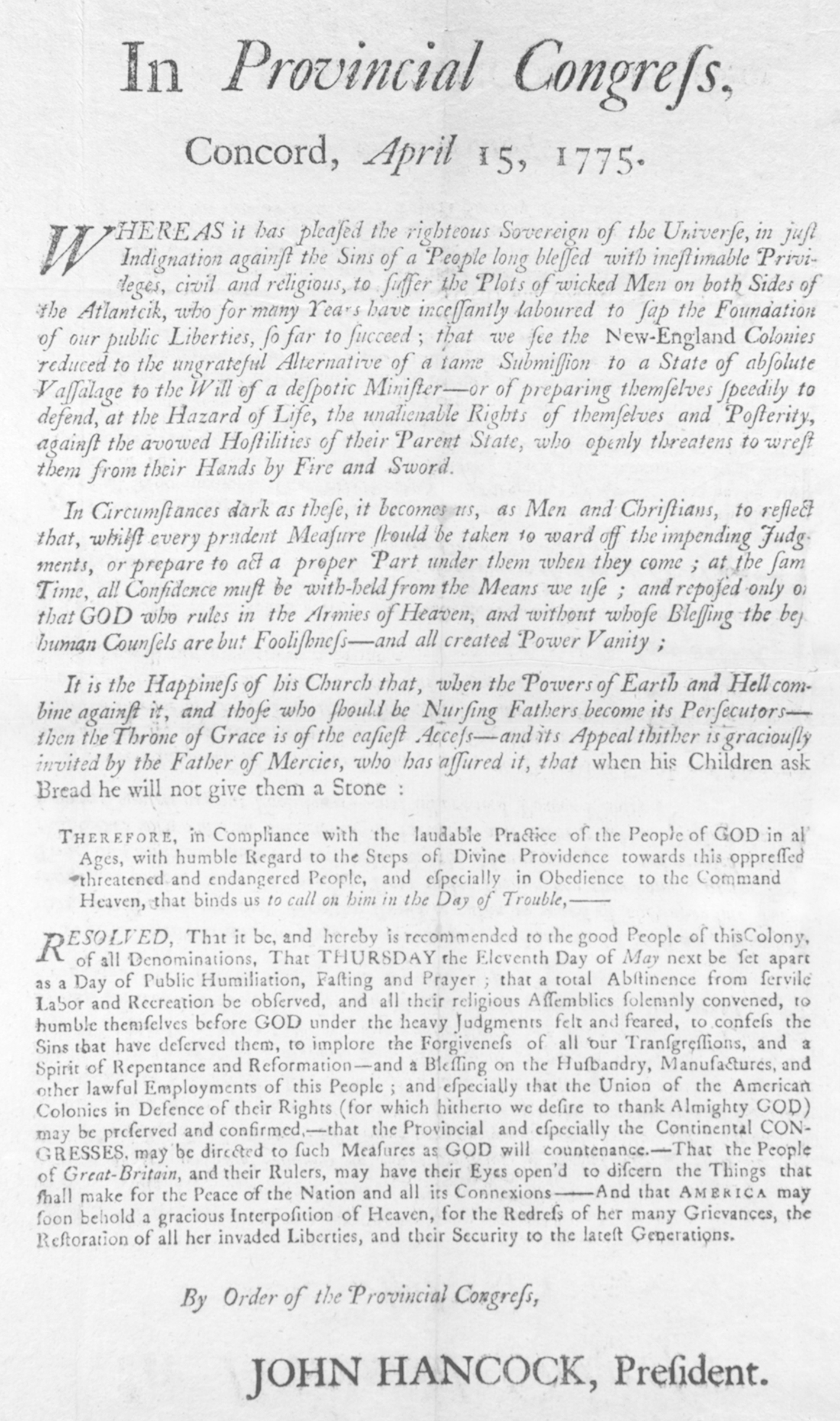
On April 15, 1775, four days before hostilities between British and American troops began at Lexington and Concord, the Massachusetts Provincial Congress proclaimed May 11 as a day of fasting and prayer throughout the colony. The fast day proclamation accused the British ministry of inciting the “Powers of Earth and Hell” to harass the Congregational Church in Massachusetts. Those, it asserted, “who should be Nursing Fathers become its Persecutors.”1 “Nursing Fathers”? Where did this peculiar phrase, more appropriate for an aberration in biology than statecraft, come from and what did it mean?
In this fast-day proclamation, the Massachusetts Provincial Congress claimed that “those who should be Nursing Fathers [have] become its Persecutors,” refering to perceived threats to the Congregational Churches by Britain. See the third paragraph. Courtesy Library of Congress.
Those familiar with colonial Massachusetts would assume, correctly, that the phrase had theological roots. It comes from the prophet Isaiah and in 1775 had been in use for more than two hundred years by British and American religious and political leaders (including two kings of England) to express their conviction that the government of any state must form a nurturing bond with religious institutions within its jurisdiction, that the civil authority must, in fact, become the “nursing father” of the church.
After the Declaration of Independence in 1776, substantial numbers of American citizens continued to use the nursing fathers metaphor to articulate their view about the proper relationship between government and religion, a view at polar opposites to Thomas Jefferson’s assertion in 1802 that there should be a “wall of separation” between church and state.2 Jefferson’s phrase was an arresting one, but it languished, as a scholar has recently demonstrated, in relative obscurity until after World War II, when the Supreme Court embraced it in the Everson case (1947).3 It is, therefore, no exaggeration to say that Jefferson’s “wall” formulation has had a short and controversial run of only fifty years compared to the two hundred and fifty years in which the nursing fathers metaphor dominated the church-state dialogue in the Anglo-American world.
Patrons and Protectors for the Reformers
Isaiah was a favorite book of the seminal thinkers of the Protestant Reformation of the sixteenth century, many of whom wrote commentaries on it: Zwingli (1529), Luther (1532), Munster (ca. 1540), Brenz (1550), Castiello (1551), Calvin (1551, 1552, 1559), Musculus (1557), and Bullinger (1567).4 Most of these savants thought Isaiah 49:23 deserved only a few perfunctory remarks. For Luther the verse meant little more than that “queens and wives of important men are to be converted to the Gospel.”5 John Calvin, however, was impressed by the possibility that the nursing father metaphor in verse 23 could promote the mission of the newly reformed churches. By giving the verse a militantly sectarian interpretation, he excited the imagination of English-speaking Reformers who, beginning in the 1560s, appropriated the metaphor and broadcast it across the British Isles.
Calvin’s extensive comments on Isaiah 49:23, bristling with the belligerence of the early Reformers, locked in a lethal struggle with the Church of Rome. Princes who defended the true, reformed religion “obtained,” Calvin declared, “this highest pinnacle of rank, which surpasses dominion and principality of every sort, to be ‘nursing-fathers’ and guardians of the Church.” “The Papists,” he continued, “have no other idea of kings being ‘nursing fathers’ of the Church than that they have left to their priests and monks very large revenues, rich possessions and prebends, on which they might fatten, like hogs in a sty.” For the Protestant prince, “‘nursing’ aims at an object quite different from filling up those insatiable gulls”; rather it was “about removing superstitions and putting an end to all wicked idolatry, about advancing the kingdom of Christ and maintaining purity of doctrine, about purging scandals and cleansing from the filth that corrupts piety and impairs the lustre of Divine majesty.” Of course, Protestant princes would “supply the pastors and ministers of the Word with all that is necessary for food and maintenance,” but material support was incidental to a higher spiritual obligation. To “shew themselves to be ‘nursing fathers,’” they must, above all, be “protectors of believers, and shall bravely defend the doctrine of the Word.”6
It was Calvin’s habit to work ideas from his numerous biblical commentaries, including his Commentary on Isaiah, into the multiplying and progressively expanding editions of his Institutes of the Christian Religion. In 1559 he introduced “nursing fathers” into book four of the Institutes. There Calvin noted that “Isaiah, when he predicts that ‘kings shall be nursing-fathers and queens nursing-mothers’ to the Church, does not depose them from their thrones; but rather establishes them by an honourable title, as patrons and protectors of the pious worshipers of God.”7 This rather economical treatment of the passage would, no doubt, have encouraged contemporary readers to seek a fuller exposition of Calvin’s views on Isaiah 49:23 by turning to his popular Commentary.
Confident, apparently, of obtaining an English audience, Calvin dedicated the first edition of his Commentary to the young Protestant king, Edward VI. Lamenting that the “Roman Antichrist, far and wide usurping and tyrannizing over the sanctuary of God, tears, crushes, and tramples under his feet all that belonged to God,” Calvin urged Edward to devote himself to the promotion of “pure doctrine”: “I expressly call upon, or rather, God himself addresses you by the mouth of his servant Isaiah, charging you to proceed, to the utmost of your ability and power, in carrying forward the restoration of the Church. . . . You daily read and hear that this duty is enjoined on you. . . . More especially Isaiah, as I have said, calls Kings the nursing fathers of the Church, (Is. xlix. 23) and does not permit them to withhold that assistance which her afflicted condition demands.”8
When Queen Mary, a Catholic, ascended the English throne in 1553, she attempted to compel the country to return to Rome. According to Calvin, the “oppression of pure doctrine, which raged with prodigious violence for a short period” claimed as one of its victims his Commentary, which was “banished” from the realm.9 Protestant fortunes revived in 1559, when Elizabeth became queen. Calvin dedicated his expanded 1559 edition of the Commentary to the new monarch, urging her to lay aside “all other kinds of business, a vast number of which, I have no doubt, will crowd upon you at the commencement of your reign” and concentrate with “invincible determination” on purifying the nation’s religion. Entreated Calvin: “You ought to be stimulated, venerable Queen, by a sacred regard to Duty; for the Prophet Isaiah demands not only from Kings that they be nursing fathers, but also from Queens that they be nursing mothers. (Isa. xlix. 23.) This duty you ought to discharge . . . by removing the filth of Popery.”10
Whether Elizabeth read Calvin’s Commentary is unknown, but the Geneva Reformer’s writings enjoyed a great vogue among her subjects. An English translation of his Institutes of the Christian Religion went through seven printings between 1561 and 1599. A translation of Calvin’s sermons on Job was reprinted five times in ten years.11 Both Elizabethan Puritan leaders and their opponents in the Anglican hierarchy appealed to Calvin’s authority in theological disputes. The Puritan Thomas Cartwright, for example, arguing with the future Archbishop of Canterbury, John Whitgift, exclaimed that “we receive M. Calvin, and weigh of him, as of the notoblest [sic] instruments that the Lord hath stirred up for the purging of His Churches, and of the restoring of the plain and sincere interpretation of the Scriptures, which hath been since the Apostles’ times.”12
Calvin was personally acquainted with many of the Elizabethan Anglican leaders, who, during the Marian persecutions, fled to the European continent and found refuge in Switzerland and neighboring countries. These English exiles, it has been said, “came under the spell of Calvin’s genius.”13 One of them, John Jewel, became Bishop of Salisbury upon Elizabeth’s accession and began the administration of his diocese with “decided leanings to Calvinism.” Jewel certainly knew Calvin’s Commentaryon Isaiah, for in 1562 he incorporated the nursing father metaphor into his Apology for the Church of England, a book that was “immediately adopted on all sides as the literary exposition of England’s ecclesiastical position” and soon was considered so “authoritative” that it was chained to lecterns in churches throughout England.14 By using the nursing father metaphor to describe the obligation of civil authorities to the church, Jewel embedded the concept in the consciousness of Anglicans, who habitually employed it during the following centuries; used by every priest from luminaries like Richard Hooker to the humblest parish curate, it became a mainstay of the church’s vocabulary.15
A “Christian prince,” Jewel declared,
hath the charge of both tables committed to him by God, to the end he may understand that not temporal matters only but also religious and ecclesiastical causes pertain to his office; besides also that God by his prophets often and earnestly commandeth the king to cut down the groves, to break down the images and altars of idols, and to write out the book of the law for himself; and besides that the prophet Isaiah saith “A king ought to be a patron and nurse of the church” . . . we see by histories and by examples of the best times that good princes ever took the administration of ecclesiastical matters to pertain to their duty.16
The prophetic commission to the king as nursing father served, in Jewel’s view, two purposes: it trumped the Church of Rome’s pretensions, based on a theory of papal supremacy, to control English ecclesiastical affairs; and it authorized the English monarchy to impose its own brand of uniform religious truth throughout the realm. In response to attacks by Catholic theologians, Jewel issued a Defense of the Apology in 1567, which, like Calvin, he dedicated to Queen Elizabeth as the “nource” [nurse] of the church.17
However, neither Jewel’s influence nor the term’s appearance in the 1560 English Geneva Bible, which translated Isaiah 49:23 as “Kings shal be thy nourcing fathers,” were sufficient to supersede a rival translation of the nursing father metaphor. Other authors, evidently uneasy about the propriety of a word picture of a suckling male, rendered it “foster fathers.” The phrase Calvin used in the Latin versions of his Commentary on Isaiah and in his Institutes which Jewel18 and the Geneva Bible translated as nurse and nourcing fathers, he (or his typesetters) spelled variously as Ecclesiae nutritios, Ecclesiae nutricios, Ecclesiae nutricii, and nutritii tui.19Nutritios and its variant spellings were derived from the Latin feminine noun nutrix, which a standard Latin-English dictionary translates as “a nurse, foster mother.”20 Therefore, Thomas Norton, the translator of the frequently reprinted 1561 English edition of the Institutes, was on solid ground in rendering Calvin’s “Ecclesiae nutritios” as “fosterfathers of the church.”21 William Allen in his An Apologie . . . of Two English Colleges (1581) employed the same locution. “Kings,” wrote Allen, “are called by the Prophete [Isa: 49.23] her foster fathers, as Queenes be also named her nources: because it belongeth to the earthly power that God hath given them, to defend the lawes of the Church, to cause them to be executed, and to punish rebels and transgressors of the same.”22
The Stuarts as Establishers of True Religion
The royal prestige of James I secured the victory of the nursing fathers metaphor. In the course of his celebrated campaign to persuade the Dutch government to expel from its dominions the “wretch Heretique” Conrad Vorst, James issued his widely read Declaration against Vorstius (1610).23 In this polemic, James declared “that it is one of the principal parts of that duetie which appertaines unto a Christian King, to protect the trew Church within his owne Dominions, and to extirpate heresies, is a maxime without all controversie.” “Those honorouable Titles . . . Nutritius Ecclesiae, Nursing father of the Church,” James asserted, “doe rightly belong unto every Emperour, King, and Christian Monarch.”24
Charles I also called himself “an indulgent nursing father,” giving the metaphor the cachet of a second royal patron.25 The incessant use of the metaphor by the Anglican hierarchy to compliment the Stuart kings26 and their successors—William III, for example, was extolled as “a Nursing Father to Zion the Church of God”27—put it in general circulation and secured it a place in the vocabulary of political controversy. The metaphor was used by two of the seventeenth century’s most celebrated intellectual antagonists, political philosophers Robert Filmer and John Locke.28 Through Locke’s Second Treatise of Government, it came to the attention of a wide American audience. That it retained its vitality among eighteenth-century thinkers is attested by Edmund Burke, who referred to the civil magistrate as a “Nurse and Increasor of Blessings.”29
Puritan opponents of the Church of England under Elizabeth and the Stuarts differed among themselves on many issues, none more important than church government. Some Puritans favored a presbyterian form of church government, others a congregational one. Congregationalists were split between those who regarded themselves as a loyal opposition within the Church of England—the settlers of Massachusetts Bay belonged in this camp—and those “separatists” who utterly renounced the Church. Both wings of the Congregational movement subscribed to the Anglican interpretation of the ecclesiastical role of civil authority, as articulated by James I, that the ruler was obliged to establish true religion in his realm, and both appropriated the “nursing father” metaphor to convey this understanding.
The separatist position received its clearest formulation in the “Confession of 1596,” a document issued in Amsterdam by men who had been driven out of England by political authorities who had executed their leaders and brutally persecuted their flocks. The authors of the “Confession,” nevertheless, asserted that “it is the office and Duty of Princes and Magestrates . . . to suppress and root out by their authoritie all false ministries, voluntarie Relligions, and counterfeyt worship of God, to destroy the Idoll Temples, Images, Altares, Vestments, and all other monuments of Idolatrie and superstition” and to confiscate all church property of “anie false ministeries . . . And on the other hand to establish & mayntein by their lawes every part of Gods word his pure Relligion and true ministerie. . . . They accompt it a happie blessing of God who granteth such nourcing Fathers and nourcing Mothers to his Church.”30
The English Civil War: Protectors or Enforcers?
The religious dynamics of the English Civil War compelled the mainstream, nonseparating Congregationalists, now called Independents, to temper some of their earlier doctrinal zeal. On January 31, 1648, the day after the execution of Charles I, one of the most learned Independent ministers, Dr. John Owen, delivered a famous sermon in Parliament on the limits of religious toleration. According to Owen, scripture commanded “kings and judges to serve the Lord, in promoting the kingdom of the Lord Jesus Christ. And it is promised, Isa. xlix. 23, that ‘they shall be nursing-fathers and nursing-mothers to the church’ of Christ, even then when she shall ‘suck the breasts of kings’ (earthly things are the milk of kingly breasts).”31
Among the “earthly things” the nursing fathers were required to supply, Owen listed the following: the “providing or granting of places requisite for the performance of that worship which in the gospel is instituted”; “protection, as to peace and quietness in the use of the ordinances of the Lord Jesus Christ, from violent disturbers”; and “supportment and provision [for the gospel ministry] as to earthly things, where regularly failing.”32 Owen was as confident as the authors of the 1596 Confession that “it was the duty of the magistrate,” as nursing father, “not to allow any public places for (in his judgment) false and abominable worship; as also, to demolish all outward appearances and demonstrations of such superstitious, idolatrous, and unacceptable service.”33 Those publicly and obstreperously propagating “uncouth” religious opinions were to be suppressed. But out of respect for the welter of Protestant religious opinions that had surfaced during the Civil War, Owen would permit the magistrate to allow the public airing of a variety of religious views (at least on matters indifferent) and would offer a wide latitude for the expression of religious opinions in private.
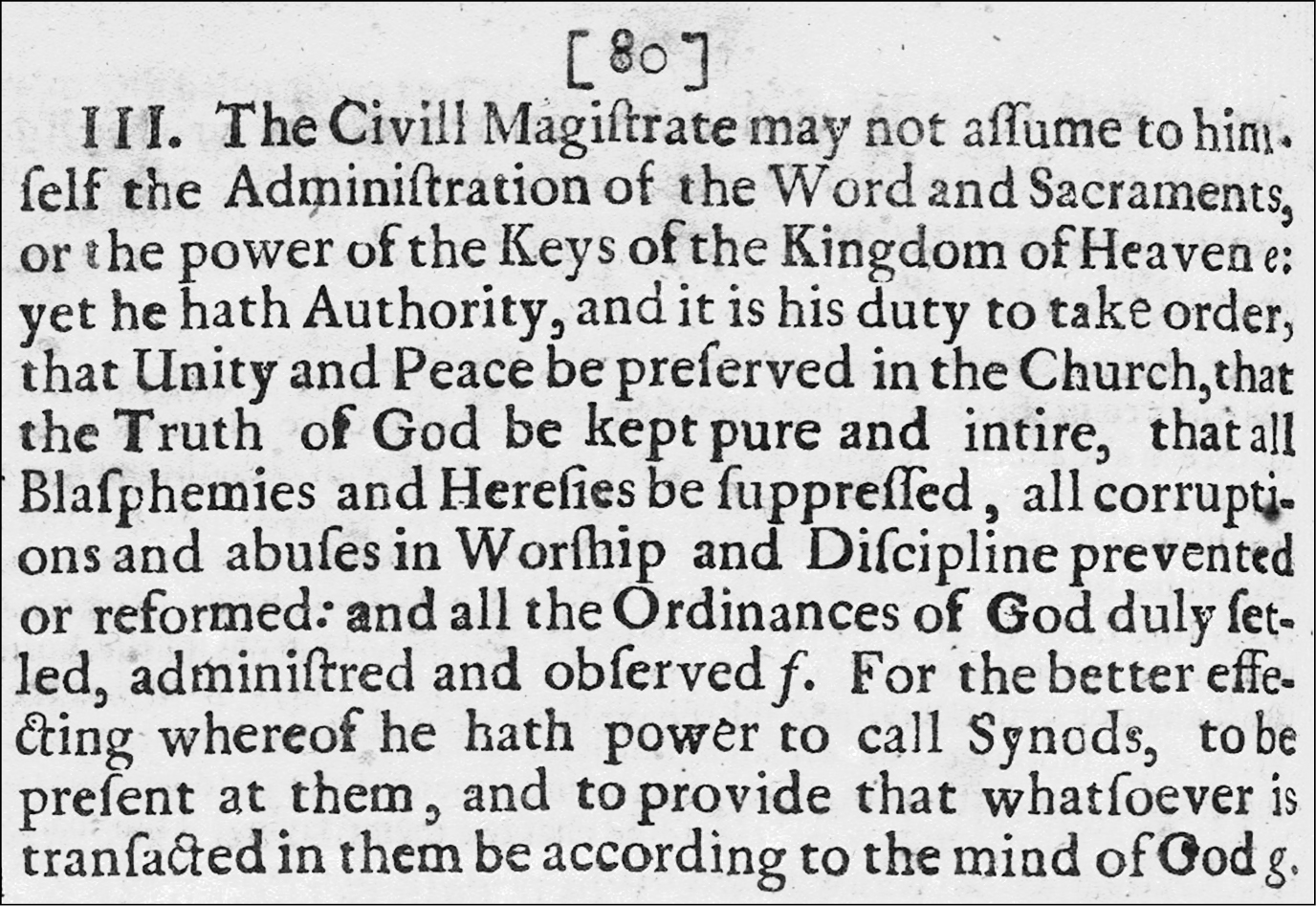
This was a position that many Presbyterians, especially those in Scotland, were not prepared to countenance. John Knox, the great pillar of Scottish Presbyterianism, was a disciple of Calvin who carried his preceptor’s view on church-state relations directly from Geneva to the court of Queen Mary at Edinburgh. In an interview which the Reformer called “the first reasoning betwixt the queen and John Knox,” September 4, 1561, Knox lectured the young monarch in the following manner: God “subjects people under princes, and causes obedience to be given unto them; yea, God craves of kings that they be as it were foster-fathers to his Church, and commands queens to be nurses to his people.”34 Knox’s use of foster fathers gave the term as much prestige in Presbyterian circles as Jewel’s simultaneous use of nursing fathers had done in the Anglican community. The metaphor eventually achieved a higher status among Presbyterians because it was incorporated by reference into the Westminster Confession of 1646,35 for the past three centuries the basic creed of the denomination.
Humble Advice of the Assembly of Divines, Now by Authority of Parliament Sitting at Westminster (London, 1658). The position of the Westminster Confession on the role of the state in religious affiars. Courtesy Library of Congress.
The English Civil Wars did not make Presbyterians as malleable as the Independents, a point vividly illustrated by one of the classics in the literature of Presbyterian apologetics, Samuel Rutherford’s Lex, Rex. Writing in 1644, Rutherford championed the nursing father metaphor (which in Scotland had by now supplanted Knox’s foster fathers). He began his book with the strong, if conventional, assertion that “Kings and all Magistrates are Gods, and Gods deputies and lieutenants upon earth” as well as “nursing fathers of the Church.” Later in his work Rutherford tackled the question of whether kings were fathers “univocally, or only analogically.” He concluded, “Though the Word warrant us to esteem King’s fathers, Esa. 49. 23 . . . yet they are not essentially and formally fathers by generation . . . and yet are they but fathers metaphorically.” Rutherford, in fact, preferred the term “Nurse-father” and applied it to kings, judges, and other civil officials. He took an uncompromising view of the role of the nurse-father, who was not only “appointed for Civill Policy, but for the maintenance of true religion, and for the suppression of idolatrie and superstition.” “The King,” Rutherford declared, “hath a chiefe hand in Church affaires, when he is a Nurse-Father, and beareth the Royall Sword to defend both the Tables of the Law.” Rutherford made Henry VIII a posthumous “Nurse-father” because he had defended the faith “by his Sword.”36
In 1652 a heated exchange occurred between an anonymous defender of the mainstream conception of the nursing father metaphor and Roger Williams, who was in England at the time defending Rhode Island’s interests. A pamphlet, The Examiner Examined, contained a long subtitle asserting that the civil magistrate was obliged to “advance the true Religion.” Quoting in justification the text from “Esay 49.22, 23,” the anonymous advocate posed the following proposition: “Whether a Magistrate that knowes the Doctrine of Salvation by Christ Jesus, doe fulfill the Office of a Nursing Father, if he doe not cause this saving Food to be given to his Children; and Poyson, that is contrary Doctrine to be kept from them.”37 In an impassioned rejoinder, The Examiner Defended, Williams employed his distinctive, antitypological exegetical approach to argue that “this Prophesie of Kings and queens being nursing fathers and nursing mothers to the Saints” applied only to the Jews of the Old Testament. “Consequently,” he asked
Whether all those bloody persecutors (Papists and Protestants), who have used to drawn this shaft out of the Quiver of Scripture, whereby to pierce the tender heart of Jesus; yea and all that give a power to the Civil magistrate in Spirituals from this Scripture, Have not most ignorantly profaned the prophecy, and that to usurpation over the temple of God, the Consciences of Gods own people; and to bloody violence vagainst their Bodies, although under a cloak of providing wholesome food for their children and prohibiting poyson, etc.
After offering several more objections to the popular interpretation of Isaiah 49:23, Williams concluded by asking whether it
was not this very Doctrine that cost the late King Charles his Crown, and Life? Who being flattered and bewitched into this dream of a Nursing father, and a judge of wholesome food and poyson for his people; he forced poyson for food on the Scotch Nation . . . and prosecuting those fatal Wars, which (by a naked Hand from heaven) justly pluckt up root and branch, both Ceremonies, Bishops, and king together.38
A few years later an even more eminent advocate of liberty of conscience, John Milton, attacked the conventional understanding of Isaiah 49:23. Milton’s eye was apparently caught by a passage in a precis of protestant theology, Compendium Theologiae Christianae (Basel, 1626) by the Swiss theologian Johannes Wolleb (Wollebius), which “caused a considerable sensation” in London in the 1650s, when it appeared in an English translation.39 In his Abridgement of Christian Divinitie, as the translation was called, Wolleb asserted that “Magistrates are the Churches nursing-fathers, as they are keepers of the two Tables of the law, as they preserves Churches and Schools, and defend the Truth.” In reply, Milton declared that “churches do not need the supervision of magistrates,” or of kings, acting as “foster-fathers” (apparently, a deliberate substitution by Milton for what he considered the excessive Anglican, royalist usage of “nursing fathers”). “The magistrate should protect religion, not enforce it,” because “Christ’s kingdom is not of this world, it does not stand by force and constraint, the constituents of worldly authority. So the gospel should not be made a matter of compulsion, and faith, liberty and conscience cannot be.”40
Americans in 1776 were unacquainted with—and could not have been influenced by—Williams’s polemic against the nursing fathers; like his other theological writings it had long been forgotten, if, in fact, it had ever been known in the colonies. Nor is it likely that they would have been aware of Milton’s strictures against the metaphor, since his essay attacking it was not published during his lifetime. But it is significant that men of the stature of Williams and Milton attempted to discredit the metaphor, for their efforts attest to its potency in seventeenth-century England.
The point in showing how firmly seventeenth-century Anglicans, Presbyterians, and Congregationalists-Independents were wedded to the nursing fathers metaphor is that they were the largest Protestant denominations in Great Britain and sent the largest number of settlers to North America.41 By carrying the nursing fathers concept with them, members of these denominations established it as the model for church-state relations in most American colonies.
Supporters of Religious Institutions in Eighteenth-Century American Colonies
As the eighteenth century dawned in British North America, Anglicans routinely used the nursing father metaphor. Consider the controversy over the behavior of Francis Nicholson, appointed governor of Virginia in 1698. To his enemies among the Virginia planter elite, Nicholson was “a monstrous compound of . . . hypocrisy and profaneness.”42 Others, however, admired him for his financial generosity toward the Church of England and called him a “true son or rather Nursing Father of her in America.”43 At a meeting of Anglican clergymen in Philadelphia in 1704, Nicholson’s conduct was strongly endorsed: “We cannot but with a Christian Indignation consider that so good a Nursing Father of our holy Mother, so unparalleled and munificent a promoter of it should be ungratefully traduced.”44 The next year, as controversial a figure as Nicholson, Lord Cornbury, Governor of New York, was commended for his financial generosity toward the church: “For his eminent care and protection of us; he is truly our Nursing Father.”45
The most popular Anglican clergyman in eighteenth-century America, though an opponent of the church’s hierarchy, was the famous evangelist George Whitefield, one of the principal promoters of the Great Awakening in the 1740s. Whitefield’s partiality to the nursing fathers metaphor was exhibited in a sermon preached before a huge crowd in Philadelphia in 1746 in a recently erected revivalistic arena, the “New Building.” George II, Whitefield declared, “deserved that great and glorious title which the Lord promises kings should sustain in the latter days, I mean a nursing Father of the Church.”46 Whitefield’s sermon, immediately published, assured the metaphor the widest possible circulation in America.
Presbyterians did not begin emigrating to the American colonies until the second decade of the eighteenth century and did not become a critical mass in American public life until the 1760s. Their principal spokesman in the Revolutionary period was John Witherspoon, who arrived in the colonies from Scotland in 1768. Shortly thereafter, Witherspoon delivered the famous series of lectures to his students at Princeton which were frequently republished as Lectures on Moral Philosophy. In this work, Scottish Presbyterianism’s traditional emphasis on nursing fathers and nursing mothers appeared in the following passage: “Many are of opinion, that besides all this, the magistrate ought to make public provision for the worship on God. . . . And indeed there seems to be a good deal of reason for it, that so instruction may be provided for the bulk of the common people. . . . The magistrates right in this case seems to be something like that of a parent.”47
Nursing fathers was a central concept of New England Congregationalists. One of their early historians, Edward Johnson, composed an imaginary “proclamation for Voluntiers,” which Christ himself was depicted as inspiring on the eve of emigration from England in 1628. The Saviour instructed the settlers that when “your feete are once safely set on the shores of America” they were to “provoke . . . all that are in authority to cast downe their Crownes at the Feet of Christ, and take them up againe at his command under his Standard as nursing Fathers and nursing Mothers to the Churches.”48 Twenty years later, in 1648, New England church leaders adopted the Cambridge Platform, a creed as authoritative among the faithful as the Westminster Confession was among Presbyterians. The Platform asserted that the “Magistrates are nursing fathers & nursing mothers & stand charged with custody of both Tables.”49 Historians note that the patronage of Increase and Cotton Mather insured that notion of the nursing fathers continued to thrive in New England.50
Eighteenth century sermons teemed with the metaphor, as, for example, Elisha Williams’s well-known A Seasonable Plea for the Liberty of Conscience and the Right of Private Judgment (1744), in which Williams, the rector of Yale College, 1726–1739, argued that “the civil authority of a state are obliged to take care for the support of religion, or in other words, of schools and the gospel ministry, in order to their approving themselves nursing fathers (as, I suppose, every body will own, and therefore I shall not spend any time in proving it).”51 In the 1760s preachers of the Connecticut Election sermon featured the nursing fathers metaphor. In 1762, Joseph Bellamy, a stalwart in the “New Divinity” theological movement, described the ideal governor as exhibiting toward the citizens “all the good will and tenderness which are wont to reside in the heart of a nursing father or nursing mother toward an infant child.”52 Three years later, the election sermon was preached entirely from the text Isaiah 49:23. Calling his sermon The Duty of Civil Rulers, to Be Nursing Fathers to the Church of Christ, Edward Dorr listed a variety of ways in which the magistrates were to act as nursing fathers, the principal one being the paying of ministers’ salaries from public revenues.53 In 1771 a Congregational minister in Stonington, Connecticut, Joseph Fish, cited “Isa. 49.23 and kings shall be thy nursing fathers, and queens thy nursing mothers” as an example of God’s “precious promise” to support the church. Fish gave the text what by that date had become a reactionary reading by suggesting that it would authorize political authorities to suppress the dissenting zealots who were plaguing his ministry. “As nurses or parents take care of their helpless children,” Fish wrote, “carrying them in their arms, treating them with all tenderness and affection, and stretching out their hands for their protection and defence, so shall kings and queens treat the church of Christ.”54
Paymasters of Religious Establishment in the New Republic
After the Declaration of Independence, the calls for civil authorities to become nursing fathers of the church assumed a sense of anxious urgency in those states where the churches that had enjoyed exclusive state patronage during the colonial period were now under siege by reformers demanding their disestablishment. On September 13, 1783, an article appeared in the Virginia Gazette, or, The American Advertiser that contained, its author claimed, “the sentiments of the judicious Christians in this State.” Religion was flagging, the “judicious Christians” declared, and “the friendly aid of the Legislature is wanting.” Otherwise, God might inflict
some severe stroke to rouse us to a sense of our duty and interest. Far be it from us to suppose that you [the legislators] conceive it beneath your dignity, to become nursing fathers of the church, and to promote true piety and devotion amongst us . . . and to raise up a numerous body of subjects, who will fear God and honor the Magistrates . . . and will become the best soldiers, the most industrious and wise citizens, that cannot fail to exalt these States to that degree of grandeur and happiness which will . . . raise the admiration of the whole earth.
In the same vein, the citizens of Amherst County adjured the General Assembly of Virginia on November 27, 1783, not to “think it beneath your Dignity to become Nursing Fathers of the Church” by funding religion in the state.55
In Revolutionary New England, the nursing fathers metaphor continued to be a coin of the realm. A member of the Massachusetts Constitutional Convention of 1780 asserted that on the convention floor one of the principal arguments used for the continuation of public funding for the state’s Congregational ministers was the reminder “that the prophet Isaiah, in speaking of gospel times, had declared, that kings should become nursing fathers and queens nursing mothers, to the church; which most certainly implied, that the civil authority would make suitable provision for the support and maintenance of public worship and teachers of religion.”56 Ezra Stiles, in his important 1783 sermon The United States Elevated to Glory and Honor, vented the post-independence anxiety of the Congregationalist establishment. Stiles worried that
if even the Holy Redeemer himself and his apostles were to reappear among us, while unknown to be such, and importune the public government and magistracy of these states to become nursing fathers to the church, is it not to be feared that some of the states, through timidity and fearfulness of touching religion, would excuse themselves and dismiss these holy messengers.
“May we not humbly wish,” Stiles asked his audience, the members of the Connecticut General Assembly, “that you would not repudiate the idea of being nursing fathers to our spiritual Israel, the church of God within this state? Give us, gentlemen,” Stiles continued, “the decided assurance that you are friends of the churches, and that you are friends of the pastors.”57
It is obvious from the evidence cited that by 1776, many Americans, especially those with pre-independence religious establishments, were preoccupied with what Calvin and his contemporaries regarded as a distinctly secondary duty of the civil authorities acting as nursing fathers: the use of public funds to provide financial support for the ministry. The reason for this change in focus is simple: the Toleration Act of 1689 and the subsequent commitment of many eighteenth-century lay and clerical leaders to freedom of conscience undercut the state’s theoretical right to establish the true religion by eradicating the false. Under the new dispensation, what had previously been considered false was permitted to flourish, as the state stood impotently by. Calvin’s, James I’s, or Rutherford’s concept of the nursing father, sword in hand, dispatching the heretics became instantly obsolete in 1689 and was succeeded in both England and America by the idea that the nursing father should become the preacher’s paymaster.
The idea behind Calvin’s concept of the nursing father was clear enough. By establishing the true religion, the civil authorities prepared the way for the eternal salvation of its citizens. By what rationale, however, did the state as nursing father confine itself solely to what John Owen called “supportment”? This question became especially pressing after 1776, when many of the new American state governments tried to pass general assessment acts, which laid religious taxes to pay a wide assortment of Protestant preachers. Since every denomination could not be the repository of the one true way to salvation, why should the nursing father pay any of them? The answer given by the intended ecclesiastical beneficiaries and their lay supporters was not, spiritually, a very edifying one: the state was urged to provide financial subventions to the churches as an act of self interest because the churches were uniquely qualified to help it achieve its secular objectives. This rationale turned on its head Calvin’s case for the state as nursing father. To the great Reformer, the state, in its capacity as facilitator of salvation, acted as the agent of the church; after 1776, the church in many places came to be depicted as the agent of the state.
Most of the post-1776 arguments that stressed the civic contribution of the church were articulated by Dorr in his 1765 Nursing Fathers sermon. According to Dorr, “The civil interests of mankind, the safety of the state requires, that there be some religious establishments.” He hammered away at this point: “The practice of religion and virtue, tends, above all other things, to promote those very ends, for which men entered into society”; “The public profession and practice of religion, was a benefit to the state, and absolutely necessary, to the safety and security of civil government”; religion was the “best security mankind can possibly have, of the quiet and peaceable enjoyment of their lives, liberties and properties”; and it promotes “the public welfare and happiness of mankind.”58 Post-independence preachers did not improve much on Dorr. Religion was necessary, Phillips Payson declared in 1778, “to support and preserve order and government in the state;” it was the “great foundation of public prosperity and national happiness,” John Witherspoon asserted in 1782; and it was “productive of really great and extensive public good,” Bishop James Madison of Virginia claimed in 1799.59 Statements such as these became hackneyed observations that tripped from the lips of every preacher and politician, including George Washington, in the Founding period.60 The problem with the incessant argument for government support of religion on the grounds of its “public Utility” was that it reduced religion to the level of other activities that promoted the secular agenda of the state and resulted, finally, in speakers in the Massachusetts Constitutional Convention of 1820 equating religion with road building programs and the militia.61 This degrading comparison, as a style of advocacy, became one of the many factors that produced the disenchantment that led to the disestablishment of religion in the commonwealth in 1833.
Since some of the talk after 1776 about the obligation of the state was obviously special pleading by Anglican and Congregational ministers, fearful that their publicly funded salaries would stop, it is a fair question to ask how broad, in fact, was the constituency for the nursing fathers metaphor? Elisha Williams claimed in 1744 that “ever body” agreed that civil magistrates should be nursing fathers of the church, but Williams meant “ever body” in New England, not throughout the colonies.62 Isaac Backus, the New England Baptist leader, confirmed in 1768 that “many” of his fellow citizens, in justification of his area’s entrenched system of religious taxation, “plead in this case that promise to the church, that Kings shall be her nursing fathers and Queens her nursing mothers.”63 The metaphor continued to be on the tip of most New England tongues and was regularly encountered after 1776 in the region’s political and theological controversies, as the following statement, made in 1785 by the future Chief Justice of Massachusetts Theophilus Parsons, demonstrates: “The Christian church was formed by Christ: she took her name from him, and was so far wedded to state policy as that he made ‘kings and queens nursing fathers and mothers.’”64 In fact, after 1776, to break the monotony of using the term nursing fathers, New Englanders began addressing their magistrates in print as “civil” and “political” fathers.65 “The people call them fathers,” said the preacher of the New Hampshire election sermon in 1791, “we are willing to be their political children, as long as they are good parents.”66 That all the New England states after 1776 laid some form of general religious tax indicates that the majority of legislators and their constituents must have believed that the state as nursing father was obliged to provide financial support to the church.67
The “Democratizaton” of the Metaphor
What was the situation in the Episcopalian (formerly Anglican) colonies from Maryland southward? Here again we have the testimony of a leading Baptist, John Leland, about the power of the nursing fathers metaphor. Reflecting in 1791 on his recently concluded fourteen-year pastorate in Virginia, Leland observed that the “rulers” there, his friends Jefferson and Madison excepted, had been swayed by Episcopal ecclesiastical influence to try to promote the public financing of religion on the grounds that it would be “advantageous to the state” and that “this they often do the more readily when they are flattered by the clergy that if they thus defend the truth they will become nursing fathers to the church and merit something considerable for themselves.”68 That the Virginia and Maryland Assemblies were on the verge of passing a general religious tax in 1785, that the Georgia Assembly actually passed such a measure the same year, and that a similar measure failed by only a handful of votes in South Carolina a few years earlier demonstrate the existence in the South of a strong sentiment in favor of the state assuming the role of the nursing father as paymaster of the church.69
General assessment taxes were defeated by the combined opposition of the Baptists and Presbyterians as well as that of civil libertarians like Jefferson. Baptists and Presbyterians considered general assessment taxes as a Trojan horse that would lead to the reestablishment of the Church of England in the full plenitude of its pre-1776 power, including the power to persecute “dissenters” which still occurred sporadically after independence. The Baptists and Presbyterians did not, however, repudiate the nursing fathers metaphor, for they valued the spirit of church-state relations that it signified. By redefining the metaphor, they tried to rescue it and make it relevant to the pluralistic religious environment that was emerging in the new American republic.
The Presbyterian act of redefinition was impressive because it involved an alteration in the denomination’s creed, the Westminster Confession. In 1729, American Presbyterians adopted the text of the Confession as it had come from the pens of its authors in 1646. The General Assembly held in Philadelphia in 1788, called to align the church with the new American nation, put the spotlight on the nursing fathers metaphor by elevating it from a footnote reference to Isaiah 49:23 in the 1646 Confession to an exposition in the main body of the text in the section on the Civil Magistrate. According to the 1788 version of the Confession, “as nursing fathers, it is the duty of civil magistrates to, protect the Church of our common Lord, without giving the preference to any denomination of Christians above the rest . . . no law of any commonwealth should interfere with, let, or hinder, the due exercise [of religion] among the voluntary members of any denomination of Christians.”70 In other words, the state must be fair as well as solicitous, a position strongly supported by the Baptists, whose ministers, after 1776, imitated their Congregationalist counterparts by calling the civil authorities “political fathers.”71 “That promise that kings shall become nursing fathers and queens nursing mothers,” Isaac Backus reminded his fellow New Englanders, “carries in its very nature an impartial care and tenderness for all their children.”72 In a memorial to the Massachusetts Provincial Congress, December 2, 1774, the Baptists urged that “civil rulers ought undoubtedly to be nursing fathers to the church, by reproof, exhortation, and their own good and liberal example, as well as to protect and defend her against injustice and oppression.”73
That there was, by 1788, substantial support for the Presbyterian-Baptist position among members of the old “established” denominations is demonstrated by the Massachusetts election sermon of 1788 in which the Congregationalist preacher David Parsons informed Governor John Hancock and the assembled civil and ecclesiastical dignitaries that rulers should “afford protection and encouragement” to all of the state’s ministers:
They should be patrons and nursing Fathers to the church of Christ; and use their utmost endeavors to advance his Kingdom. All the which they may do without binding the rights of conscience, or exerting their authority to impose articles of faith, or modes of worship; or enforcing these by penalties. Indeed such an exercise of power in a ruler would be to extend his commission beyond its limits, and to defeat its design, which was to protect and preserve the rights of conscience.74
Congregationalists in neighboring Connecticut endorsed this position. Possibly fearing that the United States might be infected by the antireligious violence of the French Revolution, the preacher of the 1795 election sermon, Andrew Lee, informed the dignitaries assembled at Hartford that their duty was to protect the state’s churches, even as they guaranteed freedom of conscience to all. “It is,” said Lee, “incumbent on those who are set to rule for God to be nursing fathers to the cause of God.” “Let true religion only be defended from external violence,” the preacher urged his audience.75 In 1803 the preacher of the election sermon, Matthias Burnet, captured this shift in emphasis on the rulers’ duty by saluting Connecticut’s magistrates as the “venerable fathers of your country” who had “become nursing, protecting fathers to the church.”76
What the Presbyterians and Baptists, with Congregationalist concurrence, were attempting to do was obvious: they wanted to democratize the nursing fathers by redefining their mission from the exertion of coercive authority on behalf of one church, to the exertion of the state’s authority to guarantee to all communities of faith the equal protection of the law. According to the revised conception of the nursing fathers, the state ought to protect all churches within its jurisdiction from malefactors, bigots, and bullies. Furthermore, it ought to promote Christian worship in a variety of ways: by making public facilities—courthouses, post offices, federal office buildings—available on a nondiscriminatory basis for church services, by sponsoring the distribution of accurate editions of the Bible, by defending the sanctity of the Sabbath, and by providing religious instruction in the public schools.77
At the time, say, of Washington’s first inauguration, Congregationalists, Episcopalians, Presbyterians, and Baptists composed the vast majority of the population of the United States. If the members of these denominations agreed with the positions of their leaders and spokesmen about relations between church and state—and there is no reason to suppose that they did not—a strong case can be made that in 1789 or at any time between 1776 and 1800 a substantial majority of the American people believed that relations between government and religion should be described by the nursing father metaphor. There was, to be sure, disagreement about how far the nursing father could employ coercive authority to support the church, but, at a minimum, all agreed that the state should have warm, paternal feelings for its religious institutions, and that civil authorities, in so far as the law allowed, should be friends, helpers, and protectors of the churches, should treat them as any good father would treat his children. Perhaps Isaac Backus expressed the prevailing sentiment best, when he asserted that a “sweet harmony” should exist between church and state.78
Diffusion and Disappearance of the Phrase in the Nineteenth and Twentieth Centuries
America’s attachment to the nursing father metaphor appeared to many to be threatened by the election of the alleged “atheist” Thomas Jefferson to the presidency in 1800. During the presidential campaign, John Mitchell Mason, a popular Presbyterian minister in New York City and a founder of Union Theological Seminary, admonished his fellow citizens that
you are commanded to pray for your rulers: it is your custom to pray, that they may be men fearing God and hating covetousness. You entreat him to fulfill his promise, that kings shall be to his church nursing-fathers, and queens her nursing-mothers. With what conscience can you lift up your hands in such a supplication, when you are exerting yourselves to procure a president who does not fear God. . . . Do you think the church of Christ is to be nurtured by the dragon’s milk of infidelity?79
Nevertheless, while it is certainly true that Jefferson did not, like James I, publicly exult in his role as a nursing father of the church, an argument can be made that, within the space imposed by his aversion to the use of state power to promote religion, he played the part. Jefferson, after all, attempted to give religion his symbolic support by conscientiously attending church services in the House of Representatives and, more to the point, he extended a helping hand to the infant churches in the raw, young city of Washington by permitting them to conduct services in government facilities, specifically, in the State Department and War Office buildings. In assisting these churches Jefferson was following the practice of public officials in his native Virginia, which was imitated throughout the South and West in the early years of the new republic. Having moved into a new capitol building in the underdeveloped city of Richmond on the heels of the passage of the Virginia Statute for Religious Freedom (1786), the state legislature threw open the capitol to religious groups of all complexions, including Catholics, who conducted in these official precincts everything from masses to vestry meetings.80
The nursing fathers metaphor continued to be used in the nineteenth century but its focus became diffuse. In 1826, for example, field representatives of the American Home Missionary Society asked the churches of New York state to redouble their efforts in the “new settlements” in the western United States. How much, they were reminded, “does Isaiah tell us of kings being nursing fathers, and queens nursing mothers, to the church, when he speaks of the wilderness and solitary place budding as the rose.”81 In 1833 the Reverend Jasper Adams, president of the College of Charleston, South Carolina, used the metaphor to explain why the Christian church was “taken under the protection” of the Roman Emperor Constantine in the fourth century A.D. “It was the prediction of ancient prophecy,” wrote Adams, “that, in the last days, kings should become nursing fathers and queens nursing mothers to the Church;—and what was more natural than to understand this prophecy as meaning a strict and intimate union of the Church, with the civil government of the Empire.”82 A dispute among Virginia churches in 1844–45 about the wisdom of seeking a general incorporation act for the state’s religious denominations revived the metaphor in its more familiar political setting. Opponents of the incorporation act, an innocuous measure similar to those in force throughout the United States, alleged that “a powerful State never grants privileges to the church without requiring, sooner or later, heavy payment. A State, nursing a church, has always been like a she-bear hugging a lamb.”83 The Baptist-Presbyterian attempt to democratize the nursing fathers metaphor had not, obviously, prevented demagogues from employing it to arouse atavistic anxieties about religious oppression.
By the 1850s, the metaphor was disappearing from public discourse. The practice which it represented continued, however, until well after the Civil War, most visibly in Congress, which did not lose its taste for helping local religious groups. In 1865, for example, Congregationalists in Washington, attempting to organize a church, approached the leadership of the House, which allowed the petitioners to use its chambers. The result was that by 1868, before the Congregationalists moved into their new church, “nearly 2000 assembled every Sabbath for the regular services in this large hall. . . . This audience was said to be the largest Protestant Sabbath audience then in the United States.”84
By a curious coincidence, in the years immediately after World War II, the two principal models of church-state relations in American history crossed paths, heading in opposite directions. In a series of decisions beginning with Everson v. Board of Education in 1947, the Supreme Court announced its discovery that religion should be partitioned off from government by a “wall of separation,” an enforced estrangement that most Americans in the Founding period would have found repugnant. At virtually the same time, in 1950 to be specific, the nursing fathers metaphor, having vanished from public discourse, disappeared from the printed page. In 1950 a new authorized Catholic English language translation of the Bible appeared, the New American Bible, followed two years later by a new authoritative Protestant English language translation, the Revised Standard Version. In both editions, nursing fathers in Isaiah 49:23 was replaced by its earlier competitor, foster fathers. (A new, authoritative Jewish translation of Old Testament dispensed with fathers altogether, rendering Isaiah 49:23 as “kings shall tend your children.”)85 In the numerous subsequent reprintings of both the Catholic and Protestant Bibles, foster fathers continued to hold its place. Postwar commentaries on Isaiah by distinguished biblical scholars followed the foster fathers trend, as did new scholarly translations of Calvin’s Institutes.86 The oblivion into which the nursing fathers metaphor fell is illustrated by a book, published in 1996, by a British scholar, The Fifth Gospel: Isaiah in the History of Christianity, in which the author surveyed the use of Isaiah by writers from the early Church fathers to modern feminism and found no references to Isaiah 49:23.87 Another scholar has recently published a volume arguing that there was an “American revolution against patriarchal authority in the second half of the eighteenth century,”88 unaware of the inconvenient (for his thesis) prominence of the nursing fathers metaphor during this precise period. Yet another illustration of modern amnesia is a volume published in 1984 by the political scientist Aaron Wildavsky, entitled The Nursing Father: Moses as a Political Leader. Wildavsky considered the title “nursing father” a compelling one, even for a modern audience—“what else,” he remarked, “is a leader if not a ‘nursing father’”—but he found the metaphor’s scriptural locus, not in Isaiah, but in Numbers 11:12.89
Could the concept of the nursing fathers, as Professor Wildavsky hints, still be serviceable in modern America? This, of course, is a matter of speculation, but the question at least suggests that it may be premature to write an epitaph for the venerable metaphor. It was not vanquished by a competitor, the wall of separation, for it had receded from the national memory before Everson was decided. Nursing fathers, nevertheless, expressed the view of the Founders’ generation toward the relations between government and religion far more accurately than Jefferson’s catchy phrase in the Danbury Baptist letter. In other words, in the early years of the republic, Calvin, whom Jefferson hated with a passion that he reserved for few others, bested the master of Monticello.
Notes
1. Massachusetts Provincial Congress, Fast Day Proclamation, April 15, 1775, Broadside Collection, Rare Book and Special Collections Division, Library of Congress, Washington, D.C. Rare books that can be found in this collection will hereafter have the citation Rare Book and Special Collections, LOC.
2. The terms “church and state” and “government and religion” are used interchangeably in this paper. Professor Jon Butler, among others, insists there should be a distinction between the terms, especially in United States during the Founding period. In the context of the nursing fathers metaphor an argument could be made that church and state should be used until the passage of the Toleration Act of 1689 on the grounds that before that time the state, in the person of a king or republican civil magistrate, supported one church that was believed to embody the true faith. After 1689, and especially after 1776 in America, the state often undertook to support several (Protestant) denominations, an arrangement that might justify speaking of the state and the churches, or, perhaps better, government and religion. Jon Butler, “Why Revolutionary America Wasn’t a ‘Christian Nation,’” in Religion and the New Republic, ed. James H. Hutson (Lanham, Md.: Rowan and Littlefield, 2000), 196.
3. Daniel L. Dreisbach, “Thomas Jefferson, a Mammoth Cheese, and the ‘Wall of Separation between Church and State,’” in Religion and the New Republic, 89.
4. David C. Steinmetz, “John Calvin on Isaiah 6: A Problem in the History of Exegesis,” in Calvin and Hermeneutics, ed. Richard C. Gamble (New York: Garland, 1992), 175.
5. Martin Luther, Works, ed. Hilton C. Oswald, 55 vols. (St. Louis: Concordia, 1955–86), 17:188.
6. John Calvin, Commentary on the Book of the Prophet Isaiah, trans. William Pringle, 4 vols. (Edinburgh: Calvin Translation Society, 1850), 4:39–40. Calvin published a Latin edition of his Commentary on Isaiah in 1551 and a French one the following year. In 1559 he brought out a new Latin edition, so extensively revised that he claimed it “ought justly to be reckoned a new work.” Another Latin edition appeared in 1570, a French one in 1572, and other reprintings followed. Calvin, Commentary on Isaiah, 1:xvi.
7. John Calvin, Institutes of the Christian Religion, trans. John Allen, 6th American ed., 2 vols. (Philadelphia: Presbyterian Board of Christian Education, 1928), 2:637.
8. Calvin, Commentary on Isaiah, 1:xxii, xxiv, emphasis in original.
12. John Whitgift, The Works of John Whitgift, ed. John Ayre, 3 vols. (Cambridge: Cambridge University Press, 1851–53), 1:243–47, quoted in Basil Hall, “Calvin against the Calvinists,” in John Calvin, ed. G. E. Duffield (Grand Rapids, Mich.: Eerdmans, 1966), 35.
13. W. H. Fere, The English Church in the Reigns of Elizabeth and James I (London: Macmillan, 1924), 8, quoted in W. M. Southgate, “The Marian Exiles and the Influence of John Calvin,” in The Making of English History, ed. Robert L. Schuyler and Herman Ausubel (New York: Dryden, 1952), 173. Southgate argued that scholars had exaggerated Calvin’s influence on the Marian exiles, even though he admitted that “Calvin was probably the strongest single influence upon their thought.” Southgate, “Marian Exiles,” 173.
14. For more on Jewel, see Sidney Lee, ed., Dictionary of National Biography, 20 vols. (London: Oxford University Press, 1903–30), 10:815–19.
15. For Hooker’s use of the metaphor, see Richard Hooker, Of the Lawes of Ecclesiastical Polity, in The Folger Library Edition of the Works of Richard Hooker, ed. W. Speed Hill, 7 vols. (Cambridge: Belnap Press of Harvard University Press, 1977–98), 3:233.
16. John Jewel, An Apology of the Church of England, ed. J. E. Booty (Ithaca, N.Y.: Cornell University Press, 1963), 115. Jewel wrote the Apology in Latin; Booty’s text is the 1564 English translation by Lady Ann Bacon, considered the “official English version” of the book. Jewel, Apology of the Church of England, xlvi.
17. John Jewel, A Defense of the Apologie of the Churche of Englande (London: Henry Wykes, 1570), preface (unnumbered), Rare Book and Special Collections, LOC. For a copy of Jewel’s tract, see the LoC online exhibition at loweb.loc.gov/exhibits/religion/re105.html.
18. Lady Ann Bacon translated Jewel’s Latin into the English word nurse. Jewel, Apologyof the Church of England, 115.
19. John Calvin, Commentarii in Isaiam Prophetam (Geneva: Apud Jo. Crispinum, 1551), 486, 495–96; John Calvin, Commentarii in Isaiam Prophetam (Geneva: Apud Jo. Crispinum, 1559), 426, 436–37; John Calvin, Commentarii in Isaiam Prophetam (Geneva: Apud Jo. Crispinum, 1570), 426, 436–37; John Calvin, Institutio Christianae religionis (Geneva: Olina Roberti Stephani, 1559), 551. These books can be found in the Folger Shakespeare Library, Washington, D.C.
20. D. P. Simpson, Cassell’s Latin Dictionary (New York: Funk and Wagnalls, 1968), 400.
21. Norton’s translation went though seven printings between 1561 and 1599. Cited here is the 1562 edition: John Calvin, The Institution of the Christian Religion . . . Translated into Englishe . . . by T. N. (London: Richarde Harrison, 1562), 551. This can be found in the Folger Shakespeare Library, Washington, D.C.
22. William Allen, An Apologie and True Declaration of the Constitution of Two English Colleges (Rheims: n.p., 1581), cited in Hooker, Works of Richard Hooker, 6:1029.
23. Conrad Vorst (Conradus Vorstius) was a reputed Socinian whom the Dutch government had appointed to succeed the famous Arminius on the theological faculty at the University of Leiden.
24. Bernhard Fabian, ed., James I: The Workes (Hildesheim: G. Olms, 1971), 349.
25. “Charles II,” in Encyclopedia Britannica, 15th ed., 28 vols. (Chicago: Encyclopedia Britannica, 1979), 4:53. Charles’s admirers believed “God had particularly made good his promise to our Part of his Church, that Kings should be its Nursing Fathers.” Matthias Symson, The Hanoverian Succession: One of the Blessings of the Restoration (London: n.p., 1729), 8. This work can be found in the British Library.
26. For a reminder to Charles II that “to be a Nursing Father of the Church is one of the richest jewels in a Kings Crown,” see Henry King, A Sermon Preached at White-Hall on the 29th of May (London: Henry Herringman, 1661), 16–17, Rare Book and Special Collections, LOC.
27. John James Caesar, The Glorious Memory of a Faithful Prince (London: J. H., 1702), 6. For Queen Mary as a “Nursing Mother of this Church of England,” see Thomas Dawes, A Sermon Preach’d at the Parish Church of St. Chad’s in Shrewsbury, March 5. 1694/5 Being the Funeral Day of Our Most Gracious Sovereign Queen Mary (London: F. C., 1695), 28–29. For Queen Anne “as a Nursing Mother to His Church and a Terrour to its Enemies,” see Samuel Chandler, England’s Great Duty on the Death of their Josiah (London: T. Parkhurst, 1702), 22. All these books can be found in the British Library.
28. For more on Filmer, see Robert Filmer, Patriarcha and Other Writings, ed. Johann P. Somerville (Cambridge: Cambridge University Press, 1991), 238. For Locke, see John Locke, Two Treatises of Government, ed. Peter Laslett, 2d ed. (Cambridge: Cambridge University Press, 1967), 360.
29. Edmund Burke, “Vindication of Natural Society,” in The Writings and Speeches of Edmund Burke, ed. T. O. McLoughlin and James T. Boulton, 1 vol. to date (Oxford: Clarendon, 1997–), 1:140.
30. Williston Walker, ed., The Creeds and Platforms of Congregationalism (1893; reprint, New York: Pilgrim, 1991), 71–72.
31. John Owen, “Righteous Zeal Encouraged by Divine Protection; with a Discourse about Toleration,” in The Works of John Owen, ed. William H. Goold, 16 vols. (1851; reprint, London: Banner of Truth Trust, 1967), 8:192.
34. William C. Dickinson, ed., John Knox’s History of the Reformation in Scotland, 2 vols. (London: Thomas Nelson and Sons, 1949), 2:17.
35. The Confession of Faith (1646; reprint, Edinburgh: Free Presbyterian Church of Scotland, 1967), 102.
36. Samuel Rutherford, Lex, Rex: The Law and The Prince (London: John Field, 1644), 6–7, 111, 141, 191, 430, 431, Rare Book and Special Collections, LOC.
37. Anonymous, The Examiner Examined (London: n.p., 1652), 3. This can be found in the Union Theological Seminary Library.
38. Roger Williams, The Complete Writings of Roger Williams (New York: Russell and Russell, 1963), 7:207–13.
39. For Wolleb, see J. J. Herzog and Phillip Schaff, eds., The New Schaff-Herzog Encyclopedia of Religious Knowledge, 13 vols. (New York: Funk and Wagnalls, 1908–14), 12:407.
40. John Milton, Christian Doctrine, in Complete Prose Works of John Milton, ed. Don M. Wolfe, 8 vols. (New Haven, Conn.: Yale University Press, 1953–83), 6:797, 799. For Wolleb, see Johannes Wollebius, Abridgment of Christian Divinitie (n.p., 1650), 1:26, quoted in Milton, Christian Doctrine, 797 n.
41. New England and the southern colonies were settled, respectively and almost exclusively, by Congregationalists and Anglicans. The overwhelming majority of inhabitants in each region retained its allegiance to its mother church until the eve of the American Revolution, although, beginning in the 1740s, Baptists began to make inroads in both sections. Presbyterians began immigrating to the middle colonies in substantial numbers early in the eighteenth century; by 1776 approximately 275,000 had arrived. James G. Leyburn, “Presbyterian Immigrants and the American Revolution,” Journal of Presbyterian History 54 (spring 1976): 26. Figures on the exact number of members of religious denominations in colonial America are notoriously imprecise. The number of churches of each denomination correlates roughly with the proportion of members in society at large. In 1740, Congregationalist churches were the most numerous in the thirteen colonies, 423 in number, followed by 246 Anglican churches and 160 Presbyterian. In 1780, Congregationalists still led with 749 churches, followed by Presbyterians, 495; Baptists, 457; and Episcopalians (formerly Anglicans), 406. Edwin S. Gaustad, Historical Atlas of Religion in America, rev. ed. (New York: Harper and Row, 1976), 4–5.
42. Fouace (?) to the Bishop of London, September 28, 1702, Fulham Palace transcripts, Manuscript Division, Library of Congress.
43. John Talbot to SPG (Society for the Propagation of the Gospel), October 20, 1704, SPG transcripts, Manuscript Division, Library of Congress.
44. Pennsylvania Convention to the Bishop of London, August 31, 1704, in Historical Collections Relating to the American Colonial Church, ed. William Stevens Perry, 5 vols. (1870; reprint, New York: AMS, 1969), 2:506–7.
45. William Urquhart and John Thomas to SPG, November 14, 1705, SPG transcripts.
46. George Whitefield, Britain’s Mercies, and Britain’s Duties, 2d ed.(Boston: S. Kneeland and T. Green), reprinted in Ellis Sandoz, ed., Political Sermons of the American Founding Era (Indianapolis: Liberty, 1991), 125, emphasis in original.
47. Jack Scott, ed., An Annotated Edition of Lectures on Moral Philosophy by John Witherspoon (Newark: University of Delaware Press, 1982), 161.
48. J. Franklin Jameson, ed., Johnson’s Wonder-Working Providence, 1628–1651 (New York: Scribner’s Sons, 1910), 24, 32.
50. David D. Hall, The Faithful Shepherd: A History of the New England Ministry in the Seventeenth Century (Chapel Hill: University of North Carolina Press, 1972), 227, 240.
52. Joseph Bellamy, The Works of Joseph Bellamy, D.D., 2 vols. (1853; reprint, New York: Garland, 1987), 1:584.
53. Edward Dorr, The Duty of Civil Rulers, to Be Nursing Fathers to the Church of Christ (Hartford: Thomas Green, 1765), Rare Book and Special Collections, LOC. For a copy of Dorr’s tract, see James H. Hutson, Religion and the Founding of the American Republic (Washington, D.C.: Library of Congress, 1998), 60.
54. Joseph Fish, The Examiner Examined (New London: Timothy Green, 1771), 57–58, Rare Book and Special Collections, LOC.
55. Revolutionary Religious Petitions, Library of Virginia, Richmond, Virginia.
56. A Member of the Convention, Boston Independent Chronicle, February 10, 1780.
57. Ezra Stiles, The United States Elevated to Glory and Honor (New Haven, Conn.: Thomas and Samuel Green, 1783), reprinted in John W. Thornton, ed., The Pulpit of the American Revolution (1860; reprint, New York: Da Capo, 1970), 490, 512.
59. Phillips Payson, A Sermon Preached before the Honorable Council (Boston: John Gill, 1778), reprinted in Thornton, Pulpit of the American Revolution, 340. John Witherspoon, Thanksgiving Proclamation, October 11, 1782, in Journals of the Continental Congress, 1774–1789, ed. Galliard Hunt, 34 vols. (Washington, D.C.: United States Government Printing Office, 1904–37), 23:647. Bishop James Madison, An Address to the Members of the Protestant Episcopal Church, in Virginia (Richmond: T. Nicolson, 1799), 23.
60. Washington asserted that religion and morality were the “great pillars” of human happiness and public prosperity. Farewell Address, 1796, broadside, Rare Book and Special Collections, LOC.
61. The idea of the “public Utility” of religion was everywhere during the Revolutionary period. See James H. Hutson, Religion and the Founding of the American Republic (Washington, D.C.: Library of Congress, 1998), 61–65. Heman Lincoln, speech, December 26, 1820, in Journal of Debates and Proceedings in the Massachusetts Constitutional Convention, 1820–1821 (1853; reprint, New York: Da Capo, 1970), 423. For the equation of religion and the militia, see “Defence of the Third Article,” in The Christian Examiner and General Review 13 (January 1833): 353.
63. Isaac Backus, A Fish Caught in His Own Net (Boston: Edes and Gill, 1768), reprinted in William G. McLaughlin, ed., Isaac Backus on Church, State, and Calvinism: Pamphlets 1754–1789 (Cambridge: Harvard University Press, 1968), 238, emphasis in original.
64. [Theophilus Parsons], An Answer to a Piece, Entitled, “An Appeal to the Impartial Public” (Salem: S. Hall, 1785), 19, Rare Book and Special Collections, LOC.
65. See, for example, Payson, Sermon Preached before the Honorable Council, 340; Samuel Cooke, A Sermon Preached at Cambridge (Boston: Edes and Gill, 1770), reprinted in Thornton, Pulpit of the American Revolution, 179, 181; Simeon Howard, A Sermon Preached before the Honorable Council (Boston: John Gill, 1780), 393, reprinted in Thornton, Pulpit of the American Revolution, 393; David Tappan, A Sermon Preached before His Excellency John Hancock (Boston: Thomas Adams, 1792), reprinted in Sandoz, Political Sermons, 1118, 1121; Stephen Peabody, Sermon before the General Court of New Hampshire (Concord N.H.: George Hough, 1797), reprinted in Sandoz, Political Sermons, 1336. Thomas Stone, A Sermon Preached before His Excellency Samuel Huntington (1792; reprint, New York: Readex Microprint, 1985), 29, microfiche.
66. Israel Evans, A Sermon, Delivered at Concord (Concord, N.H.: George Hough, 1791), reprinted in Sandoz, Political Sermons, 1070.
67. Thomas Curry, The First Freedoms: Church and State in America to the Passage of the First Amendment (New York: Oxford University Press, 1986), 163–92.
68. John Leland, The Rights of Conscience Inalienable (New London: T. Green and Son, [1791]), in Sandoz, Political Sermons, 1091.
70. Presbyterian Church in the U.S.A., The Constitution of the Presbyterian Church of the United States of America (Philadelphia: Board of Christian Education of the Presbyterian Church in the U.S.A., 1955), 67.
71. Caleb Blood, A Sermon (Rutland, Vt.: Anthony Haswell, 1792), 34, quoted in Curry, First Freedoms, 190.
72. Isaac Backus, An Appeal to the Public for Religious Liberty (Boston: John Boyle, 1773), reprinted in McLaughlin, Isaac Backus on Church, State, 323, emphasis in original.
73. Memorial to the Massachusetts Provincial Congress, December 2, 1774, in Alvin Hovey, A Memoir of the Life and Times of the Rev. Isaac Backus (1858; reprint, New York: Da Capo, 1972), 217.
74. David Parsons, A Sermon Preached before His Excellency John Hancock (Boston: Adams and Nourse, 1788), 12–13, Rare Book and Special Collections, LOC.
75. Andrew Lee, A Sermon, Preached before His Excellency Samuel Huntington (1795; reprint, New York: Readex Microprint, 1985) 16–17, microfiche.
76. Matthias Burnet, An Election Sermon, Preached at Hartford (1803; reprint, Worcester, Mass.: American Antiquitarian Society, 1965), 22, microfiche.
77. For the Baptists’ support of these positions, see Lucy Warfield Wilkinson, “Early Baptists in Washington, D.C.,” in Records of the Columbia Historical Society 29–30 (1928), 215–16; William G. McLoughlin, Isaac Backus and the American Pietist Tradition (Boston: Little, Brown, 1967), 149–50; and Curry, First Freedoms, 190.
79. John Mitchell Mason, The Voice of Warning, to Christians, on the Ensuing Election of a President of the United States (New York: G. F. Hopkins, 1800) reprinted in Sandoz, Political Sermons, 1471, emphasis in original.
80. See James H. Hutson, “Thomas Jefferson’s Letter to the Danbury Baptists: A Controversy Rejoined,” William and Mary Quarterly, 3d series, 56 (October 1999): 787.
81. Constitution of the American Home Missionary Society (New York: D. Fanshaw, 1826), 73.
82. Jasper Adams, The Relation of Christianity to Civil Government in the United States (Charleston, S.C.: A. E. Miller), reprinted in Daniel Dreisbach, ed., Religion and Politics in the Early Republic:Jasper Adams and the Church-State Debate (Lexington: University Press of Kentucky, 1996), 40.
83. Thomas Buckley, “After Disestablishment: Thomas Jefferson’s Wall of Separation in Antebellum Virginia,” Journal of Southern History 61 (August 1995): 462.
84. Everett O. Alldredge, Centennial History of the First Congregational United Church of Christ, Washington, D.C., 1865–1965 (Baltimore: Port City, 1965), 10.
85. Tanakh: A New Translation of the Holy Scriptures According to the Traditional Hebrew Text (Philadelphia: Jewish Publication Society, 1985), 725. Compare to the 1941 Jewish Publication Society edition: “And kings shall be thy foster-fathers, And their queens thy nursing mothers,” 539.
86. Walter Brueggemann, Isaiah, 2 vols.(Louisville: Westminster, 1998), 2:117–19. John Calvin, Institutes of the Christian Religion, ed. John T. McNeill, trans. Ford Lewis Battle (Philadelphia: Westminster, 1960), 2, 490.
87. John F. A. Sawyer, The Fifth Gospel: Isaiah in the History of Christianity (Cambridge: Cambridge University Press, 1996).
88. Jay Fliegelman, Prodigals and Pilgrims: The American Revolution against Patriarchal Authority, 1750–1800 (Cambridge: Cambridge University Press, 1982), 267.
89. Aaron Wildavsky, The Nursing Father: Moses as a Political Leader (University: University of Alabama Press, 1984), 57–58.