The tension between American colonists and Great Britain that eventually led to the American Revolution is often characterized by a famous statement attributed to James Otis: “Taxation without representation is tyranny.”1 Colonists in the mainland English colonies declared that they were Englishmen, that they had the rights of Englishmen, and that among these rights was that of being taxed by their representatives. They further emphasized that they were not represented in the English Parliament, and, subsequently, Parliament had no right to levy taxes on colonists. At the same time that Otis was decrying Parliamentary taxation, Isaac Backus, a New England leader of the Baptist community, was denouncing ecclesiastical taxes levied by colonial governments as tyranny. In the American Revolution, political and religious elements combined to oppose the British but also critiqued many things that the colonists themselves were doing. Indeed, the American Revolution was one of the significant turning points in history. It served as a propelling catalyst, hastening the process of change. Many positive tendencies, forces, and developments that had long been gathering strength seemed to have burst forth during the late eighteenth century. The religious consequences of this war were in many respects greater than that which took place during any other secular event in American history.2
One of the main principles that I have learned as I have studied and taught history is that to simplify history is to falsify history. There is no simple explanation for any major event. One cannot accurately describe the background of the War for Independence by limiting the discussion to political or constitutional issues. One must also consider economic, social, and religious forces. In this lecture transcript (which has been footnoted and edited), I emphasize religion at war in support of the American Revolution. But remember, to simplify history is to falsify it. Perhaps, this emphasis may seem inappropriate because I shall not concentrate on attitudes of loyalists or neutrals, or on many of the political and economic issues that are generally considered the most significant forces in leading to the Revolution. My purpose is to examine incidents from history that will help us better understand the impact of religion on the causes and consequences of the American Revolution.
Religion in the Southern Colonies
Prior to the American Revolution, the Church of England was a tax-supported faith in all southern English mainland colonies and in New York City. Settlers in these colonies were required by law to pay an ecclesiastical tax that was used to purchase property, build meetinghouses, and pay salaries of Anglican ministers. Religious establishments in various colonies were very different. For example, Virginia had over 90 ministers and parishes and possibly more than 160 churches or chapels. At the same time, there were only 2 Anglican meetinghouses in Georgia, a less-populated colony that had only about a dozen churches. The religious situation also varied between large settlements, plantations, and rural areas. Most people in the southern colonies attended church infrequently partly because they lived on isolated farms located miles from the nearest meetinghouse. In the South towards the end of the colonial period, no more than 10 percent, perhaps even 5 percent, of all people were active members of a church. And yet, colonists throughout the South were required by law to pay a tax that was used to support the Church of England.3
Although a high percent of colonists in the South either did not attend church regularly or did not consider themselves members of the state-supported religion, colonists could not disestablish the Anglican Church under the colonial political system. In order for laws to be enacted in royal colonies (all southern colonies were royal colonies), bills had to be endorsed by the assembly comprised of representatives of the people. This legislative body had the sole right of formulating revenue bills. Prior to passage, bills also had to be approved by the council that was usually made up of wealthy aristocrats generally loyal to the crown and to the state church. These members were usually appointed for life. To become law, bills also had to be approved by the governor, who had absolute veto power in royal colonies. If, by chance, a governor was persuaded to sign a disestablishment bill, the king would have disallowed it because the king was the nominal head of the Church of England. Subsequently, many Southern colonists were frustrated because they were required by law to pay an ecclesiastical tax, which they did not approve and could not repeal.4
Baptists, Presbyterians, and Deists
Shortly prior to the American Revolution, a number of developments occurred in the England mainland colonies that weakened the religious establishments. One was the growth of the Baptists. Few Baptists lived in most colonies before 1740, but following the Great Awakening (beginning about the 1730s), the Baptists increased significantly in numbers and influence. Baptists solved the problem of shortage of ministers by calling new converts to serve as part-time ministers. Most of these ministers were farmers who preached the gospel in their spare time. Baptist preachers generally did not rely on parishioners for their financial support. Between 1740 and 1776, Virginia and other colonies were flooded with itinerant ministers. Thousands were converted, and more united with the Baptists than any other religious persuasion. Members of this faith created hundreds of new congregations. Converts gathered in homes and other buildings and eventually built small meetinghouses. Importantly, Baptists emphasized as fundamental beliefs religious liberty and separation of church and state. They interpreted these beliefs as meaning that people should not be required to pay ecclesiastical taxes. Ecclesiastical taxation, they declared, was tyranny.5
Another development that took place during the pre-Revolutionary period was the growth of the Presbyterian faith. Early in the eighteenth century, after Indians threatened the lives of old settlers, Virginians decided to create a buffer zone on the frontier. They advertised that free land was available to anyone who would settle in the western wilderness and defend the colony. Prior to the Revolution, emigrants from Northern Ireland (Presbyterians) and Germany poured into western Pennsylvania, Maryland, Virginia, and the Carolinas. At the time of the American Revolution, a high percent of all people living in the western sections of the South, including the Shenandoah Valley, were not members of the Church of England. Even though there were few Anglican ministers available to serve the people in the western sections of the South, by law, all settlers were supposed to pay an ecclesiastical tax that supported the state church.6
Simultaneous to the growth of the Baptists and influx of Presbyterians in the South and other colonies was the impact of the Enlightenment, or eighteenth-century rational thinking. Prior to the American Revolution, many colonial leaders were influenced by a new age of reason. Previously, people lived in what came to be called the Age of Authority, where individuals tended not to question the Bible or teachings of the clergy. In the Age of the Enlightenment, however, many influential leaders replaced elements of faith with axioms of reason. As many leaders in the colonies examined the tenets of traditional Christianity, they identified many beliefs that they considered unreasonable, such as a belief in hell fire and brimstone, original sin, and the Trinity (God being three persons of one essence).7 Some of the better-educated Americans, such as Thomas Jefferson, considered the Trinity as a mathematical inconsistency. Jefferson wrote in a letter to John Adams, “Three are one and one is three; and yet that the one is not three, and the three are not one. . . . This constitutes the craft, the power and the profit of the priests. Sweep away their gossamer fabrics of factitious religion, and they would catch no more flies.”8
The Toleration Act passed by the English Parliament in 1689 (which applied to the colonies) extended toleration to Trinitarian Protestants. Although there were no organized Protestant societies that embraced creeds that differed from the traditional concept of the Trinity, in most mainland colonies in the eighteenth century, there was an increase in the number of Protestants who rejected that belief and fell outside the Act’s protection. The Toleration Act of 1689 also did not extend toleration to Roman Catholics. In most English mainland colonies during most of the eighteenth century, Roman Catholics were not permitted legally to attend public masses, vote, or hold public office. During the years of increased political debates on the rights of colonists, opposition, often led by leaders of the Revolution who had been influenced by the Enlightenment, was mounting to replace toleration and religious restrictions with a new birth of religious freedom.9
The Parson’s Cause Case
One of the major events that demonstrate the complex nature of the coming of the Revolution was the Parson’s Cause Case. In Virginia, tobacco was the medium of exchange, and beginning in the 1690s ministers were paid an annual salary of 16,000 pounds of tobacco. Tobacco prices had remained level at about 2 pence a pound, but in the 1750s, there was a drought that caused a shortage of tobacco and an increase in the price. After the drought, tobacco sold for about 6 pence a pound. Because of this price increase, the Virginia assembly passed laws in 1755 and 1758 that provided that people could pay the ministers’ salaries with a reduced amount of tobacco, thereby reducing the ministers’ salaries by approximately two-thirds of the amount of tobacco they would have received. Ministers complained, arguing that when prices were low, they were not benefited with an increased amount of tobacco. It wasn’t fair, they reasoned, to give them less when prices were high. Their complaints were submitted to the British government, and the king disallowed the controversial laws.10
Ministers were jubilant, but the people hesitated in paying the clergy their legal salaries. The laws had already been enacted and the tax had already been paid, but now colonists were told that the laws of 1755 and 1758 were of no effect. Since settlers hesitated in making proper payments, ministers decided to sue members of their parishes. One of these ministers was Rev. James Maury. A jury was summoned to determine the extent of damages. Technically, this was an easy task: just take the amount actually paid and multiply by three. The person being sued called on a new attorney, Patrick Henry, who had recently passed the bar.11 During the trial, Henry denounced the clergy, saying that the clergy were in Virginia to bless the lives of the people and that by refusing to acquiesce to the laws that had been passed for the benefit of the people the clergy had degenerated into tyrants. Henry argued that instead of paying the ministers the additional amount of tobacco, the people should remove them from office; the clergy should be punished, he said, not paid. Henry further argued, “A king, by disallowing acts of this salutary nature . . . degenerated into a Tyrant, and forfeits all rights to his subjects’ obedience.” This attack was in 1763, before the passage of the Stamp and Townsend Acts. Many were shocked with Patrick Henry’s denunciations, and, according to some reports, said, “Treason, treason!” “The gentleman has spoken treason.”12
Patrick Henry stood his ground. He continued to denounce the clergy and the king. The jury finally deliberated and awarded the parson one penny, the least amount that they could determine. It was a jubilant victory for the people, and ministers decided not to sue additional members of their parishes.13
The Parson’s Cause Case demonstrates that prior to the American Revolution, the clergy in Virginia were beginning to lose their influence and an anti-clerical attitude was developing, and that there was growing opposition to the ecclesiastical establishment in Virginia—the Church of England.
Disestablishment of Religion in the South
Shortly after the colonists declared independence, they began forming new governments. Representatives of the people gained political control and began writing constitutions and declarations of rights. In October 1776, Virginians began considering the fate of the Church of England. Baptists, Presbyterians, and leaders influenced by the Enlightenment (many being members of the Church of England) united in opposition against the established church. Before the end of that year, Virginia voted that citizens no longer were required to pay ecclesiastical taxes. Within months after Americans declared independence, citizens began the process of destroying the Anglican establishment. Within two years, every Anglican state religion in the new nation was disestablished, replacing the traditional public support of religion with an experiment of voluntary support. In Maryland, Virginia, North Carolina, South Carolina, Georgia, and New York City, the Anglican Church was nearly ruined economically. The Church of England was eventually replaced in the new nation by the Protestant Episcopal Church, but the Revolution was a major setback to this church.14
Thomas Jefferson was a member of the committee on religion in Virginia that was formed shortly following our declaring independence from England. To secure religious liberty, the committee reviewed acts which restricted toleration. Jefferson wrote a bill guaranteeing all people of all faiths, Christians and non-Christians, complete religious liberty.15 The bill was finally passed in Virginia in 1785 and became law in 1786. For the first time through the legislative process, representatives of the people passed a law guaranteeing all people complete religious freedom. Jefferson regarded the writing and adoption of this bill as one of his greatest contributions. When he left instructions regarding the inscriptions on his tomb, he wanted people to remember him for being the author of the Declaration of Independence, the founder of the University of Virginia, and the author of the Statute of Religious Liberty. Prior to and during the conflict between the colonists and the British, religious matters were a major issue; when colonists created new governments, one of the important objectives of many legislators was the establishment of religious liberty.16
Religion in New England
New England’s religious situation was very different from the South’s. Except for Rhode Island, the Congregational Church was a tax-supported religion in that region, but, unlike the South, a high percent of church attendees in those colonies were members of the state religion. Whereas Jefferson could argue that two-thirds of the people of Virginia were opposed to the established church, he could not say that about the people in New England. Prior to the 1680s, the Congregational Church was the only legal religion in most of New England, and some who opposed this faith were beaten, branded, clipped, imprisoned, and fined; Mary Dyer, a Quaker missionary, was hanged on Boston Common. Before the end of the seventeenth century, however, pressure from England forced the Puritans to grant toleration to Trinitarian Protestants. Although Anglicans, Baptists, and Quakers (members of the Society of Friends) were allowed to officially organize during the eighteenth century, the Congregational Church continued to be the state church or tax-supported religion.17
During the early decades of the eighteenth century, Anglicans, Baptists, and Quakers increased their objections to paying ecclesiastical rates. The legislature responded by establishing a program of exemptions through certificates. Although some Baptists insisted that they complied with the certification laws, they were nonetheless imprisoned. One Baptist farm preacher, Isaac Backus, emerged as the foremost spokesman of his faith.18 This pioneer champion of liberty delivered sermons, published pamphlets, and wrote many articles that appeared in American newspapers exposing what he called the tyranny that was taking place, especially in Massachusetts where he lived. Backus persisted in identifying those who were imprisoned for failing to pay ecclesiastical taxes and describing groups who were enduring other forms of persecution.19
As the crisis between the colonists and the British intensified in the mid-1770s, Isaac Backus and other Baptists agreed that they would not comply with the certification laws nor would they pay ecclesiastical taxes. They estimated the amount of their assessed taxes that was used to support the state church and deducted that amount from the taxes they paid. This Baptist rebellion coincided with the outbreak of the Revolution. Members of this faith strongly supported the patriot cause, and many joined militias that were organized to force Britain to repeal what were considered intolerable laws. Since leaders of the American Revolution in Massachusetts decided not to act against those who failed to pay their ecclesiastical taxes, the Baptist revolt proved successful.20
During the war, Congregational leaders remained in control of the state governments in Massachusetts, Connecticut, and New Hampshire. The new governments adopted different programs for the public support of religion that enabled many to secure exemptions from or to opt out of ecclesiastical assessments. Some people were instructed to pay the tax but were allowed to designate the local religious society that should receive such funds, and some groups who objected to such a program were not required to pay any ecclesiastical taxes.21 Gradually, throughout New England the public support of religion was discontinued. The last vestige of a state religion finally disappeared in the United States in 1833 when Massachusetts replaced a partial religious establishment with a system of voluntary support of religion.22
Ministers not only played an important role in advancing toleration in New England, but they also helped prepare colonists for the rebellion.23 Isaac Backus was one of the influential leaders of the patriot cause. For ten years prior to the Revolution, the minister from Middleboro, located south of Boston, discussed the nature of government in his sermons and publications. Governments were instituted, Backus reasoned, to protect the rights of people. When he identified these rights, he discussed the right to be taxed only by representatives of the people and emphasized the right of religious freedom. Meanwhile, he denounced many Parliamentary laws, such as the Stamp Act, the Townsend Act, the Tea Act, and the Quebec Act, as acts of tyranny.24
Following the first battles at Lexington and Concord in April 1775, Backus grabbed his pen and mounted his pulpit; in sermons and pamphlets, he urged others to support the patriot cause. He asked the question, “Are defensive wars in harmony with teachings found in our Scriptures?” “Yes,” he replied, and said, in essence, the British have attacked. They are taking from us our liberty, our rights, and our lives. We must unite with the troops that are organizing. In harmony with many others, Backus also taught a principle emphasized in the Declaration of Independence. People, he explained, are justified in revolting when their rights are violated. And during the war, the minister from Middleboro periodically mounted his horse, rode to areas where troops were camped, and encouraged soldiers to continue fighting for a righteous cause.25
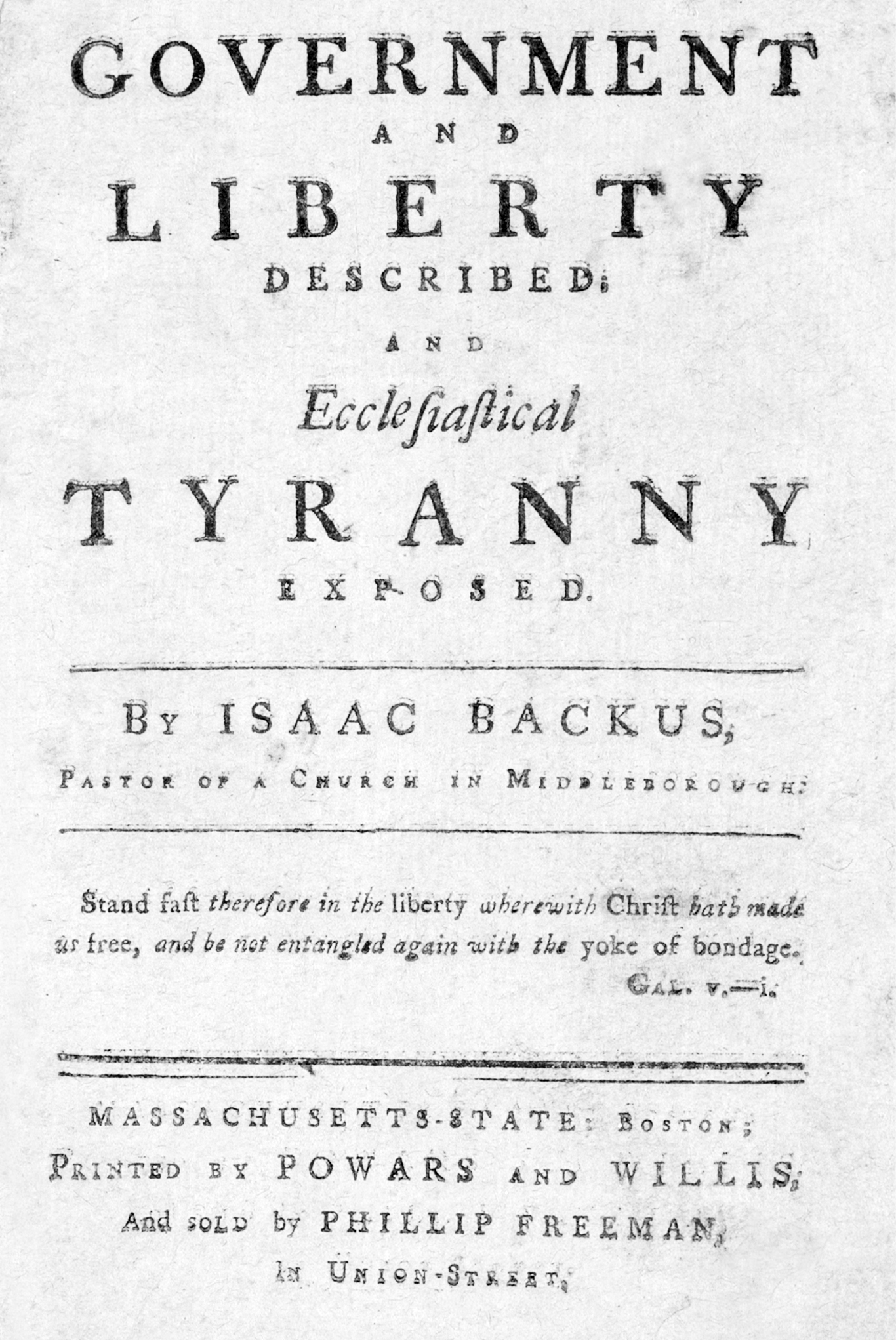
Throughout the war years, Backus urged others to support patriots in their struggle for increased liberty. One of the pamphlets published by this leader in 1778 that helps us better understand religion at war in support of that conflict was entitled Government and Liberty Described; and Ecclesiastical Tyranny Exposed. In this pamphlet, Backus continued to teach others political principles upon which the war was based. Backus argued that governments were instituted to preserve men’s liberty, and he continued to identify the rights of men and to determine actions of the British that violated these rights. Freedom is not the privilege of acting at random, he reasoned, but the right to act by “reason and rule.” Liberty is like the raging force of a mighty stream, he added, eventually eroding everything in its path and not resting until all obstacles are removed.26
Taking advantage of a new birth of political freedom, Backus also continued to emphasize the right of religious freedom. He declared in that 1778 treatise on liberty that one of the obstacles that needed to be removed was intolerance. The law of liberty is not yet a reality in Massachusetts, he added; tyranny is continuing. Baptists are still being persecuted, he explained. Mobs are interrupting baptismal services and are driving Baptists from their homes.27
Thus, Isaac Backus continued to fight for religious liberty. Nevertheless, Backus recognized the role that the American Revolution had played in increasing political and religious freedom. Particularly impressive is the statement he included in 1805 in one of his last publications: “We have cause to remember with thankfulness, that God has established a civil government over us, which allows equal liberty to all; so that each one may lead a quiet and peaceful life in all godliness and honesty. Such great, such unspeakable privileges demand proportional love and obedience.”28
In this tract from 1778, Isaac Backus denounced tax-supported churches as tyranny. Courtesy Library of Congress.
Conclusion
The American Revolution led to greater religious changes than any other secular event in American history. It led to the disestablishment of the Church of England and the weakening of the Congregational establishment, and it accelerated the movement to replace the public support of religion with the practice of voluntary support of religion. The American Revolution also advanced the movement of legal religious liberty. During this war for independence, America became a laboratory of creating governments and constitutions. Unlike any other group in the history of the world, representatives of the people created new state and national governments. While involved in this great experiment, Americans concentrated on issues such as individual rights, sovereignty, separation and fusion of powers, representation, and religious freedom.29 One of several remarkable accomplishments of the Revolutionary generation was the framing of laws and bills of rights guaranteeing religious freedom to people of all faiths, not just Trinitarian Protestants, but Catholics, Jews, and people of other religious persuasions.
The new birth of freedom in the new nation led to the organization of many new religious communities, such as the Methodist Church (which emerged in Britain but was officially organized in the United States), Unitarian and Universalist societies, various communal societies, and many restorationist groups. This multiplication of faiths united with other forces which accelerated the movement of religious freedom and helped precipitate the world’s greatest religious revival.30
In the early nineteenth century, there was greater political and religious freedom in the young nation than in any other country.31 Americans set an example that eventually influenced many other nations. Religion at war in support of the American Revolution helped precipitate a movement that changed the history of the world.
Notes
1. Whether Otis ever used these exact words is not known. See “James Otis,” Dictionary of American Biography, ed. Dumas Malone, 22 vols. (New York: Charles Scribner’s Sons, 1928–37), 14:102.
2. Milton V. Backman Jr., American Religions and the Rise of Mormonism, rev. ed.(Salt Lake City: Deseret Book, 1970), 183–85; Robert T. Handy, A History of the Churches in the United States and Canada (New York: Oxford University Press, 1977), 142-45; and Nathan O. Hatch, The Democratization of American Christianity (New Haven: Yale University Press), 3–15, 210.
3. Backman, American Religions, 254–63. The arm of the law was weak in the English colonies, especially in the frontier.
4. Lawrence Henry Gipson, The Coming of the Revolution (New York: Harper, 1954), 2–3. See also L. W. Labaree, Royal Government in America (New Haven: Yale University Press, 1930).
5. Milton V. Backman Jr., Christian Churches of America: Origins and Beliefs, rev. ed. (New York: Charles Scribner’s Sons, 1983), 133–36. For a depiction of the persecution of Baptists in Virginia, see The Dunking of David Barrow and Edward Mintz in the Nansemond River, 1778, oil painting by Sidney E. King, 1990, in James H. Hutson, Religion and the Founding of the American Republic (Washington, D.C.: Library of Congress, 1998), 71.
6. David Hackett Fischer, Albion’s Seed: Four British Folkways in America (New York: Oxford University Press, 1989), 617–18, 633–34.
8. Thomas Jefferson to John Adams, August 22, 1813, printed in The Writings of Thomas Jefferson, ed. Thomas A. Lipscomb, 20 vols. (Washington, D.C.: Thomas Jefferson Memorial Association, 1903–4), 13:350.
9. Sydney E. Ahlstrom, A Religious History of the American People, 2 vols., Image ed. (Garden City, N.Y.: Image, 1975), 1:413, 433–36.
10. Henry Mayer, A Son of Thunder: Patrick Henry and the American Republic (New York : Watts, 1986), 59–61.
11. For more on Henry, see Hutson, Religion and the Founding, 67.
12. Letters of James Maury printed in Ann Maury, Memoirs of a Huguenot Family (New York: George P. Putnam, 1853), 420–23; Sanford H. Cobb, The Rise of Religious Liberty in America (New York: Macmillan, 1902), 110–11. What Henry actually said is not fully known, but some accounts are just too interesting to be doubted, such as “Give me liberty or give me death.” Portions of his remarks were recorded shortly following the trial.
14. Backman, American Religions, 183; Handy, A History of the Churches in the United States, 144–46.
15. For a copy of Jefferson’s An Act for Establishing Religious Freedom, see Hutson, Religion and the Founding, 73.
16. Backman, American Religions, 199–200; Dumas Malone, Jefferson and His Times, 6 vols. (Boston: Little, Brown, 1948–81), 1:276–80.
17. Backman, American Religions, 161–75. Partly because of the religious diversity that characterized the Middle Colonies and Rhode Island, there were no religious establishments in that area (except in New York City) in the eighteenth century. Prior to the American Revolution, by their examples and experiments, these colonies led a movement of voluntary support of religion and the securing of a policy of religious liberty. See Winthrop S. Hudson, Religion in America, 3d ed. (New York: Charles Scrinbers’ Sons, 1983), 99–106.
18. For more on Backus, see in Hutson, Religion and the Founding, 69.
19. William G. McLoughlin, Isaac Backus and the American Pietistic Tradition (Boston: Little, Brown, 1967), 110–15.
20. McLoughlin, Isaac Backus, 59–60, 126–28, 134–35, 157–66.
21. For a legal analysis and full text of such a “protest” and opting out, see John W. Welch, “Jesse Smith’s 1814 Protest,” BYU Studies 33, no. 1 (1993): 131–44.
23. Alice M. Baldwin, New England Clergy and the American Revolution (New York: Ungar, 1958).
24. Milton V. Backman Jr., “Isaac Backus: Pioneer Champion of Religious Liberty” (Ph.D. diss., University of Pennsylvania, 1969), chaps. 6–7. Between 1770 and 1787, Backus published thirty-two tracts (five of which were revised and republished). Ten tracts were written in an effort to secure religious freedom. He also wrote ten articles that were published in Boston newspapers. His political theories in support of the American Revolution were included in a number of these publications.
25. McLoughlin, Isaac Backus, 123–27, 134; Backman, “Isaac Backus,” chap. 9. See Diaries of Isaac Backus, 8:145–51, Backus Collection, Andover Newton Theological Library, Newton Centre, Massachusetts; and Isaac Backus, History of New England with Particular Reference to the Denomination of Christians Called Baptists, 2d ed., 2 vols. (Newton, Mass.: Backus Historical Society, 1871), 1:529–30, 536–37; 2:192–96.
26. Isaac Backus, Government and Liberty Described; and Ecclesiastical Tyranny Exposed (Boston: Powars and Willis, 1778), 3–6, 11. This pamphlet was probably read by more Americans than any other tract written by Backus.
27. Backus, Government and Liberty Described, 15–20.
28. Isaac Backus, A Great Faith Described and Inculcated (Boston: Lincoln, 1805), 16.
29. For a discussion of major issues considered by founders of this nation, including the framers of the Constitution of 1787, see Jack N. Rakove, Original Meanings: Politics and Ideas in the Making of the Constitution (Ann Arbor: University of Michigan Press, 1998); J. Reuben Clark Jr., Stand Fast by Our Constitution (Salt Lake City: Deseret Book, 1965), 147–50, 187–88; and Edmund S. Morgan, Inventing the People: The Rise of Popular Sovereignty in England and America (New York: Norton, 1988).
30. Backman, American Religions, 283–309. Some of the new religious communities that were organized following the American Revolution did not embrace the traditional concept of God. Subsequently, some Christian faiths would not have been permitted legally to hold public meetings by the provisions of the Toleration Act of 1689.
31. Cobb, Rise of Religious Liberty in America, 2–6, 15–18, 509, 521–28; Richard L. Bushman, “1830: Pivotal Year in the Fulness of Times,” Ensign, vol. 8 (September 1978), 9. For a discussion of the transformation of American Christianity following the American Revolution, see Hatch, Democratization of American Christianity, 3–15, 210.