In the spring of 1786, Thomas Jefferson, then serving as ambassador to France, traveled to London to visit John Adams, then serving as minister to the Court of St. James’s. On April 4, during a delay in trade and treaty negotiations, the two patriots set off for a coach tour of the English countryside. Among other places of interest they visited were Edgehill and Worcester, sites of the first and last battles of the English Revolution in the mid seventeenth century. From his diary it is clear that Adams was deeply moved to walk “the Scænes where Freemen had fought for their Rights.” “This was history he knew in detail,” observes Adams’s recent biographer David McCollough. It was a history well known to Jefferson as well. Both men recognized that the seeds of political and religious liberty in America had been sown more than a century before on English soil. Hence Adams was dismayed to discover the locals at Worcester were “so ignorant and careless” regarding the sites where seventeenth-century Englishmen had, like eighteenth-century Americans, thrown off the yoke of monarchy. “I was provoked,” Adams records, “and asked, ‘And do Englishmen so soon forget the Ground where Liberty was fought for? Tell your Neighbours and your Children that this is holy Ground. . . . All England should come in Pilgrimage to this Hill, once a Year.”1
Modern Americans may well feel equally rebuked under Adams’s censure. For we, too, remain largely oblivious of the struggles where “Liberty was fought for” in mid-seventeenth-century England. This anecdote reminds us that the English Revolution served as a prelude to the American Revolution and that this connection was well known by the Founders, not to mention by their foes.2 Examples abound of the ongoing influence of the English Revolution on Adams, Jefferson, and their compatriots. Adams credited James Harrington, Algernon Sidney, Marchamont Needham, John Milton, and other English Commonwealthmen with having convinced him “that there is no good government but what is Republican.”3 Likewise, Thomas Jefferson drew heavily from Milton’s anti-prelatical tracts when drafting legislation on religious freedom for Virginia.4 Similarly, Jefferson specifically summoned up the rhetoric of the English Revolution when, just two weeks before his death, he celebrated the jubilee of the Declaration of Independence by declaring “the palpable truth, that the mass of mankind has not been born with saddles on their backs”—an image which was derived from a speech that one of Oliver Cromwell’s soldiers, Richard Rumbold, delivered from the scaffold just before his execution.5 These examples illustrate the way that the rhetoric, principles, people, places, and historical events of the so-called “Good Old Cause” resonated across the years and over the sea to American shores. My purpose is to trace how Milton and, more broadly, the English Revolution served as conduits conveying principles of civil and religious liberty to the early American republic.
Since the time of English historian Thomas Babington Macaulay it has become commonplace to think of the abortive English Revolution as completed in the Glorious Revolution of 1688. However, it might be more accurate to say, as does historian Lydia Dittler Schulman, “The real victory of the English Commonwealth was the American Revolution.” The influences of the English Revolution on the American Revolution included “natural and inalienable rights, the contractual nature of government, the subjection of magistrates to law, the legitimacy of revolution when rulers cease to govern for the good of the people, the superiority of mixed and balanced government, and the importance of education.” Schulman concludes, “The body of political thought generated by the Great Rebellion and the Glorious Revolution is now generally recognized as a major ideological influence on the American Revolution.”6
Milton and the English Revolution played a significant role in the story of religion and the founding of the American republic, though this chapter is often overlooked in accounts of its founding. Too often, the intellectual origin of the American Revolution has been understood narrowly in terms of the triumph of Enlightenment values. In Enlightenment meta-narratives, religion typically figures as a villain that visited vicious sectarian violence on Europe during the sixteenth and seventeenth centuries until it was restrained by secular values of tolerance, separation, disestablishment, and freedom of inquiry during the eighteenth century. Such explanations, however, oversimplify and distort the intellectual genealogy of religious toleration. As the theme of the Library of Congress exhibition implied, and as is abundantly evident when one considers the influence of a figure like Milton upon the Founding, religion was not simply the source of intolerance. It also played a positive role in the rise of tolerant democratic republics such as ours. In Milton we see how apparently secular Enlightenment principles were powerfully and proleptically articulated within an older religious discourse of Christian liberty.7
Commitment to such shared civic virtues fostered a special sense of kinship in the Founders toward their seventeenth-century English forebears, particularly Milton. In Milton, Americans could discern civic virtues framed in what became a distinctively American idiom, which Nathan Hatch calls “civil millennialism” or “Christian republicanism,” by which Hatch means the “convergence of millennial and republican thought.”8 Early Americans heard this convergence in Milton’s prose. A good example can be found in Milton’s tract for press liberty, Areopagitica, which situates a proto-Jeffersonian call for freedom of speech—“Give me the liberty to know, to utter, and to argue freely according to conscience, above all liberties”—within a rhetoric of Protestant millennialism that could have come straight out of Puritan New England.9 Similarly, early American readers heard the strains of Christian republicanism sounding in Milton’s poetry, particularly Paradise Lost. Milton’s epic is said to have “supplied some of the core mythology of . . . the revolutionary enterprise” in early America;10 and similarly, to have served as “a natural literary handbook of revolutionary polemicists.”11
My argument is that the English Revolution served as a well-known prelude to the American Revolution in early America, playing an important role in the origin of our conception of civic and religious liberty; and that Milton served as the “leading authority on republican ideas” in early America. This is not because he was “the most original or systematic of the Commonwealthmen,” but because he, more than any other, championed liberty in soaring prose and sublime poetry calculated to survive the failure of his cause and to speak to early Americans with a familiar voice.12 Milton made seventeenth-century revolutionary thought available to subsequent generations on both sides of the Atlantic. As Scott Simkins argues,
Milton’s poetry and prose . . . ran through colonial consciousness like a vein of gold through a mine. Rather than looking at the colonists’ political inheritance as a layer cake, with Rousseau stacked on Montesquieu stacked on Locke, consider it like a marble cake, with swirls of related ideas from Magna Carta to Areopagitica to L’Esprit des Lois.
Thus, according to Simkins, a “link existed between Puritan and American revolutions due largely to Milton.”13
Milton and the Defense of American Liberty
To discern the Miltonic marbling that runs through the American republic’s concept of religious liberty, one needs to “ring the bell backward,” in T. S. Eliot’s phrase, conjuring the life and times of “one who died blind and quiet.”14 Milton felt that he lost his eyesight in the defense of liberty. But for the leniency of Charles II and the intervention of friends, he could well have lost his life in the cause as well. Although his life and works are more complex and dynamic than can be fully accounted for under any single idea, Christian liberty surely lays claim to be a lodestar guiding his career. Milton took considerable pride in his role as heroic defender of liberty. For example, in an autobiographical account of his prose writing, he characterized his rather disparate prose pamphlets as a deliberate, coherent, and systematic effort to “advance the cause of true and substantial liberty . . . which is best achieved, not by the sword, but by a life rightly undertaken and rightly conducted.”15 Likewise, in his poetry he frequently presents himself as a defender of true Christian liberty. To cite but one example, consider Sonnet 12, “I did but prompt the age to quit their cloggs,” in which he presents himself to his nation as a spokesmen for the “rules of antient libertie.” True liberty must be distinguished from license: “For who loves that [liberty], must first be wise and good.”16 A brief rehearsal of Milton’s biography reveals why Americans looked to Milton as a natural ally in their own struggle for liberty and the great exponent of the English Revolution.
Born in 1608, Milton’s life-experiences and thought “arise from the same set of cultural circumstances” that led Puritan separatists to migrate to Plymouth Plantation and other colonists subsequently to break away to found Rhode Island.17 While Milton did not emigrate, religiously his life traces an arc of separation from established religion. With the advantage of hindsight, it is of course possible to exaggerate the young Milton’s Puritan sympathies. Even so, one can scarcely fail to notice indications in his early life of the Puritan trajectory Milton would follow.
Milton likely inherited his feelings for religious liberty from his father. John Milton Sr. was something of a martyr for the cause of religious freedom, having been disinherited when he embraced Protestantism. His famous son would likewise prove himself willing to suffer for truth’s sake and would celebrate this particular kind of courage as a high heroic virtue.18 The young Milton may have also imbibed a love for religious liberty from his local minister and tutor. He was raised in a left-leaning Church of England parish, which chose its own minister, Richard Stock, a man of Puritan sympathies. Of perhaps even greater influence on young Milton was his tutor, Thomas Young. A Scottish Presbyterian, Young manifested some of “the same disaffection” that led John Winthrop to leave England. Young left England for Germany in 1620, the same year the pilgrims set sail in the Mayflower. In Elegy 4 (1627), Milton depicts Young sympathetically as a religious exile. And much later, in an anti-prelatical tract, Milton defended his old tutor’s attack on church hierarchy. The fires of religious liberty thus seem to have been lit in Milton even as a boy.
And they grew brighter in college. Cambridge was at the epicenter of Puritan discontent. In 1629, when Milton received his B.A. from Cambridge, the Reverend John White urged the graduates to consider migrating to Massachusetts Bay. Milton, of course, chose to stay in England—but ultimately not in the Church of England. Soon after Milton received his M.A. and should have been ordained, William Laud became archbishop. Laudian reforms, which imposed High Church ceremonialism on the Church of England, “plunged many a Puritan into a crisis of conscience, John Milton among them.” Milton’s growing recognition that he could not enter the ministry as both he and his parents had intended from childhood is evident in his university poem “Lycidas” (1637), which attacks the corrupt clergy in the Laudian church. The forces that drove some across the sea to New England led Milton to feel “church-outed.” This discontentment with the state church was a critical factor in his decision to embrace a literary vocation as a poet.19
Milton did not, however, immediately pursue a poetic vocation. Rather, he chose to put his poetic career on hold during his middle years specifically to defend the cause of liberty, even though this meant temporarily restricting himself to the “left hand” of prose. Milton spent the 1640s and 1650s writing pamphlets in the defense of liberty, first as a private citizen and subsequently as a minister in Cromwell’s Council of State. In his early anti-prelatical tracts, like Of Reformation and The Reason of Church-Government, Milton opposed the lordly power of bishops. Subsequently, verifying James I’s fear that “no bishop” would mean “no king,” Milton opposed political tyranny in such tracts as Eikonoklates and The Tenure of Kings and Magistrates. Milton’s unwavering opposition to tyranny moved him ever leftward, politically and religiously—from nominal Anglican, to Presbyterian, to Independent, to church of one.
The Tenure proved especially attractive to early American patriots. In it, well before Locke, Milton advanced a contract-theory of government upon which he argued for the right of a people to depose tyrants. A phrase from The Tenure may have influenced Jefferson’s famous opening lines of the Declaration of Independence, the first draft of which reads: “We hold these truths to be sacred and undeniable; that all men are created equal and independent, that from that equal creation they derive rights inherent and inalienable.” Similarly, Milton bluntly asserted: “No man who knows ought, can be so stupid to deny that all men naturally were borne free, being the image and resemblance of God himself.”20 Notably, both Milton and Jefferson grounded the natural right to personal liberty in a religious understanding of Creation and human nature, though the religious basis for natural rights was more muted by Jefferson. Supplying a Miltonic context for the Declaration foregrounds the religious origin of what became a secular Enlightenment idea—namely, the inalienable right to liberty.
Another important liberty tract for Americans from Milton’s middle years is Areopagitica, a ringing defense of toleration. Tradition has it that Roger Williams personally brought a copy of Areopagitica to Rhode Island. A century later, Areopagitica was the first of Milton’s works to be printed in America—published, not coincidentally, on the eve of the Revolution (1774).21Areopagitica, which contains Milton’s loftiest prose on liberty, appealed to revolutionaries across the Channel as well as across the Atlantic. It was rendered into French by Honoré Mirabeau, in a translation which, in deference to French Enlightenment tastes, suppressed the profoundly religious basis of its argument. Mirabeau’s translation of Areopagitica was read at the opening of the “States General” in 1788.22 Thus Milton’s defense of religious toleration was sounded at the beginning of both the American and French Revolutions.
The greatest labor of Milton’s middle years was his Defensio pro populo Anglicano (Defense of the English People). This treatise defended, before an international tribunal and against attack by the learned Continental scholar Salamsius, the English people’s right to overthrow a monarchy and to establish a commonwealth. Writing Defensio took a toll on Milton, whose eyesight by then was rapidly failing. He believed that preparing this long erudite defense of liberty cost him his sight. Nevertheless, he expressed his willingness to lay this terrible offering on the altar of freedom, comparing his choice to that of Achilles, who preferred glory and early death over ignominy and long life.23Defensio established Milton’s international reputation as Europe’s most learned champion of republican principles.
Milton continued to espouse “that which is call’d not amiss the good Old Cause” to the end of his days, however unpopular the cause ultimately became.24 In February 1659, he published another discourse on religious toleration, A Treatise on Civil Power. And soon thereafter, he published and republished a desperate appeal to the English people not to abandon the republic for monarchy. The most courageous and at the same time foolhardy act of Milton’s life was publishing The Readie and Easie Way to Establish a Free Commonwealth in March 1659, and then again in May, only weeks before Charles II was to be restored to the throne. During these perilous times, when other regicides were scrambling for cover, Milton bravely called attention to himself as an unrepentant Commonwealthman. Faced with what he regarded as the enormous calamity of his countrymen, who had been Providentially led out of bondage, now “chusing them . . . a captain back for Egypt,” Milton felt compelled to utter what he feared may be the last words of “reviving liberty” to his backsliding English nation. And this he did in a politically naive, pragmatically futile, but grandly prophetic gesture: “Thus much I should perhaps have said though I were sure I should have spoken only to trees and stones; and had none to cry to, but with the Prophet, O earth, earth, earth! to tell the very soil it self, what her perverse inhabitants are deaf to.”25
These should have been the last lines Milton ever published, but against all odds, he survived the restoration of Charles II. From the Restoration to end of his life, Milton remained an unreformed republican and advocate of religious toleration. Not only did he publish a prose tract entitled Of True Religion, which forcefully reprised his earlier defenses of religious toleration and disestablishment, but he championed Christian liberty obliquely in his great last poems: Paradise Lost, Paradise Regain’d, and Samson Agonistes. Issued under the state censor’s watchful eye, these poems are necessarily circumspect about the poet’s republican sympathies. Nevertheless, their author’s libertarian principles are clear enough to have made the poems suspect to Tories, like Samuel Johnson and T. S. Eliot, as well as dear to Whigs like John Toland and patriots like Thomas Jefferson. Though masked, the “Good Old Cause” continues to animate Milton’s great last poems. The poems are not merely timeless monuments, but speak to the particular conditions of religious dissent during the Restoration. One measure of this is evinced by the chapter subtitles of a recent book about the literature of Non-Conformity, each of which is drawn from Paradise Lost.26 Similarly, literary critics over the last three decades have been busily recovering the radical and, more recently, republican subtexts of Milton’s great final poems.27 There is now abundant evidence that Milton’s poetry and prose served as conduits of Commonwealth ideas to subsequent generations of readers.
Milton’s Influence on the Founding
Nowhere was Milton’s influence more apparent than in early America. Milton was not only the most important spokesperson of the English Commonwealth period, but he was possibly the most influential of any literary figure. Several important book-length studies have demonstrated Milton’s importance in early America. George Sensabaugh’s pioneering book Milton in Early America thoroughly documents Americans’ extensive knowledge and use of Milton during the colonial and early republican periods. Sensabaugh concludes that, after Isaac Watts, Milton was the most quoted modern poet in colonial America and that no other author, ancient or modern, “impressed on Americans distinct modes of feeling and speaking; none etched on their minds visions of a transcendent world” more than Milton, whose reputation eclipsed even that of Homer and Vergil.28
Nancy Armstrong and Leonard Tennenhouse corroborate Sensabaugh’s assertions in The Imaginary Puritan. They claim that Milton was “the most widely read author in eighteenth-century America. . . . If a home in the American colonies possessed any books besides the Bible, they were likely to be The Pilgrim’s Progress and Paradise Lost.”29 Moreover, Milton’s significance cannot adequately be measured merely by cataloguing how frequently his works were cited, sold, or found in personal libraries. Milton’s influence in early America was as profound as it was pervasive, impressing itself deeply on the American character. The power of his impact is partly a function of timing, for Milton’s shaping influence was greatest precisely as America was fashioning its national identity. It is also partly a function of the mythic appeal of his works and life. Armstrong and Tennenhouse argue for the presence of something they call the “mind of Milton” in our national life, functioning as an ongoing vehicle for transmitting the impact of the English Revolution on American culture.30
Similarly, Keith W. F. Stavely argues, in a book entitled Puritan Legacies: Paradise Lost and the New England Tradition, 1630–1890, that Milton imparted a “structure of feeling” with respect to such revolutionary principles as antinomianism and Arminianism—principles that lasted for hundreds of years in America.31 Stavely ingeniously illustrates the continuing impact of Milton in his final chapter, which undertakes an ethnographic study of Charles F. Morse, a “secularized Puritan as country editor” in late nineteenth-century Marlborough, Massachusetts. In the quotidian experience of Morse’s life and New England town, Stavely delineates the continuing presence of a Miltonic “structure of feeling.”32
If Milton’s influence was evident, even in attenuated forms, at the end of the nineteenth century, it was even more pronounced during the Revolutionary era.33 The ideological influence of Paradise Lost on those who first fashioned this country has been most ably set forth in Lydia Dittler Schulman’s book entitled Paradise Lost and the Rise of the American Republic. Schulman traces the profound and enduring impact of Milton’s distinctive formulation of republican principles on the Founders. She is especially attentive to the appeal implicit in Milton’s idea of Christian liberty, which conjoins notions of freedom with self-discipline. As Shulman notes, Milton’s appeal to American patriots such as John Adams lies precisely in the fact that Milton, like Adams, saw humans as at once rational, free, empowered with self-transcendence, and hence capable of self-government; and at the same time as fallible, corruptible, subject to temptations, and hence in need of personal and political checks and restraints. Put another way, Milton’s special appeal derives from the fact that he emphasizes both human ameliorability, the fulfillment of which requires political and religious freedom, and human fallibility, the presence of which necessitates the need for self-discipline, political restraints, and virtuous leadership.34 By espousing republican values in terms of this complex ideal of Christian liberty, Milton spoke to both ends of the political spectrum occupied by the early patriots. For Jefferson and his intellectual heirs, Milton became a champion of religious freedom and opponent of political oppression. For Adams and those of his disposition, Milton embodied the idea of liberty based in reason and self-discipline and thus was adduced as an opponent of demagoguery and other forms of “individualism gone awry.”35 This distinction is developed below in my discussion of Adams and Jefferson.
It should be clear from this brief survey of the scholarship on Milton in America that no single paper can hope to provide anything like a full account of Milton’s influence on the Founding, much less of the broader impact of the English Revolution for which he was a spokesperson. I must therefore skip over such fascinating historical details as the fact that Benjamin Franklin adapted Milton’s hymn to creation from Book 5 of Paradise Lost for his own private liturgy36 and devote the balance of the paper to Milton’s influence on four figures featured in the Library of Congress exhibition: two from the colonial period, Roger Williams and Jonathan Mayhew; and two whose impact was greatest during the Revolution and early republic, John Adams and Thomas Jefferson.
Roger Williams and Jonathan Mayhew
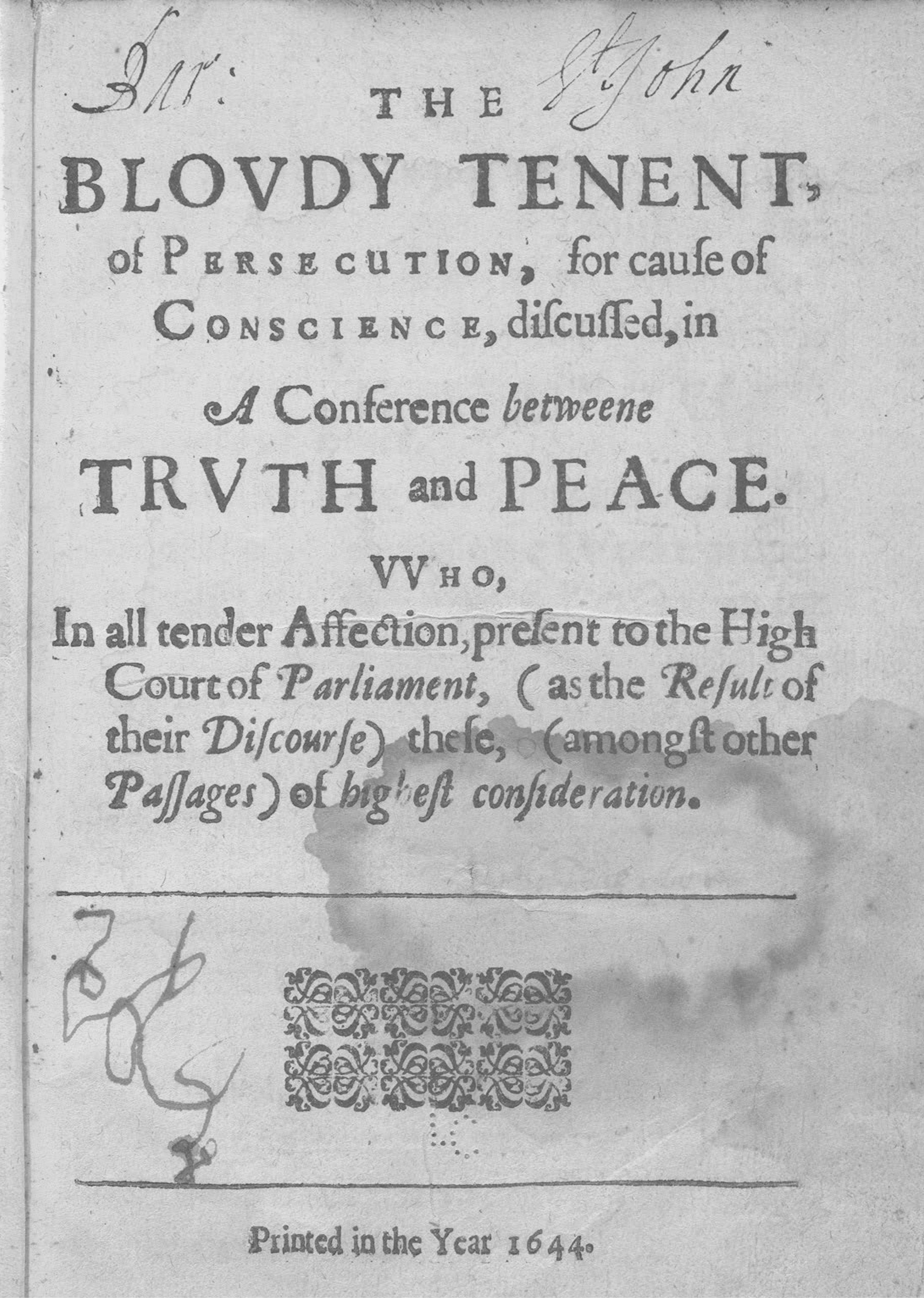
Unlike Mayhew, Adams, and Jefferson, Roger Williams was Milton’s contemporary. Moreover, Williams and Milton knew each other personally: they read each other’s works, shared each other’s political and religious sympathies, and studied languages together on Williams’s trips back to old England. And they made common cause in the defense of religious freedom, an alliance illustrating the origins of our religious liberty in the English Revolution. In 1644, both Williams and Milton published similar defenses of religious toleration. In February and July, Williams published Queries of Highest Consideration and his famous The Bloudy Tenent, of Persecution, for Cause of Conscience Discussed, an eloquent early appeal for untrammeled religious toleration. In November of the same year, Milton published his equally famous attack on censorship, Areopagitica, which argued as well for freedom of conscience and religious toleration. It was likely at this time and through this circumstance that Milton and Williams first became personally acquainted.37
Though ideological allies, Milton and Williams did not espouse identical positions on religious toleration in Areopagitica and The Bloody Tenet. Milton’s focus is on press freedom, and specifically on the opprobrious practice of prior restraint. He proposed broad but limited freedom for Protestants to publish their beliefs. However, he excepted “Popery” and books “absolutely either against faith or manners.”38 By contrast, Williams advocated complete toleration; he included Catholic, Jew, Muslim, and pagan. Nevertheless, both Williams and Milton were clearly allied in the cause of toleration and separation. Both men roused the same enemies and raised the same concerns from the establishment; both were regarded as radical and dangerous by Parliament and singled out for censure and suppression.39 Written within months of each other, The Bloody Tenet and Areopagitica constitute the most important calls for religious freedom in Early Modern English. Each helped shape the concept of religious tolerance for the early American republic. It is no coincidence that both these seminal texts emerged during the tumultuous 1640s from controversies engendered by the English civil wars, which served as a seedbed for religious liberty in America.
Roger Williams’s The Bloudy Tenent [Bloody Tenet] was one of the earliest pleas for religious liberty in the colonies. Courtesy Library of Congress.
During the Commonwealth period in the early 1650s, Roger Williams was again in England and was again linked with Milton in the defense of religious toleration, along with Henry Vane the Younger, Milton’s friend and ally in the English Revolution and erstwhile governor of Massachusetts. All three opposed efforts by Cromwell’s regime, in response to the proliferation of radical sects, to limit religious toleration and reestablish a state church.40 Although it is possible to romantically exaggerate the degree of friendship between Milton and Williams, there is no doubt that the two were on amicable terms. In 1652, Williams taught Milton Dutch while Milton, in exchange, helped him with “many more languages.”41 At this time they may have also discussed Williams’s antinomianism. Like Williams, Milton would subsequently endorse a “qualified antinomianism . . . as a concomitant of Christian liberty.”42
Milton also had a major influence on Jonathan Mayhew (1720–89), a Congregationalist minister in Boston, whose sermons during the decades prior to 1776 played a key role in preparing the country for revolution. As the Library of Congress exhibition notes, Mayhew’s Discourse concerning Unlimited Submission and Resistance to Higher Powers (1750) was considered by John Adams to be the first shot of the American Revolution. If so, it is a salvo that explicitly continued the battles waged during the English Revolution between Royalist and Roundhead. The sermon was given in connection with the centennial of the execution of Charles I, in response to Tory eulogies of Charles I that condemned seventeenth-century regicides such as Milton and that argued for unlimited submission to monarchs.43 Furthermore, there is a significant and demonstrable connection between Mayhew and Milton. The story of how this came about constitutes a fascinating chapter in the annals of the Founding’s intellectual history.
After Milton’s death, his legacy was continued primarily by the Whigs.44 Some Whig admirers, like Addison, downplayed Milton’s radical politics, on the whole ignoring his prose and regicide past while celebrating his poetry as sublime, timeless, and apolitical. However, Milton’s radicalism was not entirely suppressed. It was admired by a faction called the Real Whigs, which deliberately set about to preserve and transmit Commonwealth ideals into the eighteenth century.45 Key figures in this effort were the deist John Toland, who published a collection of Milton’s prose in 1697, and the Nonconformist Thomas Hollis, who disseminated Commonwealth literature broadly, on both sides of the Atlantic—including Toland’s edition of Milton’s prose. Eventually, Hollis became a correspondent with Jonathan Mayhew in Boston, sending him so-called “liberty books” from the English Revolution, including generous selections of Milton’s defenses of “civil, religious, and domestic liberty.” So effective was Hollis in fomenting revolutionary sentiment in the colonies that the great Tory critic Samuel Johnson blamed the American Revolution upon the mischief created by Hollis, “because he had rescued so many tracts of the Interregnum and presented these ‘liberty books’ to impressionable Americans.”46 In Johnson’s eyes, the American rebellion was the baleful progeny of men such as Milton. American patriots were in effect English Commonwealthmen redivivus.
There’s reason to believe that Johnson got the etiology of the American Revolution right, at least with respect to Mayhew’s Discourse concerning Unlimited Submission. This “first shot” of the Revolution confirms Johnson’s suspicion that the rebellion in America constituted a revival of the convulsive political turmoil of the English Revolution. After all, the sermon was preached in connection with the centennial of Charles I’s execution, specifically in an effort to counter Tory readings of this watershed event. And it borrowed heavily from the arguments of a notorious regicide, John Milton. George Sensabaugh provides several pages of side-by-side analysis demonstrating Milton’s specific influence on this and other revolutionary sermons by Mayhew.47 Thus it is fair to see Mayhew’s Discourse as recontesting the great unresolved religious and political questions of mid-seventeenth-century England: Do subjects have an obligation to obey a monarch, however corrupt? Are Christians ever justified in throwing off a tyrant? Are there any legitimate religious grounds for rebellion? American Tories, like their seventeenth-century cousins the English Royalists, responded to these questions by urging quietism, consistent with the teachings by St. Paul that servants should obey masters. Mayhew, like Milton and his fellow republicans, argued that it was not only lawful for Christians to resist tyrants, but their duty. Properly considered, tyrants are not to be counted among the legitimate powers Christians are duty-bound to obey. Rather, oppressors are to be numbered among the powers in high places against whom Christians are to wrestle, according to Paul (Eph. 6:12).
The connection between Milton and Mayhew’s Discourse then is clear. Moreover, the evidence for the nexus is not only referential but explicit. Hollis wrote to Mayhew that “it is to Milton, the divine Milton, and such as him, in the struggles of the civil wars and the Revolution, that we are beholden” for our liberty.48 Further, Mayhew distributed Milton’s prose and other “liberty tracts” around the colonies with the specific intent of fostering republicanism. Included among the recipients of Milton’s republican prose were the president of Harvard and the provincial lieutenant governor of Massachusetts.49 Thus, if Mayhew’s Discourse may be described as the first shot of the American Revolution, then Milton may be said to have provided the ammunition.
From his Boston pulpit, Mayhew kept firing rounds fashioned out of the same material. A decade after the Discourse, Mayhew took up arms against the so-called “Bishops Plot.”50 He opposed the Church of England’s attempt to establish an American episcopate by sneaking Anglican bishops onto America’s shores. It was impossible for Mayhew and others steeped in the liberty books not to see the Bishops Plot in terms of the Stuarts’ efforts to impose prelatical control over religious worship in seventeenth-century England. That is, Mayhew saw the plot very much in the context of Milton’s anti-prelatical tracts. Similarly, Mayhew interpreted forced taxes imposed by the Sugar Act (1764) and Stamp Act (1765) in terms of forced tithes, against which Milton also inveighed more than a century before. As Schulman puts it, “In the minds of Mayhew and other Nonconforming colonists, as for the seventeenth-century Commonwealthmen, the issues of ecclesiastical and civil oppression, tithes and unlawful taxes, became inextricably entwined.”51 Mayhew thus vividly exemplifies the ongoing presence of Milton and the English Revolution in Colonial America. Mayhew prepared Americans to see their cause against the Crown as an extension of the Good Old Cause, their revolution as a reenactment of the English Revolution, and themselves as new Commonwealthmen bearing the banner of liberty once borne by John Milton.
John Adams and Thomas Jefferson
As young men, both Adams and Jefferson read and responded enthusiastically to Milton but in distinctly different ways. Their contrasting youthful responses to Paradise Lost prefigure political differences which would come to divide these men who defined the “North and South Poles of the American Revolution.”52 Their responses also describe, with virtually paradigmatic precision, two sides of an enduring literary crux in Milton studies regarding the nature of Milton’s Satan: Is he a legitimate hero, the Romantic champion of liberty against the tyranny of an unjust Heavenly Monarch, as Jefferson saw him? Or is he a villainous demagogue, the proponent of not liberty but its counterfeit, license, as Adams thought? These contrasting readings of Paradise Lost, as is so often the case, reveal as much about the reader’s politics as Milton’s.
Adams first read Paradise Lost as a young man of twenty-one. His journal entry for April 30, 1756, rhapsodizes that Milton’s “Powr over the human mind was absolute and unlimited” and that “His Genius was great beyond Conception, and his Learning without Bounds.”53 Although he would subsequently find Milton wanting as a practical political theorist, Adams said that his early reading of Milton’s political tracts helped convince him “that there is no good government but what is Republican.”54 Likewise, Thomas Jefferson was deeply impressed with Milton’s Paradise Lost when he first read it as a young man. He filled his commonplace book with some forty-seven quotations from Milton’s epic—many taken from Satan’s speeches. Subsequently, Jefferson also read and responded positively to Milton’s republican prose. As we have seen, Jefferson may have borrowed from Milton’s Tenure of Kings and Magistrates for the Declaration of Independence, and he explicitly drew from Milton’s tracts for his arguments in behalf of religious toleration and separation of church and state.
It is telling that what most impressed young Adams was Milton’s sublimity, grandeur, and learning; Adams was struck by the scope of Paradise Lost’s grand design. Adams was also impressed by Milton’s insistence that true liberty is inseparable from virtue. Jefferson, by contrast, fills his commonplace book with admiring citations of the grandly defiant speeches by Milton’s Satan, such as:
What though the field be lost? All is not lost; the unconquerable Will, And study of revenge, immortal hate, And courage never to submit or yield.55
Unlike Adams, what Jefferson most admired in Milton’s prose was not his erudition, not his rational republicanism, nor the grounding of liberty in virtue, but Milton’s passionate support of rebellion, religious toleration, and intellectual freedom.56
With respect to the relative power of the president versus the Congress, Adams once wrote to Jefferson, “You are afraid of the one, I, the few. . . . You are apprehensive of monarchy; I, of aristocracy.”57 This remark forecast the political differences that would ultimately divide Federalist from Republican. It is also consistent with the way each man read Paradise Lost. Adams and Americans of his persuasion found in Milton’s Satan not a hero, but an example of the dangers of demagoguery. For Federalists like Adams, the poem’s Council in Hell became a “central warning symbol” against the tyranny of those who would invoke language of revolution against tyranny in order to justify their own passion for social distinction and tyranny.58 Likewise, the Puritan Adams responded warmly to Milton’s assertion that only good people could be truly free and hence fit to entrust with political power.59
By contrast, Jefferson celebrates Paradise Lost’s rhetoric in behalf of the untrammeled freedom of the mind, even when the arguments are advanced by Satan. Jefferson’s admiration for Milton’s Satan anticipates the Romantic reaction. Jefferson would likely have agreed with Blake, who argued that Milton was “of the Devil’s party without knowing it,” and that he “wrote in fetters when he wrote of angels and God,” while he spoke from his own political experience and with true poetic inspiration when he described Hell’s revolt against the supposed tyranny of Heaven.60 Jefferson was profoundly impressed with Satan as defiant spokesperson of Romantic individualism, while Adams was most impressed with “Milton himself”—his commitment to liberty restrained by reason and virtue, his godlike ability to comprehend a “Stupendous Plan” of “him who rules the universe.”61 In their early contrasting responses to Milton, we discern the contours of the American parties that each patriot would eventually lead. In Adams’s early response to Milton, we see a nascent American Federalist, while in Jefferson’s early response, we see a proto-Republican—a darling of Jacobins and subsequent Romantic revolutionaries.
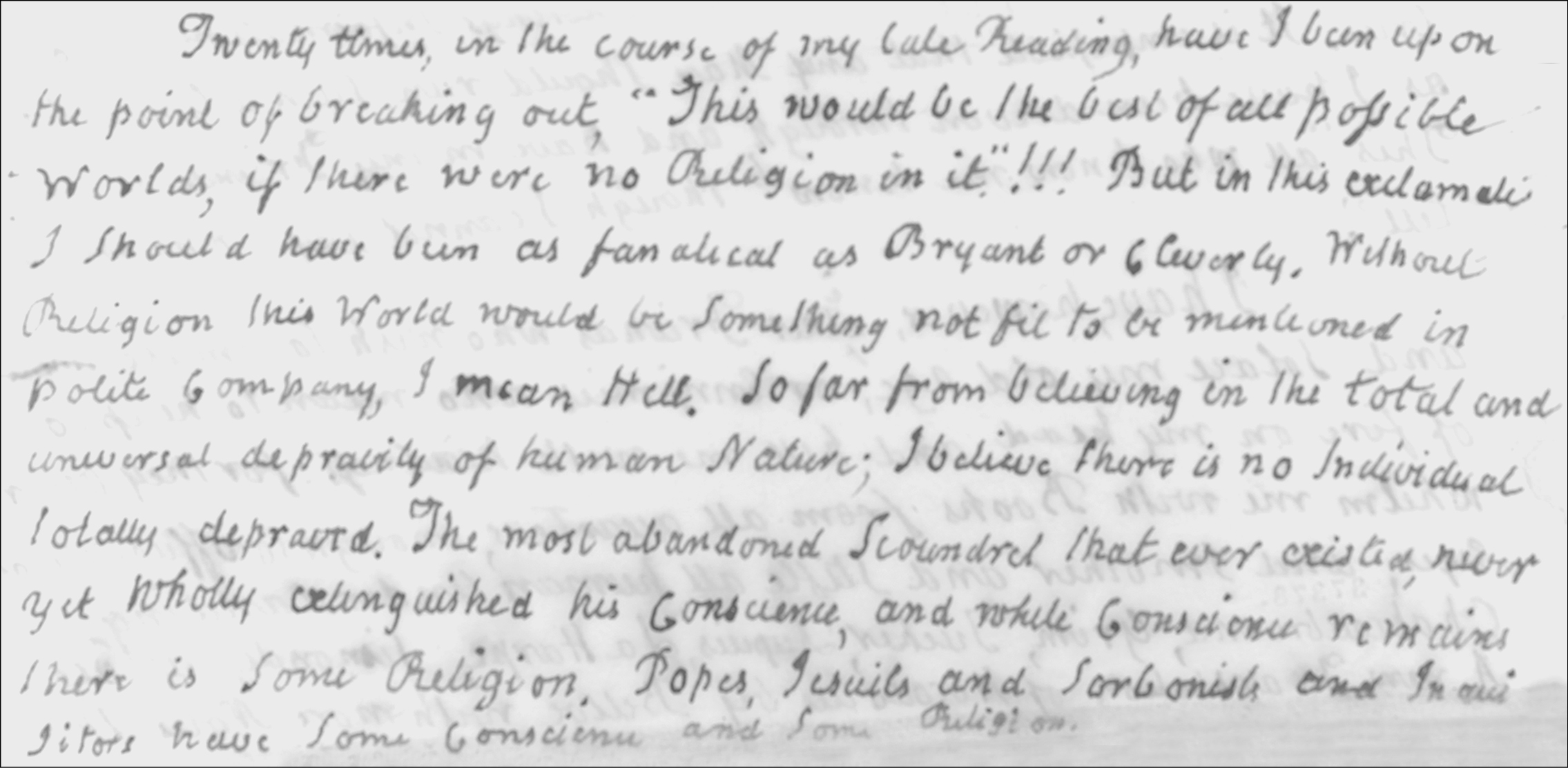
In this letter to Thomas Jefferson, April 19, 1817, John Adams expresses his views on religion and human nature. Courtesy Library of Congress.
Milton continued to figure in the mature work of both Adams and Jefferson through the Revolution, the Constitutional Convention, and into the nineteenth century. As Adams studied republican models of government, he understandably expressed disappointment with Milton. For Milton was no political theorist, nor a good source for practical advice about how to build political institutions—perhaps because he believed that personal virtue was ultimately more important to good government than political structure. Adams justly faults Milton for his slapdash proposal for a perpetual council in Readie and Easie Way. He thinks that Milton ought to have followed the lead of Commonwealthman James Harrington in advocating bicameralism. Yet despite his disaffection with Milton as a practical political thinker, Adams still turned to Milton the moralist and martyr when he, like Milton, faced political attack in his later years. Adams approvingly quoted Milton’s sonnet “I did but prompt the age” when he defended himself against the vicious partisan attacks attending the rise of parties in the early republic.62
Jefferson also combed Milton’s prose for political ideas during the Revolutionary and Republican eras. Jefferson drew most heavily from Milton in the debates over disestablishment in the State of Virginia. Milton, who fought mandatory tithes, would have been pleased that his work helped Jefferson win approval for “An Act for Exempting Dissenters from Contributing to the Anglican Church” (1776). Similarly, Jefferson again drew from Milton’s prose to construct arguments for “A Bill for Religious Freedom” (1786)—an accomplishment Jefferson regarded as so important that he stipulated it be inscribed on his tomb. Jefferson borrowed extensively from Milton in the notes about religious toleration he made, entitled “Outline of Argument.”63 Jefferson was particularly attracted to the anti-clericalism expressed by Milton in Of Reformation and Reason of Church Government. He admired Milton’s insistence that laymen were capable of expounding scripture and offering religious opinions, noting Milton’s scholarly opinion that, in the primitive church, bishops were elected by believers rather than appointed by popes. And he concurred with Milton’s view that Christianity fell into apostasy both when and because it became officially established under Constantine.64 Both men concluded from this fact about primitive Christianity that true religion not only did not need state support but may actually be harmed by establishment. As Milton avers at the end of Paradise Lost, to enforce faith by “secular power” leads to the decline of true faith.65 In light of Milton’s manifest contributions to Jefferson’s views regarding religious liberty, George Sensabaugh concludes: “It is therefore safe to say that Milton, through Jefferson, contributed tangibly to the settlement of religious freedom in Virginia; and this contribution, in turn, established a clear path between the Puritan to the American Revolution.”66
Conclusion
This remark about Jefferson and Milton may well serve to summarize the general lines of my argument. Having established that Milton and the English Revolution contributed to religious freedom in America, let me offer a concluding caution. One ought not to exaggerate the influence of either Milton or the English Revolution on the Founding. The Founders did not slavishly follow any one figure—whether Milton or Montesquieu. Nor did they seek republican principles only in English Commonwealth of the previous century. They also looked nearer at hand to Enlightenment political theory, and farther afield to classical republicanism as well as to the Florentine and Dutch republics. This said, the English Revolution as a whole, and Milton’s poetry and prose in particular, clearly did play a significant role in the history of religious freedom and the founding of the American republic.
Moreover, Milton’s influence persisted beyond the Founding well into the nineteenth century. In conclusion, let me cite but two brief examples. First, consider a comment by Margaret Fuller. After quoting with approval R. W. Griswold’s opinion that, paradoxically, Milton is our most American writer, Fuller adds her own explanation and encomium:
Mr. Griswold justly and wisely observes: “Milton is more emphatically American than any author who lived in the United States.” He is so because in him is expressed so much of the primitive vitality of that thought from which America is born, though at present disposed to forswear her lineage in so many ways. He is the purity of Puritanism. . . . He is one of the Fathers of this Age, of that new Idea which agitates the sleep of Europe, and of which America, if awake to the design of Heaven and her own duty, would become the principal exponent. But the Father is still far beyond the understanding of his children.”67
Second, consider Ralph Waldo Emerson’s view of Milton as an “apostle of freedom.” Emerson calls Milton “the sublimest bard of all,” adding that “no man can be named whose mind still acts on the cultivated intellect of England and America with an energy comparable to that of Milton.”68
Truly Milton and the English Revolution were formative influences that shaped the founding of the American Republic. Their influence stretched from seventeenth-century English battlefields like Worcester, on whose hill “liberty was fought for,” over the ocean and across the years to Bunker Hill. The Founding was wrought under the aegis of Milton and his Revolution. To some degree, we live under that banner still. We can discern traces of its influence in our national character to the extent that America still fuses today, as it did in De Toqueville’s time, the “spirit of religion” with the “spirit of liberty.”69 This is the spirit of the English Commonwealth. It is the spirit of Milton.
Notes
1. John Adams, Diary and Autobiography of John Adams, ed. L. H. Butterfield, 4 vols. (Cambridge: Belknap Press of Harvard University Press, 1961), 3:185; David McCullough, John Adams (New York: Simon and Schuster, 2001), 359.
2. For a political cartoon linking the American Revolution and the English Revolution, see The Yankee Doodles Intrenchments [sic] Near Boston 1776, in James H. Hutson, Religion and the Founding of the American Republic (Washington D.C.: Library of Congress, 1998), 42.
3. John Adams, The Papers of John Adams, ed. Robert J. Taylor, 10 vols. to date (Cambridge: Belnap Press of Harvard University Press, 1977–), 4:87.
4. George F. Sensabaugh, Milton in Early America (1964; reprint, New York: Grodian, 1979), 137–45.
6. Lydia Dittler Schulman, Paradise Lost and the Rise of the American Republic (Boston: Northeastern University Press, 1992), 15, 97.
7. That the Founding had religious origins is, of course, not an entirely novel claim. A number of political and literary historians have called attention to the pre-Enlightenment roots of American Revolution, particularly the English Revolution. I have in mind the work of political historians like Nathan O. Hatch, The Sacred Cause of Liberty: Republican Thought and the Millennium in Revolutionary New England (New Haven: Yale University Press, 1977), and Caroline Robbins, The Eighteenth-Century Commonwealthman (Cambridge: Harvard University Press, 1959), as well as of literary historians such as Schulman, Paradise Lost and the Rise of the American Republic and Keith W. F. Stavely, Puritan Legacies: Paradise Lost and the New England Tradition, 1630–1890 (Ithaca, N.Y.: Cornell University Press, 1987).
9. John Milton, Areopagitica, in The Riverside Milton, ed. Roy Flanagan (Boston: Houghton Mifflin, 1998), 1018–19. All subsequent references to Milton are to The Riverside Milton.
10. Tony Davies, “Borrowed Language: Milton, Jefferson, Mirabeau,” in Milton and Republicanism, ed. David Armitage and others (Cambridge: Cambridge University Press, 1995), 260.
11. Schulman, Paradise Lost and the Rise of the American Republic, 100.
12. Schulman, Paradise Lost and the Rise of the American Republic, 99.
14. T. S. Eliot, “Little Gidding,” Four Quartets, ll. 182, 179.
15. John Milton, Second Defense of the English People, in Riverside Milton, 1117.
16. John Milton, Sonnet 12, in Riverside Milton, 251–52. See also John Milton, The Tenure of Kings and Magistrates, “For indeed none can love freedom heartilie, but good men; the rest love not freedom, but license,” in Riverside Milton, 1057.
17. My summary of the Puritan influences on young Milton borrows from Stavely, Puritan Legacies, 3–5. Otherwise, my chief source on Milton’s life is Barbara Lewalski, The Life of John Milton: A Critical Biography (Oxford: Blackwell, 2000).
20. Milton, Tenure of Kings and Magistrates, 1060. See Davies, “Borrowed Language,” 261; and Walter Isaacson, Benjamin Franklin: An American Life (New York: Simon and Schuster, 2003), 312. Isaacson explains that it was Franklin who struck out “sacred and undeniable” and inserted instead “self-evident.” This was a deliberate attempt to relocate the ground of human liberty from religion to rationality. In a single stroke, Franklin reoriented America’s charter of freedom so its largest claims sound not scriptural but scientific, not Miltonic but Cartesian.
21. Lewalski, Life of John Milton, 541; Sensabaugh, Milton in Early America, 37.
22. Davies, “Borrowed Language,” 266, 269. Mirabeau’s translation went through three editions in four years. In addition, Areopagitica was evidently also published in 1831 in Greek, in connection with the creation of a free Greek republic. Davies, “Borrowed Language,” 270.
26. N. H. Keeble, The Literary Culture of Non-Conformity in Later Seventeenth-Century England (Leicester, Eng.: Leicester University Press, 1987).
27. See, for example, Christopher Hill, Milton and the English Revolution (New York: Viking, 1977) and David Norbrook, Writing the English Republic, 1627–1660 (Cambridge: Cambridge University Press, 2000).
29. Nancy Armstrong and Leonard Tennenhouse, The Imaginary Puritan: Literature, Intellectual Labor, and the Origins of Personal Life (Berkeley: University of California Press, 1992), 11.
30. Armstrong and Tennenhouse, Imaginary Puritan, 27–46.
44. Schulman, Paradise Lost and the Rise of the American Republic, 113–16. See also Patricia Bonomi, Under the Cope of Heaven (New York: Oxford University Press, 1986), 189–90, and Nicholas von Matlzahn, “The Whig Milton: 1667–1700,” in Milton and Republicanism, 229–53.
45. This history is told most fully in Caroline Robbins’s The Eighteenth-Century Commonwealthman (Cambridge: Harvard University Press, 1959). It is also summarized in Schulman, Paradise Lost and the Rise of the American Republic, 114–16. Complete religious freedom was one of the planks of the Real Whigs.
46. Schulman, Paradise Lost and the Rise of the American Republic, 118.
48. Schulman, Paradise Lost and the Rise of the American Republic, 122. Near the end of his life, Mayhew specifically acknowledged that he had been taught “the doctrine of Civil liberty” in his youth by Milton. Sensabaugh, Milton in Early America, 54.
49. Schulman, Paradise Lost and the Rise of the American Republic, 121–23.
50. For a political cartoon depicting the “Bishop’s Plot,” see An Attempt to Land a Bishop in America in Hutson, Religion and the Founding, 41.
51. Schulman, Paradise Lost and the Rise of the American Republic, 125.
56. Schulman, Paradise Lost and the Rise of the American Republic, 127–31; Sensabaugh, Milton in Early America, 136–37; Davies, “Borrowed Language,” 258–60.
69. “This civilization is the result . . . of two quite distinct ingredients which anywhere else have often ended in war but which Americans have succeeded somehow to meld together in wondrous harmony; namely, the spirit of religion with the spirit of liberty.” Alexis de Tocqueville, Democracy in America, trans. Gerald E. Bevan (London and New York: Penguin Books, 2003), 55.