This article is adapted from a lecture presented at Creighton University and an article by the author, entitled “The Influence of the Hebrew Bible on the Founders of the American Republic,” in Sacred Text, Secular Times: The Hebrew Bible in the Modern World, ed. Leonard. J. Greenspon (Omaha: Creighton University Press, 2000), 13–34.
From the earliest periods of the republic’s history to the present day, both the Hebrew scriptures (also known as the Old Testament) and the Christian New Testament have exerted tremendous influence on American life. However, the evidence indicates that American political life and culture were, from their earliest beginnings, grounded as much, or more, in the Hebrew scriptures than in the New Testament. Of course, Christians have generally used the Old Testament, but the particular focus on the Hebrew scriptures by both the Puritans and the Founding Fathers is remarkable. In fact, the further back one goes in American history, the more saturated with Hebraic references and allusions one finds American culture to be. Indeed, it is this Hebraic milieu, rather than one grounded in the Christian New Testament, which most fueled the fires of imagination and motivation among early American Christian colonists and Founders of the Republic. As Cecil Roth put it, “Deprive modern Europe and America of [their] Hebraic heritage and the result would be barely recognizable.”1 This paper, therefore, emphasizes the importance of the Hebrew scriptures in early American life, from the early Puritans to the Founding Fathers.
The Puritans and the Early Colonists
Many of the early American settlers were good Hebraists and were deeply rooted in the original biblical literature. This is true for churchmen, laymen, and political leaders alike.2 Hebrew was far from being an alien tongue on American Christian soil. Among political figures, William Bradford (1590–1657), one of the original Mayflower pilgrims and second governor of the Plymouth Colony, is said to have studied Hebrew most of all other languages because it allowed him to “see with his own eyes the ancient Oracles of God in their native beauty.”3 Bradford regarded Hebrew as “that most ancient language, and holy tongue, in which the Law and Oracles of God were writ; and in which God, and angels, spake to the holy patriarchs, of old time.” The study of Hebrew consoled the governor in his old age.4 Looking back to the landing at Plymouth in the harsh December of 1620 and reviewing the desperate predicament of the colonists, Bradford attributed their sustenance and ultimate success to the spirit and grace of God. He then emphasized his point by citing biblical quotations—taken not from Jesus or some other passages from the New Testament, but, rather, from the Old Testament, specifically the book of Deuteronomy and the Psalms.5
In 1648, Thomas Shepard made a similar argument when defending the Bay Colony against charges of cowardice leveled by the Puritans in England who were fighting the Cavaliers. Shepard appealed to the Old Testament: “What shall we say of the singular providence of God bringing so many shiploads of His people, through so many dangers, as upon eagles’ wings, with so much safety from year to year?” He then supported his thesis with citations from Exodus and Micah.6
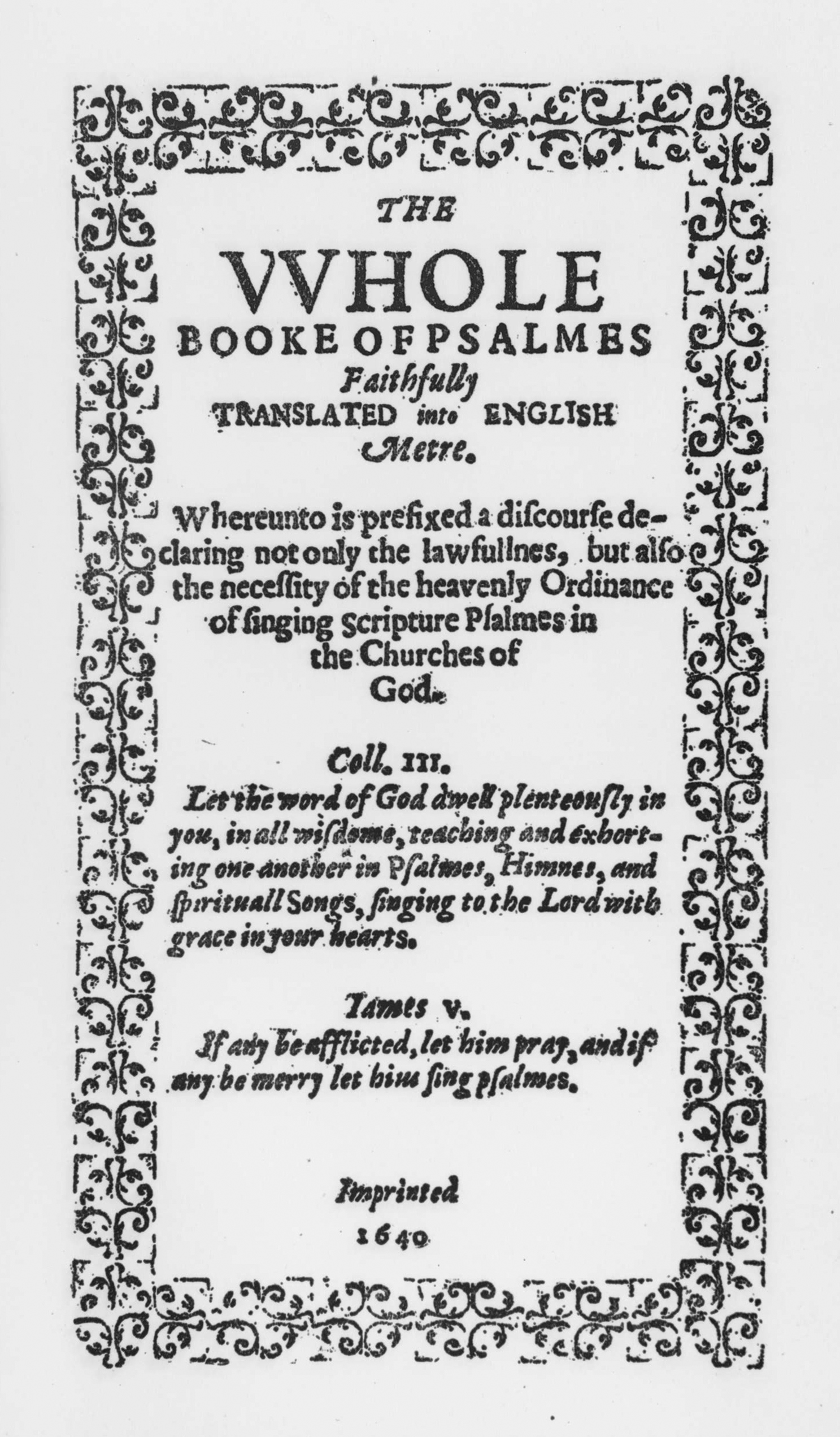
An English interpretation of the Psalms’ poetic structure, the Bay Psalm Book, was printed in 1640, making it the first book printed in the colonies.7 The first Hebrew grammar printed in America was published in 1735 by Judah Monis, a Jewish convert to Christianity and the first full-time instructor of Hebrew at Harvard University.8 Colonial America’s first colleges attached particular importance to Hebrew scholarship. At Harvard University, the nation’s oldest institution of higher learning (founded in 1636), great value was placed on the study of Hebrew as part of the curriculum, and an oration in Hebrew was delivered every year at the annual commencement ceremonies until 1817.9 Samuel Johnson, the first president of what was to become Columbia University, said in 1759 that the study of Hebrew was a “gentlemen’s accomplishment” because Hebrew was “the mother of all languages.”10 Such a declaration was a far cry from the medieval Christian belief that Hebrew was the language of the diabolical, since the Jews themselves were the children of the devil.11
The Bay Psalm Book, translated from Hebrew into English, was the first book printed in the colonies. Courtesy Library of Congress.
The effects of this Hebrew linguistic and literary dispersion on colonial culture were tremendous. Professor Randall Stewart’s assertion, which has become almost axiomatic, is instructive: “The Bible has been the greatest single influence on our [American] literature.”12 But more to the point, it was not the Christian Bible (which emphasizes the New Testament) that formed the foundation of this influence educationally, but the Hebrew scriptures. Carlos Baker, in a brilliant essay entitled “The Place of the Bible in American Fiction,” confirms our observation:
Well into the early national period, when our prose fiction began, the New England mind was saturated with the Old Testament rather than the New. All children were raised on the Bible from the cradle, and writers could assume, as we can no longer do, that the stories of Moses in the bulrushes, or Lot’s wife, or Ruth amid the alien corn, or Abraham’s sacrifice, were known to them as our children know the complex lore of missiles and moon-conquest. Professor [Perry] Miller has observed, “There are hundreds of Edens, Josephs, Elijahs for every rare crucifixion or still more rare recreation of the Manger, while Madonnas, are, of course, non-existent.”13
The Hebraic mood created and promoted by colonial leaders became so well entrenched in American life that one twentieth-century American author would declare that New England itself was also a “holy land.”14 The break with England in 1776 apparently even prompted some revolutionaries to suggest that Hebrew be adopted as the official language of the newborn country.15
Hebraic influence on colonial education, both formal and informal, was tremendous. George Washington, for example, received tutoring that contained liberal doses of Old Testament literature and lore. His half brother, Lawrence, discussed with young George “the hero-prophets” of the Hebrew scriptures. And it is most significant to note that the young future president was taught to look for answers in the Old Testament. On one of the pages of Washington’s schoolboy notebooks, penned in his own distinctive handwriting, is the instruction, “If you can’t find it in the Book of Ezekiel, look in Israel.”16 “Israel” was the group name generally applied in the eighteenth century to the first five books of the Old Testament. One biographer has written that this is proof indeed that young Washington was thinking in biblical terms in those early days.17 I would note additionally that it was the Hebrew testament in which Washington was immersed.
In 1781, while the Revolution was in progress, Ezra Stiles, president of Yale University, delivered his public commencement address in Hebrew. He took for a text Ezra 7:10: “For Ezra had set his heart to seek the law of the Lord, and to do it, and to teach it.” According to Charles Seymour, himself a former president of Yale, Stiles was fluent in Hebrew, which he spoke with a “grace unusual even for those days.”18 When he became president of the university in 1777, Stiles assigned Hebrew study to a prominent place in the college curriculum. Naturally, the best collection of readings for the language class was to be found in the Hebrew Bible. Little wonder, then, that the official seal of Yale University is engraved with the words “urim ve-tumim” (“light and perfection”).
Why the Interest?
Early on, the Puritans thought of themselves as the children of Israel. The Hebrew scriptures were not so important to the colonists because they liked the Jews, but, rather, because several of the colonial founders believed they were a continuation of Israel, that they were Israel restored. Along with seeing themselves as the children of Israel, the Puritans adopted an Exodus motif with regards to themselves. As Perry Miller explained, “They identified themselves and their destiny within the focus of biblical history: King James I was their Pharaoh, America was Canaan, and the Atlantic Ocean was the Red Sea.”19 This motif not only resonated with the early Puritans but would become a central idiom during the Revolutionary era. Thus, many of the colonists and founding leaders of this land centered their lives around this defining episode they called their Exodus and deliverance.
Not only did the colonial founders call America the new Promised Land, but, according to Perry Miller, “They grew to regard themselves as so like the Jews that every anecdote of tribal history seemed like a part of their own recollection.”20 From Benjamin Franklin’s grandfather, Peter Folger of Rhode Island, came a little ditty coined in 1676: “New England they are like the Jews, as like as like can be.”21 Therefore, it was only natural that colonial settlers would regard the Old Testament as a rule of life and the source of instruction in difficult political times. The Hebrew scriptures constituted for them an important guide in most aspects of life—faith as well as political practice. The cornerstone of the “New Jerusalem” which the Puritans yearned to establish in the wilderness of America was the Hebrew Bible.22 These colonists really applied the names they found in the Hebrew scriptures to their own life circumstances. They named their communities after towns mentioned in Hebrew scripture, and they chose Old Testament names for their children. An examination of place names in modern America reveals that half the states contain a Bethel, around twenty states have a Goshen or a Hebron, and there are at present about thirty Jerusalems or its derivative, Salem.23 Other common biblical place names include Sharon, Damascus, Moriah, Jordan, Canaan, Lebanon, and Carmel. On the other hand, the name Nazareth, which seems specifically Christian since it does not appear anywhere in the Old Testament, is not so common in America.24
Thus, the identification with the children of Israel was the fundamental motive behind the particular importance the Puritans placed on the Hebrew scriptures. This sense of chosenness has resonated throughout American history, and the Exodus motif was to become a major motif throughout the American Revolution.
Colonial Politics
The Exodus motif continued its influence on various aspects of American politics. It is nowhere better demonstrated than in Revolutionary-period political commentary. Political satire in the form of biblical parodies became especially popular in New England during the pre-Revolutionary years owing to increasing American dislike of British governmental interference. Bernard Bailyn tells us that no fear, no accusation, no warning was more common among the voices of opposition than those which spoke of tyranny and attempted enslavement on the part of the British government. British actions were viewed as “the attempts of a wicked administration to enslave America.”25 With slavery present throughout the colonies, American reacted strongly to such images. The First Continental Congress, in a letter to the British people, expounded on “the ministerial plan for enslaving us,” and the Second Continental Congress justified its actions by references to “the rapid progress of a tyrannical ministry.”26
Such denouncements had a special resonance in the colonies where people generally were acquainted with the biblical book of Esther. Here they possessed a ready-made model for a wicked, tyrannical, and ministerial conspiracy, attempting to usurp sacred rights and enslave an entire people, namely, the bloodthirsty Haman at the court of Ahasuerus. In 1775, a Newbury, Massachusetts, minister, Oliver Nobel, wrote:
Haman the Premier, and his junto of court favorites,flatterers, and dependents in the royal city, together with governors of provinces, councilors,boards of trade, commissioners and their creatures,officers and collectors of REVENUE, solicitors, assistants, searchers, and inspectors, down to tide-waiters and their scribes, and the good Lord knows whom and how many of them, together with the coachman and servants of the whole . . . Not that I am certain the Persian state had all these officers . . . or that the underofficers of state rode in coaches or chariots . . . But as the Persian monarchy was despotic . . . it is highly probable [they did] . . . Now behold the DECREE obtained! The bloody PLAN ripened! [The] cruel perpetrators of the horrid PLOT and a banditti of ministerial tools through the provinces [had everything in readiness.] But behold! . . . A merciful GOD heard the cries of this oppressed people.27
This was not the first time a British leader had been associated with the Esther story. As early as 1747 Cadwallader Colden, acting governor of New York, had been described as New York’s Haman by an angry patriot, Philip Livingston.28
Colonial propaganda often took the form of biblical imitation to review and criticize specific enactments of the British government. In what has been described as “the most ambitious and nearly successful of half a dozen Biblical imitations which appeared in the Revolutionary period,” The First Book of the American Chronicles of the Times reviewed the six months following the passage of the Port Bill. The American Chronicles was published serially in Philadelphia during the winter of 1774–1775 and according to Bruce Granger “catches the accent of the Old Testament chronicles books, though sometimes the diction has a synthetic ring.”29 However, the American Chronicles is so clever and complete in its characterization that identification of the intended protagonists becomes an engaging exercise.
Bruce Granger summarizes the American Chronicles as follows:
When the men of Boston learned that the great Sanhedrim [British government] had passed “a decree that their harbours be blocked up” and that Rehoboam the king [King George III of England] had sent Thomas the Gageite to enforce it, they “entered into a solemn league and covenant, that they would obey the book of the law, and none other.”
The parody continues as the Israelite tribes (that is, the colonies) “take pity on the Bostonites”:
And they got ready their camels and their asses, their mules and their oxen, and laded them with their meat, their fine wheaten flour, their rice, their corn, their beeves and their sheep, and their figs and their tobacco abundantly, and six thousand shekels of silver, and threescore talents of gold, and sent them, by the hands of the Levites, to their brethren, and there was joy in the land.
Continuing his description of Chronicles, Granger explains,
In letters to Rehoboam, Thomas complains that the Americanites are “giants, men of great stature, and we seemed but as caterpillars in their sight.” Rehoboam [King George III of England] replies, “My Grandfather corrected them with rods, but I will chastise them with scourges.” When Thomas lays siege to Boston, a man of the town declares that they do not mean to sell their birthright ‘for a dish of TEA.’
The American Chronicles ends with Mordecai (Benjamin Franklin) lamenting, “Wo unto the land whose king is a child, whose counsellors are madmen, and whose nobles are tyrants, that devise wicked counsel, for they shall be broken like potters clay.”30 It was reported by the North Carolina Gazette that The First Book of the American Chronicles of the Times sold upwards of three thousand copies in just a few days.31
The New Republic
Cecil Roth has pointed out that the Hebraic conception of the tripartite agreement between God, his people, and their earthly ruler formed the basis of support for constitutional government in England. This was taken over by colonial leaders, and, in turn, “by the fathers of the American Revolution, who were inspired at every turn by the ideas of the Bible.” Professor Roth continues,
The “Pilgrim Code” of Plymouth Colony (1636) and the “Body of Liberties” of Massachusetts (1647) were confessedly based on the Hebrew scriptures, and the leaders of the American Revolution, from Benjamin Franklin downwards, were imbued with Hebrew conceptions.
It was Hebraic mortar . . . that cemented the foundations of the republic.32
Without question, the Exodus motif remained an effective metaphor during the Revolution and was prominent in the minds of its leaders as well as common supporters of the Revolution. On July 5, 1776, the Liberty Bell was rung to signal the Continental Congress’s adoption of the Declaration of Independence. Commissioned in 1751 by the Pennsylvania Provincial Assembly to hang in the new State House (renamed Independence Hall) in Philadelphia, the Liberty Bell was inscribed with the words of Leviticus 25:10: “And proclaim liberty throughout all the land unto all the inhabitants thereof.” It is significant that this potent symbol of the nation’s freedom bore a verse from the Hebrew scriptures and not something from one of the sayings of Jesus or Paul on freedom and liberty. During the Revolution, references to ancient Israel as a symbol of the American colonies were constant, especially in New England. The Boston Gazette, for example, ran a communication in 1782 which began, “My dear countrymen, my sincere wish and prayer to God is, that our Israel may be saved from the rapacious jaws of a tyrant.”33
On the same day that the Declaration of Independence was adopted, Thomas Jefferson, John Adams, and Benjamin Franklin were assigned the task of formulating an official seal for the new nation.34 They and other national founders, including the Reverend Thomas Hooker (who wrote the constitution for Connecticut), believed that a presentation of the Exodus motif would be the most substantive and appropriate image to display on the Great Seal of the new republic, because it symbolized the ideals of the new nation.35 Similar is Franklin’s description of the way he thought it should be portrayed:
Moses standing on the Shore, and extending his Hand over the Sea, thereby causing the same to overwhelm Pharoah who is sitting in an open Chariot, a Crown on his Head and a Sword in his Hand. Rays from a Pillar of Fire in the Clouds, reaching to Moses, to express that he acts by Command of the Deity.
Motto, Rebellion to Tyrants is Obedience to God.36
Jefferson’s proposal was very similar.
Pharaoh sitting in an open chariot, a crown on his head and a sword in his hand passing thro’ the divided waters of the Red sea in pursuit of the Israelites: rays from a pillar of fire in the cloud, expressive of the divine presence and command, reaching to Moses who stands on the shore and, extending his hand over the sea, causes it to overwhelm Pharaoh. Motto. Rebellion to Tyrants is Obedience to god.37
Jefferson’s scheme seems to have derived from Franklin’s, but this was not his only proposal, at least not according to John Adams, who presents us with added insight. In writing to Mrs. Adams on August 14, 1776, Adams reported that for the image of the Great Seal, “Mr. Jefferson proposed the children of Israel in the wilderness, led by a cloud by day and a pillar of fire by night; and on the other side, Hengist and Horsa, the Saxon chiefs from whom we claim the honor of being descended, and whose political principles and form of government we have assumed.”38 According to one writer, Jefferson, who had studied the institutes of Anglo-Saxon government, believed that they were very close to, and an extension of, those principles of representative government practiced by ancient Israel under the leadership of Moses.39
The Old Testament and the Founding Fathers
Benjamin Franklin
Not only does Benjamin Franklin’s proposal for the Great Seal of the United States reflect a significant understanding and application of the Exodus motif as found in the Hebrew scriptures, but several of his other papers and letters also convey a sense of Franklin’s thorough knowledge of the Old Testament and its influence upon him as well as his contemporaries.
One of the more interesting examples is a letter to Samuel Cooper, dated May 15, 1781, wherein Franklin extolled the virtues of a sermon that Cooper had preached to celebrate the inauguration of the new government. Franklin noted:
Nothing could be happier than your Choice of a Text, and your Application of it. It was not necessary in New England, where everybody reads the Bible, and is acquainted with Scripture Phrases, that you should note the Texts from which you took them; but I have observed in England, as well as in France, that Verses and Expressions taken from the sacred Writings, and not known to be such, appear very strange and awkward to some Readers.40
Since the text of Samuel Cooper’s sermon was taken from Jeremiah 30:20–21, “Their Congregation shall be established before me: and their Nobles shall be of themselves, and their Governor shall proceed from the midst of them,” one wonders how accurate Franklin’s comment “everybody . . . is acquainted with Scripture Phrases” would be in our day. However, one also wonders if Franklin was not really telling us that in his day New Englanders knew the biblical references to every passage of scripture that applied to their situation as a new nation in the context of the Exodus motif.
The Exodus motif remained a powerful metaphor for Franklin throughout his life. In a letter to the editor of the Federal Gazette, dated 1788, Franklin unequivocally applied the circumstances of ancient Israel to those of the American colonists. Franklin drew heavily on the Exodus motif for what turns out to be a comparison of the ancient Israelites and the anti-federalists in America.
One would have thought that this Appointment of Men, who had distinguish’d themselves in procuring the Liberty of their Nation, and hazarded their Lives in openly opposing the Will of a powerful Monarch, who would have retain’d that Nation in Slavery, might have been an Appointment acceptable to a grateful People; and that a Constitution framed for them by the Deity himself might, on that Account, have been secure of a universal welcome Reception. Yet there were in every one of the thirteen Tribes some discontented, restless Spirits, who were continually exciting them to reject the propos’d new government, and this from various Motives.
Many still retain’d an Affection for Egypt, the Land of their Nativity; and these, whenever they felt any Inconvenience or Hardship, tho’ the natural and unavoidable Effect of their Change of Situation, exclaim’d against their Leaders as the Authors of their Trouble; and were not only for returning into Egypt, but for stoning their deliverers.41
The parallels between the ancient Israelites and the American colonists are unmistakable: a new nation seeking to secure liberty from a powerful monarch, a new constitution framed with God’s help, and the disaffected of the new nation seeking to return to the land of their nativity and captivity. Franklin concluded his letter by affirming his belief in the divinely inspired nature of the federal Constitution and the influence of Providence upon the General Convention. He could hardly conceive of such a momentous transaction as was undertaken by the Constitutional Convention being left to chance.42
Thomas Jefferson
Jefferson, like John Adams, did not possess a very high regard for sole reliance on the biblical text. As historian Edwin Gaustad explains, if God had spoken literally to humankind at one time, “the vagaries of centuries of translation and transmission had left the contemporary reader of the Bible with imperfect texts, meaningless phrases, corrupted manuscripts.”43 Jefferson’s counsel was to read the Bible as one would read Livy or Tacitus. Those ideas “which contradicted the laws of nature, must be examined with more care, and under a variety of faces.” Jefferson cited the story of Joshua commanding the sun to stand still, as a case in point. As anyone could plainly discern, such an event would be contrary to natural law. Examine all the circumstances, Jefferson advised, and then ask which is more probable: an error in reporting or a violation of nature’s law?44 The surest course was trust in reason, which, in the words of Adams, was “a revelation from its Maker which can never be disputed or doubted.”45 Yet, Jefferson definitely was not an atheist as some have charged—nor was he an agnostic.
For all of Jefferson’s cautions, he was still greatly influenced by the Bible, as his proposal for the Great Seal of the new nation testifies. And with regard to the ideological foundations of the new nation, we find him making more direct references to the Hebrew scriptures than to the New Testament. For him the opening phrases of the Declaration of Independence were neither idle or rhetorical: under “the Laws of Nature and of Nature’s God . . . all men are created equal, . . . they are endowed by their creator with certain unalienable rights.” Thus, Jefferson exulted in the words of Psalm 148—recommending them to John Adams “as an excellent portrayal of Nature’s God”46 (recapitulating the famous phrase he used in the Declaration of Independence):
Praise the Lord! Praise the Lord from the heavens, praise him in the heights! Praise him all his angels, praise him, all his host! Praise him, sun and moon, praise him, all you shining stars! Praise him, you highest heavens, and you waters above the heavens! Let them praise the name of the Lord! For he commanded and they were created. And he established them for ever and ever; He set a law which cannot pass away.
Jefferson was also fond of Psalm 18:9–10 because the words of that passage spoke of Nature, which itself spoke the language of God.
Scholars have devoted considerable time trying to understand where Jefferson got the phrase “pursuit of happiness” that is included in the Declaration (that is, “all men are . . . endowed by their creator with certain unalienable rights . . . Life, Liberty, and the pursuit of Happiness”). Likewise, commensurate effort has been expended in determining what he meant. As Pauline Maier explains, the Hebrew scriptures tremendously influenced colonial thinking on this point: “For Jefferson and his contemporaries, happiness no doubt demanded safety or security, which would have been in keeping with the biblical phrase one colonist after another used to describe the good life—to be at peace under their vine and fig tree with none to make them afraid (Micah 4:4).”47
So even though Jefferson may not have been a biblical literalist, nor did he accept every verse as inspired, he was, without question, deeply influenced by the texts of the Hebrew scriptures. They were, so to speak, “in the air” he breathed. In his second inaugural address, he called for “the favor of that Being in whose hands we are, who led our fathers, as Israel of old, from their native land, and planted them in a country flowing with all the necessaries and comforts of life.”48 In the words of one of Jefferson’s biographers, “Jefferson not only knew his Bible, he also knew when it seemed most appropriate to evoke its imagery.”49 That imagery most relevant to America’s circumstances came in healthy measure from the Hebrew scriptures. In fact, in at least one of his writings, Jefferson seems to distinguish the Old Testament from the New Testament by referring to the first as the Bible, while the New Testament was simply the “Testament.” Both, he said, are part of the common law.50
Other Founders
Others who shared the views of Jefferson and Adams regarding the excellence of reason over revelation also demonstrated their familiarity with the Hebrew scriptures. Ethan Allen of Vermont, who published Reason the Only Oracle of Man in 1784, quoted Job 11:17 when he acknowledged that scripture implied that “none by searching can find out God,” and inferred that even reason could not resolve every issue.51
From among the updated papers of Alexander Hamilton we read his following incomplete comment about the Jewish people:
[The] progress of the Jews . . . from their earliest history to the present time has been & is, intirely [sic] out of the ordinary course of human affairs. Is it not then a fair conclusion that the cause also is an extraordinary one—in other words that it is the effect of some great providential plan? The man who will draw this Conclusion will look for the solution in the Bible. He who will not draw it ought to give us another fair solution.52
Such a reference can only be to the Hebrew scriptures, which presents the destiny of Israel, specifically the Jews, as following a divinely appointed or providential plan. The New Testament, on the other hand, sometimes portrays the Jews in a very unfavorable light—some would even say in diabolical terms (compare John 8:44 where the Jews are called the children of the devil by Jesus).
After the War
After the war was over, the stories and themes of the Hebrew scriptures continued to be used by many as vehicles to inform and teach the public about historical events and political issues. Thomas Jefferson, who made explicit reference to certain passages in the Old Testament, was himself referred to symbolically in the context of those scriptures by others. Medford, Massachusetts, pastor David Osgood employed bitter invective against Jefferson as president. If George Washington was the nation’s King David, said Osgood, Jefferson was the rebellious son Absalom. In 1801 the Reverend Nathanael Emmons preached a fast-day sermon on the radical and regrettable change of leadership in Israel, but of course everyone understood that he meant the United States.53
Timothy Dwight
Perhaps the most impressive presentation of national history cast in the guise of Hebrew narrative events was published in 1785 by Timothy Dwight. Entitled The Conquest of Canaan, this American epic poem, written in eleven books in rhymed pentameters, retells the story of Joshua’s leadership of Israel during their conquest of the promised land. But, in fact, it is a colossal and symbolic account of Washington’s conquest of the British and the establishment of America. Dwight wanted to give the New World an epic poem of their own such as the Iliad was to Greece or the Aeneid to Rome. And though he was a rigid Calvinist, and “a Yankee Christian gentleman,” he chose an episode from the Hebrew scripture as the pattern for his work.54
As the poem opens, the reader understands that Joshua is the hero, “Chief,” and “Leader” of the action, divinely appointed.
THE Chief, whose arm to Israel’s chosen band Gave the fair empire of the promis’d land, Ordain’d by Heaven to hold the sacred sway, Demands my voice and animates the lay.55
The Israelites, in accord with sacred history as outlined in the Book of Joshua, are represented in circumstances of extreme distress. Jabin, the Canaanite king of Hazor, has sent an army to afflict Israel. Hanniel presents a defeatist oration, rehearsing the Israelites’ misery, the impossibility of their success because of the strength, skill, and numerous allies of their enemy’s armies. Even if they are able to conquer Canaan they will be ruined in the process.
Joshua tries to reply that Providence is with them, but is interrupted by Hanniel who openly accuses Joshua of trying to usurp kingly authority. However, Joshua’s rebuttal carries the hour. He points out the misery of their experience under the King of Egypt (that is, King George of England), and declares the certainty of their success, the favor and revealed designs of Heaven, and he exults in the future glory of their own kingdom.
This epic is as full of noble speech and deeds on the one hand, and yet gore and savage battle on the other, as any reader of the Hebrew scriptures could ever want.
Now where the Chief terrific swept the field, And, cloth’d in terror, ranks on ranks repell’d; Whilst a red deluge o’er his footsteps spread, And countless torrents sprouted from the dead.56
Ultimately, Joshua and Israel’s armies are successful. As the poem ends, Israel expresses gratitude to God, the Great Being who gave them both victory and their great mortal leader, Joshua.
The storm retir’d; the ensigns gave command, And round their Leader throng’d the conquering band. . . . While Joshua’s thoughts mount upward to the skies, And fear, and wonder, in his bosom rise.57
It takes no great imagination to see, throughout the poem, the connection between ancient Israel’s situation and the new American nation, which, having just defeated the British, owes it gratitude to God and to General Washington, a leader in the mold of Joshua. In fact, the work is explicitly dedicated to
George Washington, Esquire, Commander in Chief of the American Armies The Savior of his Country, The Supporter of Freedom, And Benefactor of Mankind.58
The Conquest of Canaan is an epic of considerable emotion and power, and made more poignant by an appreciation for the original story in the Hebrew scriptures. It undoubtedly had an impact on contemporary times, as did other symbolic presentations connecting the new nation with events described in the Hebrew Bible. For the first president’s inaugural in 1789, a Hebrew prayer was written in which the name of Washington appears as an acrostic. The prayer invokes God’s blessing on the father of the country as well as the vice president, senators, and representatives of the United States.59
Conclusion
Truly, the Hebrew scriptures influenced American colonial life in so many and profound ways that it is as difficult to take note of them as it is to be cognizant of the air we breathe. Of this period Perry Miller has said, “The remarkable aspect about . . . such daily conversation as we find reliably recorded, is that the Biblical vision out of which these particular examples come was so predominantly, almost exclusively, confined to the Old Testament.”60 This Hebraic influence on the founders and founding of the American Republic is especially keen. Though we may think of the American Revolution as being under the direct influence of rationalists and rationalism, the images, even the language, from the pages of the Hebrew Bible were at least as powerful a force in shaping the new nation as Locke and Paine.
Ironically, in the early decades of the nineteenth century, when Protestant piety was turning away from the Old Testament towards the New (as Jefferson seems to have done in his later life), there was a cultural flowering or efflorescence of Hebraic feeling and imagery in art and popular literature. It came from the political sphere; it continues to infuse our national ethos today. Echoes of the words of Herman Melville, written in 1850, seem to continue to reverberate in the collective unconscious of the American nation, and they seem particularly poignant at this time in our nation’s history. “We Americans are the peculiar, chosen people—the Israel of our time; we bear the ark of the liberties of the world.”61
Notes
1. Cecil Roth, The Jewish Contribution to Civilization (New York: Harper and Brothers, 1940), 16. For a picture of a Hebrew text, see a Sefardi Torah scroll [eighteenth century] in James H. Hutson, Religion and the Founding of the American Republic (Washington D.C.: Library of Congress, 1998), 9.
2. See the partial but extensive list of colonial Hebraists in Robert H. Pfeiffer, “The Teaching of Hebrew in Colonial America,” Jewish Quarterly Review 45 (1955): 365–66.
3. David de Sola Pool, Hebrew Learning among the Puritans of New EnglandPrior to 1700 (Baltimore: n.p., 1911), 32, quoted in William Chomsky, Hebrew: The Eternal Language (Philadelphia: Jewish Publication Society of America, 1975), 249.
4. “William Bradford,” in Dictionary of American Biography, ed. Allen Johnson, 10 vols. (New York: Charles Scribner’s Sons, 1937), 1:562.
5. Perry Miller, “The Garden of Eden and the Deacon’s Meadow,” American Heritage 7 (December 1955), 59.
6. Miller, “Garden of Eden and the Deacon’s Meadow,” 59.
11. Joshua Trachtenberg, The Devil and the Jews (Philadelphia: Jewish Publication Society of America, 1983), 61–63.
12. Randall Stewart, American Literature and Christian Doctrine (Baton Rouge: Louisiana State University Press, 1958), 3.
13. Carlos Baker, “The Place of the Bible in American Fiction,” in Religious Perspectives in American Culture, ed. James Smith Ward and A. Leland Jamison (Princeton: Princeton University Press, 1961), 247, quoting Miller, “Garden of Eden and the Deacon’s Meadow,” 55. Baker adds, “The very probable reason [was] that these [New Testament] images smacked of popery.” Baker, “Place of the Bible in American Fiction,” 247.
14. Howard A. Bridgman, New England in the Life of the World: A Record of Adventure and Achievement (Boston: Pilgrim, 1920), 5.
15. Gabriel Sivan, The Bible and Civilization (Jerusalem: Keter, 1973), 236.
16. William H. Wilbur, The Making of George Washington (Deland, Fla.: Patriotic Education, 1970), 126.
23. Timothy P. Weber, “Mapping the American Zion,” Textures: Hadassah National Jewish Studies Bulletin 13, no. 2 (1995), 3.
24. The place name Nazareth is to be found eight times in countries around the world; four of those are in the United States: Colorado, Kentucky, Pennsylvania, and Texas.
25. Quoted in Bernard Bailyn, The Ideological Origins of the American Revolution (Cambridge: Belnap Press of Harvard University Press, 1967), 126.
27. Quoted in Bailyn, Ideological Origins, 127, emphasis in original.
28. Quoted in Milton Klein, “Prelude to Revolution in New York: Jury Trials and Judicial Tenure,” William and Mary Quarterly, 3d series, 17 (1960), 445.
29. Bruce I. Granger, Political Satire in the American Revolution, 1763–1783 (Ithaca, N.Y.: Cornell University Press, 1960), 70.
30. Granger, Political Satire, 68–69, quoting Samuel Adams, The First Book of the American Chronicles of the Times (Philadelphia: B. Town, 1774–75), 1–70.
32. Roth, Jewish Contribution to Civilization, 15.
33. (Boston) Gazette, May 6, 1782, quoted in Miller, “Garden of Eden and the Deacon’s Meadow,” 58.
34. Richard S. Patterson and Richardson Dougall, The Eagle and the Shield: A History of the Great Seal of the United States (Washington, D.C.: U.S. Government Printing Office, 1978), 6. For Jefferson’s and Franklin’s written proposals for the Great Seal, see Hutson, Religion and the Founding, 50. For an artist’s rendition of the descriptions, see Rebellion to Tyrants Is Obedience to God, drawing by Benson J. Lossing, 1856, in Hutson, Religion and the Founding, 51.
35. W. Cleon Skousen, The Making of America (Washington, D.C.: National Center for Constitutional Studies, 1985), 32.
36. Thomas Jefferson, The Papers of Thomas Jefferson, ed. Julian B. Boyd, 30 vols. to date (Princeton: Princeton University Press, 1950–), 1:494, emphasis in original.
40. Benjamin Franklin, The Writings of Benjamin Franklin, ed. Albert Henry Smyth, 10 vols. (New York: Haskell House, 1970), 8:257 n.
41. Franklin, Writings of Benjamin Franklin, 9:699, emphasis in original.
42. Franklin, Writings of Benjamin Franklin, 9:702–3.
43. Edwin Gaustad, Sworn on the Altar of God: A Religious Biography of Thomas Jefferson (Grand Rapids, Mich.: Eerdmans, 1996), 28. Skepticism over the Bible’s infallibility persisted in American culture as represented by a statement by the founder of The Church of Jesus Christ of Latter-day Saints, Joseph Smith: “Ignorant translators, careless transcribers, or designing and corrupt priests have committed many errors” in the transmission of the biblical text. Joseph Smith Jr., Teachings of the Prophet Joseph Smith, ed. Joseph Fielding Smith (Salt Lake City: Deseret Book, 1970), 327.
44. Thomas Jefferson, The Writings of Thomas Jefferson, ed. Andrew A. Lipscomb, Monticello ed., 20 vols. (Washington: Thomas Jefferson Memorial Association, 1903–4), 6:258–60.
45. Quoted in Gaustad, Sworn on the Altar of God, 29.
50. Jefferson, Writings of Thomas Jefferson, 14:75.
51. Quoted in Gaustad, Sworn on the Altar of God, 29.
52. Alexander Hamilton, The Papers of Alexander Hamilton, ed. Harold C. Syrett, 26 vols. (New York: Columbia University Press, 1961–79), 26:774, emphasis in original.
59. Jacob Kabakoff, “The Use of Hebrew by American Jews During the Colonial Period,” in Hebrew and the Bible in America: The First Two Centuries, ed. Shalom Goldman (Hanover, N.H.: University Press of New England, 1993), 193.
60. Miller, “Garden of Eden and the Deacon’s Meadow,” 55.
61. Quoted in Miller, “Garden of Eden and the Deacon’s Meadow,” 61.