Given Thomas Jefferson’s prominence in the fight to establish religious and political liberty in America, an examination of his personal religious beliefs and how those beliefs relate to his political doctrines is well warranted. This is no small task, however. Jefferson was, to put it simply, a very complicated man and thinker. For good reason, one of the best single-volume biographies of his life is titled American Sphinx.1 Jefferson was especially laconic when the topic turned to his own theological views. As he once wrote in a letter to a correspondent seeking information for a biographical sketch, “Say nothing of my religion. . . . It is known to my god and myself alone.”2 Nevertheless, Jefferson left behind a voluminous collection of personal writings and public papers from which one can tease out the evolving general contours of his religious beliefs and their influence on his politics. Jefferson’s attitudes toward Christianity—at least Christ’s moral teachings—changed over time, and these changes appear to have prompted Jefferson to subtly modify his earlier political philosophy.
Background: John Winthrop and the Puritan Heritage in America
Much of Jefferson’s religious and political philosophies responded, in part, to a Puritan legacy delineated by the thought of an earlier figure in America’s cultural history, John Winthrop. Winthrop, the first governor of Massachusetts, was singled out by Alexis de Tocqueville as a figure of founding importance for America.3 As Tocqueville saw it, the most important cause of America’s singular democratic success was not her fertile land kindly separated from aristocratic Europe or her ingenious constitutional and federal laws but her national character, defined by her ideas and ideals. Of course, the sources for these ideals were as varied as the different geographic regions that made up early America. However, for Tocqueville, the first and most significant influencers of these powerful American mores were the Puritans, among whom John Winthrop stood out above all others.
Perhaps the richest resource of the Puritan legacy comes from Winthrop’s political sermon delivered on the deck of the Arbella, the lead ship of the 1630 Puritan migration. This sermon spelled out his vision of public life in New England and was titled “A Model of Christian Charity.”4 The speech contained five ideals that continue to have a profound impact on American culture and public life.
First, Winthrop taught that the settlement was to be a model society of Christian love, which meant that these New Englanders should care for each other as they cared for themselves, specifically that there should be no poor among them. One of Winthrop’s chief criticisms of England and her Church was that not nearly enough was being done to help the poor.5 Such was not the case in Winthrop’s Boston, where a remarkably efficient system of welfare provided for those who could not provide for themselves.
Second, the colonists must learn to rule themselves. Winthrop himself was a trained lawyer and as governor saw that the fundamentals of the English legal tradition took root in Massachusetts. Both community and church business were conducted by consent. Though it was a hierarchical society by contemporary standards, the Massachusetts Bay Colony practiced an unusually advanced form of democracy. Almost forty years before John Locke published his Second Treatise, this hardy band of Puritans were making their own social contracts, holding regular elections, extending the franchise, and separating legislative and executive powers.
Third, these early New Englanders must be educated. Winthrop taught that to purify their faith and arm themselves against the influence of Anglican clerical powers, the Massachusetts Bay colonists must have highly educated preachers and parishioners. Thus, even in the very earliest and most challenging years of the colony, Winthrop and his fellow Puritan leaders set up Harvard College.
Fourth, they must be a “city on a hill.” Borrowing this image from the book of Matthew, Winthrop taught that the charity they practiced must not just be to members of their own community, but to the rest of mankind. They were to be a people whose positive influence knew no boundaries. The sense that America has a special mission in the larger world is one of the most permanent and powerful ideals passed on by this visionary Puritan to succeeding generations of Americans.
Last, Winthrop taught they must persecute those who jeopardized the community’s standing before God. Of course, Winthrop did not preach this explicitly, but the Puritan tendency to punish severely those who undermined prevailing orthodoxies was built into the very logic of Winthrop’s view of Christian charity. According to Winthrop, charity was not just a matter of loving others but also of loving God. And the Puritans particularly believed that the love between God and man was of “a most strict and peculiar manner.”
The Puritans saw themselves as a special, covenant people, not unlike the children of Israel—an allusion that crops up repeatedly in Winthrop’s sermon. They believed that God loved them above all people, and therefore if they would love him above all other things and manifest their love through a strict and careful obedience to the covenant they established with him, they would prosper like no other plantation in the world. Alternatively, they believed if they stumbled in their collective covenant with God, he would, like a jealous and jilted lover, punish them severely. Specifically, Winthrop warned of shipwreck on the Atlantic crossing or perishing in the wilderness upon arrival. It thus was a matter of life and death to see that every colonist strictly adhered to the communal covenant with God.
The Library of Congress exhibition Religion and the Founding of the American Republic contained an etching of Mary Dyer, a Quaker, being led to her execution in Massachusetts in 1660.6 As the exhibition explained, Mary was killed in part because she was a follower of Anne Hutchinson, a woman who espoused the “evil” doctrine of direct, personal revelation—a powerful threat to the orthodoxy Winthrop and others thought needed to prevail for Puritan survival. Something not seen in the exhibition, but which is almost as horrific as the etching of Dyer’s execution, is an account in Winthrop’s own journal about how, in 1638, he had Mary Dyer’s miscarried fetus disinterred from its grave so its reportedly monstrous deformities could be catalogued and used as evidence of God’s punishment for Dyer’s unorthodox and headstrong beliefs.7
This is the complicated, dual legacy of a figure like John Winthrop, and it underscores the complicated, dual legacy of religion in American political life. On one hand, a number of the religious influences and related social practices that Winthrop was instrumental in planting deeply in American soil provided a powerful foundation for the unique mores and positive national character that enabled America to scale so quickly and successfully the sunlit uplands of modern, republican democracy. On the other hand, Winthrop is also representative of America’s legacy of a severe and awful spirit of religious persecution in the very name of religion.8
The persistence of this spirit of persecution in America was well manifest throughout the Library of Congress exhibition, which concluded with a sketch of the nineteenth-century martyrdom of Joseph Smith.9 Such persecution is utterly tragic, but it is not cause for utter pessimism about our history or our future. The exhibition also showed that between Mary Dyer and Joseph Smith, much happened in America to combat the darker, persecuting side of religion’s influence on American political life.
Thomas Jefferson’s Early Political Philosophy—Secular Liberalism
Thomas Jefferson loathed man’s inhumanity to man in the name of religion. Jefferson’s stance was neatly and symbolically captured in the Library of Congress exhibition: directly underneath the etching of the execution of Mary Dyer sat a first edition copy of Thomas Jefferson’s Notes on the State of Virginia opened to Query 17, where Jefferson laments the long history of religious persecution in this country.10 Arguably, no one has done more to stem this tragic tendency in American political life than Jefferson.
In one of his earliest and most significant political accomplishments, the drafting of the Declaration of Independence, Jefferson steered America away from the Winthropian aspiration to be a “model of Christian charity.” Jefferson began the Declaration by recasting the world in which politics took place. The opening line of Winthrop’s “Model of Christian Charity” situated his constituents’ departure from England in an environment where God’s care and providence operated everywhere and at “all times.” Jefferson’s memorable first seven words, “When in the course of human events,” conveyed that even earth-shattering political movements such as the American Revolution take place as part of a drama more mortal than divine. While Winthrop’s speech endeavored to fully satisfy the demands of a jealous God, Jefferson only aimed to accommodate “a decent respect to the opinions of mankind.”11
But what about those famous lines at the end of the Declaration that appealed to the “supreme judge of the world” and humbly acknowledged “a firm reliance on the protection of divine Providence”? Those passages were not written by Jefferson. They were added by his editors in the Continental Congress. Nor was Jefferson responsible for the famous “endowed by their Creator” line in the second sentence; this came from the drafting committee, which slightly revised Jefferson’s original rough draft before forwarding it to the full Congress.12
Of course, God was not entirely missing from Jefferson’s political cosmology. Jefferson claimed in his rough draft that the “laws of nature and of nature’s god” “entitle” a people to throw off their subordinate status and acquire an “equal and independent station” in the universe of politics. To be entitled to something presupposes the existence of a standard of judgment by which one might ascertain whether one is or is not entitled. In politics, Jefferson’s first sentence argued that such a standard exists: “nature’s god” provides a norm by which key considerations of politics can be judged. While Jefferson sought to liberate America from the extensive demands of the punishing and providential God of Winthrop, he stopped well short of an amoral Machiavellianism, which holds that politics is not subject to any moral requirements higher than getting and keeping power.
Because “nature’s god” of Jefferson’s politics was a barely visible and inactive presence—sustaining a morality by which to judge politics but neither punishing those who offend such a morality or blessing those who follow it—there was no need for Jefferson, or any statesman, to insist on a careful obedience to this god. In just the first sentence of the Declaration, Jefferson did much to relieve the pressure for Americans to persecute one’s religious-minority neighbors to please a far-reaching God who demanded orthodoxy. Some may have found this view of God uninspiring if not blasphemous. For instance, it appears to greatly water down, if not eliminate, the political community’s need to show their love for God and each other through obedience to God’s commandments—a need which is a fundamental component of virtually any traditional understanding of Christian charity (Matt. 22:36–40). Nevertheless, the image of an inactive god did provide a number of salient political features based on what Jefferson believed were the fundamental rules, or self-evident truths, the god of nature sets for politics.
The first truth Jefferson tendered is that “all men are created equal.” By this, Jefferson meant simply that no man has a God-given or natural claim to rule over another. One may possess superior physical, intellectual or spiritual talents—one may in fact be a potential member of what Jefferson hoped would be a “natural aristocracy . . . of virtue and talents”—but one is not, ipso facto, entitled to rule over another.13 In other words, because no natural political authority exists, all men are naturally free to govern themselves.
Jefferson’s claim about natural equality led to a claim about natural rights, namely that all are endowed with certain inalienable rights including life, liberty, and the pursuit of happiness. This troika of rights is tantamount to an inherent freedom from the rule of another. Consider how one scholar has characterized what Jefferson meant by the right to the pursuit of happiness:
When Jefferson spoke of an inalienable right to the pursuit of happiness, he meant that men may act as they choose in their search for ease, comfort, felicity, and grace, either by owning property or not, by accumulating wealth or distributing it, by opting for material success or asceticism, in a word, by determining the path to their own earthly and heavenly salvation as they alone see fit.14
In a letter to Doctor John Manners written toward the end of his life, Jefferson confirmed this interpretation by stating that the same god who put it “in the nature of man to pursue happiness” had also left man “free in the choice of place as well as mode” of that happiness.15
From the first two assertions in the Declaration about equality and rights followed two concrete criteria for judging the moral legitimacy of government. One is that government must “secure” the free and safe exercise of these “inherent” rights, and two, the government that does so must derive its “just powers from the consent of the governed.” The existence of a state of natural equality implies that no natural political authority exists. However, natural equals cannot individually secure, in the face of strong anthropological forces, the rights to which their equality entitles them. They mutually agree on a form of government that will effect the safe exercise of their rights to live their lives as they see fit. By design, this contractually created power will set some limits on the full and free exercise of individual rights, for rights must be limited to some degree in order to protect one person’s rights from the unfettered practice of rights by another. This limitation does not signal a surrender of those rights. It only signals that natural equals have, of their own accord, agreed on a conventional form of authority to identify and enforce conventional limits to those rights.
We are left with a political paradigm often referred to as classical, or philosophical, liberalism (this is to distinguish Jefferson’s form of liberalism from “modern” liberalism associated with today’s welfare state). At the base of this paradigm is a rather bland, thin morality. It is the simple morality of natural rights. It does not ask much of us. We are not commanded to be fully committed practitioners of Christian charity, nor are we allowed to be Machiavelli’s prince. And while this morality is thin, it is broad: it applies to all men everywhere, regardless of a particular religious or nonreligious orientation. This morality gives rise to a certain kind of government. The government, like the morality, is thin but broad in its scope. It creates only a wall of separation between itself and complex private moralities, as well as walls of protection between the private moralities themselves.
The government’s range must extend to encompass the different kinds of private moralities that constitute a republic. The followers of these private moralities are free to reach the heights of Judeo-Christian righteousness or the self-satisfying pursuits of Epicureanism so long as in their quest they do not trouble the rights of those who subscribe to some other competing morality or try to undermine or hijack the foundational public morality.
Many religious believers today may find this broad, thin public morality too secular and insufficient to sustain a stable community of freedom. But consider for a moment what it might have meant to a Mary Dyer or a Joseph Smith had such a public morality widely prevailed in the America they inhabited.
Jefferson’s Changing Views on Christianity
Jefferson’s paradigm should be well regarded for the protections it offers religious believers (especially those outside of mainstream religious beliefs), but at the time of drafting the Declaration, Jefferson was not a promoter of organized religion. Though Jefferson was raised an Anglican, most historians agree that in his teens he experienced something of a “religious crisis.” While more or less continuing a lifelong habit of attending the Anglican church, in the place of his former faith he appears to have adopted “a vaguely defined natural religion” based on reason and moral-sense philosophy.16
Jefferson’s youthful rejection of the traditional Protestant Christianity of his day can be attributed to a budding preference for evidence and reason, as heavily underscored in his “Literary Commonplace Book,” where Jefferson, in his teens and twenties, copied passages from his favorite poets, dramatists, and philosophers. The author Jefferson copied down most extensively is Lord Bolingbroke, an English Tory whose writings have been characterized by one scholar as “a veritable summa of rationalistic criticisms of revealed religion.”17 Jefferson copied, among other things, Bolingbroke’s rejection of the Bible as an inspired text because inspiration cannot be proved by reason and evidence, of miracles as testimony of the divinity of Christ because they are found convincing only in an environment where “ignorance . . . abound[s],” and of the general gospel message as a comprehensive ethical guide because
it is not true that Christ revealed an entire body of ethics, proved to be the law of nature from principles of reason, and reaching all the duties of life. if mankind wanted such [a] code, to which recourse might be had on every occasion, as to an unerring rule in every part of the moral duties, such a code is still wanting; for the gospel is not such a code.18
Not only did Jefferson find Christianity rationally unconvincing, he also saw it as the source of unacceptable tyranny and malice. In 1822, a minister sent Jefferson some pamphlets and asked for his opinion on them. Jefferson wrote in response, “I have never permitted myself to meditate a specified creed. These formulas have been the bane and ruin of the Christian church, its own fatal invention which, thro’ so many ages, made of Christendom a slaughter house, and at this day divides it into Casts of inextinguishable hatred to one another.”19
In an 1819 letter he sent to William Short—who had earlier written to Jefferson that Epicurus was the “wisest of the ancient philosophers” and the ultimate source of instruction for “the attainment of happiness in this poor world”—Jefferson flatly asserts, “I too am an Epicurean.” However, a few lines later, Jefferson concludes, “But the greatest of all the Reformers . . . was Jesus of Nazareth. . . . [From him] we have the outlines of a system of the most sublime morality which has ever fallen from the lips of man. . . . Epictetus and Epicurus give us laws for governing ourselves, Jesus a supplement of the duties and charities we owe to others.”20 This statement appears to virtually invert the Bolingbroke claim that Jefferson copied in his youth.
The intellectual and spiritual journey that led Jefferson to this new position is a well documented, if not often told, story. During the decade before Jefferson’s ascension to the presidency, a series of experiences unquestionably altered Jefferson’s view of the role that Christianity in general, and Christian charity in particular, should play in the public morality of the country over which he was destined to preside.
In December 1789, Jefferson reluctantly accepted George Washington’s request to serve as secretary of state and returned home from France. It was not long before Jefferson locked horns with Washington’s influential secretary of treasury, Alexander Hamilton. Jefferson felt that Hamilton and, later, Adams consistently favored centralized government over local control, manufacturing concerns over agrarian interests, regal pomp over democratic simplicity, and royal England over republican France. Jefferson saw in these choices courtly intentions designed to turn America from its democratic-republican moorings for which he had labored almost all his entire adult life. This split produced a decade-long political battle that would give rise to the United States’ first political parties, the Federalist party of Hamilton and Adams and the Republican party of Jefferson and Madison, and would go down in history as one of the most acrimonious periods of American politics.21
From the start, Jefferson saw Federalist actions as grave threats to the sacred truths of human equality and liberty enshrined in the Declaration.22 However, by the end of the campaign of 1800, the increasingly ugly fight between Federalists and Republicans gave Jefferson pause to consider a different threat to the full realization and perpetuation of the verities of 1776. Undermining successful self-rule was what Jefferson considered a dangerous lack of love among American citizens of different political persuasions.23 One of the very first letters Jefferson wrote after becoming president was to Elbridge Gerry, wherein he stated, “It will be a great blessing to our country if we can once more restore harmony and social love among its citizens. I confess, as to myself, it is almost the first object of my heart, and one to which I would sacrifice everything but principle.”24
Jefferson’s mounting alarm over the political dangers associated with a lack of “social love” in America coincided with a fairly dramatic transformation of his views on Christianity. In the mid-1790s, sometime after resigning from Washington’s cabinet, Jefferson read An History of the Corruptions of Christianity by Joseph Priestly, the English chemist turned Unitarian theologian. In this book, Priestly argued that early church leaders corrupted original Christianity with esoteric and irrational doctrines like the Trinity, original sin, and the Atonement to appeal to intellectual pagans and to exercise control over commoners through mysteries only the church fathers could interpret.25 Priestley’s work cleared away much of what Jefferson found unacceptably mysterious and irrational in Christianity since his young days of reading Bolingbroke.
At roughly the same time that Jefferson’s attitude toward Christianity was being reshaped by the arguments of Priestly, Jefferson was in Philadelphia serving as a bored, marginalized vice-president to Adams. He began visiting regularly with Benjamin Rush, his old friend from the Continental Congress who was prayerfully determined to see Jefferson come to believe in the divinity of Jesus Christ and the importance of Christianity for America’s political well-being.26
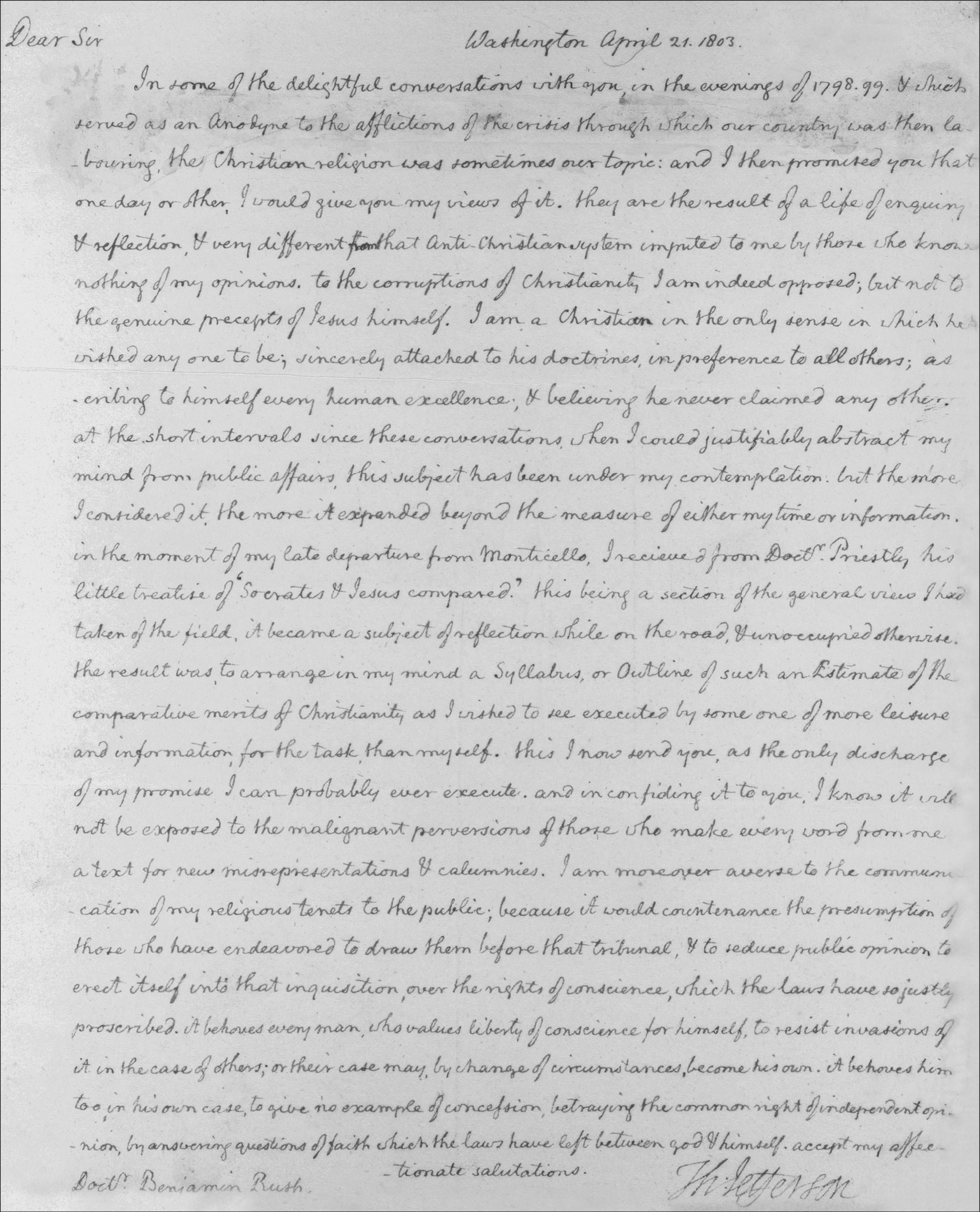
Jefferson never came to share Rush’s millennial vision for America, or accept the divinity of Christ or the seemingly irrational concepts of miracles and atonement. To the end, he remained more of an Enlightenment deist than a traditional Christian believer. However, his conversations with Rush, combined with his readings of Priestly and growing concern over the social animosity that seemed to jeopardize the survival of the republic, appear to have significantly transformed his attitude about the general validity and political importance of Christian morality.27 As Fred Luebke has shown, from 1786 (the year Jefferson secured enactment of his bill establishing religious freedom in Virginia) through the end of the eighteenth century, Jefferson wrote very little on religion. Yet, from January 1800 to August 1801 he “wrote more letters with religious content than during his entire life prior to that time.”28 On April 21, 1803, just two years into his presidency, Jefferson wrote to Rush that, “To the corruptions of Christianity, I am indeed opposed; but not the genuine precepts of Jesus himself. I am a Christian in the only sense in which he wished one to be; sincerely attached to his doctrines, in preference to all others.”29
Thomas Jefferson, letter to Benjamin Rush, April 21, 1803. In this letter, Jefferson expresses his views on Christianity, mentions Joseph Priestly’s influence (line thirteen), and mentions his hesitation of making his religious sentiments known (line twenty-two). Courtesy Library of Congress.
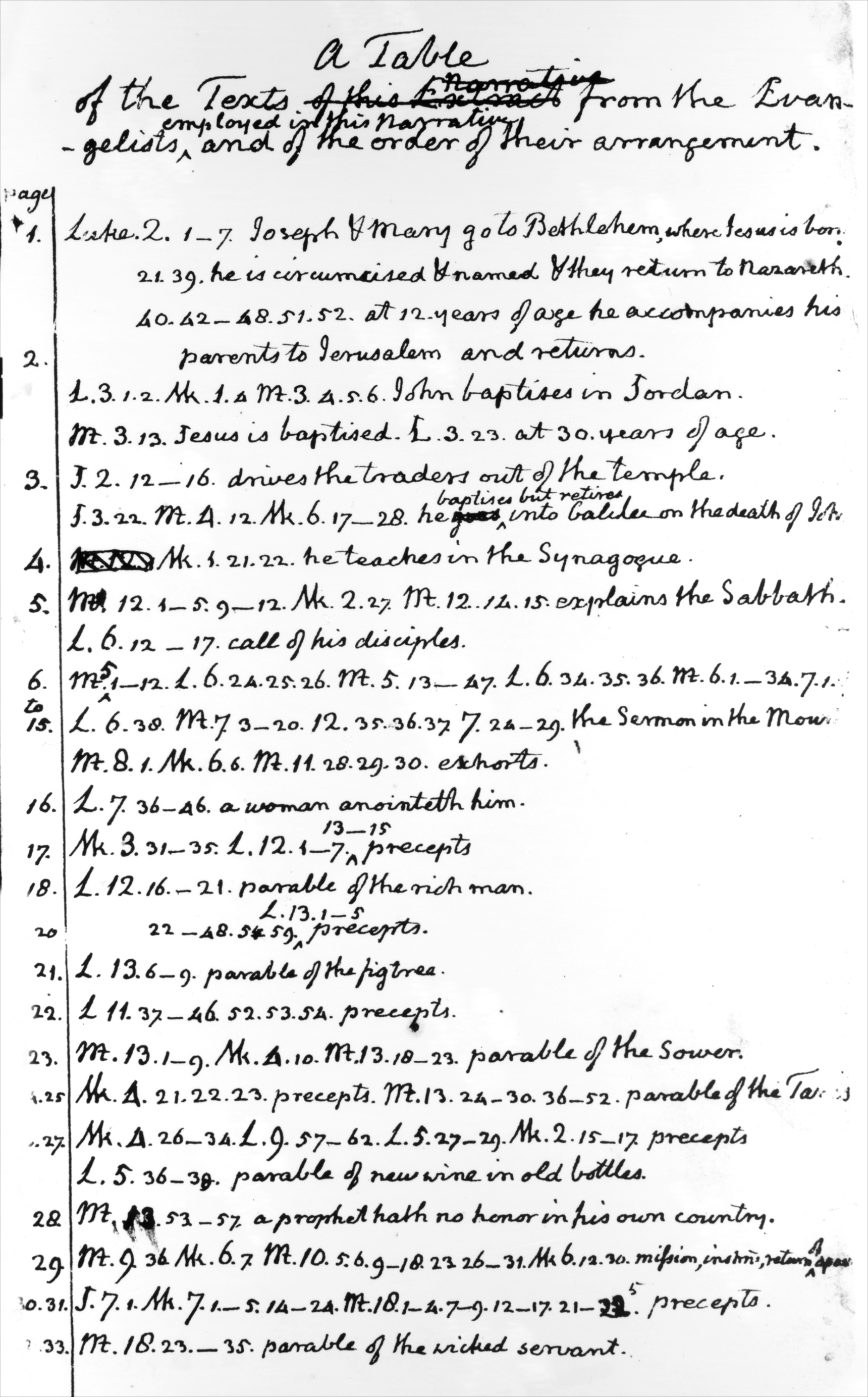
Both the strength and direction of Jefferson’s new views are perhaps best illustrated by the fact that just two years into his presidency Jefferson spent what he later reported was “one or two evenings only, while I lived at Washington, overwhelmed with other business,” cutting out what he believed were the unadulterated teachings of the New Testament and pasting them onto large sheets of folded paper, which he then had bound. He titled the book The Philosophy of Jesus of Nazareth.30 The index of this collection is illuminating. Prominent are the more compassionate, mercy-oriented parables found in Luke, like the “Lost Sheep,” the “Prodigal Son,” and the “Good Samaritan,” which Jefferson specifically characterized, in his table of contents page, as “true benevolence.”31 One also finds the passages from Matthew (chapters 19 and 22) concerning the two great commandments of Christian love, which Jefferson categorized as Jesus’s “general moral precepts.” Jefferson did not include any passages concerning the divinity of Christ’s birth, the miracles of his ministry, or, most notably, the atoning, sacrificial nature of his death. Jefferson included comparatively few passages from the more esoteric book of John.
Influence of Christian Morality on Jefferson’s Later Political Philosophy
The pressing question then is this: how did Jefferson’s altered views on what he called true and charitable “doctrines of Jesus” affect his political philosophy? The timing and importance of Jefferson’s First Inaugural make it an unmatched platform for understanding Jefferson’s revised and most influential thoughts on charity and politics. This speech is significant because, unlike when he wrote the Declaration, Jefferson was speaking only for himself, unconstrained by writing for a committee and larger voting assembly. Additionally, at the delivery of his First Inaugural, Jefferson was a few weeks shy of his fifty-eighth birthday. When he drafted the Declaration, he was only thirty-three years old. The First Inaugural speech was Jefferson, pure and mature. It is also significant that this speech came immediately on the heels of the bruising election of 1800 and right in the heart of Jefferson’s intense reflections on his views of Christian doctrine and belief, as prompted by Priestly and Rush.
Draft of index to Thomas Jefferson, The Life and Morals of Jesus of Nazareth Extracted Textually from the Gospels in Greek, Latin, French, and English (Washington, D.C.: Government Printing Office, 1904). Original at the Smithsonian. Here Jefferson listed some of the passages he considered to be the “real” teachings of Jesus.
Jefferson’s opening paragraph introduced something of a controlling theme for the whole address. Jefferson spoke of “the happiness, and the hopes of this beloved country committed to the issue and the auspices of this day.”32 Peppered throughout the rest of the address were six more references to happiness or synonyms of happiness. From beginning to end, national happiness rang as the leitmotif of the First Inaugural. The speech then went on to connect, at least implicitly, his view of Christian charity (though he never used the terms Christian or charity) as essential to America’s national happiness.
After the introductory paragraph, Jefferson’s first move was to extend a charitable olive leaf of peace to his former Federalist enemies, saying, famously, “Every difference of opinion is not a difference of principle. We have called by different names brethren of the same principle. We are all Republicans, we are all Federalists.”33 John Marshall, one of Jefferson’s most ardent Federalist foes, called the speech “well judged and conciliatory.”34 Benjamin Rush was delighted to discover that in response to the publication of the address in Philadelphia, “Old friends too long separated by party names were reunited.”35
All this had to be gratifying for Jefferson, for such a reaction was his stated objective. Early in the second paragraph, Jefferson said, “Let us, then, fellow citizens, unite with one heart and one mind. Let us restore to social intercourse that harmony and affection without which liberty and even life itself are but dreary things. And let us . . .”36 The full-throated power of this passage was that it rhetorically underscored its substantive message of national unity. Each line began with the phrase “let us,” and this anaphora conveyed a tone of gentle persuasion, demonstrating respect, or care, for the will of all listening. Jefferson did not simply dictate his own will upon the country, but he petitioned for cooperative collaboration in a countrywide effort to be of “one heart.” This passage was more than just a deferential and poetic plea that partisan citizens be kinder and more respectful toward each other. It contains within it a somewhat startling and important addendum to the self-evident truths of the Declaration.
Jefferson explained that without affection, “liberty and even life itself are but dreary things.”37 He linked dreariness,38 a clear antonym of happiness, to the absence of affection, a concept closely related to, if not embodied in or synonymous to, love.39 He used the term dreariness with the terms life and liberty, the other two prominent components of the Declaration’s famous triad of rights. This rhetoric alerted his careful listeners to an insight concerning the Declaration’s “pursuit of happiness” clause: the pursuit of human happiness would be a difficult, if not impossible, task in an atmosphere absent of love practiced as a milder, more humanistic form of Christian charity. Jefferson more explicitly connected human happiness and New Testament–grounded love in later private correspondence, in which he declared that the charitable “doctrines of Jesus” as he understood them “tend all to the happiness of man.”40
Jefferson listed two “blessings” he thought were essential to national happiness. The first was allegiance to “republican principles,” or, to adopt language used earlier, the principles of public morality and natural rights. The second was what he called a benign religion.
Enlightened by a benign religion, professed, indeed, and practiced in various forms, yet all of them inculcating honesty, truth, temperance, gratitude, and the love of man; acknowledging and adoring an overruling Providence, which by all its dispensations proves that it delights in the happiness of man here and his greater happiness hereafter.41
Given Jefferson’s early and sometimes visceral denouncements of religion, both private and public, this statement was remarkable. Jefferson was, for the first time, openly congratulating America for its widespread religiosity, especially because that religiosity generally promoted a “love of man” and adoration of God—two staples of traditional Christian charity. Of course, keeping consistent with his deistic leanings and his firm view that government should not endorse or be governed by specific religions, Jefferson was careful to present religion in the most pluralistic light possible. Thus, he chose the generic term “religion” over a general reference to Christianity. Similarly, Jefferson preferred a vague reference to “Providence” over a more anthropological sounding “God” as the stated object of religious devotion. However, given what Jefferson revealed in his private communications with Rush and Priestly behind the scenes of his ascension to the presidency, it seems reasonable that his reconsideration of Christianity was coloring much of his speech.
Jefferson asked and answered the question “What more is necessary to make us a happy and prosperous people?” Jefferson identified “one thing more” needed to “close the circle of our felicities”: “a wise and frugal Government, which shall restrain men from injuring one another, shall leave them otherwise free to regulate their own pursuits of industry and improvement, and shall not take from the mouth of labor the bread it has earned.” As Jefferson put it, these restraints are the “sum of good government” that round out America’s circle of happiness.42
One should be cautious, however, of assuming from this speech that Jefferson was as extremely libertarian as many claim today. Jefferson’s First Inaugural defense of the night-watchman state must be contextualized. First, the speech clearly reflected Jefferson’s sense of federalism, which held that most governance should be carried on at the state and local levels, basically limiting the federal government to “the defense of the nation, and its foreign and federal relations.”43 And there is clear evidence that Jefferson did see a role for local governments to play in actively caring for the poor.44 Furthermore, Jefferson’s sense was that vast income inequalities did not exist in America to the extent they did in Europe at that time, or in America today.45 One should be wary of presuming that Jefferson would advocate the night-watchman state of his day for the America of our day. Nevertheless, Jefferson’s theoretical point remains clear; the demands of love do not radically alter his overall commitment to a form of classically liberal government.
At first blush, it would seem Jefferson’s revised thoughts on religion produced a theory of government little different than the one strictly coming out of his original public morality of natural rights; government remains, by and large, limited and individualistic, protecting wide swaths of human freedom. But Jefferson’s phrase “the circle of our felicities” suggested a different conceptual framework than first mapped out by the Declaration. Rather than foundations and walls of separation, we now might see private moralities as separate arcs on the same circle, where some of the powers and virtues of private religion feed into and off of a public morality of natural rights ensured by a wise and frugal government unmistakably devoted to protecting individual rights. This is not quite as theoretically tidy as the first conceptual framework of the Declaration of Independence. But when has the practice of politics, especially democratic politics, ever been tidy?
By publicly teaching that the practice of some form of charity is essential to national happiness and helps ensure the stable perpetuation of democratic, rights-protecting government, and by privately teaching that the best resource for an understanding of charity is located in the New Testament, President Jefferson signaled the political importance and legitimacy of a specifically Christian concept of charity as he would not have done in his early career. While the public morality of natural rights would continue to properly limit the statesman from deploying discriminating and coercive legal sanctions to support Christian charity, Jefferson appears to have believed that a wise statesman would readily use the non-coercive, but nonetheless political, powers of his office to carefully advance charity. The more mature framework of Jefferson’s thought, therefore, continues to effectively war against the unfortunate American tendency to persecute religious and other minorities even as it positively harnesses key components of one narrow but complex private morality whose finest expression is found in the teachings of Jesus Christ.
Notes
1. Joseph J. Ellis, American Sphinx: The Character of Thomas Jefferson (New York: Alfred A. Knopf, 1996).
2. Thomas Jefferson to Joseph Delaplaine, December 25, 1816, in Thomas Jefferson, Jefferson’s Extracts from the Gospels: “The Philosophy of Jesus” and “The Life and Morals of Jesus,” ed. Dickinson W. Adams and Ruth W. Lester (Princeton, N.J.: Princeton University Press, 1983), 4.
3. Alexis de Tocqueville, Democracy in America, ed. Harvey Mansfield and Delba Winthrop (Chicago: University of Chicago, 2000), xvii.
4. John Winthrop and others, The Winthrop Papers, 5 vols. (Boston: Massachusetts Historical Society, 1929–47), 2:282–95.
7. John Winthrop, The [Abridged] Journal of John Winthrop, 1630–1649, ed. Richard S. Dunn and Laetitia Yeandle (Cambridge: Belknap Press of Harvard University Press, 1996), 140–42.
8. It is important to qualify here that not all early Christian settlers in America demonstrated the kind of persecuting zeal associated with Winthrop and other Puritan figures. Roger Williams and the Baptists of Rhode Island, and William Penn and the Quakers of Pennsylvania, also exerted strong influences on America’s cultural development and were far more accommodating to those of differing religious persuasions.
9. For the depiction of Joseph Smith’s martyrdom, see Martyrdom of Joseph and Hiram Smith in Carthage Jail, June 27, 1844, in James H. Hutson, Religion and the Founding of the American Republic (Washington, D.C.: Library of Congress, 1998), 110, or see lcweb.loc.gov/exhibits/religion/re107.html.
11. The most authoritative documentation of the Declaration of Independence and its preceding drafts is located in Thomas Jefferson, The Papers of Thomas Jefferson, ed. Julian P. Boyd, 30 vols. to date (Princeton, N.J.: Princeton University Press, 1950–), 2:420.
12. Pauline Maier, American Scripture: Making the Declaration of Independence (New York: Knopf, 1997), 148–49.
13. Thomas Jefferson, Writings, ed. Merrill D. Peterson (New York: Viking Press, 1984), 1305.
14. Ronald Hamowy, “Jefferson and the Scottish Enlightenment: A Critique of Gary Wills’s Inventing America: Jefferson’s Declaration of Independence,” William and Mary Quarterly 36, no. 4 (1979): 519.
15. Thomas Jefferson, The Writings of Thomas Jefferson, ed. Andrew A. Lipscomb, 20 vols. (Washington, D.C.: Thomas Jefferson Memorial Foundation, 1903–4), 15:124.
16. Jefferson, Jefferson’s Extracts from the Gospels, 5.
17. Jefferson, Jefferson’s Extracts from the Gospels, 5–6. For Jefferson’s notations on Bolingbrooke in Jefferson’s “Literary Commonplace Book,” see the Library of Congress online exhibition at lcweb.loc.gov/exhibits/religion/rel02.html.
18. Thomas Jefferson, Jefferson’s Literary Commonplace Book, ed. Douglas L. Wilson (Princeton, N.J.: Princeton University Press, 1989), 25, 33, 35.
19. Jefferson, Jefferson’s Extracts from the Gospels, 404.
20. Jefferson, Jefferson’s Extracts from the Gospels, 390, 388, emphasis added.
21. See John Herbert Aldrich, Why Parties? The Origin and Transformation of Political Parties in America (Chicago: University of Chicago Press, 1995), 68–69. For a political cartoon attacking Jefferson during the 1800 election, see The Providential Detection, 1800, in Hutson, Religion and the Founding, 81, or see lcweb.loc.gov/exhibits/religion/re106–2.html.
25. Jefferson, Jefferson’s Extracts from the Gospels, 14.
26. Donald J. D’Elia, “Jefferson, Rush and the Limits of Philosophical Friendship,” Proceedings of the American Philosophical Society 117, no. 5 (October 25, 1973): 336–37.
27. Jefferson, Jefferson’s Extracts from the Gospels, 19.
28. Fred C. Luebke, “The Origins of Thomas Jefferson’s Anti-Clericalism,” Church History 32, no 3 (1963): 352.
29. Jefferson, Jefferson’s Extracts from the Gospels, 331.
30. Jefferson, Jefferson’s Extract from the Gospels, 27, 369.
31. Jefferson, Jefferson’s Extract from the Gospels, 59.
38. Noah Webster’s 1828 American Dictionary of the English Language defines dreary as meaning “gloomy” and “sorrowful.” Noah Webster’s First Edition of an American Dictionary of the English Language (1828; reprint, San Francisco: Foundation for American Christian Education, 1987).
39. Webster’s 1828 Dictionary defines love as “kindness, benevolence, charity, and . . . the qualities which render social intercourse agreeable.”
40. Jefferson, Jefferson’s Extracts from the Gospels, 405.
44. As Jefferson explains in his Notes on Virginia, “The poor who have neither property, friends, nor strength to labour, are boarded in the houses of good farmers, to whom a stipulated sum is annually paid. To those who are able to help themselves a little, or have friends from whom they derive some succours, inadequate however to their full maintenance, supplementary aids are given, which enable them to live comfortably in their own houses, or in houses of their friends. Vagabonds, without visible property or vocation, are placed in workhouses, where they are well clothed, fed, lodged, and made to labour. Nearly the same method of providing for the poor prevails through all our states; and from Savannah to Portsmouth you will seldom meet a beggar” (Jefferson, Writings, 259).
At the time Jefferson gave this report, Virginia’s care of the poor was being carried out according to a law passed in 1775. This law was revised—largely through the efforts of Thomas Jefferson—in 1785, when the Virginia legislature passed a “Bill for Support of the Poor” designed to render aid and care to the “poor, lame, impotent, blind, and other inhabitants of the county as are not able to maintain themselves.” Jefferson, Papers of Thomas Jefferson, 2:420. The major change between the policies of 1775 and 1785 was that, in keeping with Jefferson’s desire for a stronger separation of church and state, the care for the poor was transferred from Anglican vestrymen to “aldermen” of the county. Manifesting, well after his presidency, an enthusiasm for his early Virginia program of local care of the poor, Jefferson wrote to Adams in 1813, “My proposition had for further object to impart to these wards those portions of self-government for which they were best qualified, confiding to them the care of the poor, their roads, their police . . . in short to have made them little republics.” Jefferson, Writings, 1308.