The Library of Congress exhibition Religion and the Founding of the American Republic was displayed at BYU at the same time that Salt Lake City was hosting the 2002 Winter Olympic games. Media coverage, of course, focused on the games and the ensuing award ceremonies, but far more enduring public trophies of the human spirit were housed in the exhibition. Among those treasures were several key documents and original publications written by the Founding Fathers from Virginia, whose stand on religious freedom indelibly changed the face of law and society in America.
The views and writings of early Virginian leaders such as Thomas Jefferson, James Madison, and George Mason have had a tremendous impact on the subsequent understanding and protections of religious freedom in the United States. Indeed, much of the language and interpretation of the First Amendment to the United States Constitution has been derived over the years from writings of these Virginia Founders. This impact is not surprising, given the importance of Virginia at the time of the founding and the stature of these remarkable men, who were truly Olympians of the spirit. Virginia, the largest and most populous state in the new union, was also one of the states where the Church of England was most fully established, resulting in significant church-state challenges after the American Revolution.1 The debates over establishment of religion brought out Virginia’s best talent and resulted in deeply thoughtful documents and legal solutions that have continued to influence American understandings of freedom of religion. Much truth still remains in what John Adams wrote to Patrick Henry in 1776: “We all look up to Virginia for examples.”2
The most powerful examples from Virginia are a handful of documents that continue to have lasting effect on our understanding of religious freedom, such as the Virginia Declaration of Rights, James Madison’s Memorial and Remonstrance, Jefferson’s Statute on Religious Freedom, and his Danbury letter. For us as specialists in this area of constitutional law, looking over the originals of these documents and other similar ones contained in the Library of Congress exhibition was reminiscent of looking at certain treasured items each of us has in our homes, such as gifts from close friends and family, pictures, or other items linked to important life events. If an outsider came to our homes, they would not see the significance of the items, but members of our households know what these things mean. In the household of our heritage as Americans and as human beings, many of the items in the Library of Congress exhibition are infused with meaning of far greater magnitude. They look like little things, simple books or parchments, but these objects represent some of the greatest achievements and deepest sacrifices of the American people. They lie at the foundations of the society in which we now live. In this article, an outgrowth of the lecture delivered by Professor Durham in connection with the Library of Congress exhibition, we hope to share some insight into the reasons why certain key documents from Virginia are particularly charged with meaning for us as modern Americans and as inheritors of their legacy.
Examining Virginia’s struggle for religious freedom demonstrates just how tenuous the quest for that freedom was in the era of the early republic.3 Even when the First Amendment was ultimately ratified in 1791, the United States Constitution only barred Congress from establishing religion; states were free as a matter of constitutional law to continue the establishment and funding of churches that existed prior to the Revolutionary War.4 Many states felt that an established church was vital to the promotion of public virtue—deemed an essential element of republican government. In fact, several states did continue to support one or a range of established churches until 1833, when Massachusetts became the last state to disestablish its state church.5 While Virginia was not the first state to end the establishment of religion, its decision and the documents arising in the course of developments there have had a unique influence in the history of the United States. This influence ultimately led to the adoption of the First Amendment and eventually to the system of benevolent separation of church and state that has emerged in the years since.
Before we turn our attention to some key documents from Virginia, we would like to mention in passing one non-Virginian work displayed in the exhibition: Roger Williams’s Bloody Tenet of Persecution.6 Roger Williams, one of the great figures in the struggle for religious freedom, was driven out of intolerant Puritan Massachusetts to found Rhode Island, the state with the longest history of protecting religious freedom. Roger Williams and the Bloody Tenet of Persecution stand for a certain heritage that is sometimes missed in the focus on the Virginia Founders. Today we talk glibly of the separation of church and state, but often overlook the fact that this idea has two poles. All too often, the focus is on protecting the state from overly powerful religion, with the result that the importance of protecting religion recedes from view. Roger Williams is the great apostle of the countervailing value that holds that a primary aim of separation is to protect religion from the state. His book, a key contribution to the seventeenth-century debate, is the fountainhead of this vital stream in our constitutional tradition.7 In contrast, the great Virginians—Jefferson, Madison, and others—tend to be associated with the other pole in the tradition of separation, which emphasizes the need for equality and for protecting the state from the excessive power that had too often accrued to organized religion in the history of Europe. Though we will not address Roger Williams in this article further, it is worth noting at the outset that in some ways the quieter, less visible strand of separationism associated with Roger Williams may be the more critical one, particularly in our secular age.
“Free Exercise”: The Virginia Declaration of Rights
A key early document on religious freedom was the Virginia Declaration of Rights, authored primarily by George Mason in June 1776. Article 16, the final article, addresses religious freedom:
Religion, or the duty which we owe to our CREATOR and the manner of discharging it, can be directed only by reason and conviction, not by force or violence; and therefore, all men are equally entitled to the free exercise of religion according to the dictates of conscience; and that it is the mutual duty of all to practice Christian forbearance, love, and charity, toward each other.8
This provision articulates a number of significant points. First, it is a key early source of the language of the Free Exercise Clause of the First Amendment. Another aspect that is less obvious is the somewhat paradoxical phrase “Entitled to the free exercise of religion according to the dictates of conscience.” Freedom and “dictates” are generally considered opposites. However, their placement together is not an accident and it is, in our view, something that is often forgotten about religious freedom. In our time, we tend to think of religious freedom as of one of many liberties that we have, as though religion is like a club one chooses to join. What that idea overlooks is a fundamental aspect of the nature of religion and why religious freedom is so important. This concept varies according to religious tradition, but certainly for most of the traditions we think of in America, religion is more than simply something that one chooses; the voice of conscience dictates and commands. It is at least in part because of that deep compulsion of conscience and respect for the human response to this call that the law protects religious freedom.
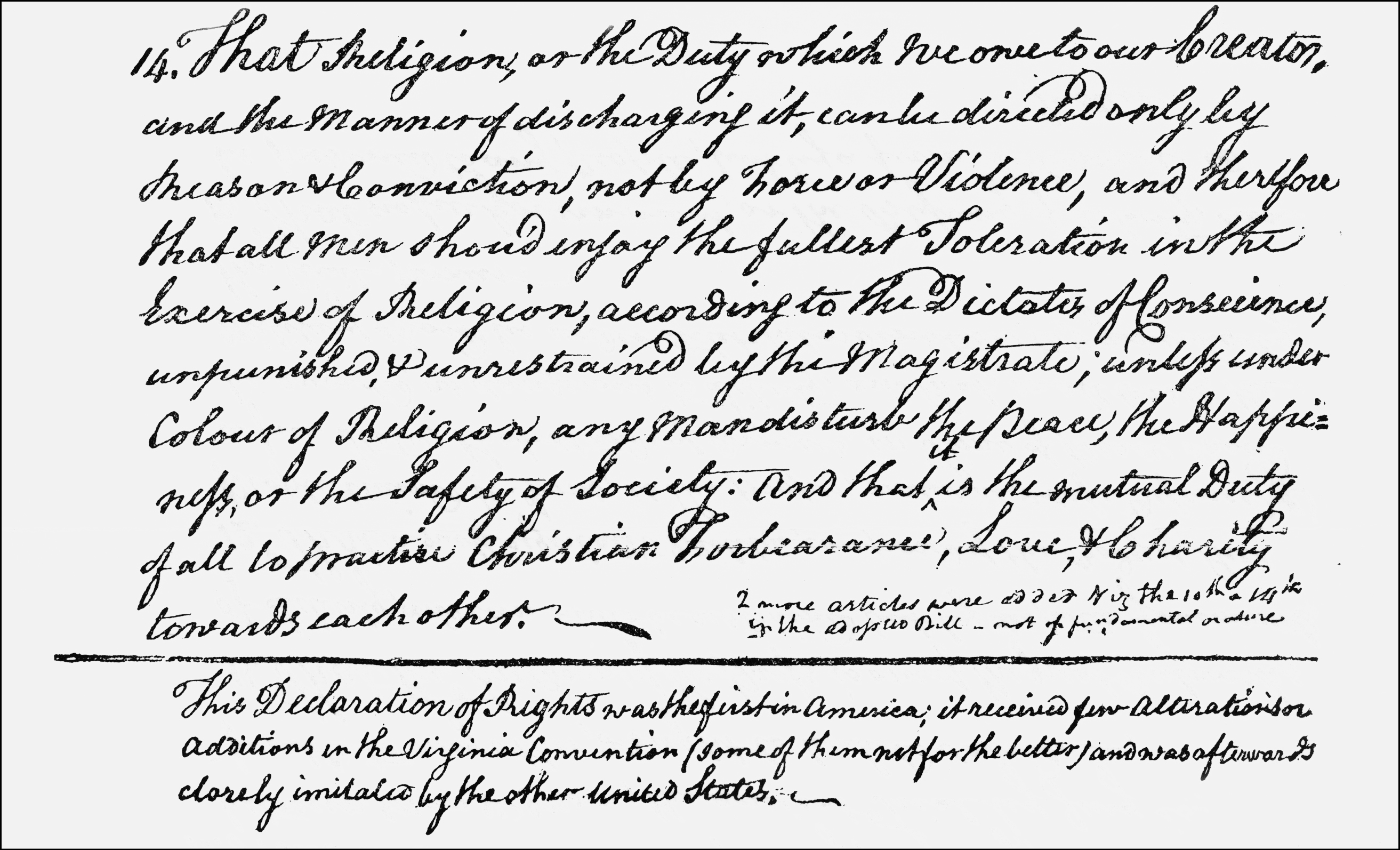
The Virginia Declaration of Rights has significance that goes beyond being the verbal source for the phrase “free exercise.” The clauses originally drafted by Mason read, “All Men shou’d enjoy the fullest Toleration in the Exercise of Religion.”9 The phrase ultimately adopted represented a significant shift from thinking solely in terms of religious toleration to thinking about full free exercise of religion. In the European states that were forward-looking enough to already have some notion of religious toleration, toleration meant that there was an established or dominant religion that would tolerate, or put up with some of these dissenters.10 Significantly, James Madison along with Edmond Pendleton suggested changing the phrase to “all men are equally entitled to the free exercise of religion.”11 This phrase articulated a significant paradigm shift in the way people think of religious liberty. Less obvious, perhaps, but still significant here, is the sense that freedom of belief is a natural right—an idea of great significance for subsequent documents.
George Mason’s draft of his Virginia Declaration of Rights. This draft had two fewer articles than the final one; here article fourteen dealt with religious freedom. From Kate Mason Rowland, The Life of George Mason, 1725–1792 (New York: G. P. Putman’s Sons, 1892).
James Madison also wanted to add the following phrase at the end of the Declaration of Rights: “And therefore that no man or class of men ought, on account of religion to be invested with peculiar emoluments or privileges; nor subjected to any penalties or disabilities.”12 This amendment failed. Already in 1776, Madison was pressing for a view that would suggest a stricter separation of church and state that would cut off the established church and end the pattern of state financial support of the church. But Virginia had not yet come that far. As of 1776 and the adoption of the Virginia Declaration of Rights, freedom of conscience was affirmed, but Virginians were not ready to take on the task of disestablishing the church.
At this time, Thomas Jefferson, ideologically sympathetic to Madison’s position, was doing some fairly extensive studies of the legal background of various statutes relevant to the relationship of church and state. Based on this research, Jefferson campaigned in 1776 for the repeal of all the laws passed during the colonial period that restricted religious freedom.13 As indicated, however, the legislature did not do that. Indeed, the legislature wanted to retain what by today’s standards was as a fairly strict control over religion generally.14
By 1777, Jefferson drafted what was to become the statute on religious liberty, but by that time, the colonists were in the throes of the Revolutionary War.15 Understandably, issues of church and state were pushed to the back seat.
Attempts at Disestablishment: The Memorial and Remonstrance
After the Revolutionary War, the leading revolutionaries were acutely conscious that they were engaged in a radical experiment in nation building. They realized that the success of this venture was anything but a foregone conclusion. There was no real historical experience with the kind of government that was being considered. One of the issues in particular running through the pamphlet literature, the sermons, and the thought of the Revolutionary period was the importance and vulnerability of the republican order.16 The leading political figures were all convinced that for the experiment in democracy to work, there had to be a heavy dose of “public virtue,” which the Founders understood as the willingness to sacrifice private interests in the interest of the common good.17
After the war, however, there was a widespread perception that people started relaxing and returning to their more material pursuits. Religious devotion, assumed to be critical to the cultivation of public virtue, appeared to be declining.18 As a result, the leading thinkers began to worry that there was too much luxury and decadence, that American society was rapidly disintegrating, and that the experiment was at risk. This concern was particularly evident in Virginia. People seemed to be losing interest in religion, working instead on their farms and trying to get gain to be able to buy material things. Religious leaders and those committed to the democratic experience were concerned, particularly since the republic was thought to be at a very vulnerable point.19
In the eyes of many, the weakened status of the traditional Church of England (now the Episcopalian Church) and of other religions constituted an ominous threat to the success of the republican experiment. Clergy salaries had gone unpaid during the war, and the clergy were dependent on subscriptions by local members to pay their bills. The dismal financial state and insecure position of the clergy provided a strong disincentive for candidates for the priesthood.
It was natural in that setting that powerful political leaders such as Patrick Henry should view state financial support for religion as crucial to the success of the republican venture. This was a natural response to questions about how the state could best help religion to flourish and inculcate the civic virtues that the state needed in order to survive. Because religion was thought to be crucial to the survival of the republic, and both religion and the republic were in danger, many citizens sought a way to rehabilitate the forces of religion.
Patrick Henry turned out to be a strong advocate for shoring up support for the established church in his state, and he proposed a general assessment to give financial support to religion in Virginia.20 His bill, eventually titled “Bill Establishing a Provision for Teachers of the Christian Religion,” enjoyed wide support.21 The bill sought to tax Virginians to support churches, but allowed individuals to specify the church to which their tax moneys would go. Those who wished to support no church at all would be able to earmark their funds for their local schools.22 Many petitions began circulating in support of the bill, resting on the need to promote civic virtue and the bill’s evenhanded approach.23
Patrick Henry was an extremely influential politician, and it appeared that as long as Henry was in the Virginia state legislature, he would be able to outflank Madison and the rest of the opposition to his plan for a general assessment. In one of the many small miracles that led to modern American protections of religious freedom, Patrick Henry was elected governor in November 1784.24 Once he became governor, he was no longer a direct participant in legislative leadership, and his influence on the general assessment bill was reduced, with the result that it was never acted upon.25
Having succeeded in delaying action on the general assessment legislation in late 1784, the bill’s opponents started a broad public campaign.26 The most memorable and influential document to come out of that controversy was James Madison’s Memorial and Remonstrance.27 This memorial, or petition, was circulated across Virginia for signature and submission to the Virginia General Assembly.28 Of all the documents on religious freedom drafted by the Virginia Founders, the Memorial and Remonstrance is the most profound. For a short document originally written as a political pamphlet, it constitutes a remarkable collection of arguments that remain current and persuasive to this day. While a full study of the document is worthwhile, we highlight here only a few of its key statements.
The petition begins, “We hold it for a fundamental and undeniable truth, ‘that Religion or the duty which we owe to our Creator and the manner of discharging it, can be directed only by reason and conviction, not by force or violence.’”29 Madison and Jefferson agreed that government could not compel religion. While government can perhaps compel outward observance—the hypocrisy of outward performance—the inner life of the soul cannot be driven.
Madison continued, “This right is in its nature an unalienable right.”30 Drawing on the natural rights tradition, Madison underscored that religious freedom is not merely an accommodation granted by a permissive government. Governments often have a hard time reconciling themselves to that idea. In contemporary terms, this principle is usually expressed by the phrase “human rights”—there are inalienable rights that we have simply because we are human beings. As rights that belong to all humans, these have normative validity, even if they are violated in fact by governments.
“It is unalienable, because the opinions of men, depending only on evidence contemplated in their own minds cannot follow the dictates of other men.”31 The immensely personal and personally compelling nature of religious belief forms the core importance of the right. Ultimately, conscience is something that only one’s own mind can respond to and to which individuals must answer for themselves. Later in the Memorial and Remonstrance, Madison connected this reality with a related insight that civil magistrates have no special capacity to judge rival conceptions of religious truth. The implication that they have such a capacity “is an arrogant pretension falsified by the contradictory opinions of Rulers in all ages, and throughout the world.”32 Attempts to use religion “as an engine of Civil policy” are, in Madison’s words, “an unhallowed perversion of the means of salvation.”33
“It is the duty of every man to render to the Creator such homage and such only, as he believes to be acceptable to him. This duty is precedent both in order of time and in degree of obligation, to the claims of Civil Society.” Here one sees the natural rights and the natural law tradition at work. Madison distinguishes religious freedom from other rights, which are rights among other men, because religious rights arise from duties owed towards their Creator. Religion involves obligations that are “prior to” any social contract and higher than mere social obligations.34 Since all obligations imposed by states are social obligations, those duties are necessarily subordinate to the natural right to freedom of religion.
Madison explained,
Before any man can be considered a member of Civil Society, he must be considered as a subject of the Governor of the Universe: And if a member of Civil Society, who enters into any subordinate Association, must always do it with a reservation of his duty to the General Authority; much more must every man who becomes a member of any particular Civil Society, do it with the saving of his allegiance to the Universal Sovereign. We maintain therefore that in matters of Religion, no mans right is abridged by the institution of Civil Society and that Religion is wholly exempt from its cognizance.35
The central idea expressed here is that, just as associations within a particular society are governed by the laws of that society, the laws of society are subject to the higher order laws of the universal sovereign. In effect, freedom of religion is a kind of “reservation clause” on the “treaty” of the social contract. By its nature, freedom of religion is unalienable, and thus cannot be waived in the process of human beings creating and acceding to fundamental charters of government.
Madison not only makes natural law arguments for religious freedom, but offers pragmatic considerations as well. “Who does not see,” he argues, “that the same authority which can establish Christianity, in exclusion of all other Religions, may establish with the same ease any particular sect of Christians, in exclusion of all other Sects?”36 No denomination is safe when the government is entrusted with the power to determine preferred versions of religion. Madison draws upon a line of thought going back to arguments in Locke’s Letter on Toleration37 to explain that, contrary to the common assumption that endorsing or supporting religion would give added stability to a country, a broad understanding of religious freedom that treats all citizens equally gives greater legitimacy and stability to a nation. Not only does such a nation gain a “lustre to [the] country” by taking in religious refugees, but the “moderation and harmony” gained will increase support for a government, promote health and prosperity, and prevent animosities and jealousies over government preference and support.38
Disestablishment: The Statute on Religious Freedom
Owing in no small part to the influence of the Memorial and Remonstrance, the general assessment bill was defeated. Shortly thereafter, Madison took the occasion to resurrect the bill Jefferson had drafted in 1777 concerning religious freedom. The bill was passed in January 16, 1786. It outlawed any government compulsion to support religious worship or teaching and barred any civil penalties for individuals’ religious opinions or belief. The extensive introductory section of the bill reiterates many of the arguments for religious freedom that Madison raised in the Memorial and Remonstrance.39 The opening is particularly stirring and well known:
WHEREAS Almighty God hath created the mind free; that all attempts to influence it by temporal punishments or burthens, or by civil incapacitations, tend only to beget habits of hypocrisy and meanness, and are a departure from the plan of the Holy author of our religion, who being Lord both of body and mind, yet chose not to propagate it by coercions on either.40
Jefferson continued in the same vein, with such powerful phrases as “our civil rights, have no dependence on our religious opinions, any more than our opinions in physics or geometry.”41 In sum, “All men shall be free to profess, and by argument to maintain, their opinions in matters of religion, and that the same shall in no wise diminish, enlarge, or affect their civil capacities.”42
Although the statute was simple legislation and these protections could thus be repealed by subsequent legislation, the statute, in its final paragraph, gives a powerful statement of the primacy of the rights addressed: “And though we well know that this assembly elected by the people . . . have no power to restrain the acts of succeeding assemblies, constituted with powers equal to our own, . . . yet we are free to declare and do declare, that the rights hereby asserted are the natural rights of mankind.”43
In some ways, Virginia’s 1786 Statute on Religious Freedom comes later than similar developments in other states. In the legislatures of many other colonies, a burst of activity disestablishing official churches had occurred in 1776 and 1777.44 However, calling the Virginia statute a latecomer is misleading because a number of these other constitutions were not necessarily understood to embody the full strength of the Jeffersonian-type commitment to religious freedom. While many would argue that scholars and historians—particularly judicial historians—have overemphasized the Virginia model, there can be no doubt that the Virginia Statute on Religious Freedom was a vital starting point for many of the developments that have shaped American church-state tradition.
Even in its own day, the Virginia law received widespread publicity and enjoyed a good deal of influence. In a letter to Madison in 1786, Jefferson wrote from Paris:
The Virginia act for religious freedom has been received with infinite approbation in Europe and propagated with enthusiasm. I do not mean by the governments, but by the individuals who compose them. It has been translated into French and Italian, has been the best evidence of the falsehood of those reports which stated us to be in anarchy. It is inserted in the new “Encyclopédie,” and is appearing in most of the publications respecting America.45
Separation of church and state as contained in the Virginia bill was part of what Europeans came to understand as quintessentially American. Jefferson added,
In fact, it is comfortable to see the standard of reason at length erected, after so many ages, during which human mind has been held in vassalage by kings, priests and nobles; and it is honorable for us to have produced the first legislature who had the courage to declare, that the reason of man may be trusted with the formation of his own opinions.46
Jefferson’s sense of the importance of the statute transcended the time of its enactment. Jefferson chose to have engraved on his gravestone the three things that he thought were his most important accomplishments. The first, not surprisingly, was the Declaration of Independence. The third was founding the University of Virginia. The second is authoring the Virginia Statute on Religious Freedom. The literal wording is “Here was buried Thomas Jefferson, author of the Declaration of American Independence, of the Statute of Virginia for religious freedom, and the father of the University of Virginia, born April 2nd, 1743.”
“A Wall of Separation”: The Danbury Letter
While Jefferson may have seen the Virginia Statute on Religious Freedom as one of his most significant works, his church-state attitudes tend to be more closely associated with a phrase from a letter he wrote to the Danbury Baptist Association in Connecticut in 1802—“a wall of separation between church and state.”47 The Danbury letter was in fact one of the most famous documents in the Library of Congress exhibition. Building on Jefferson’s support, through Madison, of the First Amendment, the Supreme Court has used this phrase from Jefferson’s later letter as “an authoritative declaration of the scope and effect” of the First Amendment.48 However questionable this interpretative strategy may be from the perspective of those who think experience from other states should be given greater attention, Jefferson’s phrase has come to be closely associated with the First Amendment and with the ideological divide over the degree of government accommodation of religious organizations. Because of the contemporary significance of Jefferson’s metaphorical wall, the Danbury letter has proved to be both tremendously significant and exceedingly controversial.49
Before the Library of Congress originally mounted this exhibition in 1998, it had the FBI Laboratory examine the holograph draft of the letter in order to decipher what Jefferson had blotted out immediately after the phrase “a wall of separation between church and state.”50 The resulting disclosures have led to considerable controversy over what the scratched-out portion can teach us about Jefferson’s thought.
It appears that the inked-out lines referred to Jefferson’s rejection of public days of thanksgiving and public fasts, describing these as “religious exercises” that were taken from the practice of English kings. In the margin, he noted that the “paragraph was omitted on the suggestion that it might give uneasiness to some of our republican friends in the eastern states where the proclamation of thanksgivings etc. by their Executives is an ancient habit & is respected.”51
By itself, this omission and explanation does not seem unduly controversial, given Jefferson’s general thought on the subject of government displays of religious devotion.52 What proved controversial was the interpretation given by James H. Hutson, chief of the Manuscript Division at the Library of Congress, when he announced the FBI’s findings.53 He tried to put the letter in context, arguing that the letter was written to Jefferson’s Federalist opponents to defend his policy of not declaring public days of thanksgiving and fasts.54 The letter, a response to an address from the Danbury Baptist Association, was a typical venue for “dissemination of partisan views.”55 Hutson argued that the inked-out portion shows that Jefferson “expected the American public to conclude that he refused to proclaim thanksgivings and fasts, not because he was irreligious, but because he was an American patriot who would not genuflect at the altar of British monarchy as Federalist leaders had done.”56 Hutson then reasoned that, after eliminating the argument to avoid offending New England Republicans that supported thanksgivings and fasts, Jefferson tried to rebut the contentions that he was an atheist through his public participation in worship services, including those held in the Capitol. This participation began within forty-eight hours after his issuance of the letter and lasted throughout his presidency; Jefferson also made available executive-branch buildings for church services.57 Ultimately, Hutson took the position that Jefferson’s letter and action combine to support an assumption that “in the relationship between religion and government, a distinction could be drawn between active and passive, which government, although it could not take coercive initiatives in the religious sphere, might serve as a passive, impartial venue for voluntary religious activities.”58
Because Jefferson’s theories and “wall of separation” have served as a touchstone for Supreme Court understandings of the First Amendment, Hutson’s reinterpretation of Jefferson’s thought carries enormous potential significance. For example, the extent to which the government can passively support voluntary religious activities has been the subject of several recent Supreme Court cases that permit government aid to flow to religious institutions if it is channeled via voluntary choices.59 Many view these decisions as constituting a significant shift in establishment clause analysis. While some scholars have supported Hutson’s arguments,60 others have challenged him, asserting that the inked-out portions of the Danbury letter add little to what is already known of Jefferson’s views and actions61 and do not alter the core principles Jefferson stood for or the questions that modern courts must decide.62 Most significantly perhaps, Hutson’s work has performed a valuable service in bringing increased attention to the context of the famous “wall” metaphor and Jefferson’s own public religious devotion. Perhaps the wall was intended to have a few doors and windows in it.
Conclusion
We live at a time when the principles of religious freedom enshrined in our founding documents have begun to find their way into a growing body of international documents, such as the Universal Declaration of Human Rights, the International Covenant on Civil and Political Rights, and the European Convention on Human Rights and Fundamental Freedoms, to name a few. While these documents do not use exactly the same wording that Jefferson, Madison, and the other framers used, these historic statements have become increasingly influential in much of the modern world, serving as crucial benchmarks as various countries strive to establish their own constitutional orders.
To us, the reality of this enduring influence has been brought home with particularly telling force as we have had opportunities to take visiting foreign government officials responsible for religious affairs in their countries to see Jefferson’s grave or Jefferson Memorial. These modern leaders clearly understand that they serve roles in their countries that parallel those functions played by Jefferson in ours. They understand the fragility of religious freedom. Conscious of the unstable situations and uncertain futures of their own countries, and acutely aware of the many pressures that chip away at religious liberty, they understand in ways we often forget just how much courage and determination was required to stand for religious freedom in Jefferson’s day, or in any other day. As we see their dedication and come to understand the tremendous challenges they face, we are renewed in our appreciation for the Olympians of every country and for the precious documents in all the households of human heritage that have built the grand edifice of religious freedom.
Notes
1. Thomas E. Buckley, Church and State in Revolutionary Virginia, 1776–1787 (Charlottesville: University Press of Virginia, 1977), 5.
2. John Adams, The Works of John Adams, ed. Charles F. Adams (Boston: Little, Brown, 1850–56) 9:387.
3. See the discussion of fragility in Joseph J. Ellis, Founding Brothers (New York: Knopf, 2000).
4. Modern readers often overlook the obvious wording of the federal establishment clause: “Congress shall make no law respecting an establishment of religion.” At the time of its adoption, this clause was designed both to prevent the federal government from establishing a church and to keep the federal government from interfering with existing church-state arrangements in the states. See Steven D. Smith, Foreordained Failure: The Quest for a Constitutional Principle of Religious Freedom (New York: Oxford University Press, 1995).
5. Leo Pfeffer, Church, State, and Freedom (Boston: Beacon, 1967), 139–49.
6. Roger Williams, The Bloudy Tenent of Persecution, for Cause of Conscience, Discussed, in a Conference between Truth and Peace (n.p.: 1644).
7. For an excellent exposition of Williams’s views, see Mark DeWolf Howe, The Garden and the Wilderness (Chicago: University of Chicago Press, 1965).
8. Virginia Gazette (Williamsburg), June 14, 1776.
9. James Madison, The Papers of James Madison, ed. William T. Hutchinson and William M. E. Rachal, 27 vols. to date (Chicago: University of Chicago Press, 1962–), 1:173. See also Buckley, Church and State in Revolutionary Virginia, 18.
10. See the discussion of this progression in Malcolm Evans, “Historical Introduction to Freedom of Religion and Belief as a Technique for Avoiding Religious Conflict,” in Facilitating Freedom of Religion and Belief: A Deskbook, ed. Tore Lindholm (Leiden: Martinus Nijhoff, 2004 forthcoming).
12. Madison, Papers of James Madison, 1:174. It is interesting that, given their later disagreements on this issue, Madison was able to persuade Patrick Henry to sponsor the amendment. At the time, Patrick Henry denied that the amendment would disestablish the Church of England in Virginia. Buckley, Church and State in Revolutionary Virginia, 18–19.
13. Buckley, Church and State in Revolutionary Virginia, 30–31.
14. At this time, the legislature was still dictating the contents of the liturgy. Buckley, Church and State in Revolutionary Virginia, 21.
15. Thomas Jefferson, The Papers of Thomas Jefferson, ed. Julian B. Boyd, 29 vols. to date (Princeton: Princeton University Press, 1950–), 2:545–47.
16. Buckley, Church and State in Revolutionary Virginia, 72–73.
17. Gordon S. Wood, The Creation of the American Republic, 1776–1787 (Chapel Hill: University of North Carolina Press, 1969), 65–70. See alsoJames H. Hutson, Religion and the Founding of the American Republic (Washington, D.C.: Library of Congress, 1998), 62.
18. Wood, Creation of the American Republic, 428–29.
19. See William Warren Sweet, The Story of Religion in America, 2d ed. (New York: Harper, 1950), 172–204.
20. Edwin S. Gaustad, Neither King nor Prelate: Religion and the New Nation, 1776–1826 (Grand Rapids, Mich.: Wm. B. Eerdmans, 1993), 38–39.
21. For a picture of Henry’s A Bill Establishing a Provision for Teachers of the Christian Religion, see Hutson, Religion and the Founding, 66.
22. Buckley, Church and State in Revolutionary Virginia, 108–9.
23. See William Wirt Henry, Patrick Henry: Life, Correspondence, and Speeches, 3 vols. (New York: Charles Scribner’s Sons, 1891), 2:201–9.
24. Buckley, Church and State in Revolutionary Virginia, 100–101.
27. Madison, Papers of James Madison, 8:295. For a picture of Madison’s draft of A Memorial and Remonstrance, see Hutson, Religion and the Founding, 72.
28. Buckley, Church and State in Revolutionary Virginia, 135–37.
37. John Locke, A Letter concerning Toleration (Indianapolis: Bobbs-Merrill, 1955). See alsoJohn Locke, Two Treatises of Civil Government (London: Dent, 1953).
45. Thomas Jefferson, The Best Letters of Thomas Jefferson, ed. J. G. de Roulhac Hamilton (Boston: Houghton, Mifflin, 1926), 25.
46. Jefferson, Best Letters of Thomas Jefferson, 25.
47. Thomas Jefferson to Messrs. Nehemiah Dodge, Ephraim Robbins, and Stephen S. Nelson, a Committee of the Danbury Baptist Association in the State of Connecticut, Jan. 1, 1802, Thomas Jefferson Papers, Manuscript Division, Library of Congress. For a picture of Jefferson’s “Danbury Baptist letter,” see Hutson, Religion and the Founding, 85.
48. See Daniel L. Dreisbach, Thomas Jefferson and the Wall of Separation between Church and State (New York: New York University Press, 2002).
49. Reynolds v United States, 98 U.S. 145, 164 (1878); see also Committee for Public Education v Nyquist, 413 U.S. 756, 761.
50. James H. Hutson, “Thomas Jefferson’s Letter to the Danbury Baptists: A Controversy Rejoined,” William and Mary Quarterly 56 (October 1999): 776.
52. See Matthew S. Holland, “Thomas Jefferson: Religious Beliefs and Political Doctrines,” in this book.
53. See Forum, William and Mary Quarterly 56 (October 1999): 775–824.
54. Hutson, “Jefferson’s Letter to the Danbury Baptists,” 776–81.
55. Hutson, “Jefferson’s Letter to the Danbury Baptists,” 782.
56. Hutson, “Jefferson’s Letter to the Danbury Baptists,” 783.
57. Hutson, “Jefferson’s Letter to the Danbury Baptists,” 784–86.
58. Hutson, “Jefferson’s Letter to the Danbury Baptists,” 789.
59. See, for example, Zelman v Simmons-Harris, 536 U.S. 639 (2002); Good News Club v Milford Cent. School, 533 U.S. 121 (2001); Mitchell v Helms, 530 U.S. 793 (2000).
60. See Thomas E. Buckley, “Reflections on a Wall,” William and Mary Quarterly 56 (October 1999): 795–800.
61. See Robert M. O’Neil, “The ‘Wall of Separation’ and Thomas Jefferson’s Views on Religious Liberty,” William and Mary Quarterly 56 (October 1999): 793.
62. See Edwin S. Gaustad, “Thomas Jefferson, Danbury Baptists, and ‘Eternal Hostility,’” William and Mary Quarterly 56 (October 1999): 801–4; Isaac Kramnick and R. Laurence Moore, “The Baptists, the Bureau, and the Case of the Missing Lines,” William and Mary Quarterly 56 (October 1999): 817.