William Clayton’s deep affection for his mother-in-law may have suffered a small test on the morning of September 5, 1840. After months of preparing his family, including Thomas and Lydia Moon, for emigration to America, he had taken them to the port of Liverpool and spent the night with them on the ship North America. His plan was to remain behind temporarily to fulfill what he considered his most important mission at the moment: to go to Birmingham to preach the gospel. But suddenly his mother-in-law, overwhelmed with all the “toil and trouble” she saw ahead, began to weep. She wanted Clayton to go with them and made her wishes known not only to her son-in-law but also to Brigham Young and John Taylor. Probably out of respect for her and all she had done for the Church the past three years, the two Apostles consented. Clayton was stunned but, loyal disciple that he was, changed his plans immediately. Three days later he was on his way to America. It was another new beginning, and in this case a mother-in-law’s feelings not only changed a missionary’s career but also may have affected some other important aspects of Mormon history.
It was not that Clayton did not have the emigration impulse—practically every Church member in Britain was caught up in that. America, after all, was designated by revelation as the land of Zion, where modern Israel should gather in the last days. Convinced that calamities would soon overtake their nation, the British Saints were ready recipients of the call to gather “home” with the Saints in Zion. Between 1840 and 1890 over eighty thousand European Mormons migrated to America, about fifty-five thousand of whom were from England alone.1
Though the “gathering” was a fundamental gospel concept almost from the beginning, Church leaders were reluctant to preach it immediately among the European converts. Church authorities first had to establish a solid membership base, firmly committed to the fundamentals of the faith; then they could encourage emigration. When the first missionaries left for England in 1837, Joseph Smith instructed them to “adhere closely to the first principles of the Gospel, and remain silent concerning the gathering, the vision, and the Book of Doctrine and Covenants, until such time as the work was fully established, and it should be clearly made manifest by the Spirit to do otherwise.”2
Following this counsel, the American missionaries did not encourage the gathering, but many British Saints were eager to quit their homeland for the New World anyway. Some, no doubt, were caught up in the general emigration impulse that had taken hold among the working class, but the impulse was also a natural outgrowth of their reverence for the prophet, and their desire to be where he was gathering the central body of the Church. Even before the Apostles arrived on their 1840 mission, many Saints were making their own preparations to emigrate. As a member of the mission presidency, Clayton was disturbed with their lack of respect for counsel. These Saints, he wrote Willard Richards, were “making ready for America without council and in their present state of religion I only feel to say if they should go as soon as they anticipate some of them will wish themselves back again.”3
The problem drew very close to Clayton, for his wife’s cousin, John Moon, was among those pressing for permission to leave. The matter was taken up with the mission president, Joseph Fielding, who soon instructed Clayton and his relatives that he did not feel it was the will of God for any elders or priests to leave without a definite call. At the same time, he did not totally discourage them. Seeming to anticipate what would happen very shortly, he wrote to Willard Richards, “We would if we were in their place, act as if we expected to go the coming summer, but we had no thought of that being the signal for the gathering to begin, nor have we had any instruction to give such a signal and till we do I will not be responsible for any thing that is or may be done about it. If any go they will not say that Brother or President Fielding gave his sanction to it.”4 Fielding was willing to allow the Moons and others to go to America if they would go as regular emigrants, rather than as an organized group of Saints, but he also suggested that premature emigration might be a stratagem of Satan and that the desire to emigrate had led some Saints astray.
In April 1840, things began to change, and at a special conference on the fifteenth the Apostles opened the door for approved emigration. All the Saints who wished to leave with Church approval must receive recommends from Church leaders. At the same time they tried to give all classes equal opportunity by declaring that the wealthy Saints would not receive recommends unless they also assisted the poor.5 Four months later the First Presidency gave its official sanction to the beginning of emigration in a general address to the Saints throughout the world. “The work of the gathering spoken of in the Scriptures will be necessary to bring about the glories of the last dispensation,” the faithful were told. Then, in what the British Saints must have considered a bit of an understatement, Church leaders observed, “It is probably unnecessary to press the subject on the Saints, as we believe the spirit of it is manifest, and its necessity obvious to every considerate mind; and everyone zealous for the promotion of truth and righteousness, is equally so for the gathering of the Saints.”6 The Saints from afar were at last being called to assist in building up the Church in its new gathering place in Nauvoo, Illinois, and in building a new temple.
Some were too eager to wait for official approval, and on June 6, forty-one members, under the leadership of John Moon, sailed for America on the Britannia. On July 22, shortly after their arrival in New York harbor, Moon wrote to William Clayton and described the voyage. Invoking the Book of Mormon statement that America was a “choice land,” reserved in part for the descendants of the ancient prophet Joseph, Moon expressed the typical emotion of an immigrant Saint when he wrote: “I feel myself glad to find my feet upon the land of Joseph after so long and tedious journey.” Then, after describing his first sight of Long Island with its green trees and white houses, he said, “Such a beautiful sight I never saw. I did rejoice to behold the land of Joseph: Yea, I thought, it did pay for all the hardships which I had gone through.”7 Like many Saints to follow, John Moon and company did not consider themselves strangers in a strange land. They were only embarking upon a new career in a home that the Lord had preserved for them. Unfortunately, illness and financial difficulty caught up with the Moons and delayed their progress in that career. Instead of going on to Illinois, they were forced to spend the fall and winter in Pennsylvania, trying to find work and planning to join the Saints in Nauvoo the following spring.8
Clayton, meanwhile, was preparing for his own voyage, though he was not really aware of it at the time. Planning to send his family to America while he remained behind, he went home to Penwortham on July 23, and began winding up his affairs. August 27 was the scheduled date of departure, and there was much to do if the Claytons and Moons were to gather all they could take with them and dispose of everything else before they left. But he also missed his friends in Manchester. A month later he wrote to Brigham Young and Willard Richards: “Oh that I could send all the love I feel to my brethren and the Saints in M.”9
The first few days in Penwortham were spent completing a task he had been assigned earlier: writing a history for Heber C. Kimball.10 Clayton had drawn particularly close to Kimball—a friendship that endured for many years—and in the process, Kimball recognized and took advantage of Clayton’s writing skill. There was good reason. Any comparison of the handwriting, spelling, and general grammatical skills of the two men would demonstrate that Clayton clearly had the advantage. Possibly for this reason, as well as the fact that Kimball was so busy as a Church leader, Clayton drew the task of preparing the Apostle’s history.
It is not precisely clear what particular history Clayton the ghostwriter was preparing, but it was probably the “History of the British Mission,” which was later signed by Kimball, Orson Hyde, and Willard Richards and published in Joseph Smith’s History of the Church.11 This work contained an account of missionary work in England, beginning with Heber C. Kimball’s arrival in 1837, to April 6, 1840. No doubt Clayton was writing it under Kimball’s direction, and changes were probably made before it was published, but evidently the basic draft was completed by Clayton during this time of preparation. This was only a portent of things to come, for soon he would be called upon again not only by Kimball but also by other Church leaders to keep their journals and perform important clerical duties.
There was also much to do to make his family’s emigration arrangements, and Clayton’s activities during the next two months were probably typical of Saints preparing to leave England for new homes on the other side of the Atlantic. On August 18, after deciding what could be taken and what must be left behind, the family had a public sale. “We are now almost empty,”12 Clayton wrote the next day, and they seemed satisfied with their proceeds. At least they were not going penniless to America. The only thing they had trouble selling was John Moon’s bass viol, which he had left with Clayton to dispose of, and Clayton finally had to leave it for John Melling to try to sell.
Then Clayton learned that the sailing date was postponed until September 4, for not all the Saints who wanted to go were quite ready. The spirit of the gathering had caught hold, and Church leaders in England were actively helping to arrange for passage, but it was no easy task to coordinate the activities of two hundred Saints who must sell all the possessions they could not carry, arrange all their personal affairs, and make their way to Liverpool for embarkation. Clayton was relieved at the postponement, he said, “for we had hardly time to settle up our business by the 4 of September.”13
In the meantime, Clayton did more than make sailing preparations. He preached on occasion in Penwortham, noted with gratitude the continuing success of missionary work, and was even the target of an outburst of anti-Mormon sentiment. On the night of Saturday, August 29, some mischief-maker threw a note addressed to Clayton, along with another addressed to a Brother Whitehead, into Whitehead’s shop. The note sarcastically suggested that Clayton and Whitehead preach a sermon from Ecclesiastes 10:1, which reads, “Dead flies cause the ointment of the apothecary to send forth a stinking savour: so doth a little folly him that is in reputation for wisdom and honour.”14 Though the notewriter signed himself a lover of the Mormons, he was clearly not their friend.
The sailing was delayed a second time, but finally, on September 4, Clayton and his family, with a company totaling twenty-six emigrating Saints, took their baggage by train from Preston to Liverpool. At that point they were suddenly confronted with a test of their bargaining abilities that many an emigrant at the bustling port of Liverpool probably failed. Clayton engaged a cart to carry their luggage from the train to the dock, agreeing to pay “1/1½” (1 shilling and 1½ pence). When they arrived at the dock, however, they had what Clayton called a “hard contest.” A new man arrived, professing to be the owner of the cart and demanding 1/6. When Clayton refused to pay the inflated price, the man threatened to call the police and demanded an additional shilling. But Clayton was not to be taken in. “I told him that for his bad behavior I would not give him anything more than the bargain,” he wrote, whereupon the cart owner grumbled for a while longer but finally “took it and went away in a rage.” Several Saints, however, not anticipating such a problem, paid exorbitant prices for their cartage because they did not make firm agreements, as Clayton had done, before they engaged their porters.15
As the day closed, Clayton observed, “All the company was confused and busily arranging their boxes.” The emigrants were not yet organized, but that night all who were there slept aboard ship or, as Clayton said, “We slept in the ship this night or lay awake.” The unfamiliar surroundings, the uncomfortable wooden bunks, and the anticipation of what was to come undoubtedly kept most of them from sleeping much.
The next day, Saturday, September 5, Clayton’s plans took a sudden new direction when his mother-in-law demanded that he go with them, and Church leaders agreed. The blow was twofold: not only would he be kept from his mission in Birmingham, for which some of the Saints had already raised money to help him, but also he might never see Manchester again, and many of his beloved converts there. This was too much, so even though he agreed to go with the emigrants he decided he must make one last visit to his friends. He left for Manchester immediately. When he arrived at 7:30 that evening, the generous Saints who had cared for him in sickness and in health for the past two years had one more chance to help. He was ill when he got there, slept at the Hardman house that night, and continued ill most of the next day. But the Manchester Mormons turned out in numbers to wish him farewell. Many came to the Hardman house to see him; some gave him money or food; Sarah Crooks gave him linen and cut it out for shirts; and Arthur Smith purchased some material for pants and cut out other clothing for him. The next day, Jane Hardman gave him a watch guard and Thomas Miller gave him a new hat. It was an emotional weekend among the Saints at Manchester, and as Clayton said, “Some of them wept much at parting.”
Sarah Crooks was probably one of those who wept. So far as she knew, this was the last time she and William would ever see each other, for she had no immediate plans to emigrate herself. When William arrived at the Hardman home, Sarah and her friend Rebecca Partington were preparing to leave the boardinghouse that night. Something unpleasant was going on between the two, Clayton could tell, and, he wrote, “It almost broke my heart.”
On Monday, Clayton made his way back to Liverpool, where his family and the other Saints were waiting aboard the North America. Still not feeling well, he was even more distressed when he found Willard Richards waiting at the ship. The newest Apostle, it appears, disagreed with the others on the matter of Clayton’s going to America and frankly told him so. “This gave me some trouble,” Clayton wrote, in what was probably a classic understatement of his real feelings. But it was too late to turn back, and that night he joined in making ready for sailing the next day.
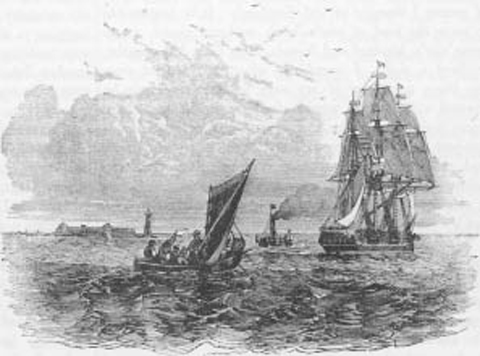
There were 206 Saints aboard the North America when it was towed from Liverpool on the morning of Tuesday, September 8, with Captain Alfred B. Lowber at the helm (illus. 2-1). The Mormons constituted perhaps a little more than half of the passengers.16 This included Brigham Young, Willard Richards, and John Taylor, who came to see the Saints off and went with them about fifteen miles out to sea. At that point the steam-powered tugboat that had accompanied the North America turned back, and the Apostles along with two other Saints returned with it. The great Mormon emigration was fully underway: a few Saints had gone on their own; Moon’s company of forty had arrived in New York; and another company of fifty Scottish Saints would leave a month later. Including Clayton’s company, over three hundred British members arrived in America by the end of 1840. Clayton’s diary provides an intimate view of what was undoubtedly typical of many emigrant crossings of the 1840s.
William Clayton did not clarify how many family members he was responsible for as he sailed from the shores of England, but there were at least seven besides himself: Ruth and their two children, Sarah and Margaret; Ruth’s parents, the elderly Thomas and Lydia Moon; and two of Ruth’s sisters, Margaret and Lydia. In addition, Ruth was about one month pregnant. It is understandable that “old Lydia,” as Clayton sometimes affectionately called his mother-in-law, was so insistent that he come.
One thing that distinguished Mormon emigrant companies from most others was that they were completely organized, with leaders chosen by Church authorities. In the case of Clayton’s group, the organization took place while he was on the way to Manchester on September 5. Elder Theodore Turley, a returning American missionary, was placed in charge, with Clayton and five others named as counselors. Turley was an effective leader, and Clayton supported him thoroughly.
Crossing the Atlantic Ocean in 1840 may have been harder on Clayton than crossing the plains in America seven years later. The first day out seemed to set the pattern. Many of the passengers, including Clayton, had never been to sea and almost immediately became sick. Clayton was so ill, in fact, that when the Apostles had left the group to return on the steamer, he was unable even to send any letters with them. But that was only the beginning. The ship’s mate came down to the steerage class compartment and told the passengers to fasten down all their boxes, for they expected to have a “good rocking.” The “good rocking” came that night in the form of a heavy wind, and Clayton described the effect most vividly. “This was a new scene,” he said. “Such sickness, vomiting, groaning and bad smells I never witnessed before and added to this the closeness of the berths almost suffocated us for want of air.”
Illus. 2-1. Frederick Piercy’s etching of an emigrant ship leaving Liverpool harbor in the 1850s. William Clayton and his extended family likely had a similar experience when they emigrated in 1840. Frederick Piercy, Route from Liverpool to the Great Salt Lake Valley, 1854, L. Tom Perry Special Collections, Harold B. Lee Library, Brigham Young University, Provo, Utah
The gale was so strong that Captain Lowber decided to change course, taking the ship around the north coast of Ireland, but even then they were pounded by wind and water for three more days. The crew tried to reef the sails, but before they finished four sails were blown away. Little wonder that nearly the entire company remained ill the whole time. Clayton was so sick that he was confined to his bed all four days and was not even aware of it when the ship twice came perilously close to a whirlpool. He was told about it later. “We was in great danger,” he wrote with feeling, “but the Lord delivered us.” On Friday night, September 11, one little girl became so frightened that she lost her senses, and on Sunday night, after the storm abated, she died. The next day her body was buried at sea.
This was only the first of several tragedies that suddenly tried anew the faith of Clayton and the emigrating Saints. Many of them continued ill, and at least three children were so seriously sick that the Saints lost hope for their survival. Elder Turley was distressed, for he believed that if they would only exercise enough faith the children would live. On September 18, he called the Saints together, spoke with great feeling on the subject, and asked them to express their feelings. One man replied that he believed the Holmes child would not recover, but Clayton responded sharply that he did not believe it was the will of God that they should lose one soul. Elder Turley agreed. This had a cheering effect upon the Saints, and “the power of darkness was in some degree banished.” They prayed with the children, exhorted them to faith, but that night the Holmes child died. “This was a grief to our minds—but it was so,” wrote Clayton. The next day the body was sewn in canvas by the ship’s crew and unceremoniously thrown overboard. Four more children were buried at sea before the voyage was over.17
Clayton remained ill throughout the entire voyage, and so did his wife and mother-in-law. In addition, there were many problems with which all the Mormons had to deal, not the least of which were the close, uncomfortable quarters in steerage passage. If steerage in the North America was anything like other emigrant ships in the early 1840s, it consisted of one long room, no partitions, and a row of beds on each side. In some cases one berth accommodated five to eight persons, and privacy was nonexistent. One critical observer reported to a Parliamentary committee: “I have known cases of females who have had to sit up all night upon their boxes in the steerage, because they could not think of going into bed with strange men.”18 Sanitation facilities left everything to be desired, with no place to wash and even in some cases no toilet facilities. Laundering, if done at all, was done on the open deck with salt water, for fresh water was strictly rationed. Though a few Saints could afford second cabin, which provided separate compartments, the overwhelming majority in these early years were steerage passengers. In effect, the two hundred Mormons aboard the North America had simply rented the steerage compartment, and this became at once their community home, their chapel, their washroom, and their sickroom for thirty-three days. The filth and the aroma that could accumulate under such conditions were enough to keep Clayton ill, and it was with some relief that he reported on September 19, after the death of a child, that “after the place was cleansed out gas was burned to sweeten the ship air and prevent disease.”
Under such crowded, uncomfortable conditions it is not surprising that even among the Saints some friction occurred. On one occasion, Elder Turley became disgusted with their lack of cleanliness, though perhaps it was not completely the Saints’ own fault. On Monday, September 21, many were still too ill to move, but the steerage was becoming almost too filthy to bear. Turley preached a long sermon on cleanliness, probably reminding his charges that “cleanliness is next to Godliness,” then he went around to inspect the berths. To his disgust he found that some seasick Saints had not even undressed since they came aboard the ship. The filth he found in their clothes and bunks after they had been there for nearly two weeks was sickening and, as Clayton described it, “made the most awful smell when discovered almost too much to bear.” Turley resolutely took it upon himself to drag some of them out of bed, undress and wash them, then order the entire place cleaned out. Little wonder that the sensitive Clayton remained ill nearly the entire voyage.
There were other sources of potential friction in this crowded emigrant ship. Each group or family tried to mark off its own living space by stacking its boxes in agreed-upon places. But with space at an absolute premium, even an inch or so could be precious. On one occasion, Clayton “had words” with a woman and her family who, he believed, had trespassed on his space. “They are but one family and have two boxes out, we are two families and have but one,” he complained. “I desired them to move one about four inches but they would not. She railed a little at me and used some hard words.” Another problem came when some of the company accused Elder Turley of making a profit from the voyage—as much as a shilling a head for each of the Saints. Turley was, to say the least, disgusted with such petty charges but quickly produced all his bills and accounts to satisfy his critics that he had, indeed, used their money properly. He also took occasion to lecture them “for their hardness and unbelief.” But these were only minor incidents, which could occur within any group suddenly thrown together under unusual pressures and conditions. The miracle, perhaps, is that they did not have more frequent and more serious problems with each other.
There were also confrontations with the crew and other passengers. At times the Mormons felt the captain was against them for having so many boxes, and they also had disagreements with the passengers in second cabin. Clayton and others became upset when five young women, three of whom were from Clayton’s branch in Manchester, began associating too freely with the other passengers and members of the crew—even, reported one Saint, drinking wine with them. When Elder Turley asked them to stop, they were distressingly indifferent, telling their leader they could take care of themselves. All this antagonized the ship’s crew who, as Clayton saw it, were angry with the Mormons “because we are unwilling that the sisters should be so familiar with the mates and sailors.” It is understandable that the Mormon elders should try to maintain a sense of community and identity among the Saints, but to the average shiphand of 1840 it seemed to be an unreasonable exclusiveness.
On one serious incident, Clayton and Turley took the side of the crew. The fresh water was disappearing too rapidly, and the crew suspected someone was stealing it. When the captain found Joseph Jackson arguing about it with some passengers in second cabin, he called him aside and asked if he would steal water. Jackson replied that he believed it right for the Mormons to take water, since many were suffering and the deaths of the children were partly caused by lack of water. The captain angrily ordered Jackson back down to steerage and threatened to keep him in chains for the rest of the voyage if he said anything like that again. Jackson became indignant and again told the captain that the Saints were suffering. It may have come to violence had not Clayton reprimanded his fellow Saints and got Jackson to hold his peace. After all, the water was probably being rationed fairly, and Clayton had no wish to demand special treatment for the Mormons.
The captain was not content, now that tempers had flared. Still angry, he told Jackson that it was all right for him to preach his religion as much as he liked, but he should say nothing more than that. Later he asked Turley if he understood the laws of mutiny, to which Turley replied that he did, as well as the laws concerning water. The captain informed Turley that if Jackson said anything more he would have him bound. “Yes, and I will help you,” Turley responded.
Such actions on the part of a few Saints did not make it easy on the rest. Though Clayton was critical of the “peevish selfish actions of some of the second cabin passengers,” he was also aware that the Saints were not totally blameless when frictions arose. “Many things are lost and nobody finds them,” he complained on September 23. “Some are not saints who profess to be.” Nevertheless, Clayton and Turley were determined to make the rest of the voyage as peaceable as possible.
Perhaps Clayton dwelt too much on the imperfections of the Saints, for these numerous irritations and disagreements did not hide the fact that the members of the North America migrating company were indeed trying to be good Saints. They held regular religious services, paid attention to nightly prayers, and were, for the most part, exemplary in their efforts to care for one another. In addition, they did not fail to observe the hand of God in their journey, and Clayton frequently gave thanks for it. One particularly exciting time came about 11:00 a.m. on September 22, when the wood beneath the galley cook stove caught fire and burned through the deck. All morning the Saints had been longing for a wind, for the ship was becalmed, but at this Clayton became thankful that there was no wind for then the fire would have been terrible indeed. As soon as it was put out, a wind came up and the ship was underway again. “The Lord has been kind to us for which we feel thankful,” wrote Clayton, “but not as much as we might.”
On other occasions, Clayton expressed similar gratitude. Even when complaining about the unsaintliness of some who professed to be Saints he said, “But considering our situation all things have passed off pretty well through the blessing of God.” And on October 8, he wrote, “Last evening being my turn for prayer I felt to ask the Lord for a fair wind and I rejoice to see he has answered my prayers. The wind is very favourable near 10 mi. an hour. This is the third instance of the Lord answering my prayer for fair wind in a calm.” There was no doubt in this disciple’s mind that, in spite of their problems, the emigrating Saints were indeed on the Lord’s errand, and the Lord would see that they completed it.
Part of the Lord’s errand was missionary work, and the Saints on the North America would not let that opportunity go by. Well into the night of October 5, for example, Elder Turley talked with the captain and several passengers about the ministrations of the angel Moroni to Joseph Smith. This was a sacred story to the Mormons, but Clayton commented sadly in his journal, “They treat it with disdain—especially the Captain.” Such discussions occurred several times during that month at sea, though no one was converted. But aside from their unsuccessful preaching, and in spite of the problems caused by a few unexemplary Saints, the two hundred Mormons must have left a positive image in the minds of some. When they reached America and were about to leave the North America, Captain Lowber was most friendly. He would like to bring another company of Mormons across the Atlantic, he said, and he even went so far as to ask more questions about their beliefs and inquire where the Saints met in New York City. Elder Turley answered his questions and introduced him to the local branch president. Captain Lowber probably never joined the Church, but at least Clayton’s company finally left him with positive feelings.
Uppermost in the minds of all the Saints on the North America was to get to the new gathering place, their new home. The depth of this feeling could be expressed no better than in the simple statement made by Clayton the day the fire broke out. “As soon as the bustle subsided,” he wrote, “the wind began to blow and we were again on our way home.” At least for this English disciple, “home” was no longer England. It was, rather, a place he had never seen—it was the settlement of Commerce, renamed Nauvoo, where the Lord had told the Saints to gather and where one day a sacred temple would herald the establishment of the Kingdom of God on earth. For William Clayton, “home” was where the Saints were gathered, no matter how new or strange the place.
As these Saints sailed homeward to Zion, it was only natural that they should want their own songs to express in their own peculiar way what they were doing. So it was that Clayton composed his first Mormon hymn—or at least the first one we have a record of. Though some would not call “Gentle Gale” a masterpiece, its verses clearly captured the longing for Zion that filled the hearts of the Saints on the North America:
1 With darkness long we’ve been o’erwhelm’d, Upon proud Britains land; But now the Lord has call’d us forth By his Almighty hand.
Chorus: Across the sea, we cheerfully go, Our kindred Saints to see, Blow gentle gale, fill every sail; And waft us over the sea.
2 God sent his servants from afar, This joyful news to tell; That we might all be saved from sin, And in his presence dwell. Across the sea, &c.
3 They told us that the Lord designed, Poor Zion to restore; And gather all her sons from far, That she might weep no more. Across the sea, &c.
4 Soon as the message we obeyed, And realized its power; To cross the mighty flood we then Were longing every hour. Across the sea, &c.
5 At length the time began to dawn, That we must hast away; And gather up for Zion too, To wait the perfect day. Across the sea, &c.
6 Sectarians breathed out their scorn, And said we soon should rue; But trusting to the word of God, We bade them all adieu. Across the sea, &c.
7 We gave our friends the parting hand, And relatives most dear; They poured their blessing on our heads, And drop’d the parting tear. Across the sea, &c.
8 But soon we hope to meet again With those we’ve loved before, And dwell with them on Zion’s land In peace forever more.
And now across the sea we go, Our kindred Saints to see; Blow gentle gale, fill every sail, And waft us over the sea.19
On October 7, the excited immigrants caught their first glimpse of America—Cape Cod. The next few days were frantic as the crew busily cleaned the ship and everyone made ready to arrive at New York harbor. On October 10, they had their first view of Long Island.
The next morning, Sunday, the North America was anchored between Ellis Island and Governor’s Island, probably about a mile from the southern tip of Manhattan. An American doctor came aboard and, after examining them, pronounced the Saints fit to enter their new homeland. The ship then sailed farther into New York Harbor, and at exactly ten minutes after twelve Clayton, Turley, and Joseph Jackson set foot on American soil. Clayton was elated. The “superior neatness and tastely state of the buildings” impressed him, as did the large red apples they were able to buy for a cent apiece. The three went to the home of a Church member for dinner, then to church services in Military Hall (probably the old U.S. arsenal), along with several other immigrants. Curiously, one of the first peculiarities Clayton noticed about the Americans at the service was “all the men and wome. . . . sitting cross legged and all the left leg over the right.” He was not too tired to be observant.
The immigrants had taken thirty-three days to cross the ocean, and it would take them another forty-four to travel to western Illinois. They were eager to get underway. The next two nights were spent aboard the North America while Elder Turley made arrangements for a river steamer, the Congress, to take them up the Hudson River as far as the Erie Canal. On October 13, the Saints took their leave of the ship and that night they slept aboard the Congress. With obvious pleasure at his sudden change of circumstances, Clayton noted in his diary, “I slept in best cabin.”
Always a keen observer, the new immigrant was intensely interested in the sights and sounds of New York City and its surroundings. What a contrast from Penwortham, Manchester, and other cities he had known in England. “I felt struck,” he said, “to see the horses and carts even to see the light harnesses and small carts and light loads drawn by them. The drivers all ride. The fruit is quite delicious to English people.” As they left New York behind on October 14, he was impressed with the “white and very neat” buildings and with the “several spires towering towards the sky [which] bore a majestic appearance.” When he awoke the next morning they were nearly a hundred miles up the Hudson, near the village of Catskill, and again Clayton was struck by the “beautiful white houses and banks on the river’s side.” He described the grainfields, pumpkin patches, farms, still more homes, and, he said, “in some places we saw fruit on the trees.” For a young couple who had spent their lives in the industrial cities of England and had probably spent little if any time in the countryside, the pastoral scenes along the Hudson were something to marvel at. That night they stopped at Troy, where they would make ready for the trip along the Erie Canal.
Completed in 1825, the famous Erie Canal connected the Hudson River with Lake Erie, thus providing an all-water route from New York City to the rapidly developing western states in the Ohio Valley. It traversed the broad, beautiful valley of the Mohawk and the passenger and freighting trade it carried soon made New York City the leading metropolis in America. It was the most convenient route west, and as Clayton and his companions boarded their horse-drawn canal boats they were only doing the same thing as tens of thousands of westering migrants both before and after them.
They engaged three boats, though at prices they all thought exorbitant, and at 3:45 in the afternoon of October 16, were on their way to Buffalo. Again Clayton was delighted with the scenery—the livestock, an aqueduct that he described as a “stupendous work,” and the beautiful towns they passed. He was astounded at the engineering of the canal and described it in a letter to his friends in Penwortham. “The canal is upwards of 360 miles long,” he wrote, “and is raised by a great number of locks. At the town of Lockport there are five locks together which raises the canal 60 feet. This is a stupendous work. After these locks the canal has been cut through a rock of solid stone upwards of a mile.”20
The trip in the canal boat was fairly leisurely—calm water, no noise or pollution from a steam engine, and time to stop and gather fruit or buy groceries at shops along the way. Fresh milk, the immigrants happily discovered, could be purchased for four cents a quart. In addition, the owner of Clayton’s boat was a religious man, so on Sunday the boat stopped and some of the Saints held their own prayer services. Some also took advantage of the time to do something they had not been able to do since leaving England: wash their clothes in fresh water.
The trip along the canal, though generally calm, was not entirely without incident. On October 20, it rained as they were passing Utica, and one of the horses slipped into the canal, nearly drowning. Such accidents were not uncommon, for Clayton heard that a little earlier a horse drawing another boat had actually drowned.
Clayton and Turley were on the last boat, the Silver Arrow, so on October 22, they took a faster packet to catch up with the others at Buffalo and make arrangements for the next part of the trip. The next day, they reached Buffalo and met the other two boats. The passengers on the J. D. Hawks reported that three more children had died since the group separated. It was better aboard the second boat, the Chawtauqua, though provisions were running low. It was another two days before the Silver Arrow arrived.
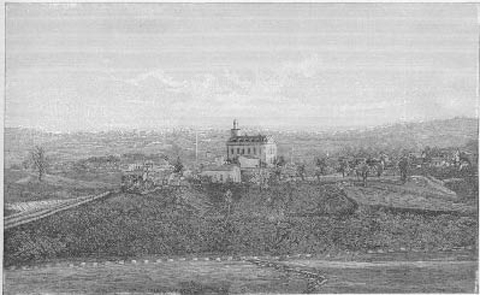
Turley and Clayton, meanwhile, made arrangements for passage on a lake steamer, the Wisconsin, which would take them to the village of Chicago. The cost was $10 apiece, and at this point Turley began to worry about the poorest among his charges. He had been told that passage could be secured for half that price, and now he was afraid some would have to remain in Buffalo. They could not afford the rest of the journey at that price. Turley was “much cast down,” Clayton said, at the thought of leaving them, and “almost heartbroke.” But miraculously, Hiram Kellog, presiding elder at Kirtland, Ohio, showed up. He and Turley were old friends, and when Turley told him of the problem he immediately volunteered to take the whole company to Kirtland, where they would be more comfortable during the winter than in the rustic pioneer settlement of Commerce. They decided that all who wanted to, and could raise the money, would go on to Commerce, but the rest would go to Kirtland. There, in the shadow of the first Latter-day Saint temple, they would spend the winter (illus. 2-2).21
The next day, Sunday, the Silver Arrow arrived in Buffalo. On Monday another disappointment came when it was discovered that the captain of the Wisconsin had changed his plans and was not going to Chicago. Those who planned to go on scurried to make other arrangements and finally booked passage on the Illinois. Three days later, October 20, they said farewell to the families remaining behind and were again on their way “home.” The Saints who remained appeared cheerful, but Clayton saw the disappointment in their eyes and felt their sadness in his own heart. “Some was inclined almost to wish they had not left England rather than be left short of Commerce,” he wrote. “We felt considerable at parting,” he later reported, but he added, “yet we knew that all was well. We have since seen that it was right, they went to Kirtland.”22
The water trip to Chicago took the immigrants the length of Lake Erie, past Detroit, up Lake Huron, past Mackinaw Island, and down Lake Michigan. They arrived at Chicago on November 4 and immediately rented teams and wagons to take them overland to the Rock River. The company became separated, there were several of the usual disagreements, and Clayton rented a house at Dixon, Illinois, for a dollar a day until Turley and other stragglers could catch up.
A glimpse of some aspects of frontier life is seen in Clayton’s description of what happened in and around Dixon. There was no fireplace in the empty rented house, so they cooked outdoors. All the way between Chicago and Dixon, the settlers continually urged the young women in the company to remain behind—suggesting a shortage of women in these western settlements—and at Dixon the residents wanted the entire company to settle down with them. In the empty house, Clayton and his companions had nothing to sleep on, so they made their beds on the wooden boxes that held all their belongings. Often, said Clayton, “the sides of a box made our bones ache, but,” he assured his friends still in England, “the more we suffered the more cheerful we appeared.”23
At Dixon the group purchased a boat for $75, and within a few days had it fixed up. On November 15, they loaded themselves and all their boxes and pushed out into the Rock River. From there on they depended on the current to float them downstream to the city of the Saints. They spent eleven days on the water, but each evening they pulled into shore because the islands and the logs in the river made it treacherous at night.
The weather was becoming very cold, for it was late in the season, but the little company remained cheerful. On November 20, they went through the rapids that separated the Rock River from the mighty Mississippi. They were only about 130 miles from their destination, and Clayton said that simply entering the Mississippi “caused us to rejoice much.” The next night, Saturday, they camped on the bank of the huge river and held a meeting. Elder Turley was deeply concerned, now that their journey was almost complete, that they have no ill feelings toward each other. It was a moving spiritual experience for all of them. Turley asked those who had quarreled to forgive each other, and many Saints acknowledged their faults before the group and asked forgiveness. Then, as often happened in early Mormon meetings, some of them began to speak in tongues, and William Poole interpreted. “It was a time of rejoicing,” Clayton recorded, as the Saints anticipated their arrival home.
Illus. 2-2. A rendition of the Kirtland Temple published in the Illustrated American in December 1890. Clayton and other immigrants were eager to visit the town formerly occupied by the Saints. L. Tom Perry Special Collections, Harold B. Lee Library, Brigham Young University, Provo, Utah
Sunday night the group was at Burlington, Iowa, about thirty-five miles above the Mormon settlement, and in anticipation of their arrival the next day they bathed and changed their clothes. But the next day they only made it to within nine miles before they had to stop for the night. Tuesday, November 24, was the great day for Clayton. He seemingly could not wait to get there, for he and a few others decided to walk the nine miles to Commerce. They arrived at noon, and the first people they met were some Saints from Manchester who had arrived a week earlier. A committee had been formed to find accommodations for the new arrivals, and as soon as the boat arrived Clayton and his family took their luggage to a new but very small house on the banks of the Mississippi. At that point, Clayton summarized in his journal the joy and relief that all the Saints must have felt as they arrived in the long-sought promised land, as well as their feeling that this strange and unfamiliar land was, indeed, their home.
Thus ended a journey of over 5000 miles having been exactly 11 weeks and about 10 hours between leaving Liverpool and arriving at our journeys end. We had been much exposed to cold weather and suffered many deprivations and disconveniences yet through the mercy of God we landed safe and in good health with the exception of 8 persons one of whom died soon after landing. We were pleased to find ourselves once more at home and felt to praise God for his goodness.24
The first night in the city of the Saints was spent at the home of Henry Moore, sleeping on the floor. The next day, Clayton and his family together with three other families—fourteen people in all—moved into the house they had been temporarily assigned to. They made their beds of hay on the floor and were so cramped for space that they had to move their beds each morning. Under these crowded conditions, William Clayton began to carve out a new life for himself among the gathered Saints in Nauvoo.
Clayton’s emigration from his homeland would not be complete until he reported to his friends in England. He knew they would be both curious and anxious about many things, and on November 29, only five days after his arrival in Commerce, he wrote a lengthy report to Penwortham. On December 10, he wrote his friends in Manchester. The letters were similar in tone, but each contained different details and the Saints in each town were instructed to transmit their letter to members in the other. The excitement of arriving at a new home; the busy and difficult process of getting settled; the thoughts of a disciple on the journey just passed; and the advice of a now experienced emigrant to his friends back home—all were graphically portrayed in these two letters, which provided a fitting climax to the story of William Clayton’s emigration.25
Clayton waxed eloquent in portraying the hardships of the journey, and his attitude toward hardship—that tribulation could only in the long run do him good—would be a keystone of his discipleship throughout his life. Living on new and different kinds of foods, alternately suffocating with heat aboard ship or freezing with cold, sleeping on boards and boxes, sleeping outdoors in severe weather: all this and more he detailed to his friends back home. “I once could not have believed that it was possible for me to endure the toils I have endured,” he wrote to Manchester, “but to the praise of God be it spoken, all I have endured has never hurt or discouraged me, but done me good.” So good, in fact, were the difficulties that he assured his eager readers that “we have been far more healthy and cheerful than when at home. . . . The Lord has preserved us from sicknes. . . . and we are now at our journeys end far more healthy and looking better than when we left England. I can assure you brethren and sisters that if you will be faithful you have nothing to fear from the journey.” For his friends in Penwortham he told a story that would add emphasis to his point. As they had passed the rapids separating the Rock River from the Mississippi, some got out and walked, including Clayton’s mother-in-law, “old Lydia” Moon, and her husband. The Penwortham Saints knew the Moons well and could therefore appreciate the fact that, “something like a young woman,” Lydia picked up Clayton’s daughter Sarah, who was “very fat and heavy” and started off at a quick pace. “I was considerably amused at this,” he wrote, “but went to her relief. I mention this to show that the journey had done the old folks no harm.”26
Should the Penwortham and Manchester Saints come to the New World? Clayton could have no other answer than an emphatic “yes!”—no matter what the trials. “The journey lies before you,” he wrote to Penwortham, “and although it is impossible for pen to describe to you the difficulties you will have to endure you must come or suffer the vengeance of heaven as for my part I will say that if I were in England now and had experienced all the journey it would not in the least deter me from coming.” He gave the Manchester Mormons both encouragement and realistic caution: “Stand firm by the truth like men and women, and be not afraid to come to this land, but don’t for a moment suppose that all will be peace & ease when you get here. These are days of tribulations and we must endure our portion.”
Clayton had also been confirmed in the hard lesson that tribulation would not always come from the outside, for even within the faith there were imperfections that must be dealt with. The immigrant company was mixed, he told the Saints in Penwortham, coming from various parts of the country and having different experiences in the Church. “Some have been fed a little on strong food, others but newly baptized,” he said, and all this together “has increased our troubles.” In such company, he realistically observed, “You may naturally suppose many things would occur to try all parties. . . . We have not yet suffered sufficient to make us all of one mind and wherever you go you may expect fine men as men and not as angels, and man is naturally prone to evil as the sparks fly upwards.” Such philosophical resignation to the reality of continuing differences among the Saints was another keystone of this British immigrant’s faith, and one that he would often be reminded of throughout his life. Even in Nauvoo, he warned the Manchester Mormons, the Saints were not all perfect, but that was only to be expected. “There are some who are not good Saints and some very good ones. Joseph says, that when he is out preaching he always tells the people not to come here for examples, but to set them and to copy from the Savior who is our pattern. It is not until corn is gathered into the barn that thrashing and sorting commences.”
What kind of country would the future immigrants be coming to, and what about the city of the Saints? Clayton’s description of western Illinois was almost idyllic. The land, he told both groups, was “exceeding rich” and beautiful, with plenty of food in great variety. Peaches, citrus fruit, pumpkins, squash, and potatoes were all readily available, and he told them what prices they could expect to pay for sugar, honey, molasses, flour, cornmeal, and beef. The city, too, was full of promise. “Commerce, or rather Nauvoo,” he reported to Manchester, “is a large city. The houses are built of wood and each house has an acre of land attached [sic] to it. There is space left for streets apparently from 10 to 15 yards wide. There are houses belonging to the saints for several miles round.”27
All this philosophy and advice was interesting, but the Saints in Manchester and Penwortham probably found just as great, if not more, interest in the more pragmatic part of his letter to Penwortham. What should an emigrant take with him as he left England? Clayton’s experienced advice no doubt reflected some stern realities of the emigration process in the 1840s, as well as something about life on the Western frontier.
First, he told them, bring clothing from England, for it was “coarse and dear” in America. He advised the women to obtain either linen or cotton “trousers” and flannel petticoats, and the men to get a suit of cotton cloth. So far as footwear was concerned, he discouraged strong shoes with nails, and observed that all the men wore boots, which could be obtained in New York for sixteen shillings. “I have only seen 2 or 3 pair of shoes except Englishmen had them.”
With regard to luggage, his advice was highly practical. He recognized that more luggage would mean more toil, but in the long run it would be worth the effort. The cost to carry it all to Nauvoo would be so much less than the cost of replacing what they left behind that it would be foolish not to bring everything possible. “We brought considerable of pots and I am glad we did for they will pay for carriage. They are scarce in this region.” Their pots (apparently earthenware) had carried well, for they were packed in hay. Tools were of special importance, and Clayton was sorry he did not bring a set of joiner’s tools. He also told the Saints to save all their working clothes (a most pragmatic suggestion for life on the frontier), but then added, almost as if he suddenly wondered if all his cautions would discourage some Saints, “But neither let clothes nor goods detain you from coming.”
How to pack, of course, was of special interest. In Clayton’s day, an emigrant’s main problem was how to pack as much as he could, regardless of weight, into as many homemade wooden boxes as he had space for. “You must make your boxes very strong,” he warned the Saints, “say inch boards well put together.” They should be of such a size that if needed, three would make into a bed, and he suggested four feet long, two and a half feet wide, and two feet deep.
The Saints in England would also want to know firsthand about Joseph the Prophet. By then Clayton had met him, heard him speak, and formed his own impressions. “If I were in England,” he reported in the Manchester letter, “I would raise my voice and testify that Joseph is a man of God, which will roll forth unto the end of the earth and gather together all the good there is on the earth.” From that point on, the life of the English immigrant would be inextricably woven with that of the Prophet, and the influence would be profound.
Notes
1. P. A. M. Taylor, Expectations Westward: The Mormons and the Emigration of Their British Converts in the Nineteenth Century (Edinburgh: Oliver and Boyd, 1965), 144.
2.History of the Church, 2:492. It is not clear whether the vision referred to was Joseph Smith’s First Vision, which occurred in spring 1820, or the remarkable vision of the “three degrees of glory,” which was given to Joseph Smith and Sidney Rigdon in 1832 and now stands as section 76 of the Doctrine and Covenants. In the early years of the Church, Joseph Smith did not circulate his account of the 1820 vision very widely, and it was not included in any Church publications or missionary literature prior to 1840. That year the first printed account of the vision appeared in England, in a tract by Orson Pratt entitled An Interesting Account of Several Remarkable Visions and of the Late Discovery of Ancient American Records. On the other hand, the 1832 vision contained some very advanced doctrines, and asking the missionaries to avoid discussing it would be consistent with Joseph Smith’s instructions that they stick to preaching the “first principles.” In addition, the fact that he did not want them even to discuss the Doctrine and Covenants on this first mission to England also strongly suggests that he had the 1832 vision in mind.
3. Clayton to Willard Richards, January 30, 1840, Willard Richards Collection.
4. Joseph Fielding to Willard Richards, March 25, 1840, Willard Richards Collection.
7. Clayton to Brigham Young and Willard Richards, August 19, 1840, Brigham Young Papers. The major portion of this letter consists of Clayton’s copy of a letter he had received from John Moon, dated New York, July 22, 1840.
8. Clayton to Edward Martin, November 29, 1840, in Heart Throbs of the West, 5 (Salt Lake City: Daughters of the Utah Pioneers, 1944), 373–80; Clayton to “Beloved Brothers and Sisters,” December 10, 1840. The Manchester letter is actually in the writing of William Hardman who, according to the note he penned at the end, received it from Clayton with instructions to copy it and send the copy to the Saints at Penwortham and Preston. Hardman noted to these Saints, “And from several pages in this letter I am led to infer that there is a letter at Preston or Penwortham which we are to see, if so, and you have got it, I can assure you we shall feel extremely grateful if you will favour the Saints in Manchester with a copy of it. May the Lord bless you all with unity and love and save you into his celestial kingdom is the prayer of your brother in the New & Everlasting Covenant. Wm. Hardman.”
9. Clayton to Young and Richards, August 19, 1840.
10. Allen and Alexander, eds., Manchester Mormons, 168.
11.History of the Church, 4:313–21. Another early account of Heber C. Kimball’s mission is Thompson, Heber C. Kimball. Clayton may have had a hand in this volume also.
12. Clayton to Young and Richards, August 19, 1840.
13. Allen and Alexander, eds., Manchester Mormons, 168.
14. Allen and Alexander, eds., Manchester Mormons, 169.
15. Allen and Alexander, eds., Manchester Mormons, 170–71. Most of what follows respecting Clayton’s voyage to America and arrival at Nauvoo is based on his diary account in Manchester Mormons.
16. The information about sailing around the north coast of Ireland is in Rose Marie Hart Clayton, “History of Ruth Moon,” typescript, Wanda Clayton Papers, University of Utah. P. A. M. Taylor suggests that an emigrant ship of 1840 would carry three or four hundred passengers (see Expectations Westward, 176–79). Taylor provides some interesting material on the nature of such emigrant voyages. Another excellent and much more detailed treatment is David H. Pratt and Paul F. Smart, “Life on Board a Mormon Emigrant Ship,” in the Proceedings of the World Conference on Records (Salt Lake City), August 12–15, 1980, series 418 on file in the library of the Genealogical Society of The Church of Jesus Christ of Latter-day Saints. For some details on the North America and her sister ships of the Black Ball line, see Conway B. Sonne, Saints on the Seas: A Maritime History of Mormon Migration, 1830–1890 (Salt Lake City: University of Utah Press, 1983), 49, 52, 69–70, 148–59. Clayton wrote the captain’s name as “Lower,” but Sonne lists it as “Lowber.”
17. These included Mormon Harris, son of Paul and Jane Harris; the child of Elizabeth and William Poole; the child of a Brother and Sister Corbridge; and the child of a Brother Perry. P. A. M. Taylor has sampled records of Mormon transatlantic crossings, and from these it appears that Clayton’s voyage was not unlike the others. Bad weather, broken masts, and shortages of food plagued many of them. Most of the emigrants, being poor, traveled in steerage as did Clayton and his party. This meant cramped quarters, sickness, lack of privacy, and sometimes death. The British Passenger Acts, when they were enforced, seem later to have improved the problem of privacy (Taylor, Expectations Westward, 176–207).
18. Quoted in Taylor, Expectations Westward, 178–79.
21. Kirtland, Ohio, was the first Latter-day Saint gathering place after Joseph Smith and his followers left the state of New York in early 1831. There were many sacred memories for Church members in Kirtland. Here the “law of consecration” had first been introduced, and in 1836 the Kirtland Temple was completed. The temple was the first building for public worship to be erected by the Saints, but it was also the place where special religious ordinances were introduced (foreshadowing the endowment ceremony introduced at Nauvoo), and where on one occasion the Savior and certain ancient prophets had visited and instructed Joseph Smith and Oliver Cowdery. It was small wonder that Clayton also longed to see Kirtland. As his group was traveling on Lake Erie, they stopped at Fairport to take on wood, and Clayton later reported to his friends, “We were then only about eleven miles from Kirtland. I had a great desire to go and see the house of the Lord, but could not” (Clayton to Martin, November 29, 1840). The most recent and most complete treatment of the Kirtland era is Milton V. Backman Jr., The Heavens Resound: A History of the Latter-day Saints in Ohio, 1830–1838 (Salt Lake City: Deseret Book, 1983).
24. Allen and Alexander, eds., Manchester Mormons, 201.
25. Clayton to Martin, November 29, 1840, Clayton to the Saints at Manchester, December 10, 1840. The quotations in the following description all come from these two letters.
26. Clayton to Martin, November 29, 1840. Clayton says more about their good health in this letter, which is worth quoting. He was clearly trying to persuade his friends in Penwortham that hardships could not hurt them.
Old Thomas has not had one day bad health since we left England, except a little seasickness. Margaret Moon has grown so very fat that all her best dresses are very much too little, she has only one that she can wear the others she cannot get on. Yesterday I had to take my pen knife and cut her new shift sleeves (which her sister made) open for they had made her arms almost black. She is indeed a fat lump and has to keep going from house to house when she had time to sing for the saints. A hymn which I composed on the ship has to be sung almost every time she goes out. Brother William Poole is at work for a farmer about 10 miles from here. He is grown so fat that all his clothes are too little. His wife also is very healthy, fat and cheerful. She seems to be well and has lost her rheumatism. My wife and children are well at present. My youngest child has been poorly with her health. We are all about as merry as we dare be and would be glad to see you all here too.
27. Clayton to the Saints in Manchester, December 10, 1840. Sugar and honey were 5 pence per pound, molasses 2 pence, potatoes 2 shillings per bushel, and flour 20 shillings per 200 pounds. Clayton also observed that the price of the best brandy in Nauvoo was 3 shillings per quart, and that “at any of the taverns you may pour your own glass of anything for about 2 pence.” Drunkenness, however, did not seem to be a problem. As Clayton observed with satisfaction, “I have only seen about 3 drunken men since I arrived in America. I have heard of 3 I did not see.” Clayton to Martin, November 29, 1840.