Economics, politics, and social life made up only part of the Nauvoo story. Equally if not more important to William Clayton was the Nauvoo he felt, deep inside: the spirit of thousands of disciples whose dedication to a cause provided the building blocks for the architects of whatever was done. “Thou has done more for me than I have deserved,” he prayed in gratitude at the end of Nauvoo’s most distressing year, 1844, and then continued: “And now O God I will praise thee. I will speak good of thy name for all thy mercies and I here record my gratitude to thee and my confidence in thy work and my determination to endure to the end.”1 The full meaning of the Nauvoo experience, at least for William Clayton, can hardly be understood without an appreciation for this kind of devotion.
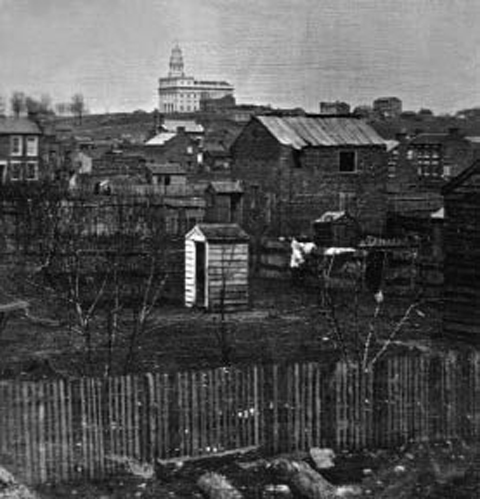
The Nauvoo Temple became at once the most important landmark and most important symbol of the city of the Saints (illus. 5-1). At the zenith of Nauvoo’s glory, this majestic hilltop edifice dominated the landscape like a citadel commanding its dependent city. Outwardly it symbolized not only the success of the Church as an institution but also the sacrifice, toil, and faith of the ordinary Saints who, like William Clayton, worked so hard for its completion. More fundamentally, it said to the Saints that the veil between heaven and earth was very thin indeed, for the sacred ceremonies that would take place within its walls would win for them their final exaltation. Like the tabernacle of Moses or the temple of Solomon, it was the place where God would dwell—a modern Sinai where, he had promised, “I deign to reveal unto my church things which have been kept hid from before the foundation of the world, things that pertain to the dispensation of the fullness of times.”2
From the time he went to work for Joseph Smith until he left Nauvoo four years later, Clayton was bound to the temple as much as to the Church itself. He kept its records, wrote its history, and participated in the final exhilaration of its most sacred ceremonies. At first, however, he was hardly aware of all it would mean. All he knew was that in a revelation received by Joseph Smith in January 1841, the Saints were commanded to build the temple with the finest materials and workmanship available and were told that it would become the only place where baptisms for the dead and other ordinances “for the salvation of the living and the dead” could be performed. It would be sacred space—probably the most sacred space on earth—and the revelation spoke of “your anointings, and your washings, and your baptisms for the dead, and your solemn assemblies, and your memorials for your sacrifices by the sons of Levi, and for your oracles in your most holy places wherein ye receive conversations, and your statutes and judgements.”3 But what all this meant only God and his Prophet, Joseph, seemed to know for sure.
On June 29, 1842, Willard Richards entrusted to William Clayton’s care all the books and records pertaining to the temple, including the “Book of the Law of the Lord” (discussed later in this chapter). By then temple construction was well along its way. The cornerstones were laid, the limestone walls were a few feet in the air, the basement was finished, and the beautifully carved wooden baptismal font was in use for baptisms for the dead. Later, when he wrote his temple history, Clayton took every opportunity to report evidence of the divine hand in whatever happened. A miraculous healing on the day the font was dedicated, for example, impressed him deeply. Samuel Rolfe had a serious infection on one hand, and Joseph Smith instructed him to wash in the font and it would be healed. Rolfe did so, and, in spite of the fact that doctors said it would not heal until spring, “in one week afterwards his hand was perfectly healed. After this time baptisms was continued in the font, and many realized great blessings, both spiritually and bodily.”4
Illus. 5-1. Like many other Saints, Clayton devoted considerable effort to completing the Nauvoo Temple, which symbolized faith and dedication. Clayton kept the account books and other records in connection with building the temple, and he wrote a history of its construction. Courtesy Church Archives
But if the hand of God was there, so, inevitably, was the hand of man, and this brought Clayton no end of distress. The temple committee consisted of Alpheus Cutler, Elias Higbee, and Reynolds Cahoon. In November 1842, the stonecutters brought serious charges of “oppressive and unchristian conduct” against Higbee and Cahoon. They were accused of distributing provisions unevenly and giving more iron and steel tools to Cahoon’s sons than to other workers. After a ten-hour hearing before Joseph Smith, the committee was fully exonerated,5 but a month later the stonecutters were complaining again. Joseph Smith exonerated the committee a second time and wrote a pointed letter to the workers reminding them of its high standing and the need to pay it “proper deference.” He further instructed the laborers that the committee’s policy in distributing pork, beef, and other provisions was ultimately for furthering the temple and advised them
to submit patiently to their economy and instructions; and that we, with one accord with united feelings, submit patiently to the yoke that is laid upon us, and thereby secure the best interest, to the Temple of the most High God, that our limited circumstances can possible admit of: and then having done all on our part, that great Eloheem, who has commanded us to build a house shall abundantly bless us and reward us for all our pains.6
Ever the middle man, Clayton was sent to the stone shop to read the letter to the workers. Some, he said, were satisfied, but three “seemed not exactly so.”
The squabbling broke out again, and on April 7, it was William Clayton who brought charges against the committee before the general conference of the Church. He accused its members of partiality in distributing goods, money, and “store pay” (that is, credit at Joseph Smith’s store). He also noted that the son of one committee member had received all of the above but that none of his labor had been placed on the tithing account. This was a serious breach of religious duty, for one day in ten was supposed to be donated as tithing labor. Committee members, furthermore, were charged with taking “store pay” for themselves but being too tightfisted in what they would allow to others. Hyrum Smith, however, rose to the committee’s defense, and in the end the conference sustained it in its work, thus exonerating it for a third time. That evening Cahoon complained angrily to Clayton about the accusations, but when the beleaguered scribe explained why he made them (apparently to clear the air, as much as anything else), Cahoon appeared satisfied—at least for the time being.7 By the end of the year, however, Cahoon was angry again and even attempted, Clayton believed, to turn the stonecutters against him.8 Such tension among brothers in the gospel dismayed Clayton deeply, though he probably saw it also as another test of his discipleship.
The temple rose steadily, and by the end of October 1842, a temporary floor was laid so that preaching meetings could be held. A year later the Twelve were given the responsibility for collecting money for the temple wherever they traveled, and one of Clayton’s jobs was to receive and account for it. The money was also sometimes used to sustain those who worked on the temple, and William Clayton was not above requesting a little for himself. On May 30, 1843, for example, he asked the Twelve, in behalf of the temple committee, to provide help for the family of William Player, the chief stone setter, promising that he would then give tithing credit to those who had furnished the means. Then he added, almost with a touch of disgruntlement at the meager pay he was receiving for all the time he was putting in, a request for aid to his own family, promising that “I will also work it out like a good fellow (i.e.) to the best of my ability.”9
Meanwhile Clayton continued working hard as temple recorder, keeping track of all donations, purchases, and other financial transactions. His authorized salary was two dollars per day, though it is unclear that he actually received that much on a regular basis. He also began to compile the notes from which he later wrote his history of the temple. At first he worked in the counting room of Joseph Smith’s new brick store on Water Street, but the work became so voluminous that eventually Clayton needed more room. Accordingly, the temple committee erected a small brick office for him, near the temple. He moved in on November 2, 1842.10
Clayton was so sure that future generations would want to know of various unique efforts in behalf of the temple that he duly reported some of them in his “History of the Nauvoo Temple.” Early in 1844, for example, Hyrum Smith asked the women of the Church to pledge one cent per week for glass and nails, promising them first choice of seats in the main floor assembly hall when the temple was complete. When Clayton prepared his temple history a year later, he observed that many women paid a year in advance, and that already $2,000 had been raised. In July 1844, the women from La Harpe and Macedonia branches made an unusual consecration. Convinced that a new crane was needed to speed the work along, they offered the means to build it. Clayton and the temple committee decided to accept the offer, and Raymond Clark’s wife collected the contributions. By the end of August the crane was complete and in operation.11
For William Clayton, however, the meaning of the temple could hardly be separated from the pervasive powers of Joseph Smith over his willing heart and mind. So complete was his will to believe that like potter’s clay, the young scribe from Penwortham was molded and shaped by the Prophet’s influence into an avid, self-confident, and even stubborn disciple. One of the finishing touches was applied on April 21, 1843, when the two were riding together on the prairie. Wrote Clayton, “He swore to me he would forever defend & protect me and divide earthly things with me if I would be faithful to him which I cheerfully promised.”12 That promise could only strengthen the loyalty that was already there.
Such experiences were sacred to Clayton, and he repaid in kind by becoming one of the Prophet’s most tireless and uncompromising defenders. Quick to speak up whenever he felt an injustice was in the making, he became irate at even the hint of slander. In March 1842, he wrote to William Hardman in England, taking special pains to defend the character of the Prophet. Notwithstanding the disappointments of 1841, he declared, “My faith in this doctrine, and in the prophet and officers is firm, unshaken, and unmoved, nay, rather, it is strengthened and settled firmer than ever.” There had been charges of business fraud that, Clayton declared, “i, myself, know positively to be false.” Then, responding to rumors of intemperance, he categorically asserted:
With regard to J. Smith getting drunk, I will say that I am now acting as clerk for him and at his office daily, and have been since February 10th, and I know that he is as much opposed to the use of intoxicating drinks as any man need be.—I have never seen him drunk, nor have I ever heard any man who has seen him drunk since we came here. I believe he does not take intoxicating drink of any kind: our city is conducted wholly upon temperance principles. As to his using snuff and tobacco, I know he does no such thing. To conclude, I will add that, the more I am with him, the more I love him, the more I know of him, and the more confidence I have in him; and I am sorry that people should give heed to evil reports concerning him, when we all know the great service he has rendered the church.13
When he wrote to the Times and Seasons about Joseph Smith’s trial at Dixon in May 1844, he was vehement against those who dared to debase the Prophet. The mere fact that they criticized him was, in Clayton’s mind, enough evidence to convict them. “When I hear men speak reproachfully of him,” he declared, “I never ask for a second evidence of their corruptness or baseness. . . . Shame on the man or set of men who show themselves so degraded and miserably corrupt.”14 If Joseph himself sometimes used a sharp tongue against his detractors, Clayton only enjoyed what he heard. When a certain man from Quincy, for example, began to tantalize the Prophet in January 1844, Clayton was delighted to hear the Church leader tell the offender, “In the name of the Lord,” that not many years would pass away before the man was in the hands of the devil himself.15
Clayton saw the Prophet in every mood and seemingly loved him the more for each one. On occasion he found him weeping,16 while at other times he observed his anger. On August 1, 1843, Joseph rode in his buggy to the temple, where he began to discuss with Clayton and others the fact that some of his property was being sold for taxes. Suddenly Walter Bagby, the county assessor and collector, appeared and when Joseph confronted him with the issue, he denied all knowledge of it. As the discussion heated up, Joseph told Bagby that he was always abusing the citizens in the area, and Bagby angrily called Joseph a liar. Obviously irritated, the Church leader stepped down from his buggy, whereupon Bagby picked up a stone to throw at him. Enraged, Joseph went after his attacker and struck him two or three times. It took Daniel H. Wells, who just happened to be there, to separate the two. To Joseph Smith’s credit he apparently recognized that, despite the provocation, his attack on Bagby was inappropriate. Joseph asked Wells, who was not yet a member of the Church but was a Nauvoo justice of the peace, to assess a fine on him. Wells refused, whereupon Joseph immediately went before Newel K. Whitney, a city alderman, and explained what had happened. Jacob Backenstos, another friend but also not a member, also appeared before Whitney and swore out an official deposition concerning the assault. Whitney imposed a fine, Joseph paid it and then went on to a political meeting.17 It may have seemed out of character for the Prophet to engage in fisticuffs, but the fact that on occasion he demonstrated such strictly human qualities probably made him all the more believable to William Clayton.
Joseph Smith was creating sacred history—at least that is how his followers, including William Clayton, felt. Everything he did, whether secular or religious, was important to the Kingdom, and a memory of it would be essential to preserving his place in the hearts and minds of future generations. Just as the memory of what Jesus did and said was written and compiled to become the sacred histories of the founding of Christianity, so the events in the life of the Latter-day Saint prophet, as recorded by himself as well as his disciples, would soon constitute the sacred history of the Restoration.
As early as 1830, Joseph himself developed an avid concern about recording his history,18 though in the long run he wrote very little in his own hand. Instead, during the fourteen years he led the Church he either dictated his ideas to scribes or relied on clerks and other associates to record his actions as well as his sermons and other pronouncements. When, under his direction, various clerks and Church historians began to compile his official history, most of it came from the notes and journals of those who had been close to him. This included the Nauvoo journal of William Clayton (see appendix 1).
The history was only partially complete when Joseph died, and it was finally finished in 1858. It was a monumental work, and its place as sacred history was epitomized in a statement issued by Wilford Woodruff and George A. Smith. Emphasizing their painstaking efforts to make it absolutely correct, they also explained that in its final form, the history had been revised under the “strict inspection” of Brigham Young and approved by him. “We, therefore, hereby bear our testimony,” they solemnly wrote, “unto whom these words shall come, that the History of Joseph Smith is true, and it is one of the most authentic histories ever written.”19 A half-century later it was edited by B. H. Roberts and published by the Church in six volumes. Roberts reemphasized the aura that readers would feel surrounding it. “In publishing the History of the Church of Jesus Christ of Latter-day Saints,” he wrote, “it is felt that a solemn duty is being performed to the Saints and to the world. The events which make up the history of the Church in this age are the most important that history can chronicle.”20
One problem with Joseph Smith’s published History of the Church, however, is that it does not reflect Joseph himself as much as it reflects the image of Joseph as he was seen by scribes and journalists.21 The history is written in the first person, as if Joseph were doing the writing, though usually the first person account of an event is really a paraphrase or adaptation of someone else’s account. At times the only essential difference is that “Joseph,” “he,” or “President Smith” is changed to “I.” The fact that what the compilers were doing was well known at the time indicates that there was no intent to deceive. They simply were using the best sources available to help them reconstruct Joseph Smith’s activities and conversations. William Clayton’s journal provided many such entries, which suggests that much of the “first person” Joseph Smith portrayed in the work is, in reality, only the Joseph Smith that William Clayton or someone else saw and heard. Even with that qualification, however, the work is invaluable, but there is a continuing concern with whether the history as reported is always the way Joseph saw it or would have written it himself.
The famous story of the Kinderhook plates, and William Clayton’s role in it, suggests the nature of the problem. Sometime in April 1843, six small, thin, bell-shaped metal plates were “discovered” in a mound near the town of Kinderhook, about fifty-five miles south of Nauvoo. Each measured about 2⅞″ high and 2¼″ wide at the bottom, and each contained strange markings that seemed to resemble Egyptian hieroglyphics. Quickly the news spread to Nauvoo, and by the first of May the plates themselves had arrived. During the next few weeks it became a common belief that Joseph Smith would soon translate them. Even the Church periodical the Times and Seasons, as well as a broadside put out by the Nauvoo Neighbor, told readers that a translation would be forthcoming. The latter reproduced facsimiles of all twelve sides of the plates. Nothing more was heard about it, however, and a later confession of one of the “discoverers,” as well as a modern electronic and chemical analysis of one surviving plate, has eliminated any doubt that the whole thing was a hoax, intended to lure Joseph Smith into the trap of publishing a translation and then embarrassing him.
Not surprisingly, even those close to Joseph Smith gave somewhat differing accounts of the discovery, and what might be expected from it, but there is nothing directly from Joseph on the matter. Therein lies one example of the difficulty with the way Joseph Smith’s history was compiled. In this case, William Clayton’s diary was the source for the only thing recorded there about the Kinderhook plates. What the Prophet really said or would have written is conjectural, but the account from Clayton’s diary, May 1, 1843, is as follows:
I have seen 6 brass plates which were found in Adams County by some persons who were digging in a mound. They found a skeleton about 6 feet from the surface of the earth which was 9 foot high. [At this point there is a tracing of a plate in the journal.] The plates were on the breast of the skeleton. This diagram shows the size of the plates being drawn on the edge of one of them. They are covered with ancient characters of language containing from 30 to 40 on each side of the plates. Prest J. has translated a portion and says they contain the history of the person with whom they were found and he was a descendant of Ham through the loins of Pharoah king of Egypt, and that he received his kingdom from the ruler of heaven and earth.
For comparison’s sake, the account as edited for Joseph Smith’s history for the same date reads
I insert fac-similies of the six brass plates found near Kinderhook, in Pike county, Illinois, on April 23, by Mr. Robert Wiley and others, while excavating a large mound. They found a skeleton about six feet from the surface of the earth, which must have stood nine feet high. The plates were found on the breast of the skeleton and were covered on both sides with ancient characters.
I have translated a portion of them, and find they contain the history of the person with whom they were found. He was a descendant of Ham, through the loins of Pharoah, king of Egypt, and that he received his kingdom from the Ruler of heaven and earth.22
In 1981, Stanley B. Kimball provided readers of the Ensign with clear evidence that the plates were a hoax, and he argued convincingly that Joseph Smith was not, in fact, ever really taken in by it.23 In the diary, Clayton was not quoting the Prophet directly, but it is evident that he believed Joseph had read and translated “a portion” of the plates and knew something about the person with whose skeletal remains they were “found.” It was William Clayton’s understanding of what Joseph Smith believed that was transposed into a first-person account and became Church history. Fortunately scholar Dean Jessee is in the process of clarifying the sources for Joseph Smith’s history and separating the Prophet’s own writings from those of others.24
The Kinderhook episode was only a sidelight, and nothing came of it, but William Clayton made other, much more important contributions to what became Joseph Smith’s official history. Several entries in Clayton’s Nauvoo journal were the direct sources for entries in the History of the Church, some of which are noted elsewhere in this work. In addition, Clayton was one of several scribes who kept the “Book of the Law of the Lord.” For the most part, this large, leather-bound record contains notations of consecrations and tithing for the building of the temple, and 370 pages, covering the period from September 12, 1842, to May 4, 1844, are in William Clayton’s handwriting. But it also contains some manuscript sources used in compiling the History of the Church, and about sixty-one pages of this material were written by Clayton, mostly in the third person, and then later transposed to the first person for the sake of the published history. Some of this, however, is also direct dictation from Joseph Smith. A letter to Emma Smith, for example, is there, though presumably Emma received the original and Clayton merely made a copy of it before it was sent. In addition, certain tender reflections by Joseph Smith on the value of his friends, on August 16 and 23, 1842, were dictated directly to Clayton, who recorded them in the sacred record book and later made them available for the published history.25 Beyond that, the original manuscripts of some revelations that became part of the history as well as part of the Doctrine and Covenants are in the handwriting of William Clayton. Section 127 of the Doctrine and Covenants, which is a letter dealing with baptism for the dead, is one example.
Clayton was also the source for at least one famous prophecy of Joseph Smith, though the manuscript source of the prophecy, as it now stands in the official History of the Church, is conjectural. On May 18, 1843, Joseph and William were in Carthage, where they dined with Judge Stephen A. Douglas at the home of Sheriff Jacob Backenstos. After dinner, according to Clayton’s journal, the Prophet and the judge engaged in conversation over “sundry matters,” though the nature of the discussion was not described. It probably concerned the Missouri persecutions and the failure of the federal government to assist the Mormons, but Clayton simply reported that “the Prest. said ‘I prophecy in the name of the Lord God that in a few years this government will be utterly overthrown and wasted so that there will not be a potsherd left’ for their wickedness in conniving at the Missouri mobocracy. The judge appears very friendly and acknowledged the propriety of the prests. remarks.”26 Sixteen years later, however, when that part of Joseph Smith’s history was first published in the Deseret News, the report of the conversation was greatly expanded, and in a curiously uncharacteristic manner. Instead of following their usual editorial practice of putting in whatever they could gather that Joseph Smith said, without identifying the sources, the compilers introduced this conversation by stating that “the following brief account is from the journal of William Clayton, who was present.” Then followed a 450-word report of the conversation in which, it said, Joseph spent about three hours telling Douglas of the Missouri persecutions, in “a very minute manner.” He also told of his trip to Washington in 1840, emphasizing the cool reception he received in his effort to obtain federal redress and President Martin Van Buren’s “pusillanimous reply, ‘Gentlemen, your cause is just, but I can do nothing for you.’” It was in this context that he prophesied that “unless the United States redress the wrongs committed upon the Saints” and punish the perpetrators, the government would be overthrown because of “their wickedness” in permitting the crimes against the Mormons.
Then he added the prediction that became famous in Mormon history: “Judge you will aspire to the Presidency of the United States, and if ever you turn your hand against me or the Latter Day Saints, you will feel the weight of the hand of the Almighty upon you; and you will live to see and know that I have testified the truth to you, for the conversation of this day will stick to you through life.”27 When the History of the Church was published in book form, B. H. Roberts added an editorial note commenting on the fact that in 1857 Douglas gave a speech in Springfield, Illinois, that was critical of the Mormons, and observing that he did, indeed, lose his bid for the presidency in 1860 and died a year later.28
The question, however, is, where did this expanded version of the original entry in William Clayton’s journal come from? If, as the editors of the History of the Church reported, Clayton was the source, then there can be only two possibilities. One is that Clayton wrote in more than one journal, perhaps another volume of the “Book of the Law of the Lord,” that simply has not come to light. This is by no means impossible, for it is known that Clayton kept other books and that on occasion the things recorded in one journal were either duplicated or, in some cases, expanded upon in another.29 The other possibility is that Clayton, who was still working with the Church historians and clerks when the history was being completed, was asked about the prophecy and, drawing on a vivid memory of the occasion, provided the expanded account. This version is certainly not inconsistent with the original journal entry, and, given the profound impact Joseph’s words always had on Clayton, it is not unlikely that he would remember clearly at least the gist of that dramatic conversation, even after many years. In any case, this is one more example of the various ways in which William Clayton helped write what he considered sacred history.
Clayton literally thrived on the teachings of Joseph Smith, no matter how new or different they were. The Nauvoo period saw more significant new ideas and practices take their place in the Church than at any time in its history, and William Clayton was there when the Prophet introduced many of them. Some of the ideas advanced by Joseph may have been considered, even by close associates, to be matters of personal interpretation rather than official doctrine, but not so for William Clayton: if they came from the Prophet, he believed them all.30
The examples of new and different doctrines Clayton learned from Joseph Smith are too numerous to detail here, but some that impressed him most will illustrate the important religious metamorphosis he experienced in Nauvoo. He was intrigued, for example, with the Prophet’s frequent reference to the Kingdom of God, including the political implications of that Kingdom. He made special note, therefore, of a definition of the Kingdom given by the Prophet. It exists, Clayton heard him say, “wherever the oracles of God are & subjects to obey those oracles. What constitutes the kingdom of God? An administrator who has the power of calling down the oracles of God, and subjects to receive those oracles no matter if there are but three, four, or six there is the kingdom of God.”31 The “oracles” were the commandments, the “administrator” was Joseph Smith, and Clayton was one of the “subjects.” This was another way of saying that the Church was, in fact, the earthly Kingdom of God and that Joseph Smith was God’s only true prophet.
Sometimes instructions from God are delivered by heavenly messengers, and on at least two occasions Clayton heard Joseph Smith instruct certain leading Church members on how to tell the difference between such a messenger and an evil spirit. The idea had been presented to the Quorum of the Twelve as early as 1839, but Clayton heard it in December 1840 and again when he was at the Prophet’s home on February 9, 1843. There are really two kinds of beings in heaven, Joseph said on the last occasion, “angels, who are resurrected personages, having bodies of flesh and bone. . . . [and] the spirits of just men made perfect who are not resurrected.” Presumably the latter will also be resurrected in due time, but even without bodies of flesh and bones they can deliver messages to mortals. The key, then, is to ask anyone who claims to be a messenger from God to shake hands with you. If he is an angel, he will do so and you will feel it. If he is the “spirit of a just man made perfect,” he will not move, for he will not deceive. But “if it be the devil as an angel of light, when you ask him to shake hands he will offer you his hand, and you will not feel anything; you may therefore detect him.”32 So confident was Clayton and other Nauvoo Saints in the close relationship between themselves and heaven that it would have surprised none of them to have an “angel,” a “spirit of a just man,” or a devil appear and talk to them. The statement was later made scripture and became Doctrine and Covenants 129, and Clayton provided the source: the published version is practically verbatim from his diary.
Clayton’s diary is the source for other statements of the Prophet that eventually became part of Mormonism’s sacred scriptures.33 In addition, Clayton was among the scribes who recorded many doctrinal sermons, including what has been termed “Joseph Smith’s greatest sermon”: the famous “King Follett Discourse.” Here, at the height of his career and only two months before his death, the Prophet dramatically brought together several of his most important and progressive doctrinal innovations. Clayton’s record of that all-important sermon was one of four from which the published text was finally amalgamated.34
Perhaps the most fundamental doctrines taught publicly by Joseph Smith in Nauvoo related to the nature of God and the relationship of God to men and women. It is impossible to tell how Clayton perceived God prior to his association with Joseph Smith, but before the Nauvoo period it was not necessarily a fundamental of the faith to believe that God the Father was a tangible being of flesh and bones. Church members understood that there was a clear distinction between the persons of the Father and the Son, so they were not trinitarian in the traditional Christian sense. But in the 1830s, according to the “Lectures on Faith,” they were taught that the Father was a “personage of spirit, glory and power,” while the Son was a “personage of tabernacle, made, or fashioned like unto ma. . . . possessing the same mind with the Father, which mind is the Holy Spirit.”35 Only in 1838, the year Church members were driven into Illinois, did a description of a more anthropomorphic God the Father begin to find its way into the Latter-day Saint press (although the idea was probably being preached before it got into print). That year Parley P. Pratt wrote that “we worship a God who has both body and parts: who has eyes, mouth and ears, and who speaks when he pleases, to whom he pleases.”36 That same year Joseph Smith began preparing the account of his First Vision for publication—a narrative that clearly distinguished between the Father and the Son and implied the material nature of both. Two years later, in 1840, the First Vision was published in missionary literature, and before the end of his life Joseph Smith made an understanding of the Godhead a fundamental of the faith.
William Clayton was present on April 2, 1843, when Joseph announced to a select group that the Father and the Son both have bodies of flesh and bones, but that the Holy Ghost is a “personage of Spirit.” If this were not so, he said, the Holy Ghost could not dwell in us. “A Man may receive the Holy Ghost, and it may descend upon him and not tarry with him.”37 By this time, then, it was a fundamental doctrine that the Godhead consists of three separate, identifiable heavenly beings, that the Father and the Son are tangible beings, and that the Holy Ghost, or Holy Spirit, is a spiritual personage. A more elaborate theology of the Holy Ghost, however, was worked out more fully only many years after the death of Joseph Smith.38
As different as it was, this new concept of God might not have seemed quite so profound if it had not been coupled with another doctrine relating to man and his potential. This, in part, was the significance of the King Follett Discourse. Man, Joseph Smith revealed to his disciples, is actually a god in embryo! If we understand the true nature of God, and our relationship to him, then we also understand that it is part of his plan that we progress eternally until we become like him—gods and goddesses! “God himself was once as we are now,” he said, “and is an exalted man, and sits enthroned in yonder heavens!”
It is significant that the King Follett sermon was a funeral sermon, for in discoursing on the dead, Joseph could tell his listeners of the potential they all had. It was clearly related to their understanding of God and their relationship to him. “It is the first principle of the gospel,” he continued, “to know for a certainty the character of God, and to know that we may converse with Him as one man converses with another, and that He was once a man like us; yea, that God himself, the Father of us all, dwelt on an earth.” At the same time, he taught that all people existed, as individual spirits, prior to their being born on earth. God, the Father of these spirits, “finding he was in the midst of spirits and glory, because he was more intelligent, saw proper to institute laws whereby the rest could have a privilege to advance like himself.” This was the basis for the doctrine of eternal progression as well as the concept of a plurality of gods, which holds that mortals can, through obeying the principles of the gospel, prepare themselves to become gods.
All this had even more implications in terms of tying together several other doctrines previously advanced. The concept of the three degrees of glory, first spelled out in 1832,39 took on new meaning when it was realized by the Saints in Nauvoo that only those who attained the celestial kingdom would have the godly exaltation they now believed possible. In 1843, Joseph went even further by indicating to Clayton and a group of close friends that if a man and his wife entered into the covenant of marriage under the authority of the priesthood, they would “continue to increase and have children in the celestial glory,”40 which was another way of saying that they would become like God. This, as Clayton saw it, was part of the “new and everlasting covenant,” and Joseph told his little group of disciples that to gain the highest degree of glory “a man must enter into this order of the priesthood and if he dont he cant obtain it. He may enter into the other but that is the end of his kingdom he cannot have an increase.”41 This is the way Clayton recorded it in his journal, and this entry became the basis for one of the most oft-quoted statements in the Doctrine and Covenants.
The King Follett Discourse enhanced still more previous teachings and practices, including baptism for the dead. “The greatest responsibility in this world that God has laid upon us,” Joseph said in his sermon, “is to seek after our dead,” for, as Paul had said, “They without us cannot be made perfect.” The impact of these words was that later not only baptism but also other priesthood ordinances would be performed in behalf of the dead in the temple, so that the dead, too, could continue on the road toward eternal exaltation. This doctrine symbolized the Church’s emphasis on the family and tied the generations together. Little wonder that Clayton was especially impressed with that part of the King Follett funeral sermon. Already he had lost members of his family, and even though he recorded the sermon separately, he also recorded in his diary the Prophet’s emphasis on the importance of being buried with one’s relatives. In the Resurrection, he said, “we shall want to see our relatives first & shall rejoice to strike hands with our parents, children, &c when rising from the tomb.”42
As many more new things were taught in Nauvoo, it all must have seemed somewhat overwhelming to William Clayton. Here he was, a former English factory clerk sitting at the feet of the Prophet while he received revelation, expounded upon doctrine, and planned the building of the Kingdom of God on earth. The effect on the disciple from Penwortham is seen in his journal entry for May 17, 1843. This was the second day of instruction from Joseph Smith in Ramus, Illinois, and Clayton duly recorded the most important new ideas he heard. Some of them were in the form of definitions. “Salvation,” for example, meant “a mans being placed beyond the powers of all his enemies.” The phrase “more sure word of prophecy” meant “a mans knowing that he was sealed up unto eternal life by revelation & the spirit of prophecy, through the power of the Holy priesthood.” With reference to “matter,” Joseph said that “there is no such thing as immaterial matter. All spirit is matter but is more fine or pure and can only be discerned by purer eyes We cant see it but when our bodies are purified we shall see that it is all matter.” But Joseph also told an anecdote concerning a man who had pressed him too hard to perform a marriage ordinance before the Lord was willing to have it performed.43 “I learned from this,” wrote Clayton, “never to press the prophet but wait with patience & God will bring all things right.” Clayton’s discipleship was maturing, as he was developing a patient hopefulness and expectation that all he wanted eventually would come. That led him to pour out another of his frequent prayers: “I feel to pray that God will let me live so that I may come to the full knowledge of truth and salvation & be prepared for the enjoyment of a fulness of the third heavens.”
The impact went even further. Sitting at the feet of Joseph Smith was an honor, but Clayton saw his association with other leading men of the Church as an almost equal privilege. On the evening of January 23, 1844, for example, he went to a party at which Joseph Smith was also in attendance. His poignant reflections on the evening reveal his sentimentalism as well as his tendency toward self-effacement: “Whilst hearing bro. Hancock sing a song I was led to reflect upon the feelings I had 3 years ago whilst listening to him when singing. I then felt it a privilege to associate with such men, and when I reflect upon the privileges I now enjoy I am led to conclude, truly the mercy of God has been great and I am not worthy of such great blessings.”44
Most of these things were public, but there was another side to Clayton’s spiritual Nauvoo. Like the unseen supporting structures that give stability to a house, it was the private teachings of Joseph Smith, confided in a relatively few faithful disciples, that had the most permanent effect on Clayton’s life and became the most sustaining elements of his broadening religious faith. Because of his closeness to the Prophet, Clayton became a member of two highly confidential groups: the Council of Fifty and Joseph Smith’s private prayer circle. Each group had an impact on the Church and each held great spiritual significance for the impressionable William.
The Council of Fifty (sometimes referred to as the General Council) was not an ecclesiastical organization, though it was organized and dominated by the priesthood. Joseph Smith saw it as a secular body that would handle secular and political affairs and anticipate the establishment of the political Kingdom of God on earth. It consisted wholly of men the Prophet felt he could trust, for like Clayton their loyalty had already been tested and they could take without dismay the new and sometimes startling concepts he would advance. The council planned and directed Joseph Smith’s political campaign for the presidency, directed the industrial development of Nauvoo after his death, and exercised important political influence in the Territory of Utah. In essence, it was seen as the political arm of the priesthood, responsible for preparing for the Second Coming of Christ and the establishment of his millennial reign.45
The philosophical roots for the organization of the Council of Fifty reached back many years and were directly related to the millennial expectations of the Church. The immediate impetus, however, came from two letters signed by Lyman Wight and four others who were working in the Church’s lumber camps in Black River Falls, Wisconsin Territory. These were read at a special meeting attended by the Twelve, Bishop George Miller, and the temple committee on the evening of March 10, 1844. The letters proposed a grandiose scheme for Mormon colonization in the Southwest and led to an important discussion where, according to Clayton, “many great and glorious ideas were advanced.”46
The next day they met again and this time organized a council to consider not only the proposal from Wisconsin but also “the best policy for this people to adopt to obtain their rights from the nation and insure protection for themselves and children; and to secure a resting place in the mountains, or some uninhabited region, where we can enjoy the liberty of conscience guaranteed to us by the Constitution.” This was the official organization of the Council of Fifty, or the government of the Kingdom of God, and when the group met the following day William Clayton was appointed “Clerk of the Kingdom.” What a change in status, he must have thought, for a former factory clerk from Penwortham!47
As a member of such a prestigious body, Clayton could hardly contain his exuberance. There, he wrote, “the principles of eternal truths rolled forth to the hearers without reserve and the hearts of the servants of God [were] made to rejoice exceedingly.” They even voted on April 11 to make Joseph Smith their “Prophet, Priest and King,” confirming him with “loud Hosannas.” The deliberations of the council were confidential, and Clayton kept the confidence well, reporting only a few details in his diary. He apparently kept careful notes during the meetings, then spent long hours recording them in the official minute books.48
The council met frequently during the last four months of Joseph Smith’s life. During the first month it gradually added to its numbers until by April 18, it actually consisted of fifty-two members, including William Clayton as clerk and his friend Willard Richards as recorder. The grand significance of the council, so far as Clayton was concerned, was that it was “making laws and sanctioning principles which will in part govern the saints after the resurrection.” He did not see it as an immediate replacement for civil government, but he firmly believed that whatever principles it established would govern during the millennium. “Is there not a similarity,” he asked himself, “between this grand council & the council which sat previous to the organization of the world?” No wonder he felt so honored to be a part of it.49
Clearly the Council of Fifty had important religious significance for Clayton, but of even greater spiritual importance was his invitation to become a member of Joseph Smith’s private prayer circle. In a way, this represented the culmination of his evolution from factory clerk to confidant of the Prophet.
Variously called the “Holy Order,” the “Quorum of the Anointed,” the “First Quorum,” or just the “Quorum,” the prayer circle may have had its origin as early as 1842. It was not fully established with the inclusion of women, however, until September 28, 1843. From then until the death of Joseph Smith this select group met at least weekly. The members were instructed by Joseph in the ceremonies that would subsequently be administered in the Nauvoo Temple. They were initiated into the Quorum through a washing and anointing that symbolized the spiritual cleanliness and progress they sought to attain. At the meetings, dressed in special priesthood robes, they went through the endowment ordinances that consisted of religious instruction, learning certain symbolic “signs and tokens,” and taking upon themselves sacred covenants pertaining to their personal lives and conduct. All this was held to be a most sacred part of the Restoration of the “ancient order of things.” They also participated in fervent prayer concerning the problems of the day. Membership was restricted—only sixty-five persons had been admitted before the death of Joseph Smith—but as soon as the temple was usable, in December 1845, this exclusiveness ended, as originally intended by the Prophet. The Anointed Quorum was a preliminary training group, preparing to help introduce the endowment ceremony to the membership of the Church as a whole.
It is easy to see how important it was to Clayton that he become a member of the Quorum. As a close friend of the Prophet it seemed almost as if he had been deprived of a spiritual right when, by December 1843, he had not been invited to participate. He even suspected that two members of the Quorum, in particular, were keeping him out: Reynolds Cahoon, with whom he had previously disagreed because of the actions of the temple committee, and Emma Smith. All this, he lamented on December 2, “sink[s] my mind and fills me with agony.” That day he even went so far as to write a long letter on the subject to the Prophet. Three days later, Joseph Smith personally returned the letter, assured him that he had no need to be troubled, and explained that it had just not been convenient as yet to admit him. He also assured Clayton that his paranoia concerning Cahoon was ill-founded, for Cahoon considered him to be “true blue.”
On January 22, 1844, Clayton’s hopes were realized when Reynolds Cahoon himself came to his home and informed him that he had been voted into the Quorum. “This filled my heart with joy and gratitude,” he wrote, “for truly the mercy of the Lord and the kindness of my brethren have been great to me.” Immediately one of the women in Nauvoo began making his priesthood robe and garment, which were necessary for the endowment ceremony, and on February 3, he received the washing and anointing ordinances and was admitted to the Quorum. He could not refrain from recording the depths of his feelings: “This is one of the greatest favors ever conferred on me and for which I feel grateful. May the God of Joseph preserve me & mine house to walk in the paths of righteousness all the days of my life & oh that I may never sin against him or displease him. For thou oh God knowest my desire to do right that I may have eternal life.”50 Ruth Clayton also became a member of the Quorum, on December 22, 1844, and thus shared with her husband the right to introduce the endowment to the rest of the Nauvoo Saints. For Clayton, and for all the other Church members who shared his experience, this was the meaning of Nauvoo—the stepping-stone to eternal life.
True to his commitment to keep sacred things secret, Clayton noted several meetings in his diary but never gave the most confidential details. These meetings continued after the death of Joseph Smith, and one of Clayton’s most extensive notations, wherein he provided some interesting insight into the nature of some of the meetings, came on Sunday, December 7, 1845. Several members of the Quorum were meeting in the temple, clothed in their ceremonial robes, and Joseph Fielding (Clayton’s former mission president from England) gave the opening prayer. It became a kind of testimony meeting (most appropriate for the Sabbath) as several expressed their feelings about the privilege of being there “in spite of the combined opposition of men and devils.” During the speaking, the sacrament of the Lord’s supper, consisting of broken bread and wine, was distributed, after which Brigham Young addressed the group. “He gave much good instruction,” Clayton noted, “and the spirit of God rested upon him.” One interesting comment provides some important insight into the attitudes toward the Quorum of this new Church leader:
He stated “that a few of the quorum had met twice a week ever since Joseph and Hyrum were killed and during the last excitement, every day and in the hotest part of it twice a day to offer up the signs and pray to our heavenly father to deliver his people and this is the cord which has bound this people together. If this quorum and those who shall be admitted into it will be as dillegent in prayer as a few has been I promise you in the name of Israels God that we shall accomplish the will of God and go out in due time from the gentiles with power and plenty and no power shall stay us.”51
After the death of Joseph Smith, Clayton became especially anxious to see the temple completed, but giving the endowment to the Saints at large was even more important. If they could not complete the temple fully before they had to quit Nauvoo, at least they would complete and dedicate enough of it to administer these sacred ordinances to as many Saints as possible. On November 29, 1845, carpet was laid on the main floor of the attic as well as in several of the smaller rooms that surrounded it. On the next day, Sunday, the attic floor was dedicated in impressive ceremonies, with Clayton keeping the minutes, and the Anointed Quorum rehearsed parts of the temple ordinances “in order to perfect them.”52
December 10 was the day set aside for the first official endowments to be given in the temple, but that day also saw a strange series of events that demonstrates the almost ironic circumstances in which the Saints of Nauvoo found themselves. At 11:45 a.m. a Catholic priest and his associate were admitted to the temple for the purpose of negotiating the purchase of Church property, possibly including the temple itself. Paradoxically, the Saints were sacrificing to complete the temple so they could offer to everyone the ceremonies already received by the Quorum, while at the same time they were painfully aware that they soon must leave and were actually contemplating the sale of the temple. After some discussion, Brigham Young proposed that the Catholics lease it for a period of five to thirty-five years and that the profits go toward finishing it and keeping it in repair. The visitors agreed to consider the proposal and left about 12:30 p.m. A few hours later, Clayton and others consecrated sixteen bottles of oil in preparation for the coming ceremonies, and at 3 p.m. the first “washings and anointings” to be performed in the temple commenced. Later that evening the full endowment ceremony was conducted for the first time in the temple. At 9:30 it was complete, and Brigham Young then called everyone into the celestial room, where they all knelt while Amasa Lyman offered prayers.
Clayton’s main task that day was keeping records, and though it must have been a marvelous day for him it was also a long one, partially dulled by illness. “At this time,” he wrote, “I went home being very unwell having been writing and keeping minutes all day.” The others remained until 3:30 the next morning.53 From that day until they finally left Nauvoo the Saints flocked to the temple, and the exclusive nature of the Quorum of the Anointed came to an end.
As important and revolutionary as these things were, it was Joseph Smith’s teachings on marriage that had a more visible and far-reaching effect on William Clayton’s life than anything else he learned in Nauvoo. Two doctrines, eternal marriage and plural marriage, went hand-in-hand, and Clayton learned of them during the last two years of his association with the Prophet.54
Why would the straitlaced, idealistic William Clayton, who was almost overly concerned with what people thought of him, seriously consider the practice of plural marriage when it so clearly violated all his earlier values as well as the morality and sensibilities of the society in which he lived? He and Ruth Moon had a good marriage, which had endured considerable adversity. He was also close to her family. By the time the doctrine of polygamy was presented to Clayton, Ruth had borne three children, and on February 17, 1843, just two months before his second marriage, she presented him with his first son. It was no lack of love or compatibility that led him to take additional wives. The most compelling factor was his single-minded conviction that whatever Joseph Smith told him to do was right and that he must spare no pains to accomplish it. At the same time, his affection for Sarah Crooks of Manchester was still there, and once he was convinced that the principle was true, it was only natural that he should think of her as a possible second wife.55
The doctrines of eternal marriage and plural marriage were both spelled out in a revelation that William Clayton recorded for Joseph Smith on July 12, 1843. The Prophet had been teaching both for some time, but plural marriage, at least, remained a private doctrine, and the revelation itself was not made public until 1852. It nevertheless formed the basis for all future explanations of the doctrines.
Now known as Doctrine and Covenants 132, the revelation was actually concerned with something much more basic to Mormon thought than simply whether a man should have more than one wife. It began with an explanation of the eternal nature of priesthood authority and the relationship of that authority to the marriage ceremony. To Latter-day Saints, this was fundamental, for the priesthood could reside only in one church on the earth. Through that authority, and through it alone, they believed God would transmit whatever information or instructions that were essential to man’s eternal salvation. In this case the revelation dealt with covenants or contracts and what it was that made them eternally binding. The ordinances performed by the priesthood are eternal, it explained, and, unlike other contracts, the covenants made under that authority are everlasting. With regard to marriage, then, the Saints were told that any marriage not performed by one holding God’s authority is binding so long as both parties live, but is invalid when they “are out of the world.” This had important overtones for people like Clayton who loved their families and longed to be with them after death.
Long before 1843, Joseph Smith had begun to unfold to the Saints the concept of the eternal nature of the family. Baptism for the dead, for example, which Clayton accepted enthusiastically, implied the hope for continuing family relationships. But even baptism must be performed by proper authority. How logical it would seem to be told that the most important of all earthly covenants—marriage—would last beyond the grave only if it were validated by the priesthood. The revelation informed the Saints, then, that if a marriage were performed by proper authority it would be binding for eternity. This was the doctrine of eternal marriage.56
Only after explaining the eternal nature of the priesthood and of marriage did the revelation deal with Joseph Smith’s original inquiry. He had asked, it said, “wherein I, the Lord, justified my servants Abraham, Isaac, and Jacob, and also Moses, David and Solomon, my servants, as touching the principle and doctrine of their having many wives and concubines.” The answer was that they had been given to the ancient prophets by the Lord himself, and that since these men “did none other things than that which they were commanded, they have entered into their exaltatio. . . . and sit upon thrones, and are not angels but gods.” The overpowering thought that they, too, might become gods helped disciples such as Clayton understand why God would authorize the same practice in modern times. Even though a Book of Mormon prophet condemned the practice among his own people, he had also reminded them that “if I will, saith the Lord of Hosts, raise up seed unto me, I will command my people.”57 It was choice “seed”—eternal families and eternal progression—that the new revelation was about, so far as Clayton was concerned. It authorized Joseph Smith to be like the prophets of old and to instruct others in the same doctrine. The only requirement was that plural marriages be both authorized and performed by proper priesthood leaders. Anything less than this was adultery. Joseph Smith taught that plural marriage was one more step in the “restoration of all things.” William Clayton accepted it as such and eventually became one of the most married men in the Church.
It seems probable that Clayton had at least heard of plural marriage before he was formally instructed to practice it. For several years, Joseph Smith had been teaching it to a few highly trusted friends and Church leaders. Their instructions, however, were to keep it secret; otherwise there would be a public outcry, both in and out of the Church, and in the midst of already troubled times the Saints could hardly afford that. Selected stalwarts must be instructed first, then it would be preached to the rest.58
For many of those to whom it was introduced, the new doctrine was almost impossible to accept, and for some who heard it the thought was downright revolting. Joseph once said that for years even he refused to accept it, “until the angel of the Lord threatened to slay him if he did not reveal and establish this celestial principle.”59 If it was that difficult for him, it was as much or more so for his disciples. Brigham Young, John Taylor, the Pratt brothers—all felt nothing but dismay when he broached the subject to them.
William Clayton’s closest friend among the Apostles, Heber C. Kimball, was given a particularly difficult two-part test before he was fully convinced. Evidently Joseph wanted not only to teach him the doctrine but also to try his loyalty with a test as severe as that of Abraham. Sometime in summer 1841, the Prophet told Heber that he wanted to be sealed to Heber’s wife, Vilate. Stunned and crushed, Heber fasted and prayed in anguish for three days, but in the end he took his beloved Vilate to the Prophet and told him she was his. The proffered sacrifice turned Joseph Smith to tears, and then he sealed Heber and Vilate for time and eternity. There, in practice, Heber was taught the principle of eternal marriage. But the test was not completely over. Later the Prophet told Heber that he must now secretly take a plural wife—even keeping the secret from Vilate. Again the hapless Apostle anguished, though eventually he did as he was commanded. But Vilate, meanwhile, sensing her husband’s misery, engaged in a long and fervent prayer of her own. The answer was a personal revelation about what her husband had done and the truth of the principle. Again a test was passed, with the result that Vilate was as converted as anyone and fully supported her husband in what they believed were his new, eternal, priesthood responsibilities.60
It is unlikely that Clayton was totally surprised when it came his turn to adopt “the principle,” as it was called. He was well acquainted with all the leading people in town and could easily have had at least some inkling of this sacred and solemn development. At the same time, given his personal integrity as well as his obvious devotion to his wife and children, it seems equally unlikely that he seriously broached the subject for himself until he was instructed by the Prophet. But, unlike others, Clayton did not question the Prophet once the instruction came, and he entered this challenging new order of things almost immediately.
It may have been his continuing friendship with Sarah Crooks, in particular, that made him a willing listener when the instructions came. The record is confusing on whether it was in February or March 1843 that he was finally taught the doctrine, but it is clear that his affection for Sarah had something to do with the way the Prophet chose to tell him about it. Over thirty years later, Clayton wrote a reminiscent account of the event and had it notarized. Here he stated that the Prophet discussed the subject with him sometime in February. In his daily journal, however, he made an entry on March 9 that seems to be the same incident described in his reminiscence. Allowing for the obvious possibility that his memory was not perfect, and that he did not have his diary at hand when he made the notarized statement, it seems most accurate to rely on the chronology suggested in the diary. But that raises another interesting question. Sarah Crooks was the subject of the conversation on March 9, but Clayton had already written her a letter on February 12. Was he jumping the gun, so to speak, and inviting Sarah to come even before he was sure of the Prophet’s authorization? This is interesting speculation but nothing more.
Clayton’s diary suggests that he had been thinking about polygamy and had even received some preliminary instructions from Brigham Young before he heard officially from Joseph Smith. In what seems to be a cryptic reference to it, Clayton noted on March 7, 1843, that Brigham Young called him to one side and wanted, at the first opportunity, to give him some instructions on the priesthood. “He said the prophet had told him to do so & to give me a favor which I have long desired. For this again I feel grateful to God & his servant, and the desire of my heart is to do right and be saved.” Two days later, William and Joseph were taking a private walk when the Prophet “told me it was lawful for me to send for Sarah & said he would furnish the money.” Could this be the favor he had so long desired? If his later reminiscence actually reflects that conversation of March 9, then there were some other interesting and important things said:
One day in the month of February, date not remembered [probably, in fact, March], the prophet invited me to walk with him. During our walk he said he had learned that there was a sister back in England to whom I was very much attached. I replied there was, but nothing farther than an attachment such as a brother and sister in the church might rightfully entertain for each other. He then said, “Why don’t you send for her?” I replied, “In the first place I have no authority to send for her, and if I had, I have not the means to pay expenses.” To this he answered, “I give you authority to send for her, and I will furnish you the means,” which he did. This was the first time the prophet Joseph talked with me on the subject of plural marriage. He informed me that the doctrine and principle was right in the sight of our Heavenly Father, and that it was a doctrine which pertained to celestial order & glory. After giving me lengthy instructions and information concerning the doctrine of celestial or plural marriage he concluded his remarks by the words, “It is your privilege to have all the wives you want.” After this introduction our conversations on the subject of plural marriage were very frequent, and he appeared to take particular pains to inform and instruct me in respect to the principle. He also informed me that he had other wives living, besides his first wife Emma, and in particular gave me to understand that Eliza R. Snow, Louisa Berman, Desdemona Fullmer, and others were his lawful wives in the sight of Heaven.61
William Clayton thus learned for sure what he had probably suspected: the Prophet was teaching the doctrine of plural marriage and already had several wives sealed to him. Unlike some members of the Church in Nauvoo, it was not difficult for Clayton to accept this new principle, and he fully supported his leader in its practice. It is not surprising, then, that less than two months later, on May 1, 1843, Joseph Smith called upon Clayton to come to his home and perform still another plural marriage for him, this time to Lucy Walker. Such experiences, together with even more instructions on both plural marriage and eternal marriage received as he kept up his constant, almost daily, association with the Prophet for the rest of Joseph’s life, convinced this faithful disciple “that the doctrine of plural and celestial marriage is the most holy and important doctrine ever revealed to man on this earth, and that without obedience to that principle no man can ever attain to the fullness of exaltation in celestial glory.”62
The stepped-up course of instruction resulted not only in new vistas of knowledge for the Prophet’s clerk but also in a growing sense of spiritual exhilaration. On May 16, he was with Joseph Smith and others in Ramus, Illinois. That evening, at the home of Benjamin F. Johnson, the Prophet instructed the group in the matter of eternal marriage. The impact on Clayton was immediate. “I feel desirous to be united in an everlasting covenant to my wife,” he wrote in his journal, “and pray that it soon may be.” On July 22, that sealing ordinance took place as he and
Ruth were joined together for eternity. But Clayton received an even more powerful spiritual boost, if such were possible, in the Johnson home that night of May 16. As the instruction proceeded, Joseph suddenly put his hand on William’s knee and said to him, “Your life is hid with Christ in God,” and then explained to Johnson that “nothing but the unpardonable sin can prevent him [that is, Clayton] from inheriting eternal glory for he is sealed up by the power of the priesthood unto eternal life having taken the step which is necessary for that purpose.”63 Clayton was already the husband of a second wife, and he was beginning to comprehend the sealing power of the priesthood as it applied to his eternal salvation as well as to his marriages.
Incredible as it may seem, Ruth not only accepted the principle but also welcomed each new wife into the fold and treated her warmly and with affection. This was especially true, of course, with her sister Margaret, who lived in the same house with them.64 The Prophet, on the other hand, was not so fortunate, and it caused William no end of distress to observe the problems of his leader.
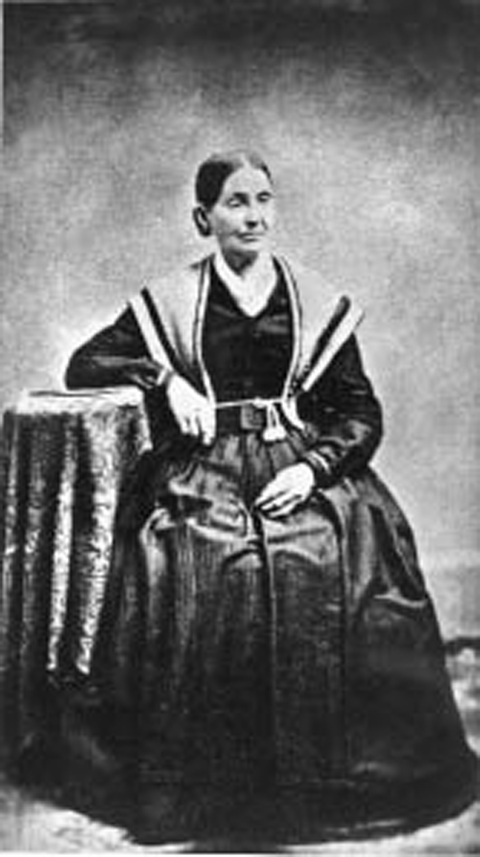
The relationship between Joseph and Emma (illus. 5-2) was paradoxical, to say the least. On the one hand, the evidence clearly suggests that they were deeply in love and maintained the tenderest of feelings toward each other until the day Joseph died.65 With the obvious exception of plural marriage, Emma openly supported him in nearly all his revelations and policies. She was appointed by her husband as the first president of the Relief Society, and she was a central figure in the sacred Anointed Quorum. On the other hand, understandably, she simply could not accept polygamy, and it was this that caused whatever strains came into their marriage. Curiously, it never seemed to threaten the marriage itself, but the tensions it caused were sometimes almost unbearable to both. Unfortunately for William Clayton, he became privy to some of those tensions.66 Not only that, but Joseph’s brother Hyrum also refused to accept either eternal or plural marriage. The two people closest to the Prophet, his wife and his counselor-brother, were also the source of his greatest burden as he tried to unfold these principles to them. He did not want to open the temple and perform sealings, eternal marriages, and plural marriages for everyone else, he felt, until these two accepted the doctrines and could teach them side by side with him.
Before the end of May 1843, however, Hyrum finally accepted both the principle of eternal marriage and the principle of plural marriage. Emma, too, accepted eternal marriage, and on May 28 she was sealed to her husband for eternity.67 Meanwhile she at least nominally, though temporarily, consented to plural marriage and reluctantly agreed to Joseph’s marriage to Emily and Eliza Partridge. On May 23, she watched Judge James Adams, a high priest, perform the ceremonies. Later, it appears, she also consented to Joseph’s marriage to Maria and Sarah Lawrence.68 Marriage for eternity and the sacred temple ceremonies were all now part of Emma’s fundamental faith. The thought of polygamy, however, continued to plague and dismay her, in spite of her nominal consent to some marriages, and she was never really converted to the principle.
Illus. 5-2. Emma Hale married Joseph Smith in 1827. As an early member of the Church, she endured many hardships in New York, Ohio, Missouri, and Illinois. In 1842, Emma became the first president of the Relief Society. Courtesy Church Archives
So it was that in the midst of some of his own difficulties, William Clayton was called upon by Joseph Smith to record the revelation that, the Prophet hoped, would help convert his wife. As Clayton reported in his journal on July 12, 1843:
This a.m. I wrote a Revelation consisting of 10 pages on the order of the priesthood, showing the designs in Moses, Abraham, David and Solomon having many wives & concubines. After it was wrote Prests. Joseph and Hyrum presented it and read it to E. who said she did not believe a word of it and appeared very rebellious.
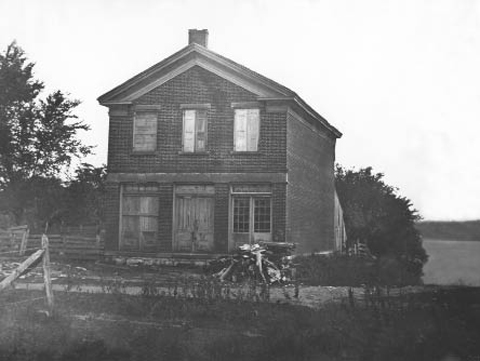
As Clayton recounted the story in more detail later, he was working in the office of Joseph Smith’s store (illus. 5-3) when the two brothers came in discussing plural marriage. The recently converted Hyrum said to Joseph, “If you will write the revelation on celestial marriage, I will take
and read it to Emma, and I believe I can convince her of its truth and you will hereafter have peace.” Joseph simply smiled and replied, “You do not know Emma as well as I do,” but Hyrum continued to press by saying that he could convince any reasonable man or woman of its truth. Still doubtful, Joseph nevertheless consented and indicated that “he knew the revelation perfectly from beginning to end.”
Joseph began to dictate, and Clayton wrote it sentence by sentence as it came from the Prophet. Joseph read it over, pronounced it correct, and then let Hyrum take it to Emma. Hyrum returned a wiser man, never, he reported, having been subject to a more severe “talking to.”69
But at least the revelation was in writing, and sometime during the day it was read to several Church authorities. The next day, with Joseph’s permission, Joseph C. Kingsbury made an exact copy of it. A few days later, Joseph Smith told Clayton and a few friends that Emma had destroyed the original copy. Continually, he said, she had teased him about it and finally “to get rid of her annoyance” and to pacify her he allowed her to destroy it. He could dictate it again if necessary but a copy had already been preserved.70
Clayton watched and prayed as Joseph continued his seemingly hopeless efforts to persuade his wife. The day after the revelation was recorded, Joseph called William into a private room where he and Emma had been having a serious discussion. They told William of an agreement they had entered into, and, though the details are not recorded, it must have had something to do with the principle. Both Joseph and Emma stated their feelings on many subjects and “wept considerably.” Deeply affected, Clayton wrote in his journal on July 13, “O may the Lord soften her heart that she may be willing to keep and abide by his Holy Law.”
The sacred, the secret, and the solemn: these gave Nauvoo the most meaning for William Clayton. Of all such experiences, however, one of the most solemn was the murder of Joseph Smith. As a nasty wound eventually heals and even strengthens some member of the body, the death of the Prophet left a void in Clayton’s life that in the healing only strengthened his internalization of and commitment to all Joseph Smith had done.
Though Clayton, and perhaps most of the faithful Saints, did not perceive it that way, Joseph Smith’s death was in some respects a political assassination. It was clear to the residents of western Illinois that the Mormons were a growing political force and that neither the Whigs nor the Democrats could count on their consistent support at the polls. At least by 1843 both parties had stopped courting their favor, and much of the populace seemed willing to believe almost any story about them. Rumors of polygamy were rampant, which was enough to raise the righteous indignation of even moderate citizens. Misperceptions of Joseph Smith’s teachings about the political Kingdom of God only added to the fearful accusations that the Mormons were attempting to gain the kind of political influence that might even lead to a religious state. John C. Bennett, who had earlier maneuvered his way into the confidence of Joseph Smith and was even elected mayor of Nauvoo, became so enraged when certain of his chicaneries were discovered that he published a series of newspaper exposes denouncing Mormon leaders for allegedly threatening his life, swindling local citizens, acting immoral, and plotting the conquest of certain Midwest states. And after Thomas Sharp, editor of the Warsaw Signal, was defeated by William Smith in the 1842 election for the state House of Representatives, he bitterly stepped up his already vehement newspaper attacks on the Latter-day Saints, calling for their extermination or expulsion.71 It did not help matters in Illinois when Joseph Smith announced his candidacy for the presidency of the United States.
Illus. 5-3. Clayton worked for a time in the office of Joseph Smith’s Red Brick Store, and it was here that Clayton recorded the revelation on plural marriage as the Prophet dictated it. Courtesy Church Archives
The story of the deaths of Joseph and Hyrum Smith is well known, but to follow the events through the eyes of William Clayton helps one sense more deeply the mounting tenseness and apprehension felt in the preceding weeks by those closest to the Prophet. The Twelve were away on missions (promoting, at least part of the time, the Prophet’s presidential platform), and Joseph therefore had none of the top Church leaders to rely on during the final difficulties. He naturally turned to his closest friends, including William Clayton.
The final events were precipitated on June 7, when a group of bitter seceders from the Church and members of other faiths published the first and only number of the Nauvoo Expositor. All the charges were there, including so-called political dictatorship and polygamy, and William Clayton was incensed. He knew the Prophet well enough to know he was no dictator and that his personal morality was of the highest order. “Truly,” he wrote of the Expositor in what was almost an understatement, “it seems to be a source of falsehood and bitter misrepresentation.”72 After the city council declared the offending newspaper a public nuisance and had its press destroyed, a groundswell of outrage raced through the area and all the old hatreds seemed to focus on Joseph Smith.73 Clayton heard rumors of mob action, heard Joseph Smith telling the Saints in Nauvoo to stand firm and protect themselves, and saw Joseph writing the Twelve, requesting them to come home without delay. It was a time of foreboding, and William Clayton sensed it deeply. Threats on the Prophet’s life were openly made, and the governor of the state, Thomas Ford, traveled to Carthage in a personal attempt to keep the peace.
On the evening of June 22, William Clayton called on Joseph Smith to discuss the best measures to be taken in case of mob attack. He then went home, but suddenly, at 1 a.m., he was roused with the message that Joseph wanted him. Fully aware of the plot afoot to take their lives, Joseph and Hyrum had decided that the best thing for them as well as for the Church was to flee across the Mississippi and perhaps find refuge in the Rocky Mountains. Joseph, Hyrum, and Willard Richards were preparing to leave, and Joseph told William W. Phelps, another close friend and scribe, to inform their wives and get their feelings on the subject. When Clayton arrived at the river, Joseph whispered his assignment to him: he was to give the records of the Kingdom of God (that is, the Council of Fifty) to a faithful man who would take them away to safety, or he should burn or bury them. Clayton certainly could not bear to part with or destroy the sacred and important records he had so faithfully kept, so he hurried home and early that Sunday morning gathered up not only the private records but also the public records and buried them.
That afternoon Joseph and Hyrum changed their minds, partly because Emma Smith sent a message to her husband urging them to return. They finally decided to submit themselves to arrest, go to Carthage, and try again to be released through the legal process. Late that afternoon as Joseph arrived back in Nauvoo, Clayton was there to greet him.
The next morning, Joseph, Hyrum, and several others whose names appeared on a writ started for Carthage. On the way they encountered a Captain Dunn with a contingent of militia, who had orders from the governor that the state arms in possession of the citizens of Nauvoo (that is, the Nauvoo Legion) should be turned over to him. Joseph returned to Nauvoo, countersigned the order, and instructed his followers to obey it. But Clayton caught the true feelings of the citizens of Nauvoo when he wrote: “Many of the brethren looked upon this as another preparation for a Missouri massacre nevertheless as Joseph requested they very unwillingly gave up the arms.”74 Later in the day, Joseph left Nauvoo the second time, and Clayton sadly observed:
Prest Josh rode down home to bid his family farewell He appeared to feel solemn & though[t]ful and from expressions made to several individual[s], he expects nothing but to be massacred. This he expressed before he returned from over the river but their appearing no alternative but he must either give himself up or the City be massacred by a lawless mob under the sanction of the Governor.75
By the next day, Clayton and others were fully persuaded that mobsters were ready to attack the city. One piece of convincing evidence appeared when Joseph Smith’s colorful and impetuous bodyguard Orrin Porter Rockwell got into a fight with one of the dissenters, Francis M. Higbee. A letter fell out of Higbee’s hat, and whoever recovered it read that seventy mobsters were gathered on the Iowa side of the river planning to descend on Nauvoo that night.76
On Wednesday, June 26, Clayton had his last chance to perform a service for Joseph Smith. In Carthage Jail (illus. 5-4), about noon, the Prophet wrote a letter to Jesse B. Thomas, presiding judge of the circuit court. Thomas was friendly to the Mormons and Joseph thought of him as “a great man and a gentleman.”77 Ten days earlier, Thomas had advised Joseph with regard to the Expositor affair, telling him that he should go before some justice in the county and have an examination of the charges specified in the writ against him. Joseph had followed that advice and was dismissed from custody in a habeas corpus hearing in Nauvoo. In his letter, Joseph briefly explained his circumstances and asked the judge to go to Nauvoo, make himself comfortable at the Smith home, and be ready to hear another habeas corpus case. Joseph, who expected to go to Nauvoo with the governor the next day, sent the letter to William Clayton with instructions that he should get a messenger to take it to Judge Thomas. Clayton received the message that afternoon, did as he was instructed, then sat down and wrote his final letter to Joseph Smith. It contained several short messages. One was that a Mr. Marsh, with whom Joseph had done business, was ready to put up bail for him in any amount. He also reported that he had sent the message to Judge Thomas and ended his letter with these words: “All is peace in Nauvoo. Many threats keep coming that the mob are determined to attack the city in your absence, but we have no fears. With fervency and true friendship, I remain yours eternally, William Clayton.” The letter arrived at Carthage Jail at 6:15 p.m.78
The next day, June 27, Clayton saw the governor arrive in Nauvoo, listened to him talk, and was outraged at what he thought was an unfair and intemperate speech. Little did he realize that late that afternoon his prophet was murdered by a mob.
Illus. 5-4. Mobs attacked Carthage Jail on June 27, 1844, killing both Joseph and Hyrum Smith and wounding John Taylor and Willard Richards, all of whom were being held there. From an engraving by Frederick Piercy. Frederick Piercy, Route from Liverpool to the Great Salt Lake Valley, 1854, L. Tom Perry Special Collections, BYU, Provo, Utah
Clayton went to bed that evening oblivious of the tragic affair taking place in Carthage. Early the next morning, Orrin P. Rockwell woke him with the stunning news that Joseph and Hyrum had been shot to death. Clayton’s diary entry for that day is one of the longest he ever wrote, and it contains within it all the sorrow, solemnity, and dismay that any disciple could feel. “I went out & met brother Cutler & several others,” he wrote, “and the news soon became general. Sorrow & gloom was pictured in every countenance and one universal scene of lamentation pervaded the city. The agony of the widows & orphan children [that is, the wives and children of Joseph and Hyrum] was inexpressible and utterly beyond description.” He went on with a lengthy description of what had happened at Carthage, as he understood it (which turned out to be a fairly accurate account), emphasizing what he considered to be the culpability of the governor for not providing better protection for the Prophet. He then wrote a prayer that, though vengeful in its tone, is a perfect reflection of the anger and frustration felt by many at the sudden tragedy:
And now O God wilt thou not come out of thy hiding place and avenge the blood of thy servants. —that blood which thou hast so long watched over with a fatherly care—that blood so noble—so generous—so dignified, so heavenly you O Lord will thou not avenge it speedily and bring down vengeance upon the murderers of thy servants that they may be rid from off the earth and that the earth may be cleansed from these scenes, even so O Lord thy will be done. We look to thee for justice. Hear thy people O God of Jacob even so Amen.
Clayton saw the bodies of Joseph and Hyrum arrive in Nauvoo about 2 p.m. and was part of the large procession of mourners that collected on the hill and followed them to the Mansion House (illus. 5-5). There they heard exhortations to be peaceful and calm and not to utter threats. He concluded his diary entry for the day:
Few expressions were heard save the mourns for the loss of our friends. All seem to hang on the mercy of God and wait further events. Some few can scarce refrain from expressing aloud their indignation at the Governor and a few words would raise the City in arms & massacre the Cities of Carthage & Warsaw & lay them in ashes but it is wisdom to be quiet. After the bodies were laid out I went in to see them. Joseph looks very natural except being pale through loss of blood. Hyrum does not look so natural. Their aged mother is distracted with grief & it will be almost more than she can bear.
Thus ended the life of the man for whom William Clayton came to Nauvoo in the first place, the man who gave Nauvoo its ultimate meaning for him. But what was that meaning, both for Clayton and the Mormon people? It was different for different people, of course, but perhaps for William Clayton it can be summed up in the aftermath of the martyrdom of the Prophet.
Illus. 5-5. Hyrum and Joseph Smith. Courtesy Museum of Church History and Art
Joseph was Clayton’s ideal, and his death on June 27 was a profound and indelible shock. “The blood of those men,” he wrote in that long entry of June 28, “and the prayers of the widows and orphans and a suffering community will rise up to the Lord of Sabaoth for vengeance upon those murderers.” Not that Clayton himself would take vengeance—violence was no part of his personality—but he fully expected that somehow, some time, the perpetrators of the crime as well as the people that allowed it to happen would be duly punished. He was shocked when those accused of the assassination, including Thomas Sharp, were tried but not convicted. “Thus the whole State of Illinois have made themselves guilty of shedding the blood of the prophets by acquiting those who committed the horrid deed,” he wrote later in his history of the temple, “and it is now left to God and his saints to take vengeance in his own way and in his own time.”79
In the confusing times that followed, Clayton observed the various claimants to Church leadership and was himself in the thick of the debate over who should take Joseph’s place as trustee-in-trust. He resented Emma’s efforts to draw Joseph’s property to herself and to influence the selection of the trustees.80 For a short time Clayton himself was appointed as the temporary trustee. As he observed the debates on what should happen he could not help but comment that “the greatest danger that no[w] threatens us is dissensions and strifes amongst the church. There are already 4 or 5 men pointed out as successors to the Trustee & President & there is danger of feelings being manifest. All the brethren who stand at the head seem to feel the delicacy of the business.”81
There were several seemingly viable alternatives so far as leadership was concerned. The decision one made depended in part, at least, on his personal experience in Nauvoo as well as deep emotional considerations. This was especially true of Clayton. Of all the options available, what Nauvoo meant to him could only be fulfilled in the course taken by Brigham Young and the Twelve. For Clayton, Nauvoo was Joseph Smith, but it was also the most sacred, trying, and emotional experiences to which Joseph Smith had introduced him. Only through the Twelve would the Council of Fifty, the Anointed Quorum, the endowment, the eternity of marriage, and the practice of plural marriage be maintained as he understood them. Clayton was never as intimate with Brigham Young as he was with Joseph Smith—there was, in fact, a seeming coolness at times. But because of his personal involvement with so many private activities and concerns of the Prophet, it was easy for him to transfer his loyalty to the man who seemed most likely to carry on those same activities.
In a way, William Clayton’s Nauvoo was the secret Nauvoo, for all the things that had the most long-lasting effect on him were secrets he shared with the Prophet and a limited number of faithful disciples. Thousands of other westering Mormons were introduced to the temple ceremonies before they left Nauvoo and to the concept of eternal marriage, but comparatively few were aware of polygamy and its implications. Other Saints who may or may not have known of these things followed either Brigham Young or some other claimant to leadership for various emotional or rational reasons. But the church Clayton knew and loved in 1845 was something different from the church he knew in 1840, and Joseph Smith had been responsible for all that was new. William was absolutely committed to the change, and he would stay with it.
Clayton’s Nauvoo, then, was really the Joseph Smith he knew, and in later years he kept the memory of that Joseph Smith alive. He constantly reminded the Utah Saints of what Joseph had said and done, and on one occasion was even criticized for not being able to bend enough to preach one aspect of the gospel “according to Brigham” instead of the way he remembered Joseph putting it.82 On another occasion one of his sons found him weeping as he listened to some brethren singing, and he explained that this singing reminded him of the Prophet. It was a natural opportunity for the boy to ask, “Father, did the Prophet Joseph really see an angel?” Clayton forcefully replied, “My son, he did see an angel, and don’t you ever doubt it.”83 At the same time, William recognized the subjective, emotional nature of his commitment to the Prophet of Nauvoo, and he admitted it. As he wrote to Joseph C. Rich in 1869, “I could not hear the ‘old settlers’ talk coolly about the murder of the Prophet and Patriarch without getting terribly mad and showing it. You did not feel it as I did, hence you can act wisely and with prudence. I could not.”84
Notes
1. Clayton, Nauvoo Journal, “Reflections,” January 1, 1845.
4. Clayton, “History of the Nauvoo Temple,” 21 (see app. 2, p. 420). For a short, general account of the building of the temple, see Miller and Miller, Nauvoo, 107–21. For a description of the font, see History of the Church, 4:446–47. See also Lisle G. Brown, “The Sacred Departments for Temple Work in Nauvoo: The Assembly Room and the Council Chamber,” BYU Studies 19 (spring 1979): 361–74; Stanley B. Kimball, “The Nauvoo Temple,” Improvement Era 66 (November 1963): 974–78, 980, 982, 984; Don F. Colvin, “A Historical Study of the Mormon Temple at Nauvoo, Illinois” (master’s thesis, Brigham Young University, 1962).
5. Clayton, Nauvoo Journal, November 28, 1842; History of the Church, 5:196–97.
16. Clayton, Nauvoo Journal, March 9, 1844. The reason for Joseph’s sadness on this day is unclear, but the fact that Clayton would record such tender moments is another reflection of his concern for the Prophet.
17. Clayton, Nauvoo Journal, August 1, 1843. Compare History of the Church, 5:523–24, 531. This is Willard Richards’s report of a speech given by Joseph Smith on August 13, 1843, in which the Prophet commented on the same incident. This report is slightly different from Clayton’s account:
He then complained of the treatment he had received from Walter Bagby, the county assessor and collector, who has exercised more despotic power over the inhabitants of the city than any despot of the eastern country over his serfs. I met him, and he gave me some abusive language, taking up a stone to throw at me: I seized him by the throat to choke him off.
The Backenstos deposition is found in the Fleming Collection, Church Archives.
18. See Doctrine and Covenants 21:1; 47:1, 3, 4; 69:3–8; 85:1, for various early revelations to Joseph Smith emphasizing the importance of historical records. Joseph Smith first began writing and dictating his own history in 1832.
19.Deseret News, January 20, 1858, as quoted in Dean C. Jessee, “The Writing of Joseph Smith’s History,” BYU Studies 11 (summer 1971): 473.
20. In preface by B. H. Roberts to History of the Church, iii.
21. This concept is well developed by Dean C. Jessee in his preface to Personal Writings of Joseph Smith. See also Jessee, “The Reliability of Joseph Smith’s History,” Journal of Mormon History 3 (1976): 23–47, for a very important critical evaluation of that work. For further details on the writing and reliability of Joseph Smith’s History, see Jessee, Has Mormon History Been Deliberately Falsified? (Sandy, Utah: Mormon Miscellaneous, 1982); Howard C. Searle, “Authorship of the History of Joseph Smith, a Review Essay,” BYU Studies 21 (winter 1981): 101–22; Searle, “Early Mormon Historiography: Writing the History of the Mormons, 1830–1858” (Ph.D. diss., University of California, Los Angeles, 1979).
23. Stanley B. Kimball, “Kinderhook Plates Brought to Joseph Smith Appear to Be a Nineteenth-Century Hoax,” Ensign 11 (August 1981): 66–74.
24. Jessee’s Personal Writings of Joseph Smith was a pathbreaking publication in this effort, for here he reproduced only those items that were written in Joseph Smith’s own hand or were clearly taken down verbatim as dictated by the Prophet. Since the publication of Personal Writings, however, Jessee has taken on the even more ambitious project of editing all of Joseph Smith’s papers. See The Papers of Joseph Smith Volume 1: Autobiographical and Historical Writings (Salt Lake City: Deseret Book, 1989) and The Papers of Joseph Smith Volume 2: Journal, 1832–1842 (Salt Lake City: Deseret Book, 1992). Jessee’s third volume in this series will be published in 2002. In addition, subsequent volumes of The Papers of Joseph Smith are currently being prepared by various scholars under the general editorship of Dean Jessee.
25. Jessee, ed., Personal Writings of Joseph Smith, 525–37, 690–91. Additional information on the “Book of the Law of the Lord” was graciously provided by Dean C. Jessee.
27.Deseret News, September 24, 1856. Compare History of the Church, 5:393–94.
28.History of the Church, 5:395–98. For more on Stephen A. Douglas and the Mormons, see “Judge Douglas and the Mormons,” Millennial Star 19 (October 1857): 702–704; Vern Bullough, “Polygamy: An Issue in the Election of 1860?” Utah Historical Quarterly 29 (April 1961): 119–26; Sister Mary O. S. F. Henriella, “The Interest of Stephen A. Douglas in the Mormons of Nauvoo, Illinois during 1836–1846” (master’s thesis, DePaul University, 1945); Bruce A. Van Orden, “Stephen A. Douglas and the Mormons,” in Regional Studies in Latter-day Saint Church History: Illinois, ed. H. Dean Garrett (Provo, Utah: Department of Church History and Doctrine at Brigham Young University, 1995), 359–79.
29. In 1852, for example, Clayton kept two journals while he was crossing the plains on his way to England on a mission. One was his personal journal, and the other was the official camp journal. The entries largely duplicate each other, but there are some variations.
30. A case in point is seen in some of Joseph Smith’s comments on the resurrection of little children. At least as early as March 1842, he was teaching that little children would be resurrected not as full-grown individuals but with the same stature as when they died and that they would not grow further. Their intelligence, however, would be equal to that of anyone. (See Joseph Smith’s sermon of March 20, 1842, as reported in the History of the Church, 4:553–56; Woodruff Journal, March 20, 1842, as reproduced in Andrew F. Ehat and Lyndon W. Cook, eds., The Words of Joseph Smith [Provo, Utah: BYU Religious Studies Center, 1980], 106–9.) On May 18, 1843, Clayton asked Joseph whether children who die in infancy would grow. “He answered ‘no, we shall receive them precisely in the same state as they died in no larger. They will have as much intelligence as we shall but shall always remain separate and single. They will have no increase. Children who are born dead will have full grown bodies being made up by the resurrection’” (Clayton, Nauvoo Journal, May 18, 1843). The same doctrine was also taught in the famous King Follett Discourse by Joseph Smith on April 7, 1844. This doctrine never “caught on,” however, in the mainstream of Mormon thought. Some have tried to explain it simply by suggesting that it may have been reported inaccurately (see, for example, B. H. Roberts’s editorial comment on the March 1842 sermon in History of the Church, 4:556, note, and his bracketed insertions, with editorial comment, in the King Follett Discourse in History of the Church, 6:316). An equally reasonable explanation, however, is that even the Prophet was not above doctrinal speculation at times and that this may have been one of those occasions. Clayton’s reporting of the idea in his diary adds strength to the evidence that Joseph taught the doctrine, but this should not be disturbing to those who recognize that not everything the Prophet ever said carried a “thus saith the Lord” stamp.
31. Clayton, Nauvoo Journal, January 22, 1843. Compare History of the Church, 5:256–59. The sermon as recorded in the History of the Church dealt with much more than Clayton suggests in his journal, but he was evidently most impressed with the statement given above (compare also Doctrine and Covenants 90:4–5; 124:39, 124–26).
32. The first recorded presentation of this idea by Joseph Smith was to members of the Quorum of the Twelve on June 27, 1839, as they were preparing for their important mission to England. (See Wilford Woodruff, Journal, and Ehat and Cook, eds., Words of Joseph Smith, 6.) Apparently Joseph taught it somewhat regularly after that. It was first published as a revelation in the Deseret News on April 23, 1856, and in 1876 it was placed in the Doctrine and Covenants as section 129. References to Joseph’s teaching this doctrine are found on August 8, 1839, in December 1840, and on March 21, 1841 (Ehat and Cook, eds., Words of Joseph Smith, 12, 44, 66). The December 1840 reference is in a curious source titled “Extracts from Wm Clayton’s Private Book.” The original “Private Book” is not available for research. A photocopy of the “Extracts” is available in the Scott G. Kenney Research Collection, J. Willard Marriott Library, University of Utah, Salt Lake City. A photocopy of the Kenney Papers is available in the Harold B. Lee Library, Brigham Young University, Provo, Utah. L. John Nuttall also made excerpts from Clayton’s “Private Book,” but these are incomplete. The Nuttall Papers are housed in the Harold B. Lee Library.
33. The whole of Doctrine and Covenants 131 in the Ehat and Cook, eds., Words of Joseph Smith, for example, is excerpted from his entries for May 16 and 17, 1843.
34. See Donald Q. Cannon, “The King Follett Discourse: Joseph Smith’s Greatest Sermon in Historical Perspective,” BYU Studies 18 (winter 1978): 179–92; Stan Larson, “The King Follett Discourse: A Newly Amalgamated Text,” BYU Studies 18 (winter 1978): 193–208; Van Hale, “The Doctrinal Impact of the King Follett Discourse,” BYU Studies 18 (winter 1978): 209–25.
35. “Lectures on Faith,” bound with the 1835 edition of the Doctrine and Covenants 52–53.
36. Parley P. Pratt, Mormonism Unveiled: Zion’s Watchman Unmasked, and Its Editor, Mr. L. R. Sunderland, Exposed: Truth Vindicated: The Devil and Priestcraft in Danger! (New York: Parley P. Pratt, 1838), 29.
37. In Clayton’s Nauvoo Journal, April 2, 1843, he simply makes reference to the latter part of the statement, indicating that “the Holy Ghost is a personage, and a person cannot have the personage of the H. G. in his heart. A man may receive the gifts of the H. G., and the H. G. may descend upon a man but not to tarry with him.” (Compare Doctrine and Covenants 130:22–23; History of the Church, 5:325. See commentary in Ehat and Cook, eds., Words of Joseph Smith, 268, note 5.)
38. For further treatment of the development of some doctrines, see James B. Allen, “Line Upon Line,” Ensign 9 (July 1979): 32–39; Allen, “Emergence of a Fundamental: The Expanding Role of Joseph Smith’s First Vision in Mormon Religious Thought,” Journal of Mormon History 7 (1980): 43–62; Thomas G. Alexander, “The Reconstruction of Mormon Doctrine: From Joseph Smith to Progressive Theology,” Sunstone 5 (July–August 1980): 24–33.
40. Clayton, Nauvoo Journal, May 16, 1843. The full quotation from Clayton is interesting:
He said that except a man and his wife enter into an everlasting covenant and be married for eternity while in this probation by the power and authority of the Holy priesthood they will cease to increase when they die (ie., they will not have any children in the resurrection[)], but those who are married by the power & authority of the priesthood in this life & continue without committing the sin against the Holy Ghost will continue to increase & have children in the celestial glory.
41. Clayton, Nauvoo Journal, May 16, 1843; compare Doctrine and Covenants 131:1–4.
42. Clayton, Nauvoo Journal, April 16, 1843. For a more complete version of the funeral sermon, compare History of the Church, 5:360–63.
45. For studies of the Council of Fifty, see Hansen, Quest for Empire; James R. Clark, “The Kingdom of God, the Council of Fifty, and the State of Deseret,” Utah Historical Quarterly 26 (April 1958): 130–48; Marvin S. Hill, “Quest for Refuge: An Hypothesis as to the Social Origins and Nature of the Mormon Political Kingdom,” Journal of Mormon History 2 (1975): 3–20; D. Michael Quinn, “The Council of Fifty and Its Members, 1844 to 1945,” BYU Studies 20 (winter 1980): 163–97; Andrew F. Ehat, “It Seems Like Heaven Began on Earth: Joseph Smith and the Constitution of the Kingdom of God,” BYU Studies 20 (spring 1980): 253–80.
46.History of the Church, 6:254–60; Flanders, Nauvoo, 290–92; Clayton, Nauvoo Journal, March 10–11, 1844.
47.History of the Church, 6:260–63; Clayton, Nauvoo Journal, March 13, 1844. At the beginning of 1845, Clayton reminisced about the importance of the new organization:
This organization was called the council of fifty or kingdom of God and was titled by revelation as follows, “Verily thus saith the Lord, this is the name by which you shall be called, the kingdom of God and his law with the keys and power thereof and judgments in the hands of his servants Ahman Christ.” In this council was the plan arranged for supporting president Joseph Smith as a candidate for the presidency of the U.S. Prest. Joseph was the standing chairman of the council and myself the clerk. In this council was also devised the plan of establishing an immigration to Texas and plans laid for the exaltation of a standard and ensign of truths for the nations of the earth. In this council was the plan devised to restore the Ancients to the knowledge of the truth and the restoration of union and peace amongst ourselves. In this council was Prest. Joseph chosen as our prophet, Priest, & King by Hosannas. In this council was the principles of eternal truths rolled forth to the hearers without reserve and the hearts of the servants of God made to rejoice exceedingly. (Clayton, Nauvoo Journal, “Reflections,” January 1, 1845)
48. Clayton, Nauvoo Journal, April 11, 1844, records the vote: “Prest. J. was voted our P. P. & King with loud Hosannas.” This is a very important entry so far as the history of the Council of Fifty is concerned, but the question as to whether Joseph Smith was actually ordained a king is still debatable. Evidence presented in Hansen, Quest for Empire, 66–67, is open to some question. Clayton, Nauvoo Journal, August 18, 1844, provides one indication that Clayton spent a lot of time copying the records of the Kingdom.
49. Clayton, Nauvoo Journal, March 10, 1845. The grand council in heaven refers to the belief that the “plan of salvation” was presented to all God’s spirit children in their premortal state, and those who accepted it were those who would have the privilege of coming to earth for a probationary period. See Abraham 3:22–28 in the Pearl of Great Price. For more on Joseph Smith’s prayer circle, see D. Michael Quinn, “Latter-day Saint Prayer Circles,” BYU Studies 19 (fall 1978): 79–105.
50. Clayton, Nauvoo Journal, February 3, 1844. With reference to the apparent stress between William Clayton and Emma Smith, it might be noted that even a week or so before Clayton wrote to Joseph Smith, he lamented in his journal that Emma had power to prevent him from being admitted to Joseph’s “Lodge.” The term “Lodge” seems almost certainly to refer to the Anointed Quorum (Clayton, Nauvoo Journal, November 21, 1843).
52. Clayton, Nauvoo Journal, November 30, 1845; History of the Church, 7:534–35. The latter entry is based almost verbatim on the Clayton journal, except that a few items in the journal are omitted, such as the fact that the participants were dressed in their temple clothing and that they rehearsed the ceremonies.
53. Clayton, Nauvoo Journal, December 10–11, 1845.
54. A fine and very important paper on the origin of the concept of “eternal marriage” and its relationship to “plural marriage” is Andrew F. Ehat’s, “An Overview of the Introduction of Eternal Marriage in The Church of Jesus Christ of Latter-day Saints: 1840–43” (unpublished manuscript in possession of the author, 1980). This material is also incorporated in Ehat’s “Joseph Smith’s Introduction of Temple Ordinances and the 1844 Mormon Succession Question” (master’s thesis, Brigham Young University, 1982). Ehat marshals a great deal of evidence relating to the introduction of the eternal marriage concept. He has also done some excellent sleuthing to arrive at the date of Emma Smith’s sealing to Joseph.
55. It seems significant to note here that, as detailed in chapter 7 herein, Clayton’s first three plural wives were women he had known in England, and that he also proposed to Sarah Crooks the moment he could get permission from the Prophet. For a statistical analysis of polygamous marriages, see Stanley S. Ivins, “Notes on Mormon Polygamy,” Western Humanities Review 10 (summer 1956): 229–30. Clayton was among the very small minority that took more than one additional wife.
56. In the modern Church this is also sometimes referred to as the doctrine of celestial marriage. There was a distinction in the days of Joseph Smith, however, as the term celestial marriage seemed to be used as a synonym for plural marriage. It is also a doctrine that living people may be sealed by proxy in behalf of the dead who had no chance to have the ordinance performed properly on the earth, just as they may perform proxy baptisms.
58. The literature on plural marriage is voluminous, and often controversial. Still one of the best discussions on plural marriage in Nauvoo, particularly with reference to the evidence dealing with Joseph Smith’s wives, is Danel W. Bachman, “A Study of the Mormon Practice of Plural Marriage before the Death of Joseph Smith” (master’s thesis, Purdue University, 1975). See also Richard S. Van Wagoner, “Mormon Polyandry in Nauvoo,” Dialogue: A Journal of Mormon Thought 18 (fall 1985): 67–83. A recent attempt to provide a comprehensive coverage of Joseph Smith’s wives is Todd Compton, In Sacred Loneliness: The Plural Wives of Joseph Smith, 3d ed. (Salt Lake City: Signature Books, 1992). But see also two important critiques of that book: Richard Lloyd Anderson and Scott H. Faulring, “The Prophet Joseph Smith and His Plural Wives,” FARMS Review of Books 10, no. 2 (1998): 67–104; Danel W. Bachman, “Prologue to the Study of Joseph Smith’s Marital Theology: In Sacred Loneliness: The Plural Wives of Joseph Smith [by] Compton, Todd,” FARMS Review of Books 10, no. 2 (1998): 105–37. The most recent attempt to provide a broad coverage of this history of plural marriage is Richard S. Van Wagoner, Mormon Polygamy: A History (Salt Lake City: Signature Books, 1986). For an insightful discussion of how plural marriage was generally accepted by the women of the Church, see Kahlile Mehr, “Women’s Response to Plural Marriage,” Dialogue: A Journal of Mormon Thought 18 (fall 1985): 84–98. For more on this practice in Nauvoo, see the listings under “Smith, Joseph, Jr., plural marriage” in James B. Allen, Ronald W. Walker, and David J. Whittaker, Studies in Mormon History 1830–1997: An Indexed Bibliography (Urbana: University of Illinois Press, 2000).
59. Helen Mar Whitney, Why We Practice Plural Marriage (Salt Lake City: Juvenile Instructor Office, 1884), 53, as cited in Kimball, Heber C. Kimball, 87.
61. William Clayton, “Another Testimony—Statement of William Clayton,” 3–5, a statement notarized by John T. Caine. Here Clayton misspelled the names of Louisa Beaman and Desdimona W. Fullmer.
62. Clayton, “Another Testimony,” February 16, 1874, 12.
63. Quotations are from Clayton, Nauvoo Journal, for the dates indicated. See also History of the Church, 5:391. On that occasion, Joseph Smith said that the “unpardonable sin is to shed innocent blood, or be an accessory thereto.” Elsewhere, denying the Holy Spirit or, in other words, denying Christ after having received the testimony of the Holy Spirit concerning the divinity of Christ, is called unforgivable. Doctrine and Covenants 76:34–35. Some join these two ideas by observing that to deny Christ is the same as joining in shedding his blood. Bruce R. McConkie, A New Witness for the Articles of Faith (Salt Lake City: Deseret Book Company, 1985), 232–33.
64. This relationship is discussed in full in chapter 7, “One Man’s Families.”
65. A biography of Emma Smith, Mormon Enigma: Emma Hale Smith (Garden City, N.Y.: Doubleday, 1984), by Linda King Newell and Valarie Tippets Avery has shed much new light on the relationship between Joseph and Emma.
66. Clayton provides important evidence for the fact that Emma recognized the existence of the doctrine of plural marriage, that it caused some strain between her and Joseph, and that she came near, at times, to accepting it. See James B. Allen, “One Man’s Nauvoo: William Clayton’s Experience in Mormon Illinois,” Journal of Mormon History 6 (1979): 44, note 17. Newell and Avery’s Mormon Enigma provides more evidence of this.
67. Ehat, “Joseph Smith’s Introduction of Temple Ordinances,” 61–63. On May 26, 1843, Clayton made a special note in his Nauvoo journal that this was the day “Hyrum received the doctrine of the priesthood.” This clearly meant plural marriage.
70. Clayton, “Another Testimony,” 10‒11. For a full and perceptive discussion of the authenticity of Clayton’s claims concerning the revelation, see Bachman, “Plural Marriage,” 204–16. For a comment on Joseph Kingsbury’s involvement in copying the revelation, see Lyndon W. Cook, Joseph C. Kingsbury: A Biography (Provo, Utah: Grandin Book Company, 1985), 78–79.
71. For more details and references on some political issues and on the martyrdom, see chapter 8 herein.
73. For a thorough study of the Expositor affair and its legal ramifications, see Dallin H. Oaks, “The Suppression of the Nauvoo Expositor,” Utah Law Review 9 (winter 1965): 862–903.
78. Clayton, Nauvoo Journal, June 26, 1844; History of the Church, 6:598–99.
79. Clayton, “History of the Nauvoo Temple,” 80–81. See app. 2, p. 436.
80. Clayton’s discomfort with Emma probably began during Joseph Smith’s lifetime, partly because of the strains he saw over the problem of polygamy, and therefore some of his reporting may have been distorted. On May 21, 1844, for example, Clayton reported that when Joseph had ridden outside of Nauvoo to keep away from an officer with a subpoena, he sent Clayton to find out how Emma felt about Joseph’s returning home. “I found her crying with rage and fury because he had gone away,” Clayton wrote. “She wanted him to go home. I came and told him & he returned home at 9 o’clock.” What Clayton did not report was that Emma was very ill at the time and Joseph was evidently worried about her (see History of the Church, 6:398–99).
82. Minutes of the School of the Prophets, Salt Lake City, February 10, 1873, Church Archives.
83. Louis Clayton, “William Clayton,” Instructor 82 (May 1947): 205.
84. Clayton to Jos. C. Rich, December 19, 1869, William Clayton Letterbooks, Bancroft Collection, University of California, Berkeley (microfilm in Church Archives). Hereafter, all William Clayton letters come from the Bancroft Collection unless otherwise noted.