Our Lord has spoken clearly in his revelation to the prophets on what is right and what is wrong in our personal conduct and social relations. He has revealed to man the saving ordinances of the priesthood. He has revealed the doctrine of eternal progression which sets forth a profound purpose—potential exaltation with God.
But it is interesting that the Lord has offered little in the scriptures about the specifics of how to teach the gospel. The scriptures do stress that we should teach by example and by the power of the Holy Spirit,1 and by his own teaching the Lord demonstrated the worth of teaching with parables,2 of spontaneity in teaching as he structured lessons out of questions raised,3 and of communicating love while teaching.4 But he has said very little on specifically how we are to teach the gospel. This he has left largely to us to find out.
Latter-day Saint educators (parents, Church teachers, and officers) have the responsibility of finding and implementing effective ways of teaching the gospel. We all need to find out how we can increase our power to influence others to live the revealed doctrines of Christ. By power we mean simply the teacher’s ability to produce attitude changes which implement gospel doctrines. Since we influence others in many ways, the ideas discussed here form only one suggested way of increasing the educator’s ability to influence others with a desired effect.
Basic Components of Latter-day Saint Teaching and Some of Their Interrelationships
A common saying in secular educational circles is that the ideal teaching situation consists of Mark Hopkins sitting on one end of a log and a pupil on the other.5 What I read into this notion is that the ideal is to get a great teacher in a face-to-face relationship with a student. Together the two can meaningfully share ideas initiated by the teacher, with the intent of certain change being generated in the student. Much can be said for this ideal. But we must first consider its existing rudiments.
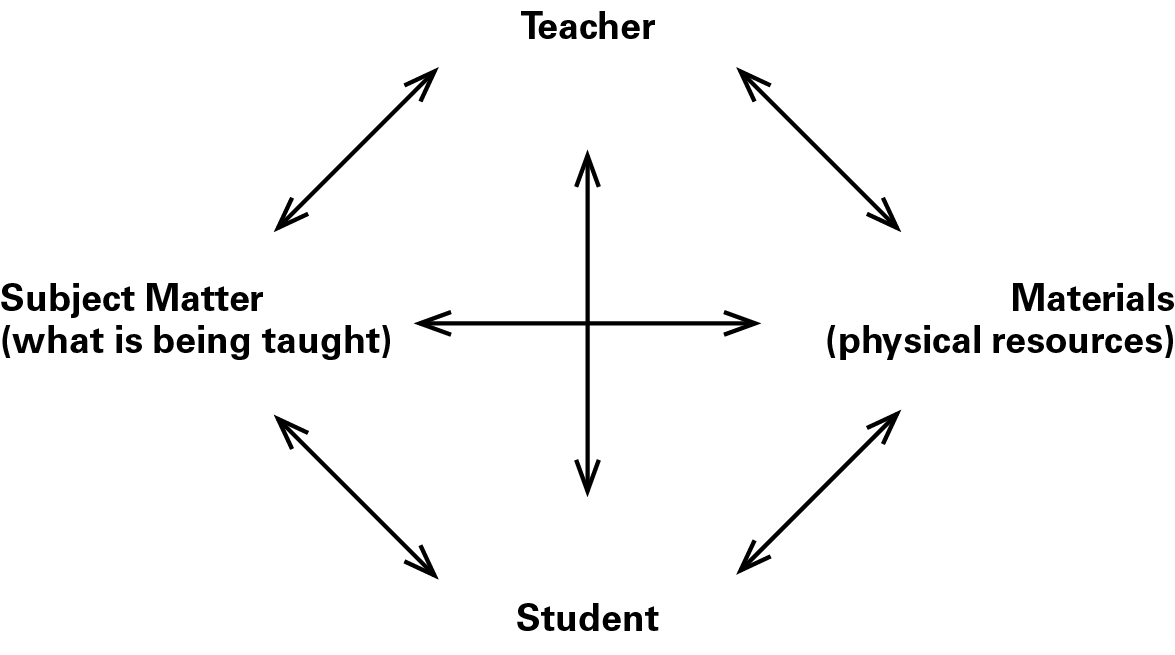
The Mark Hopkins arrangement consists basically of a teacher, a student, an idea, and a log. Fundamentally, these properties exist in all teaching. The teacher is the transmitter6 or initiator7 of ideas. The student is the receiver. The ideas we will call subject matter or that which is being taught.8 The log symbolizes materials or physical resources used to help transmit ideas. Materials consist of all physical properties useful in instruction.
Each of these four components—teacher, student, subject matter, and materials—has relevancy to the others. It is indeed the way in which their constituent parts are organized which largely determines the success or failure of establishing desired changes in the student. As in systems theory, which has made success possible in notable undertakings such as placing man on the moon, effective teaching calls for planning the interrelationship of vital factors which have bearing on hoped for results. Our basic model then would appear as given in figure 1.
Fig. 1. Basic components of teaching
We usually think of teaching in a formal classroom setting. But in this model, a parent driving his car to grandmother’s house could well be the teacher and his child in the passenger seat the student, with the car possibly serving as both subject matter and materials. Teaching takes place in other daily activities such as at the dinner table, on the ski slope, or in the church hallway after a meeting, as well as in a formal priesthood, Sunday School, or seminary class.
Wherever the four teaching components interrelate in process, teaching exists in some form. Conversely, all teaching situations possess these components. The extent of instructional power is determined by expedient controls brought to bear on the organization of the teaching components.
When the necessary balance is attained, an equilibrium of power exists among the teaching components sufficient to prevent any one component, or its parts, from becoming strong enough to inappropriately exclude another. To say it another way, a consequence of balance is power which is produced by appropriate distribution of focus on the intrinsic qualities of teacher, student, subject matter, and materials. But balance does not necessarily imply equal emphasis to the four components. For example, materials might be deemphasized on some occasions to attain balance. Mark Hopkins’s best moment in teaching might have been in the use of only a log for materials. On the other hand, the student might find himself in a well-balanced instructional environment that is almost completely mechanical, such as role playing the Sumarian game with a talking typewriter. Each teaching moment will call for its own unique type of emphasis as expedient measures are considered in instructional planning.
Relationship of Subject Matter to Teacher and Student
If a teacher focuses on the subject matter to the exclusion of student needs and interests, he will limit the possibilities of changing the student. The teacher must establish relevancy between subject matter and the student’s world. By way of illustration, the gospel teacher will share with the football player ideas about the Lord’s “game of life.” The teen-age girl who is interested in making herself physically attractive will be taught ways of becoming spiritually attractive. The restless child who wants to enjoy physical play will be led by the teacher in an instructional body action song, such as “I Have Two Little Hands,” which helps transmit the subject matter.
We have all observed some teachers of the gospel giving overemphasis to subject matter by means of rigid theological exposition. Paying excessive attention to the ideas being taught, the teachers appear stereotyped, setting forth, usually through the lecture method, doctrines of their convictions. They focus, for the most part, on the teacher-subject matter relationship to the considerable exclusion of teacher-student, teacher-materials, subject matter–materials, student–subject matter, and student-materials relationships. Here, both the effect of a Mark Hopkins and a functional use of the log are missing, and the student is only vaguely in view.
Many progressives in secular education in the 1920s and ’30s gave much emphasis to the experience of the student. Out of the progressive movement came such clichés as “I don’t teach subject matter, I teach students.” It is not uncommon even today to hear Church teachers puppet this progressive idea. Of course, the properly balanced view in discussion of student and subject matter would be “I teach students subject matter.”
One of the serious side effects in this deemphasis of subject matter is a consequential deemphasis of academic excellence. Academic excellence connotes intellectual merit and is promoted by giving considerable meaningful focus to subject matter. Teaching students subject matter with effective use of materials gives the fundamentals for balance in attaining academic excellence.
In the history of Latter-day Saint curriculum, many courses of study for priesthood and auxiliary classes have presented only the content of subject matter. They were written as regular historical or doctrinal books presenting only ideas to be taught, with no offering to the many inexperienced teachers in the Church of how to organize these ideas for instruction. This neglect has not strengthened teaching in the Church.
Relationship of Materials to Subject Matter, Teacher, and Student
The teacher must find and develop uses of materials which would best help transmit subject matter to the student. He may find flannel board materials for teaching certain ideas about the plan of salvation to be more effective than a recorded talk on the subject. In another teaching moment, the voice and spirit of the teacher would be the media used to obtain optimal power. There are no “best” materials to use in all teaching situations. What is best can be determined only in terms of each teaching moment in the specific relationship of teacher, student, subject matter, and materials.
While some teachers “teach students” and others teach subject matter, some others ride materials “hobby horses.” One teacher will insist on having an overhead projector for every lesson he teaches. Another, in outright laziness or chronic insecurity, will habitually read his lessons from books. Another will use few other materials but pictures.9 But the teacher with optimal power, on the other hand, will be both flexible and inventive. He will often try new materials which he will have selected and prepared for their support of what is being taught. And all this he will do in relation to the needs, understandings, and interests of the student.
The instructional media specialist is making an excellent contribution to teaching with his improved and new instructional materials; but, because of his focus on media, he faces the constant hazard of imposing imbalance by overemphasis on the materials. He might thereby sometimes actually limit instructional power. For example, a motivating movie may not in some cases have as much instructional value as a meaningful teacher-student discussion or be as helpful as having a student become directly involved in role playing a personal problem he is attempting to resolve.
Sometimes instructional equipment even distracts from ideas being taught. In one gospel class, I observed a small group of boys so intrigued by the light in a filmstrip projector that they were oblivious to the message on the screen. A projector can have considerable instructional utility, but focus of student attention on the ideas being taught is the commanding aspect of power to influence.
There are many effective materials which enhance instructional power. These materials are particularly useful to the teacher who might lack charisma or the ability to communicate well. An overhead projector or tape recorder can actually serve as a crutch to the less effective teacher. Some people do not believe in crutches, but, if a crutch will help a man get where he wants to go, why not use it? Quality instructional materials used skillfully and in proper balance help poor teachers to do better and help better teachers to excel.
Relationship of the Spirit of the Holy Ghost to Teacher and Student
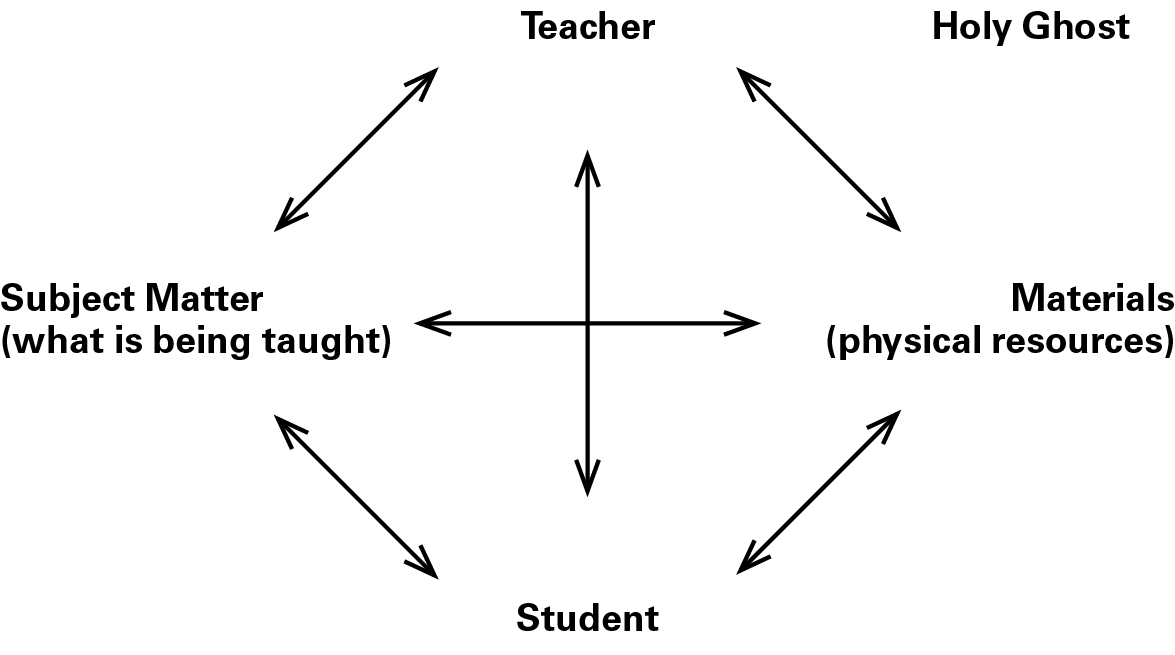
Spiritual excellence, which should be of particular import to the gospel teacher, is assisted through appropriate balance of the four teaching components. Harmonious arrangements attained through balance set the stage for spiritual experience shared by teacher and student because of the relevance and compatibility that is engendered. But gospel teaching is distinctive in that, to be most powerful, it must involve a fifth component—the Spirit of the Holy Ghost. The complete model would then appear as follows in figure 2.
Fig. 2. Basic components of Latter-day Saint teaching
It was mentioned earlier that the scriptures instruct us to teach by the Spirit. The Holy Ghost can become a second teacher, for He testifies and reconfirms to the sincere student the authenticity of truth which is taught by the worthy teacher.10 Optimal and ultimate power rests with God. The truly significant power is found in the teacher who keeps the commandments of God, loves his students, which I am convinced is the great commandment in teaching, and then teaches by the power and guidance of the Holy Spirit.
As with our earlier model, the teacher who best produces worthy effects maintains a balance by skillfully organizing all five components of teaching. It is not hard to remember individuals of great faith lulling classes and audiences to sleep due to poor organization of the teaching components and ineptness of communicating ideas to other people. Yet, many Latter-day Saint educators often fall short in teaching by the Spirit. Most of us are not as close to the Lord as we ought to be. And because of this, we as well as the students are the losers.
Occasionally, teachers whose spiritual perceptions are skewed appear on the scene. The more radical of them may tend to equate everything by the Spirit, and in some instances go so far as to start spiritualist movements. It has been known to happen. Such individuals depart so far from a balanced perspective that the very component they seek to embrace so tenaciously, the Holy Spirit, eludes their grasp, and they are left holding fast to a spirit that is foreign to God.
A teacher must maintain a proper balance by attending to the realities of the student’s life as lessons are presented. Within such context of reality, the teacher should seek to make the Lord his constant companion in his private life and upon appropriate occasions should seek to provide his students with deeply meaningful spiritual experiences.
Relationship of Teacher and Student in Meaningful Experience
It would be very difficult for a Church teacher, officer, or parent to have meaningful religious experience with a student without first being an exemplar of Christ’s doctrine. For how can one implant in others moral principles that he has not come to understand, appreciate, and live himself? As is taught in the Priesthood Teacher Development Program, “You teach what you are.” It is with the educator that the student appropriately identifies. When the parent, officer, or teacher lives Christ’s teachings, he becomes in a sense the subject matter and material in action. If he then, with a delicate sensitivity, builds a bridge into his student’s world to feel the pulsations of the pupil’s heart, and the two openly share feelings of love, they will find themselves in a meaningful relationship. But it takes time, patience, and sacrifice of self-interests to accomplish this end; and this quality of rapport is usually much more difficult to attain in groups than in an ongoing face-to-face relationship with an individual. There is merit in frequently having a log—with only two ends to sit on. This is why the home can be such a powerful school of learning. The relationship of the teacher-parent and student-child is frequent, continuous, and usually face-to-face. The instruction is individualized.
The meaningful religious relationship is not tempered with compulsion but with persuasion and choice. When the teacher attempts to force, he violates Christ’s doctrine of free agency through denial of another’s freedom, and thereby a divine educational precept is exploited.
Power to influence the student on the other end of the log is couched in sensitivity and adaptability to the student’s feelings. This implies care, respect, trust, and is manifest in an interpersonal fusion of the two individuals.11 Power to influence is particularly manifest in that man or woman who is a living example of the Latter-day Saint doctrine he or she professes. It is much easier for a student to love a teacher and internalize his presentments if the teacher is intrinsically good.
Meaningful experience between teacher and student is of course enhanced through intellectual understanding as well as through effective understanding. For example, as the student comes to comprehend the doctrine of mercy and justice in relation to the atonement of Jesus Christ, the teacher who imparts this knowledge brings his protégé into his own world of intellectual understanding. The sharing of knowledge as well as the sharing of feeling has a magnetic fusing effect.
Meaningful experience is further enhanced by opportunities being provided for the student to practice Christ’s doctrine in social relationships. Much then can be said for the gospel classroom or home with controlled social activity. John Dewey noted that a fundamental criterion in measuring the worth of a form of social life is the extent to which “the interests of a group are shared by all its members.” Dewey held that a community which makes provision for “participation in its good of all its members on equal terms” implies a particular social ideal.12 In my observation, I have found no religious or political organization that so inclusively sweeps the individual into the mainstream of its tenets through social experience as does the Latter-day Saint Church. Church doctrine permeates almost every waking moment of the orthodox Latter-day Saint. Precepts of honesty and other lofty ideals carry into his daily work routine, and much of his free time is spent in social relationships in Church activity. But it is up to the parent, Church teacher, and officer to see that the student is meaningfully involved in practicing Christ’s doctrine in social exchange with other orthodox Latter-day Saints.
For example, if in a meaningful way a student hears the teacher relate a faith-promoting experience which brings out the value of prayer, then, in the thinking of the student, the doctrine of prayer is justified to be practiced. When the student bears his own testimony of the value of prayer, he is in process of justifying the value of the doctrine of prayer by an expression of having tested it through practice. When Church doctrines and experienced practices are used to justify and reflect each other, their realities are sustained in the thinking of the participants. Relating scriptures to life experiences is another form of this justifying technique. We as Latter-day Saints often use this approach in testimony meetings, talks, and prayers without fully recognizing its significant educational value.
There are yet two matters which pertain to the teacher-student relationship of which the educator should be aware; for these matters have significant bearing on the parent’s, Church teacher’s, and officer’s lack of effectiveness in influencing students to live the revealed doctrines of Christ. First, the educator often falls short in preparing the student to cope with the larger society on academic and moral issues. Second, the Latter-day Saint student suffers from a lack of continuity of religious experience in the Church.
Coping with the Larger Society: The Teacher-Student Relationship
Many young people being raised in the Church are brought up under somewhat of a protective canopy from the enticements of the world. Along with parents and siblings, they hold family prayer, attend Church regularly, have weekly home evenings, do not break the Word of Wisdom, pay a full tithing, and generally love their fellowmen. Many of their friends are active Latter-day Saints with similar patterns of conduct. Others in the Church, however, are exposed early in life to “worldly” practices, being raised in less wholesome environments. The principle of accessibility suggests that we tend to internalize thoughts and practices, whether they are good or bad, which are most available or accessible to us.13
Those individuals and stimuli nearest the student in meaningful relationships will therefore tend to have the most significant influence on the student. Continuous accessibility to orthodox Latter-day Saints and Church doctrine and continuous inaccessibility to values incongruent with Church values would then appear to be the ideal environment for educating the student. But the problem remains that sooner or later the student will be exposed to “worldly” ideas. The Latter-day Saint educator must then prepare the student early in life to cope with unorthodox values. In addition to initiating the student into Latter-day Saint teachings and practices, the educator would appropriately expose the student to conflicting ideas, under controlled conditions, in such ways as to justify and entrench the revealed doctrines of Christ in his thinking.
The parent, teacher, and officer would then identify the problems with which the student must one day cope. For example, the wise educator would be aware of the new attitude about sexual freedom and the many ways it is propagandized through the mass and private media. The educator would identify the trend of rebellion against authority; he would be aware of the nihilistic and anarchistic movements. The educator would assess conditions pertaining to drug abuse, alcoholism, and smoking. He would understand the evil implications of certain hard rock music. If he has students in higher education, he would have insights into such theories and philosophies as organic and social evolution, Freudian psychology, and existentialism, which may be claimed to suggest incongruencies with Christ’s doctrine. Then with much care the educator would prepare his student, not only dressing the student well in the doctrinal armor of Christ but also assessing with the student the strategy of the evil forces in forthcoming inevitable attack.
To illustrate this method of coping, an alert mother who has a teen-age daughter saw a Hollywood star on TV wearing “hot pants.” The mother, suspecting that a new fad for exposing the female body was being introduced, called in her daughter and told her about the new trend that she suspected was starting. They discussed the sacredness of the body in terms of Church teachings, and the daughter formed the opinion that “hot pants” were in poor taste. The daughter influenced her best friend with the same attitude. The two girls then formed an alliance that they would never wear “hot pants.” If the mother-educator had waited to cope with the problem of “hot pants” until the daughter was influenced by the mass media and peers to wear them, the story might have ended quite differently. Worldly philosophies and other moral issues can be effectively coped with in this same way by using Christ’s doctrine as the framework and criteria for determining truth and right. This, I think, is part of what Christ meant when he said, “Seek ye first the Kingdom of God.”14 A student who has not been prepared to meet the forthcoming incongruencies of life has not received a properly balanced Latter-day Saint education.
Providing Continuity of Religious Experience: The Teacher-Student Relationship
There is considerable emphasis in the Church to provide the student with a correlated curriculum. This means that attempts are being made to sequence gospel teachings in courses of study to reduce redundancy and to emphasize what is considered needed by students in various age groups. This approach, of course, has sound educational underpinnings.15 Where attention is particularly needed, however, is in correlating the experiences of each individual student. In other words, the experiences of the individual student need to be balanced.
Latter-day Saint education is a continuous unfolding from within. For the best effect in this unfolding process, each successive experience of the student should be brought into a continuous order. Each experience should not only meet its immediate purpose but assist experiences which follow for the individual. Each performance of the student should be balanced with those which both precede and come after it so as to achieve order in experience.16 The educator must then provide a continuity of initiations into Church teachings and practices. Latter-day Saint educators are not yet significantly successful in accomplishing this.
Continuity of experience is made possible particularly through the student’s participation with “significant others.” I would define significant others as individuals most meaningfully accessible to the student. Parents are, of course, significant others, but Church officers and teachers can also play this role, though to a lesser extent. But the officer or teacher must have frequent, ongoing, meaningful contact with the student. The excessive turnover of officers and teachers, as well as substitutions and absenteeism, gives but limited opportunity to the student to form an identity with his educators.
The Latter-day Saint student has many teachers. For example, a male teen-ager is taught by parents, MIA leaders, a Sunday School teacher, priesthood advisors, and a seminary teacher, in addition to school teachers and others. Each parent, Church officer, and teacher may have little idea what the others have taught. Because of past teachings, the student already knows much of what he is now being taught. Within a week’s time a certain teaching might be redundantly repeated again and again to the student. Clearly, each successive religious experience is not building meaningfully on preceding experiences.
What can be done to improve a student’s continuity of experience with parents, Church officers, and teachers? Parents should prepare home evening lessons regularly and prepare well with each child’s needs in mind. Parents should spend every possible minute with their children in ways that are meaningful to the children. Officers and teachers should be dedicated to those under their care, meet every expected commitment, and go the second mile in visiting with and getting to know the student and the student’s parents. A concentrated effort should be made to decrease the frequency of substitution and turnover of officers and teachers. All who are in a present teacher or officer role of influencing an individual student should meet frequently in correlating the experiences of that individual. Such an approach in balancing the religious experience of each individual student will offer more power than a far removed curriculum committee spending untold hours trying to determine whether the atonement should be taught to fifteen or sixteen year olds.
There is significant merit in the frequent, continuous, and meaningful relationship between teacher and student. Plato was continuously with Socrates for some ten plus years. Aristotle began a long study with Plato about twenty years before Plato’s death at age eighty-one. James Mill gave daily intensive instruction to his son John Stuart throughout the boy’s childhood and adolescence. Christ spent the better part of three years with his apostles, day after day and often into the night, preparing them in gospel ideals. Instructional power has something to do with making orthodox teachers as well as the subject matter of gospel teachings secure in the pupil’s experienced existence.
Summary
We can increase our power to influence others to live the revealed doctrines of Christ by attaining instructional power through appropriate balance of the intrinsic qualities of the teacher, student, subject matter, and materials components. We must also recognize that the spirit of the Holy Ghost is an essential ingredient in effective Latter-day Saint education. When appropriate balance in the use of these five factors is attained in the teaching process, an equilibrium of power exists in changing the lives of students.
Several of the ideas in this paper were adapted from a doctoral dissertation by the author, “An Investigation of Selected Educational Conditions within the Latter-day Saint Community,” Teachers College, Columbia University, New York City, N.Y., 1970. The problem statement of the dissertation is “By what processes is the new generation inducted into valued doctrines and institutions of the Latter-day Saint community.”
Dr. Hobbs is executive secretary of Teacher Development and coordinates the program for improvement of instruction of priesthood and auxiliary teachers in the Church. He has served in various administrative positions with the Department of Seminaries and Institutes of Religion and has written several publications on the Latter-day Saint teaching process.
5. This remark originated from a speech delivered to the Williams College alumni on 28 December 1871 by General, later President, James A. Garfield. Garfield was a student of Mark Hopkins, the latter having served with distinction as professor of philosophy at Williams College for over fifty years, and as college president thirty-six of these years. Garfield has also been quoted by some as saying, “The ideal college is Mark Hopkins on one end of a log and a student on the other.” Possibly a more accurate account by Garfield, however, is the statement: “I am not willing that this discussion should close without mention of the value of a true teacher. Give me a log hut, with only a simple bench, Mark Hopkins at one end and I on the other, and you may have all the buildings, apparatus and libraries without him.” See Houston Peterson, Great Teachers (New York: Vintage Books, 1946), p. 75. Encyclopaedia Britannica (1960) 11:738. Dumas Malone, ed. Dictionary of American Biography (New York: Charles Scribner, 1964), 5:216.
6. This idea of transmission is taken from John Dewey, Democracy and Education (New York: The Free Press, 1966), pp. 1–4. For a brief discussion on Dewey’s transmission and LDS doctrine, see Charles R. Hobbs, “An Investigation of Selected Educational Conditions within the Latter-day Saint Community,” Unpublished dissertation, Teachers College, Columbia University, New York City, N.Y., 1970, pp. 15–16
7. Peters gives an excellent discussion on “initiation” as an educative process. Drawing from Peters, we might say that the teacher initiates the student into ideas being taught. R. S. Peters, “Education as Initiation,” Reginald D. Archambault ed. Philosophical Analysis and Education (New York: The Humanities Press, 1965), pp. 87–111.
8. This definition of subject matter was taken from John Herbert, A System for Analyzing Lessons (New York: Teachers College Press, 1967), p. 17.
9. With a child who is yet in the concrete operations stage of learning, the use of many pictures may give appropriate balance.
10. Based on John 14:16–17, 26; 15–26; Moroni 10:5; D&C 50:13–14.
11. Erich Fromm, The Art of Loving (New York: Harper & Row, 1956), p. 15.
12. John Dewey, Democracy in Education (New York: The Free Press, 1966), p. 99.
13. Charles R. Hobbs, “An Investigation of Selected Educational Conditions within the Latter-day Saint Community,” unpublished doctoral dissertation, Teachers College, Columbia University, New York City, New York, 1970, p. 106.
15. Bruner has been among the leaders in proposing a structured sequenced curriculum in public schools. See Jerome Brunet, Toward A Theory of Instruction (New York: W. W. Norton and Co., 1966), pp. 39–42.
16. Adapted from John Dewey, Democracy in Education (New York: The Free Press, 1966), pp. 23–25.