Christ gives the rich young ruler divine feedback. J. Kirk Richards, The Rich Young Ruler, c. 2019, oil on panel. Courtesy the artist.
In his classic book What Got You Here Won’t Get You There, Marshall Goldsmith asserts that feedback is the key to accelerated leadership growth. We are often blind to destructive interpersonal habits that hold us back from greater contributions, he argues. His remedy is simple: Solicit 360-degree feedback from as many colleagues as possible and get a comprehensive view of your strengths and weaknesses; face the feedback with humility and then get to work on changing behavior. For Goldsmith, this kind of feedback is central to effective leadership development. It is not a verdict on the past but a crucial lever for the next step forward.1
Decades of research affirm that feedback is indispensable for effective leadership development. Inviting feedback is a required first step in many training programs and coaching engagements2—a “nearly universal” practice among Fortune 500 companies.3 High-quality feedback has been shown to heighten self-awareness,4 improve performance,5 and deepen engagement.6 Leaders who regularly seek feedback are routinely considered more effective and more transformational than those who do not.7
But there are problems with feedback. Advice can be misguided or unhelpful. When delivered poorly, it can shame rather than elevate.8 All too frequently, feedback reflects more about the evaluator than the person being evaluated; more than half of our judgments about others spring from our biases, preferences, and distortions rather than from observable reality. We routinely assume we are the “source of truth” about another person’s performance—an assumption that rarely holds.9 In many contexts, human feedback is more distortion than insight.
In discussing feedback, scholarship focuses almost exclusively on performance, efficiency, and engagement. It rarely explores the effect of feedback on moral development. The literature seldom asks how feedback might shape honesty, compassion, humility, or integrity—traits that anchor Christ-centered leadership.
This article centers on the need for Latter-day Saint disciples to start seeking and receiving feedback as a key accelerator of moral change generally and leadership development specifically. Feedback is not strongly embedded in Latter-day Saint culture. We rotate through volunteer callings without ever receiving formal evaluations. We occasionally offer suggestions to one another, but a cultural preference for being nice often outweighs corrective candor. As a result, many Saints progress without the steady stream of insight that could quicken their spiritual and leadership growth.
We certainly can do more to encourage feedback in our wards, stakes, and programs, despite the possibility that some of the feedback will be flawed. Even more importantly, we should seek a constant flow of divine feedback—insight on our behavior received directly from God. “If ye then, being evil, know how to give good [feedback] . . . how much more shall your Father which is in heaven give good [feedback] to them that ask him” (Matt. 7:11). Divine feedback addresses the very dimension that leadership literature neglects: moral formation. If we hope to develop the next generation of Christ-centered leaders and become such leaders ourselves, we must enlist the Lord—the ultimate source of truth—as our guide. Unlike human evaluation, divine feedback is consistently loving, perfectly accurate, and entirely directed toward our eternal progress. We can trust it. Receiving it consistently accelerates moral transformation and leadership development in ways no mortal system can.
This article proceeds in two main parts. First, I present original qualitative research demonstrating how sustained feedback can contribute to moral character development. Drawing on interviews with graduates of The Other Side Academy (a residential program for people with extensive criminal histories), I show that feedback is not merely a performance tool but a potent mechanism for developing integrity, honesty, humility, and a strong work ethic. Second, I examine gospel practices that parallel these transformative dynamics. Using scripture study, the light of Christ, and meditation as examples, I show how Latter-day Saints can receive personalized, daily feedback from God through the Holy Ghost. By soliciting and incorporating divine feedback into our lives, we can accelerate our character growth and deepen our capacity to live and lead in Christ’s way.
The Other Side Academy Case Study
I begin by sharing original qualitative research from a case study on feedback-giving practices at The Other Side Academy (TOSA).10 Based in Salt Lake City, Utah, TOSA serves people deeply entrenched in criminal lifestyles. Most of its students are repeat felony offenders and long-term drug addicts—some with histories of being incarcerated more than fifty times. Students usually come to TOSA through the court system; judges and prosecutors agree to let them attend TOSA instead of serving long prison sentences.
TOSA is not a light-touch, Band-Aid program. It is an intensive, two-and-a-half-year residential program that requires students to work hard and apply themselves. It is known for its success. For example, its recidivism rate—the percentage of people who are rearrested after completing the program—is vastly lower than the national average.11 TOSA’s stories of transformation are remarkable: Hardened, deceitful “criminals” turn into loving, honest, hardworking community members over the space of two or three years. As one who has worked with similar programs my entire career, I was eager to discover their secret sauce.
My research sought to understand exactly how these students changed. Academics and policymakers are generally stumped as to how to help this population—rehabilitative efforts almost always fail with persistent offenders. But TOSA consistently unlocks transformation, both quickly and deeply. To uncover what was going on, my colleague Shima Baradaran Baughman and I conducted thirty-three interviews with members of the TOSA community, including program graduates, staff members, senior leaders, and dropouts. Interviews were primarily conducted in person and lasted from one to two hours. We supplemented these interviews with field observations and a review of organizational materials, internal handbooks, and other documents.
I quickly found that feedback played a central role in driving the students’ transformation process. Perhaps more than any other mechanism, feedback drove personal change. While the literature rarely describes feedback in moral terms, that is precisely what I found: Feedback can accelerate moral growth and character development, especially when given in the spirit of love and with ample opportunities to practice applying it.
To describe how feedback shaped students’ moral development, I will first briefly outline the structure of the program itself. Students at TOSA advance through four developmental stages over the course of their time on-site: freshman, sophomore, junior, and senior. As they demonstrate progress, they earn new responsibilities and privileges. Initially, freshmen spend most of their day working in assigned jobs on-site, such as cleaning, cooking, and laundry. As sophomores, they join one of TOSA’s work crews. These off-site, student-run businesses include a moving company, a thrift store, and a storage business. Revenues from these enterprises pay for the program’s cost. These work crews form the backbone of the program’s curriculum, teaching teamwork, reliability, and hard work. As juniors and seniors, students begin mentoring newer students and take on new leadership responsibilities. While their days are filled with work, students’ evenings are devoted to classes, workshops, and group meetings that foster personal growth and healthy living. Weekends include prosocial community activities and optional worship services.
Once they are ready to graduate, students receive robust supports to help them transition back home. TOSA connects students to employers, provides financial and housing assistance, and welcomes them into a tight-knit alumni network. Many graduates continue returning to campus for coursework, service, and fellowship. Other graduates are hired on as staff: Every single TOSA staff member was a former student and knows firsthand what overcoming a life of criminality and addiction requires. They serve as powerful role models for students, continually reminding them that change is possible.
The program is anchored in twelve core values that permeate every aspect of life at TOSA (fig. 1): “(1) You alone can do it, but you can’t do it alone. (2) Make and keep promises. (3) Self-reliance. There is no free lunch. (4) Impeccable honesty. (5) Act as if. (6) Embrace humility. (7) Each one teach one. (8) 200% accountability. (9) Forgiveness. (10) Boundaries. (11) We are faith friendly. (12) Pride in work.”12 Together, these values create a coherent moral framework for students. (One student even went so far as to say that TOSA’s values “became my religion.”)13 TOSA takes these values seriously, imbuing them into every policy, interaction, and practice. Staff preach them constantly, and students come to internalize them. Our interviews were peppered with statements that demonstrated how deeply these values had taken root.
Figure 1. Twelve Core Values from The Other Side Academy. Courtesy The Other Side Academy.
Feedback for Moral Formation
Two core values inform the development of TOSA’s unique feedback-giving practices. First, staff and students commit to practicing “impeccable honesty.” Their internal documents explain as follows:
Many of us have spent much of our lives on the street, in jails, prisons, and rehab programs. We have perfected skills of lying, manipulating and using those around us. Dishonesty has become such a habit that we are even disconnected from our own feelings and truths. . . . At TOSA we made a commitment to get to the Other Side. We get to this new way of being by practicing impeccable honesty—about our actions, thoughts, and feelings. We are surrounded by others who will expect this of us and hold us to account for anything less. Honesty is the value we place on ourselves—it is the only path to reconnecting with ourselves and having real relationships with others.14
Second, they commit to being “200% accountable” and holding one another accountable for being honest and demonstrating healthy behavior. Upon arrival, TOSA students agree to keep a lengthy list of rules: no drugs, no violence, no threats, no flirting, no being disrespectful, keep your room tidy, push in your chair after meals, and so on. They also commit to holding each other accountable for keeping those rules and living out the organization’s core values.
TOSA implements this honesty and accountability through several distinct feedback practices. Any time someone breaks a rule, they are immediately called out. (For example, a student fails to push in his chair after a meal. A staff member notices it and instantly says, “Hey, man, please push in your chair.”15) Students are expected to receive these corrections without excuses or defensiveness. When their behavior warrants a stronger correction, they receive more public confrontations. When students break a rule, they consistently receive a consequence—usually a set number of hours spent cleaning the house. They also face consequences if they fail to hold others accountable. For example, if I notice that you didn’t push in your chair but I don’t say anything to you, I will also receive a consequence for not correcting your behavior.
In addition, two evenings a week, students gather in twenty-person groups, where they give each other verbal feedback on their behavior that week. For approximately two hours, students and staff confront each other with any observations on their behavior. They share how the other group members affected them that week, bringing up any conflicts, disrespect, or dishonesty that surfaced.
Receiving this feedback can be painful, but nearly everyone we spoke to described it as vital for changing character. These feedback-giving mechanisms force students to hear how their behavior is impacting members of the community. When a student hears week after week from fifteen different people that she is being disrespectful, the feedback starts to sink in. Over time, students choose to do something about the feedback. They start making changes to their behavior in hopes of avoiding similar feedback in the future. As one graduate explained,
[One day, I got the feedback from another student], “Hey man, we were prepping that couch and on the moving company, and you didn’t come in to help us with that dresser. I feel like you’re lazy. You need to step it up.” . . . I was lazy. I mean, da[rn] well lazy. . . . When people bring it up to me, I need to step it up. . . . At first, [the feedback] will upset me. It will get me mad. But . . . at the end, when you’re done with all the feedback, even if you try to fight the feedback, you have to go to your room. You have to lay your head on that pillow. And you can’t go to sleep just thinking about all that feedback, all that stuff that [staff and students] are throwing at you. Man, screw that guy [that gave me the feedback]. Screw that guy. But man, I was being lazy. Or man, I could have done a little bit more, even though he pissed me off. . . . It takes some time for you [to] start making some changes, . . . but over time, when you keep getting that same feedback, you’re going to want to get different feedback. You’re going to make some decisions to stop getting that stuff.16
Over time, this repeated feedback translates into character change. Students start addressing the behaviors they receive feedback on. They gradually start telling the truth, respecting others, and working hard. Eventually, these feedback mechanisms trigger significant changes in their moral character.
You learn a lot in groups. . . . You’re able to [see] like, that person lied, and he’s getting really hard feedback and a lot of serious consequences. And so I’m not going to do that. . . . I’ve been a liar my whole life, [but] . . . I don’t like being called a liar when people are giving feedback. . . . I can tell you the last time I lied. . . . I was about two months into the [program], . . . exactly eight years ago. . . . So that was the last time I lied. . . . And I’m like, I’m going to fix this. I don’t want to be a liar. . . . I’m going to actually start changing something. Groups . . . actually helped me not lie ever again.17
With this continual flow of feedback, students come to see the parts of their character and behavior that need changing. They then start working on those characteristics, and their identity slowly begins to change. As one graduate put it, “You don’t get to show up and just be lazy . . . because [someone is] going to call you out on that. And then you have to start giving your all. Human beings are capable of being so much more, but [it requires] calling people out and pushing them, giving feedback—to help them see.”18
The extent of feedback-giving practices present at TOSA is uncommon compared to other residential communities or workplaces. But TOSA founder Joseph Grenny explains it is especially needed for this population: “If you lack a social conscience, if you don’t have enough sense of guilt over harming other people in your life or harming yourself, the only way to awaken a conscience is to be in a place where everybody lets you know all the time how you affect them. . . . And so that’s what we’re going to be doing. We’re going to let you know how you[’ve] affected [me]. And if you listen to groups, . . . it’s always about trying to awaken something in you by helping you realize how what you did affected others.”19
This is exactly the process that makes TOSA’s environment so transformative. Students receive constant feedback on their behavior, in a setting that rewards, models, and encourages healthy living. They are held accountable for what they do, and in time, their behavior and identity begin to change. The feedback drives moral development.
Feedback Given in Love
In talking about these mechanisms, graduates were quick to point out that the feedback is effective because it is given in love. One graduate explained,
When I would get in trouble . . . and be held accountable for things, I would always react in that way [thinking,] “You guys don’t like me,” . . . and they would be like, “Gosh, Jessica. . . . We still love you. . . . We still love you. You know, you got this.” . . . Every time you’re addressed harshly or you’re given a lot of harsh feedback, . . . it’s always followed up by 1,500 other conversations. There’s always a follow-up. . . . There was always so much love on the ground. It’s like, in that moment [during groups]: “Why would you do that? I can’t believe you’re doing this, you know, you know better than this.” And then later on, [they]’re like, “Hey man, what’s up? [I care about you.]”20
Another former student added, “I knew that Lola [a senior staff leader] loved me. I knew that she cared about my life, and she came from the same life that I did. And if she’s yelling at me, there’s a reason for it. That’s what made [the feedback] effective . . . because in the back of my head, I’m like, she’s yelling at me because she loves me.”21
At TOSA, love is the foundation upon which all other core values exist. Staff define love as “a commitment to the growth of another person.”22 Under this definition, withholding feedback is seen as a lack of love. As one interviewee explained,
Christopher: “Somebody can sit in a group setting and not give any feedback [to others]. [That’s] showing that they don’t love the people around them.”
Interviewer: “So the feedback is love?”
Christopher: “Absolutely. . . . This is what real love looks like—calling people out on their behaviors and telling them how they can fix it.”23
After students receive feedback, most eventually decide to take the feedback and start working on it in their daily lives. For some students, the process of addressing the feedback comes easily once they choose to do something about it. Other times, students find that many months of effort are required to make slow, incremental improvements.
Daily life at TOSA serves as the medium through which these changes occur. The experience of working and living together in a community provides “grist for the [transformative] mill.”24 Each day on-site provides ample opportunities to practice applying the feedback and changing behavior.
In time, the process of incorporating the feedback “starts chiseling away at [your] behavior.”25 “You do that [incorporating feedback into your life] long enough, and it just becomes who you are. . . . Once I started to be open to the feedback, I was able to . . . fix it.”26 Eventually, these three ingredients—feedback, love, and ongoing opportunities to practice incorporating the feedback—lead to moral formation and identity change: “You start to see yourself being somebody different in moments. You know, you start to show up different.”27 Students begin to see concrete evidence of a new identity emerging. They move from manipulative, dishonest felony offenders to hard-working, truth-telling models for their peers. The process is nothing short of miraculous.
Application to Discipleship
TOSA’s formula for building character among repeat felony offenders carries profound implications for our own journeys as disciple-leaders. As Latter-day Saints, we ought to be keenly interested in any model that accelerates character development. Ultimately, our purpose involves preparing a people fit to welcome the Lord when he returns; perfecting the Saints involves a great deal of character change. Anything we can do to facilitate that process should be on our radar.
We should also be interested in the model from a leadership lens. TOSA’s approach does far more than create drug-free, crime-free, contributing members of society; it produces leaders. Time and time again, I was struck during my interviews by the depth of influence TOSA graduates were having in their communities and on others trapped in criminal lifestyles. TOSA graduates are some of the best leaders we have for affecting others caught in the cycle of crime, addiction, and poverty. While the program is certainly rehabilitative in nature, it can also be characterized as leadership development.
The model carries important lessons for anyone interested in either accelerating character change or raising the next generation of Christ-centered leaders. TOSA’s formula is one we can apply to ourselves and those around us. To accelerate change, we need to repeatedly solicit feedback on our behavior—from a loving source—and then incorporate that feedback into our daily lives.
The Source of Truth
For those of us not enrolled at TOSA, where do we find sources of accurate, ongoing feedback? Academic literature suggests that not every colleague is a helpful source of feedback. Advice from others is often misguided and not always useful. When delivered harshly, it can stifle learning instead of fostering it.28 Too often, giving feedback is self-centered; it assumes my way is the right way and treats my expertise—and your lack of expertise—as accepted facts. Feedback frequently reveals more about the person giving the feedback than the person receiving it; research shows that over half of our evaluation of another person reflects our own tendencies, not theirs.29 Our perceptions of others are riddled with judgments, biases, ego, and cognitive distortions. Even at TOSA, despite its remarkable success, one student who dropped out told us he did so because he felt the feedback and consequences he received were undeserved.30
A landmark Harvard Business Review article describes these issues as a problem with our “source of truth.”31 We tend to assume when giving feedback that we are the source of truth about another person’s performance. In some cases, that belief may be justified. For example, direct instruction is needed when we’re explaining the correct procedure in an operating room or identifying specific information someone needs to do their job. In those moments, we may be a source of truth and are able to give accurate feedback. But often, we give feedback on what we think of a person’s performance and how they should do it better. In those cases, our feedback risks being “more distortion than truth.”32 We can only offer one inherently limited perspective; we can speak to what we have experienced or felt, but we can’t claim to be the ultimate source of truth.
To avoid these “feedback fallacies,” I recommend turning to the ultimate source of truth for feedback on our own behavior. God possesses perfect information. He is consistent, accurate, and reliable. His views are not tainted by ego, inexperience, or partial information. He sees things “as they really are” (Jacob 4:13). He knows our nature and the best way to nurture us. Importantly, he can communicate to us through the Spirit, letting us know where we need to improve and what we need to change. God has a perfect gauge on the condition of our hearts, our intentions, and our exercise of agency. Through the Spirit, he can give us the best kind of feedback—given from a place of perfect love, with his eye singly focused on our eternal progression and the growth of others.
In my personal experience, I have found that one of the most effective ways to accelerate our growth as disciple-leaders is to start getting God’s feedback on our everyday performance. Initially, this may happen only periodically, perhaps during temple visits or weekly sacrament meetings. With practice, we can come to receive this feedback daily. In my experience—similar to TOSA’s model—daily feedback is an ideal cadence for deepening moral development and leadership capacity.
One caveat is in order. By inviting us to go to God for feedback, I am not suggesting that we exclude other sources of input and counsel. As a lay Church run primarily by volunteers, Latter-day Saints are not known for robust feedback practices within their congregations. We do not conduct annual performance reviews for bishops or 360-degree surveys for stake presidents. Our wards, stakes, and programs would surely be strengthened if leaders and members alike sought and humbly learned from each other’s perspectives on their performance. Elder Neal A. Maxwell was known for constantly soliciting feedback on his talks from anyone he could, no matter their age or station in the Church.33 I once worked with a Relief Society first counselor who shared extensive written feedback after every Relief Society lesson I taught. It helped that she was a teacher coach professionally; her insights greatly helped my teaching, and other teachers grew significantly from her guidance.
Church members would certainly benefit from seeking greater input and feedback from others, whether working one-on-one or in councils.34 For the purposes of this article, I focus primarily on the individual level, encouraging Latter-day Saints to seek a steady flow of feedback directly from God into their daily lives.
Mechanisms for Divine Feedback
How do we get God to give us this kind of feedback? How can we create the kind of relationship where God routinely shares feedback on our performance and we feel empowered to act on it?
To invite God’s feedback into our lives, we first need a heart willing to hear and follow him (D&C 64:34). We must genuinely desire to be disciples of Christ and to have our characters increasingly reflect his. We also need an honest heart—akin to TOSA’s core value of “impeccable honesty”—where we frankly admit our egos, mistakes, and natural-man tendencies (Mosiah 3:19). Regular repentance, combined with growing self-awareness of our thoughts, biases, behaviors, and impact on others, prepares our hearts for feedback to take root.
We must also be at least somewhat conversant in the language of the Spirit. If we have never experienced personal revelation, we will not suddenly receive detailed feedback on our daily choices. It is not my intent here to rehearse every principle for learning to hear the Spirit’s voice: Those beginning this journey would do well to study the Lord’s “handbook for receiving personal revelation” found in Doctrine and Covenants 5–11, which teaches how to prepare for and recognize inspiration.35 The practice of seeking feedback from God takes practice. The more fluent we become in the Spirit’s language, the more readily we will receive God’s personalized feedback.
With those foundations in place, I now share three specific mechanisms through which divine feedback can enter our lives. In discussing each pathway, I offer examples taken from my own personal experience. These mechanisms are by no means an exhaustive list of how we might receive divine feedback, but rather, they are illustrative examples of the varied ways God can lovingly reveal where and how we can improve.
Scripture Study
One pathway God uses to give us feedback is through the scriptures. While all scripture carries value, the passages that matter most to us in a given moment are those that speak directly to our present needs—our specific circumstances, our urgent questions, the growth God is inviting us to pursue today. While it is good to read any passage in the scriptures on a given day, I have found it is better to ask God where to read in the scriptures and then discover God’s specific message for me in the passages I feel directed to read. When approached in this way, the scriptures can become a conduit for personalized, written feedback from loving heavenly parents.
To illustrate what this looks like, I will share a somewhat embarrassing example that occurred at the time I was drafting this paper. I teach at Brigham Young University’s J. Reuben Clark Law School, and one morning, I joined a few other colleagues to interview a job candidate. During the interview, the candidate said he planned to use a particular technique that he thought would especially help women, who sometimes feel less comfortable participating in law school classrooms. A few years earlier, I had conducted a research project that reached the opposite conclusion: The practice he was suggesting could hinder women rather than help them. I told him as much in the interview and thought a little bit less of him because of his perspective. Though my feedback was accurate, my voice revealed my opinion of him as a person rather than my opinion of just his technique. He became somewhat flustered, and the tone in the room shifted. Another professor stepped in and thankfully redirected the conversation.
The next morning, I felt directed in my scripture study to look up the Topical Guide entry on “peace.” I then felt drawn to one of the listed verses, Alma 13:18, where it says, “Melchizedek did establish peace in the land in his days; therefore he was called the prince of peace.” As I read, the Spirit pointed out to me that I had not been a peacemaker during the interview the day before. Seek greater peace in your approach. The way you thought less of that candidate led you to feel contention in your heart. Don’t let ego intervene, the Spirit prompted. In that moment, the Spirit shared with me God’s view of my remark. I saw more clearly the reality of my role in the situation. I resolved to be a greater peacemaker and watch out for judgmental thoughts.
The Light of Christ
A second way of receiving God’s feedback is to pay greater attention to the Light of Christ. Mormon tells us that the Light of Christ is “given to every man, that he may know good from evil” (Moro. 7:16). Latter-day Saints often reference the Light of Christ when describing how new converts recognize big-picture truths, like whether God exists. But I have found the light of Christ to operate far more frequently, and far more subtly, than we sometimes discern.
Doctrine and Covenants 88:67 tells us, “If your eye be single to my glory, your whole bodies shall be filled with light.” Five sections later, the Lord explains, “The glory of God is . . . light and truth” (D&C 93:36). Putting these two passages together, we can gather that when our minds are filled with light and truth, our bodies will be filled with light—we will feel light inside. This light is the Light of Christ, given to every human.
Mormon counsels us to “search diligently in the light of Christ” (Moro. 7:19), which to me means pay attention to the Light of Christ. Notice when you are feeling light inside and notice when you are not. As I have done this, I have come to view our bodies as feedback mechanisms that signal when we’ve attached to untrue thoughts. When I feel darkness inside instead of light, I know I have probably taken hold of some beliefs or thoughts that are distortions of truth. Noticing the absence of inner light becomes a gentle flag inviting me to examine what untrue or distorted thoughts I may be holding. Sometimes they are just minor, unconscious thoughts (“I’m not as good as so-and-so”). Sometimes they are future-focused (“I’m worried about who my son will grow up to be”). Whatever the distortion, once I notice the absence of Christ’s light, I know I have attached myself to something untrue.
I can then turn my heart to God, search out what thought I’ve held onto that might be distancing my heart from God, and start working through any beliefs that do not align with light and truth. When I begin to feel light inside again, I am essentially experiencing a form of immediate feedback, suggesting that my thoughts are now realigned with truth. By giving us the Light of Christ—which operates on even the slightest truths or deviations from the truth—God has wired our bodies to serve as feedback loops for truth.
This concept overlaps with what psychologists call interoception—the body’s ability to observe and interpret its own thoughts and internal state. For anyone seeking to have a healthier emotional life, experts frequently recommend strengthening interoceptive skills and learning to pay closer attention to internal physical sensations.36 When we focus our internal awareness on sensations of light specifically, we attune ourselves to a barometer that signals whether or not our mind’s eye is attached to truth. Of course, there are plenty of other factors that can cloud that feedback mechanism (fatigue, not taking care of our bodies, depression, trauma, and so on). But our bodies remain a powerful signal and a core way that God communicates his feedback to us.
Meditation
A third pathway for receiving God’s feedback is through meditation. Long practiced across a wide variety of religious traditions, meditation has increasingly been embraced among Latter-day Saints. President David O. McKay frequently endorsed it, and in recent years, Elder David A. Bednar,37 Bishop L. Todd Budge,38 and President Russell M. Nelson39 have all encouraged stillness or meditation as a catalyst for revelation. “I think we pay too little attention to the value of meditation, a principle of devotion,” President McKay explained. “Meditation is one of the . . . most sacred doors through which we pass into the presence of the Lord.”40
Meditation can take many forms: breathwork, mantra repetition, mindful walking, visualization, or simple stillness and pondering. My purpose is not to advocate a single method but to suggest that any practice that quiets the mind and opens the heart can become a channel for divine feedback. Across different seasons of my life, I have found that meditating helps me hear the Spirit more clearly, improves my emotional health, sharpens my thinking, and helps me live more at peace. It is also a terrific vehicle for receiving God’s corrective guidance.
My own practice is simple. I sit or walk for whatever time is available (sometimes two minutes, sometimes twenty), focusing on my breath or a chosen mantra. At the close of the meditation, I mentally rehearse the “surrender statement” common to Vedic meditations: “May I receive what I need; may I receive what I need; I surrender to what I need.” Then I listen. With a quieter mind, impressions can arise with surprising clarity.
One morning while drafting this paper, I received three specific impressions immediately after meditating, providing three points of feedback on how I had lived the previous day: Yesterday you did not draw your heart out in prayer during the day. Work on that. You also attached to some selfish thoughts about wanting to publish in a more highly ranked journal. And you needlessly hurried things along during your son’s birthday party last night instead of enjoying the moment and being present to what was happening. None of these three things were behaviors I had thought to change the night before. Each impression was corrective and delivered with a gentleness that invited change rather than shame. The feedback was specific, timely, tailored, and coming from a source of truth—hallmarks that leadership scholarship consistently identifies as defining high-quality feedback.41
Conclusion
Small, repeated experiences of divine correction—whether received through scripture, the Light of Christ, meditation, or any other channel—can profoundly shape our moral character and leadership. The specific vehicle through which it comes is not the point. My aim in highlighting three pathways is not to prescribe a narrow method but to illustrate some of the many ways God can offer specific, loving feedback when we create the space to receive it.
I should caution that overly self-critical personalities may struggle with the concept of divine feedback. Research indicates that religious individuals can at times experience more intense shame and scrupulosity over perceived moral mistakes than nonreligious people.42 For people who are already hard on themselves, an ongoing stream of correction could feel demoralizing or overwhelming—and may not even come. In my experience, I receive much more feedback from God when I treat myself with self-compassion.43 For feedback to be rooted in love, it must be both given and received in love. Once we can receive God’s feedback without our own judgmental accuser speaking out, we feel more motivated to incorporate it into our lives and then seek more. In that state, divine feedback feels not condemning but sanctifying—a joyful experience confirming we are seen, known, and empowered to change.
As disciple-leaders, we would do well to seek more of God’s feedback in our daily lives. Doing so invites him to hasten his refining work within us, deepens our moral character, and prepares us to labor more effectively in his kingdom. The fact that we have access to the ultimate source of truth through the Spirit is astounding—what better leadership coach could we have? As Jacob reminds us, “The Spirit speaketh the truth and lieth not. Wherefore, it speaketh of things as they really are. . . . Wherefore, these things are manifested unto us plainly, for the salvation of our souls” (Jacob 4:13). When we invite the Spirit to reveal the truth about our motives, behaviors, and impact on others, we position ourselves for transformational growth. By humbly, honestly, and consistently seeking divine feedback in our lives, we partner with God to accelerate our own change processes—enabling us to live and lead more like the Savior in our homes, congregations, communities, and workplaces.
Jane Mitchell is an associate professor at the J. Reuben Clark Law School at Brigham Young University. Her research and teaching focus on criminal justice and leadership.
Notes
1. Marshall Goldsmith, “Feedback,” in What Got You Here Won’t Get You There (Hyperion, 2007), 111–35. Return to footnote 1 ↩
2. Cynthia McCauley and Stéphane Brutus, “Application of 360 Feedback for Leadership Development,” in The Handbook of Strategic 360 Feedback, ed. Allan H. Church, David W. Bracken, John W. Fleenor, and Dale S. Rose (Oxford University Press, 2019), 149–60. Return to footnote 2 ↩
3. Manuel London and James W. Smither, “Can Multi-Source Feedback Change Perceptions of Goal Accomplishment, Self-Evaluations, and Performance-Related Outcomes? Theory-Based Applications and Directions for Research,” Personnel Psychology 48, no. 4 (1995): 803, 807. Return to footnote 3 ↩
5. Katherine A. Karl, Anne M. O’Leary-Kelly, and Joseph Martocchio, “The Impact of Feedback and Self-Efficacy on Performance in Training,” Journal of Organizational Behavior 14, no. 4 (1993): 379–94. Return to footnote 5 ↩
7. Susan J. Ashford, Ned Wellman, Mary Sully de Luque, Katleen E. M. De Stobbeleir, and Melody Wollan, “Two Roads to Effectiveness: CEO Feedback Seeking, Vision Articulation, and Firm Performance,” Journal of Organizational Behavior 39, no. 1 (2018): 82–95, https://doi.org/10.1002/job.2211; Ming Lou, Eryue Teng, Amanuel G. Tekleab, Li Zhang, and Yi Su, “Does Leader Feedback-Seeking Behavior Fuel Employee Voice? The Roles of Organization-Based Self-Esteem, Workplace Anxiety and Apparent Sincerity of the Leader,” Journal of Organizational Behavior (March 2026): 1–19, https://doi.org/10.1002/job.70078. See also Paul E. Levy, Richard T. Cober, and Terri Miller, “The Effect of Transformational and Transactional Leadership Perceptions on Feedback-Seeking Intentions,” Journal of Applied Social Psychology 32, no. 8 (2002): 1703–20, https://doi.org/10.1111/j.1559-1816.2002.tb02771.x. Return to footnote 7 ↩
8. Lu Xing, Jian-min (James) Sun, and Denise Jepsen, “Feeling Shame in the Workplace: Examining Negative Feedback as an Antecedent and Performance and Well-Being as Consequences,” Journal of Organizational Behavior 42, no. 9 (2021): 1244–60, https://doi.org/10.1002/job.2553. Return to footnote 8 ↩
11. Jane Mitchell and Shima Baradaran Baughman, “Eradicating Persistent Incarceration,” Texas A&M Law Review 14 (forthcoming). Note that TOSA’s dropout rate mirrors other drug treatment programs. Return to footnote 11 ↩
13. Diego (The Other Side Academy graduate), interview with author, August 2025. In accordance with our Institutional Review Board protocol, all interviewees were asked whether they preferred to be identified by their real first name or a pseudonym; names used here reflect that preference. Return to footnote 13 ↩
14. “The Other Side Academy: What We Believe,” TOSA document given to author in September 2025. Return to footnote 14 ↩
29. Steven E. Scullen, Michael K. Mount, and Maynard Goff, “Understanding the Latent Structure of Job Performance Ratings,” Journal of Applied Psychology 85, no. 6 (2000): 956–70. Return to footnote 29 ↩
30. Nathan (The Other Side Academy former student), interview with author, December 2025. Return to footnote 30 ↩
33. Bruce C. Hafen, A Disciple’s Life: The Biography of Neal A. Maxwell (Deseret Book, 2002), 530–31. Return to footnote 33 ↩
34. Doctrine and Covenants 121:43 provides suggestions for effective feedback-giving in Church settings: We are to “reprov[e] betimes with sharpness, when moved upon by the Holy Ghost; and then showing forth afterwards an increase of love toward him whom thou hast reproved.” Betimes suggests timeliness: Concerns should be raised while they are still fresh, in a timely manner. Sharpness refers to clarity and specificity, not harshness: Feedback should describe the specific, concrete behavior observed, not point to vague judgments or generalities. Return to footnote 34 ↩
35. Lynne Hilton Wilson, Learning the Language of the Lord: A User’s Guide to Personal Revelation (Cedar Fort, 2018), 10–11. Return to footnote 35 ↩
36. Lisa Feldman Barrett, How Emotions Are Made: The Secret Life of the Brain (Houghton Mifflin Harcourt, 2017), 67–72, 175–98. Return to footnote 36 ↩
37. David A. Bednar, “Be Still, and Know That I Am God,” Liahona, May 2024, 28–31. Return to footnote 37 ↩
38. L. Todd Budge, “Seek Him with All Your Heart,” Liahona, November 2024, 86–88. Return to footnote 38 ↩
39. Russell M. Nelson, “What We Are Learning and Will Never Forget,” Liahona, May 2021, 78–80. Return to footnote 39 ↩
40. David O. McKay, “Consciousness of God: Supreme Goal of Life,” Improvement Era, June 1967, 80. Return to footnote 40 ↩
41. A. L. Steelman, P. E. Levy, and A. F. Snell, “The Feedback Environment Scale: Construct Definition, Measurement, and Validation,” Educational and Psychological Measurement 64, no. 1 (2004): 165–84. See also Alison Green and Jerry Hauser, Managing to Change the World: The Nonprofit Manager’s Guide to Getting Results (Jossey-Bass, 2012). Return to footnote 41 ↩
42. David C. De Jong and Casey Cook, “Roles of Religiosity, Obsessive-Compulsive Symptoms, Scrupulosity, and Shame in Self-Perceived Pornography Addiction: A Preregistered Study,” Archives of Sexual Behavior 50, no. 2 (2021): 695–709. Return to footnote 42 ↩
43. See Kristin Neff and Christopher Germer, The Mindful Self-Compassion Workbook: A Proven Way to Accept Yourself, Build Inner Strength, and Thrive (Guilford Press, 2018). Return to footnote 43 ↩



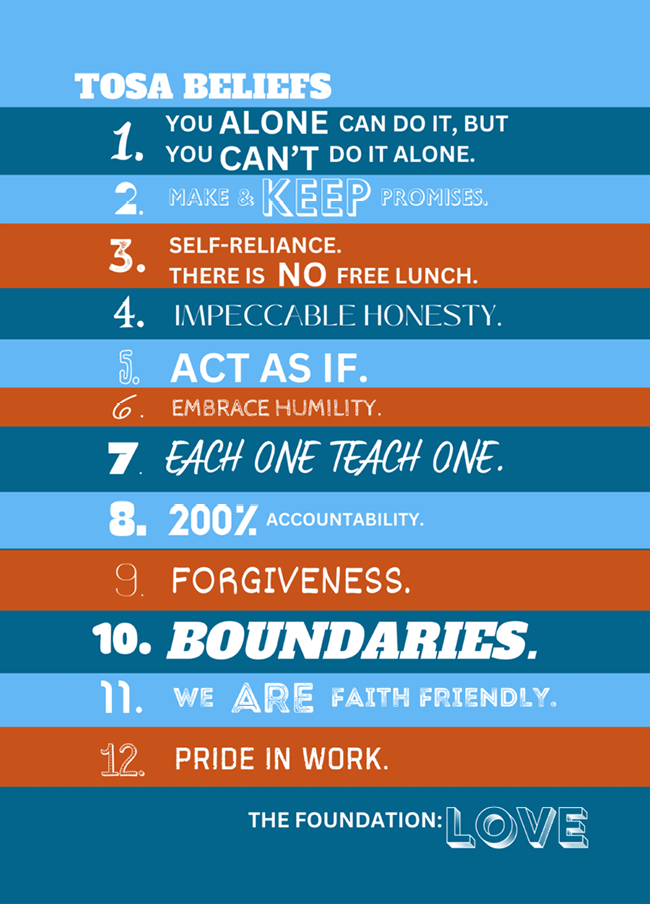 Figure 1. Twelve Core Values from The Other Side Academy. Courtesy The Other Side Academy.