I (primary author) will never forget a poignant moment in the mother’s lounge at church when our first child was about nine months old. Two other mothers with younger babies were in the lounge at the same time, and we talked as our babies nursed, then played. As I watched the two younger children crawl around, I became acutely aware that our daughter, who had not yet started to crawl, was clearly behind these other children. A panicky feeling overtook me as I wrestled with what it meant to me that these children appeared to be ahead of mine. I felt embarrassed about my unsettled feelings, sensing that even worse than the panic were my own potential feelings of disappointment in my child. All at once I felt confronted with the uncomfortable reality that as young as she was, my own identity and feelings about myself were wrapped up in her successful developmental attainments. I had quickly turned her into evidence of my goodness and capacity, instead of valuing her unique development.
That was, of course, not my last experience with such feelings. Across parenting, I found myself sometimes using my children to reinforce my view of myself. I had to confront how natural it was for me sometimes to pressure them to act, think, and feel in specific ways to comply with my high expectations for them so that I could feel validated as a mother. I found that some of my own perfectionism, my need to be exceptional to prove my own value and worth, seeped into my way of relating to my children. I needed them to be exceptional in order to feel sufficient myself.
These can be very natural feelings for parents. After all, parenting is an intensive, lifetime investment in the development and well-being of another. We care deeply about what we are investing in! But when we begin to use our children and their development as a way of addressing our own needs for achievement and validation, we lose track of truly seeing and valuing them. Our own struggle with perfectionism then becomes theirs.
The purpose of this article is to understand and address this struggle. Much has been said about the negative impact of toxic perfectionism and the importance of assessing and treating perfectionist behaviors. But how and why does toxic perfectionism develop in someone? What role, if any, does parenting play in that process? We all know individuals who have excessively high expectations of themselves and others, who fear a lack of acceptance unless they meet those standards and then self-punish when they inevitably fail. We may struggle with perfectionism ourselves. Why do we develop this orientation toward ourselves and others? What role does our family life play in that process?
Evidence suggests that inborn personality traits do play a role in a person’s susceptibility to perfectionistic tendencies.1 But those personality traits develop within a relational context. Thus both nature and nurture likely play a role. From the beginning of life, we are shaped by the interactions we have with others. Family relationships in particular play a critical role in shaping the way we understand ourselves and others. Thus, it is not surprising that a body of research suggests that experiences in family life, beginning early, can play a role in the development of toxic perfectionism.2
Yet parenting does not happen within a bubble. Research studies indicate a significant increase in toxic perfectionism among young adults internationally in the past decade. As Thomas Curran and Andrew P. Hill conclude, “Recent generations of young people perceive that others are more demanding of them, are more demanding of others, and are more demanding of themselves.”3 This perfectionism increase parallels a dramatic uptick in other mental health challenges, including anxiety and depression, which suggests an important cultural component that is increasing mental health risks for adolescents and young adults.4
Researchers have explored what factors might be contributing to perfectionism’s significant increase. Curran and Hill found that several cultural changes influence perfectionism, including the rise in “competitive individualism” (the idea that success is the result of individual effort and ability competing for limited resources), the “doctrine of meritocracy” (the idea that merit can earn you the perfect life and lifestyle), and “anxious and controlling practices” by parents who see their child’s failures as their own.5 These cultural factors appear to have an impact on children’s perfectionism by shaping parents’ ways of relating to their children. Parental behavior is, in fact, a key contributing factor for this increase in perfectionism.6
Our weaknesses as parents, including the ways our parenting might negatively impact our children, might be every parent’s greatest fear. We sense the profound dependence our children have on us to nurture, provide for, and protect them. Yet every parent’s weaknesses are consistently exposed: we don’t love perfectly, we don’t correct appropriately, and we don’t always guide and teach carefully enough. Recognizing our imperfections, we can’t help but fear what seems to be the inevitable reality that we will cause them at least some suffering and possibly even contribute to them developing some harmful ways of coping with life, including toxic perfectionism. Ironically, our fear that we might cause our children unhealthy coping patterns, like perfectionism, may cause us to be more perfectionistic about our parenting!
While it is clear that perfectionism tends to run in families,7 it would be wrong to assume that parents with perfectionistic children are necessarily parenting poorly and blame them exclusively. The development of toxic perfectionism appears to be a complex process. A child’s genetically based temperament partially shapes their experience of relationships with family members by drawing out specific responses from parents (dependent on the parent’s personality), which in turn shapes a child’s development and orientation to self and others. For example, infants who are hard to soothe and somewhat withdrawn tend to elicit fewer positive responses from parents and others than infants who are easy to soothe and have a happy disposition. Research studies suggest that children are active participants in their own development, responding to parenting based on their temperament and shaping the way they develop and manifest perfectionism.8
Yet there are things we can do to avoid creating a dynamic in our families that may contribute to the development of toxic perfectionism. Both previous research and our current study show that parenting can shape a child’s genetically based tendencies and strengthen the likelihood that children either do or do not develop perfectionistic traits. We begin by reviewing what previous research found regarding the link between parenting and children’s development of toxic perfectionism. We then present our own analyses of the Foundations data (see the introduction of this issue) and what our findings mean for parents today.
Review of Previous Research
Research on the development of toxic perfectionism indicates at least three important ways that parents may influence the development of perfectionism in children: (1) modeling perfectionism, which children imitate; (2) interacting with children in ways that require them to achieve a certain standard to experience love and connection; and (3) parenting in a way that is either coercive or neglectful, leading children to use perfectionism as a way of attaining a sense of control.
Modeling Perfectionism
First, from a social-learning perspective, parents influence the development of toxic perfectionism by modeling perfectionistic patterns that children observe and imitate.9 Research findings indicate that when children observe their parents criticizing themselves for not reaching a specific standard, or when they observe parents being unaccepting of themselves or their efforts unless they meet a certain high standard, the children may imitate the same behaviors.10 The fact that parents are the primary and most influential socializers of children, as well as the natural tendency of children to “idolize” their parents, makes children especially susceptible to imitating their parents, including their patterns of toxic perfectionism.11
This appears to be particularly true for passing on the self-oriented form of toxic perfectionism. Self-oriented perfectionism, also named discrepancy perfectionism, is defined by having excessively high expectations of ourselves and punishing ourselves with shame (including feelings of worthlessness) when expectations are not met. Self-oriented perfectionism includes a discrepancy focus, or a focus on the discrepancy “between the standards one has for oneself and one’s actual performance.”12Socially prescribed perfectionism is defined by the perception that we must meet specific standards in order to receive approval and be worthy of love from others. Other-oriented perfectionism is holding on to high expectations for other people.13 Toxic perfectionism often involves manifesting multiple forms of perfectionism, but it may be discrepancy perfectionism that passes on through parent modeling and child imitating.
Observing and imitating discrepancy perfectionism may be especially likely if the child is the same sex as the parent exhibiting the behaviors. Some research finds that daughters are more likely to develop discrepancy perfectionism when their mothers exhibit perfectionistic behaviors, while sons are more likely to imitate their father’s toxic perfectionism.14 Some have hypothesized that because mothers tend to spend more time directly interacting with their children, a mother’s toxic perfectionism may influence both sons and daughters who observe and imitate her patterns more than the father’s.15 But in fact, research studies show evidence for both the fathers’ and mothers’ perfectionism leading to adolescent perfectionism tendencies.16
Still, children with perfectionistic parents do not necessarily develop perfectionistic tendencies, let alone toxic perfectionism. Some children appear to be much more susceptible to developing toxic perfectionism, whether or not their parents model perfectionism. In particular, evidence suggests that a child who has the core personality trait of “conscientiousness” may be more susceptible to discrepancy perfectionism as an extreme form of aiming for achievement.17
Psychological Control
Another way parents shape the development of toxic perfectionism in children appears to be more influential than either parent modeling or a child’s personality characteristics. From infancy, family relationships provide the primary and essential source of interaction through which one’s understanding of self and of others develops. Every infant emerges from the womb with one task they must accomplish. They must establish a bond of deep emotional communication with someone they experience as consistently attentive, responsive, and attuned to them.18 This primary bond lays the foundations for self-awareness, regulation of emotions, and the capacity for social understanding. From within the security of these responsive relationships, children develop a sense of security about the world, the capacity for a resilient and stable self-concept, and the sense of being both valuable and valued by others.
Without this foundation, children may suffer with “an unrelenting longing for acceptance, relational connection, and the sense that [they] matter.”19 The foundational role of early relationships in shaping sense of self and value to others underscores why most perfectionism theorists suggest that the unrelenting need for acceptance and approval that is part of toxic perfectionism is often rooted in insecure and destabilizing experiences with family members early in life.20 The importance of secure and responsive family relationships continues throughout development. Beyond infancy, parenting continues to play an important role in helping children fulfill the human need for security, belonging, and being loved and valued just because they exist—not because of what they achieve or become. Parenting that does not consistently fulfill these inherent needs increases the likelihood that children will develop toxic perfectionism.21
Research findings suggest that when parents have high expectations for their children, frequently express criticism or disappointment, and then withdraw love when expectations are not met, children are more likely to develop toxic perfectionism.22 In fact, evidence suggests that high expectations along with consistent criticism create the conditions that make toxic perfectionism.23 Children learn that in order to receive their parents’ love and affection, they must meet their high expectations for success. Failure to do so is met by criticism (often personally deprecating criticism). As a result, children internalize that they are expected to meet expectations for high performance, but they also internalize the negative perception that they will never meet those expectations. W. Hugh Missildine described these children as having parents who relentlessly encouraged them to do better, but instead of rewarding them for improving, their parents continually expected the children to set and reach even higher standards.24 As a result, these children learned that they could never really be good enough.
Researchers use the term “psychological control” to describe this pattern in parenting. Psychological control is characterized by withdrawing love, shaming, and other insidious strategies to pressure children to act, think, and feel in specific ways to comply with the parents’ high standards.25 At its heart, psychological control is about controlling a child’s behavior by telling them (directly or indirectly) that if they don’t meet the standards, or if they make mistakes, they are no longer lovable, wanted, or of worth. The child becomes incredibly anxious about doing anything and may even withdraw from activities so they do not make a mistake and thus prove their worthlessness.
The developmental needs of children mean that parents are essential to influence, guide, and direct children’s behavior. Behavioral control, in which parents set clear rules and monitor children’s activities, is essential. Psychological control, however, is an attempt to place limits on children’s thoughts and feelings. It is not asking a child to help with chores, but telling them what they should feel about it, and that if they do not feel the same way as the parent, they are bad. Examples of psychological control are using manipulation to control behavior, demanding obedience and withholding acceptance of a child when they do not meet the desired standard, using harsh punishments that do not align with the offense, showing a lack of empathy, not appreciating a child’s individuality, and setting unattainable expectations.
Psychological control is the parenting characteristic most strongly linked with the development of toxic perfectionism in children, particularly the socially prescribed form.26 The link makes sense given that it is characterized by the perception that others hold excessively high standards for us, that they are judging us harshly, and that we must meet these standards in order to receive approval and be loved.
For parents who withdraw love as a means of control, scholar Leon Kass insightfully notes, “Their [children’s] capacity for trust and love has been severely crippled by the betrayal of the primal trust” all children place in their parents “to provide that durable, reliable, and absolutely trustworthy haven of permanent and unconditional love in an otherwise often unloving and undependable world.”27 When children do not experience a sense of permanent, unconditional love, they may unconsciously develop the need to appear or be perfect—to compensate for not feeling inherently accepted and valued and to manage the anxiety associated with that unmet need. Hewitt and others conclude that “many perfectionists have an inordinate need for control” as a way of avoiding any possibility of failure or revealing their weaknesses to others.28 Evidence suggests that this need may be rooted in early insecure relationships or traumatic experiences where they did not experience a sufficient sense of security in the world or a sufficient sense of their own worth in relation to others.29
As illustrated by the example shared at the beginning of the article, parents’ own “maladaptive perfectionism”30 plays an important role in shaping psychological control. Blinded by the need to meet their own expectations, these parents may not attune to their children’s unique needs and desires. Instead, toxic-perfectionist parents tend to put their own desires and expectations on their children, especially those the parents feel unable to achieve. When children do not meet their expectations, they will withdraw love and express disappointment because their children have kept them from meeting their own expectations for themselves. Their focus on meeting expectations and getting approval for their attainments may keep them from seeing or feeling empathy for their children’s unique talents and perspectives. Children who express difference, either by wanting different goals or by not having the same capacities, will feel threatening to the parent’s sense of self and need to achieve. This parental psychological control may prevent a child from forming their own personal identity and autonomy.
Whether children adopt toxic perfectionism may also be shaped by the gender of the parent who exhibits the psychological control. Some evidence suggests that fathers with maladaptive perfectionism tend to use a more domineering style in expressing their psychological control, while mothers with maladaptive perfectionism are more likely to use less overt control or aggression. As a result, studies show that children’s development of toxic perfectionism is more strongly related to their father’s type of psychological control, rather than their mother’s.31
Another negative impact on children comes when parents use psychological control as a way of managing their own separation anxiety. Evidence suggests that parents with this anxiety will psychologically control their children as a way to promote dependency.32 Any autonomous behavior by the child feels threatening to the parent, and parents then often resort to “guilt-induction and conditional approval” to keep them from becoming more independent.33
Parenting Styles: Authoritarian, Authoritative, and Permissive
Since Diana Baumrind’s landmark work identifying three distinct parenting styles, research has consistently confirmed the impact of parental style on a host of outcomes for children. The three parenting styles are authoritarian, authoritative, and permissive. Authoritarian parents are characterized by high standards, low acceptance, and unresponsiveness to children’s distinct individual needs; authoritative parents are characterized by high standards with high levels of warmth and responsiveness to children’s individual needs; permissive parents are characterized by low control, low standards, and high levels of acceptance.34
In other words, authoritarian parents are highly demanding, directive, and controlling while also more emotionally detached and less warm than other parents. Authoritative parents do have some demands, direct some activities, and provide clear and firm guidelines. However, they combine this with reasoning, warmth, and some flexibility. Authoritative parenting is considered ideal because the structure, involvement, and guidelines combined with warmth and acceptance provide the nurturing needed to help children develop self-esteem, self-regulate, be independent and cooperative, and pursue achievement. These children are more likely to “reach for the stars” yet also recognize their inherent self-worth aside from what they achieve or what may befall them. Permissive parents are accepting and responsive but avoid directing or setting standards, making it hard for children to experience the structure needed to control impulses, develop maturity in being independent, and pursue their desired achievements.
One might assume that children in an authoritarian environment would be more likely to develop perfectionism. Some evidence seems to point in this direction.35 But other evidence suggests that authoritarianism can also be linked to positive or adaptive forms of perfectionism rather than just maladaptive forms. Psychological control differs from authoritarianism because of its orientation toward love withdrawal rather than just control, infusing a different form of anxiety in a child that makes them more susceptible to maladaptive perfectionism.36 Thus, it is the combination of authoritarian parenting with psychological control that can lead to a child’s development of toxic perfectionism—not just the authoritarian parenting style on its own.
Unhealthy Emotional Bonds and Family Rigidity
The third way parents may shape the development of toxic perfectionism in children is through the level of coercion and flexibility and the level of warmth and closeness in the family’s way of operating. David Olson’s Circumplex Model identifies two dimensions of every family system that help define the level of health: cohesion and flexibility.37 Cohesion is a measure of a family’s ability to build a sense of reliance and closeness with one another while also protecting the sense of autonomy and self-development. Families that fall on the extremes of cohesion (excessively cohesive or not cohesive at all) are characterized as either emotionally enmeshed or emotionally disengaged.
Enmeshment is defined by excessive dependence on one another for emotional support, a lack of emotional independence, and a lack of separation between parents and children. Family members in an enmeshed family are emotionally reactive to one another in unhealthy ways. In addition, the parents’ overreliance on children for emotional support compromises children’s ability to form individual thoughts and behaviors separate from their parents. On the other extreme, disengagement is defined by little sense of closeness or emotional connection and an inability to turn to or rely upon one another. Family members in a disengaged family do not feel that they can share themselves or their feelings, nor do they feel they can turn to other family members for support in times of need.
Evidence suggests that both enmeshment and disengagement may be linked to the development of perfectionism.38 Families who are enmeshed have very blurry psychological boundaries, inherently increasing the likelihood of psychological control to shape the way individuals relate to one another and thus increasing the risks of maladaptive perfectionism. On the other hand, children in a disengaged family may develop perfectionism to gain basic attention, response, and engagement or to secure approval and belonging.
The second dimension defined by the Circumplex Model is flexibility. Flexibility is a measure of the family’s ability to be flexible to the need for change but also structured enough to maintain coherence across change. Families that fall on the extremes of flexibility are characterized as either rigid or chaotic, both of which are linked with increased difficulties for children. Extremes of rigidity and chaos may shape a child’s need to exert control over their life. Children in a rigid family environment may learn that in order to attain approval or acceptance, they must rigidly adhere to expectations, developing both discrepancy perfectionism and socially prescribed perfectionism. Parental psychological control is often linked with ridigity and unhealthy emotional bonds. Those in a chaotic environment may develop perfectionism as a way of getting some control over a situation that feels very out of control, imposing higher standards on themselves in reaction to the chaos and lack of predictability.
Together, these findings provide evidence for all three ways that parenting influences the development of toxic perfectionism in children: modeling maladaptive perfectionism; using psychological control by requiring children to achieve a certain standard in order to receive love and connection; and allowing extreme levels of unhealthy cohesion (neglectful or enmeshed) and flexibility (permissive or rigid) within a family unit.
Our Analyses
In our analyses, we evaluate how these three potential ways can manifest themselves in Latter-day Saint families with youth. Family variables were used to predict the level of toxic perfectionism a youth manifests—either low, medium, or high.39 The level of perfectionism was a combined measure of both discrepancy perfectionism and socially prescribed perfectionism. A youth who was low in toxic perfectionism was low in both discrepancy and socially prescribed perfectionism. A youth who was medium in toxic perfectionism was high in either discrepancy or socially prescribed perfectionism and low in the other. A youth who was high in toxic perfectionism was high in both discrepancy and socially prescribed perfectionism. The family variables that were used to predict whether a youth exhibited low, medium, or high levels of toxic perfectionism included the following: parent psychological control, parent warmth, parent verbal hostility, parent anxiety, interparental conflict, and family functioning (rigidity, chaos, enmeshment, disengagement).
The findings of these analyses build on previous research findings while focusing on Latter-day Saints. The analyses confirm that family patterns and dynamics do play a role in the development of toxic perfectionism among Latter-day Saint youth and young adults. Findings from our analyses on each of the three ways through which parenting potentially influences the development of toxic perfectionism are presented here.
In terms of children developing perfectionism by imitating their parents’ perfectionism, fathers’ and mothers’ discrepancy (self-oriented) perfectionism increased the likelihood that boys would exhibit high levels of toxic perfectionism but did not increase the likelihood of toxic perfectionism for girls. In our analyses, boys were nearly six times as likely to imitate high levels of discrepancy perfectionism when their parents exhibited discrepancy perfectionism. Specifically, only 2.2% of boys were high in perfectionism when their parent was low in discrepancy perfectionism, yet when the parent was high in discrepancy perfectionism, 12.8% of boys were high in perfectionism. Parents’ socially prescribed perfectionism did not predict perfectionism in either boys or girls.
Although girls’ perfectionism did not appear to be directly related to parents modeling perfectionism, both mother and father psychological control were strongly related to their daughters’ perfectionism. A mother’s high psychological control predicted daughters exhibiting medium levels of toxic perfectionism rather than low. A father’s psychological control appeared to exert even stronger influence. Fathers’ high psychological control predicted daughters exhibiting a high level of toxic perfectionism compared to a medium level of toxic perfectionism. In other words, a father’s psychological control seemed to tip daughters over into the highest levels of perfectionism.
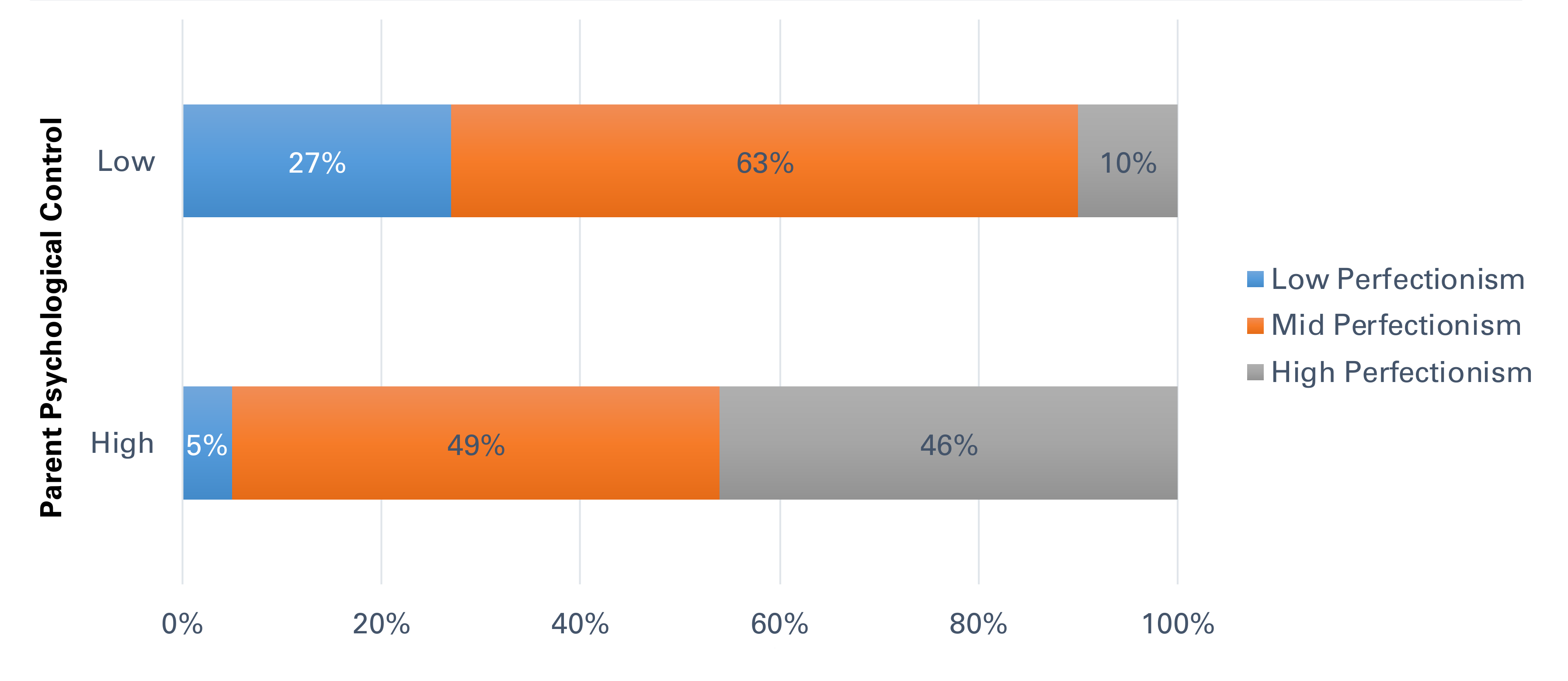
When considering mother and father psychological control together, we found that 46% of girls whose parents were both high on psychological control had high perfectionism. This is compared to just 10% of girls being high in perfectionism when both parents were low in psychological control. In other words, high parental psychological control in both parents increased the likelihood of daughters being high in toxic perfectionism by nearly five times (see fig. 1).
Figure 1. Girls’ perfectionism when both mother and father psychological control is high and when both are low.
While boys seemed to be most impacted by their parents’ experiencing and modeling discrepancy perfectionism, girls seemed to be most impacted by parents who withdrew love, shamed, or used other emotional strategies to pressure children to act, think, and feel in ways that complied with the parents’ standards. Boys tended to develop toxic perfectionism just because their parents were toxic perfectionists. But girls developed toxic perfectionism because of how their parents related to them in psychologically controlling ways.
In terms of the third method of parental influence, the current analyses found that the level of flexibility and cohesion in a family also predicted the development of toxic perfectionism in children. Specifically, greater family chaos and less family structure predicted youth having higher levels of toxic perfectionism compared to youth in nonchaotic families. Similarly, families who were disengaged and less cohesive were more likely to have youth with higher levels of toxic perfectionism. Youth who reported the highest levels of toxic perfectionism were in families with more chaos, more disengagement, and less flexibility when compared with youth exhibiting the lowest levels of toxic perfectionism. Family enmeshment did not emerge as an independent predictor of toxic perfectionism in youth.
A closer look at gender differences between boys and girls indicated that parents’ rigidity was linked with girls’ increased likelihood of exhibiting high toxic perfectionism, but rigidity was not linked with boys’ increased toxic perfectionism. Girls in a more rigid family were over four times more likely to exhibit high levels of toxic perfectionism than girls in more flexible families.
Boys, on the other hand, appeared to be more impacted by chaos in family life. Boys were more likely to exhibit high levels of toxic perfectionism when their home life was chaotic rather than structured. It may be that girls in a rigid family environment perceive that in order to receive approval they must meet rigid expectations, leading to the development of toxic perfectionism. Boys, on the other hand, may develop perfectionism as a way of gaining control in a chaotic, unpredictable family situation.
But both girls and boys exhibited increased risk for high perfectionism when members of their family were disengaged with one another. It seems that emotional disconnection and the perception that family members cannot be relied upon for support contributed to both boys and girls setting excessively high expectations of themselves out of fear of not being attended to or accepted. This finding seems to confirm the importance of secure, warm, and responsive relationships as fundamental to the development of a stable sense of self and the idea that the self is inherently valuable and valued by others. As predicted by previous research, it appears that maladaptive perfectionism may be a way for children to cope with insecure and less predictable family environments.
Interestingly, neither an authoritarian parenting style nor a permissive parenting style increased the likelihood of maladaptive perfectionism in youth. It appears that parents might be highly demanding and directing, or more detached and less warm with their children, but unless it is linked with psychological control, children are not more likely to develop toxic perfectionism.
To summarize, the families of youth with the highest levels of perfectionism were characterized by higher mother and father psychological control, more family chaos, more family disengagement, and less family flexibility. Boys appeared to be more susceptible to toxic perfectionism just by having perfectionistic parents, but they did not appear to be as impacted by psychological control. Girls, on the other hand, appeared to be strongly impacted by parents’ psychological control (especially the fathers’ psychological control) in developing and exhibiting toxic perfectionism. More rigidity in family life was also predictive of girls experiencing higher levels of toxic perfectionism, while a chaotic home environment was linked to higher levels of toxic perfectionism for boys. Boys and girls both appeared to be equally impacted by lower levels of family cohesiveness and emotional disengagement. A sense of belonging, emotional connection, and closeness appears to be protective for both boys and girls in reducing the likelihood of toxic perfectionism.
Discussion
What do these findings mean for us as Latter-day Saint parents and youth? For one thing, it’s important to realize that our own toxic perfectionism can impact our children. When our children see us self-criticize or be unaccepting of ourselves or our efforts to meet high standards, they may imitate the same behaviors, especially our sons. The sense that we are inherently loved and valued by God, and the acceptance of ourselves and our efforts, gives children permission to feel the same for themselves and establishes healthy patterns for them to imitate and follow.
Our children are also impacted by how we engage with them, including how we communicate acceptance, belonging, and love as they develop. When we use psychological control by withdrawing our love, shaming them, or trying to induce feelings of shame, we use their inherent dependence on us for their sense of worth and belonging to manipulate and control them. These forms of psychological control may be especially hard on girls, who may develop toxic perfectionism in an effort to try to secure from us a sense that they are valued and belong. We may not recognize we are doing this, especially because our own perfectionism may blind us to how we pressure our children to do or feel things in certain ways in order to meet our own expectations for ourselves as parents or in order to alleviate our own sense of anxiety.
The sense of predictability and structure we create in our family life is also important for developing a resilience to toxic perfectionism. Boys, in particular, seem to benefit from a sense of order and predictability, rather than a sense of chaos and lack of structure. But when we are too rigid or controlling, not allowing enough flexibility in adjusting to the need for change, our children may internalize the rigidity and develop a perfectionistic orientation in order to feel acceptable. This may be particularly true for girls.
Most importantly, children benefit from a sense of closeness in family life. Examples of this include knowing what is going on in one another’s lives, relying upon each other for support, caring about how one another are doing, and desiring to spend time together. Efforts to help our children feel close to us and to one another are worth it. For most of us, this means deeply internalizing the meaning of the wise statement, “Never let a problem to be solved become more important than a person to be loved.”40
Our deep sense of responsibility for our children’s well-being, their choices, and even their salvation can make it hard not to focus on what we see as their problems. It can be very natural for us to force compliance with what we think will be best. This often involves continually pointing out where they fall short; we are certain that if we just fixate on their problems, they will change and do what they should. We may not realize that, as a result of this criticism and control, our children may sense that our love for them is conditioned on them successfully meeting our expectations and that we depend on them to manage our sense of self or our anxiety. They may sense that our desires for them are tied up in our own sense of acceptability and goodness rather than what they truly need and desire.
Parenting seems to be a remarkable process of learning what it means to truly love. Sooner or later, we will sense that truly loving means wanting to see and know our children in their unique divinity as children of God. We will learn to attune ourselves to the space they need to sort out their own development and integrity in coming to know God and themselves. In doing so, we help them move out of a toxic space, in which they must prove their lovability by meeting expectations, and into a healthier space for growth, in which they are loved from the beginning and allowed to seek and pursue their own life’s journey—not out of conforming to another’s desire but because they have learned to identify and follow what they feel is best. In this new space, parents can learn to love and accept them just as they are in each moment.
This is not an easy process. As parents, we can be tempted to believe that if we just get the right formula, the right rules, the right structure, and the right answers, we will be able to parent perfectly and create a problem-free path for our children; we will have become all we think we should be as a parent. But that orientation can obscure what it really means to parent another soul. We must come to know them fully without fear, and then try to fallibly step forward, often reaching through the dark to accept them and provide the love they need to guide them in their own learning process.
Elder Dieter F. Uchtdorf captured this powerfully when he described healthy parenting:
Building faith in a child is somewhat like helping a flower grow. You cannot tug on the stem to make it taller. You cannot pry open the bud to get it to blossom sooner. And you cannot neglect the flower and expect it to grow or flourish spontaneously.
What you can and must do for the rising generation is provide rich, nourishing soil with access to flowing heavenly water. Remove weeds and anything that would block heavenly sunlight. Create the best possible conditions for growth. Patiently allow the rising generation to make inspired choices, and let God work His miracle. The result will be more beautiful and more stunning and more joyful than anything you could accomplish just by yourself.41
Ironically, perhaps, much of what we yearn for in family life and what contributes most to our children’s healthy development comes through accepting the inherent fallibility within ourselves and our children as we try to “provide rich nourishing soil,” “remove the weeds,” and “create the best possible conditions for growth.” Even our best efforts are a journey of growth rather than a quest for perfection. Our imperfections actually become gifts in binding our hearts together as we love one another through the experience of learning, making mistakes, and learning some more. Perhaps, then, the greatest gift we give our children is allowing ourselves to be human, allowing them to be human, and loving in the face of our inherent vulnerability and need for growth.
The promise of our covenant relationship with God is that we can leave behind the perfectionistic effort to continually prove that we are lovable and that we meet the assumed requirements to be acceptable. We can give up the project of managing our own image, or that of our children, and instead join God in the work of truly loving our children by doing what is needful and right to enable their growth. When we are not blinded by our own perfectionism, we can better see and know our children, understand what they are experiencing, and have greater clarity in offering what they truly need, rather than trying to get our own picture of perfection. The research on toxic perfectionism confirms this direction.
McKenna Schmidt is a student at Brigham Young University in journalism.
Notes
1. Paul L. Hewitt and Gordon L. Flett, “Perfectionism in the Self and Social Contexts: Conceptualization, Assessment, and Association with Psychopathology,” Journal of Personality and Social Psychology 60, no. 3 (1991): 456–70, https://doi.org/10.1037/0022-3514.60.3.456.
2. Paul L. Hewitt, Gordon L. Flett, and Samuel F. Mikail, Perfectionism: A Relational Approach to Conceptualization, Assessment, and Treatment (Guilford Press, 2017), 96–119.
3. Thomas Curran and Andrew P. Hill, “Perfectionism Is Increasing over Time: A Meta-Analysis of Birth Cohort Differences from 1989 to 2016,” Psychological Bulletin 145, no. 4 (2019): 410, http://dx.doi.org/10.1037/bul0000138.
4. Curran and Hill, “Perfectionism Is Increasing,” 420–21; see also Jonathan Haidt, The Anxious Generation: How the Great Rewiring of Childhood Is Causing an Epidemic of Mental Illness (Penguin Press, 2024).
5. Curran and Hill, “Perfectionism Is Increasing,” 412–13.
6. Curran and Hill, “Perfectionism Is Increasing,” 414; see also Hewitt, Flett, and Mikail, Perfectionism: A Relational Approach, 114–15.
7. See Gordon L. Flett, Paul L. Hewitt, Joan M. Oliver, and Silvana Macdonald, “Perfectionism in Children and Their Parents: A Developmental Analysis,” in Perfectionism: Theory, Research, and Treatment, ed. Gordon L. Flett and Paul L. Hewitt (American Psychological Association, 2002), 89–132, https://doi.org/10.1037/10458-004.
8. Arnold H. Buss and Robert Plomin, A Temperament Theory of Personality Development (Wiley-Interscience, 1975), 210, 215–17.
9. Albert Bandura and Carol J. Kupers, “Transmission of Patterns of Self-Reinforcement Through Modeling,” Journal of Abnormal and Social Psychology 69, no. 1 (1964): 1–9, https://doi.org/10.1037/h0041187.
10. Buss and Plomin, Temperament Theory, 91–93; see also Thomas Curran, Andrew P. Hill, Daniel J. Madigan, and Annett V. Stornæs, “A Test of Social Learning and Parent Socialization Perspectives on the Development of Perfectionism,” Personality and Individual Differences 160 (July 2020): article 109925, https://doi.org/10.1016/j.paid.2020.109925.
11. Martin M. Smith, Paul L. Hewitt, Simon B. Sherry, Gordon L. Flett, and Cassondra Ray, “Parenting Behaviors and Trait Perfectionism: A Meta-Analytic Test of the Social Expectations and Social Learning Models,” Journal of Research in Personality 96 (February 2022): 2, article 104180, https://doi.org/10.1016/j.jrp.2021.104180.
12. Robert B. Slaney, Kenneth G. Rice, Michael Mobley, Joseph Trippi, and Jeffrey S. Ashby, “The Revised Almost Perfect Scale,” Measurement and Evaluation in Counseling and Development 34, no. 3 (2001): 133.
13. For all the types of perfectionism, see table 1.1 in Gordon L. Flett and Paul L. Hewitt, Perfectionism in Childhood and Adolescence: A Developmental Approach (American Psychological Association, 2022), 20–21; see also exhibit 1.1 in Gordon L. Flett and Paul L. Hewitt, “Perfectionism and Maladjustment: An Overview of Theoretical, Definitional, and Treatment Issues,” in Flett and Hewitt, Perfectionism: Theory, Research, and Treatment, 11.
14. Angela Z. Vieth and Timothy J. Trull, “Family Patterns of Perfectionism: An Examination of College Students and Their Parents,” Journal of Personality Assessment 72, no. 1 (1999): 49–67, https://doi.org/10.1207/s15327752jpa7201_3.
15. L. Caitlin Cook and Christopher A. Kearney, “Parent and Youth Perfectionism and Internalizing Psychopathology,” Personality and Individual Differences 46, no. 3 (2009): 325–30, https://doi.org/10.1016/j.paid.2008.10.029.
16. See Paul R. Appleton, Howard K. Hall, and Andrew P. Hill, “Family Patterns of Perfectionism: An Examination of Elite Junior Athletes and Their Parents,” Psychology of Sport and Exercise 11, no. 5 (2010): 363–71, https://doi.org/10.1016/j.psychsport.2010.04.005; and Kristie L. Speirs Neumeister, Kristen Kay Williams, and Tracy L. Cross, “Gifted High-School Students’ Perspectives on the Development of Perfectionism,” Rooper Review 31, no. 4 (2009), 198–206, https://doi.org/10.1080/02783190903177564.
17. Joachim Stoeber, Kathleen Otto, and Claudia Dalbert, “Perfectionism and the Big Five: Conscientiousness Predicts Longitudinal Increases in Self-Oriented Perfectionism,” Personality and Individual Differences 47, no. 4 (2009): 363–68, https://doi.org/10.1016/j.paid.2009.04.004.
18. Allan N. Schore, Affect Regulation and the Origin of the Self: The Neurobiology of Emotional Development (Lawrence Erlbaum Associates, 1994), 12, 22; see also Allan N. Schore, “Effects of a Secure Attachment Relationship on Right Brain Development, Affect Regulation, and Infant Mental Health,” Infant Mental Health Journal 22, nos. 1–2 (2001): 7–66, https://doi.org/10.1002/1097-0355(200101/04)22:1%3C7::AID-IMHJ2%3E3.0.CO;2-N.
19. Hewitt, Flett, and Mikail, Perfectionism: A Relational Approach, 101.
20. Hewitt, Flett, and Mikail, Perfectionism: A Relational Approach, 97–103.
21. Hewitt, Flett, and Mikail, Perfectionism: A Relational Approach, 114–19.
22. Robert B. Slaney, Kenneth G. Rice, and Jeffrey S. Ashby, “A Programmatic Approach to Measuring Perfectionism: The Almost Perfect Scales,” in Flett and Hewitt, Perfectionism: Theory, Research, and Treatment, 83; see also Flett and Hewitt, Perfectionism in Childhood and Adolescence, 146–55.
23. Flett and others, “Perfectionism in Children and Their Parents,” 99–101.
24. W. Hugh Missildine, Your Inner Child of the Past (Pocket Books, 1963), 84–85.
25. See Brian K. Barber, “Parental Psychological Control: Revisiting a Neglected Construct,” Child Development 67, no. 6 (1996): 3296–319, https://doi.org/10.2307/1131780; and Bart Soenens and Maarten Vansteenkiste, “A Theoretical Upgrade of the Concept of Parental Psychological Control: Proposing New Insights on the Basis of Self- Determination Theory,” Developmental Review 30, no. 1 (2010): 74–99, https://doi.org/10.1016/j.dr.2009.11.001.
26. Bart Soenens, Andrew J. Elliot, Luc Goossens, Maarten Vansteenkiste, Patrick Luyten, and Bart Duriez, “The Intergenerational Transmission of Perfectionism: Parents’ Psychological Control as an Intervening Variable,” Journal of Family Psychology 19, no. 3 (2005): 358–66, https://doi.org/10.1037/0893-3200.19.3.358.
27. Leon R. Kass, “The End of Courtship,” Public Interest 126 (Winter 1997): 47.
28. Hewitt, Flett, and Mikail, Perfectionism: A Relational Approach, 19.
29. Hewitt, Flett, and Mikail, Perfectionism: A Relational Approach, 107–8, Flett and Hewitt, Perfectionism in Childhood and Adolescence, 170–72; see also Allan Mallinger, “The Myth of Perfection: Perfectionism in the Obsessive Personality,” American Journal of Psychotherapy 63, no. 2 (2009): 103–31, https://doi.org/10.1176/appi.psychotherapy.2009.63.2.103.
30. Bart Soenens, Maarten Vansteenkiste, Bart Duriez, and Luc Goossens, “In Search of the Sources of Psychologically Controlling Parenting: The Role of Parental Separation Anxiety and Parental Maladaptive Perfectionism,” Journal of Research on Adolescence 16, no. 4 (2006): 539, https://doi.org/10.1111/j.1532-7795.2006.00507.x.
31. Soenens and others, “Intergenerational Transmission of Perfectionism,” 362–63.
32. Soenens and others, “In Search of the Sources,” 540–41.
33. Soenens and others, “In Search of the Sources,” 542.
34. Diana Baumrind, “Authoritative Parenting Revisited: History and Current Status,” in Authoritative Parenting: Synthesizing Nurturance and Discipline for Optimal Child Development, ed. Robert E. Larzelere, Amanda Sheffield Morris, and Amanda W. Harrist (American Psychological Association, 2013), 11–34, https://doi.org/10.1037/13948-002.
35. See Flett and others, “Perfectionism in Children and Their Parents,” 117–18.
36. Soenens and others, “Intergenerational Transmission of Perfectionism,” 360.
38. Alan E. Craddock, Wendy Church, and Alexandra Sands, “Family of Origin Characteristics as Predictors of Perfectionism,” Australian Journal of Psychology 61, no. 3 (2009): 136–44, https://doi.org/10.1080/00049530802239326.
39. See the appendix for sample details. High, medium, and low levels of perfectionism were defined as in the article by Dyer in this volume.
40. Thomas S. Monson, “Finding Joy in the Journey,” Ensign 38, no. 11 (November 2008): 86.
41. Elder Dieter F. Uchtdorf, “Jesus Christ Is the Strength of Parents,” Liahona 47, no. 5 (May 2023): 58, emphasis original.