


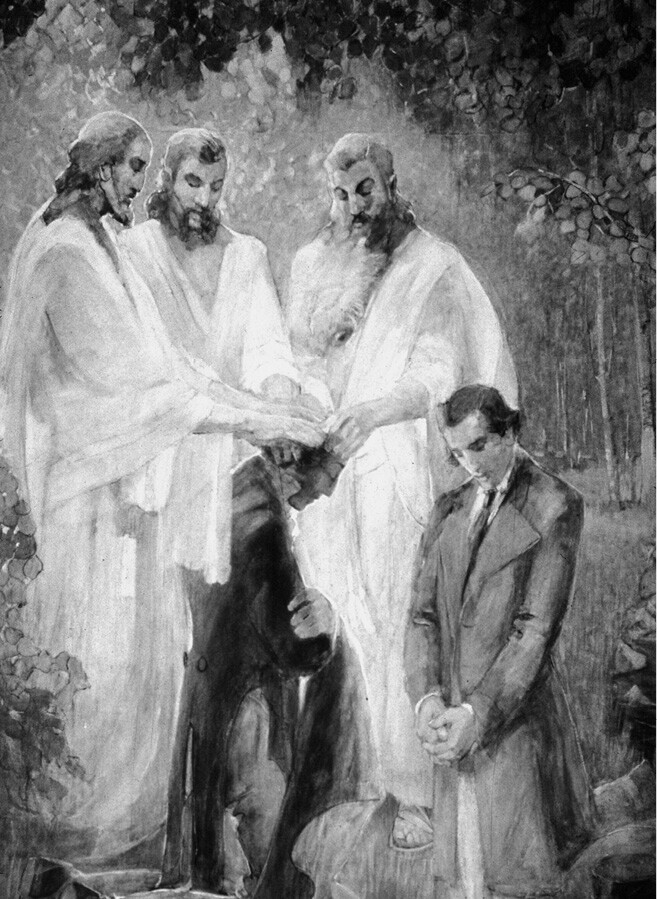
 The Restoration of the Melchizedek Priesthood, by Minerva Teichert, oil on canvas, 1934. Courtesy Church History Museum.
Notes
1. Oliver Cowdery, “Letter VIII,” Messenger and Advocate 2 (October 1835): 199, available on “Mormon Publications: 19th and 20th Centuries,” BYU Harold B. Lee Library Digital Collections, http://contentdm.lib.byu.edu/cdm/ref/collection/NCMP1820-1846/id/7162. Further words given by Moroni at that time, now found in Doctrine and Covenants 2, were provided by Joseph Smith in 1838: “Behold, I will reveal unto you the Priesthood, by the hand of Elijah.” D&C 2:1; see also “History, circa June 1839–circa 1841 [Draft 2],” 5, Church History Library, The Church of Jesus Christ of Latter-day Saints, Salt Lake City, available on Church Historians Press, The Joseph Smith Papers, http://www.josephsmithpapers.org/paper-summary/history-circa-june-1839-circa-1841-draft-2/5; Karen Lynn Davidson and others, eds., Histories: Volume 1, Joseph Smith Histories, 1832–1844, vol. 1 of the Histories series of The Joseph Smith Papers, ed. Dean C. Jessee, Ronald K. Esplin, and Richard Lyman Bushman (Salt Lake City: Church Historian’s Press, 2012), 224.
2. As Gregory Prince has observed, the earliest occurrences of the word priesthood in written Mormon sources outside the Book of Mormon begin in 1831 (27). Moreover, although priesthood authority had been restored prior to that time, the terms Aaronic Priesthood and Melchizedek Priesthood “were not adopted until 1835” (14). Gregory A. Prince, Having Authority: The Origins and Development of Priesthood during the Ministry of Joseph Smith (Independence, Mo.: Independence Press, 1993). William E. McLellin’s journal entry for October 25, 1831, speaks of “the High-Priesthood” and “the lesser Priest-Hood.” Jan Shipps and John W. Welch, eds., The Journals of William E. McLellin, 1831–1836 (Provo, Utah: BYU Studies; Urbana: University of Illinois Press, 1994), 45, 283.
3. “History, circa June–October 1839 [Draft 1],” [1], Church History Library, available on Church Historian’s Press, The Joseph Smith Papers, http://www.josephsmithpapers.org/paper-summary/history-circa-june-october-1839-draft-1/1; Davidson and others, Histories, Volume 1, 294–96; Joseph Smith Jr., History of The Church of Jesus Christ of Latter-day Saints, ed. B. H. Roberts, 2d ed., rev., 7 vols. (Salt Lake City: Deseret Book, 1971), 1:43 (hereafter cited as History of the Church).
4. While remaining true to his testimony as a witness to the Book of Mormon, David Whitmer rejected any aspect of the Restoration that recognized or promoted central Church authority. In 1885, Whitmer stated, “I moved Joseph Smith and Oliver Cowdery to my fathers house in Fayette Seneca County New York, from Harmony, Penn. in the year 1829, on our way I conversed freely with them upon this great work they were bringing about, and Oliver stated to me in Josephs presence that they had baptized each other seeking by that to fulfill the command—And after our arrival at fathers sometime in June 1829, Joseph ordained Oliver Cowdery to be an Elder, and Oliver ordained Joseph to be an Elder in the church of Christ and during that year Joseph both baptized and ordained me an elder in the church of Christ. . . . I never heard that an Angel had ordained Joseph and Oliver to the Aaronic priesthood until the year 1834 5. or 6—in Ohio.” Notwithstanding numerous attestations to the contrary by Joseph Smith and Oliver Cowdery, David Whitmer in 1885 maintained, “I do not believe that John the Baptist ever ordained Joseph and Oliver as stated and believed by some.” Zenas H. Gurley, Interview, January 14, 1885, Gurley Collection, Church History Library, quoted in Lyndon W. Cook, ed., David Whitmer Interviews: A Restoration Witness (Orem, Utah: Grandin Book, 1991), 154–55. Earlier, Whitmer had been very impressed, however, by Oliver Cowdery’s testimony regarding the visitation of Peter, James, and John; see note 10 below.
In 1878, William E. McLellin wrote, “In 1831 I heard Joseph tell his experience about angel visits many times, and about finding the plates, and their contents coming to light. . . . But I never heard one word of John the baptist, or of Peter, James, and John’s visit and ordination till I was told some year or two afterward [that is, in 1832] in Ohio.” William E. McLellin statement, 10, numbered item 28, quoted in D. Michael Quinn, The Mormon Hierarchy: Origins of Power (Salt Lake City: Signature Books, 1994), 19.
5. Part of a revelation dated August and September 1830 (D&C 27) and published for the first time in 1835 stated that Elias had informed Zacharias, the father of John the Baptist, that John would “be filled with the spirit of Elias” (D&C 27:7). “History, circa June 1839–circa 1841 [Draft 2],” 52; Davidson and others, Histories, Volume 1, 430.
6. David Whitmer, An Address to All Believers in Christ: By a Witness to the Divine Authenticity of the Book of Mormon (Richmond, Mo.: By the author, 1887), 32, available on Internet Archive, https://archive.org/stream/addresstoallbeli00whit#page/32/mode/2up.
7. “Minute Book 1” [Kirtland High Council Minutes], 30, February 17, 1834, Church History Library, available on Church Historian’s Press, The Joseph Smith Papers, http://www.josephsmithpapers.org/paper-summary/minute-book-1/34; Gerrit J. Dirkmaat and others, eds., Documents, Volume 3: February 1833–March 1834, vol. 3 of the Documents series of The Joseph Smith Papers, ed. Ronald K. Esplin and Matthew J. Grow (Salt Lake City: Church Historian’s Press, 2016), 437.
8. These verses did not appear in the earlier text of the revelation printed in the Book of Commandments, 1833. Joseph Smith recalled in 1839 that all of section 27 was received as a revelation in August 1830 but that most of the revelation, including these words, was not recorded until September 1830. “History, circa June 1839–circa 1841 [Draft 2],” 51; Davidson and others, Histories, Volume 1, 428.
9. This passage mentions “the voice of Peter, James, and John” but does not discuss a physical ordination. The reason is that this is part of a response to the preceding question, “What do we hear?” (italics added).
10. During an 1861 visit with David Whitmer, David H. Cannon reported that Whitmer recalled yet another testimony given by Cowdery regarding the appearance of Peter, James, and John: “The thing which impressed me most of all was, as we stood beside the grave of Oliver Cowdery the other Witness, who had come back into the Church before his death, and in describing Olivers action, when bearing his testimony, said to the people in his room, placing his hands like this upon his head, saying ‘I know the Gospel to be true and upon this head has Peter James and John laid their hands and confered the Holy Melchesdic Priestood,’ the manner in which this tall grey headed man went through the exhibition of what Oliver had done was prophetic. I shall never forget the impression that the testimony of . . . David Whitmer made upon me.” David H. Cannon, Diary, 5, March 13, 1917, Church History Library, cited in Dan Vogel, ed., Early Mormon Documents, 5 vols. (Salt Lake City: Signature Books, 1996–2003), 5:218.
11. Addison Everett wrote: “A few days Before Br Joseph & Hiram ware calld to Carthage By Gov. Ford I wus Passing the Mansheon House I observed Br Joseph & Hiram & some five or six Brethren in earnest conversation. Before the Door of the House. I opened the gate and steped in. . . . Br Joseph Ex[p]resed Greate simpathy for Br Oliver saying Poor Boy[,] Poor Boy[,] casting his eyes to the ground. And then Said as they Ware Tran[s]lating the Book of Mormon at His Father In Laws in Susquhanah County Penny. T[h]ey ware thretned By a Mob and in the same time Father Kng<i>hts came Down from Cole[s]vill[e] Broom[e] County New York and Desired them to go home with him and preach <to> them in his Neighbourhood And on Account of the Mob Spirit prevailing they concluded to goe. And they ware teachi[n]g And preaching the Gospele they ware taken with <a> writ and Before a Judge as fals[e] Prophets. And the Prossecuting Atorny had conceived in his own Mind That A few simple qu[e]stions would Convince the Court By the Answers Br Joseph would giv[e] <to> that <the> charge was Correct. So he calls out Jo which was the first Merical Jesus raught [wrought.] Why <said Br Joseph> we read He Created the worlds And what He done previous to that I have not as yet Learned. This answer completly confounded the Prossicuting Atorny that he requested the Judge to Dismis the case. and went out To Organ<ize> the Mob that was on the Out Side. At about this time a Lawyer By the Name of Reede I think was his name came in to the court and Stated He was Mr Smiths Atorny and wished to see him <in> a Private room And was <put> in to <a> Back room and when in he hoisted a window and told Br Joseph & Oliver to flee in to the forest which was close at hand. And they wandered in a dense Forest all Night and often times in Mud and water up to thare Knees. And Brother Oliver got quite exausted in the After Part of the Night and Brother Joseph had to put his arm arround him and allmost carry him. And Just as the day Broke in the East Brother Oliver gave out Entirely and he[,] Br Joseph[,] leaned him against an Oake tree Just out side a field fenc[e] Br Oliver Crying out how long O Lord O how Long Br Joseph hav[e] we got to suffer these things[?] Just this moment Peter James & John came to us and Ordained to us <to> the Holy Apostelship and gave <unto> us the Keys of the Disp<e>nsation of the fullness of times. And we had some 16 or 17 miles to goe to reach our place of residence and Brother Oliver could travel as well as I could <after the Endowment>. Now as to time and Place. I heard the Name of the Banks of the Susquehanah river spoken <of> But whare it was pla[c]ed I cannot till. No doubt the Oake tree and the field fence was ajacent to the river. As to time I cannot Be Very Explsit. But as the Mob spirit had not abated when they returned they had to remove to Father Whitmores <at Fayet[te] Seneca Co> to finish the Translation. I should <jud[g]e> it to <Be> the Latter part of August. Now Beloved Brother I am Not Writing as wone of the Lords Historians But as your friend reproduc<i>ng the last words I heard our Beloved and Gods Holy Prophet Speake before his depart[ure] Into the Eternal Heavens to Dwell with the Holy & Eternal gods forever & Ever!” Addison Everett to Joseph F. Smith, January 16, 1882, Joseph F. Smith Papers 1854–1918, Church History Library, underlining in original, available on Church History Library, https://dcms.lds.org/delivery/DeliveryManagerServlet?dps_pid=IE146205, images 14–19, quoted in Larry C. Porter, “The Restoration of the Priesthood,” Religious Studies Center Newsletter 9, no. 3 (May 3, 1995): 8. Angle brackets < > designate material inserted by Everett above the line. See also Addison Everett to Oliver B. Huntington, February 17, 1881, recorded in “Oliver Boardman Huntington Journal no. 14,” under backdate of January 31, 1881; and “Oliver Boardman Huntington Journal no. 15,” entry for February 18, 1883, Oliver Boardman Huntington Papers, L. Tom Perry Special Collections, Harold B. Lee Library, Brigham Young University, Provo, Utah, quoted in Porter, “Restoration of the Priesthood,” 7. The 1881 entry reads as follows: “Joseph went on to state that ‘at Coalville he & Oliver were under arrest on charge of Deceiving the people & in court he stated that the first miracle done was to create this earth. About that time his attorney told the court that he wanted to see Mr. Smith alone a few moments. When alone Mr. Reid said that there was a mob in front of the house, & ho[i]sting the window, Joseph & Oliver went to the woods in a few rods, it being night, and they traveled until Oliver was exhausted & Joseph almost carried him through mud and water. They traveled all night and just at the break of day Olive[r] gave out entirely and exclaimed ‘O! Lord! How long Brother Joseph have we got to endure this thing,’ Brother Joseph said that at that very time Peter, James, & John came to them and ordained them to the Apostleship. They had 16 or 17 miles to travel to get back to Mr. Hales his father in law and Oliver did not complain anymore of fatigue.’” Compare these comments with the early history of Joseph Smith by Joseph Knight, Reminiscences, 2, MS 3470, Church History Library, available on Church History Library, https://dcms.lds.org/delivery/DeliveryManagerServlet?dps_pid=IE1276586, image 9; Joseph Knight, “Joseph Knight’s Recollection of Early Mormon History,” ed. Dean Jessee, BYU Studies 17, no. 1 (1976): 37–38.
12. The first ordinations to the office of elder occurred in 1829. On April 6, 1830, Joseph and Oliver reordained one another as First and Second Elder and then “laid our hands on each individual member of the Church present, that they might receive the gift of the Holy Ghost, and be confirmed members of the Church of Christ.” “History, circa June–October 1839 [Draft 1],” [9]; Davidson and others, Histories, Volume 1, 366; History of the Church, 1:78. Both Joseph and Oliver were elders prior to this time. See Porter, “Restoration of the Priesthood,” 3.
13. “History, circa June 1839–circa 1841 [Draft 2],” 37; Davidson and others, Histories, Volume 1, 366; History of the Church, 1:77–78.
14. On April 6, 1853, President Young said, “I know that Joseph received his Apostleship from Peter, James, and John, before a revelation on the subject was printed, and he never had a right to organize a Church before he was an Apostle.” Brigham Young, in Journal of Discourses, 26 vols. (Liverpool: F. D. Richards, 1855–86), 1:137, available on “Journal of Discourses,” BYU Harold B. Lee Library Digital Collections, http://contentdm.lib.byu.edu/cdm/ref/collection/JournalOfDiscourses3/id/1774. On June 23, 1874, Brigham Young indicated, “[Joseph Smith] received the Aaronic Priesthood, and then he received the keys of the Melchisedek Priesthood, and organized the Church. He first received the power to baptise, and still did not know that he was to receive any more until the Lord told him there was more for him. Then he received the keys of the Melchisedek Priesthood, and had power to confirm after he had baptized, which he had not before. He would have stood precisely as John the Baptist stood, had not the Lord sent his other messengers, Peter, James and John, to ordain Joseph to the Melchisedek Priesthood.” Journal of Discourses, 18:240. In 1861, in a discourse on the priesthood, President Young said, “How came these Apostles, these Seventies, these High Priests, and all this organization we now enjoy? It came by revelation. Father Cahoon, who lately died in your neighbourhood, was one of the first men ordained to the office of High Priest in this kingdom. In the year 1831 the Prophet Joseph went to Ohio. He left the State of New York on the last of April, if my memory serves me, and arrived in Kirtland sometime in May. They held a General Conference, which was the first General Conference ever called or held in Ohio. Joseph then received a revelation, and ordained High Priests. You read in the Book of Doctrine and Covenants how he received the Priesthood in the first place. It is there stated how Joseph received the Aaronic Priesthood. John the Baptist came to Joseph Smith and Oliver Cowdery. When a person passes behind the vail, he can only officiate in the spirit-world; but when he is resurrected he officiates as a resurrected being, and not as a mortal being. You read in the revelation that Joseph was ordained, as it is written. When he received the Melchisedek Priesthood, he had another revelation. Peter, James, and John came to him. You can read the revelation at your leisure. When he received this revelation in Kirtland, the Lord revealed to him that he should begin and ordain High Priests; and he then ordained quite a number, all whose names I do not now recollect; but Lyman Wight was one; Fathers Cahoon and Morley, John Murdock, Sidney Rigdon, and others were also then ordained. These were the first that were ordained to this office in the Church. I relate this to show you how Joseph proceeded step by step in organizing the Church. At that time there were no Seventies nor Twelve Apostles.” Journal of Discourses, 9:88–89. Readers may judge for themselves if the Kirtland revelation referred to here was the visit of Peter, James, and John or the revelation instructing Joseph Smith to begin ordaining high priests. Likewise, when Brigham Young said that Joseph Smith “was taken in the spirit to the 3d heavens & all this with the aronic priesthood” (Quinn, Origins of Power, 26) before he was ordained an apostle, Brigham need not have been referring to the vision of the three degrees of glory received by Joseph Smith and Sidney Rigdon in February 1832, as Quinn argues. It was common for people to use the phrase “third heaven” from 2 Corinthians 12:2 in connection with Paul’s gift of vision in general, but this phrase is ambiguous. See, for example, “History, 1838–1856, Volume C-1 Addenda,” 69, Church History Library, available on Church Historian’s Press, The Joseph Smith Papers, http://www.josephsmithpapers.org/paper-summary/history-1838-1856-volume-c-1-addenda/69; History of the Church, 5:30.
15. Porter, “Restoration of the Priesthood,” 3, 6–7.
16. Porter, “Restoration of the Priesthood,” 3.
17. “History, 1838–1856, Volume E-1 [1 July 1843–30 April 1844],” 1919, Church History Library, available on Church Historian’s Press, The Joseph Smith Papers, http://www.josephsmithpapers.org/paper-summary/history-1838-1856-volume-e-1-1-july-1843-30-april-1844/291.
18. Quinn, Origins of Power, 22.
19. Dan Vogel, Religious Seekers and the Advent of Mormonism (Salt Lake City: Signature Books, 1988), 144–45; Quinn, Origins of Power, 10.
20. Quinn, Origins of Power, 10; “Bible Dictionary,” in Holy Bible (Salt Lake City: The Church of Jesus Christ of Latter-day Saints, 1981), 612, s.v. “Apostle.”
21. Quinn, Origins of Power, 10, 27–30. Quinn argues that Joseph and Oliver could have felt justified in ordaining elders using the authority that they received from John the Baptist because they did not at that time associate the office of elder exclusively with the Melchizedek Priesthood. In support of this position, Quinn indicates that Joseph Smith conferred the Melchizedek Priesthood upon several who had previously been ordained elders in June 1831. At the June 1831 conference in Kirtland, “the authority of the melechisedec <priesthood> was manifested and <I> conferred, <the high priesthood> for the first time, upon several of the elders.” “History, 1838–1856, Volume A-1 [23 December 1805–30 August 1834],” 118, Church History Library, available on Church Historian’s Press, The Joseph Smith Papers, http://www.josephsmithpapers.org/paper-summary/history-1838-1856-volume-a-1-23-december-1805-30-august-1834/124; History of the Church, 1:175–76. A September 1832 revelation specified that “elder and bishop are nessessarery necessary appendages belonging unto the high priesthood” (D&C 84:29). “Revelation Book 1,” 150, Church History Library, available on Church Historian’s Press, The Joseph Smith Papers, http://www.josephsmithpapers.org/paper-summary/revelation-book-1/138; Robin Scott Jensen, Robert J. Woodford, and Steven C. Harper, eds., Revelations and Translations, Volume 1: Manuscript Revelation Books, vol. 1 of the Revelations and Translations series of The Joseph Smith Papers, ed. Dean C. Jessee, Ronald K. Esplin, and Richard Lyman Bushman (Salt Lake City: Church Historian’s Press, 2011), 215.
22. Quinn dates this event only by indirect association with two other events. Quinn, Origins of Power, 23.
23. Quinn, Origins of Power, 25. Quinn also cites a discourse by Erastus Snow in 1882: “In due course of time, as we read in the history which he has left, Peter, James and John appeared to him—it was at a period when they were being pursued by their enemies and they had to travel all night, and in the dawn of the coming day when they were weary and worn who should appear to them but Peter, James and John, for the purpose of conferring upon them the Apostleship, the keys of which they themselves had held while upon the earth, which had been bestowed upon them by the Savior. This Priesthood conferred upon them by those three messengers embraces within it all offices of the Priesthood from the highest to the lowest.” Journal of Discourses, 23:183.
24. Porter, “Restoration of the Priesthood,” 8–9.
