BYU Studies Logo

11 Losing Land Claims and the Missouri Conflict in 1838

Persecution and the financial collapse in Kirtland in 1838 forced Joseph Smith to leave Ohio and headquarter the Church in Missouri, where thousands of Latter-day Saints had already settled. Once in Missouri, he and the other leaders faced the challenge of finding affordable places for these newcomers to settle, as they had previously contributed their lands and money to help satisfy debts arising from the construction of the Kirtland Temple. Daviess County, Missouri, became a strategic settlement area for the Ohio Saints.

Shortly after arriving in Missouri, Joseph and other leaders left Far West, Missouri, “to visit the north countries for the purpose of Laying off stakes of Zion, making Locations & laying claims [to land] for the gathering of the saints for the benefit of the poor.”1 The “north countries” had yet to be fully surveyed by the Federal government, and this allowed the Saints to settle on the land and obtain preemption rights that did not require them to pay for their land until the surveys were completed sometime in the future. As inspired as this solution to the land-less Mormons seemed to be, after the surveying was finished, these same rights were an impetus for non-Mormon land speculators to frantically force Mormons out of Missouri in late 1838. By examining the preemption rights and land surveying practices, this chapter explains why Mormons settled in certain parts of northern Missouri and shows how some Missourians manipulated the situation for their own personal gain. While the causes of Mormons’ expulsion from Missouri are multifaceted, this legal element is a crucial factor in this tragic story.

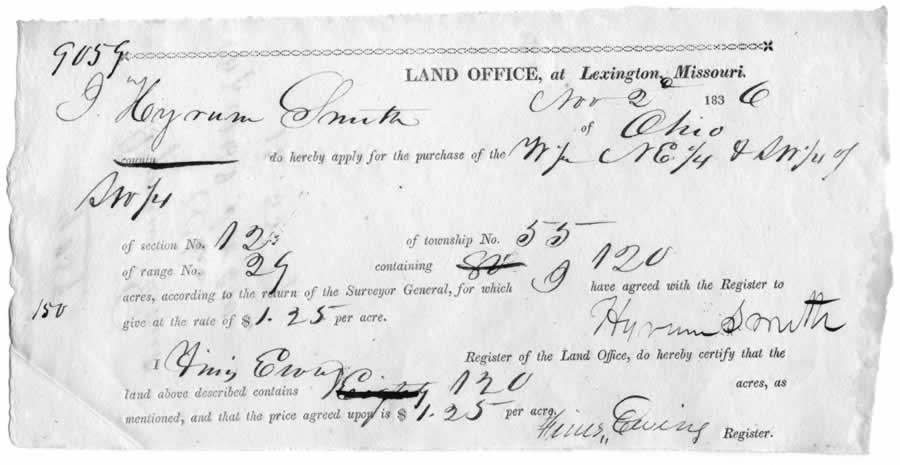
Hyrum Smith filed this preemption application in Missouri in 1836. Courtesy Church History Library, The Church of Jesus Christ of Latter-day Saints.

The Sale of Federal Lands

After the War of 1812 and a shift to nationalism emerged, Representatives Henry Clay, Daniel Webster, and John C. Calhoun led the postwar Congress to strengthen the national economy by improving infrastructure of the federal government. This included creating a new national banking system, improving roads, and selling public lands to fund the growing national government. These policies fractured the already fragile political parties and alliances, and opponents of federalism elected Andrew Jackson as president in 1828. As the voice for free enterprise, states’ rights, and laissez-faire government, Jackson expanded executive powers that increased the effort to reduce the federal debt by selling federal lands.2 Andrew Jackson recognized that the revenue generated by the sale of these public lands on the rapidly expanding western frontier could, in short order, eliminate the national debt. By his fourth annual report to Congress in 1832, Jackson was able to report that “the expenses of the [Revolutionary] war” had been met, and therefore public lands no longer needed to serve as a source of revenue, but rather could “be sold to settlers . . . at a price barely sufficient to reimburse” the government for its costs.3

The power to sell public lands and the establishment of the process for such sales rested securely in the U.S. Constitution.4 Already in 1812, the supervision of public land sales was placed in the General Land Office (GLO) within the Department of the Treasury,5 which was authorized to subdivide the public domain into land sales districts. Under the direction of the president, the GLO created local land offices to carry out its mandate of aggressively selling public lands.6 But as waves of settlers moved west, these pioneers, often referred to as squatters, became an obstacle to the orderly sale of public lands. In response, the federal government severely limited the rights squatters could have to these frontier properties. The land policies adopted in 1785, and again in the Land Act of 1787, required competitive bidding on land in an attempt to discourage and often displace squatters. In an effort to protect themselves from these laws, squatters formed claim associations, whose primary purpose was to intimidate speculators, often referred to as claim jumpers, from bidding on land improved by a squatter.

Within this setting the first universal preemption laws were enacted in 1830.7 Preemption was the process whereby individuals secured a preference right to purchase public land they had improved and inhabited, once the land was ready for sale to the public.8 The Pre-emption Act of 1830 extended preemptive rights to “every settler or occupant of the public lands” who was in possession at the date of passage and had cultivated any portion of the land not to exceed one hundred sixty acres.9 This law was originally limited to one year, but it was extended by subsequent acts in 1832, 1833, 1834, 1838, 1840.10 These renewals were necessary because Congress anticipated that preemptive claims could be granted and the final sale consummated within the span of the act or its extension, but this turned out not to be the case. Western expansion far outpaced the GLO’s ability to manage the growth.

The Preemption Process

The implementation of the preemption process was designed to be a simple and straightforward way to manage the public land problem. Yet, implementation proved both complicated and time consuming.

First, a settler would go to the local district GLO and complete a short application that included an affidavit verifying that he was improving and occupying the land to which the preemption right was being claimed.11

Second, the president would set the sale date for all land sold under the act or its extension.12 It was then the responsibility of the surveyor general over the subject area to have the land adequately surveyed and verified and the corresponding paperwork physically returned to the local land office.13

Then the local land office would publish notice that the surveys were complete and the scheduled sale would take place.14 Such notice was required to be published within a reasonable time before the sale date.

Finally, if a settler failed to pay for the preemptive land by the specified sale date, his preemptive right lapsed, and the land could be sold to any other interested party.15

The implementation of this process proved to be thorny. The difficulty centered on the rapid influx of settlers on land for which the township surveys had not been completed and certified by the general surveyor’s office. In these situations, the prospective settler chose the land he wanted to claim (up to one hundred sixty acres), began cultivating it, and then went to the local land office to complete a preemptive application. When such land had not been certified with a township survey (thereby determining to one-tenth of an acre the actual public land being purchased), the local land office registrar could verify only that the applicant had adequately occupied and cultivated the subject land and accept the application for it. This often was referred to as “proofing” the preemption claim.16 The registrar could not accept payment, as the exact price could be determined only after the township plats were received. Therefore, preemptive claims were general rights (for example, 40 acres) until the surveys were completed, whereupon they became specific rights (for example, 39.2 acres). Once the verified survey was received by the local land office, the registrar published a notice of the receipt, thereby informing the settler that he must pay for the land by the predetermined sale date or be subject to having the land sold at public sale to any interested party. Unexpectedly, however, there was a persistent, and sometimes significant, delay in getting the verified township plat surveys back to the local land office. A settler could file an application for his land and then wait months, or sometimes even years, for the surveying process to be completed, thereby triggering the requirement to pay for the land. As one might imagine, this lengthy process caused untold complications. The failure of plats to arrive at the local land office, thus preventing a sale to proceed, was “the worst bottleneck in the administrative system. . . . The end result was the cancellation or postponement of a number of public sales that had been advertised.”17 The cancellation and postponements actually worked to the Mormon’s advantage by giving them more time to raise the funds necessary to purchase the lands. Understanding these realities adds insight into Church leader’s decision to explore areas in Missouri that had not been fully surveyed, especially the 1838 LDS expansion into Daviess County.

Mormons on the Missouri Frontier

By the summer of 1831, Mormons had settled in Jackson County, and, reinforced by prophetic decree, Church members sought to build Zion there. Joseph Smith laid out a city for the Saints, including a site on which to construct a temple. Throughout 1832, Mormons arrived to support the establishment of this new Church center, and by the end of that year nearly twelve hundred Latter-day Saints lived in Missouri.18

Such rapid growth proved dangerous, as the non-Mormon population feared losing political and economic power.19 Competing religionists and early settlers fueled the simmering discontent, which erupted in violence in July 1833.20 Such violence eventually led to the forced surrender and expulsion of virtually the entire Mormon community from Jackson County in November 1833.21

These displaced Saints found temporary refuge in nearby Clay County, immediately north and across the Missouri River. They sought help from the state government, and the Saints were advised to seek redress through legal channels.22 Efforts to strengthen the Mormon community in Clay County were doomed as the initial kindness of the locals dissipated and was replaced by prejudice and enmity.

Desperate for a solution, Church leaders contemplated moving north to the unsettled Missouri frontier. Fearing the same persecutions might follow, they sought legal help to establish a safe location to resettle. One of the Church’s lawyers and also a member of the Missouri legislature representing Clay County, Alexander Doniphan agreed that moving into the unsettled areas might alleviate the tensions between the groups. Doniphan sponsored a bill during the late-1836 legislative session that would allow the Saints to settle in the entire unincorporated territorial northern portion of Ray County.23 This bill met with stiff opposition by the representatives from Ray County, resulting in a substantive compromise—the creation of two new counties in Missouri, Caldwell and Daviess, by the end of 1836. Caldwell County was informally designed to accommodate Mormons. This compromise also enlarged Ray by four townships (giving Ray twenty townships rather than the typical sixteen) and left Caldwell County with only twelve townships.24

Anticipating the creation of these counties and seeking to avoid the vicissitudes of persecution, Mormons began moving northward even before the official creation of Caldwell or Daviess counties.25 Mormons built their main settlement in Mirable Township (Caldwell County) and christened the town Far West. With the possibility of settling in northern Missouri and thereby avoiding further persecution, emigration to Caldwell County exploded. Between 1836 and 1838 “more than 4,900 of them lived in the county, along with a hundred non-Mormons.” The Far West area boasted “150 homes, four dry goods stores, three family groceries, several blacksmith shops, two hotels, a printing shop, and a large schoolhouse that doubled as a church and a courthouse.”26 A second community emerged on Shoal Creek, sixteen miles east of Far West, called Hawn’s Mill.27 By 1838, Hawn’s Mill was home to approximately twenty families, with another forty or more families settling on farms in the vicinity.28 The pace of emigration to these settlements accelerated following the economic problems in Kirtland and Smith’s decision to move from Ohio to Missouri that spring.29

Ohio Saints Relocate to Northern Missouri

The exodus from Kirtland, Ohio, was costly. Significantly in debt from the construction of the Kirtland Temple, the failure of the Kirtland Safety Society, and the expense of defending lawsuits, the Church was on the edge of financial collapse. While many have argued that the Saints left Kirtland to escape their financial obligations, the facts demonstrate a concerted and largely successful effort by Church leaders to satisfy obligations before their departure. To meet these obligations the leaders sold most of the Church’s properties. Many individuals also donated funds from the sale of their homes, farms, and businesses to pay Church debts.30 The financial sacrifice by the Kirtland Saints was considerable.

Such sacrifice by the Saints also meant that most of these people arrived in Missouri without sufficient financial means to purchase property.31 The plight of the Saints from Ohio, coupled with the ongoing emigration of new converts (most of whom also arrived without financial means), placed significant pressure on Church leaders to find an affordable place for them to settle. From this perspective it seems logical that leaders looked to unsurveyed counties in northern Missouri for new settlements, and on May 18, Smith and other key leaders, including Sidney Rigdon, David Patten, and Edward Partridge, left Far West “to visit the north countries for the purpose of Laying off stakes of Zion, making Locations & laying claims [to land] for the gathering of the saints for the benefit of the poor.”32

Some claim that the basis for Mormons’ expansion into Daviess County (the “north countries”) was that Caldwell County was overflowing with Mormons.33 A review of Missouri land sales, however, belies this conclusion. While Mirable Township, the location of Far West, had been substantially settled or claimed, most of the other eleven townships in Caldwell County remained almost entirely available through 1838. Consequently, the decision to settle the poor on unsurveyed land was not motivated by a lack of available real property in Caldwell; rather the decision stemmed from a need to find affordable land. By the time Smith arrived in Missouri in early 1838, Caldwell County had been completely surveyed, including the return of township plats. Therefore, property in this county was not ideal for the impoverished Saints because the land had to be paid for at the time of settlement.34 It appears Smith’s initiative to scout out communities in Daviess County was motivated by the realization that this land had not yet come onto the market because verified township surveys had not been completed. The law allowed impoverished Saints to secure preemption rights to their property without having to pay until the township plat surveys were completed. Because of the backlog on these surveys, new settlers anticipated working their land and generating the income necessary to purchase the property (at $1.25 per acre).

Mormons in Caldwell and Daviess counties actively participated in the federal program of preemption. Writing to her brother Levi on February 19, 1838, Hepzibah Richards, sister of Willard Richards, explained how this was to work:

People who go from [Kirtland] to Missouri by water take passage at Wellsville [Columbiana Co., Ohio] about 100 miles south of here, on the Ohio river; you can find it on the Atlas; then follow on down the Ohio and up the Missouri river quite to the western part of the State of Missouri. There are thousands of acres of good land which have never been in the market; people take up lots and settle on them, then petition for preemption rights, which are always granted. The probability is it will never come into the market, and if it does, it will be sold cheap.35

During his May 1838 trip to the “north countries,” Joseph Smith met with Saints who already had moved into Daviess County and, under his direction, organized the city of Adam-ondi-Ahman. This location was to be a central gathering place for the anticipated influx from Kirtland as well as for converts from other areas. At its height, Adam-ondi-Ahman alone boasted a population of fifteen hundred and more than two hundred homes.36 By fall 1838, Caldwell and Daviess counties had become home to roughly ten thousand Mormons.37

Missouri Land Sales in Late 1838

Although thousands of Mormons had settled new communities in Caldwell and Daviess counties in 1838, these inhabitants soon faced expulsion. The cause of that expulsion is multifaceted. From the uniqueness of Mormons’ faith, both doctrinally and in practice, to their apparent disposition for allying with the Indians, their overall antislavery stance, and their rapidly growing political power and resulting voting blocs, the non-Mormon residents of Daviess and the surrounding counties grew increasingly uncomfortable with their Mormon neighbors. Much has been written in the defense of the motives of both groups.38 Some have acknowledged that certain Missourians enjoyed an unintended windfall of improved land from Mormons’ removal.39 However, a closer look at events leading to the infamous extermination order evidences that some Missourians carefully orchestrated the persecution in October and November 1838 specifically to gain control of Mormons’ preemption rights. In fact, this appears to be central to the motives of these Missourians. They did not reap an unintended windfall; rather they orchestrated the deliberate taking of these rights.40

By presidential mandate, the date for the sale of surveyed property under the extended Act of 1830,41 which included the land in Daviess County, was set for November 12, 1838. As previously discussed, this date could be extended only in the event the verified surveys (the “township plats”) were not returned within a reasonable time of the sale date so appropriate notice could be given to the settlers who held pending preemption claims, requiring them to pay for their property. If the verified surveys were not returned, the preemptive rights were required to be extended to the next sale date pursuant to the anticipated next extension of the act. The citizens in Daviess County were aware of this sale date, as notice of the sale had been published in various local newspapers beginning in August 1838.42 The only question was whether the returned township surveys would arrive in time to allow for the proper conduct of the land sales.

In mid-September 1838, the surveyor general’s office in St. Louis, Missouri, completed the township surveys for Daviess County subject to sale on November 12, 1838. These plats were certified and sent to that office by the surveyor general, Daniel Dunklin (former Missouri governor).43 The plats were received by the local registrar, Finis Ewing, at the district office in Lexington, Missouri, on approximately September 24, but the public was not made aware of that receipt until it was published on October 21.44 This, therefore, was the first date the Saints could have learned they would definitely be required to pay for their preemption claims by November 12. It appears more than a coincidence that A. P. Rockwood reported on October 24, 1838, that the Saints’ mail had stopped coming to Far West.45

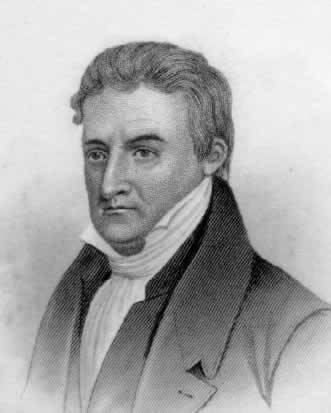
Cumberland Presbyterian Minister Finis Ewing, who persecuted Mormons in Jackson County in 1833. In 1836 he moved to Lexington, Missouri, where he became registrar of the local GLO. In that position, Ewing oversaw land rights (including preemption claims) in both Caldwell and Daviess counties. Courtesy Cumberland Presbyterian Church.

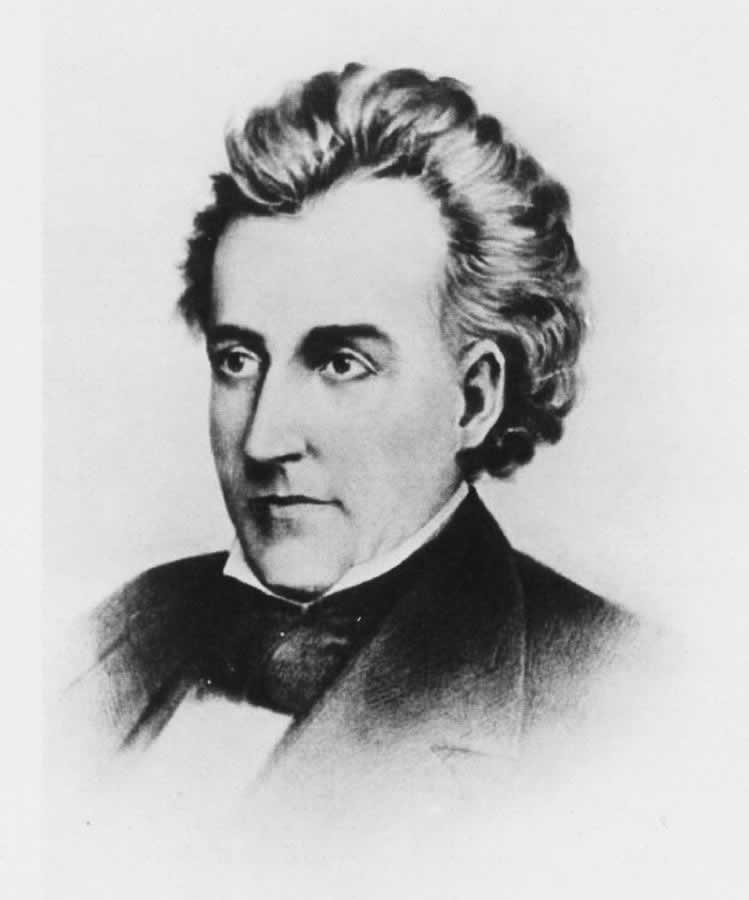
Daniel Dunklin, who resigned as Missouri governor to accept the federal position as surveyor general for Arkansas, Illinois, and Missouri. As surveyor general, Dunklin directed the completion of the surveying of Caldwell and Daviess counties in Missouri. Courtesy Church History Library, The Church of Jesus Christ of Latter-day Saints.

Before the publication of the October 21 notice, and as the predetermined sale date of November 12, 1838, moved perilously close, Mormons anticipated that the sale date likely would be moved to the following year. Consequently, by September 1838, Mormons in Daviess County had agreed to buy out their non-Mormon neighbors’ preemptive rights and possessions. This option was confirmed by General H. G. Parks in writing to General David Atchison on September 25, 1838: “On to-morrow, a committee from Daviess county meets a committee of the Mormons at Adam-on-diahmon, to propose to them to buy or sell, and I expect to be there.”46 Joseph Smith wrote on September 26, 1838, “The mob committee met a committee of the brethren, and the brethren entered into an agreement to purchase all the lands and possessions of those who desired to sell and leave Daviess county.”47 Shortly thereafter allegations arose that Mormons were burning homes and farms in Daviess County. Hyrum Smith later testified, referring to the October burnings allegedly perpetrated by Mormons, that “the houses that were burnt, together with the pre-emption rights, and the corn in the fields, had all been previously purchased by the Mormons of the people and paid for in money and with waggons and horses and with other property, about two weeks before.”48

The Land Grab

Yet some Missourians were not appeased by the purchase of their land and possessions (or commitment to do so) by Mormons. These Missourians had no apparent intention of leaving Daviess County. The tenuous peace Mormons thought they had brokered was violated before it could be fully consummated.

By the third week in October these Missourians knew that the surveys had been properly returned and that Mormons’ preemption rights probably would be paid, thereby giving Mormons title not only to their preemptive claims, but also to the newly acquired claims from their neighbors. Some Missourians were determined to thwart this outcome. For example, Sashel Woods,49 a Presbyterian minister and a leader in the military attacks on DeWitt, Adam-ondi-Ahman, and Far West,

called the mob together and made a speech to them, saying that they must hasten to assist their friends in Daviess county. The land sales (he said) were coming on, and if they could get the Mormons driven out, they could get all the lands entitled to pre-emptions, and that they must hasten to Daviess in order to accomplish their object; that if they would join and drive them out they could get all the lands back again, as well as all the pay they had received for them. He assured the mob that they had nothing to fear from the authorities in so doing, for they had now full proof that the authorities would not assist the Mormons, and that they might as well take their property from them as not.50

The ensuing weeks evidenced the implementation of Woods’s strategy by the Missourians.51 The siege of DeWitt, the Battle of Crooked River, and the Hawn’s Mill Massacre proved that any peace Mormons thought they had purchased had been lost. According to Hyrum Smith, some Missourians were “doing every thing they could to excite the indignation of the Mormon people to rescue them, in order that they might make that a pretext of an accusation for the breach of the law and that they might the better excite the prejudice of the populace and thereby get aid and assistance to carry out their hellish purposes of extermination.”52 That goal was furthered significantly by Missouri Governor Lilburn W. Boggs’s issuance of the infamous extermination order, on October 27, 1838, just six days after publication of the notice of sale.

The process of driving Mormons from Missouri is telling of Missourians’ motives. By November 1, 1838, massive numbers of troops forced a Mormon surrender at Far West. “The city was surrounded with a strong guard, and no man woman or child was permitted to go out or come in, under the penalty of death.”53 Mormon travel throughout the northern counties was restricted from that point forward.54

In addition to the travel restrictions, General John B. Clark of the Missouri militia commenced the process of systematically arresting key Mormons. By early November, Clark had arrested over fifty Church members.55 These men were not only ecclesiastical leaders, they also were the most prominent landowners in Daviess County. They were taken to Richmond to appear before Judge Austin A. King. A preliminary hearing, or “court of inquiry,” as it was then called, was conducted over two weeks to determine whether there was sufficient evidence to bind over (hold for trial) any of the arrested men.56 It hardly seems a coincidence that the hearing began on November 12—the exact day the Daviess County preemption land sales started. These sales continued for the statutory two weeks, which ran exactly concurrently with the preliminary hearing. Those critical two weeks were the Mormons’ final opportunity to exercise their preemption rights, in person, as the federal law required. But during those two weeks, all Mormons in northwest Missouri were either in the midst of their preliminary hearing or “fenced in by the gentiles”57 at Far West—with travel and communication restricted.

Judge Austin A. King, who presided over a “Court of Inquiry” against Mormon leaders to determine whether there was sufficient evidence to hold them for trial. This hearing began on November 12—the exact day the Daviess County preemption land sales started—and lasted two weeks, preventing the Mormons from completing their preemption claims. Library of Congress.

One of the purposes behind the restriction on travel is revealed through its results. Although the import of this restriction has been obscured by time, the nineteenth-century Mormons understood what had happened. Parley P. Pratt stated:

The Anti-Mormons were determined the Mormons should yield and abandon the country. Moreover the land sales were approaching, and it was expedient that they should be driven out before they could establish their rights of pre-emption. In this way their valuable improvements—the fruit of diligence and enterprise—would pass into the hands of men who would have the pleasure of enjoying without the toil of earning.58

Joseph Smith, Sidney Rigdon, and Elias Higbee also articulated this fact in their report to the United States Senate and House of Representatives on January 27, 1840. They acknowledged the persecution against the Saints, first in Jackson and then in Clay, Caldwell, and Daviess counties, was rooted in that

they were a body of people, distinct from their fellow citizens, in religious opinions, in their habits, and in their associations; and withal sufficiently numerous to make their political and moral power a matter of anxiety and dread to the political and religious parties by which they were surrounded, which prejudices arose not from what the Mormons had done; but from the fear of what they might do, if they should see proper to exercise this power.

They continued:

In addition to this, the Mormons had either purchased of the settlers or the General Government, or held by Pre-emption rights, what were regarded the best lands in that region of the Country. The tide of speculation during this period of time ran high; and the cupidity of many was thus unlawfully aroused to possess themselves of these lands, and add to their wealth by driving the Mormons from the country, and taking forcible possession of them; or constraining them to sell through fear and coercion at prices merely nominal and of their own fixing.59

Even those outside the Mormon community acknowledged this motive. In an article published in the New Yorker dated October 13, 1838, the editor succinctly wrote:

The latest accounts from the Mormon neighborhood in Missouri directly assert that all the trouble is occasioned by the “world’s people” about them, who covet the fine lands on which they have settled, or wish to frighten or drive them from the country before they have taken up any more in the fertile country surrounding their settlement. Of course, this interferes with the trade of the Preemptioners, who are determined to eject them, either by their own force, or by stirring up the State against them.60

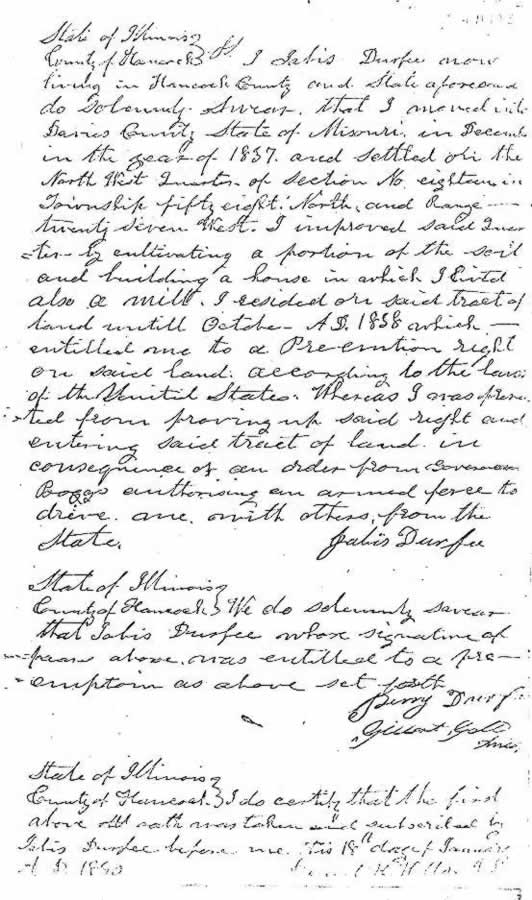
William Aldrich, a Mormon resident in Daviess County, noted in his redress petition that he “was als[o] deprived of the privelege of Proveing if my Preemption being under the spetial order of General Clark which prohibited [them] from leaving Farwest in Caldwell Co.”61 Likewise, Joseph Younger, another Mormon resident in Daviess County, claimed loss for his “perremtions Rights five hundred dollars Being cept under gard whil the Land sales at Lexinton was going on.”62 Jabis Durfee similarly explained that he had gained a preemption right in Daviess County upon which he had built a house and mill: “I resided on said tract of land untill October AD. 1838 which—entitled me to a Preemtion right on said land: according to the laws of the United States: Whereas I was prevented from proving up said right and entering said tract of land in consequence of an order from Governor Boggs authorising an armed force to drive me with others from the State.”63 His brother, Perry Durfee, echoed this complaint that he was taken prisoner and “was prohibited from entering my preemption which I held in Davis Co”64 (see fig. 1). Perhaps Willard Richards articulated it best, declaring the entire hearing at Richmond as nothing more than “a lie out of whole cloth.”65

Figure 1. Petition for redress submitted by Perry Durfee, brother of Jabis Durfee.

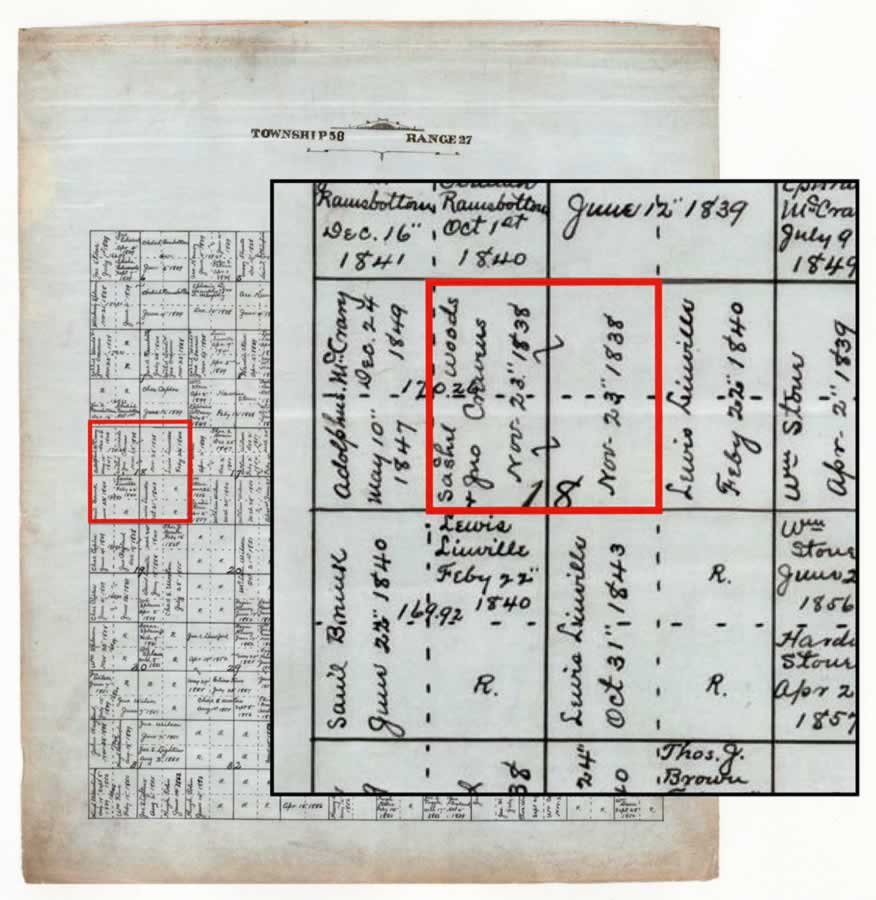
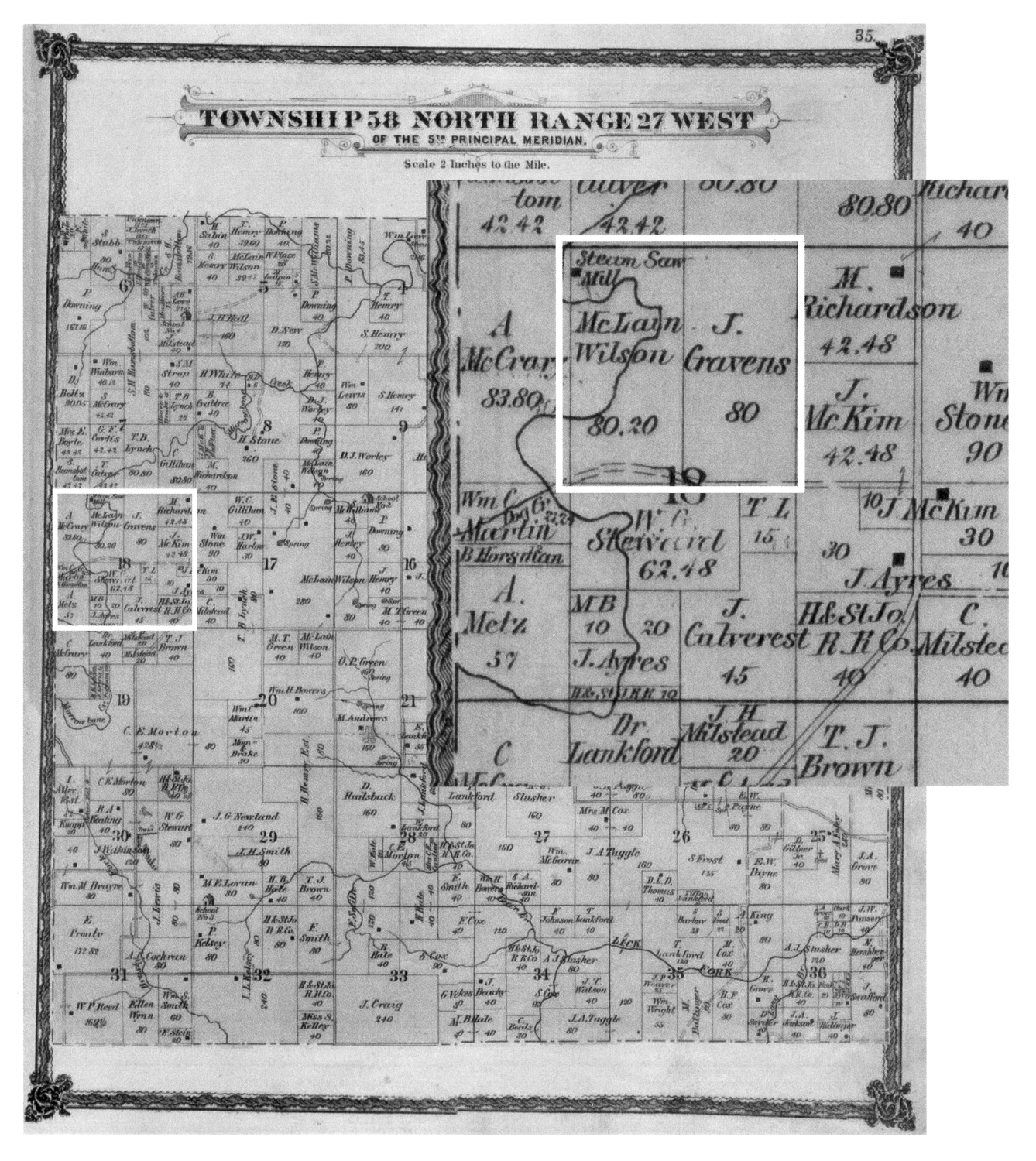
Once the time for the holders of preemption rights to exercise them had elapsed, the key actors in the preceding months’ anti-Mormon activities immediately purchased nearly eighteen thousand acres of Daviess County land.66 Based on estimates as to the number of Mormon families then living in Daviess County, it appears most of that land purchased previously had been settled and improved by Latter-day Saint occupants.67 These were strategic purchases. For example, Adam-ondi-Ahman and many other tracts in the vicinity were purchased by Sashel Woods, his sons-in-law Jon Cravens and Thomas Calloway, and Woods’s fellow Cumberland Presbyterian minister, George Houx.68 Within two months the town’s name was changed to Cravensville.69 Other tracts also were strategically chosen. The Original Entry Map for Daviess County substantiates these Missourians’ strategy to take the most valuable improved Mormon lands. For example, Cravens and Woods purchased Jabis Durfee’s claim along with his home and a mill for $1.25 per acre on November 23, 1838, the first day following the lapse of Durfee’s preemption rights.70 Interestingly, Cravens and Woods purchased no property adjacent to the Durfee site (see fig. 2). The two men surgically purchased a mill site—the most valuable of all property in the frontier. This mill site was so ideal that it continued as such for more than fifty years.71 Cravens ultimately sold half (forty acres) of Durfee’s property (eighty acres), which he purchased for $100, to McClain Wilson (see fig. 3) in 1866 for $1,225,72 thereby reaping a very substantial profit.

Figure 2. Map of Daviess County, Missouri, in 1876, showing Township 58 North Range 27 West and a close-up on section 18, where Jabis Durfee’s property had been. Reverend Sashel Woods and his son-in-law Jon Cravens purchased Durfee’s property on November 23, 1838—the day after the preemption rights lapsed. Courtesy Church History Library.

Figure 3. Map featuring Township 58 North Range 27 West and a close-up of section 18, showing Jabis Durfee’s land that Sashel Woods and Jon Cravens bought in 1838. The mill Durfee had built on the land was shown as still in existence fifty years later. Courtesy Church History Library.

Cravens and Woods were not alone. Other prominent figures in the Mormon War acquired significant property holdings in Daviess County, including Wiley C. Williams (aide to Governor Boggs), Amos Rees, William Mann, William O. Jennings, Jacob Rogers,73 and others. Most of these individuals had not been residents of Daviess County prior to the land sales, indicating they were speculators who profited from the Mormons’ misfortune.74

The Daily Missouri Republican, published in St. Louis, aptly summarized the effect of the Mormon conflict in its December 13, 1838, editorial:

We have many reports here in relation to the conduct of some of the citizens of Daviess and other counties, at the recent Land Sales at Lexington—It is reported, said to be on the authority of a gentleman direct from Lexington, that at the recent land sales the lands of Caldwell and Daviess were brought into market, and that some of the citizens who have been the most active in the excitement against the Mormons, purchased a number of the Mormon tracts of land. Where the Mormons had made settlements and improvements, it is said, these citizens have purchased them for speculation. It is said, that the town of “Adamon Diamond,” a Mormon town in Daviess, in which there are several houses,—
a very valuable site for a town—was purchased at these sales for a dollar and a quarter an acre. It is further said, that there is a company formed, embracing a number of persons, for the purpose of speculating in the lands of these people.75

While the causes of the Mormon conflict in 1838 may be multifaceted, the result was not. Some Missourians enjoyed a financial windfall by getting clear title to the Mormons’ lands in Daviess County. Whether this was the primary motive from the outset is still unclear, but it is an undisputable fact that key Missourians involved in the Mormon expulsion immediately seized a financial reward.

Conclusion

The nineteenth-century Mormons knew what had happened—and so did these Missourians who reaped the benefits. The Mormon tragedy in Missouri ended with a slow, painful walk to the Mississippi River, where the people crossed to Illinois to start rebuilding their lives. The optimism of Zion planted in Jackson County and the efforts to build refuge communities in Caldwell and Daviess counties were transferred to the founding of the “City of Joseph.”

Yet Mormons did not forget the sorrows of Missouri. While popular history has painted the persecution as religiously motivated, the facts suggest a more base reason: greed, in its most ugly and insatiable form, to “have the pleasure of enjoying without the toil of earning.”76 Such efforts stain some of the earliest land records of northern Missouri. Nearly two years after their forced departure, Mormons petitioned the federal government for redress and put the reality of their losses into perspective:

The Mormons, numbering fifteen thousand souls, have been driven from their homes in Missouri; property to the amount of two millions of dollars has been taken from them or destroyed; some of their brethren have been murdered, some wounded, and others beaten with stripes; the chastity of their wives and daughters inhumanly violated; all driven forth as wanderers; and many, very many, broken-hearted and penniless. The loss of property they do not so much deplore, as the mental and bodily sufferings to which they have been subjected; and, thus far, without redress. They are human beings, possessed of human feelings and human sympathies. Their agony of soul for their suffering women and children was the bitterest drop in the cup of their sorrows.77

Examining the orchestrated loss of Mormon land as recorded on Daviess County abstracts is academically important, but it cannot provide an adequate understanding to the totality of these tragic events.


A more extensive version of this article was first published as “Mormon Land Rights in Caldwell and Daviess Counties and the Mormon Conflict of 1838: New Findings and New Understandings,” BYU Studies 47, no. 1 (2008): 4–55.


Notes

1. Joseph Smith Jr., Scriptory Book, May 18, 1838, MS, Church History Library, The Church of Jesus Christ of Latter-day Saints, Salt Lake City. See also Dean C. Jessee, The Papers of Joseph Smith, 2 vols. (Salt Lake City: Deseret Book, 1989–92), 2:243.

2. See James D. Richardson, ed., A Compilation of the Messages and Papers of the Presidents, 1789–1897, 10 vols. (By the author, 1899), 2:450–51.

3. Richardson, Messages and Papers of the Presidents, 2:600–601.

4. “The Congress shall have Power to dispose of and make all needful Rules and Regulations respecting the Territory or other Property belonging to the United States.” U.S. Constitution, art. 4, sec. 3.

5. Opinions of the Attorney General (hereafter cited as Ops. Atty. Gen.), no. 66 (July 4, 1836), General Public Acts of Congress, Respecting the Sale and Disposition of the Public Lands, with Instructions Issued, from Time to Time, by the Secretary of the Treasury and Commissioner of the General Land Office, and Official Opinions of the Attorney General on Questions Arising under the Land Laws, 2 vols. (Washington, D.C.: Gales and Seaton, 1838), 2:103–4.

6. An Act Authorizing the President of the United States to Remove the Land Office in the District of Lawrence County, in the Territory of Arkansas (March 2, 1821), General Public Acts, ch. 257, 1:339.

7. An Act to Grant Pre-emption Rights to Settlers on the Public Lands (May 29, 1830), 21st Cong., 1st sess., ch. 208, in Statutes at Large of United States of America, 1789–1873, 17 vols. (Washington, D.C.: [various publishers], 1845–73), 4:420–21.

8. W. W. Lester, Decisions of the Interior Department in Public Land Cases, and Land Laws (Philadelphia: H. P. and R. H. Small, 1860), 355.

9. Pettigrew v. Shirley, 9 Mo. 683, 686 (1846).

10. Isaac v. Steel, 4 Ill. 97, 3 Scam. 97 (1841).

11. The individual who wanted to assert a preemptive right must do so by “producing his proof of such right at any time within one year from the date of the act.” General Public Acts, GLO, Circular no. 495 (May 23, 1831).

12. Pettigrew v. Shirley, 9 Mo. 683, 687 (1846).

13. Surveying was a complicated process. Initial physical surveys were contracted out by the federal government to be done by trained surveyors. While this general survey gave enough detail to know what section and range a claim was being made in, the general survey did not provide sufficient detail about the particulars within the township where the land was located. Once the state legislature created a county, the responsibility to draw townships using these physical surveys fell to the surveyor general. See generally J. B. Johnson, The Theory and Practice of Surveying (New York: John Wiley and Sons, 1904), 176–79. Once completed, these township plats had to be verified and then certified by the surveyor general’s office and sent to the local land office, referred to as the “return date.” The land could not be sold until the local land office had received back the certified township plats. Importantly, if the surveys were not returned before the end of the term of the act under which the preemptive right was asserted, such rights would be tacked onto the successor act.

14. When surveys were not returned in a timely fashion, such notice had to be cancelled or postponed.

15. General Public Acts, Circular No. 503, GLO (February 8, 1832).

16. See Gaines v. Hale, 16 Ark. 9 (1855).

17. Malcolm J. Rohrbough, The Land Office Business: The Settlement and Administration of American Public Lands, 1789–1837 (New York: Oxford University Press, 1968), 260.

18. Richard Neitzel Holzapfel and T. Jeffery Cottle, Old Mormon Kirtland and Missouri: Historic Photographs and Guides (Santa Ana, Calif.: Fieldbrook Productions, 1991), 162.

19. Richard L. Bushman, “Mormon Persecutions in Missouri, 1833,” BYU Studies 3, no. 1 (1960): 11–20.

20. B. H. Roberts, The Missouri Persecutions (Salt Lake City: George Q. Cannon and Sons, 1900), 85–97.

21. Milton V. Backman Jr., The Heavens Resound: A History of the Latter-day Saints in Ohio, 1830–1838 (Salt Lake City: Deseret Book, 1983), 170–72.

22. “History of Joseph Smith,” Times and Seasons 6 (May 1, 1845): 880. The Mormons retained four attorneys—Alexander Doniphan, David Atchison, Amos Rees, and William Wood—to seek legal assistance to return to their homes in Jackson County. Roger D. Launius, Alexander William Doniphan: Portrait of a Missouri Moderate (Columbia: University of Missouri Press, 1997), 15.

23. Launius, Alexander William Doniphan, 39–40.

24. The History of Daviess County, Missouri (Kansas City, Mo.: Birsall and Dean, 1882), 235.

25. Copies of the “Original Entries for Lands in Caldwell County,” Caldwell County Recorder’s Office, Kingston, Missouri, as cited in Leland H. Gentry, “The Land Question at Adam-ondi-Ahman,” BYU Studies 26, no. 2 (1986): 10 n. 14.

26. James B. Allen and Glen M. Leonard, The Story of the Latter-day Saints (Salt Lake City: Deseret Book, 1976), 116–17. See also Robert Allen Campbell, Campbell’s Gazetteer of Missouri (St. Louis, Mo.: R. A. Campbell, 1874).

27. Named after Jacob Hawn (traditionally spelled “Haun,” but a review of applicable land records, as well as the marker on his grave evidences that he spelled his name “Hawn”), who built a gristmill on Shoal Creek. Jacob Hawn settled on approximately forty acres on Shoal Creek and entered his claim for this property on December 7, 1835, more than a year before the creation of Caldwell County. See “Original Entries for Lands in Caldwell County,” Caldwell County Recorder’s Office, Kingston, Missouri. His mill site became the center of the community commonly referred to as Haun’s Mill. Mormons settled along the east-west running Shoal Creek, building multiple mills around Hawn’s own mill. Consequently, this area comprised some of the most valuable lands owned by Mormons.

28. Alma R. Blair, “The Haun’s Mill Massacre,” BYU Studies 13, no. 1 (1972): 62–63; Beth Shumway Moore, Bones in the Well: The Haun’s Mill Massacre, 1838; A Documentary History (Norman, Okla.: Arthur H. Clark, 2006), 29, 39; www.farwesthistory.com/haunsm.htm.

29. An account of this three-month journey is in Kirtland Camp, Journal, March–October 1838, MS, in the handwriting of Elias Smith, Church History Library.

30. “Of the $52,251.44 recorded debt of Joseph and the [Temple] Committee, $47,062.83 was paid. There were no defrauded creditors, but rather paid creditors, 90% of whose claims were satisfied in a reasonably prompt time frame. And that payment came largely after the Saints had abandoned Kirtland and the Symbol of their sacrifice, the Temple.” Gordon A. Madsen, “The Impact of Litigation against Joseph Smith and Others on the Kirtland Economy” (presented at the Mormon Historical Society 2005, Killington, Vermont), 17, copy in author’s possession.

31. “Typical of Saints who faced the uncertainties of the exodus from Kirtland with little or no money or means was Truman O. Angell, the skilled temple carpenter. He and his wife and two small children left in a one-horse wagon. Their first day out of Kirtland, he had to spend his last money to repair the wagon, leaving him with ‘a rickety wagon, a balky horse, not a penny in my pocket, a family to feed and a thousand miles to go.’” Karl R. Anderson, Joseph Smith’s Kirtland: Eyewitness Accounts (Salt Lake City: Deseret Book, 1989), 238.

32. Smith, Scriptory Book, May 18, 1838. See also Jessee, Papers of Joseph Smith, 2:243.

33. See, for example, Sidney Rigdon, An Appeal to the American People: Being an Account of the Persecutions of the Church of Latter Day Saints; and of the Barbarities Inflicted on Them by the Inhabitants of the State of Missouri, 2d ed. (Cincinnati, Ohio: Shepard and Stearns, 1840), 15; Elders’ Journal 1, no. 3 (July 1838): 33.

34. The township plat for Mirable Township (location of Far West) was completed on January 15, 1835. Township Plat for Mirable Township, Church History Library.

35. Selections from Letter of Hepzibah Richards, February 19, 1838, cited in Journal History of the Church, February 19, 1838, Church History Library, also available on Selected Collections from the Archives of The Church of Jesus Christ of Latter-Day Saints, 2 vols. (Provo, Utah: Brigham Young University Press, 2002), vol. 2, DVD 1, microfilm copy in Harold B. Lee Library, Brigham Young University, Provo, Utah.

36. Stephen C. LeSueur, The 1838 Mormon War in Missouri (Columbia: University of Missouri Press, 1987), 30, 101–11.

37. Modern historians put the number around ten thousand. See, for example, Susan Easton Black and Richard E. Bennett, eds., A City of Refuge, Quincy, Illinois (Salt Lake City: Millennial Press, 2000), 6, 24.

38. Alexander L. Baugh, “A Call to Arms: The 1838 Mormon Defense of Northern Missouri” (PhD diss. Brigham Young University, 1996; Provo, Utah: BYU Studies and Joseph Fielding Smith Institute for Latter-day Saint History, 2000); LeSueur, 1838 Mormon War in Missouri; Bushman, “Mormon Persecutions in Missouri, 1833”; Roberts, Missouri Persecutions. Suffice it to say that some commentators cast a broad net of blame on both Mormons and Missourians. Certainly blame can be found on both sides of the conflict. In terms of proportionality, however, the ultimate harm inflicted by Missourians on Mormons dwarfs any reasonable, comparable acts by Mormons. How can one compare the Battle of Crooked River with the Hawn’s Mill Massacre? Or compare the burning of Jacob Stolling’s store in Gallatin with the extermination order?

39. See, for example, LeSueur, 1838 Mormon War in Missouri, 237–39.

40. Mormons living in Caldwell and Daviess counties were fully aware of the preemption rights to the lands they were occupying and cultivating. Pursuant to Smith’s revealed direction (see D&C 123:1–6), the Saints prepared redress petitions after being expelled from Missouri. In late 1839 these petitions were taken to Washington, D.C., where 491 of them were presented. Additional efforts to obtain redress occurred in 1840 and 1842. A final attempt was made in fall 1843. More than 770 petitions were prepared. See Paul C. Richards, “Missouri Persecutions: Petitions for Redress,” BYU Studies 13, no. 4 (1973): 520–43; Clark V. Johnson, ed., Mormon Redress Petitions: Documents of the 1833–1838 Missouri Conflict (Provo, Utah: BYU Religious Studies Center, 1992).

41. The 1830 act was extended by Congress on June 22, 1838. This extension granted preemption rights to all settlers who were occupying and cultivating land at the time the extension was passed.

42. Such notice to anyone with possible claims was published in the Missouri (St. Louis) Argus starting on August 5, 1838, and reprinted every week through August, September, and October. The Southern Advocate (Jackson) also carried a similar notice in September 1838 and then every week through November. Gentry, “The Land Question at Adam-ondi-Ahman,” 55 n. 34.

43. Daniel Dunklin, as surveyor general, noted the surveys were “examined and approved” in St. Louis on September 15, 1838. These surveys were started by Joseph C. Brown and completed by Lisbon Applegate. See Township Surveys for Daviess County, September 15, 1838, Church History Library.

44. The delay in publishing this notice is somewhat suspect. While beyond the scope of this paper, evidence exists that Ewing helped orchestrate the taking of Mormons’ preemptive rights in Daviess County. The returned surveys had been received by the local land office in Lexington and published in the Southern Advocate (Jackson), October 21, 1838, 4. This notice informed the public that payment for preemption claims would be due by November 12, 1838.

45. Albert Perry Rockwood, Journal, October 24, 1838, in handwriting of Phinehas Richards, Church History Library.

46. Document Containing the Correspondence, Orders, &C in Relation to the Disturbances with the Mormons (Fayette, Mo.: Boon’s Lick Democrat, 1841), 33.

47. Manuscript History of the Church, B-1, addendum note U, 7, Church History Library.

48. “Missouri vs. Joseph Smith,” Times and Seasons 4 (July 1, 1843): 248. Hyrum Smith’s entire testimony appears on pages 246–56.

49. Sashel Woods was a Cumberland Presbyterian minister and considered Finis Ewing his mentor. Reverend Ewing’s animosity toward Mormons propelled him to be one of the key players in orchestrating their expulsion from Jackson County in 1833. Ironically three ministers, Cornelius Gilliam, Samuel Bogart, and Sashel Woods, “led much of the opposition to the Saints.” LeSueur, 1838 Mormon War in Missouri, 247.

50. Rigdon, Appeal to the American People, 29–31.

51. Woods was not alone. Concurrent with his efforts, “Cornelius Gilliam was busily engaged in raising a mob in Platt and Clinton counties, to aid Woods in his effort to drive peaceable citizens from their homes and take their property.” Rigdon, Appeal to the American People, 31.

52. “Missouri vs. Joseph Smith,” 246–47.

53. “Missouri vs. Joseph Smith,” 250.

54. “On his [General John B. Clark’s] arrival there [Far West], he placed guards around the town, so that no person might pass out or in without permission. All the men in town were then taken and put under guard, and a court of inquiry was instituted, with Adam Black on the bench.” Rigdon, Appeal to the American People, 46.

55. Gordon A. Madsen, “Joseph Smith and the Missouri Court of Inquiry: Austin A. King’s Quest for Hostages,” BYU Studies 43, no. 4 (2004): 97.

56. At the conclusion of the preliminary hearing, twenty-nine people were released outright. Twenty-four of the remaining were bound over for trial. All but ten of these individuals were released on bail, leaving Smith and other Church leaders as the sole remaining prisoners. Madsen, “Joseph Smith and the Missouri Court of Inquiry,” 98.

57. Mormons used this phrase to describe the sieges to their cities, particularly Far West. This phrase appeared as commentary in some of the deeds Mormons were forced to execute in conveying their lands to the Missourians. For example, in a warranty deed dated November 15, 1838, with eight grantors—Austin Hammer, Samuel Zimmer, James Huntsman, Issac Ellis, John Pye, John York, David Norton, and Elias Benner—to Willis G. Casper as grantee contains the following language in the text of the deed: “All being Latterday Saints now living in Caldwell County in Missouri and being fenced in by the Gentiles commanded by John B. Clark who is murdering our People and so we are going to leave the County & State, we do for the good of the poor.” Copy of this deed in Church History Library. Interestingly, three of the grantors, Austin Hammer, John York, and Elias Benner, had been killed sixteen days earlier at the Hawn’s Mill Massacre. There was no signatory line for Elias Benner, while Austin Hammer’s and John York’s signatures were made by an “X.” Signing with an “X” is a legally recognized signature for people who are illiterate, but neither Hammer nor York were illiterate, as they had filed applications for their land at the Lexington Land Office on November 26, 1836, and had signed their names on these applications. See Austin Hammer and John York, Preemption Applications, Church History Library.

58. Parley P. Pratt, Late Persecution of the Church of Jesus Christ, of Latter Day Saints (New York: J. W. Harrison, 1840), 149; italics in original. “If the Saints who fled DeWitt hoped they would escape their tormentors, they hoped in vain. Sashiel Woods urged the troops who had surrounded the town to hurry to Daviess County, because the pre-empted lands would soon go on sale and must be secured by Missourians.” Marvin S. Hill, Quest for Refuge: The Mormon Flight from American Pluralism (Salt Lake City: Signature Books, 1989), 89.

59. Memorial, Joseph Smith, Sidney Rigdon, and Elias Higbee, Washington, D.C., to the Honorable Senate and House of Representatives of the United States, January 27, 1840, photocopy of the original in National Archives and Church History Library, 8–9.

60. The article continues: “The Columbia [Missouri] Patriot distinctly asserts that such are the true causes of all the trouble. A committee of the citizens of Chariton county have been among the Mormons, to investigate the truth of the accusations against them, and they declare them wholly unfounded. Jo. Smith and Rigdon have given bonds of $1,000 each to keep the peace [and have certified]: ‘We are friendly to the Constitution and laws of this State and of the United States, and wish to see them enforced.” See “The Mormons,” New Yorker 6 (October 13, 1838): 59.

61. Johnson, Mormon Redress Petitions, 414.

62. Johnson, Mormon Redress Petitions, 386–87.

63. Johnson, Mormon Redress Petitions, 442. Dated January 18, 1840, Jabis Durfee’s redress petition notes, in part, “I moved into Davies County State of Misouri in December in the year of 1837 and settled on the North West Quarter of Section No eighteen in Township fifty eight North and Range—twenty Seven West. I improved said Quarter by cultivating a portion of the soil and building a house in which I lived also a mill. I resided on said tract of land untill [sic] October AD. 1838 which—entitled me to a Preemtion right on said land: according to the laws of the United States: Whereas I was prevented from proving up said right and entering said tract of land in consequence of an order from Governor Boggs authorising an armed force to drive me with others from the State.” From this description, Durfee’s property can be found on the Original Entry Map for Daviess County, Missouri, Church History Library. As the foregoing maps document, Sashel Woods and Jon Cravens purchased Durfee’s property on November 23, 1838. This undoubtedly was a strategic purchase, as no other property surrounding Durfee’s was bought at that time. The reason for selecting this property by Woods and Cravens is obvious—the mill.

64. Johnson, Mormon Redress Petitions, 443.

65. Rough Draft, Manuscript History of the Church, 1838–39 draft history, 30, MS, Church History Library.

66. A review of the “Original Entries for Lands in Daviess County” shows that between November 21 and December 31, 1838, thousands of acres were bought. Mormons did not purchase a single acre. See “Original Entries for Lands in Daviess County.”

67. Document Containing the Correspondence, Orders, &C, 27.

68. See “Original Entries for Lands in Daviess County.” This document shows these men obtained the patent rights for most of Adam-ondi-Ahman on November 28, 1838, and the rest on December 18, 1838.

69. Cravensville, Missouri, Plat Records, Church History Library.

70. Johnson, Mormon Redress Petitions, 442, n. 103.

71. The maps are copies of the Illustrated Historical Atlas of Daviess County Missouri (Philadelphia, Pa: Edward Brother, 1876), 35 (copy in author’s possession). The second document shows the existence of the mill that Durfee originally built in 1837.

72. John and Ruhama Cravens, Warranty Deed to McClain Wilson, December 7, 1866, Church History Library.

73. William Mann, William O. Jennings, and Jacob Rogers participated in the Hawn’s Mill Massacre on October 30, 1838. Baugh, “Call to Arms,” 417, 418, 420.

74. See “Original Entries for Lands in Daviess County.”

75. The editorial continued: “I should not have felt authorised to allude to these reports, for I know nothing of the source from whence they come, but for the fact, that the same matter was incidentally alluded to yesterday in the Senate. Many other things are said in connection with these sales, but for the present I do not feel authorised to give them. This matter should receive the attention of the committee on this subject, for it may lead to a better understanding of the causes of these disturbances. I look upon it as a matter of the greatest importance, how the committee on this subject may conduct this inquiry. The character of the State and the reputation of every citizen is involved in it, and it is due to all that a full investigation and impartial report should be made.” Letter to the Editor, Daily Missouri Republican, December 13, 1838, 2.

76. Pratt, Late Persecution of the Church of Jesus Christ, 149.

77. “The Petition of the Latter-day Saints, commonly known as Mormons,” 26th Cong., 2d sess., H. Doc. 22 (December 21, 1840), 12–13.